REVIEW 4 major objections 4 minor 37 references
Diffusive Mobile MC with Absorbing Receivers: Stochastic Analysis and Applications
T0 review · 4 major / 4 minor · reviewed 2026-08-14 · deepseek-v4-flash
Pith's one-line read This paper derives the mean, variance, PDF, and CDF of a mobile molecular channel's time-variant impulse response with an absorbing receiver, then applies them to drug delivery and OOK design under imperfect CSI.
desk verdict First full stochastic characterization of the time-variant CIR for 3D mobile MC with absorbing receivers—useful, mostly sound, but the hard-core approximation and Lemma 4 proof need attention. read the letter →
The pith
A machine-rendered reading of the paper's core claim, the machinery that carries it, and where it could break.
The reading
What carries the argument
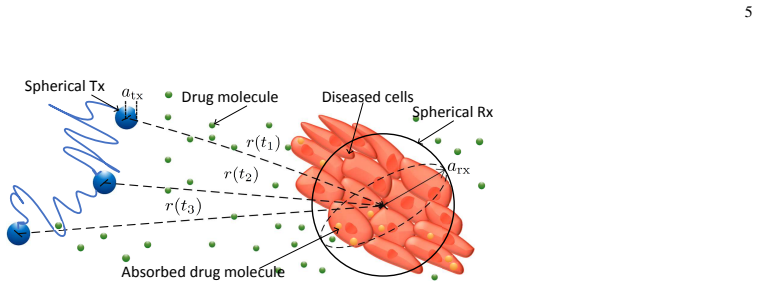
The load-bearing object is the random Tx-Rx distance $r(t)$, whose PDF is the free-diffusion noncentral-chi (generalized Rayleigh) density $$f_{r(t)}(r)=\frac{r}{r_0\sqrt{\pi D_2 t}}\exp\left(-\frac{$r^{2}$+$r_0^{2}$}{4D_2 t}\right)\$\sinh$\left(\frac{r_0 r}{2D_2 t}\right),$$ with $D_2 = D_{\mathrm{Tx}}+D_{\mathrm{Rx}}$ the effective relative diffusion coefficient. Around this object the paper builds a change-of-variables mechanism: the deterministic CIR $$h(t,\tau)=\frac{a_{\mathrm{rx}}}{\sqrt{4\pi D_1\$tau^{3}$}}\left(1-\frac{a_{\mathrm{rx}}}{r}\right)\exp\left(-\frac{(r-a_{\mathrm{rx}})^2}{4D_1\tau}\right)$$ is unimodal in $r$, so the PDF and CDF of $h$ are obtained by evaluating the distance PDF and CDF at the two inverse distances $r_1(h)<r_2(h)$ and summing. For the absorption probability $p(t,T_b)$, the same map is monotone decreasing in $r$, so only one inverse branch is needed. This transformation is what converts known single-particle hitting-rate formulas into a full stochastic channel characterization.
What would settle it
Run a particle-based simulation with a reflecting boundary at the receiver surface (the transmitter bounces back on collision) using an initial distance $r_0$ only slightly larger than $a_{\mathrm{Tx}}+a_{\mathrm{Rx}}$ and a large $D_{\mathrm{Tx}}$, so that collisions are frequent, and compare the empirical mean and PDF of $h(t,\tau)$ with Theorem 1 and Theorem 2; a systematic deviation that grows as $r_0$ approaches $a_{\mathrm{Tx}}+a_{\mathrm{Rx}}$ would show the free-diffusion approximation is inadequate in close-encounter regimes.
Extended reading notes
Core claim
The central discovery is that the randomness of all three diffusing entities collapses into a single random variable, the distance $r(t)$ between the transmitter and receiver centers, which follows a noncentral chi distribution with three degrees of freedom, Eq. (8). Because the absorbing-receiver CIR $h(t,\tau)$ is a deterministic, unimodal function of $r(t)$ — it rises as the receiver approaches the optimal distance and falls as it moves away — the statistics of $h$ follow from a two-branch transformation: every sub-maximum value $h$ corresponds to two distances, one on each side of the distance that maximizes the CIR. The mean of the CIR is obtained in closed form (Theorem 1), the variance via a numerically integrable second-moment expression (Corollary 1), and the PDF and CDF as explicit compositions of the distance PDF and CDF with the two inverse branches (Theorem 2 and Corollary 2). The same machinery, applied to the monotone relation between distance and absorption probability $p(t,T_b)$, yields the PDF and CDF of $p$ (Corollary 3), and these feed the drug-delivery and communication optimization problems.
Load-bearing premise
Everything downstream inherits the free-diffusion distance PDF (8), which lets the transmitter diffuse through the receiver instead of being reflected at its surface; if close transmitter-receiver encounters are frequent, the mean, variance, PDF, and CDF in Theorems 1-2 and Corollaries 1-3 become biased.
Editorial extensions
If this is right
- With only the initial Tx-Rx distance and the diffusion coefficients known, the full time-dependent distribution of the received absorption rate becomes computable, so release schedules for drug delivery can be designed offline with no real-time position tracking.
- The optimized drug release profile is tri-phasic — large initial release, then reduction, then increase as the carrier diffuses away — and uses 27–54% fewer molecules than constant release while meeting the target absorption rate.
- Designs that ignore transmitter mobility fail to keep the expected absorption rate above the target for most of the treatment window, so mobility must be included for reliable drug delivery.
- In OOK threshold detection with imperfect CSI, optimizing the detection threshold and release profile lowers the maximum frame BER by up to a factor of 8 relative to uniform release for $A=10^5$ molecules and $T=3000$ s.
- The maximum bit-frame duration that keeps molecule usage efficiency above a target can be found from the CDF of the distance distribution, since the probability that a released molecule is absorbed above a threshold decreases with release time.
Reading between the lines
- The two-branch transformation is not specific to the CIR: any channel quantity that is unimodal in the Tx-Rx distance, such as per-molecule mutual information, could be given a PDF and CDF by the same inverse-branch construction, with monotone quantities such as $p(t,T_b)$ as the one-branch special case.
- The Chebyshev-based bound $P_\theta(t)\ge 1-1/\beta^2$ is conservative by design; a designer who instead evaluates the derived CDF of $g(t)$ can choose $\beta$ from the actual tail of the absorption rate and potentially release fewer molecules for the same reliability.
- Because the distance statistics depend on the diffusion coefficients only through $D_2=D_{\mathrm{Tx}}+D_{\mathrm{Rx}}$ and the CIR depends on them through $D_1=D_X+D_{\mathrm{Rx}}$, an experiment that varies receiver mobility while holding these sums fixed would test whether the derived channel statistics are invariant under that trade-off; this symmetry is not explicitly discussed in the paper.
- The model treats the receiver as a perfectly absorbing sphere; replacing it with a reversible-adsorption surface would break the closed-form CIR expression, but the inverse-branch machinery would survive as long as a monotone or unimodal distance-to-surface statistic can be identified.
Signed reviews
Editorial analysis
A structured set of objections, weighed in public.
Referee Report
Summary. The paper analyzes a 3D diffusive mobile molecular communication (MC) system in which a spherical transparent transmitter, a spherical absorbing receiver, and signaling molecules all undergo Brownian motion. The authors derive the mean, variance, PDF, and CDF of the time-variant channel impulse response h(t,tau), and the PDF and CDF of the probability p(t,Tb) that a released molecule is absorbed during a bit interval. These stochastic channel results are then applied to two design problems: a controlled-release drug delivery system that minimizes the total released drug amount subject to a target absorption rate, and an MC system with imperfect CSI where the detection threshold, release profile, and bit-frame duration are optimized. The analytical results are compared with particle-based and Monte Carlo simulations for the chosen system parameters.
Significance. The paper's main derivations in Section III are direct probabilistic computations from the noncentral chi-distributed Tx-Rx distance and the known absorbing-sphere CIR formula, with no fitted parameters; this is a strength and makes the mean, variance, PDF, and CDF of h and p potentially useful building blocks for mobile MC design. The authors also honestly acknowledge in Remark 2 that the free-diffusion distance PDF is an approximation because it ignores steric exclusion of the transmitter by the receiver. If the application-level flaws identified below are corrected, the framework would be a useful contribution to mobile molecular communication and drug-delivery modeling. In its current form, however, the paper contains several nontrivial errors in the application theorems that undermine the claimed design guarantees.
major comments (4)
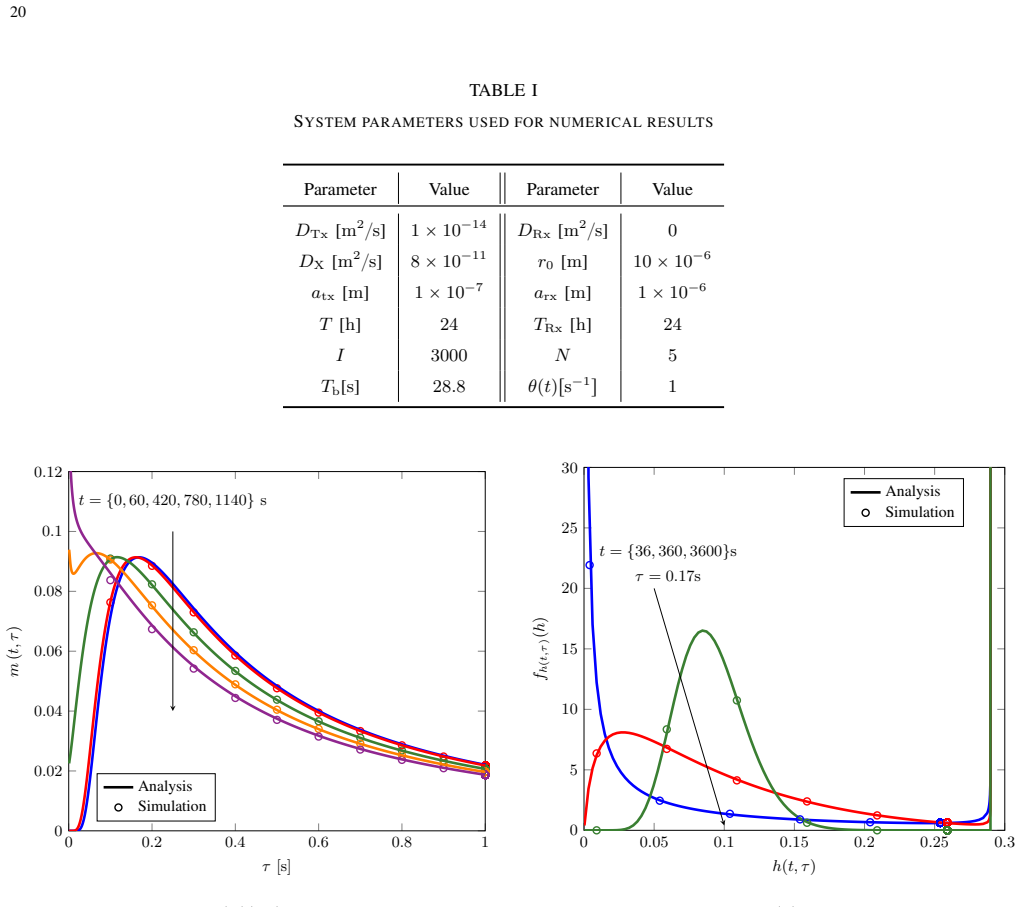
- [Section III-A, Eq. (8), Remark 2] The distance PDF f_r(r) in Eq. (8) is the free-diffusion noncentral chi density, which assigns positive probability to r < atx + arx even though the physical model has a hard-core exclusion between the transmitter and receiver. Remark 2 dismisses this by noting that (8) tends to zero as r tends to zero, but that does not control the integrated forbidden mass or the distortion of the boundary layer near r = atx + arx. Since the CIR in Eq. (1) is sharply peaked near r = arx for small tau, this is exactly the region where the approximation error matters most. All subsequent results (Theorems 1-2, Corollaries 1-3) inherit this bias. The numerical validation in Figs. 2-3 uses r0 = 10 um, arx = 1 um, atx = 0.1 um, where the forbidden mass is negligible at the plotted times, so it does not exercise the fragile regime r0 close to arx + atx or D2 t comparable to r0^2. The paper should either state and justify the parameter regime in which (8) is accurate, or quantify the approximation error.
- [Section III-D, Theorem 3, Eq. (29)] The convolution formula (29) for the PDF of g(t) assumes that the terms alpha_i h(t_i, t - t_i) are independent across release times. Under the stated model, h(t_i, t - t_i) depends on r(t_i), and the random variables r(t_i) for different i are correlated because the transceivers follow continuous Brownian motion. Thus g(t) is a sum of dependent random variables and Theorem 3 is not valid for the model described in Section II. The drug-delivery performance evaluation in Fig. 6 relies on this theorem, so the corresponding analytical claims are not established. The Monte Carlo description in Section VI-A is also ambiguous: it must be clarified whether different release times are sampled from a single Brownian trajectory or independently, since only the latter would agree with the convolution formula but would be inconsistent with the model.
- [Appendix E, Lemma 4] The proof of Lemma 4 claims that dF_{r(t)}(r)/dt < 0 for all r. This is not true in general: for a fixed r < r0, the CDF F_{r(t)}(r) starts at 0 and initially increases as diffusion brings probability mass below r. Even for r > r0, the derivative expression in (44) can be positive when the term -2n - 3/2 + (x^2 + r0^2)/(4D2 t) becomes positive for large t and small n. Therefore the proof is incorrect, and the monotonicity used to obtain the maximum bit-frame duration in Section V-D is not justified unless additional restrictions on r and t are provided.
- [Appendix D, Lemma 3] The convexity claim in Lemma 3 is not correct as stated. With a = p(1-p), b = eta, c = xi - eta, one computes the second derivative of zeta(alpha) = (c - p alpha)/sqrt(2a alpha + 2b) and obtains zeta''(alpha) = [-5a^2 p alpha - 8abp - 3a^2 c]/(2a alpha + 2b)^{5/2} < 0, so zeta is concave. For erf(zeta) to be convex, the term -2 zeta (zeta')^2 in its second derivative must dominate zeta'', and this is not guaranteed; for example, with p = 0.5, eta = 1, xi = 2, the second derivative of erf(zeta(alpha)) is negative at alpha = 10. Consequently, the objective in (38) is not established to be convex, and the claim that the interior-point method yields a global optimum is unsupported.
minor comments (4)
- [Lemma 1, Eq. (9)] The CDF in Eq. (9) is printed with sqrt(2 DTx t) in the Marcum Q-function, whereas Eq. (5) and the proof in Appendix A, Eq. (43), use sqrt(2 D2 t). This matters when DRx > 0, which is the case in the MC application in Section VI-C; please correct the typo.
- [Section VI-A] The paragraph describing the Monte Carlo setup after Fig. 3 should specify whether r(t_i) at different release times are generated from correlated Brownian paths or independently. The current wording is ambiguous and is directly relevant to whether the simulation validates Theorem 3 or the independent-release assumption.
- [Corollary 1, Remark 4] The 'second moment' expression in Eq. (14) is an unevaluated integral involving 1/r1, which is acknowledged in Remark 4. Since this integral is a central object in the variance computation, please provide numerical integration details or bounds on the truncation error.
- [Theorem 2, Eq. (17)] The PDF formula in (17) uses the notation h'(r, tau) and h_hat without a clear formal definition of h_hat as the deterministic mapping in Eq. (1). A short sentence defining h_hat(r, tau) explicitly would improve readability.
Circularity Check
No circularity: the time-variant CIR statistics are direct probabilistic computations from known absorbing-receiver formulas and Gaussian diffusion, with no fitted parameters; self-citations are non-load-bearing.
full rationale
The derivation chain is self-contained against external benchmarks. The CIR h(t,tau) in Eq. (1) and the absorption probability p(t,Tb) in Eq. (4) are taken from the cited external literature [1], [2] and are not redefined in terms of the paper's own outputs. The distance PDF f_{r(t)}(r) in Eq. (8) is derived in Appendix A from the standard noncentral chi distribution of the Gaussian relative displacement, using textbook results [28], [29], [37]. The mean in Theorem 1 is obtained by substituting Eqs. (1) and (8) into Eq. (10) and evaluating standard integrals; the second moment in Corollary 1 is the same substitution for h^2; the PDF and CDF in Theorem 2 and Corollary 2 are the standard change-of-variables formulas applied to the two monotonic branches of h(r), as proven in Appendix B; and the PDF/CDF of p in Corollary 3 follow the same transformation using Eq. (4). No parameter is fitted to make these expressions match simulations, and the numerical verification uses independent particle-based simulation with reflecting boundary conditions. The citations to the authors' prior works are not load-bearing: D1 = DX + DRx and D2 = DTx + DRx are explicit algebraic definitions stated in the text, and Eq. (34) for the bit error rate is used only in the application sections, not in the derivation of the channel statistics. Remark 2 openly concedes that Eq. (8) is an approximation because the transmitter is allowed to penetrate the receiver, noting that the true PDF vanishes for r < atx + arx; this is a correctness/validation limitation, not a circular reduction, because the theorems honestly inherit the stated approximate model and the simulations exercise the reflected motion. The design optimizations in Sections IV and V use the derived moments, PDFs, and CDFs as inputs to linear and convex programs, so they do not rename any fitted quantity as a prediction. Overall, there is no step in which a claimed output is equivalent by construction to an input or to a self-cited unverified result.
Assumptions & free parameters
assumptions (7)
- domain assumption The positions of Tx, Rx, and molecules evolve as mutually independent Brownian motions with diffusion coefficients D_Tx, D_Rx, and D_X.
- domain assumption The environment is unbounded 3D with constant temperature and viscosity; molecules do not react except at the absorbing receiver.
- domain assumption For a fixed transceiver distance r(t), the CIR is the known absorbing-sphere formula (1) and the absorption probability is (4).
- ad hoc to paper The distance PDF (8) is approximated by the free-diffusion noncentral chi distribution even though the real transmitter must reflect at the receiver's boundary.
- domain assumption The tumor is represented as one effective spherical absorbing receiver with surface area equal to the tumor's surface area.
- domain assumption The received signal q_i is approximately Gaussian with mean and variance given by (3), and ISI is negligible.
- standard math The integral evaluations in Theorem 1 and the noncentral chi CDF follow from standard tables and known special function identities.
Cite this review
Pith. "Pith review of Diffusive Mobile MC with Absorbing Receivers: Stochastic Analysis and Applications." pith.science (2026). https://pith.science/paper/WOYRIHMV
@misc{pith2026190805600,
  author       = {Pith},
  title        = {Pith review of: Diffusive Mobile MC with Absorbing Receivers: Stochastic Analysis and Applications},
  year         = {2026},
  howpublished = {\url{https://pith.science/paper/WOYRIHMV}},
  note         = {Machine review of arXiv:1908.05600}
}
read the original abstract
This paper presents a stochastic analysis of the time-variant channel impulse response (CIR) of a three dimensional diffusive mobile molecular communication (MC) system where the transmitter, the absorbing receiver, and the molecules can freely diffuse. In our analysis, we derive the mean, variance, probability density function (PDF), and cumulative distribution function (CDF) of the CIR. We also derive the PDF and CDF of the probability p that a released molecule is absorbed at the receiver during a given time period. The obtained analytical results are employed for the design of drug delivery and MC systems with imperfect channel state information. For the first application, we exploit the mean and variance of the CIR to optimize a controlled-release drug delivery system employing a mobile drug carrier. We evaluate the performance of the proposed release design based on the PDF and CDF of the CIR. We demonstrate significant savings in the amount of released drugs compared to a constant-release scheme and reveal the necessity of accounting for the drug-carrier's mobility to ensure reliable drug delivery. For the second application, we exploit the PDF of the distance between the mobile transceivers and the CDF of p to optimize three design parameters of an MC system employing on-off keying modulation and threshold detection. Specifically, we optimize the detection threshold at the receiver, the release profile at the transmitter, and the time duration of a bit frame. We show that the proposed optimal designs can significantly improve the system performance in terms of the bit error rate and the efficiency of molecule usage.
Figures

Figures from the paper (2 more)


Reference graph
Works this paper leans on
-
[12]
Stochastic channel modeling for diffusive mobile molecular communication systems,
A. Ahmadzadeh, V . Jamali, and R. Schober, “Stochastic channel modeling for diffusive mobile molecular communication systems,” IEEE Trans. Commun. , vol. 66, no. 12, pp. 6205–6220, Dec. 2018
work page 2018
-
[25]
Diffusive mobile molecular communications over time-variant channels,
A. Ahmadzadeh, V . Jamali, A. Noel, and R. Schober, “Diffusive mobile molecular communications over time-variant channels,” IEEE Commun. Lett. , vol. 21, no. 6, pp. 1265–1268, Jun 2017
work page 2017
-
[1]
Channel modeling for diffusive molecular communication–A tutorial review,
V . Jamali, A. Ahmadzadeh, W. Wicke, A. Noel, and R. Schober, “Channel modeling for diffusive molecular communication–A tutorial review,” Proceedings of the IEEE, Early Access, pp. 1–46, 2019
work page 2019
-
[2]
Three-dimensional channel characteristics for molecular communications with an absorbing receiver,
H. B. Yilmaz, A. C. Heren, T. Tugcu, and C. Chae, “Three-dimensional channel characteristics for molecular communications with an absorbing receiver,” IEEE Commun. Lett. , vol. 18, no. 6, pp. 929–932, Jun. 2014. 29
work page 2014
-
[3]
A comprehensive survey of recent advancements in molecular communication,
N. Farsad, H. B. Yilmaz, A. Eckford, C. B. Chae, and W. Guo, “A comprehensive survey of recent advancements in molecular communication,” IEEE Commun. Surveys Tuts. , vol. 18, no. 3, pp. 1887–1919, Feb. 2016
work page 1919
-
[4]
A molecular communications model for drug delivery,
M. Femminella, G. Reali, and A. V . Vasilakos, “A molecular communications model for drug delivery,” IEEE Trans. Nanobiosci. , vol. 14, no. 8, pp. 935–945, Dec. 2015
work page 2015
-
[5]
Molecular communication using brownian motion with drift,
S. Kadloor, R. S. Adve, and A. W. Eckford, “Molecular communication using brownian motion with drift,” vol. 3, no. 1, pp. 89–99, Jun. 2012
work page 2012
-
[6]
Improving receiver performance of diffusive molecular communication with enzymes,
A. Noel, K. Cheung, and R. Schober, “Improving receiver performance of diffusive molecular communication with enzymes,” IEEE Trans. Nanobiosci. , vol. 13, no. 1, pp. 31–43, Mar. 2014
work page 2014
Show all 37 references
-
[7]
Molecular communication and nanonetwork for targeted drug delivery: A survey,
U. A. K. Chude-Okonkwo, R. Malekian, B. T. Maharaj, and A. V . Vasilakos, “Molecular communication and nanonetwork for targeted drug delivery: A survey,” IEEE Commun. Surveys Tuts. , vol. 19, no. 4, pp. 3046–3096, May 2017
2017
-
[8]
Mobile ad hoc nanonetworks with collision-based molecular communication,
A. Guney, B. Atakan, and O. B. Akan, “Mobile ad hoc nanonetworks with collision-based molecular communication,” IEEE Trans. Mobile Comput. , vol. 11, no. 3, pp. 353–366, Mar. 2012
2012
-
[9]
Performance evaluation of leader-follower-based mobile molecular communication networks for target detection applications,
T. Nakano, Y . Okaie, S. Kobayashi, T. Koujin, C. Chan, Y . Hsu, T. Obuchi, T. Hara, Y . Hiraoka, and T. Haraguchi, “Performance evaluation of leader-follower-based mobile molecular communication networks for target detection applications,” IEEE Trans. Commun., vol. 65, no. 2,...
2017
-
[10]
Adaptive detection and ISI mitigation for mobile molecular communication,
G. Chang, L. Lin, and H. Yan, “Adaptive detection and ISI mitigation for mobile molecular communication,” IEEE Trans. Nanobiosci., vol. 17, no. 1, pp. 21–35, Jan. 2018
2018
-
[11]
Mutual information and maximum achievable rate for mobile molecular communication systems,
L. Lin, Q. Wu, F. Liu, and H. Yan, “Mutual information and maximum achievable rate for mobile molecular communication systems,” IEEE Trans. Nanobiosci. , vol. 17, no. 4, pp. 507–517, Oct. 2018
2018
-
[13]
Transposition errors in diffusion-based mobile molecular communication,
W. Haselmayr, S. M. H. Aejaz, A. T. Asyhari, A. Springer, and W. Guo, “Transposition errors in diffusion-based mobile molecular communication,” IEEE Commun. Lett. , vol. 21, no. 9, pp. 1973–1976, Sep. 2017
1973
-
[14]
On flow-induced diffusive mobile molecular communication: First hitting time and performance analysis,
N. Varshney, W. Haselmayr, and W. Guo, “On flow-induced diffusive mobile molecular communication: First hitting time and performance analysis,” IEEE Trans. Mol. Biol. Multi-Scale Commun., Early Access, pp. 1–1, Jul. 2019
2019
-
[15]
On diffusive molecular communication with mobile nanomachines,
N. Varshney, A. K. Jagannatham, and P. K. Varshney, “On diffusive molecular communication with mobile nanomachines,” in 2018 52nd Annual Conference on Information Sciences and Systems (CISS) , Mar. 2018, pp. 1–6
2018
-
[16]
Effect of tumor shape, size, and tissue transport properties on drug delivery to solid tumors,
M. Sefidgar, M. Soltani, K. Raahemifar, H. Bazmara, S. Nayinian, and M. Bazargan, “Effect of tumor shape, size, and tissue transport properties on drug delivery to solid tumors,” Journal of Biological Engineering , vol. 8, no. 12, Jun. 2014
2014
-
[17]
Diffusion of macromolecules in agarose gels: Comparison of linear and globular configurations,
A. Pluen, P. A. Netti, R. K. Jain, and D. A. Berk, “Diffusion of macromolecules in agarose gels: Comparison of linear and globular configurations,” Biophysical Journal, vol. 77, no. 1, pp. 542–552, 1999
1999
-
[18]
Smart nanoparticles for drug delivery: Boundaries and opportunities,
B. K. Lee, Y . H. Yun, and K. Park, “Smart nanoparticles for drug delivery: Boundaries and opportunities,” Chemical Engineering Science, vol. 125, pp. 158–164, Apr. 2015
2015
-
[19]
Diffusion of drug delivery nanoparticles into biogels using time-resolved microMRI,
X. Wang, Y . Chen, L. Xue, N. Pothayee, R. Zhang, J. S. Riffle, T. M. Reineke, and L. A. Madsen, “Diffusion of drug delivery nanoparticles into biogels using time-resolved microMRI,” The Journal of Physical Chemistry Letters , vol. 5, no. 21, pp. 3825–3830, Oct. 2014
2014
-
[20]
Implantable microchip: the futuristic controlled drug delivery system,
K. B. Sutradhar and C. D. Sumi, “Implantable microchip: the futuristic controlled drug delivery system,” Drug Delivery , vol. 23, no. 1, pp. 1–11, Apr. 2014
2014
-
[21]
Pharmacokinetic modeling and biodistribution estimation through the molecular communication paradigm,
Y . Chahibi, M. Pierobon, and I. F. Akyildiz, “Pharmacokinetic modeling and biodistribution estimation through the molecular communication paradigm,” IEEE Trans. Biomed. Eng. , vol. 62, no. 10, pp. 2410–2420, Oct. 2015
2015
-
[22]
Releasing rate optimization in a single and multiple transmitter local drug delivery system with limited resources,
S. Salehi, N. S. Moayedian, S. S. Assaf, R. G. Cid-Fuentes, J. Sol-Pareta, and E. Alarcn, “Releasing rate optimization in a single and multiple transmitter local drug delivery system with limited resources,” Nano Commun. Netw. , vol. 11, pp. 114–122, Mar. 2017. 30
2017
-
[23]
Lifetime improvement of a multiple transmitter local drug delivery system based on diffusive molecular communication,
S. Salehi, N. S. Moayedian, S. H. Javanmard, and E. Alarcn, “Lifetime improvement of a multiple transmitter local drug delivery system based on diffusive molecular communication,” IEEE Trans. Nanobiosci. , vol. 17, no. 3, pp. 352–360, Jul. 2018
2018
-
[24]
Diffusive mobile MC for controlled-release drug delivery with absorbing receiver,
T. N. Cao, A. Ahmadzadeh, V . Jamali, W. Wicke, P. L. Yeoh, J. Evans, and R. Schober, “Diffusive mobile MC for controlled-release drug delivery with absorbing receiver,” in 2019 IEEE International Conference on Communications (ICC) , May 2019
2019
-
[26]
A molecular communication system using acids, bases and hydrogen ions,
N. Farsad and A. Goldsmith, “A molecular communication system using acids, bases and hydrogen ions,” in 2016 IEEE 17th International Workshop on Signal Processing Advances in Wireless Communications (SPA WC) , July 2016, pp. 1–6
2016
-
[27]
Diffusive molecular communications with reactive signaling,
V . Jamali, N. Farsad, R. Schober, and A. Goldsmith, “Diffusive molecular communications with reactive signaling,” in 2018 IEEE International Conference on Communications (ICC) , May 2018, pp. 1–7
2018
-
[28]
Generalized Rayleigh processes,
K. S. Miller, R. I. Bernstein, and L. Blumenson, “Generalized Rayleigh processes,” Quarterly of Applied Mathematics , vol. 16, no. 2, pp. 137–145, Jul. 1958
1958
-
[29]
Computation of the noncentral chi-square distribution,
G. H. Robertson, “Computation of the noncentral chi-square distribution,” The Bell System Technical Journal , vol. 48, no. 1, pp. 201–207, Jan 1969
1969
-
[30]
Modeling and simulation of molecular communication systems with a reversible adsorption receiver,
Y . Deng, A. Noel, M. Elkashlan, A. Nallanathan, and K. C. Cheung, “Modeling and simulation of molecular communication systems with a reversible adsorption receiver,” IEEE Trans. Mol. Biol. Multi-Scale Commun. , vol. 1, no. 4, pp. 347–362, Dec 2015
2015
-
[31]
A. P. Prudnikov, Y . A. Brychkov, and O. I. Marichev, Integrals and Series . New York: Gordon and Breach Science, 1986, vol. 1
1986
-
[32]
Boyd and L
S. Boyd and L. Vandenberghe, Convex Optimization. USA: Cambridge University Press, 2004
2004
-
[33]
Math 556 Mathematical Statistics I - Some Inequalities,
D. A. Stephens, “Math 556 Mathematical Statistics I - Some Inequalities,” Lecture Notes, Fall 2008
2008
-
[34]
Papoulis and S
A. Papoulis and S. U. Pillai, Probability, Random V ariables and Stochastic Processes . USA: McGraw-Hill, 2002
2002
-
[35]
Mathematical modeling and simulation of drug release from microspheres: Implications to drug delivery systems,
D. Y . Arifin, L. Y . Lee, and C. Wang, “Mathematical modeling and simulation of drug release from microspheres: Implications to drug delivery systems,” Advanced Drug Delivery Reviews , vol. 58, no. 12, pp. 1274–1325, Sep 2006
2006
-
[36]
The mechanisms of drug release in poly(lactic-co-glycolic acid)-based drug delivery systems - A review,
S. Fredenberg, M. Wahlgren, M. Reslow, and A. Axelsson, “The mechanisms of drug release in poly(lactic-co-glycolic acid)-based drug delivery systems - A review,” International Journal of Pharmaceutics , vol. 415, no. 1, pp. 34–52, May 2011
2011
-
[37]
Moments of the generalized Rayleigh distribution,
J. H. Park, “Moments of the generalized Rayleigh distribution,” Quarterly of Applied Mathematics , vol. 19, no. 1, pp. 45–49, Apr. 1961
1961
Reviewed August 14, 2026 · model on record in the stance chip above.
Discussion (0). Continue with ORCID to comment.