REVIEW 4 major objections 5 minor 17 references
Distribution through Repeated Market with Buying Rights
T0 review · 4 major / 5 minor · reviewed 2026-08-07 · deepseek-v4-flash
Pith's one-line read This paper proves that a repeated market with tradable buying rights has a coalition-proof equilibrium, and that this mechanism asymptotically halves the expected gap between entitlements and actual purchases relative to a free market.
desk verdict First explicit equilibrium for strategic traders in a repeated buying-rights market, but the proof of the price-convergence theorem breaks off where a contraction bound is needed, leaving the headline half-frustration claim unproven. read the letter →
The pith
A machine-rendered reading of the paper's core claim, the machinery that carries it, and where it could break.
The reading
What carries the argument
The load-bearing object is the buying right, a second commodity that must be held one-for-one with the scarce good at settlement but may itself be traded for money. The two-stage trading rule — first stage: buyers spend rights plus money on good; second stage: buyers trade good and rights in equal volume — combined with the rule that money from selling rights cannot be spent until the next round, creates a "useless money" pool that becomes the poor buyers' budget in the following Market. The Greedy price equation (Eq. 3) is the central identity: it equates buyers' useful money to the value of their rights at price $p_\tau$. The recursive transfer $M_b^{\tau+1} = m_b + \max\{0, p_\tau R_b^\tau - M_b^\tau\}$ ties each buyer's next-round money to their current frustration, and the contraction argument (Proposition 3.13) forces the price toward 1. The distribution mechanism $\phi$ matters only through monotonicity and budget balance, so proportional and contested-garment allocations are interchangeable for the theorems.
What would settle it
For the smallest nontrivial instance — one seller, two buyers, constant per-round endowments, fixed claims — simulate both the free market and the rights market under the Greedy strategies (Eqs. 2 and 4) for, say, ten thousand rounds. If the price fails to approach 1, or if the average frustration of the rights market exceeds half the free-market average, Theorem 3.16 is false. A second check: enumerate all single-round deviations for a three-trader instance and verify none improves any trader's total utility; a profitable deviation would contradict Theorem 3.5.
Extended reading notes
Core claim
The central discovery is that tradable rights do more than reallocate entitlements statically: they turn the rights market into an intertemporal transfer that moves purchasing power toward underfunded buyers. Under the Greedy profile, sellers offer exactly the good they receive each round at price $p_\tau$ solving $\sum_{b\in B} M_b^\tau - \max\{0, p_\tau R_b^\tau - M_b^\tau\} = p_\tau \sum_{b\in B} R_b^\tau$, and buyers buy or sell rights at that same price. Theorem 3.5 shows that no trader and no coalition of traders can profitably deviate at any horizon, and the equilibrium is polynomial-time computable. Theorem 3.16 is the fairness result: as $\tau\to\infty$, the expected frustration of the rights-equipped market is at most half that of the free market. The mechanism behind the bound is that each buyer's money stabilizes at $M_b = m_b + \max\{0, R_b - M_b\}$, so a poor buyer with claim $R_b$ and income $m_b$ obtains $(m_b + R_b)/2$ of good instead of $m_b$, exactly halving the shortfall $R_b - m_b$. Because the limiting price is the free-market clearing price (normalized to 1), the fairness gain comes without distorting the price signal.
Load-bearing premise
The mechanism's guarantees stand or fall on the stationarity of per-round inflows — constant good supply $g_s$ and constant money income $m_b$ with fixed claims $D_b$ — since under time-varying supply the Greedy strategies are no longer an equilibrium and the half-frustration bound is not proved.
Editorial extensions
If this is right
- A regulator who introduces tradable rationing rights can guarantee, in the long run, that the average gap between buyers' entitlements and their realized purchases is at most half of the free-market gap, with the price converging to the free-market clearing price.
- Because the equilibrium is coalition-proof, no subset of buyers, of sellers, or of both can jointly improve their payoffs by coordinated deviation, making the allocation robust beyond the Nash notion.
- The equilibrium is computable in polynomial time — essentially a piecewise-linear solve of one price equation — so the mechanism is implementable at the scale of thousands of traders.
- The half-frustration bound holds for any rights-distribution mechanism satisfying the axioms of Definition 2.1, so the regulator is free to choose proportional, contested-garment, or other fair allocations without breaking the theorem.
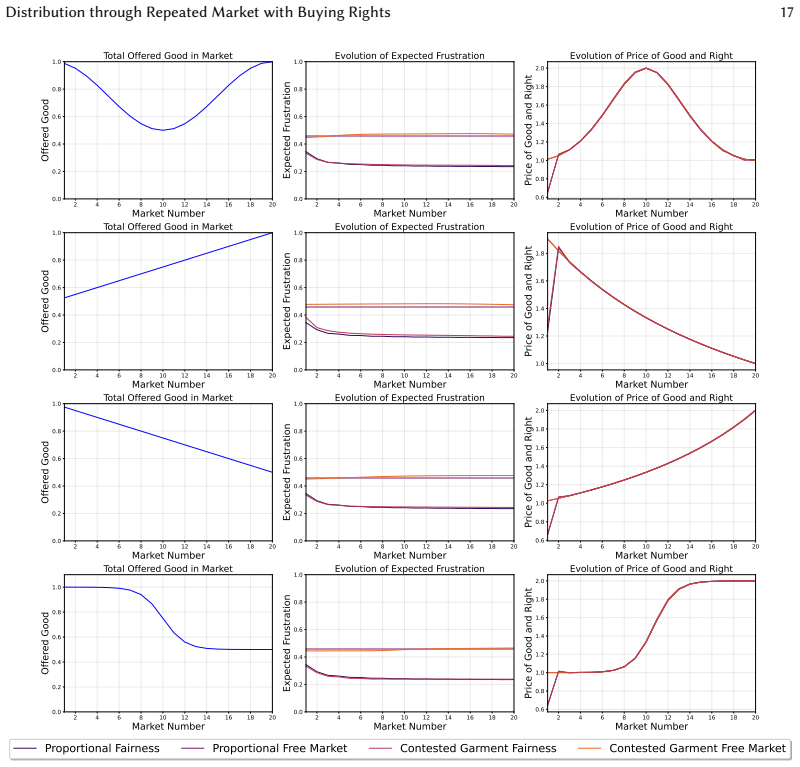
- Empirical evidence in the paper indicates that the price tracks the free-market price and frustration stays near half under time-varying supply, despite the formal requirement of constant inflows.
Reading between the lines
- Read as an income-transfer scheme, the mechanism lets cash-poor buyers monetize their entitlements each round, turning a static ration into a repeat-purchase subsidy; the authors do not frame it in welfare terms.
- A natural next step is endogenizing claims: since the paper notes buyers have no incentive to report claims truthfully, coupling the mechanism with verification or a scoring rule could restore incentive compatibility.
- Under stationary but stochastic inflows, the price-contraction argument would likely be replaced by a martingale or contraction-in-expectation argument, plausibly preserving the half-frustration bound in expectation — a conjecture, not a paper claim.
- In cap-and-trade settings, the model suggests that allocating allowances each compliance period and banning same-period use of allowance-sale revenue should halve the gap between allocated and surrendered allowances while keeping allowance prices near market clearing; testing this on allowance-market data would be a direct empirical check.
Signed reviews
Editorial analysis
A structured set of objections, weighed in public.
Referee Report
Summary. The paper studies a repeated market with a divisible good, money, and tradable buying rights allocated by a public distribution mechanism. It defines 'Greedy' strategies, claims they form a coalition-proof equilibrium computable in polynomial time, that the price converges to the free-market clearing price, and that asymptotic expected frustration is at most half of the free market's. The theoretical claims are supported by analytic arguments and by simulations for constant and time-varying supply.
Significance. If the equilibrium and convergence results are correct, the paper offers an appealing mechanism-design result: a repeated hybrid market can asymptotically halve the gap between entitlements and realized purchases without changing the limiting price, and the equilibrium is simple enough to compute. The paper is careful to state the stationarity assumptions under which the theory applies and to test robustness empirically, including cases where the theoretical guarantees fail. It also avoids parameter fitting: the half-frustration bound follows from the derived dynamics rather than from calibrated constants, which strengthens the claim.
major comments (4)
- [§3.3, Proposition 3.13] The proof never establishes the contraction inequality. After Eq. (12) the text reads "so the contraction condition is" and then splits into cases, but the case analysis only derives sign conditions such as p_τ > 1 or p_τ < 1; it does not bound |p_{τ+1}−1|/|p_τ−1|. Consequently p_τ → 1 is not proven, and Theorem 3.16, which relies on the asymptotic price being 1 and on the fixed point M_b = (m_b+R_b)/2, is unsupported as written. The proof needs to be completed or the convergence claim weakened.
- [§3.2, Lemma 3.8] Equation (11) is asserted without derivation. This identity is used to upper-bound the deviating seller's price and is therefore essential to the seller-deviation argument. Without a proof of Eq. (11), Lemma 3.8 and hence the equilibrium claim of Theorem 3.5 are not fully established. Please supply the missing derivation or an alternative argument.
- [§3.2, Lemma 3.11] The coalition-proofness proof is a sketch. For example, in case (2) the claim "any price change will not decrease Money_{S\C} get" is stated without formal support, and in case (3) the assertion that a deviating seller coalition "cannot get more Money" is not derived from the mechanism rules. Since coalition-proofness is an explicit part of Theorem 3.5, this needs a rigorous proof or a clear reference to one.
- [§3.2, Lemmas 3.9 and 3.10] The individual deviation lemmas are also informal in places. In Lemma 3.10, buyer case (1) asserts that selling Right at a lower price gives the buyer less Money in the next Market, but the argument does not account for the simultaneous change in the price of Good in the following Market. These lemmas can likely be made rigorous, but as written they do not constitute a complete proof of the no-deviation conditions.
minor comments (5)
- [§2.2, Definition 2.2] The word "amought" should be "amount".
- [§3.2, Lemma 3.6] The derivative expression is written as (1+Ñ)/(1+Ñ) with Ñ>0 and 0<\tilde R<\tilde N; as typeset this is not meaningful. The denominator should presumably involve \tilde R. Please correct the notation and the derivation.
- [§3.2, Eq. (5)] Equation (5) defines ΔM_B as a nonnegative amount, but the text later refers to "useful Money" and "useless Money" without clearly distinguishing the two variables; please use distinct symbols.
- [§3.3, Proposition 3.13] The statement says the price mapping is non-expansive on R with the L1 norm, but the contraction part is not proved (see major comment). The statement should be adjusted to what is actually shown.
- [§4.1.1] The text says the second scenario "makes the Claim of each buyer |B|-times smaller" and later says "for |B|≥4, there is enough Good..."; the figures and captions could be more explicit about the normalization of claims and income, since this affects the interpretation of the asymptotic frustration results.
Circularity Check
No significant circularity: the equilibrium and frustration bounds are derived from the stated dynamics rather than fitted, assumed, or imported from self-citations.
full rationale
The paper's central claims are Theorem 3.5 (Greedy strategies form a coalition-proof equilibrium) and Theorem 3.16 (expected frustration is asymptotically at most half of the free market's). Neither claim reduces to its inputs by construction. The Greedy price p_tau is defined as the solution of the market-clearing equation (3), which is derived from the two-stage market mechanism, the Money transition (7), and the restriction that Money from Right sales cannot be used in the current Market. The equilibrium proof then consists of lemmas analyzing deviations in volume and price (Lemmas 3.8-3.10) and coalition deviations (Lemma 3.11). These arguments may be incomplete or flawed, but they are not circular: the candidate strategy is not assumed to be an equilibrium; it is verified against deviations. The frustration bound follows algebraically from the asymptotic fixed point M_b = (m_b + R_b)/2, obtained by combining the Money transition (7) with the claimed price convergence p_tau -> 1. This is a derived consequence of the model, not a fitted parameter or a renamed assumption. The comparison with the free market uses the same entitlement benchmark R_b for both systems, which is a modeling choice explicitly acknowledged in Section 2.2, not a circularity. The paper cites prior work by the same research group (Loebl et al. 2022, 2025; Sychrovsky et al. 2023) for the mechanism, the frustration measure, and the myopic version, but these citations are attribution and background; the theorems in this paper are argued from the model's own equations rather than by invoking those citations as load-bearing evidence. There is no imported uniqueness theorem, no ansatz smuggled via citation, and no renaming of a known result as a new one. The skeptical reviewer's concern about Proposition 3.13 is a gap in the proof of the contraction inequality, which would be a correctness risk rather than a circularity: even if the convergence proof is incomplete, that does not mean the claim is equivalent to its assumptions. Overall, no specific derivation step equates the conclusion to an input or fits a parameter to the target quantity, so the paper has no significant circularity.
Assumptions & free parameters
free parameters (1)
- storage cost c in seller utility
assumptions (7)
- domain assumption Per-round endowments g_s and m_b are constant during the Repeated Market, with sum g_s = sum m_b = 1.
- domain assumption Buyers' utility is min(D_b, G_b^tau) and sellers' utility is M_s^tau - c G_s^tau; claims D_b are fixed across rounds.
- domain assumption The rights distribution mechanism phi is myopic, non-strategic, and public, depending only on offered volume and claims.
- domain assumption Money obtained by selling rights cannot be used to buy Good in the same Market.
- domain assumption Traders optimize the undiscounted sum of per-round utilities over the finite horizon T.
- standard math Existence of the price p_tau solving Eq. (3) is guaranteed by Brouwer fixed-point theorem, and p_tau is bounded by the free-market clearing price.
- domain assumption Information structure: sellers know all buyers' money and claims; buyers know their own state and all offers once posted.
Cite this review
Pith. "Pith review of Distribution through Repeated Market with Buying Rights." pith.science (2026). https://pith.science/paper/WP5CVB5M
@misc{pith2026250517271,
  author       = {Pith},
  title        = {Pith review of: Distribution through Repeated Market with Buying Rights},
  year         = {2026},
  howpublished = {\url{https://pith.science/paper/WP5CVB5M}},
  note         = {Machine review of arXiv:2505.17271}
}
read the original abstract
Resource distribution is a fundamental problem in economic and policy design, particularly when demand and supply are not naturally aligned. Without regulation, wealthier individuals may monopolize this resource, leaving the needs of others unsatisfied. While centralized distribution can ensure fairer division, it can struggle to manage logistics efficiently, and adapt to changing conditions, often leading to shortages, surpluses, and bureaucratic inefficiencies. Building on previous research on market-based redistribution, we examine a repeated hybrid market that incorporates buying rights. These rights, distributed iteratively by a central authority (for instance, as digital tokens), are intended to enhance fairness in the system - a unit of right is required to acquire a unit of the resource, but the rights themselves can also be traded alongside the resource in the market. We analyze how this regulatory mechanism influences the distribution of the scarce resource in the hybrid market over time. Unlike past works that relied on empirical methods, we explore the exact analytical properties of a system in which traders optimize over multiple rounds. We identify its market equilibrium, which is a natural generalization of the free market equilibrium, and show that it is coalition-proof. To assess the fairness in the system, we use the concept of frustration, which measures the gap between the resources a buyer is entitled to through their buying rights and what they actually obtain through trading. Our main theoretical result shows that using buying rights reduces the frustration by at least half compared to the free market. Empirical evaluations further support our findings, suggesting the system performs well even beyond the theoretically studied assumptions.
Figures


Figures from the paper (3 more)


Reference graph
Works this paper leans on
-
[6]
The distribution can be thought of in terms of communicating vessels
Illustration of the contested garment distribution. The distribution can be thought of in terms of communicating vessels. Each vessel is split in two part, with the volume of the bottom part equal to half of the claim of each claimant. The liquid in the vessels represents the commodity being distributed. Therefore, the total volume of the liquid is equal ...
work page 2025
-
[11]
Critical Distribution System. arXiv:2207.00898 [cs.GT] https://arxiv.org/abs/2207.00898 Martin Loebl, Anetta Jedličková, and Jakub Černý
-
[12]
Southern economic journal (1997), 1084–1093
The relative efficiencies of market and planned economies. Southern economic journal (1997), 1084–1093. Warut Suksompong
work page 1997
-
[16]
Mitigation and Adaptation Strategies for Global Change 25 (2020), 1403–1421
Multi-round auctions in an emissions trading system considering firm bidding strategies and government regulations. Mitigation and Adaptation Strategies for Global Change 25 (2020), 1403–1421. Distribution through Repeated Market with Buying Rights 21 Claims Fig
work page 2020
-
[1985]
Journal of economic theory 36, 2 (1985), 195–213
Game theoretic analysis of a bankruptcy problem from the Talmud. Journal of economic theory 36, 2 (1985), 195–213. Guiomar Calvo, Alicia Valero, and Antonio Valero
work page 1985
-
[1997]
The bullwhip effect in supply chains. (1997). Martin Loebl, Anetta Jedlickova, and David Sychrovsky
work page 1997
-
[1999]
Worst-case equilibria. (1999), 404–413. Hau L Lee, V Padmanabhan, and Seungjin Whang
work page 1999
-
[2006]
Econometrica 74, 1 (2006), 47–92
Efficiency of large double auctions. Econometrica 74, 1 (2006), 47–92. N.C. Dormady
work page 2006
Show all 17 references
-
[2011]
in: Handbook of Social Choice and Welfare 2 (2011), 393–506
Fair allocation rules. in: Handbook of Social Choice and Welfare 2 (2011), 393–506. William Thomson
2011
-
[2013]
Games and Economic Behavior 82 (2013), 582–591
Market and non-market mechanisms for the optimal allocation of scarce resources. Games and Economic Behavior 82 (2013), 582–591. Martin W Cripps and Jeroen M Swinkels
2013
-
[2014]
Energy Economics 44 (2014), 468–482
Carbon auctions, energy markets & market power: An experimental analysis. Energy Economics 44 (2014), 468–482. Piotr Dworczak, Scott Duke Kominers, and Mohammad Akbarpour
2014
-
[2015]
Mathe- matical Social Sciences 74 (2015), 41–59
Axiomatic and game-theoretic analysis of bankruptcy and taxation problems: an update. Mathe- matical Social Sciences 74 (2015), 41–59. Q. Wang, C. Cheng, and D Zhou
2015
-
[2017]
Resources, Conservation and Recycling 125 (2017), 208–217
Assessing maximum production peak and resource availability of non-fuel mineral resources: Analyzing the influence of extractable global resources. Resources, Conservation and Recycling 125 (2017), 208–217. https://doi.org/10.1016/j.resconrec.2017.06.009 Daniele Condorelli
2017 doi
-
[2020]
A vailable at SSRN 3609182 (2020)
Redistributive allocation mechanisms. A vailable at SSRN 3609182 (2020). Robert J Aumann and Michael Maschler
2020
-
[2021]
Econometrica 89, 4 (2021), 1665–1698
Redistribution through markets. Econometrica 89, 4 (2021), 1665–1698. Marion King Hubbert et al
2021
-
[2022]
Nature Human Behaviour 6, 10 (01 Oct 2022), 1398–1407
Human-centred mechanism design with Democratic AI. Nature Human Behaviour 6, 10 (01 Oct 2022), 1398–1407. https://doi.org/10.1038/s41562-022-01383-x Elias Koutsoupias and Christos Papadimitriou
2022 doi
-
[2023]
Economics Letters 222 (2023), 110956
A characterization of maximum Nash welfare for indivisible goods. Economics Letters 222 (2023), 110956. https://doi.org/10.1016/j.econlet.2022.110956 Richard S. Sutton and Andrew G. Barto
2023
Reviewed August 7, 2026 · model on record in the stance chip above.
Discussion (0). Continue with ORCID to comment.