REVIEW 4 major objections 5 minor 95 references
Scoot: A Perceptual Metric for Facial Sketches
T0 review · 4 major / 5 minor · reviewed 2026-08-14 · deepseek-v4-flash
Pith's one-line read The paper claims a co-occurrence-texture metric, Scoot, tracks human judgments of sketch similarity better than standard image-quality metrics.
desk verdict Nice dataset and meta-measure idea, but Scoot's reported advantage is a fit to the same human judgments used to pick its hyperparameters—and even then Gabor beats it on the larger set. read the letter →
The pith
A machine-rendered reading of the paper's core claim, the machinery that carries it, and where it could break.
The reading
What carries the argument
The load-bearing device is the gray-level co-occurrence matrix $\mathbf M$ computed on a quantized sketch $I'$, where $M(i,j)|_d$ counts how often gray value $i$ appears at a displacement $d$ from gray value $j$. The paper's contribution is to apply this classical texture statistic at block level: the image is split into a $k\times k$ grid, the matrix is normalized within each block, and the Contrast and Energy statistics are concatenated across blocks and averaged over four displacement orientations to form a feature vector; similarity is then $E_s = 1/(1+\|\vec\Psi(X'_s)-\vec\Psi(Y'_s)\|_2)$. This machinery carries the argument because it makes the metric sensitive to stroke direction and regional content while staying insensitive to small resizing and rotation, exactly where pixel-level metrics fail.
What would settle it
A held-out 2AFC sketch-similarity dataset built without the paper's selection rules, where the complete-versus-light-stroke ordering is not assumed in advance, would settle the claim: if a standard metric such as SSIM or FSIM, or a deep-feature metric, agreed with human choices at least as often as Scoot on such a benchmark, the claimed perceptual superiority would fail.
Extended reading notes
Core claim
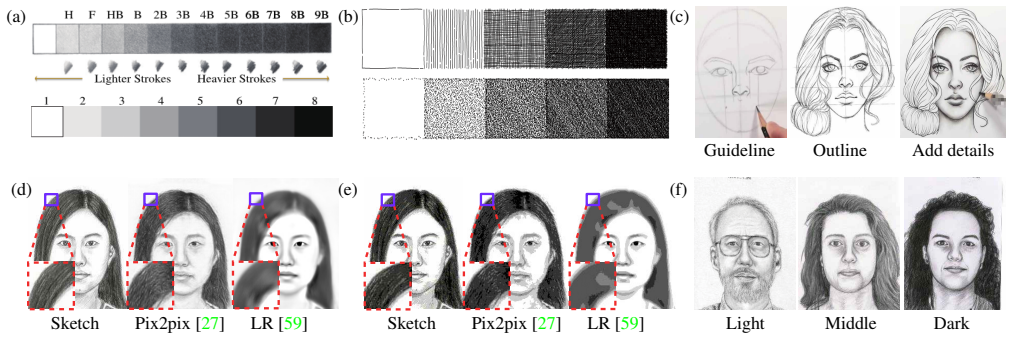
The paper's central discovery is that the perceptual gap in sketch evaluation comes from a mismatch of scale: pixel-level image-quality metrics miss the block-level spatial arrangement and stroke-direction statistics that human viewers use. Scoot measures similarity by quantizing each sketch to six gray levels, computing gray-level co-occurrence matrices inside a 4-by-4 grid of blocks, extracting Contrast and Energy statistics per block, averaging over four orientations, and comparing the resulting feature vectors with a Euclidean-distance-to-similarity mapping $E_s = 1/(1+\|\vec\Psi(X'_s)-\vec\Psi(Y'_s)\|_2)$. On the paper's three meta-measures and on its human two-alternative forced-choice databases, this construction outperforms IFC, SSIM, FSIM, VIF, and GMSD by wide margins. The paper reads that evidence as showing that spatial structure and co-occurrence texture are generally applicable perceptual features in face sketch synthesis.
Load-bearing premise
The claim rests on treating the three meta-measures and the newly collected human rankings as valid, unbiased yardsticks for perceptual similarity — in particular, on assuming a complete synthetic sketch is always perceptually better than a light-stroke thresholded version — and on assuming the settings tuned on those same benchmarks will keep their advantage on other sketches.
Editorial extensions
If this is right
- Face sketch synthesis papers could evaluate quality with a metric that, on the paper's human-judgment data, agrees with people roughly 26 percentage points more often than the best standard metric tested.
- Slight resizing and rotation of reference sketches, common when artist sketches do not align with photos, would no longer flip the ranking of synthesis algorithms the way they do for SSIM, VIF, and GMSD.
- The block-level co-occurrence construction offers a simple, non-learned alternative to learned perceptual metrics for tasks where texture and stroke direction matter.
- Complete sketches that preserve hair, eyes, and other facial texture are ranked above incomplete light-stroke versions, matching the expectation that content capture is part of perceptual quality.
- The released human-judgment databases give future sketch-synthesis methods a way to test their evaluation choices against actual human perception.
Reading between the lines
- As an editorial extension, the same construction could be tested on non-face line drawings and stylized illustrations; the paper's argument only requires texture and spatial structure to be the relevant perceptual cues, which is plausible but unverified there.
- Because the grid size, quantization level, and feature pair were selected on the same benchmarks used for evaluation, an independent evaluation on a separate dataset is needed before treating the reported margin as the metric's true advantage.
- The meta-measures themselves could serve as a reusable protocol: any future sketch-similarity metric, learned or hand-crafted, could be reported against the same three properties, making cross-paper comparisons direct.
- A natural extension is to let a learned deep network consume the block-level co-occurrence features as input; the paper shows hand-crafted features already carry a large share of the perceptual signal, so a hybrid might combine their stability with learned flexibility.
Signed reviews
Editorial analysis
A structured set of objections, weighed in public.
Referee Report
Summary. The paper proposes Scoot, a perceptual similarity metric for facial sketches that combines gray-level co-occurrence matrix statistics (Contrast and Energy) computed on a k x k block grid, with features averaged over four orientations after quantizing images to N_l gray levels. The authors introduce three meta-measures: stability to slight resizing, rotation sensitivity, and content capture capability. They also collect a two-alternative forced-choice (2AFC) human judgment dataset (RCUFS/RCUFSF) with about 152k judgments. Experiments in Table 2 compare Scoot with classical IQA metrics and with texture/edge features, reporting that Scoot achieves the best performance on the meta-measures and high agreement with human judgments.
Significance. If the central claim were established, the paper would provide a simple and potentially useful perceptual metric for face sketch evaluation, and the human judgment dataset plus the meta-measure suite would be valuable community resources. The manuscript deserves credit for collecting a large-scale human judgment dataset, evaluating a broad set of texture and edge features, and including sensitivity analyses for grid size and quantization. The main obstacle is that the reported advantage of Scoot is partly a selection artifact: its hyperparameters and feature combination were chosen using the same evaluation criteria on which it is subsequently judged. The claim is also contradicted by the paper's own Table 2 for one of the two human-judgment benchmarks. The contribution is therefore promising but not yet supported by an independent test.
major comments (4)
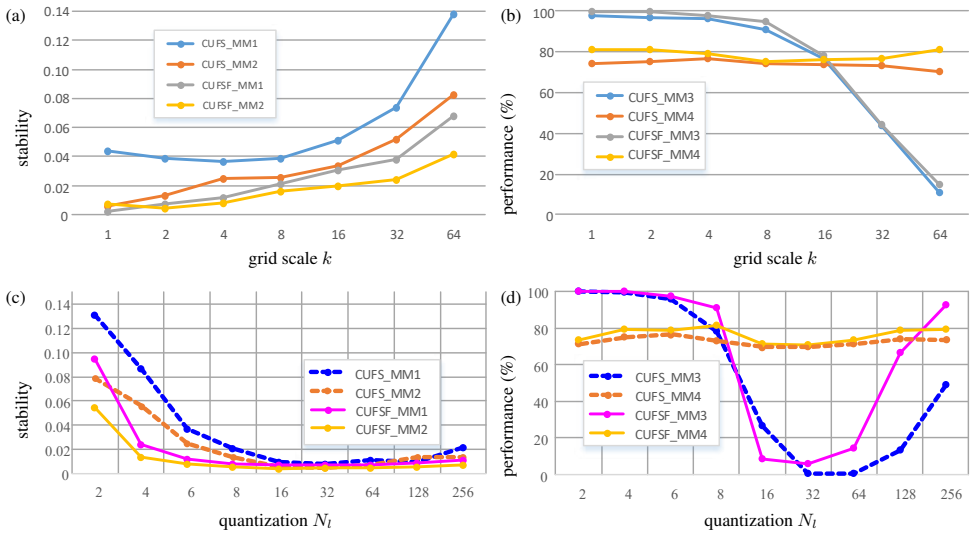
- [Sec. 6, Table 2, Fig. 7] The hyperparameters of Scoot are selected using the same benchmarks that later serve as evidence. Section 6 states that the three meta-measures and the human judgments were applied to test every single feature, every feature pair, and the triple, and Fig. 7 shows k=4 and N_l=6 chosen after inspecting MM1-MM3 and Jud curves. Consequently, the favorable results for Scoot/CE in Table 2 are a fit to the evaluation criteria, not an out-of-sample prediction. The paper needs a validation protocol in which k, N_l, and the feature set are frozen before evaluating on held-out datasets, or a nested cross-validation.
- [Table 2] The claim that Scoot exceeds prior work is not supported by Table 2 on the larger human-judgment benchmark. On RCUFSF, the Gabor feature configuration reaches 80.9% human-judgment agreement while Scoot/CE reaches 78.8%, and HE reaches 80.3%. The abstract and conclusion state unqualified superiority. This discrepancy must be addressed, either by restricting the claims to the specific meta-measures or by reporting a formal comparison that justifies the ordering across all criteria.
- [Sec. 4.2, Fig. 5] The MM3 content-capture meta-measure assumes as ground truth that a complete SOTA synthetic sketch is always perceptually better than a 'light stroke' version produced by thresholding at gray level 170. This assumption is not validated with human judgments and may not hold for all reference sketches or synthesis algorithms. Since MM3 is one of the three pillars of the evaluation, the assumption needs justification, or the incomplete versions should be constructed and validated using human judgments.
- [Table 2 caption] The caption claims that all differences are statistically significant at the alpha<0.05 level, but no statistical test, sample size, variance estimate, or multiple-comparison correction is described anywhere in the manuscript. Without this information the reader cannot verify the significance claim, and the test would in any case be invalidated by the parameter selection on the same data. The authors should report a concrete test procedure and confidence intervals.
minor comments (5)
- [Abstract] The phrase 'quick assess' should be 'quickly assess', and there is a spacing error in 'metric,called'.
- [Sec. 3.3, Eq. (6)] The norm notation in Eq. (6) uses triple vertical bars with a subscript 2; this should be typeset consistently as a standard Euclidean norm.
- [Fig. 7] The caption refers to MM4, but only MM1-MM3 are defined in Sec. 4.2; clarify what MM4 denotes, likely the human-judgment measure.
- [Sec. 5.3] The sentence 'To increase an inherently noisy process' should be revised to something like 'To reduce the effect of noise in human judgments'.
- [Algorithm 1] Step 4 refers to 'CE features' before the choice of C and E is explained; the algorithm should state that p=2 and that the selected statistics are Contrast and Energy, with the selection procedure described in Sec. 6.
Circularity Check
The benchmark advantage is partly a fit: the CE feature set and hyperparameters were selected on the same human-judgment and meta-measure columns that Table 2 uses as evidence, with no held-out validation.
-
fitted input called prediction
[Sec. 4.1 Implementation Details; Sec. 6 Discussion; Table 2]
"The size of spatial structure k in Sec. 3.2 is set to 4 to achieve the best performance. The quantization parameter Nl in Eq. (6) is set to 6 grades. We have demonstrated that p = 2 (e.g., C in Eq. 3 combined with E in Eq. 4) achieve the best performance (see Sec. 6). ... We have applied our three meta-measures as well as human judgments to test the performance of the Scoot metric using each single feature, each feature pair and the combination of all three features. ... Thus, we choose 'CE' feature as our final combination."
The final comparison in Table 2 reports Scoot's agreement with the RCUFS/RCUFSF human judgments and its MM1/MM2/MM3 scores. Those are the same columns used in Sec. 6 to select the CE feature combination and in Sec. 4.1 and Fig. 7 to select k=4 and Nl=6. The paper provides no frozen-configuration held-out evaluation, so the headline claim that Scoot exceeds prior work is not an out-of-sample prediction; it is a report of the selection criterion. This is the fitted-input-called-prediction pattern: the configuration that performed best on the test criteria is then presented as the configuration that beats the baselines on those same criteria.
full rationale
The central issue is not that Scoot's formula is defined in terms of its evaluation data; the co-occurrence statistics, block grid, and Euclidean similarity are ordinary, independently motivated components. Neither is the paper's reliance on self-citations load-bearing: [9,10] are cited only as methodological inspiration alongside external references [33,37], and no uniqueness theorem or exclusive justification is imported from the authors' prior work. The real circularity is in the evaluation loop. Section 6 explicitly states that the three meta-measures and human judgments were used to test each single feature, each pair, and the triple, and that CE was chosen as the final combination on that basis; Section 4.1 similarly states that k=4 and Nl=6 were set to achieve the best performance. Table 2 then reports Scoot's performance on exactly those same meta-measure and human-judgment columns as evidence of superiority. Because no separate validation set or frozen-configuration test is described, the reported advantage is partly a selection artifact rather than an independent verification. The table itself also weakens the headline claim: on RCUFSF, Gabor reaches 80.9% human-judgment agreement and HE reaches 80.3%, while Scoot/CE reaches 78.8%, so the selected configuration is not uniformly best even on the selection criterion. This is partial circularity of the fitted-input-called-prediction kind, not a fully self-definitional derivation.
Assumptions & free parameters
free parameters (5)
- N_l = 6 (number of gray levels after quantization) =
6
- k = 4 (grid size for block-level spatial structure) =
4
- p = 2 (feature combination Contrast and Energy) =
CE
- T = 4 (number of orientations) =
4
- Threshold 170 for light-stroke meta-measure =
170
assumptions (3)
- domain assumption Co-occurrence statistics capture perceptual texture similarity.
- domain assumption Block-level spatial division preserves holistic content.
- domain assumption 2AFC human preferences are ground truth for perceptual similarity.
Cite this review
Pith. "Pith review of Scoot: A Perceptual Metric for Facial Sketches." pith.science (2026). https://pith.science/paper/WP5DY52W
@misc{pith2026190808433,
  author       = {Pith},
  title        = {Pith review of: Scoot: A Perceptual Metric for Facial Sketches},
  year         = {2026},
  howpublished = {\url{https://pith.science/paper/WP5DY52W}},
  note         = {Machine review of arXiv:1908.08433}
}
read the original abstract
Human visual system has the strong ability to quick assess the perceptual similarity between two facial sketches. However, existing two widely-used facial sketch metrics, e.g., FSIM and SSIM fail to address this perceptual similarity in this field. Recent study in facial modeling area has verified that the inclusion of both structure and texture has a significant positive benefit for face sketch synthesis (FSS). But which statistics are more important, and are helpful for their success? In this paper, we design a perceptual metric,called Structure Co-Occurrence Texture (Scoot), which simultaneously considers the block-level spatial structure and co-occurrence texture statistics. To test the quality of metrics, we propose three novel meta-measures based on various reliable properties. Extensive experiments demonstrate that our Scoot metric exceeds the performance of prior work. Besides, we built the first large scale (152k judgments) human-perception-based sketch database that can evaluate how well a metric is consistent with human perception. Our results suggest that "spatial structure" and "co-occurrence texture" are two generally applicable perceptual features in face sketch synthesis.
Figures


Figures from the paper (3 more)


Reference graph
Works this paper leans on
-
[1]
An investigation of the textural characteristics associated with gray level cooc- currence matrix statistical parameters
Andrea Baraldi and Flavio Parmiggiani. An investigation of the textural characteristics associated with gray level cooc- currence matrix statistical parameters. IEEE T Geosci. Re- mote., 33(2):293–304, 1995
1995
-
[2]
Algorithm AS 89: the upper tail probabilities of Spearman’s rho
DJ Best and DE Roberts. Algorithm AS 89: the upper tail probabilities of Spearman’s rho. J R STAT SOC C-APPL , 24(3):377–379, 1975
1975
-
[3]
A computational approach to edge detection
John Canny. A computational approach to edge detection. IEEE TPAMI, 8:679–698, 1986
1986
-
[4]
A new LDA-based face recognition system which can solve the small sample size problem
Li-Fen Chen, Hong-Yuan Mark Liao, Ming-Tat Ko, Ja-Chen Lin, and Gwo-Jong Yu. A new LDA-based face recognition system which can solve the small sample size problem. Pat- tern Recognition, 33(10):1713–1726, 2000
2000
-
[5]
BING: Binarized normed gradients for objectness estimation at 300fps.Computational Visual Media, 5(1):3–20, 2019
Ming-Ming Cheng, Yun Liu, Wen-Yan Lin, Ziming Zhang, Paul L Rosin, and Philip HS Torr. BING: Binarized normed gradients for objectness estimation at 300fps.Computational Visual Media, 5(1):3–20, 2019
2019
-
[6]
An analysis of co-occurrence texture statis- tics as a function of grey level quantization
David A Clausi. An analysis of co-occurrence texture statis- tics as a function of grey level quantization. Can. J Remote. Sens., 28(1):45–62, 2002
2002
-
[7]
Generating images with perceptual similarity metrics based on deep networks
Alexey Dosovitskiy and Thomas Brox. Generating images with perceptual similarity metrics based on deep networks. In NIPS, pages 658–666, 2016
2016
-
[8]
Link the head to the beak: Zero shot learning from noisy text description at part precision
Mohamed Elhoseiny, Yizhe Zhu, Han Zhang, and Ahmed Elgammal. Link the head to the beak: Zero shot learning from noisy text description at part precision. In IEEE CVPR, 2017
2017
Show all 95 references
-
[9]
Structure-measure: A New Way to Evaluate Fore- ground Maps
Deng-Ping Fan, Ming-Ming Cheng, Yun Liu, Tao Li, and Ali Borji. Structure-measure: A New Way to Evaluate Fore- ground Maps. In IEEE ICCV, pages 4548–4557, 2017
2017
-
[10]
Enhanced-alignment Measure for Binary Foreground Map Evaluation
Deng-Ping Fan, Cheng Gong, Yang Cao, Bo Ren, Ming- Ming Cheng, and Ali Borji. Enhanced-alignment Measure for Binary Foreground Map Evaluation. In IJCAI, pages 698–704, 2018
2018
-
[11]
Rethinking RGB-D salient object detection: Mod- els, datasets, and large-scale benchmarks
Deng-Ping Fan, Zheng Lin, Jia-Xing Zhao, Yun Liu, Zhao Zhang, Qibin Hou, Menglong Zhu, and Ming-Ming Cheng. Rethinking RGB-D salient object detection: Mod- els, datasets, and large-scale benchmarks. arXiv preprint arXiv:1907.06781, 2019
1907 arXiv
-
[12]
Salient objects in clutter: Bringing salient object detection to the foreground
Deng-Ping Fan, Jiang-Jiang Liu, Shang-Hua Gao, Qibin Hou, Ali Borji, and Ming-Ming Cheng. Salient objects in clutter: Bringing salient object detection to the foreground. In ECCV, pages 1597–1604. Springer, 2018
2018
-
[13]
Shifting more attention to video salient object detection
Deng-Ping Fan, Wenguan Wang, Ming-Ming Cheng, and Jianbing Shen. Shifting more attention to video salient object detection. In IEEE CVPR, pages 8554–8564, 2019
2019
-
[14]
Example-based synthesis of stylized facial animations
Jakub Fi ˇser, Ondˇrej Jamriˇska, David Simons, Eli Shechtman, Jingwan Lu, Paul Asente, Michal Luk´aˇc, and Daniel S`ykora. Example-based synthesis of stylized facial animations. ACM TOG, 36(4):155, 2017
2017
-
[15]
Learning style translation for the lines of a drawing
William T Freeman, Joshua B Tenenbaum, and Egon C Pasz- tor. Learning style translation for the lines of a drawing. ACM TOG, 22(1):33–46, 2003
2003
-
[16]
Theory of communication
Dennis Gabor. Theory of communication. part 1: The anal- ysis of information. Journal of the Institution of Electrical Engineers-Part III: Radio and Communication Engineering, 93(26):429–441, 1946
1946
-
[17]
Texture analysis using grey level run lengths
Mary M Galloway. Texture analysis using grey level run lengths. NASA STI/Recon Technical Report N, 75, 1974
1974
-
[18]
Composition-aided sketch-realistic portrait generation
Fei Gao, Shengjie Shi, Jun Yu, and Qingming Huang. Composition-aided sketch-realistic portrait generation. arXiv preprint arXiv:1712.00899, 2017
2017 arXiv
-
[19]
Deepsim: Deep similarity for image quality assess- ment
Fei Gao, Yi Wang, Panpeng Li, Min Tan, Jun Yu, and Yani Zhu. Deepsim: Deep similarity for image quality assess- ment. Neurocomputing, 257:104–114, 2017
2017
-
[20]
Face sketch–photo synthesis and retrieval using sparse rep- resentation
Xinbo Gao, Nannan Wang, Dacheng Tao, and Xuelong Li. Face sketch–photo synthesis and retrieval using sparse rep- resentation. IEEE TCSVT, 22(8):1213–1226, 2012
2012
-
[21]
Face sketch synthesis algorithm based on E-HMM and selective ensemble
Xinbo Gao, Juanjuan Zhong, Jie Li, and Chunna Tian. Face sketch synthesis algorithm based on E-HMM and selective ensemble. IEEE TCSVT, 18(4):487–496, 2008
2008
-
[22]
Local face sketch synthesis learning
Xinbo Gao, Juanjuan Zhong, Dacheng Tao, and Xuelong Li. Local face sketch synthesis learning. Neurocomputing, 71(10-12):1921–1930, 2008
1921
-
[23]
Programmable style for NPR line draw- ing
St ´ephane Grabli, Emmanuel Turquin, Fr ´edo Durand, and Franc ¸ois X Sillion. Programmable style for NPR line draw- ing. Rendering Techniques (Eurographics Symposium on Rendering), 2004
2004
-
[24]
Statistical and structural approaches to texture
Robert M Haralick et al. Statistical and structural approaches to texture. Proceedings of the IEEE, 67(5):786–804, 1979
1979
-
[25]
Textu- ral features for image classification
Robert M Haralick, Karthikeyan Shanmugam, et al. Textu- ral features for image classification. IEEE Transactions on Systems, Man, and Cybernetics, pages 610–621, 1973
1973
-
[26]
Locality preserving projec- tions
Xiaofei He and Partha Niyogi. Locality preserving projec- tions. In NIPS, pages 153–160, 2004
2004
-
[27]
Image-to-image translation with conditional adver- sarial networks
Phillip Isola, Jun-Yan Zhu, Tinghui Zhou, and Alexei A Efros. Image-to-image translation with conditional adver- sarial networks. In IEEE CVPR, pages 1125–1134, 2017
2017
-
[28]
A modified convolutional neural network for face sketch synthesis
Licheng Jiao, Sibo Zhang, Lingling Li, Fang Liu, and Wen- ping Ma. A modified convolutional neural network for face sketch synthesis. PR, 76:125–136, 2018
2018
-
[29]
Adap- tive representation-based face sketch-photo synthesis
Jie Li, Xinye Yu, Chunlei Peng, and Nannan Wang. Adap- tive representation-based face sketch-photo synthesis. Neu- rocomputing, 269:152–159, 2017
2017
-
[30]
Free-hand sketch synthesis with deformable stroke models
Yi Li, Yi-Zhe Song, Timothy M Hospedales, and Shaogang Gong. Free-hand sketch synthesis with deformable stroke models. IJCV, 122(1):169–190, 2017
2017
-
[31]
A nonlinear approach for face sketch synthesis and recognition
Qingshan Liu, Xiaoou Tang, Hongliang Jin, Hanqing Lu, and Songde Ma. A nonlinear approach for face sketch synthesis and recognition. In IEEE CVPR , volume 1, pages 1005– 1010, 2005
2005
-
[32]
Bayesian Tensor Inference for Sketch-Based Facial Photo Hallucination
Wei Liu, Xiaoou Tang, and Jianzhuang Liu. Bayesian Tensor Inference for Sketch-Based Facial Photo Hallucination. In IJCAI, pages 2141–2146, 2007
2007
-
[33]
How to evaluate foreground maps? In IEEE CVPR, pages 248–255, 2014
Ran Margolin, Lihi Zelnik-Manor, and Ayellet Tal. How to evaluate foreground maps? In IEEE CVPR, pages 248–255, 2014
2014
-
[34]
Modeling the shape of the scene: A holistic representation of the spatial envelope
Aude Oliva and Antonio Torralba. Modeling the shape of the scene: A holistic representation of the spatial envelope. IJCV, 42(3):145–175, 2001
2001
-
[35]
Superpixel-based face sketch–photo synthesis.IEEE TCSVT, 27(2):288–299, 2017
Chunlei Peng, Xinbo Gao, Nannan Wang, and Jie Li. Superpixel-based face sketch–photo synthesis.IEEE TCSVT, 27(2):288–299, 2017
2017
-
[36]
Multiple representations-based face sketch–photo synthesis
Chunlei Peng, Xinbo Gao, Nannan Wang, Dacheng Tao, Xuelong Li, and Jie Li. Multiple representations-based face sketch–photo synthesis. IEEE TNNLS, 27(11):2201–2215, 2016
2016
-
[37]
Measures and meta- measures for the supervised evaluation of image segmenta- tion
Jordi Pont-Tuset and Ferran Marques. Measures and meta- measures for the supervised evaluation of image segmenta- tion. In IEEE CVPR, pages 2131–2138, 2013
2013
-
[38]
Neural style transfer: a paradigm shift for image-based artistic ren- dering? In ACM NPAR, page 5, 2017
Amir Semmo, Tobias Isenberg, and J ¨urgen D¨ollner. Neural style transfer: a paradigm shift for image-based artistic ren- dering? In ACM NPAR, page 5, 2017
2017
-
[39]
Image information and visual quality
Hamid R Sheikh and Alan C Bovik. Image information and visual quality. IEEE TIP, 15(2):430–444, 2006
2006
-
[40]
An information fidelity criterion for image quality assess- ment using natural scene statistics
Hamid R Sheikh, Alan C Bovik, and Gustavo De Veciana. An information fidelity criterion for image quality assess- ment using natural scene statistics. IEEE TIP, 14(12):2117– 2128, 2005
2005
-
[41]
Lazy random walks for superpixel segmentation
Jianbing Shen, Yunfan Du, Wenguan Wang, and Xuelong Li. Lazy random walks for superpixel segmentation. IEEE TIP, 23(4):1451–1462, 2014
2014
-
[42]
Real-time superpixel seg- mentation by DBSCAN clustering algorithm
Jianbing Shen, Xiaopeng Hao, Zhiyuan Liang, Yu Liu, Wen- guan Wang, and Ling Shao. Real-time superpixel seg- mentation by DBSCAN clustering algorithm. IEEE TIP , 25(12):5933–5942, 2016
2016
-
[43]
Submodular trajectories for better motion segmentation in videos
Jianbing Shen, Jianteng Peng, and Ling Shao. Submodular trajectories for better motion segmentation in videos. IEEE TIP, 27(6):2688–2700, 2018
2018
-
[44]
An isotropic 3×3 image gradient operator
Irvin Sobel. An isotropic 3×3 image gradient operator. Ma- chine Vision for Three-dimensional Scenes, pages 376–379, 1990
1990
-
[45]
Real-time exemplar-based face sketch synthe- sis
Yibing Song, Linchao Bao, Qingxiong Yang, and Ming- Hsuan Yang. Real-time exemplar-based face sketch synthe- sis. In ECCV, pages 800–813. Springer, 2014
2014
-
[46]
A benchmark for automatic visual classification of clinical skin disease images
Xiaoxiao Sun, Jufeng Yang, Ming Sun, and Kai Wang. A benchmark for automatic visual classification of clinical skin disease images. In ECCV, pages 206–222. Springer, 2016
2016
-
[47]
Beginner’s Guide to Sketching
Bomba Sylwia, Cai Rovina, Croes Brun, Gerard Justin, and Lewis Marisa. Beginner’s Guide to Sketching. 3dtotal Pub- lishing, 2015
2015
-
[48]
NIMA: Neural image assessment
Hossein Talebi and Peyman Milanfar. NIMA: Neural image assessment. IEEE TIP, 27(8):3998–4011, 2018
2018
-
[49]
Face sketch synthesis and recognition
Xiaoou Tang and Xiaogang Wang. Face sketch synthesis and recognition. In IEEE CVPR, pages 687–694, 2003
2003
-
[50]
Face sketch recognition
Xiaoou Tang and Xiaogang Wang. Face sketch recognition. IEEE TCSVT, 14(1):50–57, 2004
2004
-
[51]
Facial Sketch Synthesis Using 2D Direct Combined Model-Based Face-Specific Markov Network
Ching-Ting Tu, Yu-Hsien Chan, and Yi-Chung Chen. Facial Sketch Synthesis Using 2D Direct Combined Model-Based Face-Specific Markov Network. IEEE TIP , 25(8):3546– 3561, 2016
2016
-
[52]
High- quality facial photo-sketch synthesis using multi-adversarial networks
Lidan Wang, Vishwanath Sindagi, and Vishal Patel. High- quality facial photo-sketch synthesis using multi-adversarial networks. In IEEE FG, pages 83–90, 2018
2018
-
[53]
Random sampling for fast face sketch synthesis
Nannan Wang, Xinbo Gao, and Jie Li. Random sampling for fast face sketch synthesis. Pattern Recognition, 76:215–227, 2018
2018
-
[54]
Evaluation on synthesized face sketches
Nannan Wang, Xinbo Gao, Jie Li, Bin Song, and Zan Li. Evaluation on synthesized face sketches. Neurocomputing, 214:991–1000, 2016
2016
-
[55]
Bayesian face sketch synthesis
Nannan Wang, Xinbo Gao, Leiyu Sun, and Jie Li. Bayesian face sketch synthesis. IEEE TIP, 26(3):1264–1274, 2017
2017
-
[56]
Heterogeneous image transformation
Nannan Wang, Jie Li, Dacheng Tao, Xuelong Li, and Xinbo Gao. Heterogeneous image transformation. PRL, 34(1):77– 84, 2013
2013
-
[57]
Transductive face sketch-photo synthesis
Nannan Wang, Dacheng Tao, Xinbo Gao, Xuelong Li, and Jie Li. Transductive face sketch-photo synthesis. IEEE TNNLS, 24(9):1364–1376, 2013
2013
-
[58]
A comprehensive survey to face hallucination
Nannan Wang, Dacheng Tao, Xinbo Gao, Xuelong Li, and Jie Li. A comprehensive survey to face hallucination. IJCV, 106(1):9–30, 2014
2014
-
[59]
Data-driven vs
Nannan Wang, Mingrui Zhu, Jie Li, Bin Song, and Zan Li. Data-driven vs. model-driven: Fast face sketch synthesis. Neurocomputing, 2017
2017
-
[60]
Semi-coupled dictionary learning with applications to image super-resolution and photo-sketch synthesis
Shenlong Wang, Lei Zhang, Yan Liang, and Quan Pan. Semi-coupled dictionary learning with applications to image super-resolution and photo-sketch synthesis. In IEEE CVPR, pages 2216–2223, 2012
2012
-
[61]
Dual-space linear dis- criminant analysis for face recognition
Xiaogang Wang and Xiaoou Tang. Dual-space linear dis- criminant analysis for face recognition. In IEEE CVPR, vol- ume 2, pages II–II, 2004
2004
-
[62]
Random sampling lda for face recognition
Xiaogang Wang and Xiaoou Tang. Random sampling lda for face recognition. In IEEE CVPR, pages 259–265, 2004
2004
-
[63]
Random sampling for subspace face recognition
Xiaogang Wang and Xiaoou Tang. Random sampling for subspace face recognition. IJCV, 70(1):91–104, 2006
2006
-
[64]
Face photo-sketch syn- thesis and recognition
Xiaogang Wang and Xiaoou Tang. Face photo-sketch syn- thesis and recognition. IEEE TPAMI, 31(11):1955–1967, 2009
1955
-
[65]
A universal image quality index
Zhou Wang and Alan C Bovik. A universal image quality index. IEEE SPL, 9(3):81–84, 2002
2002
-
[66]
Image quality assessment: from error visibility to structural similarity
Zhou Wang, Alan C Bovik, Hamid R Sheikh, and Eero P Simoncelli. Image quality assessment: from error visibility to structural similarity. IEEE TIP, 13(4):600–612, 2004
2004
-
[67]
Computer- generated pen-and-ink illustration
Georges Winkenbach and David H Salesin. Computer- generated pen-and-ink illustration. In ACM SIGGRAPH , pages 91–100, 1994
1994
-
[68]
Robust face recognition via sparse represen- tation
John Wright, Allen Y Yang, Arvind Ganesh, S Shankar Sas- try, and Yi Ma. Robust face recognition via sparse represen- tation. IEEE TPAMI, 31(2):210–227, 2009
2009
-
[69]
Ip102: A large-scale benchmark dataset for insect pest recognition
Xiaoping Wu, Chi Zhan, Yu-Kun Lai, Ming-Ming Cheng, and Jufeng Yang. Ip102: A large-scale benchmark dataset for insect pest recognition. In IEEE CVPR, pages 8787–8796, 2019
2019
-
[70]
Photo-sketch synthesis and recognition based on subspace learning
Bing Xiao, Xinbo Gao, Dacheng Tao, Yuan Yuan, and Jie Li. Photo-sketch synthesis and recognition based on subspace learning. Neurocomputing, 73(4-6):840–852, 2010
2010
-
[71]
Multi-channel weighted nuclear norm minimization for real color image denoising
Jun Xu, Lei Zhang, David Zhang, and Xiangchu Feng. Multi-channel weighted nuclear norm minimization for real color image denoising. In IEEE ICCV, 2017
2017
-
[72]
Gradient magnitude similarity deviation: A highly efficient perceptual image quality index
Wufeng Xue, Lei Zhang, Xuanqin Mou, and Alan C Bovik. Gradient magnitude similarity deviation: A highly efficient perceptual image quality index. IEEE TIP, 23(2):684–695, 2014
2014
-
[73]
Clinical skin lesion diagnosis using representations inspired by dermatologist criteria
Jufeng Yang, Xiaoxiao Sun, Jie Liang, and Paul L Rosin. Clinical skin lesion diagnosis using representations inspired by dermatologist criteria. In IEEE CVPR, pages 1258–1266, 2018
2018
-
[74]
Content-adaptive sketch por- trait generation by decompositional representation learning
Dongyu Zhang, Liang Lin, Tianshui Chen, Xian Wu, Wen- wei Tan, and Ebroul Izquierdo. Content-adaptive sketch por- trait generation by decompositional representation learning. IEEE TIP, 26(1):328–339, 2017
2017
-
[75]
End-to-end photo-sketch generation via fully convolutional representation learning
Liliang Zhang, Liang Lin, Xian Wu, Shengyong Ding, and Lei Zhang. End-to-end photo-sketch generation via fully convolutional representation learning. In ACM ICMR, pages 627–634, 2015
2015
-
[76]
FSIM: A feature similarity index for image quality assess- ment
Lin Zhang, Lei Zhang, Xuanqin Mou, and David Zhang. FSIM: A feature similarity index for image quality assess- ment. IEEE TIP, 20(8):2378–2386, 2011
2011
-
[77]
Com- positional model-based sketch generator in facial entertain- ment
Mingjin Zhang, Jie Li, Nannan Wang, and Xinbo Gao. Com- positional model-based sketch generator in facial entertain- ment. IEEE TOC, 48(3):904–915, 2018
2018
-
[78]
Markov random neural fields for face sketch synthesis
Mingjin Zhang, Nannan Wang, Xinbo Gao, and Yunsong Li. Markov random neural fields for face sketch synthesis. In IJCAI, pages 1142–1148, 2018
2018
-
[79]
Face sketch synthesis from coarse to fine
Mingjin Zhang, Nannan Wang, Yunsong Li, Ruxin Wang, and Xinbo Gao. Face sketch synthesis from coarse to fine. In AAAI, 2018
2018
-
[80]
The unreasonable effectiveness of deep features as a perceptual metric
Richard Zhang, Phillip Isola, Alexei A Efros, Eli Shechtman, and Oliver Wang. The unreasonable effectiveness of deep features as a perceptual metric. In IEEE CVPR, pages 586– 595, 2018
2018
-
[81]
Robust face sketch style synthesis
Shengchuan Zhang, Xinbo Gao, Nannan Wang, and Jie Li. Robust face sketch style synthesis. IEEE TIP, 25(1):220– 232, 2016
2016
-
[82]
Face sketch synthesis from a single photo–sketch pair
Shengchuan Zhang, Xinbo Gao, Nannan Wang, and Jie Li. Face sketch synthesis from a single photo–sketch pair. IEEE TCSVT, 27(2):275–287, 2017
2017
-
[83]
Face sketch synthesis via sparse representation-based greedy search
Shengchuan Zhang, Xinbo Gao, Nannan Wang, Jie Li, and Mingjin Zhang. Face sketch synthesis via sparse representation-based greedy search. IEEE TIP, 24(8):2466– 2477, 2015
2015
-
[84]
Robust face sketch synthesis via generative adver- sarial fusion of priors and parametric sigmoid
Shengchuan Zhang, Rongrong Ji, Jie Hu, Yue Gao, and Chia- Wen Lin. Robust face sketch synthesis via generative adver- sarial fusion of priors and parametric sigmoid. In IJCAI, pages 1163–1169, 2018
2018
-
[85]
Face sketch synthesis by multidomain adversar- ial learning
Shengchuan Zhang, Rongrong Ji, Jie Hu, Xiaoqiang Lu, and Xuelong Li. Face sketch synthesis by multidomain adversar- ial learning. IEEE TNNLS, 2018
2018
-
[86]
Lighting and pose robust face sketch synthesis
Wei Zhang, Xiaogang Wang, and Xiaoou Tang. Lighting and pose robust face sketch synthesis. In ECCV, pages 420–433. Springer, 2010
2010
-
[87]
Coupled information-theoretic encoding for face photo-sketch recog- nition
Wei Zhang, Xiaogang Wang, and Xiaoou Tang. Coupled information-theoretic encoding for face photo-sketch recog- nition. In IEEE CVPR, pages 513–520, 2011
2011
-
[88]
Fast face sketch synthesis via kd-tree search
Yuqian Zhang, Nannan Wang, Shengchuan Zhang, Jie Li, and Xinbo Gao. Fast face sketch synthesis via kd-tree search. In ECCV, pages 64–77. Springer, 2016
2016
-
[89]
Jiaxing Zhao, Ren Bo, Qibin Hou, Ming-Ming Cheng, and Paul L. Rosin. FLIC: fast linear iterative clustering with active search. Computational Visual Media, 4(4):333–348, 2018
2018
-
[90]
Contrast prior and fluid pyramid integration for RGBD salient object detection
Jia-Xing Zhao, Yang Cao, Deng-Ping Fan, Ming-Ming Cheng, Xuan-Yi Li, and Le Zhang. Contrast prior and fluid pyramid integration for RGBD salient object detection. In IEEE CVPR, 2019
2019
-
[91]
Edge-based network for salient object detection
Jia-Xing Zhao, Jiang-Jiang Liu, Deng-Ping Fan, Jufeng Yang, and Ming-Ming Cheng. Edge-based network for salient object detection. In IEEE ICCV, 2019
2019
-
[92]
Markov weight fields for face sketch synthesis
Hao Zhou, Zhanghui Kuang, and Kwan-Yee K Wong. Markov weight fields for face sketch synthesis. In IEEE CVPR, pages 1091–1097, 2012
2012
-
[93]
Deep graphical feature learning for face sketch synthesis
Mingrui Zhu, Nannan Wang, Xinbo Gao, and Jie Li. Deep graphical feature learning for face sketch synthesis. InIJCAI, pages 3574–3580, 2017
2017
-
[94]
A multilayer-based framework for online background subtraction with freely moving cameras
Yizhe Zhu and Ahmed Elgammal. A multilayer-based framework for online background subtraction with freely moving cameras. In IEEE ICCV, 2017
2017
-
[95]
Two stages of curve detection suggest two styles of visual com- putation
Steven W Zucker, Allan Dobbins, and Lee Iverson. Two stages of curve detection suggest two styles of visual com- putation. Neural computation, 1(1):68–81, 1989
1989
Reviewed August 14, 2026 · model on record in the stance chip above.
Discussion (0). Continue with ORCID to comment.