REVIEW 4 major objections 5 minor 79 references
Landau levels in the mixed state of two-dimensional nodal superconductors: models, featured magneto-optical response and quantized thermal Hall effect
T0 review · 4 major / 5 minor · reviewed 2026-08-10 · deepseek-v4-flash
Pith's one-line read A two-dimensional topological-insulator–superconductor heterostructure is claimed to host Landau levels with Chern number ±1 in its vortex lattice, with quantized thermal Hall conductivity and peaked magneto-optical response as…
desk verdict Plausible symmetry-based route to Bogoliubov Landau levels in a 2D TI-SC heterostructure, but the central numbers are in a missing supplement. read the letter →
The pith
A machine-rendered reading of the paper's core claim, the machinery that carries it, and where it could break.
The reading
What carries the argument
The machinery that carries the argument is the generalized chiral symmetry for tilted Dirac/Weyl cones, expressed by $\zeta^\dagger H_{\mathrm{BW}}\zeta = -H_{\mathrm{BW}}$ with $\zeta = (\sigma_z - i\eta_x\sigma_y)/\sqrt{1-\eta_x^2}$. Together with this, the key structural move is to absorb the vortex-lattice phase into an effective vector potential $\mathbf{A}_{\mathrm{eff}} = \mathbf{a} + \kappa m\mathbf{u}_s$ after the Anderson gauge transformation, where $\mathbf{a} = \frac{1}{2}\nabla\phi$ is the superconducting gauge field and $\mathbf{u}_s$ the supercurrent velocity. In the heterostructure Weyl superconductor this effective potential couples to Bogoliubov–Weyl fermions and preserves the generalized chiral symmetry, which protects a dispersionless zeroth Landau level and yields the $\sqrt{n}$ ladder; in the intrinsic Weyl superconductor the external vector potential drops out of the pairing-linearized Hamiltonian, the supercurrent term enters as $\eta_x v_F m v_{s,x}\sigma_z$ and breaks the symmetry, so only Bloch-wave-like quasiparticles survive. For the 2D TI–superconductor heterostructure, the zero-field Hamiltonian has a Bogoliubov–Dirac node at $\beta^2 = 1+\Delta_0^2$, and the numerical vortex-lattice solution shows that the same symmetry logic produces Dirac Landau levels with Chern numbers $\pm1$.
What would settle it
Direct numerical diagonalization of the full BdG Hamiltonian (8) on a finite vortex lattice, without the low-energy projection, would settle the main claim: if the spectrum shows avoided crossings or fails to follow $E_n=\sqrt{n}E_1$ as the magnetic length $l_B$ is varied, the central claim collapses. Experimentally, measuring $\kappa_{xy}/T$ at low temperature in a TI–s-wave superconductor heterostructure and finding values that do not match integer sums of the level Chern numbers (or plateau values that drift non-trivially with temperature) would falsify the quantized thermal Hall prediction.
Extended reading notes
Core claim
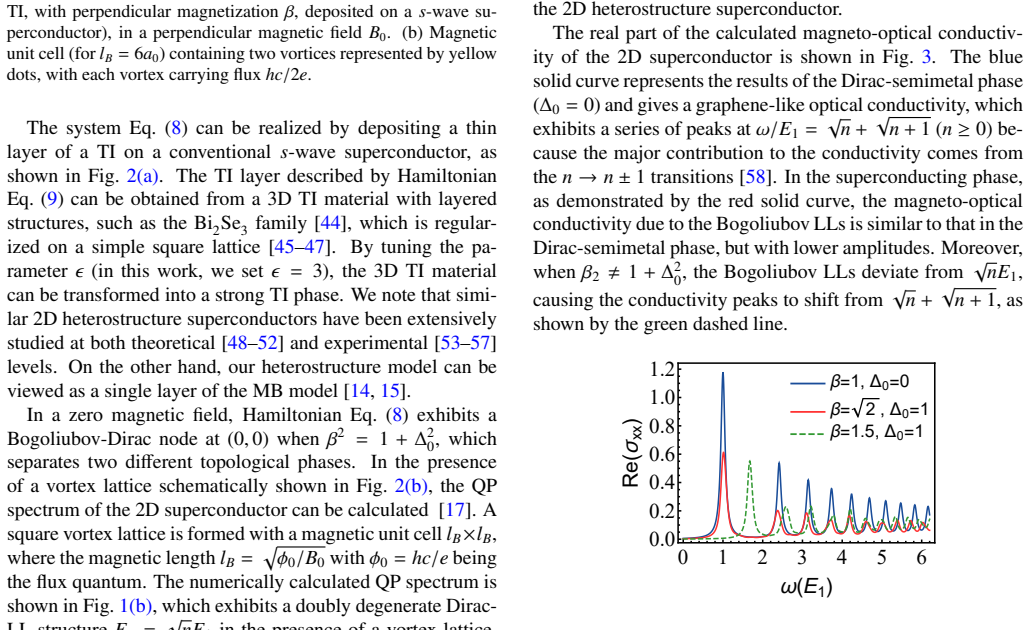
On its own terms, the paper's central claim is that a 2D superconducting system—a thin topological-insulator layer proximitized by an s-wave superconductor, described by a four-band Bogoliubov–de Gennes Hamiltonian with a Dirac node tuned by magnetization and pairing gap—hosts Landau levels of Bogoliubov quasiparticles in the mixed state. At the fine-tuned condition $\beta^2 = 1+\Delta_0^2$ the vortex-lattice spectrum is a doubly degenerate Dirac ladder $E_n=\sqrt{n}E_1$ with a dispersionless zeroth level; when $\beta$ and $\mu$ are tuned the degeneracy splits into massive-Dirac ladders whose individual levels have Chern number $+1$ or $-1$, the same values as the normal-state Landau levels. Because Bogoliubov quasiparticles are charge-neutral, the electric Hall conductivity is not the quantized observable; instead the paper defines a transverse conductivity tensor $\tilde{\sigma}_{xy}(\xi)$ built from Berry curvature of occupied levels and shows it develops integer plateaus, so that $\kappa_{xy}/T \to (\pi^2/3)(k_B/\hbar)^2\tilde{\sigma}_{xy}(0)$ is quantized at low temperature. The paper also predicts that optical transitions between the Bogoliubov levels produce magneto-optical conductivity peaks at $\omega/E_1 = \sqrt{n}+\sqrt{n+1}$, analogous to graphene but with reduced amplitude, and that detuning away from the nodal condition shifts the peak positions. In short, the paper claims that the mixed state of this heterostructure is a genuine Landau-quantized nodal superconductor with measurable topological transport signatures.
Load-bearing premise
The claim rests on the assumption that the vortex-lattice supercurrent, after the Anderson gauge transformation, acts only as an effective vector potential that preserves the generalized chiral symmetry rather than scattering quasiparticles into Bloch waves, and the paper validates this assumption only numerically, with the details placed in the Supplemental Material.
Editorial extensions
If this is right
- If the 2D heterostructure is realized as a topological-insulator layer on an s-wave superconductor in a perpendicular field, the vortex-lattice spectrum should show a $\sqrt{n}$ Dirac ladder with a dispersionless zeroth level.
- The magneto-optical conductivity should exhibit peaks at $\omega/E_1 = \sqrt{n}+\sqrt{n+1}$ in the gapless case, with peak positions shifting when the nodal condition $\beta^2 = 1+\Delta_0^2$ is violated.
- At low temperature, $\kappa_{xy}/T$ should approach an integer multiple of $(\pi^2/3)(k_B/\hbar)^2$ because each filled Bogoliubov level contributes Chern number $\pm1$ to the transverse tensor.
- The contrast between intrinsic and heterostructure Weyl superconductors implies that Landau quantization in a vortex state depends on the generalized chiral symmetry of the low-energy Hamiltonian, not merely on the nodal structure.
- Because the zeroth Bogoliubov level has nearly uniform Berry curvature, it is a candidate flat band for interaction-driven fractional quantum thermal Hall states.
Reading between the lines
- Extension beyond the paper: the symmetry criterion could be used as a screening rule—for any candidate 2D nodal superconductor, checking whether the vortex-lattice effective Hamiltonian preserves the generalized chiral symmetry would predict whether a $\sqrt{n}$ ladder appears before performing the full vortex-lattice diagonalization.
- Extension beyond the paper: if the quantized $\kappa_{xy}/T$ plateau is observed, the temperature scale at which quantization sets in would provide an independent measure of the first inter-level spacing $E_1$, cross-checking the magneto-optical peak positions.
- Extension beyond the paper: because the effective vector potential contains the internal superconducting gauge field $\mathbf{a}$, vortex lattices in these heterostructures might act as synthetic magnetic fields for neutral Bogoliubov quasiparticles, tunable independently of the external flux.
- Extension beyond the paper: the claim that only the zeroth Bogoliubov level has nearly uniform Berry curvature singles out that level as the place to search for fractional quantum thermal Hall states; computing the full momentum-resolved Berry curvature of the first few levels would sharpen this prediction.
Signed reviews
Editorial analysis
A structured set of objections, weighed in public.
Referee Report
Summary. The paper studies Landau quantization of Bogoliubov quasiparticles in the mixed state of nodal superconductors. It first contrasts intrinsic and heterostructure Weyl superconductors, arguing that the presence or absence of a generalized chiral symmetry determines whether supercurrents act as an effective vector potential without scattering the Landau levels. It then proposes a two-dimensional topological-insulator/s-wave-superconductor heterostructure whose vortex lattice is claimed to host Dirac-like Landau levels En = sqrt(n)E1 with Chern number ±1, leading to peaked magneto-optical conductivity and a quantized thermal Hall conductivity κxy/T in the low-temperature limit. The analytic symmetry argument is coherent, but the quantitative claims—the LL spectrum, Chern numbers, conductivity peaks, and thermal Hall plateaus—are supported only by numerical calculations placed in a Supplemental Material that is not included with the arXiv v1.
Significance. If correct, the central proposition is significant: it would provide a concrete 2D superconducting platform in which the vortex lattice does not destroy Landau quantization, yielding a genuine Landau-level spectrum of Bogoliubov quasiparticles with measurable magneto-optical and thermal Hall signatures, and it would identify a useful symmetry criterion for other nodal superconductors. The paper also makes falsifiable predictions, namely the √n + √(n+1) optical peak positions and the quantized low-temperature values of κxy/T. The analytic symmetry-based distinction between the intrinsic and heterostructure Weyl cases is a valuable conceptual contribution. However, the verification of the central claims currently depends entirely on numerical results whose details are not available in the submitted manuscript, so the significance cannot be fully assessed as submitted.
major comments (4)
- [LLs in the mixed state of 2D superconductors, Fig. 1(b)] The central numerical result—the Dirac-LL ladder En = sqrt(n)E1 in the vortex lattice of Hamiltonian (8)—is stated to follow from calculations described only by reference [17], 'See the Supplemental Material'. The arXiv v1 contains no Supplemental Material, no code, and no convergence checks. Because this figure is the sole direct evidence that the vortex lattice does not destroy Landau quantization in the proposed 2D system, the manuscript as submitted does not allow a referee or reader to verify the main claim. Please include the Supplemental Material or an equivalent appendix with the full real-space BdG Hamiltonian, the vortex phase profile, the magnetic unit cell construction, boundary conditions, k-point sampling, the values of L and l_B used, and finite-size scaling checks.
- [Text after Eq. (3)] The statement that the supercurrent velocity 'does not scatter the LLs' is load-bearing but is not established. From a = (1/2)∇φ and m u_s = (1/2)∇φ − eA, the effective vector potential A_eff = a + κ m u_s has curl ∇×A_eff = (1+κ)π Σ_i δ(r−r_i) − κ eB. Unless κ = −1, which corresponds to Δ0 = 0, the effective magnetic field is spatially nonuniform with flux-line singularities, and a periodic nonuniform field generically converts would-be Landau levels into Bloch bands, as shown in Ref. [5]. The generalized chiral symmetry protects only the zero mode, not the full √n ladder or the Chern numbers of every level. Please provide a quantitative argument, such as an estimate of the vortex-lattice scattering potential relative to the level spacing or a controlled limit, showing that this scattering is suppressed in the parameters used in Fig. 1.
- [Footnote [19], second-order-in-v_s terms] The paper explicitly neglects virtual transitions of second order in the supercurrent velocity v_s. Near each vortex core v_s diverges as 1/r, so the neglected terms are not uniformly small over the magnetic unit cell. Please estimate the magnitude of these terms and their effect on the Landau-level spectrum and Chern numbers. If the numerical calculation already includes the full BdG Hamiltonian without this second-order truncation, that should be stated explicitly, and a comparison between the truncated effective theory and the full numerics should be shown.
- [Equations (10)–(13)] The magneto-optical and thermal Hall conductivities are the main observable predictions, but the operator HM appearing in the Landau-level basis is not defined in the main text, and the velocity operator of Eq. (11) is written in a form whose gauge invariance with respect to the vortex phase and the Peierls substitution is not demonstrated. Please provide HM in the magnetic unit cell, define the current operator used, and give a derivation or reference showing that the Kubo formula in the form of Eq. (10) yields a gauge-invariant conductivity when evaluated in the magnetic Brillouin zone.
minor comments (5)
- [Fig. 1 caption] In Fig. 1(a), the two-band model is plotted as E/E1 while the single-band model is plotted as E/(0.6E1), but both curves appear on the same vertical axis; this mixing of scales should be clarified to avoid a misleading visual comparison.
- [Reference [17]] The reference to the Supplemental Material contains only the phrase 'See the Supplemental Material'; a detailed document should be provided with the submission, and the arXiv version should include it as an ancillary file.
- [Fig. 1 parameters] The captions quote l_B = 45 and l_B = 46 without stating the unit; since the lattice constant is set to 1, these values appear to be in units of a0, and the corresponding magnetic unit cell sizes and total flux should be stated explicitly.
- [Fig. 3] For the green dashed curve, the parameters β = 1.5 and Δ0 = 1 do not satisfy the gapless condition β^2 = 1 + Δ0^2, and the text states that the conductivity peaks shift, but no formula or numerical estimate is given for the shifted peak positions.
- [Eq. (12)] The low-temperature limit in Eq. (14) assumes that σ̃xy(ξ) is evaluated at ξ = 0 and that no other energy scale enters; please state explicitly the condition that the chemical potential lies in a gap of the Bogoliubov spectrum, since this is required for the quantization of κxy/T.
Circularity Check
No significant circularity: the 2D Landau-level claim rests on independent prior results (Refs. 7, 9, 10) plus new numerical diagonalization; the single self-citation (Ref. 8) is not load-bearing.
full rationale
The derivation is self-contained with respect to circularity. The effective-vector-potential reduction for the heterostructure Weyl superconductor (Eq. (3), with A_eff = a + kappa m u_s) is obtained by gauge transformation and block diagonalization 'following Refs. 7 and 18'; the Landau quantization and the generalized chiral symmetry are credited to independent prior work (Refs. 7, 9, 10). The only self-citation, Ref. [8] (Liu and Wang, PRB 110, 174520), is used to describe squeezed LLs for tilted cones in the previously studied heterostructure Weyl superconductor and is not needed for the new 2D claim. The 2D model Eq. (8) is new, and its LL spectra, Chern numbers +/-1, magneto-optical conductivity, and thermal Hall conductivity are computed from that model (Figs. 1, 3, 4) rather than fitted to the claimed outputs; the gapless condition beta^2 = 1 + Delta0^2 is a parameter choice, not a fit. The real weaknesses are verification gaps: the numerical construction is relegated to Supplemental Material [17], footnote [19] limits Eq. (3) to second order in v_s, and the nonuniform effective field a = (1/2) grad phi means the Franz-Tesanovic Bloch-wave alternative is not excluded by construction. These are correctness risks, not circular steps, because the paper does not define the sqrt(n) ladder into the model or rename a fitted quantity as a prediction. Score 1 reflects one minor, non-load-bearing self-citation and otherwise independent content.
Assumptions & free parameters
free parameters (6)
- β (mass term) =
β=2 in Fig 1(a); β=√2 in Fig 1(b); β=1.5 in Figs 3-4; fine-tuned condition β²=1+Δ0² for gapless node
- μ (chemical potential) =
μ=0.003, 0.081, 0.15, -0.021, etc.
- Δ0 (pairing amplitude) =
0.5, 1.0
- lB (magnetic length) =
45, 46, 22
- L (system size) =
22
- ε (TI model parameter) =
3
assumptions (5)
- domain assumption Mean-field BdG theory with a globally coherent superconducting phase φ(r) and the Anderson gauge transformation is valid in the vortex lattice.
- ad hoc to paper Virtual transitions to higher bands can be neglected because they are of second order in the supercurrent velocity vs.
- domain assumption The spatially varying supercurrent can be represented as an effective vector potential eA = a + κmus that produces Landau quantization.
- domain assumption The square vortex lattice with two vortices per magnetic unit cell is an appropriate model for the mixed state.
- domain assumption The clean limit (no disorder) applies to the Kubo formula and the thermal Hall calculation.
Cite this review
Pith. "Pith review of Landau levels in the mixed state of two-dimensional nodal superconductors: models, featured magneto-optical response and quantized thermal Hall effect." pith.science (2026). https://pith.science/paper/WP5G2EUR
@misc{pith2026250113168,
  author       = {Pith},
  title        = {Pith review of: Landau levels in the mixed state of two-dimensional nodal superconductors: models, featured magneto-optical response and quantized thermal Hall effect},
  year         = {2026},
  howpublished = {\url{https://pith.science/paper/WP5G2EUR}},
  note         = {Machine review of arXiv:2501.13168}
}
abstract
Landau quantization of low-energy quasiparticles (QPs) in the mixed state of gapless superconductors is a celebrated problem. So far, the only superconducting system that has been shown to host Landau levels (LLs) of Bogoliubov QPs is the Weyl superconductor. Here, we first investigate the QPs in the mixed state of two Weyl superconductors, an intrinsic one and a heterostructure one, and reveal that the QP states in the former do not form LLs, in contrast to those in the latter where LLs of QPs are shown to exist. The key is whether the low-energy Hamiltonian respects a generalized chiral symmetry. Following the analysis, we show that a twodimensional superconducting system -- a topological insulator-superconductor heterostructure respecting the generalized chiral symmetry -- exhibits LLs with Chern number $\pm 1$ in the mixed state. We also show featured responses resulting from the LLs, including peaked magneto-optical conductivity and quantized thermal Hall conductivity, which could be used as experimental probes to detect LLs in superconductors.
Figures


Figures from the paper (1 more)

Reference graph
Works this paper leans on
-
[17]
See the Supplemental Material
-
[5]
M. Franz and Z. Te ˇsanovi´c, Quasiparticles in the vortex lattice of unconventional superconductors: Bloch waves or Landau levels?, Phys. Rev. Lett. 84, 554 (2000)
work page 2000
-
[1]
Z. F. Ezawa, Quantum Hall e ffects: Field theoretical ap- proach and related topics (World Scientific Publishing Com- pany, 2008)
work page 2008
-
[2]
L. P. Gor’kov and J. R. Schrieffer, de Haas–van Alphen effect in anisotropic superconductors in magnetic fields well below Hc2, Phys. Rev. Lett. 80, 3360 (1998)
work page 1998
-
[3]
P. W. Anderson, Anomalous magnetothermal resistance of high-Tc superconductors: Anomalous cyclotron orbits at a Dirac point (1998), arXiv:cond-mat/9812063
work page Pith review arXiv 1998
-
[4]
A. S. Mel’nikov, Quantization of the quasiparticle spectrum in the mixed state of d-wave superconductors, Journal of Physics: Condensed Matter 11, 4219 (1999)
work page 1999
- [6]
-
[7]
M. J. Pacholski, C. W. J. Beenakker, and I. Adagideli, Topo- logically protected Landau level in the vortex lattice of a Weyl superconductor, Phys. Rev. Lett. 121, 037701 (2018)
work page 2018
Show all 79 references
-
[8]
Liu and L
Z. Liu and L. Wang, Landau levels and optical conductivity in the mixed state of a generic weyl superconductor, Phys. Rev. B 110, 174520 (2024)
2024
-
[9]
Kawarabayashi, Y
T. Kawarabayashi, Y . Hatsugai, T. Morimoto, and H. Aoki, Generalized chiral symmetry and stability of zero modes for tilted Dirac cones, Phys. Rev. B 83, 153414 (2011)
2011
-
[10]
Kawarabayashi, Y
T. Kawarabayashi, Y . Hatsugai, T. Morimoto, and H. Aoki, Generalization of chiral symmetry for tilted Dirac cones, In- ternational Journal of Modern Physics: Conference Series 11, 145 (2012)
2012
-
[11]
Tchoumakov, M
S. Tchoumakov, M. Civelli, and M. O. Goerbig, Magnetic- field-induced relativistic properties in type-I and type-II Weyl semimetals, Phys. Rev. Lett. 117, 086402 (2016)
2016
-
[12]
Z.-M. Yu, Y . Yao, and S. A. Yang, Predicted unusual magne- toresponse in type-II Weyl semimetals, Phys. Rev. Lett. 117, 077202 (2016)
2016
-
[13]
B. A. Bernevig, Topological Insulators and Topological Super- conductors (Princeton University Press, Princeton, 2013)
2013
-
[14]
Meng and L
T. Meng and L. Balents, Weyl superconductors, Phys. Rev. B 86, 054504 (2012)
2012
-
[15]
Meng and L
T. Meng and L. Balents, Erratum: Weyl superconductors [Phys. Rev. B 86, 054504 (2012)], Phys. Rev. B96, 019901 (2017)
2012
-
[16]
Nakai and K
R. Nakai and K. Nomura, Weyl superconductor phases in a Weyl-semimetal/superconductor multilayer, Phys. Rev. B 101, 094510 (2020)
2020
-
[18]
Baireuther, J
P. Baireuther, J. Tworzydło, M. Breitkreiz, I. Adagideli, and C. W. J. Beenakker, Weyl-Majorana solenoid, New Journal of Physics 19, 025006 (2017)
2017
-
[19]
Hamiltonian (3) does not include virtual transitions to higher bands, of second order invs
-
[20]
semimetal
Y . Kasahara, T. Iwasawa, H. Shishido, T. Shibauchi, K. Behnia, Y . Haga, T. D. Matsuda, Y . Onuki, M. Sigrist, and Y . Mat- suda, Exotic superconducting properties in the electron-hole- compensated heavy-fermion “semimetal” URu 2Si2, Phys. Rev. Lett. 99, 116402 (2007)
2007
-
[21]
Goswami and L
P. Goswami and L. Balicas, Topological properties of possible Weyl superconducting states of URu 2Si2 (2013), arXiv:1312.3632
2013 arXiv
-
[22]
H. Tou, Y . Kitaoka, K. Ishida, K. Asayama, N. Kimura, Y . O¯nuki, E. Yamamoto, Y . Haga, and K. Maezawa, Nonuni- tary spin-triplet superconductivity in UPt3: Evidence from 195 pt knight shift study, Phys. Rev. Lett.80, 3129 (1998)
1998
-
[23]
Goswami and A
P. Goswami and A. H. Nevidomskyy, Topological Weyl super- conductor to di ffusive thermal Hall metal crossover in the B phase of UPt3, Phys. Rev. B 92, 214504 (2015)
2015
-
[24]
N. T. Huy, A. Gasparini, D. E. de Nijs, Y . Huang, J. C. P. Klaasse, T. Gortenmulder, A. de Visser, A. Hamann, T. G¨orlach, and H. v. L ¨ohneysen, Superconductivity on the border of weak itinerant ferromagnetism in UCoGe, Phys. Rev. Lett. 99, 067006 (2007)
2007
-
[25]
P. K. Biswas, H. Luetkens, T. Neupert, T. St ¨urzer, C. Baines, G. Pascua, A. P. Schnyder, M. H. Fischer, J. Goryo, M. R. Lees, H. Maeter, F. Br¨uckner, H.-H. Klauss, M. Nicklas, P. J. Baker, A. D. Hillier, M. Sigrist, A. Amato, and D. Johrendt, Evidence for superconductivity ...
2013
-
[26]
M. H. Fischer, T. Neupert, C. Platt, A. P. Schnyder, W. Hanke, J. Goryo, R. Thomale, and M. Sigrist, Chiral d-wave supercon- ductivity in SrPtAs, Phys. Rev. B 89, 020509 (2014)
2014
-
[27]
Kasahara, H
Y . Kasahara, H. Shishido, T. Shibauchi, Y . Haga, T. D. Mat- suda, Y . Onuki, and Y . Matsuda, Superconducting gap structure of heavy-fermion compound URu 2Si2 determined by angle- resolved thermal conductivity, New Journal of Physics 11, 055061 (2009)
2009
-
[28]
S. H. Simon and P. A. Lee, Scaling of the quasiparticle spectrum for d-wave superconductors, Phys. Rev. Lett. 78, 1548 (1997)
1997
-
[29]
Xiang and C
T. Xiang and C. Wu, D-wave Superconductivity (Cambridge University Press, 2022)
2022
-
[30]
R. M. Lutchyn, P. Nagornykh, and V . M. Yakovenko, Frequency and temperature dependence of the anomalous ac Hall conduc- tivity in a chiral px + ipy superconductor with impurities, Phys. Rev. B 80, 104508 (2009)
2009
-
[31]
M. Diez, I. C. Fulga, D. I. Pikulin, M. Wimmer, A. R. Akhmerov, and C. W. J. Beenakker, Phase-locked magnetocon- ductance oscillations as a probe of Majorana edge states, Phys. Rev. B 87, 125406 (2013)
2013
-
[32]
Linder, Y
J. Linder, Y . Tanaka, T. Yokoyama, A. Sudbø, and N. Nagaosa, Unconventional superconductivity on a topological insulator, Phys. Rev. Lett. 104, 067001 (2010)
2010
-
[33]
Lucignano, A
P. Lucignano, A. Mezzacapo, F. Tafuri, and A. Tagliacozzo, Ad- vantages of using high-temperature cuprate superconductor het- erostructures in the search for Majorana fermions, Phys. Rev. B 86, 144513 (2012)
2012
-
[34]
E. Wang, H. Ding, A. V . Fedorov, W. Yao, Z. Li, Y .-F. Lv, K. Zhao, L.-G. Zhang, Z. Xu, J. Schneeloch, R. Zhong, S.-H. Ji, L. Wang, K. He, X. Ma, G. Gu, H. Yao, Q.-K. Xue, X. Chen, and S. Zhou, Fully gapped topological surface states in Bi 2Se3 films induced by a d-wave high-...
2013
-
[35]
Yasui and T
K. Yasui and T. Kita, Quasiparticles ofd-wave superconductors in finite magnetic fields, Phys. Rev. Lett. 83, 4168 (1999)
1999
-
[36]
Marinelli, B
L. Marinelli, B. I. Halperin, and S. H. Simon, Quasiparticle spectrum of d-wave superconductors in the mixed state, Phys. Rev. B 62, 3488 (2000)
2000
-
[37]
N. B. Kopnin and V . M. Vinokur, Magnetic quantization of elec- tronic states in d-wave superconductors, Phys. Rev. B 62, 9770 (2000)
2000
-
[38]
Morita and Y
Y . Morita and Y . Hatsugai, Duality in the Azbel-Hofstadter problem and two-dimensional d-wave superconductivity with a magnetic field, Phys. Rev. Lett. 86, 151 (2001)
2001
-
[39]
Knapp, C
D. Knapp, C. Kallin, and A. J. Berlinsky, Dirac quasiparticles 6 in the mixed state, Phys. Rev. B 64, 014502 (2001)
2001
-
[40]
Vishwanath, Quantized thermal Hall effect in the mixed state of d-wave superconductors, Phys
A. Vishwanath, Quantized thermal Hall effect in the mixed state of d-wave superconductors, Phys. Rev. Lett.87, 217004 (2001)
2001
-
[41]
Vafek and A
O. Vafek and A. Melikyan, Index theoretic characterization of d-wave superconductors in the vortex state, Phys. Rev. Lett.96, 167005 (2006)
2006
-
[42]
Melikyan and Z
A. Melikyan and Z. Te ˇsanovi´c, Dirac-Bogoliubov-deGennes quasiparticles in a vortex lattice, Phys. Rev. B 76, 094509 (2007)
2007
-
[43]
The vertical axis for the band structure of the single-band model is E/(0.6E1)
The single-band lattice model comprises a normal stateH0(k) = cos kx + cos ky and a pair state ∆(k) = ∆(cos kx− cos ky). The vertical axis for the band structure of the single-band model is E/(0.6E1). We takeµ =−0.001 to align with the crossing point of the zeroth LLs of oppos...
-
[44]
Zhang, C.-X
H. Zhang, C.-X. Liu, X.-L. Qi, X. Dai, Z. Fang, and S.-C. Zhang, Topological insulators in Bi 2Se3, Bi 2Te3 and Sb 2Te3 with a single Dirac cone on the surface, Nature Physics 5, 438 (2009)
2009
-
[45]
Fu and E
L. Fu and E. Berg, Odd-parity topological superconductors: Theory and application to Cu xBi2Se3, Phys. Rev. Lett. 105, 097001 (2010)
2010
-
[46]
Qi and S.-C
X.-L. Qi and S.-C. Zhang, Topological insulators and supercon- ductors, Rev. Mod. Phys. 83, 1057 (2011)
2011
-
[47]
M. M. Vazifeh and M. Franz, Electromagnetic response of Weyl semimetals, Phys. Rev. Lett. 111, 027201 (2013)
2013
-
[48]
Fu and C
L. Fu and C. L. Kane, Superconducting proximity e ffect and Majorana fermions at the surface of a topological insulator, Phys. Rev. Lett. 100, 096407 (2008)
2008
-
[49]
Fu and C
L. Fu and C. L. Kane, Probing neutral Majorana fermion edge modes with charge transport, Phys. Rev. Lett. 102, 216403 (2009)
2009
-
[50]
Tanaka, T
Y . Tanaka, T. Yokoyama, and N. Nagaosa, Manipulation of the Majorana fermion, Andreev reflection, and Josephson current on topological insulators, Phys. Rev. Lett. 103, 107002 (2009)
2009
-
[51]
J. D. Sau, R. M. Lutchyn, S. Tewari, and S. Das Sarma, Generic new platform for topological quantum computation using semiconductor heterostructures, Phys. Rev. Lett. 104, 040502 (2010)
2010
-
[52]
X.-L. Qi, T. L. Hughes, and S.-C. Zhang, Chiral topological superconductor from the quantum Hall state, Phys. Rev. B 82, 184516 (2010)
2010
-
[53]
M.-X. Wang, C. Liu, J.-P. Xu, F. Yang, L. Miao, M.-Y . Yao, C. L. Gao, C. Shen, X. Ma, X. Chen, Z.-A. Xu, Y . Liu, S.- C. Zhang, D. Qian, J.-F. Jia, and Q.-K. Xue, The coexistence of superconductivity and topological order in the Bi 2Se3 thin films, Science 336, 52 (2012)
2012
-
[54]
S.-Y . Xu, N. Alidoust, I. Belopolski, A. Richardella, C. Liu, M. Neupane, G. Bian, S.-H. Huang, R. Sankar, C. Fang, B. Dellabetta, W. Dai, Q. Li, M. J. Gilbert, F. Chou, N. Samarth, and M. Z. Hasan, Momentum-space imaging of Cooper pairing in a half-Dirac-gas topological supe...
2014
-
[55]
J.-P. Xu, C. Liu, M.-X. Wang, J. Ge, Z.-L. Liu, X. Yang, Y . Chen, Y . Liu, Z.-A. Xu, C.-L. Gao, D. Qian, F.-C. Zhang, and J.-F. Jia, Artificial topological superconductor by the prox- imity effect, Phys. Rev. Lett. 112, 217001 (2014)
2014
-
[56]
Xu, M.-X
J.-P. Xu, M.-X. Wang, Z. L. Liu, J.-F. Ge, X. Yang, C. Liu, Z. A. Xu, D. Guan, C. L. Gao, D. Qian, Y . Liu, Q.-H. Wang, F.-C. Zhang, Q.-K. Xue, and J.-F. Jia, Experimental detec- tion of a Majorana mode in the core of a magnetic vortex in- side a topological insulator-supercon...
2015
-
[57]
Sun, K.-W
H.-H. Sun, K.-W. Zhang, L.-H. Hu, C. Li, G.-Y . Wang, H.-Y . Ma, Z.-A. Xu, C.-L. Gao, D.-D. Guan, Y .-Y . Li, C. Liu, D. Qian, Y . Zhou, L. Fu, S.-C. Li, F.-C. Zhang, and J.-F. Jia, Majorana zero mode detected with spin selective Andreev reflection in the vortex of a topologic...
2016
-
[58]
V . P. Gusynin, S. G. Sharapov, and J. P. Carbotte, Magneto- optical conductivity in graphene, Journal of Physics: Con- densed Matter 19, 026222 (2006)
2006
-
[59]
Jiang, E
Z. Jiang, E. A. Henriksen, L. C. Tung, Y .-J. Wang, M. E. Schwartz, M. Y . Han, P. Kim, and H. L. Stormer, Infrared spec- troscopy of Landau levels of graphene, Phys. Rev. Lett. 98, 197403 (2007)
2007
-
[60]
Orlita and M
M. Orlita and M. Potemski, Dirac electronic states in graphene systems: optical spectroscopy studies, Semiconductor Science and Technology 25, 063001 (2010)
2010
-
[61]
P. E. C. Ashby and J. P. Carbotte, Magneto-optical conductivity of Weyl semimetals, Phys. Rev. B 87, 245131 (2013)
2013
-
[62]
Z.-G. Chen, L. Wang, Y . Song, X. Lu, H. Luo, C. Zhang, P. Dai, Z. Yin, K. Haule, and G. Kotliar, Two-dimensional mass- less Dirac fermions in antiferromagnetic AFe2As2 (A= Ba, Sr), Phys. Rev. Lett. 119, 096401 (2017)
2017
-
[63]
Ahn and N
J. Ahn and N. Nagaosa, Theory of optical responses in clean multi-band superconductors, Nature Communications 12, 1617 (2021)
2021
-
[64]
T. Xu, T. Morimoto, and J. E. Moore, Nonlinear optical e ffects in inversion-symmetry-breaking superconductors, Phys. Rev. B 100, 220501 (2019)
2019
-
[65]
Kamatani, S
T. Kamatani, S. Kitamura, N. Tsuji, R. Shimano, and T. Mo- rimoto, Optical response of the Leggett mode in multiband su- perconductors in the linear response regime, Phys. Rev. B 105, 094520 (2022)
2022
-
[66]
Papaj and J
M. Papaj and J. E. Moore, Current-enabled optical conductivity of superconductors, Phys. Rev. B 106, L220504 (2022)
2022
-
[67]
D. J. Thouless, M. Kohmoto, M. P. Nightingale, and M. den Nijs, Quantized Hall conductance in a two-dimensional peri- odic potential, Phys. Rev. Lett. 49, 405 (1982)
1982
-
[68]
Cvetkovic and O
V . Cvetkovic and O. Vafek, Berry phases and the intrinsic ther- mal Hall e ffect in high-temperature cuprate superconductors, Nature Communications 6, 6518 (2015)
2015
-
[69]
Vafek, A
O. Vafek, A. Melikyan, and Z. Te ˇsanovi´c, Quasiparticle Hall transport of d-wave superconductors in the vortex state, Phys. Rev. B 64, 224508 (2001)
2001
-
[70]
4(a), and our calculations also yield ˜σxy(0)|β=1.35,µ=−0.021 = 0 and ˜σxy(0)|β=1.45,µ=−0.021 =−2
The values of ˜ σxy(0)|β=1.5,µ=0.081 and ˜σxy(0)|β=1.5,µ=0.15 are shown in Fig. 4(a), and our calculations also yield ˜σxy(0)|β=1.35,µ=−0.021 = 0 and ˜σxy(0)|β=1.45,µ=−0.021 =−2
-
[71]
T. Liu, M. Franz, and S. Fujimoto, Quantum oscillations and Dirac-Landau levels in Weyl superconductors, Phys. Rev. B96, 224518 (2017)
2017
-
[72]
Massarelli, G
G. Massarelli, G. Wachtel, J. Y . T. Wei, and A. Paramekanti, Pseudo-Landau levels of Bogoliubov quasiparticles in strained nodal superconductors, Phys. Rev. B 96, 224516 (2017)
2017
-
[73]
E. M. Nica and M. Franz, Landau levels from neutral Bogoliubov particles in two-dimensional nodal superconduc- tors under strain and doping gradients, Phys. Rev. B97, 024520 (2018)
2018
-
[74]
Guinea, M
F. Guinea, M. I. Katsnelson, and A. K. Geim, Energy gaps and a zero-field quantum Hall effect in graphene by strain engineer- ing, Nature Physics 6, 30 (2010)
2010
-
[75]
N. Levy, S. A. Burke, K. L. Meaker, M. Panlasigui, A. Zettl, F. Guinea, A. H. C. Neto, and M. F. Crommie, Strain-induced pseudo–magnetic fields greater than 300 Tesla in graphene nanobubbles, Science 329, 544 (2010)
2010
-
[76]
Ozawa and B
T. Ozawa and B. Mera, Relations between topology and the quantum metric for Chern insulators, Phys. Rev. B104, 045103 7 (2021)
2021
-
[77]
Y .-L. Wu, B. A. Bernevig, and N. Regnault, Zoology of frac- tional Chern insulators, Phys. Rev. B 85, 075116 (2012)
2012
-
[78]
Roy, Band geometry of fractional topological insulators, Phys
R. Roy, Band geometry of fractional topological insulators, Phys. Rev. B 90, 165139 (2014)
2014
-
[79]
J. Wang, S. Klevtsov, and Z. Liu, Origin of model fractional Chern insulators in all topological ideal flatbands: Explicit color-entangled wave function and exact density algebra, Phys. Rev. Res. 5, 023167 (2023)
2023
Reviewed August 10, 2026 · model on record in the stance chip above.
Discussion (0). Continue with ORCID to comment.