REVIEW 3 major objections 5 minor 51 references
Tuning the Topological Features of Quantum-Dot Hydrogen and Helium by a Magnetic Field
T0 review · 3 major / 5 minor · reviewed 2026-08-14 · deepseek-v4-flash
Pith's one-line read A magnetic field alone can flip the spin topology of a quantum dot.
desk verdict A promising and checkable central claim (q = -sgn(g), ellipticity robustness) that is currently undermined by an invalid basis state and a dimensionally inconsistent parameter in the analytic derivation; the paper deserves review, but only after a clean re-derivation. read the letter →
The pith
A machine-rendered reading of the paper's core claim, the machinery that carries it, and where it could break.
The reading
What carries the argument
The central object is the winding number $q = \tfrac{1}{2\pi}\oint (\sigma_x\,d\sigma_y - \sigma_y\,d\sigma_x)/(\sigma_x^2 + \sigma_y^2)$, computed along a closed contour enclosing the spin-texture vortices; it turns the spin field into a signed integer topological charge. The argument runs on first-order perturbed spinor wavefunctions whose in-plane spin components reduce to linear forms in $x$ and $y$ with coefficients $G^{\pm}$, plus an anisotropic correction with parameter $W$. The key mechanism is the cancellation of the $W$-dependent term in the contour integral, which makes the result independent of ellipticity, and the limiting behavior $G^{+} \to 0$, $G^{-} < 0$, which yields $q = -\operatorname{sgn}(g)$.
What would settle it
Compute the spin fields from the perturbed wavefunctions in Eqs. (14)-(15) with the displayed anisotropy parameter $W$ and check whether the correction state $\psi_{1,1/2}$ is an allowed harmonic-oscillator basis state; alternatively, image the spin texture of an InAs dot at 10 T and test whether the winding number is $+1$ as Eq. (25) predicts.
Extended reading notes
Core claim
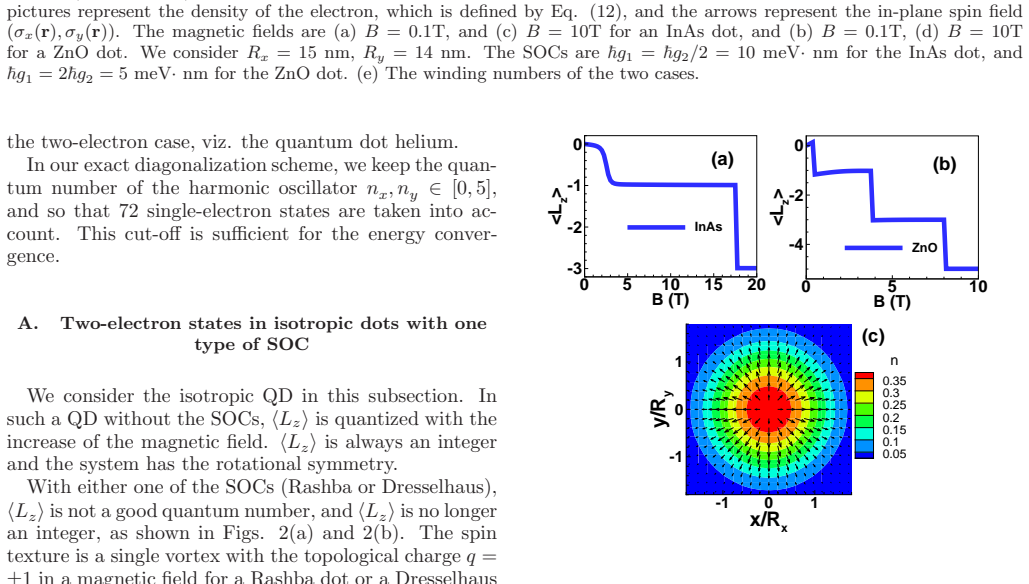
The central claim is a closed-form formula for the topological charge $q$ of the in-plane spin field: when both Rashba and Dresselhaus spin-orbit couplings are present, $q = \operatorname{sgn}(G^{\pm}_{1,x}G^{\pm}_{1,y} - G^{\pm}_{2,x}G^{\pm}_{2,y})$ (Eq. 24), where the $G$ coefficients encode the couplings, magnetic field, and confinement. Because the elliptic-anisotropy parameter $W$ drops out of the contour integral, the charge is stable against dot ellipticity. In the strong-field limit the coefficients force $q = -\operatorname{sgn}(g)$ (Eq. 25), regardless of which spin-orbit coupling is stronger. The paper further claims that in two-electron quantum-dot helium, the Coulomb interaction, by mixing angular-momentum states during the $\langle L_z\rangle: 0 \to -1$ transition, can flip the overall winding number while the edge region still follows the single-particle rule.
Load-bearing premise
The whole argument leans on a first-order perturbed wavefunction whose extra correction term and the parameter describing the dot's ellipticity are not clearly defined in the paper; if those expressions are wrong, the claimed stability of the winding number and the $q = -\operatorname{sgn}(g)$ limit are not established.
Editorial extensions
If this is right
- If $q = -\operatorname{sgn}(g)$ holds, imaging a dot's spin texture at high magnetic field gives a direct experimental readout of the sign of the Landé $g$ factor, a quantity that is otherwise hard to determine.
- If ellipticity robustness is right, the topological charge is a stable observable in realistic strained dots, not an artifact of perfect rotational symmetry.
- If the Coulomb-driven reversal of the overall winding number is right, the number of electrons in a dot becomes a second knob for topological control in the same setup.
- If the density-spin coupling picture is right, the split-merge cycles of the electron density track transitions of $\langle L_z\rangle$ between integer plateaus, giving a visible signature of the same physics.
Reading between the lines
- A natural extension is to test whether $q = -\operatorname{sgn}(g)$ survives in dots with more than two electrons; the paper hints it may, but does not establish it.
- The approach suggests that local spin-texture probes, such as scanning magnetometry or nitrogen-vacancy relaxometry, could serve as an alternative to transport measurements for $g$-factor engineering in spintronics.
- Because the $W$-dependent integral vanishes identically, the ellipticity robustness may extend to other smooth shape deformations, a conjecture the paper does not pursue.
- The visibility of the predicted reversal window depends on Coulomb interaction strength, so comparing InAs (weaker) with ZnO (stronger) dots offers a quantitative test of when the overall winding number reverses.
Signed reviews
Editorial analysis
A structured set of objections, weighed in public.
Referee Report
Summary. The manuscript studies spin textures in single- and two-electron quantum dots with Rashba and Dresselhaus spin-orbit couplings in a perpendicular magnetic field. For the single-electron dot, the authors use first-order perturbation theory to derive an analytic expression for the winding number q of the in-plane spin texture, argue that q is robust against dot ellipticity, and obtain q = -sgn(g) in the strong-field limit. For the two-electron dot, exact-diagonalization results for InAs and ZnO dots are presented, an overall winding number (OWN) is defined, and it is reported that the Coulomb interaction can reverse the OWN relative to the single-electron case, most prominently in the region where <Lz> changes from 0 to -1.
Significance. If the analytic derivation is correct, the paper makes a concrete, parameter-free prediction: a single magnetic field can tune the topological charge of the spin texture, and the sign of the Lande g factor could be inferred from the spin texture. This would be a useful result for spintronics and quantum information. The comparison between InAs (g<0) and ZnO (g>0) provides a falsifiable experimental distinction. The single-particle derivation contains no fitted parameters; material constants are taken from independent literature. The two-electron exact-diagonalization study goes beyond the earlier single-particle vortex framework of Ref. [12] by addressing Coulomb-interaction effects on the overall winding number.
major comments (3)
- [Sec. III, Eqs. (14)-(15) and (18)] The perturbed spinors in Eqs. (14) and (15) contain the state psi_{1,1/2}, which is not an eigenstate of the two-dimensional harmonic-oscillator basis introduced in Sec. II, since the oscillator quantum numbers must be integers. The first-order wavefunctions are therefore not defined in the stated basis, and the subsequent spin fields in Eqs. (19)-(20), the winding-number formulas in Eqs. (23)-(24), and the strong-field result in Eq. (25) are unsupported. In addition, the anisotropic parameter W in Eq. (18) has inconsistent dimensions: the right-hand side has dimensions of energy, while W is used as a dimensionless coefficient multiplying xy/(ell_x ell_y) in Eqs. (14)-(15) and (19)-(20). A direct first-order calculation of the H_Lz correction to the ground state gives a coefficient of the |11> component proportional to (Omega_y - Omega_x)/(sqrt(Omega_x Omega_y)(Omega_x + Omega_y)), not the expression displayed in Eq. (18). The authors should re-derive these spinors and either correct or remove the W term; as written this is a load-bearing error.
- [Sec. III and the Appendix] The derivation of q in the appendix evaluates the contour integral on a circle centered at the origin. This gives the winding number of that particular contour, but the paper never shows that this contour encloses all singularities of the spin field or that the result is independent of the contour radius when the dot is anisotropic. The vanishing of the integrals containing W only shows that those particular W-dependent terms have zero angular average on that circle; it does not by itself prove that no additional zeros or vortices appear away from the origin. Without this step, the claim that q is robust against ellipticity is not fully established. A statement about the location and number of zeros of sigma_x = sigma_y = 0 for the perturbed spinors is needed.
- [Sec. IV, Figs. 4-6] The overall winding number (OWN) is central to the two-electron claims, but the numerical procedure used to obtain it is not specified. The manuscript states that the OWN is obtained by choosing a path around the edge and also by summing the topological charge of each vortex, yet it does not describe how the contour is discretized on the real-space grid, how vortex positions are located, or how the integer charge of each vortex is assigned. Moreover, the color scale in Fig. 6 shows OWN values of 0.9, 0, and -0.9, which are not integers; if the computed winding numbers deviate from integers, the origin of the deviation must be explained. This information is required to verify the reported Coulomb-induced reversal of the OWN.
minor comments (5)
- [Title and Abstract] The title contains a typo, 'an d Helium', which should read 'and Helium'.
- [Sec. III, Eqs. (14)-(15)] The labels psi^{(0)}_+ and psi^{(0)}_- for the unperturbed ground state are confusing: for g<0 the displayed state has spin up in the upper component, while the subscript '-' normally denotes spin down. Please relabel these states to avoid ambiguity.
- [Sec. III, text after Eq. (24)] At G1xG1y = G2xG2y the denominator A^2 - B^2 in the appendix vanishes, so the winding-number formula in Eq. (24) is singular rather than giving q = 0. The statement that the texture is topologically trivial with q = 0 requires a separate argument.
- [Appendix] The word 'nominator' should be 'numerator' in the appendix.
- [Sec. IV, Figs. 4-5] Vortex positions are quoted to one decimal place in units of R_x, but the extraction method from the color maps is not described; a table or a precise numerical definition would improve reproducibility.
Circularity Check
No circularity: the topological-charge formula and its strong-field limit q=-sgn(g) are derived analytically from the Hamiltonian; self-citations are background only.
full rationale
The derivation of the winding number is self-contained. Starting from the single-electron Hamiltonian (Eq. 1) with Rashba and Dresselhaus spin-orbit coupling and Zeeman term, the paper constructs first-order perturbed spinors (Eqs. 14-15), computes the in-plane spin fields (Eqs. 19-20), and evaluates the winding-number integral in the appendix. The final expressions, q=sgn(G±1xG±1y - G±2xG±2y) (Eq. 24) and q=-sgn(g) in strong fields (Eq. 25), are obtained by algebra from the Hamiltonian parameters; no fitted parameter or pre-imposed result appears. Material parameters for InAs and ZnO are taken from independent literature, not from the paper's own prior work. The cited Ref. 12 is used for background (that spin fields form vortices) and for the rotation matrices UR and UD, but these do not carry the new proof; ellipticity robustness is proven by the vanishing of the W-dependent integral in the appendix rather than assumed. The two-electron overall winding number is computed by exact diagonalization of the same Hamiltonian, and the comparison with the single-particle q is a prediction, not a fit. Concerns about the display of W and the correction state ψ_{1,1/2} are correctness or typesetting issues, not evidence that any input was renamed as an output. Therefore no step in the paper's claimed derivation chain reduces to its inputs by construction.
Assumptions & free parameters
assumptions (3)
- domain assumption First-order perturbation theory in HLz and HSOC relative to H0 is valid for all field strengths considered, including the B→∞ limit used for q=-sgn(g).
- domain assumption The truncated harmonic-oscillator basis with nx,ny≤5 (72 single-particle states) is sufficient for convergence of the two-electron ground state and its winding number.
- domain assumption At the contour used to compute the overall winding number in two-electron dots, the electron density is low enough that Coulomb interaction is negligible, so the single-particle result q=-sgn(g) applies.
Cite this review
Pith. "Pith review of Tuning the Topological Features of Quantum-Dot Hydrogen and Helium by a Magnetic Field." pith.science (2026). https://pith.science/paper/WPLQFQZX
@misc{pith2026190806575,
  author       = {Pith},
  title        = {Pith review of: Tuning the Topological Features of Quantum-Dot Hydrogen and Helium by a Magnetic Field},
  year         = {2026},
  howpublished = {\url{https://pith.science/paper/WPLQFQZX}},
  note         = {Machine review of arXiv:1908.06575}
}
abstract
The topological charge of the spin texture in a quantum dot with spin-orbit couplings is shown analytically here to be stable against the ellipticity of the dot. It is directly tunable by a single magnetic field and is related to the \textit{sign} of the Land\'e $g$ factor. In a quantum-dot helium, the overall winding number could have different property from that of the single-electron case (quantum-dot hydrogen), since tuning the number of electron affects the winding number by the Coulomb interaction and the $z$ component angular momentum $\langle L^{}_z \rangle$. The density profile and the spin texture influence each other when the Coulomb interaction is present. When $\langle L^{}_z \rangle$ is biased away from an integer by the spin-orbit couplings, the rotational symmetry is broken which induces strong density deformation. The sign of the topological charge may also be reversed with increasing magnetic field. These findings are of major significance since the applied magnetic field alone now provides a direct route to control the topological properties of quantum dots.
Figures


Figures from the paper (4 more)


Reference graph
Works this paper leans on
-
[12]
Wenchen Luo, Amin Naseri, Jesko Sirker, and T. Chakraborty, Sci. Rep. 9, 672 (2019)
work page 2019
- [1]
-
[2]
M. Z. Hasan, and C. L. Kane, Rev. Mod. Phys. 82, 3045 (2010)
2010
-
[3]
X. L. Qi and S. C. Zhang, Rev. Mod. Phys. 83, 1057 (2011)
2011
-
[4]
uhlbauer, B. Binz, F. Jonietz, C. Pfleiderer, A. Rosch, A. Neubauer, R. Georgii, P. B\
S. M\"uhlbauer, B. Binz, F. Jonietz, C. Pfleiderer, A. Rosch, A. Neubauer, R. Georgii, P. B\"oni, Science 323, 915-919 (2009)
work page 2009
-
[5]
X. Z. Yu, Y. Onose, N. Kanazawa, J. H. Park, J. H. Han, Y. Matsui, N. Nagaosa, and Y. Tokura, Nature 465, 901-904 (2010)
work page 2010
-
[6]
Z. F. Ezawa, Quantum Hall Effects: Field Theoretical Approach and Related Topics (World Scientific, 2000)
work page 2000
-
[7]
C\^ o t\' e , Wenchen Luo, Branko Petrov, Yafis Barlas, and A
R. C\^ o t\' e , Wenchen Luo, Branko Petrov, Yafis Barlas, and A. H. MacDonald, Phys. Rev. B 82, 245307 (2010); R. C \^ o t\' e , J. P. Fouquet, and Wenchen Luo, Phys. Rev. B 84, 235301 (2011)
work page 2010
Show all 51 references
-
[8]
Penteado, Marco O
Jiyong Fu, Poliana H. Penteado, Marco O. Hachiya, Daniel Loss, and J.C. Egues, Phys. Rev. Lett. 117, 226401 (2016)
2016
-
[9]
Zutic, J
I. Zutic, J. Fabian, and S. Das Sarma, Rev. Mod. Phys. 76, 323 (2004)
2004
-
[10]
Smejkal, Y
L. Smejkal, Y. Mokrousov, Binghai Yan, and A. H. MacDonald, Nat. Phys. 14, 242 (2018)
2018
-
[11]
Gomonay, T
O. Gomonay, T. Jungwirth, and J. Sinova, Phys. Stat. Sol. RRL 11, 1700022 (2017)
2017
-
[13]
Maksym, and T
P.A. Maksym, and T. Chakraborty, Phys. Rev. Lett. 65 , 108 (1990)
1990
-
[14]
Chakraborty, Quantum Dots (Elsevier, Amsterdam 1999)
T. Chakraborty, Quantum Dots (Elsevier, Amsterdam 1999)
1999
-
[15]
Bimberg, M
D. Bimberg, M. Grundmann, and N. N. Ledentsov, Quantum Dot Heterostructures (John Wiley and Sons, Chichester, 1999)
1999
-
[16]
L. P. Kouwenhoven, D. G. Austing, and S. Tarucha, Rep. Prog. Phys. 64, 701-736 (2001)
2001
-
[17]
Hanson, L
R. Hanson, L. P. Kouwenhoven, J. R. Petta, S. Tarucha, and L. M. K. Vandersypen, Rev. Mod. Phys. 79, 1217 (2007)
2007
-
[18]
Kloeffel, and D
C. Kloeffel, and D. Loss, Annu. Rev. Condens. Matter Phys. 4, 51 (2013)
2013
-
[19]
Voskoboynikov, C
O. Voskoboynikov, C. P. Lee, and O. Tretyak, Phys. Rev. B 63, 165306 (2001)
2001
-
[20]
Governale, Phys
M. Governale, Phys. Rev. Lett. 89, 206802 (2002)
2002
-
[21]
Emperador, E
A. Emperador, E. Lipparini, and F. Pederiva, Phys. Rev. B 70, 125302 (2004)
2004
-
[22]
D. V. Bulaev, and D. Loss, Phys. Rev. B 71, (2005)
2005
-
[23]
Weiss and R
S. Weiss and R. Egger, Phys. Rev. B 72, 245301 (2005)
2005
-
[24]
ainen, Phys. Rev. Lett. 95, 136603 (2005); P. Pietil\
T. Chakraborty, and P. Pietil\"ainen, Phys. Rev. Lett. 95, 136603 (2005); P. Pietil\"ainen, and T. Chakraborty, Phys. Rev. B 73, 155315 (2006)
2005
-
[25]
Ambrosetti, F
A. Ambrosetti, F. Pederiva, and E. Lipparini, Phys. Rev. B 83, 155301 (2011)
2011
-
[26]
C. F. Destefani, S. E. Ulloa, and G. E. Marques, Phys. Rev. B 69, 125302 (2004)
2004
-
[27]
Chakraborty, and P
T. Chakraborty, and P. Pietil\"ainen, Phys. Rev. B 71, 113305 (2005)
2005
-
[28]
Cavalli, F
A. Cavalli, F. Malet, J. C. Cremon, and S. M. Reimann, Phys. Rev. B 84, 235117 (2011)
2011
-
[29]
Naseri, A
A. Naseri, A. Zazunov, and R. Egger, Phys. Rev. X 4, 031033 (2014)
2014
-
[30]
Tsitsishvili, G
E. Tsitsishvili, G. S. Lozano, and A. O. Gogolin, Phys. Rev. B 70, 115316 (2004)
2004
-
[31]
S. K. Ghosh, Jayantha P. Vyasanakere, and V. B. Shenoy, Phys. Rev. A 84, 053629 (2011)
2011
-
[32]
Yi Li, Xiangfa Zhou, and Congjun Wu, Phys. Rev. B 85, 125122 (2012)
2012
-
[33]
Avetisyan, Pekka Pietil\" a inen, and Tapash Chakraborty, Phys
S. Avetisyan, Pekka Pietil\" a inen, and Tapash Chakraborty, Phys. Rev. B 88, 205310 (2013)
2013
-
[34]
S. D. Ganichev, V. V. Bel'kov, L. E. Golub, E. L. Ivchenko, Petra Schneider, S. Giglberger, J. Eroms, J. De Boeck, G. Borghs, W. Wegscheider, D. Weiss, and W. Prettl, Phys. Rev. Lett. 92, 256601 (2004)
2004
-
[35]
C. J. Stevenson, J. Kyriakidis, Phys. Rev. B 84, 075303 (2011)
2011
-
[36]
G. A. Intronati, P. I. Tamborenea, D. Weinmann, R. A. Jalabert, Phys. Rev. B 88, 045303 (2013)
2013
-
[37]
Pfannkuche and R.R
D. Pfannkuche and R.R. Gerhardts, Phys. Rev. B 44 , 13132 (1991)
1991
-
[38]
Pfannkuche, V
D. Pfannkuche, V. Gudmundsson, and P.A. Maksym, Phys. Rev. B 47, 2244 (1993)
1993
-
[39]
Nitta, T
J. Nitta, T. Akazaki, H. Takayanagi, and T. Enoki, Phys. Rev. Lett. 78, 1335 (1997)
1997
-
[40]
Kohda, T
M. Kohda, T. Bergsten, and J. Nitta, J. Phys. Soc. Jpn. 77, 031008 (2008)
2008
-
[41]
C. R. Ast, D. Pacil\'e, L. Moreschini, M. C. Falub, M. Papagno, K. Kern, M. Grioni, J. Henk, A. Ernst, S. Ostanin, and P. Bruno, Phys. Rev. B 77, 081407(R) (2008)
2008
-
[42]
Kanai, R
Y. Kanai, R. S. Deacon, S. Takahashi, A. Oiwa, K. Yoshida, K. Shibata, K. Hirakawa, Y. Tokura, and S. Tarucha, Nat. Nanotechnol. 6, 511 (2011)
2011
-
[43]
M. P. Nowak, B. Szafran, F. M. Peeters, B. Partoens, and W. J. Pasek, Phys. Rev. B 83, 245324 (2011)
2011
-
[44]
C. L. Yang, Junfeng Dai, W. K. Ge, Xiaodong Cui, Appl. Phys. Lett. 96, 152109 (2010); A. Srinivasan, K. L. Hudson, D. Miserev, L. A. Yeoh, O. Klochan, K. Muraki, Y. Hirayama, O. P. Sushkov, and A. R. Hamilton Phys. Rev. B 94, 041406(R) (2016)
2010
-
[45]
Mannhart, D.H.A
J. Mannhart, D.H.A. Blank, H.Y. Hwang, A.J. Millis, J.-M. Triscone, MRS Bulletin 33, 1027 (2008); J. Mannhart, D.G. Schlom, Science 327, 1607 (2010); Z.L. Wang, Mater. Today 7, 26 (2004)
2008
-
[46]
Falson, D
J. Falson, D. Maryenko, B. Friess, D. Zhang, Y. Kozuka, A. Tsukazaki, J.H. Smet, M. Kawasaki, Nat. Phys. 11, 347 (2015)
2015
-
[47]
Smet, Sci
Joseph Falson, Daniela Tabrea, Ding Zhang, Inti Sodemann, Yusuke Kozuka, Atsushi Tsukazaki, Masashi Kawasaki, Klaus von Klitzing and Jurgen H. Smet, Sci. Adv. 4: eaat8742 (2018)
2018
-
[48]
W. Luo, T. Chakraborty, Phys. Rev. B 93, 161103(R) (2016); Phys. Rev. B 94, 161101(R) (2016); Phys. Rev. B 96, 081108(R) (2017)
2016
-
[49]
Chakraborty, A
T. Chakraborty, A. Manaselyan, and M. Barseghyan, J. Phys.:Condens. Matter 29, 215301 (2017)
2017
-
[50]
Chakraborty, A
T. Chakraborty, A. Manaselyan, and M. Berseghyan, in Physics of Quantum Rings (Springer, Berlin 2018), edited by V.M. Fomin
2018
-
[51]
Dementyev, P
A.E. Dementyev, P. Khandelwal, N. N. Kuzma, S.E. Barrett, L. N. Pfeiffer, K. W. West, Solid State Comm. 119, 217 (2001); N. N. Kuzma, P. Khandelwal, S. E. Barrett, L. N. Pfeiffer, K. W. West, Science 281, 686 (1998); S. E. Barrett, G. Dabbagh, L. N. Pfeiffer, K. W. West, and R...
2001
Reviewed August 14, 2026 · model on record in the stance chip above.
Discussion (0). Continue with ORCID to comment.