REVIEW 3 major objections 4 minor 1 cited by
Vector-relation configurations and plabic graphs
T0 review · 3 major / 4 minor · reviewed 2026-08-14 · deepseek-v4-flash
Pith's one-line read For a reduced plabic graph, boundary vectors determine the whole vector-relation configuration up to gauge, and the map from configurations to boundary points inverts the boundary measurement map.
desk verdict Solid plabic reconstruction theorem and a useful unifying framework, but the Q-net cluster-algebra claim is underproved as written. read the letter →
The pith
A machine-rendered reading of the paper's core claim, the machinery that carries it, and where it could break.
The reading
What carries the argument
The central object is the vector-relation configuration $(v,R)$: a nonzero vector in $\mathbb C^k$ at each white vertex and a nontrivial linear relation among the neighboring vectors at each black vertex, modulo gauge transformations. The load-bearing construction is the reconstruction map $\Psi$: starting from a boundary point $A$, it builds hyperplanes $H_j$ from the basis subsets $I_j\setminus\{j\}$ and defines candidate lines $L_w$ by intersecting the $H_j$ for strands $j$ lying to the left of $w$. What makes the construction valid is the cited description of $T_G$: on $T_G$, all relevant maximal minors of the twisted boundary data are nonzero, so the hyperplanes around each face are in general position and each $L_w$ is a genuine line. A sign comparison identifies $\Phi$ with the boundary measurement map, transferring uniqueness to and from the classical map.
What would settle it
Take a small reduced plabic graph, such as the example in the paper with two boundary dimension equal to four, and compute the boundary restriction map $\Phi$ on a one-parameter family of configurations in $\mathcal C_G^\circ$. If two distinct parameter values give the same boundary point $A$, Theorem 4.3(2) is false; conversely, random boundary points $A\in T_G$ fed through the reconstruction should always produce a full-rank coefficient matrix $K$ with all edge coefficients nonzero, and the first failure would falsify the theorem.
Extended reading notes
Core claim
The central discovery is that on a reduced plabic graph all the information in a vector-relation configuration is carried by its boundary. For a configuration with every relation coefficient $K_{bw}$ nonzero, the boundary vectors $v_1,\dots,v_n$ (a point $A=[v_1\cdots v_n]$ in the space of $k$-dimensional subspaces of $\mathbb C^n$) determine the configuration uniquely up to gauge at internal vertices. Theorem 4.3 states this sharply: the boundary restriction map $\Phi$ sends all configurations into the positroid variety $\Pi_{\mathcal M}$, its restriction to $\mathcal C_G^\circ$ is an isomorphism onto $T_G$, the image of the boundary measurement map, and $\mathcal C_G^\circ=\Phi^{-1}(T_G)$. The proof constructs the inverse explicitly: for $A\in T_G$, take the hyperplanes $H_j$ spanned by the boundary vectors indexed by $I_j\setminus\{j\}$, where $(I_1,\dots,I_n)$ is the necklace of basis subsets coming from the matroid, and for each white vertex $w$ form the line $L_w=\bigcap_{j\in S_w} H_j$; the vectors on these lines satisfy exactly one linear relation at each black vertex, with all coefficients nonzero.
Load-bearing premise
The uniqueness proof rests entirely on a cited theorem that describes exactly which boundary points can occur; if that description were wrong or incomplete, the inverse map would have no foundation.
Editorial extensions
If this is right
- For any reduced plabic graph, every boundary point in the image $T_G$ of the boundary measurement map extends to exactly one gauge class of configurations in $\mathcal C_G^\circ$; internal vectors are determined up to scale.
- The reconstruction is explicit: hyperplane intersections built from the basis subsets and strand data recover all internal vectors and relations, giving a geometric algorithm for the inverse boundary measurement map.
- Positive edge weights of a totally nonnegative boundary point acquire a geometric reading: after gauging, each internal vector is a convex combination of vectors two steps upstream, so edge weights are barycentric coordinates in a recursive construction.
- The local-move dynamics on vector-relation configurations specialize to the pentagram map, Q-nets, and discrete Darboux maps, and the face weights evolve by cluster $Y$-dynamics; in particular Q-nets carry a cluster structure.
- Configurations obtained from resistor networks form a special class of conjugate nets, while those obtained from the corresponding spin model satisfy an extra conic condition; the model locates both subvarieties inside the same state space.
Reading between the lines
- An algorithmic reading the paper leaves implicit is that the reconstruction map gives a practical way to solve geometric extension problems: given boundary data in $T_G$, each internal vector is computable by intersecting hyperplanes indexed by strands, with no need to sum matchings.
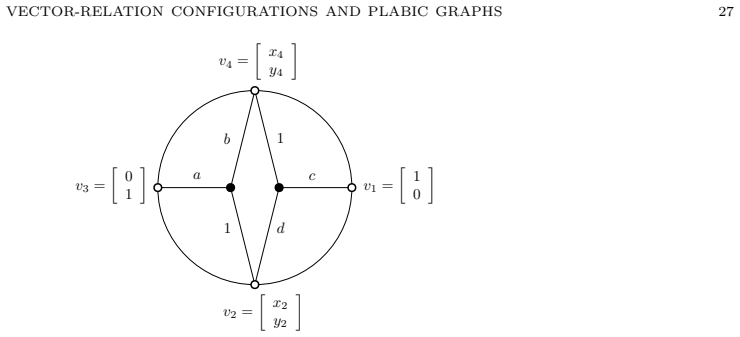
- Because non-uniqueness can only occur outside $T_G$, probing the fibers of $\Phi$ on the boundary of the positroid variety—as in the four-boundary, dimension-two example—should describe exactly how the smooth space $\mathcal C_G$ resolves singularities of $\Pi_{\mathcal M}$.
- The same vector-relation formalism is a natural search tool for cluster structures in other lattice geometries: any bipartite graph whose local moves are urban renewal carries $Y$-variables, so analogous discrete nets are candidates for integrable cluster dynamics.
Signed reviews
Editorial analysis
A structured set of objections, weighed in public.
Referee Report
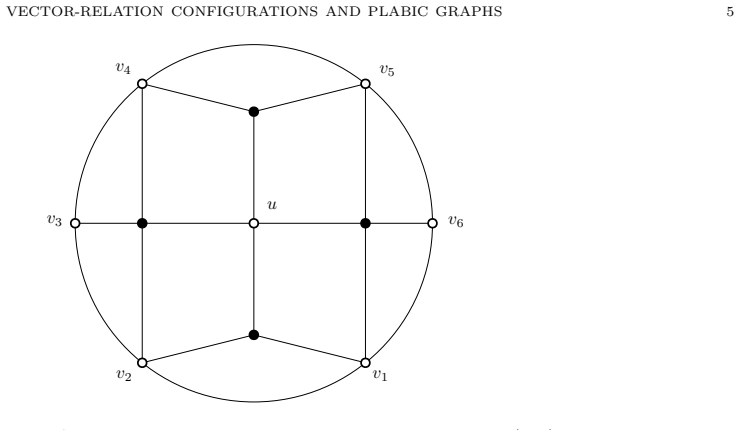
Summary. The paper introduces vector-relation configurations on planar bipartite graphs: a vector at each white vertex and a linear relation at each black vertex, modulo gauge equivalence. It shows that local graph transformations induce dynamics on these configurations that match classical urban renewal and degree-two vertex addition on edge weights (Proposition 2.1), and it defines gauge-invariant face weights that evolve by Y-variable dynamics. It then fits several known projective geometric systems into this framework: Laplace-Darboux dynamics, the pentagram map, Y-meshes, Q-nets, and discrete Darboux maps. The main computational claim for Q-nets is Proposition 3.10, which asserts that the Y-seed of Proposition 3.9 evolves by the cluster Y-dynamics of the quiver in Figure 12, thereby resolving an open question about cluster structures for Q-nets. For plabic graphs, the paper proves Theorem 4.3: the boundary restriction map Phi sends the configuration space C_G to the positroid variety Pi_M, and its restriction to the open subset C^o_G of configurations with all coefficients nonzero is an isomorphism onto T_G, the Muller-Speyer image of the boundary measurement map. This yields unique extension of generic boundary data to the interior. The paper also proves smoothness of C_G (Theorem 5.2) and identifies specializations from resistor and Ising networks.
Significance. If all claims hold, this is a valuable unification: one geometric formalism encompasses the pentagram map, Q-nets, and Darboux maps, and it provides a concrete inverse to Postnikov's boundary measurement map. The plabic graph portion is a genuine and largely self-contained theorem: the reconstruction map Psi defined by the hyperplane intersections L_w in (4.8), the Kasteleyn-sign comparison in Proposition 4.9, the uniqueness proof via acyclic orientations in Section 4.5, and the smoothness atlas in Section 5 are all presented with enough detail to be checked, building explicitly on published Muller-Speyer and Postnikov results. The Q-net cluster statement, if fully proved, would resolve a recognized open question, and Section 6 gives interesting new geometric consequences, including Koenigs nets from resistor networks and CKP maps from Ising networks. The main strength is the concrete, checkable plabic reconstruction machinery and the breadth of examples; the main weakness is the very abbreviated proof of the cluster-dynamics claim for Q-nets and related statements for Darboux maps.
major comments (3)
- [Section 3.2, Proposition 3.10 and Figure 12] The proof of Proposition 3.10 is a single sentence: 'One simply follows Y-variable dynamics of the associated cluster algebra, whose quiver is shown in Figure 12.' It does not specify the mutation sequence corresponding to the gentrification moves of Figure 11, does not check that the quiver transforms consistently under that sequence, and does not verify either displayed evolution formula. Because the abstract's claim that Q-nets admit a cluster structure rests on this proposition, this is a load-bearing gap, and the formulas involve enough indices and cyclic shifts that a small error would invalidate the advertised resolution. Please provide the explicit mutation sequence, the induced transformation of the quiver, and a derivation of at least one family of displayed Y-variable formulas, or clearly mark the cluster claim as conditional on a proof given elsewhere.
- [Section 3.3, Proposition 3.15 and the paragraph after Figure 15] The discrete Darboux case repeats the same pattern: Proposition 3.15 states that the square moves realize the time evolution, but its proof only says 'We verify the sequence of square moves using Proposition 2.4 on each step,' and the Y-dynamics are asserted by saying 'The Y-s evolve according to the Y-dynamics formulas of the associated cluster algebra. The formulas are too long to be written here.' Since the introduction advertises a cluster algebra operating in 'all cases,' this case must receive the same level of verification as the Q-net case, or be explicitly stated as a conjecture with the missing computation deferred to an appendix or a citable companion.
- [Remark 3.12] Remark 3.12 cites the authors' own in-progress work [2] ('In progress') as giving independent cluster descriptions of Q-nets and Darboux maps. If this reference is used to support the claim that the open question is resolved, it should be replaced by a citable preprint or the dependence should be removed; the present manuscript should not rely on an unpublished companion for a central claim. This is not the main obstacle to acceptance, but it is a missing-support issue that should be corrected.
minor comments (4)
- [Figure 11] The labels a, a', b, b', c, c', e, f, g, h, and G, H are defined only in the proof of Proposition 3.7; adding a caption that explains the labeling would make the figure much easier to read.
- [Proposition 3.10] The two displayed evolution formulas in Proposition 3.10 are not numbered, making it awkward to refer to them in the text or in a future erratum; please number them.
- [Section 3.2, Figure 12] The Q-net quiver in Figure 12 is central to the claimed cluster structure, but the text gives no description of its vertex set or the correspondence between vertices and the Y-variables of Proposition 3.9; this should be stated explicitly even if a full mutation computation is deferred.
- [Abstract and title page] There are typographical spacing artifacts in the title and abstract (e.g., 'VECTOR-RELA TION' and several words split by line breaks); please proofread the final version.
Circularity Check
No substantive circularity; the plabic reconstruction theorem rests on external Muller-Speyer and Postnikov results, and the only concerns are a non-load-bearing in-progress self-citation and a one-sentence Q-net cluster algebra proof.
full rationale
The central Theorem 4.3 is not circular: the reconstruction map Ψ is defined from the right twist of Muller-Speyer [23], and the proof of uniqueness uses their characterization of the image T_G, together with independent Kasteleyn sign calculations (Proposition 4.9), matching theory, and acyclicity of the orientation (Propositions 4.19 and 4.23). No parameter is fitted to force the extension, and the boundary measurement map identification is a proved equivalence, not a definitional renaming. The only self-citation is the in-progress reference [2] in Section 1.3 and Remark 3.12, which is explicitly described as an independent parallel description and is not used to prove Theorem 4.3 or Proposition 3.10, so it does not carry the derivation. One auxiliary claim does have an omitted proof: Proposition 3.10's proof reads 'One simply follows Y-variable dynamics of the associated cluster algebra, whose quiver is shown in Figure 12,' without displaying the mutation sequence of the gentrification move or checking the stated formulas; this is a verification gap in the advertised cluster structure for Q-nets, not a circular reduction. Overall the paper's main derivation chain is self-contained against published external results, with only the minor self-citation and the Proposition 3.10 gap raising the score marginally above zero.
Assumptions & free parameters
assumptions (4)
- standard math Knutson-Lam-Speyer: positroid variety is defined by vanishing of Plücker coordinates for J not in M (Theorem 4.1).
- standard math Muller-Speyer right twist characterization: the image of the boundary measurement map is the set of A in Π°_M such that Δ_SF(A') is nonzero for all faces F (Theorem 4.2).
- domain assumption Existence of Kasteleyn signs on plabic graphs and the sign matching in the boundary measurement map (Propositions 4.8 and 4.9).
- ad hoc to paper Standard cluster algebra Y-dynamics and the fact that the quiver in Figure 12 gives the same evolution as the geometric Y-variables (used in Proposition 3.10).
Cite this review
Pith. "Pith review of Vector-relation configurations and plabic graphs." pith.science (2026). https://pith.science/paper/WPODZRXM
@misc{pith2026190806959,
  author       = {Pith},
  title        = {Pith review of: Vector-relation configurations and plabic graphs},
  year         = {2026},
  howpublished = {\url{https://pith.science/paper/WPODZRXM}},
  note         = {Machine review of arXiv:1908.06959}
}
abstract
We study a simple geometric model for local transformations of bipartite graphs. The state consists of a choice of a vector at each white vertex made in such a way that the vectors neighboring each black vertex satisfy a linear relation. Evolution for different choices of the graph coincides with many notable dynamical systems including the pentagram map, $Q$-nets, and discrete Darboux maps. On the other hand, for plabic graphs we prove unique extendability of a configuration from the boundary to the interior, an elegant illustration of the fact that Postnikov's boundary measurement map is invertible. In all cases there is a cluster algebra operating in the background, resolving the open question for $Q$-nets of whether such a structure exists.
Figures


Figures from the paper (20 more)








Forward citations
Cited by 1 Pith paper
-
Edge vectors on plabic networks in the disk and amalgamation of totally non-negative Grassmannians
Geometric signatures, fixed by orientation and a gauge ray direction, completely characterize totally non-negative edge-signature systems on plabic networks in the disk.
Reference graph
Works this paper leans on
- [2]
-
[1]
Miquel Dynamics, Clifford Lattices and the Dimer Model
Niklas Affolter. Miquel dynamics, Clifford lattices and t he dimer model. arXiv:1808.04227
-
[3]
Alexander I. Bobenko and Yuri B. Suris. Discrete differential geometry , volume 98 of Graduate Studies in Mathematics . American Mathematical Society, Providence, RI, 2008. Inte grable structure
work page 2008
-
[4]
Geometric discretisation of the Toda syste m
Adam Doliwa. Geometric discretisation of the Toda syste m. Phys. Lett. A , 234(3):187–192, 1997
work page 1997
-
[5]
Multidimensional q uadrilateral lattices are integrable
Adam Doliwa and Paolo Maria Santini. Multidimensional q uadrilateral lattices are integrable. Phys. Lett. A , 233(4-6):365–372, 1997
work page 1997
-
[6]
Exact bosonization of the Ising model
Julien Dub´ edat. Exact bosonization of the Ising model. arXiv:1112.4399
-
[7]
Inverse spectral problem for GK integrab le system
Vladimir Fock. Inverse spectral problem for GK integrab le system. arXiv:1503.00289
-
[8]
Ising model and the positive orthogonal Grassmannian
Pavel Galashin and Pavlo Pylyavskyy. Ising model and the positive orthogonal Grassmannian. arXiv:1807.03282
Show all 30 references
-
[9]
Higher pentagram maps, weighted direc ted networks, and cluster dynamics
Michael Gekhtman, Michael Shapiro, Serge Tabachnikov, and Alek Vainshtein. Higher pentagram maps, weighted direc ted networks, and cluster dynamics. Electron. Res. Announc. Math. Sci. , 19:1–17, 2012
2012
-
[10]
Integrable cluster dynamics of direc ted networks and pentagram maps
Michael Gekhtman, Michael Shapiro, Serge Tabachnikov , and Alek Vainshtein. Integrable cluster dynamics of direc ted networks and pentagram maps. Adv. Math. , 300:390–450, 2016
2016
-
[11]
The pentagram map and Y -patterns
Max Glick. The pentagram map and Y -patterns. Adv. Math. , 227(2):1019–1045, 2011
2011
-
[12]
Y -meshes and generalized pentagram maps
Max Glick and Pavlo Pylyavskyy. Y -meshes and generalized pentagram maps. Proc. Lond. Math. Soc. (3) , 112(4):753–797, 2016
2016
-
[13]
Goncharov and Richard Kenyon
Alexander B. Goncharov and Richard Kenyon. Dimers and c luster integrable systems. Ann. Sci. ´Ec. Norm. Sup´ er. (4) , 46(5):747–813, 2013
2013
- [14]
-
[15]
Dimers and circle patterns
Richard Kenyon, W ai Yeung Lam, Sanjay Ramassamy, and Ma rianna Russkikh. Dimers and circle patterns. arXiv:1810.0 5616
-
[16]
Planar dimers and H arnack curves
Richard Kenyon and Andrei Okounkov. Planar dimers and H arnack curves. Duke Math. J. , 131(3):499–524, 2006
2006
-
[17]
Double-dimers, the Ising model and the hexahedron recurrence
Richard Kenyon and Robin Pemantle. Double-dimers, the Ising model and the hexahedron recurrence. J. Combin. Theory Ser. A , 137:27–63, 2016
2016
-
[18]
Kenyon and Scott Sheffield
Richard W. Kenyon and Scott Sheffield. Dimers, tilings an d trees. J. Combin. Theory Ser. B , 92(2):295–317, 2004
2004
-
[19]
Allen Knutson, Thomas Lam, and David E. Speyer. Positro id varieties: juggling and geometry. Compos. Math., 149(10):1710– 1752, 2013
2013
-
[20]
B. G. Konopelchenko and W. K. Schief. Menelaus’ theorem , Clifford configurations and inversive geometry of the Schwa rzian KP hierarchy. J. Phys. A , 35(29):6125–6144, 2002
2002
-
[21]
Totally nonnegative Grassmannian and Gras smann polytopes
Thomas Lam. Totally nonnegative Grassmannian and Gras smann polytopes. In Current developments in mathematics 2014 , pages 51–152. Int. Press, Somerville, MA, 2016
2014
-
[22]
On the vector representations of ind uced matroids
Bernt Lindstr¨ om. On the vector representations of ind uced matroids. Bull. London Math. Soc. , 5:85–90, 1973
1973
-
[23]
Greg Muller and David E. Speyer. The twist for positroid varieties. Proc. Lond. Math. Soc. (3) , 115(5):1014–1071, 2017
2017
-
[24]
The pentagram map: a discrete integrable system
Valentin Ovsienko, Richard Schwartz, and Serge Tabach nikov. The pentagram map: a discrete integrable system. Comm. Math. Phys. , 299(2):409–446, 2010
2010
-
[25]
Positive grassmannian and polyh edral subdivisions
Alexander Postnikov. Positive grassmannian and polyh edral subdivisions. arXiv:1806.05307
-
[26]
Total positivity, Grassmannian s, and networks
Alexander Postnikov. Total positivity, Grassmannian s, and networks. arXiv:0609764
-
[27]
Lattice geometry of the discrete Darboux, KP, BKP and CKP equations
W olfgang Karl Schief. Lattice geometry of the discrete Darboux, KP, BKP and CKP equations. Menelaus’ and Carnot’s theorems. J. Nonlinear Math. Phys. , 10(suppl. 2):194–208, 2003
2003
-
[28]
The pentagram map
Richard Schwartz. The pentagram map. Experiment. Math. , 1(1):71–81, 1992
1992
-
[29]
Variations on a theme of Kasteleyn, with a pplication to the totally nonnegative Grassmannian
David Speyer. Variations on a theme of Kasteleyn, with a pplication to the totally nonnegative Grassmannian. arXiv:1510.03501
-
[30]
Combinatorial formulas for Γ-coordina tes in a totally nonnegative Grassmannian
Kelli Talaska. Combinatorial formulas for Γ-coordina tes in a totally nonnegative Grassmannian. J. Combin. Theory Ser. A , 118(1):58–66, 2011. Technische Universit ¨at Berlin, Institute of Mathematics, Strasse des 17. Juni 136, 10623 Berlin, Germany Department of Mathematics, ...
2011
Reviewed August 14, 2026 · model on record in the stance chip above.
Discussion (0). Continue with ORCID to comment.