REVIEW 4 major objections 4 minor 95 references
A Complete Algebraic Solution to the Optimal Dynamic Rationing Policy in the Stock-Rationing Queue with Two Demand Classes
T0 review · 4 major / 4 minor · reviewed 2026-08-14 · deepseek-v4-flash
Pith's one-line read The paper proves that in a two-class stock-rationing queue the optimal dynamic rationing policy is always a single-threshold policy after inventory levels are reordered by policy-dependent penalty breakpoints.
desk verdict The 'complete algebraic solution' is not proven: Theorem 9 assembles the optimum from thresholds of a fixed reference policy, and the numerical experiment quietly omits the best threshold baseline. read the letter →
The pith
A machine-rendered reading of the paper's core claim, the machinery that carries it, and where it could break.
The reading
What carries the argument
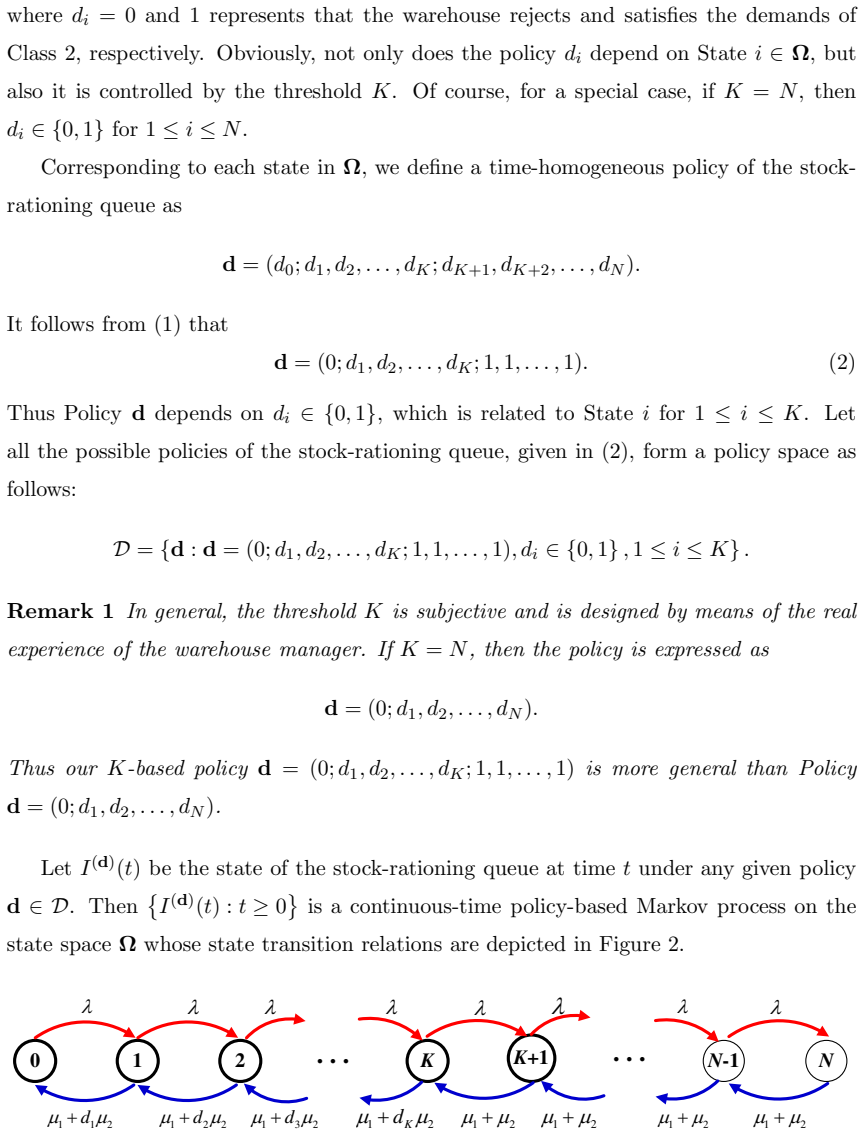
The central object is the perturbation realization factor G^(d)(i)=g^(d)(i-1)-g^(d)(i), the difference between the performance potentials of adjacent inventory levels under policy d. Combined with the linear equation G^(d)(i)+b=0 in the penalty cost P, this produces the breakpoints P_i^(d) that order the low-stock states. The performance difference equation η_{d'}-η_d=μ_2 π^(d')(i)(d'_i-d_i)[G^(d)(i)+b], valid for policies differing at a single position, carries the argument: it reduces a profit comparison between policies to the sign of one factor per inventory level, and that sign is controlled by where the penalty cost P sits relative to P_i^(d).
What would settle it
Enumerate all policies for a small instance with K low-stock levels in the middle penalty region, for example K=5, N=100, $\lambda$=3, mu_1=4, mu_2=2, C1=1, C2,1=4, C2,2=1, C3=5, C4=1, R=15, with P strictly between PL(d) and PH(d). Compute the long-run average profit of every policy from the birth-death stationary distribution, and also compute the best policy that becomes a block of zeros followed by ones after sorting levels by that policy's own breakpoints P_i^(d); if the unrestricted best profit exceeds the transformed-threshold best profit, the paper's central existence result fails.
Extended reading notes
Core claim
The paper proves that for any given policy d, the sign of G^(d)(i)+b, where G^(d)(i) is the perturbation realization factor between adjacent inventory levels and b=R+C_{2,2}-P, determines whether changing the service decision at level i improves the long-run average profit. The unique penalty value P_i^(d) where G^(d)(i)+b=0 orders the low-stock levels. Sorting those levels by the P_i^(d), the optimal dynamic rationing policy takes the transformed form d*(Transfer)=(0;0,...,0,1,...,1;1,...,1): reject Class 2 demand at the transformed levels with the smallest breakpoints and serve it at the rest. When the sorted order is the natural order 1,2,...,K, the original policy itself is a threshold policy; when it is not, the optimal policy is of what the paper calls transformational threshold type. The paper also gives three penalty regions—high, low, and middle—with explicit sufficient conditions under which the original policy is of threshold type.
Load-bearing premise
The core assumption is that a policy can be assembled coordinate by coordinate: an improving change at one stock level stays improving after changes are made at other stock levels, even though those changes alter the system's steady-state probabilities and the marginal values that justify the first change.
Editorial extensions
If this is right
- If the penalty cost P is at least PH(d), the optimal policy rejects every Class 2 demand while stock is low: d*=(0;0,...,0;1,...,1).
- If 0<P<=PL(d) and PL(d)>0, the optimal policy serves Class 2 at every low-stock level: d*=(0;1,...,1;1,...,1).
- In the middle range PL(d)<P<PH(d), the optimal policy becomes a threshold after sorting inventory levels by the breakpoints P_i^(d); when that sorted order is the natural order 1,2,...,K, the original policy itself is a threshold policy.
- The long-run average profit is linear in the penalty cost for each fixed policy, and the paper derives closed-form profit expressions for the extreme optimal policies.
- Restricting to static threshold policies is suboptimal in the middle penalty region, so a manager who insists on a fixed critical rationing level can lose profit relative to the optimal dynamic policy.
Reading between the lines
- The same sign-of-G^(d)(i)+b criterion suggests a natural extension to more than two demand classes: the single transformed threshold would likely become a staircase of cuts ordered by the analogous breakpoints, one cut per additional priority class.
- Because the breakpoints P_i^(d) depend on the reference policy, the characterization suggests an iterative policy-improvement loop—sort states by current breakpoints, apply the transformed threshold update, recompute, and repeat—that could find the optimum without enumerating 2^K policies.
- The algebra uses only the birth-death generator and the linearity of profit in P, so the threshold-after-reordering structure may persist under phase-type service times or Markovian arrival processes, although the paper does not claim that extension.
Signed reviews
Editorial analysis
A structured set of objections, weighed in public.
Referee Report
Summary. This paper studies a single-product, two-class stock-rationing queue with Poisson arrivals, exponential service times, lost sales, and a penalty cost P for serving Class 2 at low inventory. Using sensitivity-based optimization, the authors derive a performance difference equation (Lemma 2) and define P_i^(d) as the root of G^(d)(i)+b=0 for each policy d and state i. They divide the penalty range into P ≥ PH(d), 0 ≤ P ≤ PL(d), and PL(d) < P < PH(d). The paper claims that in the first two regions the optimal policy is the all-0 or all-1 threshold policy, and in the middle region the optimal policy is of 'transformational threshold type': after permuting states by the order of P_i^(d), the optimal policy is a single threshold. This is summarized as Theorem 10 and advertised as a complete algebraic solution to the optimal dynamic rationing problem.
Significance. If the main theorem were correct, it would give a structural characterization of optimal rationing policies that goes beyond the threshold results obtained by MDP/submodularity methods, and it would demonstrate the usefulness of sensitivity-based optimization for inventory rationing. The paper does contain some correct and useful building blocks: the policy-based birth-death description, the explicit stationary distribution, the linearity of the long-run average profit in P, and the single-coordinate performance difference equation are standard but carefully derived. The explicit formulas for the profit of static policies are also a useful computational reference. However, the central structural theorem is not established, and the numerical experiment intended to support it omits a key policy, so the claimed significance is not currently realized.
major comments (4)
- [Section 7.3, Theorem 9 (and Theorem 8)] The proof of the middle-region result assumes that coordinates can be optimized independently. The objects ~d_a = (0; d1, ..., d_{n0-1}, *, ..., *; 1, ..., 1) and ~d_b = (0; *, ..., *, d_{n0}, ..., d_K; 1, ..., 1) are not policies in the policy space D: no stationary distribution, perturbation realization factor, or long-run average profit is defined for them. Moreover, P_i^(d) is defined as the root of G^(d)(i)+b=0 for the fixed reference policy d, and once any other coordinate is changed, both pi(d') and G^(d')(i) change; hence the sign of G^(d')(i)+b at the same P is not controlled by P_i^(d). The 'it is easy to see from the proof of Theorem 4' step is therefore not a valid derivation, and Theorems 9 and 10 are left without proof.
- [Section 6.3, Theorem 3] The induction in the proof of Theorem 3 is invalid because the sign-transfer step (the equation relating G^(d(1))(j1)+b to G^(d)(j1)+b) applies only at the single coordinate where the two adjacent policies differ. In Step one, the argument shows only that for the policy d(1) that differs from d at coordinate j1, the sign at that same coordinate j1 is nonpositive. In Step two, to conclude G^(d(2))(j2)+b <= 0, the proof needs G^(d(1))(j2)+b <= 0 at the next coordinate j2, which was never established because d(1) and d differ only at j1. The phrase 'for each j1' does not turn this into a property of one policy at all coordinates of S(d,c). Theorem 3(1) and (2), which are used in Theorems 4 and 6, therefore do not follow.
- [Section 9, Example 2] The numerical scan restricts theta to 1 <= theta <= 15, but the static policy set D_Delta defined in Section 8 includes theta = K+1 = 16. The omitted policy d_Delta,16 is exactly (0; 0, ..., 0; 1, ..., 1), which is the policy d* of Example 1 with eta = 22.3. Since theta = 16 is not included, the observation that eta_d_Delta,9 = 21.4 < eta_d* = 22.3 does not establish that the optimal static rationing policy is suboptimal in D, and it cannot support the conclusion that the optimal dynamic policy is not of threshold type. The numerical demonstration of the paper's central claim is therefore incomplete.
- [Section 7.3, Theorem 10 and Section 6.3, Eq. (45)] The 'transformational threshold' characterization is self-referential and non-constructive. The permutation used to define d*(Transfer) is determined by sorting the values P_i^(d), but P_i^(d) is a function of the stationary distribution pi(d) of the very policy being sorted; thus the theorem describes a property that an optimal policy would satisfy after being sorted by its own P-values, rather than providing an algebraic rule that determines the optimal policy or its permutation without enumerating the 2^K policies. The title's claim of a 'complete algebraic solution' is therefore stronger than what is actually shown.
minor comments (4)
- [Section 6.3, proof of Lemma 4] PL(d) is written with a max instead of a min in the proof; the displayed definition in Eq. (47) uses min, so the proof should be corrected.
- [Section 9, Example 2, Figures 3 and 4] The vertical axis is labeled eta_d* in both figures, but the plotted quantity appears to be eta_d_Delta,theta, the long-run average profit of the static policy indexed by theta; the labels should distinguish the two quantities.
- [Section 4, Eq. (7)] The reward function uses indicator notation 1_{i<N} and 1_{i=N}; this is fine, but the same symbol 1 is later used for both an indicator and the numeral one, which makes equations such as (17) harder to read.
- [Section 5, Theorem 1] The claim that this is 'the first' general solution of Poisson equations with two free constants is not substantiated by a comparison with the cited references; please soften the claim or provide a precise novelty statement.
Circularity Check
No significant circularity: the paper's structural results are derived from the performance-difference equation and explicit sign analysis, not assumed through the definitions.
full rationale
The derivation chain is self-contained rather than circular. The perturbation factor G^(d)(i) and the root P_i^(d) are explicitly computed from the Poisson equation and the stationary distribution of a given policy d, and the sign statements in Section 6.3 follow from the linearity of G^(d)(i)+b in P. Lemma 2 then gives a local pairwise comparison, and the threshold/transformational-threshold conclusions in Theorems 4, 6, 8, 9, and 10 are consequences of applying that comparison to the sign of G^(d)(i)+b. The policy-dependent permutation used to define the transformational policy is a fixed-point self-consistency property of an optimal policy, not an input that already contains the output: the theorem states that after ordering states by the optimal policy's own P_i^(d*), the decisions are monotone, which is a substantive consequence of the sign analysis rather than a definitional identity. The main proof gaps, such as the use of wildcard sub-policies that are not admissible policies in D, are correctness concerns about the induction argument, not circular reductions of the claimed result to its own inputs. Self-citations in the paper, including references to Cao [11], Li [56], and Ma et al. [60], are used for standard background results such as the performance-difference equation and the stationary distribution of birth-death processes; these are externally established tools, and the paper's central sign and threshold arguments do not rely on an unverified self-citation chain. No fitted parameter is renamed as a prediction, and no uniqueness theorem is imported from the authors' prior work. Therefore the appropriate circularity score is 0.
Assumptions & free parameters
assumptions (4)
- domain assumption The policy-based birth-death process is irreducible, aperiodic and positive recurrent for every policy in D.
- standard math The performance difference equation (Lemma 1) from Cao [11] applies to this CTMC.
- standard math The perturbation realization factor G^(d)(i) has the explicit expression in Theorem 2, and its root P_i^(d) is unique and real.
- ad hoc to paper In the middle region, the optimal policy can be found by independent optimization over the sets Lambda1 and Lambda2 (coordinate-wise separability).
Cite this review
Pith. "Pith review of A Complete Algebraic Solution to the Optimal Dynamic Rationing Policy in the Stock-Rationing Queue with Two Demand Classes." pith.science (2026). https://pith.science/paper/WPSUSNEL
@misc{pith2026190809295,
  author       = {Pith},
  title        = {Pith review of: A Complete Algebraic Solution to the Optimal Dynamic Rationing Policy in the Stock-Rationing Queue with Two Demand Classes},
  year         = {2026},
  howpublished = {\url{https://pith.science/paper/WPSUSNEL}},
  note         = {Machine review of arXiv:1908.09295}
}
read the original abstract
In this paper, we study a stock-rationing queue with two demand classes by means of the sensitivity-based optimization, and develop a complete algebraic solution to the optimal dynamic rationing policy. We show that the optimal dynamic rationing policy must be of transformational threshold type. Based on this finding, we can refine three sufficient conditions under each of which the optimal dynamic rationing policy is of threshold type (i.e., critical rationing level). To do this, we use the performance difference equation to characterize the monotonicity and optimality of the long-run average profit of this system, and thus establish some new structural properties of the optimal dynamic rationing policy by observing any given reference policy. Finally, we use numerical experiments to demonstrate our theoretical results of the optimal dynamic rationing policy. We believe that the methodology and results developed in this paper can shed light on the study of stock-rationing queues and open a series of potentially promising research.
Figures


Figures from the paper (4 more)


Reference graph
Works this paper leans on
-
[1]
Alfieri, A., Pastore, E., Zotteri, G. (2017). Dynamic inv entory rationing: How to allocate stock according to managerial priorities. An empi rical study. International Journal of Production Economics , 189, 14–29
2017
-
[2]
C., Roemer, T
Arslan, H., Graves, S. C., Roemer, T. A. (2007). A single- product inventory model for multiple demand classes. Management Science , 53(9), 1486–1500
2007
-
[3]
Asmussen, S., Bladt, M. (1994). Poisson’s equation for q ueues driven by a Markovian marked point process. Queueing Systems , 17(1-2), 235–274
1994
-
[4]
Benjaafar, S., ElHafsi, M. (2006). Production and inven tory control of a single product assemble-to-order system with multiple customer classes. Management Science, 52(12), 1896–1912
2006
-
[5]
Y., Zhou, W
Benjaafar, S., ElHafsi, M., Lee, C. Y., Zhou, W. (2011). O ptimal control of an assembly system with multiple stages and multiple demand classes. Operations Research, 59(2), 522–529
2011
-
[6]
Bhulai, S. (2002). Markov Decision Processes: The Control of High-dimensional S ys- tems. Ph.D. Thesis, Vrije Universiteit Amsterdam. Universal Pr ess, The Netherlands. 59
2002
-
[7]
A., Dendievel, S
Bini, D. A., Dendievel, S. Latouche, G., Meini, B. (2016) . General solution of the Poisson equation for quasi-birth-and-death processes. SIAM Journal on Applied Math- ematics, 76(6), 2397–2417
2016
-
[8]
R., Mondschein, S
Bitran, G. R., Mondschein, S. V. (1995). An application o f yield management to the hotel industry considering multiple day stays. Operations Research, 43(3), 427–443
1995
Show all 95 references
-
[9]
Bulut, ¨O, Fadilo˘ glu, M. M. (2011). Production control and stock rationing for a make- to-stock system with parallel production channels. IIE Transactions, 43(6), 432–450
2011
-
[10]
Cao, X. R. (1994). Realization Probabilities: The Dynamics of Queuing Systems . New York: Springer-Verlag
1994
-
[11]
Cao, X. R. (2007). Stochastic Learning and Optimization: A Sensitivity-Base d Ap- proach. Springer
2007
-
[12]
R., Chen, H
Cao, X. R., Chen, H. F. (1997). Perturbation realizatio n, potentials, and sensitivity analysis of Markov processes. IEEE Transactions on Automatic Control , 42(10), 1382– 1393
1997
-
[13]
R., Yuan, X
Cao, X. R., Yuan, X. M., Qiu, L. (1996). A single sample pa th-based performance sen- sitivity formula for Markov chains. IEEE Transactions on Automatic Control , 41(12), 1814–1817
1996
-
[14]
G., Lafortune, S
Cassandras, C. G., Lafortune, S. (2008). Introduction to Discrete Event Systems . Springer
2008
-
[15]
Chen, S., Xu, J., Feng, Y. (2010). A partial characteriz ation of the optimal order- ing/rationing policy for a periodic review system with two d emand classes and backo- rdering. Naval Research Logistics, 57(4), 330–341
2010
-
[16]
Cheng, T. C. E., Gao, C., Shen, H. (2011). Production and inventory rationing in a make-to-stock system with a failure-prone machine and lost sales. IEEE transactions on automatic control , 56(5), 1176–1180
2011
-
[17]
P., Lee, L
Chew, E. P., Lee, L. H., Liu, S. (2013). Dynamic rationin g and ordering policies for multiple demand classes. OR spectrum, 35(1), 127–151. 60
2013
-
[18]
A., Kleindorfer, P
Cohen, M. A., Kleindorfer, P. R., Lee, H. L. (1988). Serv ice constrained ( s, S ) inven- tory systems with priority demand classes and lost sales. Management Science, 34(4), 482–499
1988
-
[19]
de V´ ericourt, F., Karaesmen, F., Dallery, Y. (2001). A ssessing the benefits of differ- ent stock-allocation policies for a make-to-stock product ion system. Manufacturing & Service Operations Management , 3(2), 105–121
2001
-
[20]
de V´ ericourt, F., Karaesmen, F., Dallery, Y. (2002). O ptimal stock allocation for a capacitated supply system. Management Science , 48(11), 1486–1501
2002
-
[21]
M., Kleijn, M
Dekker, R., Hill, R. M., Kleijn, M. J., Teunter, R. H. (20 02). On the ( S − 1, S ) lost sales inventory model with priority demand classes. Naval Research Logistics, 49(6), 593–610
-
[22]
J., De Rooij, P
Dekker, R., Kleijn, M. J., De Rooij, P. J. (1998). A spare parts stocking policy based on equipment criticality. International Journal of Production Economics , 56, 69–77
1998
-
[23]
A., Donohue, K
Deshpande, V., Cohen, M. A., Donohue, K. (2003). A thres hold inventory rationing policy for service-differentiated demand classes. Management Science, 49(6), 683–703
2003
-
[24]
Ding, Q., Kouvelis, P., Milner, J. M. (2006). Dynamic pr icing through discounts for optimizing multiple-class demand fulfillment. Operations Research, 54(1), 169–183
2006
-
[25]
Ding, Q., Kouvelis, P., Milner, J. M. (2016). Inventory rationing for multiple class de- mand under continuous review. Production and Operations Management , 25(8), 1344– 1362
2016
-
[26]
Elaydi, S. N. (1996). Dynamics of first order difference eq uations. In: An Introduction to Difference Equations , Pages 1–48. Springer
1996
-
[27]
ElHafsi, M. (2009). Optimal integrated production and inventory control of an assemble-to-order system with multiple non-unitary deman d classes. European Journal of Operational Research, 194(1), 127–142
2009
-
[28]
ElHafsi, M., Camus, H., Craye, E. (2008). Optimal contr ol of a nested-multiple- product assemble-to-order system. International Journal of Production Research , 46(19), 5367–5392. 61
2008
-
[29]
ElHafsi, M., Camus, H., Craye, E. (2010). Managing an in tegrated production in- ventory system with information on the production and deman d status and multiple non-unitary demand classes. European Journal of Operational Research , 207(2), 986– 1001
2010
-
[30]
Elhafsi, M., Zhi, L., Camus, H., Craye, E. (2015). An ass emble-to-order system with product and components demand with lost sales. International Journal of Production Research, 53(3), 718–735
2015
-
[31]
Escalona, P., Ord´ o˜ nez, F., Kauak, I. (2017). Critica l level rationing in inventory systems with continuously distributed demand. OR Spectrum, 39(1), 273–301
2017
-
[32]
Escalona, P., Ord´ o˜ nez, F., Marianov, V. (2015). Join t location-inventory problem with differentiated service levels using critical level poli cy. Transportation Research Part E: Logistics and Transportation Review , 83, 141–157
2015
-
[33]
Evans, R. V. (1968). Sales and restocking policies in a s ingle item inventory system. Management Science , 14(7), 463–472
1968
-
[34]
M., Bulut,¨O
Fadılo˘ glu, M. M., Bulut,¨O. (2010). A dynamic rationing policy for continuous-revie w inventory systems. European Journal of Operational Research , 202(3), 675–685
2010
-
[35]
C., Zhang, R
Frank, K. C., Zhang, R. Q., Duenyas, I. (2003). Optimal p olicies for inventory systems with priority demand classes. Operations Research, 51(6), 993–1002
2003
-
[36]
P., Benjaafar, S., De V´ ericourt, F
Gayon, J. P., Benjaafar, S., De V´ ericourt, F. (2009). U sing imperfect advance de- mand information in production-inventory systems with mul tiple customer classes. Manufacturing & Service Operations Management , 11(1), 128–143
2009
-
[37]
P., De Vericourt, F., Karaesmen, F
Gayon, J. P., De Vericourt, F., Karaesmen, F. (2009). St ock rationing in an M/E k/1 multi-class make-to-stock queue with backorders. IIE Transactions, 41(12), 1096–1109
2009
-
[38]
Glasserman, P. (1991). Gradient Estimation via Perturbation Analysis . Springer
1991
-
[39]
Ha, A. Y. (1997). Inventory rationing in a make-to-stoc k production system with several demand classes and lost sales. Management Science , 43(8), 1093–1103
1997
-
[40]
Ha, A. Y. (1997). Stock-rationing policy for a make-to- stock production system with two priority classes and backordering. Naval Research Logistics, 44(5), 457–472. 62
1997
-
[41]
Ha, A. Y. (2000). Stock rationing in an M/E k/1 make-to-stock queue. Management Science, 46(1), 77–87
2000
-
[42]
C., Price, B
Haynsworth, H. C., Price, B. A. (1989). A model for use in the rationing of inventory during lead time. Naval Research Logistics, 36(4), 491–506
1989
-
[43]
C., Cao, X
Ho, Y. C., Cao, X. R. (1991). Perturbation Analysis of Discrete-Event Dynamic Sys- tems. Kluwer Academic Publisher
1991
-
[44]
Huang, B., Iravani, S. M. (2006). Optimal production an d rationing decisions in supply chains with information sharing. Operations Research Letters, 35(5), 669–676
2006
-
[45]
Huang, B., Iravani, S. M. (2008). A make-to-stock syste m with multiple customer classes and batch ordering. Operations Research, 56(5), 1312–1320
2008
-
[46]
C., Chew, E
Hung, H. C., Chew, E. P., Lee, L. H., Liu, S. (2012). Dynam ic inventory rationing for systems with multiple demand classes and general demand processes. International Journal of Production Economics , 139(1), 351–358
2012
-
[47]
F., Hsiao, J
Hung, Y. F., Hsiao, J. Y. (2013). Inventory rationing de cision models during replen- ishment lead time. International Journal of Production Economics , 144(1), 290–300
2013
-
[48]
Isotupa, K. S. (2006). An ( s, Q ) Markovian inventory system with lost sales and two demand classes. Mathematical and Computer Modelling , 43(7-8), 687–694
2006
-
[49]
Jain, A., Moinzadeh, K., Dumrongsiri, A. (2015). Prior ity allocation in a rental model with decreasing demand. Manufacturing & Service Operations Management , 17(2), 236–248
2015
-
[50]
John, M. (1994). The case for using cost benefit analysis to evaluate the supply of public goods in the maritime industry. Maritime Policy and Management , 21(1), 3–13
1994
-
[51]
Kaplan, A. (1969). Stock rationing. Management Science , 15(5), 260–267
1969
-
[52]
J., Dekker, R
Kleijn, M. J., Dekker, R. (1999). An overview of invento ry systems with several demand classes. In: New trends in distribution logistics , Pages 253–265. Springer
1999
-
[53]
A., van Houtum, G
Kranenburg, A. A., van Houtum, G. J. (2007). Cost optimi zation in the ( S − 1, S ) lost sales inventory model with multiple demand classes. Operations research letters , 35(4), 493–502. 63
2007
-
[54]
Latouche, G., Ramaswami, V. (1999). Introduction to Matrix Analytic Methods in Stochastic Modeling. SIAM
1999
-
[55]
C., Hersh, M
Lee, T. C., Hersh, M. (1993). A model for dynamic airline seat inventory control with multiple seat bookings. Transportation Science, 27(3), 252–265
1993
-
[56]
Li, Q. L. (2010). Constructive Computation in Stochastic Models with Applicat ions: The RG-Factorizations. Springer
2010
-
[57]
L., Cao, J
Li, Q. L., Cao, J. H. (2004). Two types of RG-factorizati ons of quasi-birth-and-death 1015 processes and their applications to stochastic integr al functionals. Stochastic Mod- els, 20(3), 299–340
2004
-
[58]
L., Liu, L
Li, Q. L., Liu, L. M. (2004). An algorithmic approach on s ensitivity analysis of per- turbed QBD processes. Queueing Systems , 48(3-4), 365–397
2004
-
[59]
L., Ma, J
Li, Q. L., Ma, J. Y., Fan, R. N., Xia, L. (2019). An overvie w for Markov decision pro- cesses in queues and networks. In: Stochastic Models in Reliability, Network Security and System Safety , Pages 44–71. Springer
2019
-
[60]
Y., Xia, L., Li, Q
Ma, J. Y., Xia, L., Li, Q. L. (2019). Optimal energy-effici ent policies for data cen- ters through sensitivity-based optimization. Discret. Discrete Event Dynamic Systems , 29(4), 567–606
2019
-
[61]
M., Shwartz, A
Makowski, A. M., Shwartz, A. (2002). The Poisson Equati on for Countable Markov Chains: Probabilistic Methods and Interpretations. In: Handbook of Markov Decision Processes, Pages 269–303. Kluwer Academic Publishers
2002
-
[62]
Melchiors, P. (2003). Restricted time-remembering po licies for the inventory rationing problem. International Journal of Production Economics , 81, 461–468
2003
-
[63]
Melchiors, P., Dekker, R., Kleijn, M. J. (2000). Invent ory rationing in an ( s, Q ) inventory model with lost sales and two demand classes. Journal of the Operational Research Society, 51(1), 111–122
2000
-
[64]
M¨ ollering, K. (2007). Inventory Rationing: A New Modeling Approach Using Markov Chain Theory. Springer. 64
2007
-
[65]
T., Thonemann, U
M¨ ollering, K. T., Thonemann, U. W. (2008). An optimal c ritical level policy for inventory systems with two demand classes. Naval Research Logistics, 55(7), 632–642
2008
-
[66]
T., Thonemann, U
M¨ ollering, K. T., Thonemann, U. W. (2010). An optimal c onstant level rationing policy under service level constraints. OR Spectrum, 32(2), 319–341
2010
-
[67]
Nadar, E., Akan, M., cheller-Wolf, A. (2014). Optimal s tructural results for assemble- to-order generalized M-systems. Operations Research, 62(3), 571–579
2014
-
[68]
Nahmias, S., Demmy, W. S. (1981). Operating characteri stics of an inventory system with rationing. Management Science , 27(11), 1236–1245
1981
-
[69]
Neuts, M. F. (1981). Matrix-Geometric Solutions in Stochastic Models: An Algor ith- mic Approach. The Johns Hopkins University Press
1981
-
[70]
Pang, Z., Shen, H., Cheng, T. C. E. (2014). Inventory rat ioning in a make-to-stock system with batch production and lost sales. Production and Operations Management , 23(7), 1243–1257
2014
-
[71]
Papastavrou, E., Andreou, P., Efstathiou, G. (2014). R ationing of nursing care and nurse–patient outcomes: a systematic review of quantitati ve studies. The International Journal of Health Planning and Management , 29(1), 3–25
2014
-
[72]
Papier, F., Thonemann, U. W. (2010). Capacity rationin g in stochastic rental systems with advance demand information. Operations Research, 58(2), 274–288
2010
-
[73]
Papier, F., Thonemann, U. W. (2011). Capacity rationin g in rental systems with two customer classes and batch arrivals. Omega, 39(1), 73–85
2011
-
[74]
Puterman, M. L. (1994). Markov Decision Processes: Discrete Stochastic Dynamic Programming. John Wiley & Sons
1994
-
[75]
Raghavan, N. R. S., Roy, D. (2005). A stochastic Petri Ne t approach for inventory rationing in multi-echelon supply chains. Journal of Heuri stics, 11, 421–446
2005
-
[76]
Schulte, B., Pibernik, R. (2017). Profitability of serv ice-level-based price differentia- tion with inventory rationing. Production and Operations Management, 26(5), 903–923
2017
-
[77]
J., Zhang, R
Sobel, M. J., Zhang, R. Q. (2001). Inventory policies fo r systems with stochastic and deterministic demand. Operations Research, 49(1), 157–162. 65
2001
-
[78]
Tan, T., G¨ ull¨ u, R., Erkip, N. (2009). Using imperfect advance demand information in ordering and rationing decisions. International Journal of Production Economics , 121(2), 665–677
2009
-
[79]
Tempelmeier, H. (2006). Supply chain inventory optimi zation with two customer classes in discrete time. European Journal of Operational Research , 174(1), 600–621
2006
-
[80]
H., Haneveld, W
Teunter, R. H., Haneveld, W. K. K. (2008). Dynamic inven tory rationing strategies for inventory systems with two demand classes, Poisson dema nd and backordering. European Journal of Operational Research , 190(1), 156–178
2008
-
[81]
Topkis, D. M. (1968). Optimal ordering and rationing po licies in a nonstationary dynamic inventory model with n demand classes. Management Science , 15(3), 160– 176
1968
-
[82]
Turgay, Z., Karaesmen, F., ¨Ormeci, E. L. (2015). A dynamic inventory rationing problem with uncertain demand and production rates. Annals of Operations Research, 231(1), 207–228
2015
-
[83]
D., Wijngaard, J
Van Foreest, N. D., Wijngaard, J. (2014). On optimal pol icies for production- inventory systems with compound Poisson demand and setup co sts. Mathematics of Operations Research, 39(2), 517–532
2014
-
[84]
van Wijk, A. C. C., Adan, I. J., van Houtum, G. J. (2019). O ptimal lateral trans- shipment policies for a two location inventory problem with multiple demand classes. European Journal of Operational Research , 272(2), 481–495
2019
-
[85]
Veinott Jr, A. F. (1965). Optimal policy in a dynamic, si ngle product, nonstationary inventory model with several demand classes. Operations Research, 13(5), 761–778
1965
-
[86]
Wang, D., Tang, O. (2014). Dynamic inventory rationing with mixed backorders and lost sales. International Journal of Production Economics , 149, 56–67
2014
-
[87]
Wang, D., Tang, O., Huo, J. (2013). A heuristic for ratio ning inventory in two demand classes with backlog costs and a service constraint. Computers & Operations Research, 40(12), 2826–2835. 66
2013
-
[88]
H., Sun, L
Wang, Y., Zhang, S. H., Sun, L. (2013). Anticipated rati oning policy for two demand classes under service level constraints. Computers & Industrial Engineering , 65(2), 331–340
2013
-
[89]
Xia, L., Cao, X. R. (2012). Performance optimization of queueing systems with per- turbation realization. European Journal of Operational Research , 218(2), 293–304
2012
-
[90]
Xia, L. He, Q. M., Alfa, A. S. (2017). Optimal control of s tate-dependent service rates in a MAP/M/1 queue. IEEE Transactions on Automatic Control , 62(10), 4965–4979
2017
-
[91]
Xia, L., Shihada, B. (2013). Max-Min optimality of serv ice rate control in closed queueing networks. IEEE Transactions on Automatic Control , 58(4), 1051–1056
2013
-
[92]
G., Li, Q
Xia, L., Zhang, Z. G., Li, Q. L., Glynn, P. W. (2018). A c/µ -rule for service resource allocation in group-server queues. arXiv preprint arXiv:1 807.05367, Pages 1–54
2018
-
[93]
Xu, J., Serrano, A., Lin, B. (2017). Optimal production and rationing policy of two- stage tandem production system. International Journal of Production Economics , 185, 100–112
2017
-
[94]
You, P. S. (2003). Dynamic rationing policies for produ ct with incremental upgrading demands. European Journal of Operational Research , 144(1), 128–137
2003
-
[95]
Zhao, H., Deshpande, V., Ryan, J. K. (2005). Inventory s haring and rationing in decentralized dealer networks. Management Science , 51(4), 531–547. 67
2005
Reviewed August 14, 2026 · model on record in the stance chip above.
Discussion (0). Continue with ORCID to comment.