REVIEW 3 major objections 4 minor
SIFT: Self-Imagination Fine-Tuning for Physically Plausible Motion in Video Diffusion Models
T0 review · 3 major / 4 minor · reviewed 2026-07-15 · grok-4.5
Pith's one-line read Self-Imagination Fine-Tuning forces video diffusion models to invent motion from text alone, ending the habit of copying residual cues from noisy inputs and producing disentangled, physically plausible camera and object trajectories.
desk verdict Clean diagnosis of motion entanglement plus a practical pure-noise fine-tuning recipe that beats SFT and VideoREPA on two backbones; classifier-driven supervision is the real soft spot, not a fatal flaw. read the letter →
The pith
A machine-rendered reading of the paper's core claim, the machinery that carries it, and where it could break.
The reading
What carries the argument
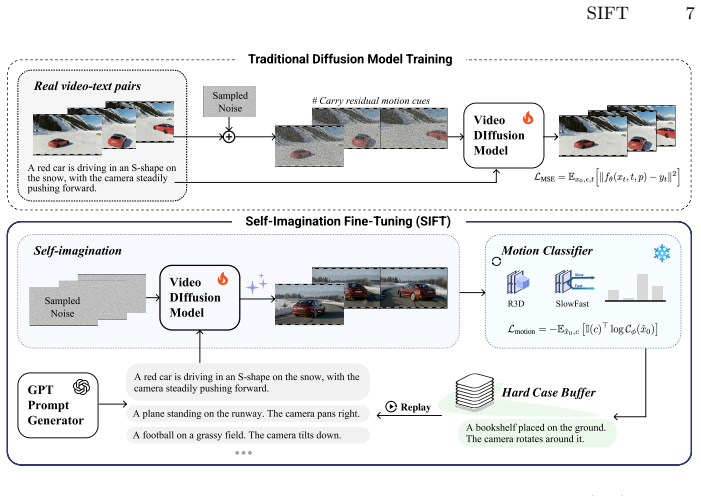
Self-Imagination Fine-Tuning (SIFT): the generator is fine-tuned by sampling pure noise, running a few high-noise denoising steps under an LLM-generated prompt that specifies a known motion class, then receiving cross-entropy loss from alternating R3D and SlowFast classifiers that judge whether the result is camera-only, object-only, both-moving or both-static; a hard-case buffer replays misclassified samples with probability that rises linearly during warm-up.
What would settle it
If human raters or an independent physics checker score a large held-out set of novel camera-versus-object prompts and find no statistically significant improvement in relative-trajectory correctness or physical-commonsense scores for SIFT-tuned models over the untuned baseline, the central claim is false.
Extended reading notes
Core claim
Motion entanglement—the unintended coupling of independent kinematic sources such as camera movement and object motion—is a pervasive failure of current video diffusion models. It arises because training data rarely separate the two motions and because denoising objectives allow the model to reconstruct residual motion cues still present in noisy inputs instead of inferring dynamics from language. Self-Imagination Fine-Tuning removes real-video inputs, generates from pure noise under freely generated prompts, and replaces pixel reconstruction with motion-aware discriminative supervision plus progressive hard-case replay. Experiments on two open-source backbones show substantial gains in phys
Load-bearing premise
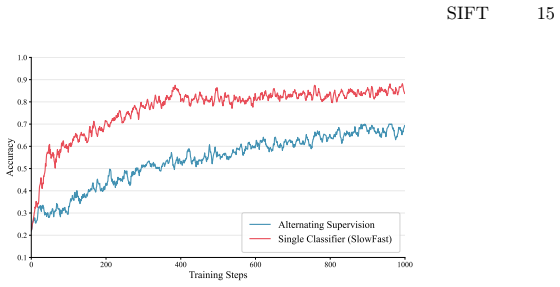
The four-way motion classifiers, trained on only four thousand noisy one-step reconstructions and reaching roughly eighty percent accuracy, supply a clean enough signal that the generator learns true kinematic disentanglement rather than merely matching classifier quirks.
Signed reviews
Editorial analysis
A structured set of objections, weighed in public.
Referee Report
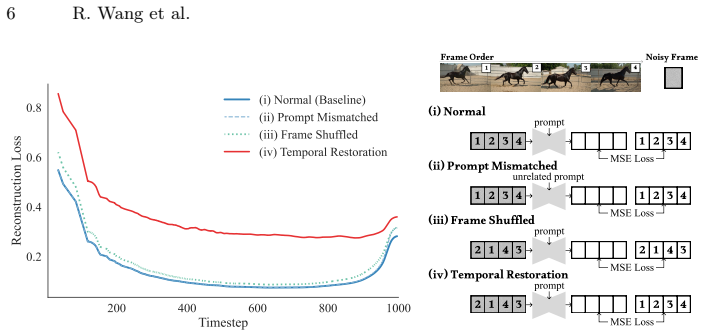
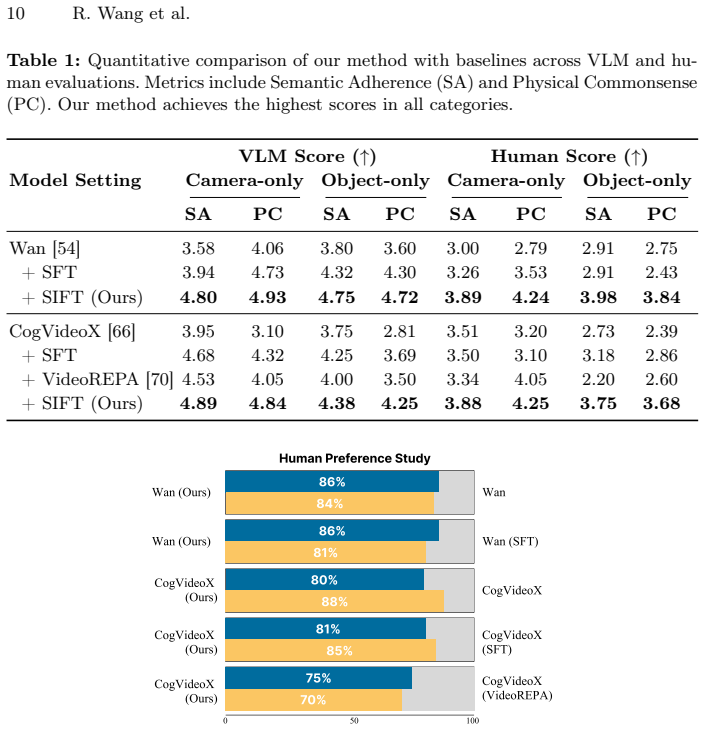
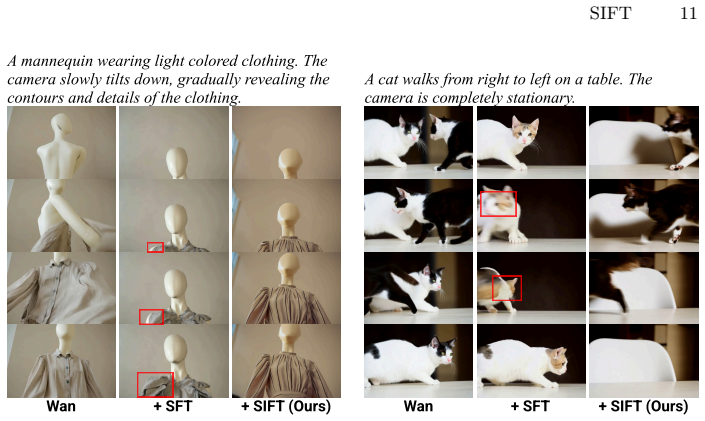
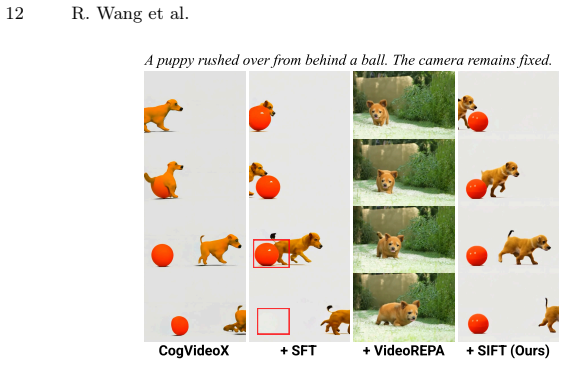
Summary. The paper identifies “motion entanglement” (unintended coupling of camera and object motion) as a kinematic failure mode of video diffusion models, attributing it to data bias and residual motion cues that create a reconstruction shortcut under pixel-level MSE training. Diagnostic experiments (Fig. 2) show that pretrained models largely ignore prompt and temporal-order perturbations when reconstructing from noisy inputs. The authors propose Self-Imagination Fine-Tuning (SIFT): generation from pure noise under freely generated text prompts, motion-aware discriminative supervision from two four-way classifiers (R3D and SlowFast) that label camera-only / object-only / both / static, and progressive hard-case replay. A lightweight MSE term on real pairs is retained for visual quality. Experiments on Wan2.1-1.3B and CogVideoX report gains in Semantic Adherence and Physical Commonsense under both VLM and human evaluation, with ablations (Table 4) isolating each component and additional tests on multi-object, articulated, and long-horizon settings.
Significance. If the gains reflect genuine kinematic disentanglement rather than classifier matching, the work supplies a practical, data-efficient route to improve motion priors in text-to-video models without collecting motion-decoupled video-text pairs. The diagnostic of residual-motion shortcuts is clean and reusable, the self-imagination framing is a clear conceptual shift from reconstruction-based SFT, and the method is shown on two open backbones with both automatic and human preference evidence. The free-prompt coverage of rare relative-motion combinations is a genuine practical advantage. These strengths make the paper a useful contribution to physics-aware video generation even if the supervisory taxonomy remains coarse.
major comments (3)
- §3.4 and Table 4: The central claim that SIFT teaches “kinematically-grounded” independent reference frames rests almost entirely on cross-entropy against two four-way classifiers (R3D 78.4 %, SlowFast 82.8 % on noisy one-step reconstructions of a 4 000-video set). The ablation shows that single-classifier variants degrade and that alternating helps, but this only demonstrates that the two classifiers disagree; it does not establish that their consensus equals true kinematic disentanglement rather than shared inductive biases. Because the generator is optimized solely against these classifiers (plus a small MSE term), residual correlations or artifacts they retain can be exploited without learning independent frames. A load-bearing check is missing: e.g., held-out human or optical-flow-based verification that the improved videos actually separate camera and object trajectories on axes th
- §4.1–4.2, Tables 1–3 and Fig. 4: Evaluation uses a 100-prompt test set (plus 50-prompt generalization subsets) scored on 1–5 Likert SA/PC by InternVideo2.5 and 20 human raters, with no error bars, confidence intervals, or inter-rater reliability. The absolute numbers and preference rates are therefore hard to interpret as robust evidence of “substantial” improvement. At minimum the paper should report variance across prompts or raters and clarify how many unique videos underlie the human preference percentages.
- Limitations and Fig. S2: The four-category taxonomy supplies no signal on direction, magnitude, or temporal transitions. The supplementary failure case (clockwise prompt yielding counter-clockwise camera motion) and residual entanglement visible in qualitative figures show that the claimed physically grounded prior remains incomplete precisely on the axes the supervision never constrains. This does not invalidate the reported gains, but it does limit the strength of the claim that SIFT endows models with “internalized physical reasoning” beyond the coarse camera/object dichotomy.
minor comments (4)
- §3.3 and Algorithm 1: The precise schedule of the few denoising steps (t = 1000, 980, 960) and the weight λ = 0.01 are stated only in the implementation details; a short sensitivity note would help readers judge free-parameter dependence.
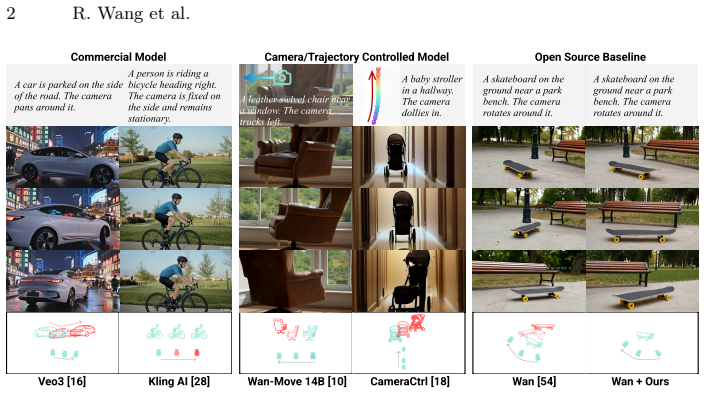
- Fig. 1 caption and main text: “red indicates physically implausible relative motion” is clear in the figure but the trajectory visualization method itself is never described; a one-sentence explanation would improve reproducibility.
- Table 4 caption correctly warns that scores are relative within the ablation group and not comparable to Table 1; the same caveat should be repeated in the main text when the ablation is discussed.
- Related Work: The distinction between kinematic entanglement and dynamics-focused physics methods is useful; a brief pointer to any concurrent work on residual-noise shortcuts in video diffusion would strengthen the positioning.
Circularity Check
No circularity: SIFT is an empirical fine-tuning procedure whose supervision labels and evaluation metrics are independent of the quantities being optimized.
full rationale
The paper's central claim is an empirical engineering result: replacing reconstruction training with generation from pure noise, cross-entropy against two external four-way motion classifiers (R3D/SlowFast trained on a separately collected 4 000-video set), and progressive hard-case replay improves SA/PC scores and human preference on held-out prompts. Motion-class ground truth for the self-imagined samples is taken directly from the LLM prompt that generated them (Section 3.4, Algorithm 1), not fitted from the generator's own outputs. Classifier accuracy (78–83 %) is reported on a held-out noisy-reconstruction validation set, not on the generator. Downstream metrics (VLM InternVideo2.5 and human Likert/preference) are external and do not reuse the training classifiers or any fitted parameter. There is no uniqueness theorem, no self-citation that supplies a load-bearing premise, no ansatz smuggled via prior work of the same authors, and no quantity that is fitted and then re-reported as a prediction. The derivation chain therefore does not reduce to its inputs by construction; the method is self-contained against external benchmarks.
Assumptions & free parameters
free parameters (4)
- motion-loss weight λ
- hard-case warm-up steps S_warmup
- learning rate and number of fine-tuning steps
- denoising timesteps used in self-imagination
assumptions (3)
- domain assumption Noisy latents retain substantial residual structural and temporal cues that diffusion models exploit as a reconstruction shortcut.
- ad hoc to paper Four discrete motion categories (camera-only, object-only, both, static) are sufficient supervisory signal for learning kinematic disentanglement.
- standard math Standard flow-matching / DDPM training objectives and DiT architectures behave as described.
invented entities (2)
-
Motion Entanglement
independent evidence
-
Self-Imagination Fine-Tuning (SIFT) paradigm
Cite this review
Pith. "Pith review of SIFT: Self-Imagination Fine-Tuning for Physically Plausible Motion in Video Diffusion Models." pith.science (2026). https://pith.science/paper/WQFP37MC
@misc{pith2026260627741,
  author       = {Pith},
  title        = {Pith review of: SIFT: Self-Imagination Fine-Tuning for Physically Plausible Motion in Video Diffusion Models},
  year         = {2026},
  howpublished = {\url{https://pith.science/paper/WQFP37MC}},
  note         = {Machine review of arXiv:2606.27741}
}
read the original abstract
Recent advances in video diffusion models have greatly improved visual fidelity, yet their generated motions often violate physical plausibility. We observe a common kinematic failure, "motion entanglement", the unintended coupling of independent motion sources, such as camera movement and object motion. We identify that this issue stems from data bias and the reconstruction-based training design of diffusion models. Training on noisy videos that still retain coarse motion cues inadvertently encourages the model to replicate existing motion without an incentive to learn how to model kinematically-grounded motions. To address this, we propose a Self-Imagination Fine-Tuning (SIFT) paradigm, which enables the model to learn from its own generated videos rather than directly reconstructing real ones, breaking the reconstruction shortcut. We further employ motion-aware discriminative supervision and a progressive hard-case replay strategy to stabilize and accelerate learning. By leveraging freely-generated text prompts, our method can densely cover a broad motion space, including rare or finely-disentangled scenarios that would be costly to collect as video data. Extensive experiments demonstrate that our approach substantially improves the physical realism, motion disentanglement, and controllability of generated videos.
Figures
Figures from the paper (4 more)
Reviewed July 15, 2026 · model on record in the stance chip above.
Discussion (0). Continue with ORCID to comment.