pith. sign in

arxiv: 2606.27741 · v1 · pith:WQFP37MCnew · submitted 2026-06-26 · 💻 cs.CV

SIFT: Self-Imagination Fine-Tuning for Physically Plausible Motion in Video Diffusion Models

Pith reviewed 2026-06-29 04:36 UTC · model grok-4.3

classification 💻 cs.CV
keywords video diffusion modelsphysical plausibilitymotion disentanglementself-imagination fine-tuningkinematic groundingmotion-aware supervisionreconstruction shortcut
0
0 comments X

The pith

Video diffusion models learn physically plausible motions by fine-tuning on videos they generate themselves.

A machine-rendered reading of the paper's core claim, the machinery that carries it, and where it could break.

The paper claims that motion entanglement arises because diffusion models trained on noisy real videos shortcut to copying biased motion patterns instead of learning kinematic rules from scratch. Switching the training signal to the model's own generated videos forces it to produce motions rather than reconstruct them, and motion-aware discriminative supervision plus hard-case replay then pushes the outputs toward disentangled, physically grounded results. This matters because current models routinely couple independent motion sources such as camera movement and object movement, producing videos that violate basic physics. Using only text prompts to create the training examples also lets the method reach rare or finely separated motion cases without new real footage.

Core claim

The reconstruction shortcut in diffusion training on noisy real videos encourages replication of existing motion patterns rather than learning grounded kinematics. SIFT breaks this by having the model train on its own generations, using motion-aware discriminative supervision and progressive hard-case replay to learn disentangled, physically plausible motions across a broad space covered by free text prompts.

What carries the argument

The Self-Imagination Fine-Tuning (SIFT) paradigm that replaces direct reconstruction of real videos with learning from the model's own generated videos under motion-aware discriminative supervision.

If this is right

  • Generated videos show substantially improved physical realism.
  • Motion entanglement between independent sources such as camera and object movement is reduced.
  • Controllability of video generation increases.
  • Dense coverage of rare and finely-disentangled motion scenarios becomes possible without costly data collection.

Where Pith is reading between the lines

These are editorial extensions of the paper, not claims the author makes directly.

  • The same self-imagination loop may help other generative models that suffer from reconstruction biases in geometry or causality.
  • Training pipelines could shift away from large curated video datasets toward prompt-driven self-generation.
  • Pairing the fine-tuned model with an external physics simulator could provide an automatic check on the learned motions.

Load-bearing premise

That the model's self-generated videos, when used for training with the added supervision, teach real kinematic principles instead of reinforcing whatever artifacts the base model already has.

What would settle it

Running the fine-tuned model on prompts known to produce entangled motions in the base model and finding no reduction in entanglement or physical violations.

Figures

Figures reproduced from arXiv: 2606.27741 by Chi Zhang, Haibin Huang, Huayang Huang, Jialun Liu, Jiepeng Wang, Ruoyu Wang, Xuelong Li, Yu Wu.

Figure 1
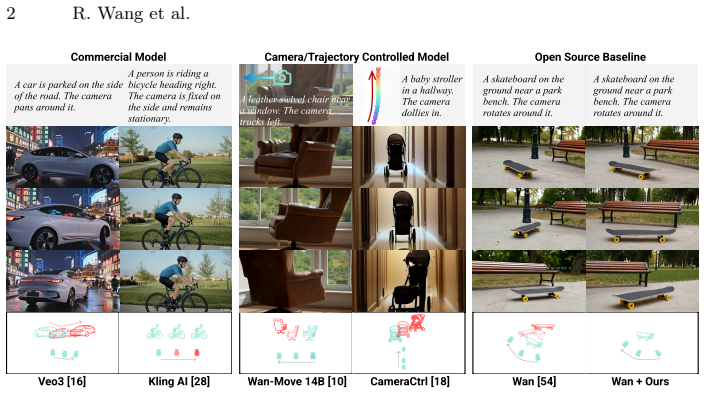
Figure 1. Figure 1: Illustration of Motion Entanglement. The first row shows the input conditions, and the last row visualizes the generated trajectories where red indicates physically implausible relative motion. Note that camera-control methods take the camera tra￾jectory and the first frame as extra conditions, while the others are purely text-to-video. inability to independently control and disentangle motions originating… view at source ↗
Figure 2
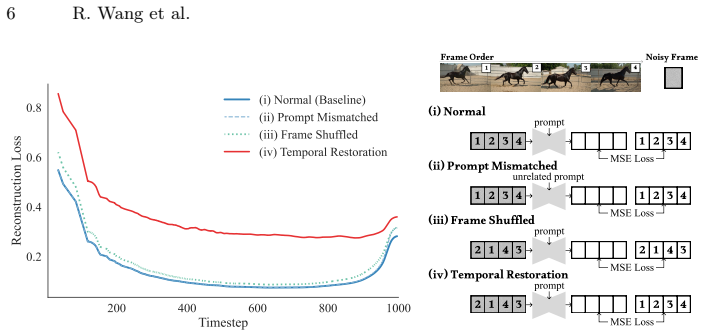
Figure 2. Figure 2: MSE loss curves of four input settings. This experiment analyzes pretrained diffusion model behavior in the training setting (one-step prediction). Because the loss is dominated by shortcut cues in the noisy input, it is largely insensitive to prompt and frame-order perturbations. This explains why standard SFT is ineffective for learning physically plausible motion generation and motivating our Self-Imagi… view at source ↗
Figure 3
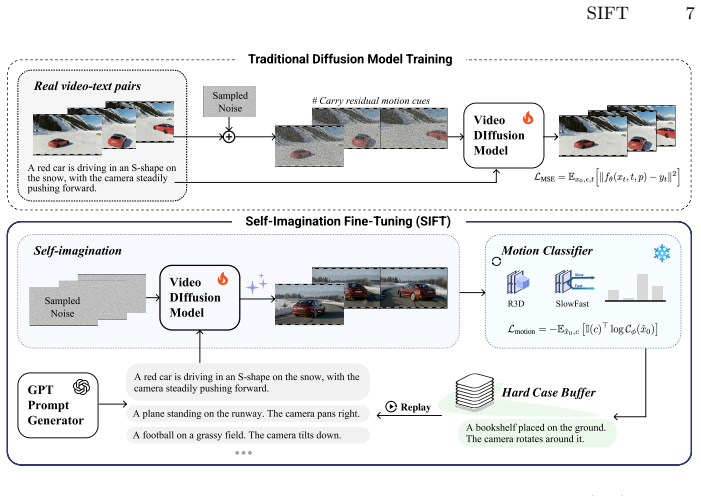
Figure 3. Figure 3: Pipeline comparison between traditional diffusion model training (top) and our proposed self-imagination fine-tuning (bottom). the model needs to imagine the video and construct motion solely from textual prompts that specify scene content and motion relations. These text prompts, which can be freely produced by large language models (e.g., GPT [23]), pro￾vide an unlimited source of training scenarios span… view at source ↗
Figure 4
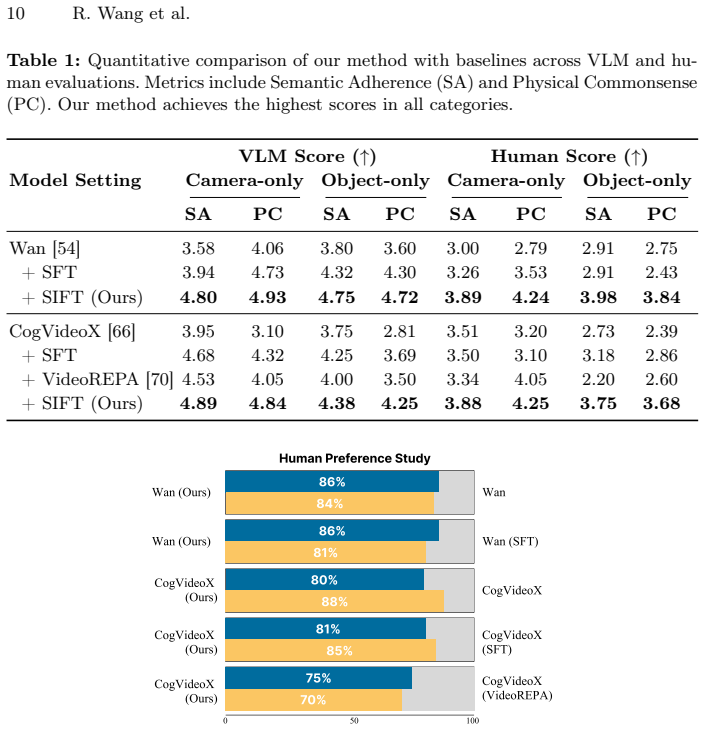
Figure 4. Figure 4: Human preference study results, showing the winning rate of our method vs. baselines. Blue bars indicate Semantic Adherence (SA) and yellow bars indicate Phys￾ical Commonsense (PC). comprises 100 test prompts, each following a precise two-clause format: {con￾tent prompt} {camera prompt}. The camera clause always begins with “The camera...” and encompasses a diverse set of 12 motion templates (e.g., pan, ti… view at source ↗
Figure 5
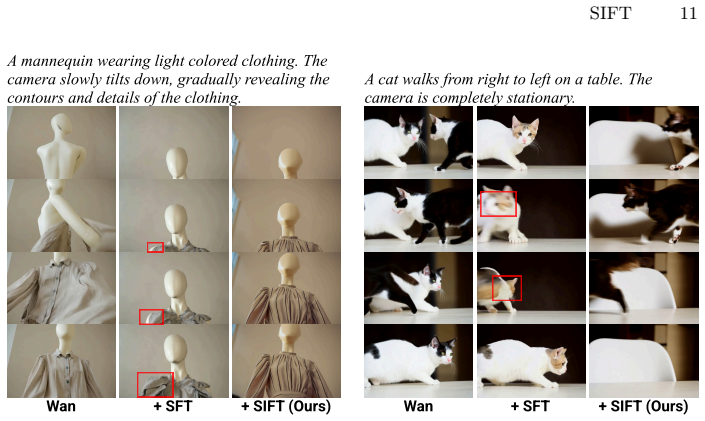
Figure 5. Figure 5: Qualitative comparison on the Wan backbone. SIFT better preserves prompt￾specified relative motion and temporal consistency than other baselines. Semantic Adherence (SA): measures how well the video content aligns with the text prompt, particularly whether the generated motions match the prompt; (2) Physical Commonsense (PC): measures whether the observed motion follows the physics laws in the real world. … view at source ↗
Figure 6
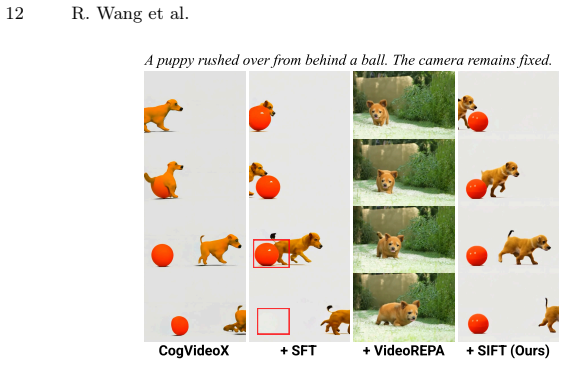
Figure 6. Figure 6: Qualitative comparison on the CogVideoX backbone. SIFT produces more coherent object interactions and more physically plausible relative motion than others. Quantitative Evaluation. As summarized in Tab. 1, both VLM-based and human evaluations across two backbone models demonstrate that our method achieves the best performance in both Semantic Adherence (SA) and Physical Commonsense (PC). The SFT baseline … view at source ↗
Figure 7
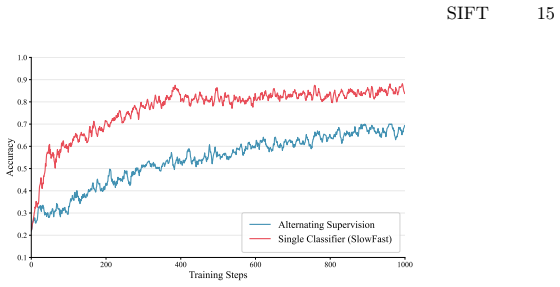
Figure 7. Figure 7: Accuracy curves of motion classifiers during training of video generative model. final performance. Moreover, the hard case replay improves training efficiency, enabling the model to achieve greater improvement within the same number of optimization steps. 5 Conclusion In this work, we identify a key kinematic limitation in current video diffusion models, which we term “Motion Entanglement”. We show that t… view at source ↗
read the original abstract

Recent advances in video diffusion models have greatly improved visual fidelity, yet their generated motions often violate physical plausibility. We observe a common kinematic failure, "motion entanglement", the unintended coupling of independent motion sources, such as camera movement and object motion. We identify that this issue stems from data bias and the reconstruction-based training design of diffusion models. Training on noisy videos that still retain coarse motion cues inadvertently encourages the model to replicate existing motion without an incentive to learn how to model kinematically-grounded motions. To address this, we propose a Self-Imagination Fine-Tuning (SIFT) paradigm, which enables the model to learn from its own generated videos rather than directly reconstructing real ones, breaking the reconstruction shortcut. We further employ motion-aware discriminative supervision and a progressive hard-case replay strategy to stabilize and accelerate learning. By leveraging freely-generated text prompts, our method can densely cover a broad motion space, including rare or finely-disentangled scenarios that would be costly to collect as video data. Extensive experiments demonstrate that our approach substantially improves the physical realism, motion disentanglement, and controllability of generated videos.

Editorial analysis

A structured set of objections, weighed in public.

Desk editor's note, referee report, simulated authors' rebuttal, and a circularity audit. Tearing a paper down is the easy half of reading it; the pith above is the substance, this is the friction.

Referee Report

3 major / 1 minor

Summary. The paper proposes Self-Imagination Fine-Tuning (SIFT) for video diffusion models to mitigate motion entanglement (unintended coupling of independent sources such as camera and object motion). It replaces direct reconstruction on real videos with fine-tuning on the model's own generations, augmented by motion-aware discriminative supervision and progressive hard-case replay, claiming this breaks the reconstruction shortcut and yields improved physical realism, disentanglement, and controllability from text prompts.

Significance. If the central claim holds under rigorous validation, the approach could meaningfully advance controllable video synthesis by enabling denser coverage of motion spaces without new curated data collection. The self-supervised loop and hard-case replay are conceptually appealing for addressing data bias, though their effectiveness depends on whether generated videos supply independent corrective signal.

major comments (3)
  1. [Abstract] Abstract: the central claim that SIFT 'substantially improves the physical realism, motion disentanglement, and controllability' is unsupported by any quantitative results, baselines, metrics, or experimental details. Without these, the magnitude of improvement and comparison to prior disentanglement methods cannot be assessed; this is load-bearing for the paper's contribution.
  2. [Abstract] Abstract (method description): the claim that training on self-generated videos 'breaks the reconstruction shortcut' and produces kinematically grounded motions rests on the unverified assumption that the model's free generations contain usable corrective signal about independent motion sources. Because the base model was trained on biased real data, its generations are expected to reproduce the same entanglements; the motion-aware discriminative head has no external oracle (physics simulation, 3D GT, or kinematic loss) and can at best reinforce statistical patterns labeled as 'disentangled.' This assumption is load-bearing for the entire paradigm.
  3. [Abstract] Abstract: the statement that 'freely-generated text prompts... densely cover a broad motion space, including rare or finely-disentangled scenarios' is not accompanied by any analysis or ablation showing that the generated distribution actually improves coverage or reduces entanglement relative to the training data distribution.
minor comments (1)
  1. [Abstract] The abstract uses several high-level terms ('motion entanglement', 'kinematically-grounded motions', 'motion-aware discriminative supervision') without concise operational definitions or references to their precise implementation in the method section.

Simulated Author's Rebuttal

3 responses · 0 unresolved

We thank the referee for their constructive feedback. We address each major comment below. Revisions have been made to the abstract to incorporate quantitative results and additional supporting analysis from the experiments.

read point-by-point responses
  1. Referee: [Abstract] Abstract: the central claim that SIFT 'substantially improves the physical realism, motion disentanglement, and controllability' is unsupported by any quantitative results, baselines, metrics, or experimental details. Without these, the magnitude of improvement and comparison to prior disentanglement methods cannot be assessed; this is load-bearing for the paper's contribution.

    Authors: We agree that the abstract would be strengthened by explicit quantitative support. The revised abstract now includes specific metrics from our experiments (e.g., improvements in physical plausibility and disentanglement scores relative to baselines) and references the relevant experimental sections for direct comparison to prior methods. revision: yes

  2. Referee: [Abstract] Abstract (method description): the claim that training on self-generated videos 'breaks the reconstruction shortcut' and produces kinematically grounded motions rests on the unverified assumption that the model's free generations contain usable corrective signal about independent motion sources. Because the base model was trained on biased real data, its generations are expected to reproduce the same entanglements; the motion-aware discriminative head has no external oracle (physics simulation, 3D GT, or kinematic loss) and can at best reinforce statistical patterns labeled as 'disentangled.' This assumption is load-bearing for the entire paradigm.

    Authors: The motion-aware discriminative head is trained on self-generated pairs to distinguish entangled from disentangled motion patterns, providing an internal corrective signal that guides the diffusion process away from reconstruction shortcuts. Ablation studies in the manuscript demonstrate that removing this component leads to measurable increases in entanglement, supporting that the self-imagination loop supplies usable signal beyond inherited biases. We have expanded the method section with further discussion of this mechanism. revision: partial

  3. Referee: [Abstract] Abstract: the statement that 'freely-generated text prompts... densely cover a broad motion space, including rare or finely-disentangled scenarios' is not accompanied by any analysis or ablation showing that the generated distribution actually improves coverage or reduces entanglement relative to the training data distribution.

    Authors: We have added a quantitative comparison of motion coverage and entanglement metrics between the original training distribution and the self-generated videos used in fine-tuning. This analysis, now summarized in the revised abstract and detailed in the experiments, shows increased diversity in motion parameters and reduced entanglement scores. revision: yes

Circularity Check

0 steps flagged

Self-supervised loop present but central claims remain empirically grounded

full rationale

The paper describes a self-imagination fine-tuning loop on model-generated videos plus discriminative supervision to break reconstruction shortcuts, yet the claims of improved physical realism and motion disentanglement rest on extensive experiments rather than reducing by definition or self-citation to the inputs. No equations, fitted predictions renamed as results, or load-bearing self-citations appear in the provided text. The method is self-contained against external benchmarks, yielding only minor circularity from the self-supervised framing itself.

Axiom & Free-Parameter Ledger

0 free parameters · 0 axioms · 0 invented entities

Only abstract available; no free parameters, axioms, or invented entities are specified.

pith-pipeline@v0.9.1-grok · 5754 in / 883 out tokens · 34556 ms · 2026-06-29T04:36:43.949339+00:00 · methodology

discussion (0)

Sign in with ORCID, Apple, or X to comment. Anyone can read and Pith papers without signing in.

Reference graph

Works this paper leans on

77 extracted references · 2 canonical work pages · 1 internal anchor

  1. [1]

    5-vl technical report

    Bai, S., Chen, K., Liu, X., Wang, J., Ge, W., Song, S., Dang, K., Wang, P., Wang, S., Tang, J., et al.: Qwen2. 5-vl technical report. arXiv (2025)

  2. [2]

    In: ICCV

    Bain, M., Nagrani, A., Varol, G., Zisserman, A.: Frozen in time: A joint video and image encoder for end-to-end retrieval. In: ICCV. pp. 1728–1738 (2021)

  3. [3]

    arXiv (2024)

    Bansal, H., Lin, Z., Xie, T., Zong, Z., Yarom, M., Bitton, Y., Jiang, C., Sun, Y., Chang, K.W., Grover, A.: Videophy: Evaluating physical commonsense for video generation. arXiv (2024)

  4. [4]

    arXiv (2023)

    Blattmann, A., Dockhorn, T., Kulal, S., Mendelevitch, D., Kilian, M., Lorenz, D., Levi, Y., English, Z., Voleti, V., Letts, A., et al.: Stable video diffusion: Scaling latent video diffusion models to large datasets. arXiv (2023)

  5. [5]

    In: CVPR

    Burgert, R., Xu, Y., Xian, W., Pilarski, O., Clausen, P., He, M., Ma, L., Deng, Y., Li, L., Mousavi, M., et al.: Go-with-the-flow: Motion-controllable video diffusion models using real-time warped noise. In: CVPR. pp. 13–23 (2025)

  6. [6]

    arXiv (2025)

    Chefer, H., Singer, U., Zohar, A., Kirstain, Y., Polyak, A., Taigman, Y., Wolf, L., Sheynin, S.: Videojam: Joint appearance-motion representations for enhanced motion generation in video models. arXiv (2025)

  7. [7]

    arXiv (2023)

    Chen, H., Xia, M., He, Y., Zhang, Y., Cun, X., Yang, S., Xing, J., Liu, Y., Chen, Q., Wang, X., et al.: Videocrafter1: Open diffusion models for high-quality video generation. arXiv (2023)

  8. [8]

    In: CVPR

    Chen, H., Zhang, Y., Cun, X., Xia, M., Wang, X., Weng, C., Shan, Y.: Videocrafter2: Overcoming data limitations for high-quality video diffusion models. In: CVPR. pp. 7310–7320 (2024)

  9. [9]

    Chen, T.S., Siarohin, A., Menapace, W., Deyneka, E., Chao, H.w., Jeon, B.E., Fang, Y., Lee, H.Y., Ren, J., Yang, M.H., et al.: Panda-70m: Captioning 70m videos with multiple cross-modality teachers

  10. [10]

    Wan-move: Motion-controllable video generation via latent trajectory guidance.arXiv preprint arXiv:2512.08765, 2025

    Chu, R., He, Y., Chen, Z., Zhang, S., Xu, X., Xia, B., Wang, D., Yi, H., Liu, X., Zhao, H., et al.: Wan-move: Motion-controllable video generation via latent trajectory guidance. arXiv preprint arXiv:2512.08765 (2025)

  11. [11]

    In: ICCV

    Feichtenhofer, C., Fan, H., Malik, J., He, K.: Slowfast networks for video recogni- tion. In: ICCV. pp. 6202–6211 (2019)

  12. [12]

    arXiv (2024)

    Fu, X., Liu, X., Wang, X., Peng, S., Xia, M., Shi, X., Yuan, Z., Wan, P., Zhang, D., Lin, D.: 3dtrajmaster: Mastering 3d trajectory for multi-entity motion in video generation. arXiv (2024)

  13. [13]

    arXiv (2025)

    Geng,Z.,Deng,M.,Bai,X.,Kolter,J.Z.,He,K.:Meanflowsforone-stepgenerative modeling. arXiv (2025)

  14. [14]

    arXiv (2025)

    Gillman, N., Herrmann, C., Freeman, M., Aggarwal, D., Luo, E., Sun, D., Sun, C.: Force prompting: Video generation models can learn and generalize physics-based control signals. arXiv (2025)

  15. [15]

    Google DeepMind: Gemini image — nano banana.https://deepmind.google/ models/gemini-image/(2025), official model page, accessed 2026-03-03

  16. [16]

    Google DeepMind: Veo 3.https://deepmind.google/models/veo/(2025)

  17. [17]

    arXiv (2023)

    Guo, Y., Yang, C., Rao, A., Liang, Z., Wang, Y., Qiao, Y., Agrawala, M., Lin, D., Dai, B.: Animatediff: Animate your personalized text-to-image diffusion models without specific tuning. arXiv (2023)

  18. [18]

    He, H., Xu, Y., Guo, Y., Wetzstein, G., Dai, B., Li, H., Yang, C.: Cameractrl: En- ablingcameracontrolfortext-to-videogeneration.arXivpreprintarXiv:2404.02101 (2024) SIFT 17

  19. [19]

    arXiv (2022)

    Ho, J., Chan, W., Saharia, C., Whang, J., Gao, R., Gritsenko, A., Kingma, D.P., Poole, B., Norouzi, M., Fleet, D.J., et al.: Imagen video: High definition video generation with diffusion models. arXiv (2022)

  20. [20]

    NeurIPS (2020)

    Ho, J., Jain, A., Abbeel, P.: Denoising diffusion probabilistic models. NeurIPS (2020)

  21. [21]

    arXiv (2022)

    Hong, W., Ding, M., Zheng, W., Liu, X., Tang, J.: Cogvideo: Large-scale pretrain- ing for text-to-video generation via transformers. arXiv (2022)

  22. [22]

    arXiv (2024)

    Hou, C., Chen, Z.: Training-free camera control for video generation. arXiv (2024)

  23. [23]

    arXiv (2024)

    Hurst, A., Lerer, A., Goucher, A.P., Perelman, A., Ramesh, A., Clark, A., Ostrow, A., Welihinda, A., Hayes, A., Radford, A., et al.: Gpt-4o system card. arXiv (2024)

  24. [24]

    NeurIPS37, 48955–48970 (2024)

    Ju, X., Gao, Y., Zhang, Z., Yuan, Z., Wang, X., Zeng, A., Xiong, Y., Xu, Q., Shan, Y.: Miradata: A large-scale video dataset with long durations and structured captions. NeurIPS37, 48955–48970 (2024)

  25. [25]

    arXiv (2024)

    Kang, B., Yue, Y., Lu, R., Lin, Z., Zhao, Y., Wang, K., Huang, G., Feng, J.: How far is video generation from world model: A physical law perspective. arXiv (2024)

  26. [26]

    In: ICCV

    Khachatryan, L., Movsisyan, A., Tadevosyan, V., Henschel, R., Wang, Z., Navasardyan, S., Shi, H.: Text2video-zero: Text-to-image diffusion models are zero- shot video generators. In: ICCV. pp. 15954–15964 (2023)

  27. [27]

    arXiv (2024)

    Kong, W., Tian, Q., Zhang, Z., Min, R., Dai, Z., Zhou, J., Xiong, J., Li, X., Wu, B., Zhang, J., et al.: Hunyuanvideo: A systematic framework for large video generative models. arXiv (2024)

  28. [28]

    Kuaishou: Kling ai.https://app.klingai.com/global/(2025)

  29. [29]

    arXiv (2023)

    Lian, L., Shi, B., Yala, A., Darrell, T., Li, B.: Llm-grounded video diffusion models. arXiv (2023)

  30. [30]

    arXiv (2025)

    Lin, Z., Cen, S., Jiang, D., Karhade, J., Wang, H., Mitra, C., Ling, T., Huang, Y., Liu, S., Chen, M., et al.: Towards understanding camera motions in any video. arXiv (2025)

  31. [31]

    arXiv (2024)

    Ling, P., Bu, J., Zhang, P., Dong, X., Zang, Y., Wu, T., Chen, H., Wang, J., Jin, Y.: Motionclone: Training-free motion cloning for controllable video generation. arXiv (2024)

  32. [32]

    arXiv (2022)

    Lipman, Y., Chen, R.T., Ben-Hamu, H., Nickel, M., Le, M.: Flow matching for generative modeling. arXiv (2022)

  33. [33]

    In: ECCV

    Liu, S., Ren, Z., Gupta, S., Wang, S.: Physgen: Rigid-body physics-grounded image-to-video generation. In: ECCV. pp. 360–378. Springer (2024)

  34. [34]

    arXiv (2022)

    Liu, X., Gong, C., Liu, Q.: Flow straight and fast: Learning to generate and transfer data with rectified flow. arXiv (2022)

  35. [35]

    arXiv (2024)

    Liu, Y., Zhang, K., Li, Y., Yan, Z., Gao, C., Chen, R., Yuan, Z., Huang, Y., Sun, H., Gao, J., et al.: Sora: A review on background, technology, limitations, and opportunities of large vision models. arXiv (2024)

  36. [36]

    In: CVPR

    Lv, J., Huang, Y., Yan, M., Huang, J., Liu, J., Liu, Y., Wen, Y., Chen, X., Chen, S.: Gpt4motion: Scripting physical motions in text-to-video generation via blender- oriented gpt planning. In: CVPR. pp. 1430–1440 (2024)

  37. [37]

    arXiv (2025)

    Ma, G., Huang, H., Yan, K., Chen, L., Duan, N., Yin, S., Wan, C., Ming, R., Song, X., Chen, X., et al.: Step-video-t2v technical report: The practice, challenges, and future of video foundation model. arXiv (2025)

  38. [38]

    arXiv (2024)

    Ma, X., Wang, Y., Jia, G., Chen, X., Liu, Z., Li, Y.F., Chen, C., Qiao, Y.: Latte: Latent diffusion transformer for video generation. arXiv (2024)

  39. [39]

    In: ACM Multimedia

    Mao, J., Wang, X., Aizawa, K.: Guided image synthesis via initial image editing in diffusion model. In: ACM Multimedia. pp. 5321–5329 (2023) 18 R. Wang et al

  40. [40]

    arXiv (2024)

    Meng, F., Liao, J., Tan, X., Shao, W., Lu, Q., Zhang, K., Cheng, Y., Li, D., Qiao, Y., Luo, P.: Towards world simulator: Crafting physical commonsense-based benchmark for video generation. arXiv (2024)

  41. [41]

    arXiv (2024)

    Nan, K., Xie, R., Zhou, P., Fan, T., Yang, Z., Chen, Z., Li, X., Yang, J., Tai, Y.: Openvid-1m: A large-scale high-quality dataset for text-to-video generation. arXiv (2024)

  42. [42]

    arXiv (2021)

    Nichol, A., Dhariwal, P., Ramesh, A., Shyam, P., Mishkin, P., McGrew, B., Sutskever, I., Chen, M.: Glide: Towards photorealistic image generation and editing with text-guided diffusion models. arXiv (2021)

  43. [43]

    In: ICCV

    Peebles, W., Xie, S.: Scalable diffusion models with transformers. In: ICCV. pp. 4195–4205 (2023)

  44. [44]

    pexels.com/(2025), accessed: 2025-11-13

    Pexels: Pexels – free stock photos, royalty free images & videos.https://www. pexels.com/(2025), accessed: 2025-11-13

  45. [45]

    arXiv (2022)

    Ramesh, A., Dhariwal, P., Nichol, A., Chu, C., Chen, M.: Hierarchical text- conditional image generation with clip latents. arXiv (2022)

  46. [46]

    In: CVPR (2022)

    Rombach, R., Blattmann, A., Lorenz, D., Esser, P., Ommer, B.: High-resolution image synthesis with latent diffusion models. In: CVPR (2022)

  47. [47]

    Saharia, C., Chan, W., Saxena, S., Li, L., Whang, J., Denton, E.L., Ghasemipour, K., Gontijo Lopes, R., Karagol Ayan, B., Salimans, T., et al.: Photorealistic text- to-image diffusion models with deep language understanding (2022)

  48. [48]

    In: ICLR (2021)

    Song, J., Meng, C., Ermon, S.: Denoising diffusion implicit models. In: ICLR (2021)

  49. [49]

    arXiv (2020)

    Song, Y., Sohl-Dickstein, J., Kingma, D.P., Kumar, A., Ermon, S., Poole, B.: Score- based generative modeling through stochastic differential equations. arXiv (2020)

  50. [50]

    In: CVPR

    Sun, K., Huang, K., Liu, X., Wu, Y., Xu, Z., Li, Z., Liu, X.: T2v-compbench: A comprehensive benchmark for compositional text-to-video generation. In: CVPR. pp. 8406–8416 (2025)

  51. [51]

    arXiv (2024)

    Tan, X., Jiang, Y., Li, X., Zong, Z., Xie, T., Yang, Y., Jiang, C.: Physmotion: Physics-grounded dynamics from a single image. arXiv (2024)

  52. [52]

    arXiv (2024)

    Team, G., Georgiev, P., Lei, V.I., Burnell, R., Bai, L., Gulati, A., Tanzer, G., Vin- cent,D.,Pan,Z.,Wang,S.,etal.:Gemini1.5:Unlockingmultimodalunderstanding across millions of tokens of context. arXiv (2024)

  53. [53]

    In: CVPR

    Tran, D., Wang, H., Torresani, L., Ray, J., LeCun, Y., Paluri, M.: A closer look at spatiotemporal convolutions for action recognition. In: CVPR. pp. 6450–6459 (2018)

  54. [54]

    arXiv (2025)

    Wan, T., Wang, A., Ai, B., Wen, B., Mao, C., Xie, C.W., Chen, D., Yu, F., Zhao, H., Yang, J., et al.: Wan: Open and advanced large-scale video generative models. arXiv (2025)

  55. [55]

    arXiv (2025)

    Wang, C., Chen, C., Huang, Y., Dou, Z., Liu, Y., Gu, J., Liu, L.: Physctrl: Gener- ative physics for controllable and physics-grounded video generation. arXiv (2025)

  56. [56]

    In: CVPR

    Wang, Q., Shi, Y., Ou, J., Chen, R., Lin, K., Wang, J., Jiang, B., Yang, H., Zheng, M., Tao, X., et al.: Koala-36m: A large-scale video dataset improving consis- tency between fine-grained conditions and video content. In: CVPR. pp. 8428–8437 (2025)

  57. [57]

    In: ICCV

    Wang, R., Huang, H., Zhu, Y., Russakovsky, O., Wu, Y.: The silent assistant: Noisequery as implicit guidance for goal-driven image generation. In: ICCV. pp. 17618–17628 (2025)

  58. [58]

    arXiv (2023) SIFT 19

    Wang, Y., He, Y., Li, Y., Li, K., Yu, J., Ma, X., Li, X., Chen, G., Chen, X., Wang, Y., et al.: Internvid: A large-scale video-text dataset for multimodal understanding and generation. arXiv (2023) SIFT 19

  59. [59]

    5: Empowering video mllms with long and rich context modeling

    Wang, Y., Li, X., Yan, Z., He, Y., Yu, J., Zeng, X., Wang, C., Ma, C., Huang, H., Gao, J., et al.: Internvideo2. 5: Empowering video mllms with long and rich context modeling. arXiv (2025)

  60. [60]

    In: AAAI

    Wu, T., Zhang, Y., Wang, X., Zhou, X., Zheng, G., Qi, Z., Shan, Y., Li, X.: Customcrafter: Customized video generation with preserving motion and concept composition abilities. In: AAAI. vol. 39, pp. 8469–8477 (2025)

  61. [61]

    In: ECCV

    Wu, T., Si, C., Jiang, Y., Huang, Z., Liu, Z.: Freeinit: Bridging initialization gap in video diffusion models. In: ECCV. pp. 378–394. Springer (2024)

  62. [62]

    In: CVPR

    Xie, T., Zhao, Y., Jiang, Y., Jiang, C.: Physanimator: Physics-guided generative cartoon animation. In: CVPR. pp. 10793–10804 (2025)

  63. [63]

    In: CVPR

    Xue, Q., Yin, X., Yang, B., Gao, W.: Phyt2v: Llm-guided iterative self-refinement for physics-grounded text-to-video generation. In: CVPR. pp. 18826–18836 (2025)

  64. [64]

    arXiv (2025)

    Xue, Z., Zhang, J., Hu, T., He, H., Chen, Y., Cai, Y., Wang, Y., Wang, C., Liu, Y., Li, X., et al.: Ultravideo: High-quality uhd video dataset with comprehensive captions. arXiv (2025)

  65. [65]

    Yang, X., Li, B., Zhang, Y., Yin, Z., Bai, L., Ma, L., Wang, Z., Cai, J., Wong, T.T., Lu,H.,etal.:Towardsphysicallyplausiblevideogenerationviavlmplanning.arXiv 2(2025)

  66. [66]

    arXiv (2024)

    Yang, Z., Teng, J., Zheng, W., Ding, M., Huang, S., Xu, J., Yang, Y., Hong, W., Zhang, X., Feng, G., et al.: Cogvideox: Text-to-video diffusion models with an expert transformer. arXiv (2024)

  67. [67]

    arXiv (2024)

    Yu, S., Kwak, S., Jang, H., Jeong, J., Huang, J., Shin, J., Xie, S.: Representation alignment for generation: Training diffusion transformers is easier than you think. arXiv (2024)

  68. [68]

    arXiv (2025)

    Zhang, K., Xiao, C., Mei, Y., Xu, J., Patel, V.M.: Think before you diffuse: Llms- guided physics-aware video generation. arXiv (2025)

  69. [69]

    In: ECCV

    Zhang, T., Yu, H.X., Wu, R., Feng, B.Y., Zheng, C., Snavely, N., Wu, J., Freeman, W.T.: Physdreamer: Physics-based interaction with 3d objects via video genera- tion. In: ECCV. pp. 388–406. Springer (2024)

  70. [70]

    arXiv (2025)

    Zhang, X., Liao, J., Zhang, S., Meng, F., Wan, X., Yan, J., Cheng, Y.: Videorepa: Learning physics for video generation through relational alignment with foundation models. arXiv (2025)

  71. [71]

    Zheng, Z., Peng, X., Yang, T., Shen, C., Li, S., Liu, H., Zhou, Y., Li, T., You, Y.: Open-sora: Democratizing efficient video production for all. arXiv (2024) SIFT 1 Overview This supplementary material provides additional implementation details, in- cluding the LLMs used for prompt generation and evaluation, together with a full description of our human ...

  72. [72]

    –Scene layout, background, and interactions align with the prompt

    Semantic Adherence Rate how well the video matches the prompt: –Objects, actions, and events correspond to the prompt (penalize miss- ing or extra elements). –Scene layout, background, and interactions align with the prompt

  73. [73]

    –Objects move only with plausible causes (no drifting or sudden changes without force)

    Physical Plausibility Rate how realistic the motions are: –Motions are continuous, stable, and physically possible in the real world. –Objects move only with plausible causes (no drifting or sudden changes without force). GPT-4o Training prompts Generation.We use GPT-4o [23] to generate 10,000 training prompts covering diverse camera-only/object-only moti...

  74. [74]

    A description of a scene with completely stationary subjects (no move- ment)

  75. [75]

    The camera

    A description of the camera action, starting with “The camera ...”. Requirements: –Subjects should be diverse: vehicles, animals, people, objects, furniture, sports equipment, artworks, etc. –Camera movements should vary and be selected only from: pan, tilt, zoom, truck, pedestal, dolly, arc, orbit, rotate. –Use simple, natural English. Avoid rare or over...

  76. [76]

    A description of a scene with moving subjects

  77. [77]

    Thecamera

    Adescriptionofacompletelystaticcamerastartingwith“Thecamera”. Requirements: –Subjects should be highly diverse: animals, people, vehicles, objects, etc. –Subject movements can be active (run, move, fly, drive, rotate, etc.) or passive (fall, flow, swing, being thrown, drift, etc.). –Ensure no two prompts are similar in subject or movement type. Gemini-Pro...