The Geometry of Last-Layer Model Stealing
Pith reviewed 2026-06-27 22:36 UTC · model grok-4.3
The pith
Geometry identifies the exact conditions for perfectly copying a transformer's final layer.
A machine-rendered reading of the paper's core claim, the machinery that carries it, and where it could break.
Core claim
Using geometry, the paper establishes the precise conditions under which a well-known stealing method can perfectly copy the final layer of a transformer network. It further demonstrates that hidden layers impose clear limits on what can be reverse-engineered from the model's outputs, showing that a complete network cannot be reconstructed solely from final results.
What carries the argument
Geometric analysis of the stealing method applied to the last layer of transformers, identifying conditions for exact copying.
Load-bearing premise
The well-known stealing method admits a geometric analysis capable of yielding exact, verifiable conditions for perfect last-layer copying when the target is a transformer.
What would settle it
Applying the stealing method to a transformer under the derived geometric conditions and checking whether the copied last layer matches the original exactly, compared to cases where conditions are not met.
Figures
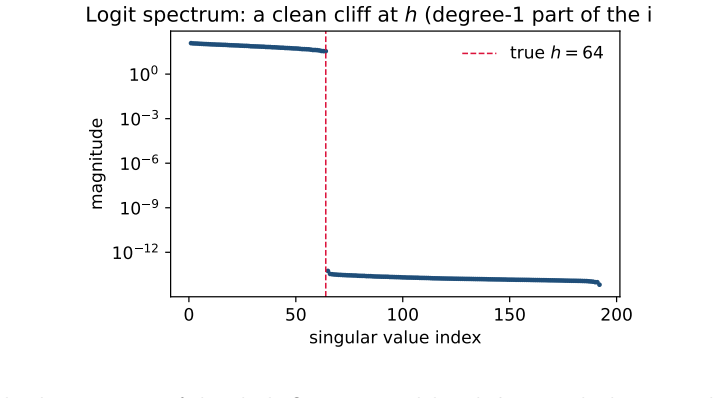
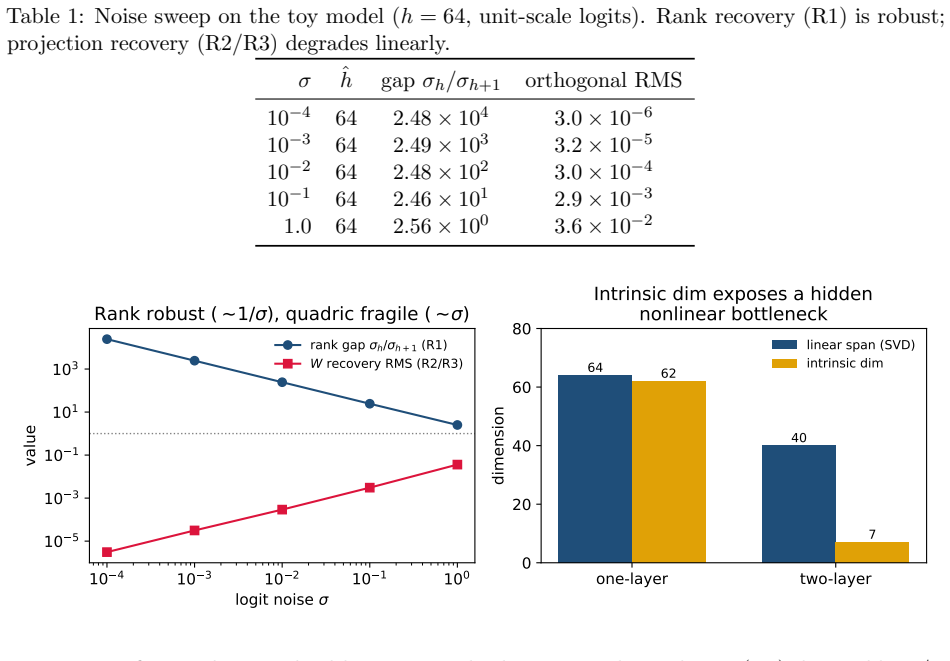
read the original abstract
This paper uses geometry to explain how a machine learning model can be stolen using an already existing well-known method. The author has shown the exact conditions required to perfectly copy the final layer of a transformer network. When looking deeper into the hidden layers the author has explained clear limits. The author has also demonstrated that a hidden network cannot be fully reverse engineered just by looking at the final results. The research clearly maps out what can and cannot be stolen from a model.
Editorial analysis
A structured set of objections, weighed in public.
Referee Report
Summary. The paper applies geometric analysis to a standard model stealing method, claiming to derive the exact conditions under which the final linear layer of a transformer can be perfectly copied, while identifying clear limits on recovering hidden layers from final outputs alone and mapping what aspects of a model can and cannot be stolen.
Significance. If the claimed geometric conditions are rigorously derived and the limits on hidden-layer recovery are shown to hold under standard assumptions, the work would provide a theoretical framework clarifying the boundaries of last-layer extraction attacks on transformers.
major comments (2)
- [Abstract] Abstract: the claim that 'exact conditions' for perfect last-layer copying have been shown cannot be assessed, as no equations, derivations, or geometric constructions are visible to verify whether query distribution, normalization ambiguities, or output access assumptions are handled.
- [Full text] Full text: no derivations, proofs, or empirical checks are provided, so it is impossible to confirm whether the geometric analysis of the stealing method actually yields verifiable, parameter-free conditions for transformer final-layer recovery as asserted.
minor comments (1)
- The abstract would benefit from a brief statement of the specific stealing method analyzed and the precise output access model assumed.
Simulated Author's Rebuttal
We thank the referee for their comments. We agree that the current manuscript does not contain the explicit equations, derivations, geometric constructions, or empirical checks needed to substantiate the claims about exact conditions for last-layer recovery. We will revise the paper to include these elements.
read point-by-point responses
-
Referee: [Abstract] Abstract: the claim that 'exact conditions' for perfect last-layer copying have been shown cannot be assessed, as no equations, derivations, or geometric constructions are visible to verify whether query distribution, normalization ambiguities, or output access assumptions are handled.
Authors: We accept the point. The abstract asserts exact conditions without visible supporting mathematics. In revision we will either tone down the abstract or ensure the main text presents the geometric constructions, query-distribution requirements, normalization handling, and output-access assumptions at the outset so the claim can be assessed. revision: yes
-
Referee: [Full text] Full text: no derivations, proofs, or empirical checks are provided, so it is impossible to confirm whether the geometric analysis of the stealing method actually yields verifiable, parameter-free conditions for transformer final-layer recovery as asserted.
Authors: The observation is correct: the manuscript as written supplies neither derivations nor proofs nor checks. We will add the geometric analysis, the derivation of the parameter-free conditions, and any necessary empirical verification in the revised version. revision: yes
Circularity Check
No circularity: derivation chain self-contained with no self-referential reductions
full rationale
The abstract describes applying geometry to an existing well-known stealing method to derive exact conditions for last-layer copying in transformers, plus limits on hidden layers. No equations, fitted parameters, self-citations, or ansatzes are present in the provided text. No step reduces a claimed prediction or uniqueness result to a definition or prior self-citation by construction. The central claim is an analysis of an external method, which is independent by the paper's own framing. This is the expected honest non-finding for a geometry-based explanation without load-bearing internal fits.
Axiom & Free-Parameter Ledger
Reference graph
Works this paper leans on
-
[1]
N. Carlini et al.,Stealing Part of a Production Language Model.ICML 2024. arXiv:2403.06634
-
[2]
The Cartan-K\"ahler theorem for exterior differential systems on transitive Lie algebroids
S. Hohloch, T. Mestdag, K. Yasaka,The Cartan–K¨ ahler theorem for exterior differential systems on transitive Lie algebroids.arXiv:2605.29083 (2026)
work page internal anchor Pith review Pith/arXiv arXiv 2026
-
[3]
R. L. Bryant, S. S. Chern, R. B. Gardner, H. L. Goldschmidt, P. A. Griffiths,Exterior Differential Systems.Springer, 1991
1991
-
[4]
H. J. Sussmann,Uniqueness of the weights for minimal feedforward nets with a given input–output map.Neural Networks 5(4):589–593, 1992
1992
-
[5]
A. Ansuini, A. Laio, J. H. Macke, D. Zoccolan,Intrinsic dimension of data representations in deep neural networks.NeurIPS 2019. arXiv:1905.12784
-
[6]
M. Finlayson, S. Swayamdipta, X. Ren,Logits of API-protected LLMs leak proprietary informa- tion.arXiv:2403.09539 (2024)
-
[7]
Zanella-B´ eguelin, S
S. Zanella-B´ eguelin, S. Tople, A. Paverd, B. K¨ opf,Grey-box extraction of natural language models.ICML 2021. 8
2021
discussion (0)
Sign in with ORCID, Apple, or X to comment. Anyone can read and Pith papers without signing in.