Constrained Optimization Algorithms for Orbital Optimization in Quantum Chemistry
Pith reviewed 2026-06-26 22:13 UTC · model grok-4.3
The pith
A modular framework using only reduced density matrices allows orbital optimization that recovers lower-energy solutions than conventional CASSCF iterations.
A machine-rendered reading of the paper's core claim, the machinery that carries it, and where it could break.
Core claim
The constrained orbital optimization (CO-CAS) framework separates the solver from the optimizer, updating orbitals on the Stiefel manifold via implicit steepest descent driven solely by reduced density matrices, which enables recovery of lower-energy stationary solutions when conventional CASSCF iterations become trapped in local minima.
What carries the argument
The orthonormality-constrained optimization on the Stiefel manifold with an implicit steepest-descent algorithm that takes reduced density matrices as input.
If this is right
- Orbital optimization with this method lowers energies relative to fixed-orbital MP2, CASCI, and DMRG calculations.
- It improves convergence behavior and the smoothness of potential-energy curves.
- The same interface works for multiple solvers including MP2, CASCI, and DMRG.
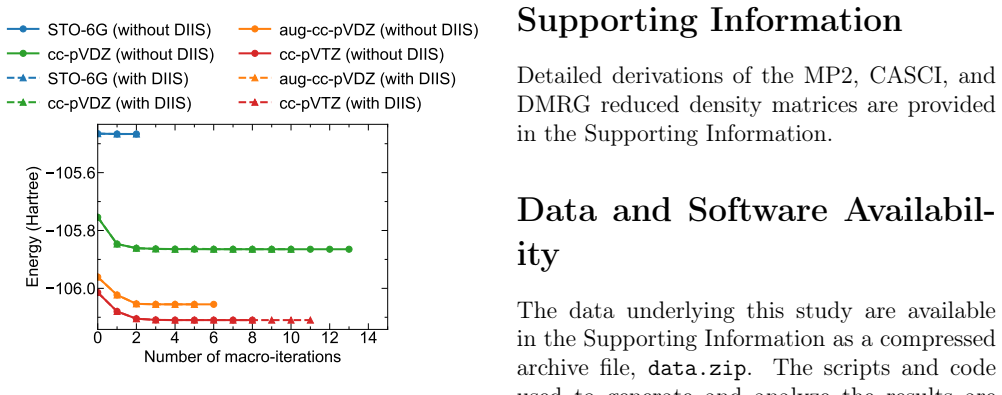
- A modified direct inversion in the iterative subspace accelerates macro-iteration convergence.
- Dynamical weighting improves state-averaged excited-state calculations.
Where Pith is reading between the lines
- This approach might extend to other correlated methods beyond those tested by supplying appropriate density matrices.
- Improved orbital optimization could lead to more reliable excited-state calculations in larger molecules where local minima are common.
- Since it avoids direct Hamiltonian access, it may integrate more easily with approximate solvers that only output density matrices.
Load-bearing premise
That reduced density matrices from the solver contain enough information to guide the orbital optimizer to better stationary points without additional wavefunction details or Hamiltonian elements.
What would settle it
Running both conventional CASSCF and the constrained optimizer on the same molecular system and finding that the constrained method does not yield a lower energy stationary point than the conventional one.
Figures
read the original abstract
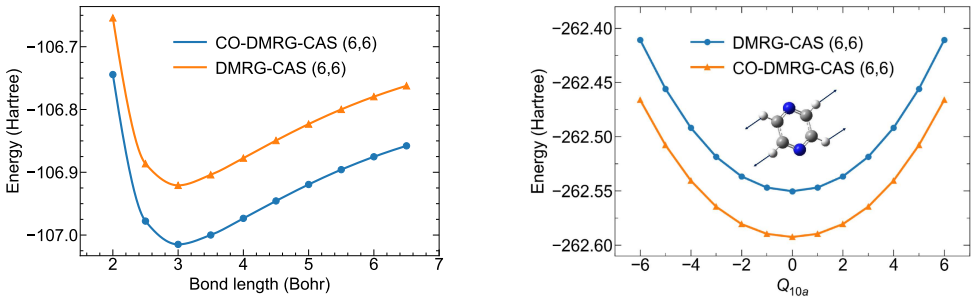
We present a modular constrained-orbital-optimization framework for quantum chemistry. The formulation separates the correlated electronic-structure solver from the orbital optimizer: the solver supplies one- and two-particle reduced density matrices, while the molecular orbitals are updated on the orthonormality-constrained Stiefel manifold with an implicit steepest-descent algorithm. Because the orbital optimizer only requires reduced density matrices, MP2, CASCI, and DMRG can be treated within the same interface. For CASCI solvers, the approach is closely related to optimal-orbital full configuration interaction and CASSCF\cite{helgaker_MulticonfigurationalSelfConsistentField_2000a}, but uses a solver-independent constrained-optimization update rather than CAS-specific orbital-rotation equations. When conventional CASSCF orbital-rotation iterations converge to higher-energy local solutions, CO-CAS can recover lower-energy stationary solutions. We also introduce a modified direct inversion in the iterative subspace procedure to accelerate macro-iteration convergence and a dynamical-weighting scheme to improve state-averaged excited-state calculations. Applications to LiF, H$_2$O, and pyrazine show that orbital optimization lowers energies relative to fixed-orbital MP2, CASCI, and DMRG references while improving convergence and potential-energy-curve smoothness.
Editorial analysis
A structured set of objections, weighed in public.
Referee Report
Summary. The manuscript presents a modular constrained-orbital-optimization (CO) framework that decouples the correlated electronic-structure solver from the orbital optimizer. The solver supplies only the one- and two-particle reduced density matrices while the orbitals are updated on the Stiefel manifold via an implicit steepest-descent algorithm; a modified DIIS accelerator and dynamical-weighting scheme are also introduced. The approach is applied to MP2, CASCI, and DMRG solvers and is claimed to recover lower-energy stationary points than conventional CASSCF orbital-rotation iterations on LiF, H_{2}O, and pyrazine while producing smoother potential-energy curves.
Significance. If the modularity and performance claims are substantiated, the framework would supply a uniform, solver-agnostic route to orbital optimization that can escape local minima encountered by standard CASSCF and improve convergence across multiple correlated methods. The explicit separation of RDM provision from the manifold-constrained update is a potentially reusable design pattern in multireference quantum chemistry.
major comments (1)
- [Abstract] Abstract: the assertion that 'the orbital optimizer only requires reduced density matrices' is inconsistent with the stated algorithm. Any first-order method on the Stiefel manifold must evaluate either the energy E = Tr(hD) + ½ Tr(gΓ) or its Riemannian gradient; both contractions require the AO one- and two-electron integrals (h, g) in addition to the supplied RDMs. This directly weakens the central claim of a fully solver-independent interface that needs 'no direct access' to the Hamiltonian.
Simulated Author's Rebuttal
We thank the referee for their careful reading of the manuscript and for identifying an important point of clarification regarding the solver-orbital optimizer interface. We address the single major comment below and will make the requested revision to improve accuracy.
read point-by-point responses
-
Referee: [Abstract] Abstract: the assertion that 'the orbital optimizer only requires reduced density matrices' is inconsistent with the stated algorithm. Any first-order method on the Stiefel manifold must evaluate either the energy E = Tr(hD) + ½ Tr(gΓ) or its Riemannian gradient; both contractions require the AO one- and two-electron integrals (h, g) in addition to the supplied RDMs. This directly weakens the central claim of a fully solver-independent interface that needs 'no direct access' to the Hamiltonian.
Authors: We agree that the orbital optimizer requires the AO one- and two-electron integrals (h, g) in addition to the RDMs supplied by the solver, since the energy or Riemannian gradient on the Stiefel manifold is obtained via the contractions E = Tr(hD) + ½ Tr(gΓ). The modularity claim refers specifically to the fact that the correlated solver (MP2, CASCI, or DMRG) is completely decoupled from the orbital-optimization loop: it only furnishes the RDMs and has no knowledge of the manifold constraints or the orbital-update algorithm. The integrals remain inside the orbital-optimizer module and are therefore solver-independent. Nevertheless, the abstract phrasing that the optimizer 'only requires reduced density matrices' is imprecise. We will revise the abstract (and the corresponding sentence in the introduction) to state explicitly that the optimizer requires the RDMs from the solver together with the one- and two-electron integrals, thereby removing any implication of a Hamiltonian-free interface. revision: yes
Circularity Check
No significant circularity detected
full rationale
The paper introduces a modular orbital optimizer on the Stiefel manifold driven by supplied 1- and 2-RDMs, with the update equations and convergence claims resting on standard constrained-optimization machinery and an external citation to Helgaker et al. for conventional CASSCF. No load-bearing step reduces by construction to a fitted parameter, self-citation chain, or definitional equivalence; the reported improvements on LiF, H2O, and pyrazine are presented as empirical outcomes of the algorithm rather than tautological restatements of its inputs. The derivation chain is therefore self-contained.
Axiom & Free-Parameter Ledger
Reference graph
Works this paper leans on
-
[1]
The Complete Active Space
Roos, Bj. The Complete Active Space. International Journal of Quantum Chemistry , volume =
-
[2]
Gradients and Non-Adiabatic Derivative Coupling Terms for Spin-Orbit Wavefunctions -
-
[3]
Second-Order Perturbation Theory with a Complete Active Space Self-Consistent Field Reference Function , author =. J. Chem. Phys. , volume =
-
[4]
The Density Matrix Renormalization Group in Chemistry and Molecular Physics:
Baiardi, Alberto and Reiher, Markus , year = 2020, journal =. The Density Matrix Renormalization Group in Chemistry and Molecular Physics:
2020
-
[5]
, year = 1988, journal =
Barzilai, Jonathan and Borwein, Jonathan M. , year = 1988, journal =. Two-
1988
-
[6]
Gradients and
Belcher, Lachlan , year = 2011, pages =. Gradients and
2011
-
[7]
Quadratically Convergent Algorithm for Orbital Optimization in the Orbital-Optimized Coupled-Cluster Doubles Method and in Orbital-Optimized Second-Order
Bozkaya, U. Quadratically Convergent Algorithm for Orbital Optimization in the Orbital-Optimized Coupled-Cluster Doubles Method and in Orbital-Optimized Second-Order. J. Chem. Phys. , volume =
-
[8]
Chan, Garnet Kin-Lic and Sharma, Sandeep , year = 2011, journal =. The
2011
-
[9]
Cremer, Dieter , year = 2011, journal =. M ller--. doi:10.1002/wcms.58 , copyright =
-
[10]
Analytical Gradients and Derivative Couplings for Dynamically Weighted Complete Active Space Self-Consistent Field , author =. J. Chem. Phys. , volume =
-
[11]
Glover, W. J. , year = 2014, journal =. Communication:
2014
-
[12]
and Mukamel, Shaul , year = 2023, journal =
Gu, Bing and Gu, Yonghao and Chernyak, Vladimir Y. and Mukamel, Shaul , year = 2023, journal =. Cavity. doi:10.1021/acs.accounts.3c00280 , copyright =
-
[13]
Gu, Bing , year = 2025, journal =. Toward. doi:10.1021/acs.jpclett.4c02896 , copyright =
-
[14]
Gu, Bing , year = 2024, journal =. Nonadiabatic. doi:10.1021/acs.jctc.3c01317 , copyright =
-
[15]
Gu, Bing and Ren, Jiajun and Zhang, Junzhe , year = 2025, journal =. Quantum. doi:10.1021/acs.jctc.5c00029 , copyright =
-
[16]
and Knowles, Peter J
Kreplin, David A. and Knowles, Peter J. and Werner, Hans-Joachim , year = 2020, journal =
2020
-
[17]
and Knowles, Peter J
Kreplin, David A. and Knowles, Peter J. and Werner, Hans-Joachim , year = 2019, journal =. Second-Order
2019
-
[18]
Regularized
Lee, Joonho and. Regularized. J. Chem. Theory Comput. , volume =
-
[19]
Li, Yingzhou and Lu, Jianfeng , year = 2020, journal =. Optimal. doi:10.1021/acs.jctc.0c00613 , copyright =
-
[20]
Lochan, Rohini C. and. Orbital-Optimized Opposite-Spin Scaled Second-Order Correlation:. J. Chem. Phys. , volume =
-
[21]
Optim Lett , volume =
Implicit Steepest Descent Algorithm for Optimization with Orthogonality Constraints , author =. Optim Lett , volume =
-
[22]
the Case of Scf Iteration , author =
Convergence Acceleration of Iterative Sequences. the Case of Scf Iteration , author =. Chemical Physics Letters , volume =
-
[23]
A General Automatic Method for Optimal Construction of Matrix Product Operators Using Bipartite Graph Theory , author =. J. Chem. Phys. , volume =
-
[24]
A Simple Method for the Evaluation of the Second-Order-Perturbation Energy from External Double-Excitations with a
Roos, Bj. A Simple Method for the Evaluation of the Second-Order-Perturbation Energy from External Double-Excitations with a. Chemical Physics , volume =
-
[25]
Annals of Physics , series =
The Density-Matrix Renormalization Group in the Age of Matrix Product States , author =. Annals of Physics , series =
-
[26]
Spin-Adapted Density Matrix Renormalization Group Algorithms for Quantum Chemistry , author =. J. Chem. Phys. , volume =
-
[27]
Pyrazine Excited States Revisited Using the Extended Multi-State Complete Active Space Second-Order Perturbation Method , author =. Phys. Chem. Chem. Phys. , volume =
-
[28]
Siegbahn, Per E. M. and Alml. The Complete Active Space. J. Chem. Phys. , volume =
-
[29]
Siegbahn, Per E. M. , year = 1984, journal =. A New Direct
1984
-
[30]
and Blunt, Nick S
Sun, Qiming and Berkelbach, Timothy C. and Blunt, Nick S. and Booth, George H. and Guo, Sheng and Li, Zhendong and Liu, Junzi and McClain, James D. and Sayfutyarova, Elvira R. and Sharma, Sandeep and Wouters, Sebastian and Chan, Garnet Kin-Lic , year = 2018, journal =
2018
-
[31]
Xie, Yujuan and Yang, Yukun and Zhu, Xiaotong and Chen, Ahai and Gu, Bing , year = 2024, journal =. Nondirect-. doi:10.1021/acs.jctc.4c00673 , copyright =
-
[32]
doi:10.48550/arXiv.2501.05003 , archiveprefix =
Path-Ordered Linked Product Approximation to the Global Electronic Overlap Matrix , author =. doi:10.48550/arXiv.2501.05003 , archiveprefix =. 2501.05003 , primaryclass =
-
[33]
The Density Matrix Renormalization Group Self-Consistent Field Method:
Zgid, Dominika and Nooijen, Marcel , year = 2008, journal =. The Density Matrix Renormalization Group Self-Consistent Field Method:
2008
-
[34]
Obtaining the Two-Body Density Matrix in the Density Matrix Renormalization Group Method , author =. J. Chem. Phys. , volume =
-
[35]
Zhu, Xiaotong and Gu, Bing , year = 2024, journal =. Making. doi:10.1021/acs.jpclett.4c01688 , copyright =
-
[36]
doi:10.1063/1674-0068/cjcp2510161 , copyright =
Xie, Yujuan and Zhu, Xiaotong and Gu, Bing , year = 2026, journal =. doi:10.1063/1674-0068/cjcp2510161 , copyright =
-
[37]
Edelman, Alan and Arias, T. A. and Smith, Steven T. , year = 1998, number =. The. doi:10.48550/arXiv.physics/9806030 , archiveprefix =. physics/9806030 , publisher =
work page internal anchor Pith review Pith/arXiv arXiv doi:10.48550/arxiv.physics/9806030 1998
-
[38]
A Framework of Constraint Preserving Update Schemes for Optimization on
Jiang, Bo and Dai, Yu-Hong , year = 2015, journal =. A Framework of Constraint Preserving Update Schemes for Optimization on
2015
-
[39]
A Feasible Method for Optimization with Orthogonality Constraints , author =. Math. Program. , volume =
-
[40]
Density Matrix Formulation for Quantum Renormalization Groups , author =. Phys. Rev. Lett. , volume =. doi:10.1103/PhysRevLett.69.2863 , copyright =
-
[41]
Density-Matrix Algorithms for Quantum Renormalization Groups , author =. Phys. Rev. B , volume =
-
[42]
Weser, Oskar and Liebermann, Niklas and Kats, Daniel and Alavi, Ali and Li Manni, Giovanni , year = 2022, journal =. Spin. doi:10.1021/acs.jpca.2c01338 , copyright =
-
[43]
2012 , publisher=
Modern quantum chemistry: introduction to advanced electronic structure theory , author=. 2012 , publisher=
2012
-
[44]
SIAM Journal on Optimization , volume=
A Riemannian BFGS method without differentiated retraction for nonconvex optimization problems , author=. SIAM Journal on Optimization , volume=. 2018 , publisher=
2018
-
[45]
2008 , publisher=
Optimization algorithms on matrix manifolds , author=. 2008 , publisher=
2008
-
[46]
Angeli, Celestino and Cimiraglia, Renzo and Malrieu, Jean-Paul , year = 2001, journal =
2001
-
[47]
A Quasidegenerate Formulation of the Second Order N-Electron Valence State Perturbation Theory Approach , author =. J. Chem. Phys. , volume =
-
[48]
Quantum-Information Analysis of Electronic States of Different Molecular Structures , author =. Phys. Rev. A , volume =
-
[49]
Analytic Energy Gradients for the Orbital-Optimized Second-Order
Bozkaya, U. Analytic Energy Gradients for the Orbital-Optimized Second-Order. J. Chem. Phys. , volume =
-
[50]
Orbital-Optimized
Bozkaya, U. Orbital-Optimized. J. Chem. Phys. , volume =
-
[51]
Orbital-
Bozkaya, U. Orbital-. J. Chem. Theory Comput. , volume =
-
[52]
An Algorithm for Large Scale Density Matrix Renormalization Group Calculations , author =. J. Chem. Phys. , volume =
-
[53]
Highly Correlated Calculations with a Polynomial Cost Algorithm:
Chan, Garnet Kin-Lic and. Highly Correlated Calculations with a Polynomial Cost Algorithm:. J. Chem. Phys. , volume =
-
[54]
Matrix Product Operators, Matrix Product States, and Ab Initio Density Matrix Renormalization Group Algorithms , author =. J. Chem. Phys. , volume =
-
[55]
The Multi-State
Finley, James and Malmqvist, Per-. The Multi-State. Chemical Physics Letters , volume =
-
[56]
Orbital Optimization in the Density Matrix Renormalization Group, with Applications to Polyenes and
Ghosh, Debashree and Hachmann, Johannes and Yanai, Takeshi and Chan, Garnet Kin-Lic , year = 2008, journal =. Orbital Optimization in the Density Matrix Renormalization Group, with Applications to Polyenes and
2008
-
[57]
Hartree--Fock Theory , booktitle =
Helgaker, Trygve and J. Hartree-. Molecular. doi:10.1002/9781119019572.ch10 , chapter =
-
[58]
Helgaker, Trygve and J. Multiconfigurational. Molecular. doi:10.1002/9781119019572.ch12 , chapter =
-
[59]
Chemical Physics Letters , volume =
A New Determinant-Based Full Configuration Interaction Method , author =. Chemical Physics Letters , volume =
-
[60]
Correlated Ab
Kossmann, Simone and Neese, Frank , year = 2010, journal =. Correlated Ab
2010
-
[61]
and Scuseria, Gustavo E
Kudin, Konstantin N. and Scuseria, Gustavo E. and Canc. A Black-Box Self-Consistent Field Convergence Algorithm:. J. Chem. Phys. , volume =
-
[62]
Conjugate. Numerical. doi:10.1007/0-387-22742-3_5 , isbn =
-
[63]
Determinant Based Configuration Interaction Algorithms for Complete and Restricted Configuration Interaction Spaces , author =. J. Chem. Phys. , volume =
-
[64]
Pulay, P. , year = 1982, journal =. Improved. doi:10.1002/jcc.540030413 , copyright =
-
[65]
A Complete Active Space
Roos, Bj. A Complete Active Space. Chemical Physics , volume =
-
[66]
Regularized Orbital-Optimized Second-Order Perturbation Theory , author =. J. Chem. Phys. , volume =
-
[67]
and Bogdanov, Nikolay A
Sun, Qiming and Zhang, Xing and Banerjee, Samragni and Bao, Peng and Barbry, Marc and Blunt, Nick S. and Bogdanov, Nikolay A. and Booth, George H. and Chen, Jia and Cui, Zhi-Hao and Eriksen, Janus J. and Gao, Yang and Guo, Sheng and Hermann, Jan and Hermes, Matthew R. and Koh, Kevin and Koval, Peter and Lehtola, Susi and Li, Zhendong and Liu, Junzi and Ma...
2020
-
[68]
A Quadratically Convergent
Werner, Hans-Joachim and Meyer, Wilfried , year = 1981, journal =. A Quadratically Convergent
1981
-
[69]
A Quadratically Convergent Multiconfiguration--Self-consistent Field Method with Simultaneous Optimization of Orbitals and
Werner, Hans-Joachim and Meyer, Wilfried , year = 1980, journal =. A Quadratically Convergent Multiconfiguration--Self-consistent Field Method with Simultaneous Optimization of Orbitals and
1980
-
[70]
The Density Matrix Renormalization Group for Ab Initio Quantum Chemistry , author =. Eur. Phys. J. D , volume =
-
[71]
and Lee, Seunghoon and Cui, Zhi-Hao and Zhu, Tianyu and Sun, Chong and Peng, Linqing and Peng, Ruojing and Liao, Ke and T
Zhai, Huanchen and Larsson, Henrik R. and Lee, Seunghoon and Cui, Zhi-Hao and Zhu, Tianyu and Sun, Chong and Peng, Linqing and Peng, Ruojing and Liao, Ke and T. Block2:. J. Chem. Phys. , volume =
discussion (0)
Sign in with ORCID, Apple, or X to comment. Anyone can read and Pith papers without signing in.