REVIEW 3 major objections 6 minor 64 references
FloE: On-the-Fly MoE Inference on Memory-constrained GPU
T0 review · 3 major / 6 minor · reviewed 2026-08-15 · deepseek-v4-flash
Pith's one-line read FloE compresses MoE experts 9.3x and runs on 11GB GPU
desk verdict The headline tradeoff—91% of full-GPU speed with only 4.4–7.6% quality loss—is not measured as a single configuration, so the paper's central claim is currently over-stated, though the underlying system ideas are solid. read the letter →
The pith
A machine-rendered reading of the paper's core claim, the machinery that carries it, and where it could break.
The reading
What carries the argument
The system rests on three components: hybrid expert compression—contextual activation sparsification $S_t$ applied to $W_{gate}$ and $W_{down}$ plus INT2 half-quadratic quantization applied to $W_{up}$, so only about 10% of gate/down weights are transferred; dual sparsity predictors—an inter-expert learning-based MLP that forecasts the next layer's active experts and a parameter-free reuse-based intra-expert predictor that computes an approximate up-projection output using the current hidden state and the next layer's up matrix to derive channel masks; and an efficient sparse GEMV kernel with compact asynchronous DRAM-to-VRAM transfer that packs selected channels into contiguous chunks and uses SIMD and multithreaded pinned-memory copies. Together these turn expert loading from a serial I/O stall into an overlapped prefetch pipeline.
What would settle it
On an MoE model with lower residual-stream similarity between consecutive layers (or on Mixtral at layer 0, where similarity is 0.44), run FloE with the reuse-based predictor and measure end-to-end tokens-per-second and downstream accuracy; if the system no longer stays near the GPU-resident baseline's speed or exceeds the reported 4.4-7.6% accuracy loss, the predictor assumption is what the result depends on.
Extended reading notes
Core claim
The paper discovers that compression sensitivity is not uniform across the three projection matrices inside an expert. Sparsifying the output of the up projection (equivalently, the input to the down projection) is the least harmful way to introduce contextual sparsity: a formal result, stated as Theorem 3.1, orders the losses as $L_{down} \leq L_{up} < L_{gate}$, and experiments confirm that down-projection-input pruning at 90% sparsity keeps perplexity nearly flat, while pruning the SiLU gate outputs degrades badly. The up projection also tolerates ultra-low-bit quantization better than the gate or down projections, so FloE assigns quantization to the up matrix and context-dependent sparsity to the gate and down matrices. On top of this, hidden states entering consecutive MoE layers have average cosine similarity above 0.95, so the next layer's expert routing and channel masks can be predicted from the current layer's hidden state, enabling prefetching and transfer-computation pipelining.
Load-bearing premise
The load-bearing premise is that the hidden state entering one MoE layer closely resembles the hidden state entering the next layer (average cosine similarity above 0.95), so the next layer's expert choices and channel sparsity can be predicted from the current layer's hidden state; the paper itself records an outlier at 0.44 for layer 0.
Editorial extensions
If this is right
- MoE models can be served in real time on consumer GPUs with around 11GB VRAM instead of requiring roughly 94GB of resident FP16 storage, without waiting out PCIe transfers.
- Per-expert parameter payloads drop 9.3x, so PCIe transfer time no longer dominates decode latency and prefetching hides most of the remaining I/O overhead.
- Longer generation sequences amortize the per-layer expert replacement overhead, so tokens-per-second improves as output length grows.
- With more VRAM (up to 21-24GB), more MoE layers can be cached, reducing expert reloads caused by misprediction and closing the gap to a fully GPU-resident model.
Reading between the lines
- Beyond the paper's claims: if the layer-to-layer hidden-state similarity is the load-bearing property, then the measured 0.44-similarity outlier at layer 0 implies the predictors should be per-layer or fall back to the true router when similarity is low.
- Beyond the paper's claims: the headline 48.7x speedup compares against an uncompressed FP16 offloading baseline; the paper's own resident-model bound is 91% of native speed, so the practical claim is near-native latency at a fraction of the memory rather than a 48.7x blanket gain over all systems.
- Beyond the paper's claims: the sensitivity ordering (sparsify gate/down, quantize up) could serve as a design rule for other MoE architectures, and should be tested on models with different activation functions, expert counts, or layer depths.
- Beyond the paper's claims: a natural extension is to evaluate the two predictors on other MoE models, since the paper validates the compression sensitivity across several architectures but does not validate the reuse-based predictor's accuracy beyond Mixtral-8x7B.
Signed reviews
Editorial analysis
A structured set of objections, weighed in public.
Referee Report
Summary. This paper presents FloE, an inference system for MoE LLMs on memory-constrained GPUs. FloE combines (i) contextual sparsification of the gate and down projections of each expert, pruning channels corresponding to low-magnitude up-projection activations; (ii) INT2 HQQ quantization of the up projection; (iii) an inter-expert learned predictor and a parameter-free reuse-based intra-expert predictor that use the current layer's hidden state to prefetch the compressed weights needed by the next layer; and (iv) a Triton sparse GEMV kernel and a compact asynchronous DRAM-to-VRAM transfer mechanism. On Mixtral-8x7B the authors report 9.3x per-expert compression, deployment with 11GB VRAM, 48.7x speedup over DeepSpeed-MII (2.60x over Mixtral-Offloading, 3.14x over Fiddler, and 91% of Mixtral-GPU's throughput), and 4.4-7.6 percentage-point average accuracy degradation on seven downstream tasks. The appendix includes a formal theorem (Theorem A.2) comparing the expected squared error of pruning gate, up, or down activations under Gaussian and shifted-exponential distributional assumptions.
Significance. If substantiated, the work would be a useful contribution for latency-sensitive MoE serving on consumer GPUs: the idea of exploiting intra-expert sparsity to shrink the offloaded expert footprint is well motivated, and the measured speedups over external baselines are large. The paper also ships a nontrivial analytical result and a broad sensitivity study across several MoE models and GPU types. However, the central claim currently overreaches: the quality figures are obtained without the dual predictors, while the wall-clock figures are obtained with them, so the headline speed-quality tradeoff has not been measured in a single configuration. The missing memory accounting for the intra-expert predictor and the lack of variance reporting further weaken the system-level claim. These gaps are fixable with additional experiments and analysis, so the paper is a candidate for major revision rather than rejection.
major comments (3)
- [§4.2 / Table 3] The downstream accuracy results reported for FloE-80% and FloE-90% (Table 3, Figure 10) are computed using true activation masks obtained from the actual inputs, not from the reuse-based intra-expert predictor of Section 3.3.2; the 4.4%-7.6% degradation quoted in the abstract and in Section 4.2 therefore does not apply to the predictor-enabled system whose end-to-end speed is measured in Section 4.1. Since Figure 4 reports only 0.95 average recall with no precision and no per-layer breakdown (and a cosine-similarity outlier of 0.44 at layer 0), the effect of the 5% miss rate on output quality and on DRAM fetches is unmeasured, so the paper's headline speed-quality tradeoff has not been established for a single FloE configuration. Please add an end-to-end accuracy measurement on the same system used for the wall-clock results, or clearly separate the compression-only quality claim from the system-level claim.
- [§3.3.2] The reuse-based predictor computes x_i W_up^{(i+1)} to predict the sparsity pattern of layer i+1, but the paper never accounts for where the next layer's up-projection matrix resides. If W_up^{(i+1)} is resident in VRAM for all experts and layers, the 11GB memory budget needs a precise accounting of its cost (the INT2 up matrices alone are roughly 3.7GB for Mixtral-8x7B using the paper's own dimensions). If it is fetched from DRAM, the predictor's computation is serialized with the very PCIe transfer the design aims to hide. Either clarify the memory layout or measure the predictor's time and memory overhead explicitly in the end-to-end results.
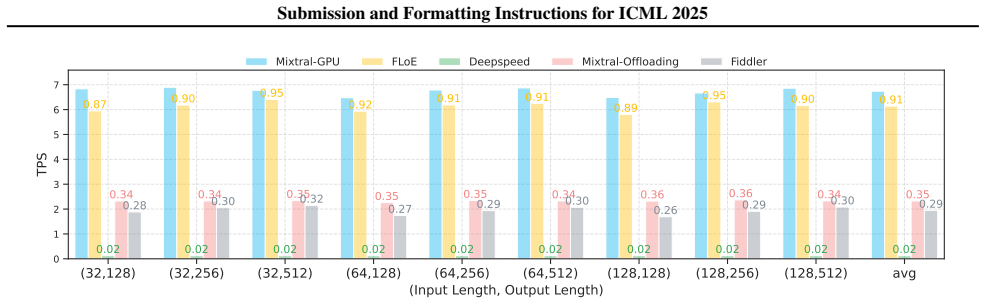
- [§4.1 / Figure 6] The end-to-end speedup numbers are reported as averages over five runs without error bars or variance, and the evaluation uses a single model (Mixtral-8x7B) and a single prompt source (ShareGPT). Given that the predictor's recall is reported as 0.95 and the speedup is highly sensitive to misprediction-triggered refetches, the absence of variance reporting makes it difficult to judge whether the 91%-of-Mixtral-GPU claim is robust. Please provide per-configuration variability and, ideally, results on at least one additional MoE model.
minor comments (6)
- [Figure 4] The caption of Figure 4 is inconsistent with the text: Sections 3.3.1 and 3.3.2 refer to an orange line for inter-expert precision and a red line for intra-expert recall, while the caption says the yellow line is intra-expert precision and the red line is inter-expert recall. Please correct the caption to match the text.
- [Theorem A.2] Equation (20) is labeled L_up, but its expression (matching Lemma A.5 and the proof) is for L_gate; please relabel it as L_gate.
- [§4.1 / Figure 7] The legend 'L.O. w/o L.O.' in Figure 7 is undefined; please spell out 'layout optimization' in the caption.
- [§4.1] The baseline name appears as 'Fildder' once and 'Fiddler' elsewhere; please unify the spelling.
- [References] The reference to ShareGPT lists the year as '20023'; this is a typo and should be corrected.
- [§4] For a systems paper with many engineering components, the absence of a code release or a detailed reproducibility statement makes the results hard to verify; please consider releasing the implementation or providing a more complete specification of the predictor training and threshold calibration procedures.
Circularity Check
No circular derivation: speed and quality numbers come from external benchmarks; the only weakness is a missing end-to-end accuracy measurement, which is an evaluation gap rather than a circular reduction.
full rationale
The paper's central claims do not reduce to their inputs. The 9.3x per-expert compression follows arithmetically from the stated INT2 W_up and 80%/90% sparsity of W_gate/W_down, and the speedups are measured against external baselines (DeepSpeed-MII, Mixtral-Offloading, Fiddler, and a GPU-resident Mixtral-GPU), so they are not fitted artifacts. The sparsity threshold t is calibrated on the C4 corpus, but the accuracy numbers are evaluated on WikiText-2 and seven held-out downstream tasks, so reporting degradation at a chosen sparsity ratio is standard operating-point evaluation, not a fitted prediction. Theorem 3.1 is a post hoc theoretical interpretation: its distributional assumptions (shifted-exponential gate activations with lambda=11, c=0.28) are fitted to activation data, but the ranking L_up < L_gate is proved from those assumptions rather than assumed, and the empirical ranking in Figure 3(a) is measured independently. There are no load-bearing self-citations and no imported uniqueness theorem. The one substantive weakness is that the abstract's 'all with only a 4.4%-7.6% average performance degradation' attaches compression-only accuracy results (Table 3, FloE-80%/FloE-90%, computed from true activation masks) to the end-to-end speed claim measured with the dual predictors in Section 4.1; the integrated predictor-based system is never evaluated for quality in the same configuration. This is a missing end-to-end measurement and a correctness/validity concern, not a circular reduction, so it does not raise the circularity score. (The abstract's 4.4%-7.6% figure is also not directly reproducible from Table 3's 6.1%/10.6% relative degradations, but that inconsistency is likewise a reporting issue, not circularity.)
Assumptions & free parameters
free parameters (4)
- Per-expert sparsity threshold t_ij =
Not reported; derived from C4 activations for target sparsity k
- Target sparsity ratio k =
90% for the 9.3x compression claim (also 80% in FloE-80)
- Shifted-exponential fit parameters (lambda, c) in Theorem A.2 =
lambda=11, c=0.28
- Inter-expert predictor weights =
32K to 2M parameters depending on layer depth
assumptions (5)
- domain assumption Hidden states input to the router and up projection in consecutive MoE layers exhibit high cosine similarity (>0.95 on average).
- domain assumption Experts in sparsely activated MoE models maintain high internal activation sparsity that persists across inputs and layers.
- domain assumption The up projection is the least sensitive to ultra-low-bit quantization among the three expert projections.
- ad hoc to paper Theorem A.2 distributional assumptions: W_down entries i.i.d. Gaussian, a_gate shifted exponential with parameters lambda and c, a_up Gaussian and independent; added for analytical tractability.
- domain assumption The next layer's up-projection matrix needed by the intra-expert predictor is accessible to the GPU without violating the offloading memory budget.
Cite this review
Pith. "Pith review of FloE: On-the-Fly MoE Inference on Memory-constrained GPU." pith.science (2026). https://pith.science/paper/WSOUZLYL
@misc{pith2026250505950,
  author       = {Pith},
  title        = {Pith review of: FloE: On-the-Fly MoE Inference on Memory-constrained GPU},
  year         = {2026},
  howpublished = {\url{https://pith.science/paper/WSOUZLYL}},
  note         = {Machine review of arXiv:2505.05950}
}
abstract
With the widespread adoption of Mixture-of-Experts (MoE) models, there is a growing demand for efficient inference on memory-constrained devices. While offloading expert parameters to CPU memory and loading activated experts on demand has emerged as a potential solution, the large size of activated experts overburdens the limited PCIe bandwidth, hindering the effectiveness in latency-sensitive scenarios. To mitigate this, we propose FloE, an on-the-fly MoE inference system on memory-constrained GPUs. FloE is built on the insight that there exists substantial untapped redundancy within sparsely activated experts. It employs various compression techniques on the expert's internal parameter matrices to reduce the data movement load, combined with low-cost sparse prediction, achieving perceptible inference acceleration in wall-clock time on resource-constrained devices. Empirically, FloE achieves a 9.3x compression of parameters per expert in Mixtral-8x7B; enables deployment on a GPU with only 11GB VRAM, reducing the memory footprint by up to 8.5x; and delivers a 48.7x inference speedup compared to DeepSpeed-MII on a single GeForce RTX 3090 - all with only a 4.4$\%$ - 7.6$\%$ average performance degradation.
Figures


Figures from the paper (8 more)




Reference graph
Works this paper leans on
-
[1]
Abdin, M., Aneja, J., Awadalla, H., Awadallah, A., Awan, A. A., Bach, N., Bahree, A., Bakhtiari, A., Bao, J., Behl, H., Benhaim, A., Bilenko, M., Bjorck, J., Bubeck, S., Cai, M., Cai, Q., Chaudhary, V., Chen, D., Chen, D., Chen, W., Chen, Y.-C., Chen, Y.-L., Cheng, H., Chopra, P., Dai, X., Dixon, M., Eldan, R., Fragoso, V., Gao, J., Gao, M., Gao, M., Garg...
arXiv 2024
-
[2]
J., Javaheripi, M., Kauffmann, P., Lee, J
Abdin, M., Aneja, J., Behl, H., Bubeck, S., Eldan, R., Gunasekar, S., Harrison, M., Hewett, R. J., Javaheripi, M., Kauffmann, P., Lee, J. R., Lee, Y. T., Li, Y., Liu, W., Mendes, C. C. T., Nguyen, A., Price, E., de Rosa, G., Saarikivi, O., Salim, A., Shah, S., Wang, X., Ward, R., Wu, Y., Yu, D., Zhang, C., and Zhang, Y. Phi-4 technical report, 2024 b . UR...
arXiv 2024
-
[3]
C., Rastegari, M., and Farajtabar, M
Alizadeh, K., Mirzadeh, I., Belenko, D., Khatamifard, K., Cho, M., Del Mundo, C. C., Rastegari, M., and Farajtabar, M. Llm in a flash: Efficient large language model inference with limited memory. arXiv preprint arXiv:2312.11514, 2023
arXiv 2023
-
[4]
Y., Rajbhandari, S., Awan, A
Aminabadi, R. Y., Rajbhandari, S., Awan, A. A., Li, C., Li, D., Zheng, E., Ruwase, O., Smith, S., Zhang, M., Rasley, J., et al. Deepspeed-inference: enabling efficient inference of transformer models at unprecedented scale. In SC22: International Conference for High Performance Computing, Networking, Storage and Analysis, pp.\ 1--15. IEEE, 2022
2022
-
[5]
Badri, H. and Shaji, A. Half-quadratic quantization of large machine learning models, November 2023. URL https://mobiusml.github.io/hqq_blog/
work page 2023
-
[6]
MoE-Lightning: High-Throughput MoE Inference on Memory-constrained GPUs
Cao, S., Liu, S., Griggs, T., Schafhalter, P., Liu, X., Sheng, Y., Gonzalez, J. E., Zaharia, M., and Stoica, I. Moe-lightning: High-throughput moe inference on memory-constrained gpus. arXiv preprint arXiv:2411.11217, 2024
work page Pith review arXiv 2024
-
[7]
Active multi-task representation learning
Chen, Y., Jamieson, K., and Du, S. Active multi-task representation learning. In ICML, volume 162 of Proceedings of Machine Learning Research, pp.\ 3271--3298. PMLR, 17--23 Jul 2022. URL https://proceedings.mlr.press/v162/chen22j.html
work page 2022
-
[8]
Boolq: Exploring the surprising difficulty of natural yes/no questions, 2019
Clark, C., Lee, K., Chang, M.-W., Kwiatkowski, T., Collins, M., and Toutanova, K. Boolq: Exploring the surprising difficulty of natural yes/no questions, 2019. URL https://arxiv.org/abs/1905.10044
arXiv 2019
Show all 64 references
-
[9]
Think you have solved question answering? try arc, the ai2 reasoning challenge, 2018
Clark, P., Cowhey, I., Etzioni, O., Khot, T., Sabharwal, A., Schoenick, C., and Tafjord, O. Think you have solved question answering? try arc, the ai2 reasoning challenge, 2018. URL https://arxiv.org/abs/1803.05457
2018 arXiv
-
[10]
D eep S eek M o E : Towards ultimate expert specialization in mixture-of-experts language models
Dai, D., Deng, C., Zhao, C., Xu, R., Gao, H., Chen, D., Li, J., Zeng, W., Yu, X., Wu, Y., Xie, Z., Li, Y., Huang, P., Luo, F., Ruan, C., Sui, Z., and Liang, W. D eep S eek M o E : Towards ultimate expert specialization in mixture-of-experts language models. In Ku, L.-W., Marti...
2024 doi
-
[11]
Deepseek-v2: A strong, economical, and efficient mixture-of-experts language model, 2024
DeepSeek-AI. Deepseek-v2: A strong, economical, and efficient mixture-of-experts language model, 2024
2024
-
[12]
Deepseek-r1: Incentivizing reasoning capability in llms via reinforcement learning, 2025
DeepSeek-AI. Deepseek-r1: Incentivizing reasoning capability in llms via reinforcement learning, 2025. URL https://arxiv.org/abs/2501.12948
2025 arXiv
-
[13]
S., Hu, W., Kakade, S
Du, S. S., Hu, W., Kakade, S. M., Lee, J. D., and Lei, Q. Few-shot learning via learning the representation, provably. arXiv preprint arXiv:2002.09434, 2020
2002 arXiv
-
[14]
The llama 3 herd of models, 2024
Dubey, A., Jauhri, A., Pandey, A., Kadian, A., Al-Dahle, A., Letman, A., Mathur, A., Schelten, A., Yang, A., Fan, A., Goyal, A., Hartshorn, A., Yang, A., Mitra, A., Sravankumar, A., Korenev, A., Hinsvark, A., Rao, A., Zhang, A., Rodriguez, A., and et al. The llama 3 herd of mo...
2024 arXiv
-
[15]
mixtral-offloading
dvmazur. mixtral-offloading. https://github.com/dvmazur/mixtral-offloading, 2023. Version v0.1.0, Accessed on: October 10, 2023
2023
- [16]
-
[17]
Switch transformers: Scaling to trillion parameter models with simple and efficient sparsity
Fedus, W., Zoph, B., and Shazeer, N. Switch transformers: Scaling to trillion parameter models with simple and efficient sparsity. Journal of Machine Learning Research, 23 0 (120): 0 1--39, 2022
2022
-
[18]
and Alistarh, D
Frantar, E. and Alistarh, D. Sparsegpt: Massive language models can be accurately pruned in one-shot. In ICML, pp.\ 10323--10337. PMLR, 2023
2023
-
[19]
A framework for few-shot language model evaluation, 07 2024
Gao, L., Tow, J., Abbasi, B., Biderman, S., Black, S., DiPofi, A., Foster, C., Golding, L., Hsu, J., Le Noac'h, A., Li, H., McDonell, K., Muennighoff, N., Ociepa, C., Phang, J., Reynolds, L., Schoelkopf, H., Skowron, A., Sutawika, L., Tang, E., Thite, A., Wang, B., Wang, K., a...
2024
-
[20]
Transformer feed-forward layers are key-value memories
Geva, M., Schuster, R., Berant, J., and Levy, O. Transformer feed-forward layers are key-value memories. In Moens, M.-F., Huang, X., Specia, L., and Yih, S. W.-t. (eds.), EMNLP, pp.\ 5484--5495, Online and Punta Cana, Dominican Republic, November 2021. Association for Computat...
2021 doi
-
[21]
Gradshteyn, I. S. and Ryzhik, I. M. Table of integrals, series, and products. Academic press, 2014
2014
-
[22]
Accelerate: Training and inference at scale made simple, efficient and adaptable
Gugger, S., Debut, L., Wolf, T., Schmid, P., Mueller, Z., Mangrulkar, S., Sun, M., and Bossan, B. Accelerate: Training and inference at scale made simple, efficient and adaptable. https://github.com/huggingface/accelerate, 2022
2022
-
[23]
J., and Li, Q
He, J., Wu, S., Wen, W., Xue, C. J., and Li, Q. Chess: Optimizing llm inference via channel-wise thresholding and selective sparsification, 2024. URL https://arxiv.org/abs/2409.01366
2024 arXiv
-
[24]
Measuring massive multitask language understanding, 2021
Hendrycks, D., Burns, C., Basart, S., Zou, A., Mazeika, M., Song, D., and Steinhardt, J. Measuring massive multitask language understanding, 2021. URL https://arxiv.org/abs/2009.03300
2021 arXiv
-
[25]
Pre-gated moe: An algorithm-system co-design for fast and scalable mixture-of-expert inference
Hwang, R., Wei, J., Cao, S., Hwang, C., Tang, X., Cao, T., and Yang, M. Pre-gated moe: An algorithm-system co-design for fast and scalable mixture-of-expert inference. In 2024 ACM/IEEE 51st Annual International Symposium on Computer Architecture (ISCA), pp.\ 1018--1031. IEEE, 2024
2024
-
[26]
Q., Sablayrolles, A., Roux, A., Mensch, A., Savary, B., Bamford, C., Chaplot, D
Jiang, A. Q., Sablayrolles, A., Roux, A., Mensch, A., Savary, B., Bamford, C., Chaplot, D. S., de las Casas, D., Hanna, E. B., Bressand, F., Lengyel, G., Bour, G., Lample, G., Lavaud, L. R., Saulnier, L., Lachaux, M.-A., Stock, P., Subramanian, S., Yang, S., Antoniak, S., Scao...
2024 arXiv
-
[27]
Johannes Welbl, Nelson F. Liu, M. G. Crowdsourcing multiple choice science questions. 2017
2017
-
[28]
Fiddler: Cpu-gpu orchestration for fast inference of mixture-of-experts models
Kamahori, K., Gu, Y., Zhu, K., and Kasikci, B. Fiddler: Cpu-gpu orchestration for fast inference of mixture-of-experts models. arXiv preprint arXiv:2402.07033, 2024
2024 arXiv
-
[29]
S wap M o E : Serving off-the-shelf M o E -based large language models with tunable memory budget
Kong, R., Li, Y., Feng, Q., Wang, W., Ye, X., Ouyang, Y., Kong, L., and Liu, Y. S wap M o E : Serving off-the-shelf M o E -based large language models with tunable memory budget. In ACL (Volume 1: Long Papers), August 2024
2024
-
[30]
CATS : Context-aware thresholding for sparsity in large language models
Lee, D., Lee, J., Zhang, G., Tiwari, M., and Mirhoseini, A. CATS : Context-aware thresholding for sparsity in large language models. In First Conference on Language Modeling, 2024 a . URL https://openreview.net/forum?id=v3w2a7EInO
2024
-
[31]
InfiniGen : Efficient generative inference of large language models with dynamic KV cache management
Lee, W., Lee, J., Seo, J., and Sim, J. InfiniGen : Efficient generative inference of large language models with dynamic KV cache management. In 18th USENIX Symposium on Operating Systems Design and Implementation (OSDI 24), pp.\ 155--172, Santa Clara, CA, July 2024 b . USENIX ...
2024
-
[32]
Training-free activation sparsity in large language models
Liu, J., Ponnusamy, P., Cai, T., Guo, H., Kim, Y., and Athiwaratkun, B. Training-free activation sparsity in large language models. arXiv preprint arXiv:2408.14690, 2024
2024 arXiv
-
[33]
Deja vu: Contextual sparsity for efficient llms at inference time
Liu, Z., Wang, J., Dao, T., Zhou, T., Yuan, B., Song, Z., Shrivastava, A., Zhang, C., Tian, Y., Re, C., et al. Deja vu: Contextual sparsity for efficient llms at inference time. In ICML, pp.\ 22137--22176. PMLR, 2023
2023
-
[34]
llama.cpp
llama.cpp. llama.cpp. https://github.com/ggerganov/llama.cpp
-
[35]
Llm-pruner: On the structural pruning of large language models
Ma, X., Fang, G., and Wang, X. Llm-pruner: On the structural pruning of large language models. NIPS, 36: 0 21702--21720, 2023
2023
-
[36]
Pointer sentinel mixture models, 2016
Merity, S., Xiong, C., Bradbury, J., and Socher, R. Pointer sentinel mixture models, 2016
2016
-
[37]
Deepspeed-mii
Microsoft. Deepspeed-mii. https://github.com/microsoft/DeepSpeed-MII
-
[38]
C., Tuzel, O., Samei, G., Rastegari, M., and Farajtabar, M
Mirzadeh, I., Alizadeh, K., Mehta, S., Del Mundo, C. C., Tuzel, O., Samei, G., Rastegari, M., and Farajtabar, M. Relu strikes back: Exploiting activation sparsity in large language models. arXiv preprint arXiv:2310.04564, 2023
- [39]
-
[40]
Pytorch: An imperative style, high-performance deep learning library
Paszke, A., Gross, S., Massa, F., Lerer, A., Bradbury, J., Chanan, G., Killeen, T., Lin, Z., Gimelshein, N., Antiga, L., Desmaison, A., Kopf, A., Yang, E., DeVito, Z., Raison, M., Tejani, A., Chilamkurthy, S., Steiner, B., Fang, L., Bai, J., and Chintala, S. Pytorch: An impera...
2019
-
[41]
Raffel, C., Shazeer, N., Roberts, A., Lee, K., Narang, S., Matena, M., Zhou, Y., Li, W., and Liu, P. J. Exploring the limits of transfer learning with a unified text-to-text transformer. arXiv e-prints, 2019
2019
-
[42]
Zero-infinity: breaking the gpu memory wall for extreme scale deep learning
Rajbhandari, S., Ruwase, O., Rasley, J., Smith, S., and He, Y. Zero-infinity: breaking the gpu memory wall for extreme scale deep learning. In Proceedings of the International Conference for High Performance Computing, Networking, Storage and Analysis, SC '21, New York, NY, US...
2021
-
[43]
L., Bhagavatula, C., and Choi, Y
Sakaguchi, K., Bras, R. L., Bhagavatula, C., and Choi, Y. Winogrande: An adversarial winograd schema challenge at scale, 2019. URL https://arxiv.org/abs/1907.10641
2019 arXiv
-
[44]
Edge-moe: Memory-efficient multi-task vision transformer architecture with task-level sparsity via mixture-of-experts
Sarkar, R., Liang, H., Fan, Z., Wang, Z., and Hao, C. Edge-moe: Memory-efficient multi-task vision transformer architecture with task-level sparsity via mixture-of-experts. In 2023 IEEE/ACM International Conference on Computer Aided Design (ICCAD), pp.\ 01--09. IEEE, 2023
2023
-
[45]
Sharegpt
ShareGPT. Sharegpt. https://huggingface.co/datasets/anon8231489123/ShareGPT_Vicuna_unfiltered, 20023
-
[46]
Glu variants improve transformer
Shazeer, N. Glu variants improve transformer. arXiv preprint arXiv:2002.05202, 2020
2002 arXiv
-
[47]
Flexgen: High-throughput generative inference of large language models with a single gpu
Sheng, Y., Zheng, L., Yuan, B., Li, Z., Ryabinin, M., Chen, B., Liang, P., R \'e , C., Stoica, I., and Zhang, C. Flexgen: High-throughput generative inference of large language models with a single gpu. In ICML, pp.\ 31094--31116. PMLR, 2023
2023
-
[48]
Sparseinfer: Training-free prediction of activation sparsity for fast llm inference, 2024
Shin, J., Yang, H., and Yi, Y. Sparseinfer: Training-free prediction of activation sparsity for fast llm inference, 2024. URL https://arxiv.org/abs/2411.12692
2024 arXiv
-
[49]
Prosparse: Introducing and enhancing intrinsic activation sparsity within large language models, 2025
Song, C., Han, X., Zhang, Z., Hu, S., Shi, X., Li, K., Chen, C., Liu, Z., Li, G., Yang, T., and Sun, M. Prosparse: Introducing and enhancing intrinsic activation sparsity within large language models, 2025. URL https://arxiv.org/abs/2402.13516
2025 arXiv
-
[50]
Promoe: Fast moe-based llm serving using proactive caching
Song, X., Zhong, Z., and Chen, R. Promoe: Fast moe-based llm serving using proactive caching. arXiv preprint arXiv:2410.22134, 2024 a
2024 arXiv
-
[51]
Turbo sparse: Achieving llm sota performance with minimal activated parameters
Song, Y., Xie, H., Zhang, Z., Wen, B., Ma, L., Mi, Z., and Chen, H. Turbo sparse: Achieving llm sota performance with minimal activated parameters. arXiv preprint arXiv:2406.05955, 2024 b
2024 arXiv
-
[52]
Sun, M., Liu, Z., Bair, A., and Kolter, J. Z. A simple and effective pruning approach for large language models. arXiv preprint arXiv:2306.11695, 2023
2023 arXiv
-
[53]
Hobbit: A mixed precision expert offloading system for fast moe inference
Tang, P., Liu, J., Hou, X., Pu, Y., Wang, J., Heng, P.-A., Li, C., and Guo, M. Hobbit: A mixed precision expert offloading system for fast moe inference. arXiv preprint arXiv:2411.01433, 2024
2024 arXiv
-
[54]
Qwen1.5-moe: Matching 7b model performance with 1/3 activated parameters", February 2024
Team, Q. Qwen1.5-moe: Matching 7b model performance with 1/3 activated parameters", February 2024. URL https://qwenlm.github.io/blog/qwen-moe/
2024
-
[55]
K., Jain, P., Netrapalli, P., and Oh, S
Thekumparampil, K. K., Jain, P., Netrapalli, P., and Oh, S. Sample efficient linear meta-learning by alternating minimization. arXiv preprint arXiv:2105.08306, 2021
2021 arXiv
-
[56]
T., and Cox, D
Tillet, P., Kung, H. T., and Cox, D. Triton: an intermediate language and compiler for tiled neural network computations. In Proceedings of the 3rd ACM SIGPLAN International Workshop on Machine Learning and Programming Languages, MAPL 2019, pp.\ 10–19, New York, NY, USA, 2019....
2019
-
[57]
On the theory of transfer learning: The importance of task diversity
Tripuraneni, N., Jordan, M., and Jin, C. On the theory of transfer learning: The importance of task diversity. NIPS, 33: 0 7852--7862, 2020
2020
-
[58]
Provable meta-learning of linear representations
Tripuraneni, N., Jin, C., and Jordan, M. Provable meta-learning of linear representations. In ICML, pp.\ 10434--10443. PMLR, 2021
2021
-
[59]
Wang, Y., Chen, Y., Jamieson, K., and Du, S. S. Improved active multi-task representation learning via lasso. In ICML, pp.\ 35548--35578. PMLR, 2023
2023
-
[60]
Moe-infinity: Activation-aware expert offloading for efficient moe serving
Xue, L., Fu, Y., Lu, Z., Mai, L., and Marina, M. Moe-infinity: Activation-aware expert offloading for efficient moe serving. arXiv preprint arXiv:2401.14361, 2024 a
2024 arXiv
-
[61]
Powerinfer-2: Fast large language model inference on a smartphone
Xue, Z., Song, Y., Mi, Z., Chen, L., Xia, Y., and Chen, H. Powerinfer-2: Fast large language model inference on a smartphone. arXiv preprint arXiv:2406.06282, 2024 b
2024 arXiv
-
[62]
and Ananiadou, S
Yu, Z. and Ananiadou, S. Neuron-level knowledge attribution in large language models. In Al-Onaizan, Y., Bansal, M., and Chen, Y.-N. (eds.), EMNLP, pp.\ 3267--3280, Miami, Florida, USA, November 2024. Association for Computational Linguistics. doi:10.18653/v1/2024.emnlp-main.1...
2024 doi
-
[63]
ReLU ^ 2 wins: Discovering efficient activation functions for sparse llms
Zhang, Z., Song, Y., Yu, G., Han, X., Lin, Y., Xiao, C., Song, C., Liu, Z., Mi, Z., and Sun, M. ReLU ^ 2 wins: Discovering efficient activation functions for sparse llms. arXiv preprint arXiv:2402.03804, 2024
2024 arXiv
-
[64]
write newline
" write newline "" before.all 'output.state := FUNCTION n.dashify 't := "" t empty not t #1 #1 substring "-" = t #1 #2 substring "--" = not "--" * t #2 global.max substring 't := t #1 #1 substring "-" = "-" * t #2 global.max substring 't := while if t #1 #1 substring * t #2 gl...
Reviewed August 15, 2026 · model on record in the stance chip above.
Discussion (0). Continue with ORCID to comment.