REVIEW 3 minor 54 references
Ribbon: Scalable Approximation and Robust Uncertainty Quantification
T0 review · 0 major / 3 minor · reviewed 2026-06-26 · grok-4.3
Pith's one-line read Ribbon approximates the Bayesian bootstrap uncertainty target via influence-function linearization around a single fitted model.
desk verdict Ribbon packages a standard first-order influence-function linearization of the Dirichlet bootstrap for ML-scale models and recovers the expected Laplace and sandwich asymptotics. read the letter →
The pith
A machine-rendered reading of the paper's core claim, the machinery that carries it, and where it could break.
The reading
What carries the argument
The influence-function linearization of the Dirichlet-reweighted bootstrap refitting target around the fitted model parameters.
What would settle it
On a low-dimensional regression problem, compute the empirical covariance of many actual Dirichlet-reweighted refits and check whether it matches the covariance produced by Ribbon's linearization to within sampling error.
Extended reading notes
Core claim
Ribbon approximates the Bayesian-bootstrap or weighted-likelihood-bootstrap refitting target via influence-function linearization around a single fitted model, is asymptotically equivalent to a flat-prior Laplace approximation under correct likelihood specification, and recovers the robust sandwich covariance under misspecification. With a general concentration parameter, Ribbon gives a calibrated Dirichlet-reweighting family whose uncertainty scale can be tuned on validation data, requiring only post-hoc linear algebra after one model fit.
Load-bearing premise
The first-order influence-function linearization around the fitted model parameters accurately captures the variability induced by Dirichlet data reweighting in the bootstrap target.
Editorial extensions
If this is right
- Uncertainty estimates become feasible for models where repeated refitting or MCMC sampling is intractable.
- The method automatically supplies the sandwich covariance when the model is misspecified without separate robust estimation.
- A single concentration parameter allows post-hoc calibration of uncertainty magnitude on validation data.
- Predictive intervals remain competitive with full bootstrap methods on regression and classification benchmarks while avoiding retraining.
Reading between the lines
- The same linearization approach could be applied to other resampling distributions beyond the Dirichlet.
- In settings with heavy misspecification, Ribbon may offer better calibration than standard Laplace approximations.
- The post-hoc nature suggests straightforward combination with existing trained models in production pipelines.
Editorial analysis
A structured set of objections, weighed in public.
Referee Report
Summary. The manuscript introduces Ribbon, which approximates the Dirichlet-reweighted (Bayesian or weighted-likelihood) bootstrap target for predictive uncertainty via a first-order influence-function linearization around the parameters of a single fitted model. The central claims are that Ribbon is asymptotically equivalent to the flat-prior Laplace approximation under correct likelihood specification, recovers the robust sandwich covariance under misspecification, and yields competitive predictive performance and calibration on synthetic regression, MNIST, and California Housing benchmarks while avoiding repeated refitting. A tunable concentration parameter is introduced to calibrate the uncertainty scale on validation data.
Significance. If the approximation accuracy and asymptotic equivalences hold, Ribbon supplies a computationally attractive route to robust uncertainty quantification that inherits the first-order reweighting properties of the Bayesian bootstrap. The explicit recovery of the sandwich estimator under misspecification and the calibration mechanism are concrete strengths; the method is grounded in standard M-estimation expansions rather than ad-hoc constructions.
minor comments (3)
- [Abstract] The abstract and introduction state that Ribbon 'gives a calibrated Dirichlet-reweighting family whose uncertainty scale can be tuned on validation data,' but the precise procedure for selecting or optimizing the concentration parameter (including any validation-set objective) is not stated explicitly; a dedicated paragraph or algorithm box would improve reproducibility.
- [Section 3] Section 3 (or wherever the influence-function linearization is derived) would benefit from an explicit display of the estimating equation whose solution is being linearized, together with the precise definition of the Dirichlet weights; this would make the claimed equivalence to the Laplace and sandwich forms immediate to verify.
- [Experiments] Table captions or the experimental section should clarify whether the reported metrics are averaged over multiple random seeds or data splits and whether any observations were excluded from the California Housing or MNIST runs; such details affect assessment of the 'improved calibration in several settings' claim.
Simulated Author's Rebuttal
We thank the referee for their positive assessment of the manuscript, the clear summary of our contributions, and the recommendation for minor revision. We appreciate the recognition of Ribbon's asymptotic properties, computational advantages, and empirical performance. Since no specific major comments were raised, we have no point-by-point rebuttals at this time and will proceed with any minor editorial or formatting adjustments as needed for the revised version.
Circularity Check
No significant circularity identified
full rationale
The derivation relies on a standard first-order influence-function linearization to approximate the Dirichlet bootstrap target. This is an external approximation technique from M-estimation theory whose validity is independent of the present paper. The claimed asymptotic equivalences to the flat-prior Laplace approximation and the sandwich covariance are direct consequences of the usual Taylor expansion of the estimating equation under correct or misspecified likelihoods; they do not reduce the target quantity to a quantity already fixed by the single fit. No self-definitional equations, fitted-input predictions, or load-bearing self-citations appear in the abstract or described chain. The method is therefore self-contained against external benchmarks and receives the default non-circularity finding.
Assumptions & free parameters
Cite this review
Pith. "Pith review of Ribbon: Scalable Approximation and Robust Uncertainty Quantification." pith.science (2026). https://pith.science/paper/WSVRPLY4
@misc{pith2026260627269,
  author       = {Pith},
  title        = {Pith review of: Ribbon: Scalable Approximation and Robust Uncertainty Quantification},
  year         = {2026},
  howpublished = {\url{https://pith.science/paper/WSVRPLY4}},
  note         = {Machine review of arXiv:2606.27269}
}
read the original abstract
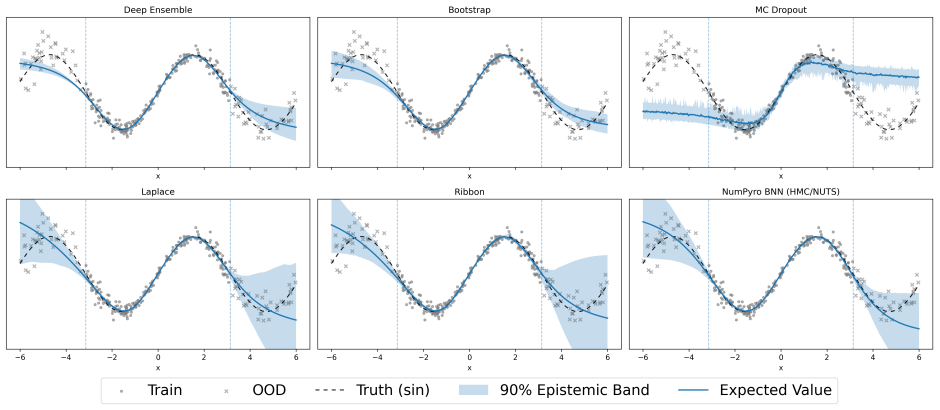
Reliably quantifying predictive uncertainty is difficult for complex, high-dimensional, or misspecified models. Both fully Bayesian and bootstrap resampling methods provide principled uncertainty estimates but are often too expensive for modern machine-learning models because they require posterior sampling or repeated model refitting. We introduce Ribbon, a scalable approximation to Dirichlet-reweighted bootstrap uncertainty. Ribbon replaces repeated refitting with an influence-function linearization around a single fitted model, preserving the first-order data-reweighting structure of the Bayesian bootstrap while requiring only post-hoc linear algebra. Ribbon approximates the Bayesian-bootstrap or weighted-likelihood-bootstrap refitting target. With a general concentration parameter, Ribbon gives a calibrated Dirichlet-reweighting family whose uncertainty scale can be tuned on validation data. We show that Ribbon is asymptotically equivalent to a flat-prior Laplace approximation under correct likelihood specification and recovers the robust sandwich covariance under misspecification. Across synthetic regression, MNIST classification, and California Housing benchmarks, Ribbon provides competitive predictive performance and improved calibration in several settings while avoiding repeated model retraining.
Figures

Reference graph
Works this paper leans on
-
[1]
1986 , publisher=
Robust Statistics: The Approach Based on Influence Functions , author=. 1986 , publisher=
1986
-
[2]
Journal of the American Statistical Association , volume=
The Influence Curve and Its Role in Robust Estimation , author=. Journal of the American Statistical Association , volume=. 1974 , doi=
1974
-
[3]
2009 , publisher=
Robust Statistics , author=. 2009 , publisher=
2009
-
[4]
Technometrics , volume=
Detection of Influential Observation in Linear Regression , author=. Technometrics , volume=. 1977 , doi=
1977
-
[5]
Technometrics , volume=
Residuals and Influence in Regression , author=. Technometrics , volume=. 1982 , doi=
1982
-
[6]
Annals of Statistics , volume=
Logistic Regression Diagnostics , author=. Annals of Statistics , volume=. 1981 , doi=
1981
-
[7]
1993 , address=
Efficient and Adaptive Estimation for Semiparametric Models , author=. 1993 , address=
1993
-
[8]
1998 , publisher=
Asymptotic Statistics , author=. 1998 , publisher=
1998
Show all 54 references
-
[9]
Econometrica , volume=
A Heteroskedasticity-Consistent Covariance Matrix Estimator and a Direct Test for Heteroskedasticity , author=. Econometrica , volume=. 1980 , doi=
1980
-
[10]
Econometric Computing with
Zeileis, Achim , journal=. Econometric Computing with. 2004 , doi=
2004
-
[11]
Neural Computation , volume=
Fast Exact Multiplication by the Hessian , author=. Neural Computation , volume=. 1994 , doi=
1994
-
[12]
Agarwal, Naman and Bullins, Brian and Hazan, Elad , booktitle=
-
[13]
Proceedings of the 32nd International Conference on Machine Learning (ICML) , pages=
Optimizing Neural Networks with Kronecker-Factored Approximate Curvature , author=. Proceedings of the 32nd International Conference on Machine Learning (ICML) , pages=
-
[14]
Proceedings of the 33rd International Conference on Machine Learning (ICML) , pages=
A Kronecker-Factored Approximate Fisher Matrix for Convolution Layers , author=. Proceedings of the 33rd International Conference on Machine Learning (ICML) , pages=
-
[15]
6th International Conference on Learning Representations (ICLR) , year=
Scalable Laplace Approximations for Neural Networks , author=. 6th International Conference on Learning Representations (ICLR) , year=
-
[16]
Proceedings of the 34th International Conference on Machine Learning (ICML) , pages=
Understanding Black-box Predictions via Influence Functions , author=. Proceedings of the 34th International Conference on Machine Learning (ICML) , pages=
-
[17]
Proceedings of the 33rd International Conference on Neural Information Processing Systems (NeurIPS) , year=
Estimating Training Data Influence by Tracing Gradient Descent , author=. Proceedings of the 33rd International Conference on Neural Information Processing Systems (NeurIPS) , year=
-
[18]
9th International Conference on Learning Representations (ICLR) , year=
Influence Functions in Deep Learning Are Fragile , author=. 9th International Conference on Learning Representations (ICLR) , year=
-
[19]
Journal of Machine Learning Research , volume=
Relativedelete: A Robust Data Deletion Algorithm Based on Influence Functions , author=. Journal of Machine Learning Research , volume=
-
[20]
Advances in Neural Information Processing Systems (NeurIPS) , volume=
Representer Point Selection for Explaining Deep Neural Networks , author=. Advances in Neural Information Processing Systems (NeurIPS) , volume=
-
[21]
Arora, Sanmi and Kuleshov, Volodymyr and Liang, Percy , booktitle=
-
[22]
International Conference on Learning Representations (ICLR) , year =
Sensitivity and Generalization in Neural Networks: An Empirical Study , author =. International Conference on Learning Representations (ICLR) , year =
-
[23]
Journal of the American Statistical Association , volume=
Strictly proper scoring rules, prediction, and estimation , author=. Journal of the American Statistical Association , volume=. 2007 , publisher=
2007
-
[24]
Advances in Neural Information Processing Systems , volume=
Can you trust your model's uncertainty? Evaluating predictive uncertainty under dataset shift , author=. Advances in Neural Information Processing Systems , volume=
-
[25]
Information Fusion , volume=
A review of uncertainty quantification in deep learning: Techniques, applications and challenges , author=. Information Fusion , volume=. 2021 , publisher=
2021
-
[26]
2024 , edition=
Statistical Inference , author=. 2024 , edition=
2024
-
[27]
2013 , publisher=
Bayesian Data Analysis , author=. 2013 , publisher=
2013
-
[28]
arXiv preprint arXiv:1206.2729 , year=
Safe probability , author=. arXiv preprint arXiv:1206.2729 , year=
-
[29]
International Conference on Machine Learning , pages=
Weight uncertainty in neural networks , author=. International Conference on Machine Learning , pages=. 2015 , organization=
2015
-
[30]
International Conference on Machine Learning , pages=
What are Bayesian neural network posteriors really like? , author=. International Conference on Machine Learning , pages=. 2021 , organization=
2021
-
[31]
Annals of Statistics , volume=
Bootstrap methods: another look at the jackknife , author=. Annals of Statistics , volume=
-
[32]
Annals of Statistics , volume=
The Bayesian bootstrap , author=. Annals of Statistics , volume=
-
[33]
Journal of the Royal Statistical Society: Series B (Methodological) , volume=
Approximate Bayesian inference with the weighted likelihood bootstrap , author=. Journal of the Royal Statistical Society: Series B (Methodological) , volume=. 1994 , publisher=
1994
-
[34]
Journal of the Royal Statistical Society: Series B (Methodological) , volume=
Residuals and influence in regression , author=. Journal of the Royal Statistical Society: Series B (Methodological) , volume=
-
[35]
International Conference on Machine Learning , pages=
Understanding black-box predictions via influence functions , author=. International Conference on Machine Learning , pages=. 2017 , organization=
2017
-
[36]
Advances in Neural Information Processing Systems , volume=
Estimating training data influence by tracing gradient descent , author=. Advances in Neural Information Processing Systems , volume=
-
[37]
arXiv preprint arXiv:2009.08423 , year=
Influence functions in deep learning: A survey , author=. arXiv preprint arXiv:2009.08423 , year=
2009
-
[38]
International Conference on Machine Learning , pages=
Optimizing neural networks with Kronecker-factored approximate curvature , author=. International Conference on Machine Learning , pages=. 2015 , organization=
2015
-
[39]
International Conference on Machine Learning , pages=
A Kronecker-factored approximate Fisher for convolution layers , author=. International Conference on Machine Learning , pages=. 2016 , organization=
2016
-
[40]
International Conference on Machine Learning , pages=
Dropout as a Bayesian approximation: Representing model uncertainty in deep learning , author=. International Conference on Machine Learning , pages=. 2016 , organization=
2016
-
[41]
Neural Computation , volume=
A practical Bayesian framework for backpropagation networks , author=. Neural Computation , volume=. 1992 , publisher=
1992
-
[42]
Advances in Neural Information Processing Systems , volume=
Laplace redux—Effortless Bayesian deep learning , author=. Advances in Neural Information Processing Systems , volume=
-
[43]
Advances in Neural Information Processing Systems , volume=
Simple and scalable predictive uncertainty estimation using deep ensembles , author=. Advances in Neural Information Processing Systems , volume=
-
[44]
International Conference on Machine Learning , pages=
Bayesian learning via stochastic gradient Langevin dynamics , author=. International Conference on Machine Learning , pages=
-
[45]
International Conference on Learning Representations , year=
Cyclical stochastic gradient MCMC for Bayesian deep learning , author=. International Conference on Learning Representations , year=
-
[46]
Proceedings of the Conference on Uncertainty in Artificial Intelligence , year=
Averaging weights leads to wider optima and better generalization , author=. Proceedings of the Conference on Uncertainty in Artificial Intelligence , year=
-
[47]
Advances in Neural Information Processing Systems , volume=
A simple baseline for Bayesian uncertainty in deep learning , author=. Advances in Neural Information Processing Systems , volume=
-
[48]
2005 , publisher=
Algorithmic Learning in a Random World , author=. 2005 , publisher=
2005
-
[49]
Journal of the American Statistical Association , volume=
Distribution-free predictive inference for regression , author=. Journal of the American Statistical Association , volume=. 2018 , publisher=
2018
-
[50]
Annals of Statistics , volume=
Predictive inference with the jackknife+ , author=. Annals of Statistics , volume=
-
[51]
International Conference on Machine Learning , pages=
Yes, but did it work?: Evaluating variational inference , author=. International Conference on Machine Learning , pages=. 2018 , organization=
2018
-
[52]
Advances in neural information processing systems , volume=
Bayesian deep learning and a probabilistic perspective of generalization , author=. Advances in neural information processing systems , volume=
-
[53]
Statistical Science , volume=
Challenges in Markov chain Monte Carlo for Bayesian neural networks , author=. Statistical Science , volume=. 2022 , publisher=
2022
-
[54]
Proceedings of the 38th International Conference on Machine Learning , pages =
What Are Bayesian Neural Network Posteriors Really Like? , author =. Proceedings of the 38th International Conference on Machine Learning , pages =. 2021 , editor =
2021
Reviewed June 26, 2026 · model on record in the stance chip above.
Discussion (0). Continue with ORCID to comment.