REVIEW 4 major objections 6 minor 66 references
ConfliBERT: A Language Model for Political Conflict
T0 review · 4 major / 6 minor · reviewed 2026-08-11 · deepseek-v4-flash
Pith's one-line read A small conflict-trained model beats much larger generalist LLMs on political violence text classification and named entity recognition.
desk verdict A useful benchmark with a real GTD result, undercut by missing prompts for the zero-shot baselines on two of three tasks; fixable, but the headline as written overstates the evidence. read the letter →
The pith
A machine-rendered reading of the paper's core claim, the machinery that carries it, and where it could break.
The reading
What carries the argument
The load-bearing object is ConfliBERT, a BERT-style transformer trained on conflict-specific text; BERT-style encoders process whole inputs in parallel and can be fine-tuned cheaply, in contrast to autoregressive generative LLMs that decode sequentially. Fine-tuning with a weighted multi-task loss on binary classification, multi-class attack labels, and NER transfers domain knowledge from the pretraining corpus into the specific task labels. The paper's comparisons also introduce ConfLlama, a Llama-3-8B model fine-tuned on GTD via QLoRA, as a same-scale generative check on whether fine-tuning rather than architecture drives the result.
What would settle it
Fine-tune Gemma 2, Llama 3.1, and Qwen 2.5 on the same BBC, re3d, and GTD training splits used for ConfliBERT, using similar epochs and adaptation methods, and evaluate on the same test splits; if their F1, AUC, and multi-label metrics reach or exceed ConfliBERT's, the paper's central claim fails.
Extended reading notes
Core claim
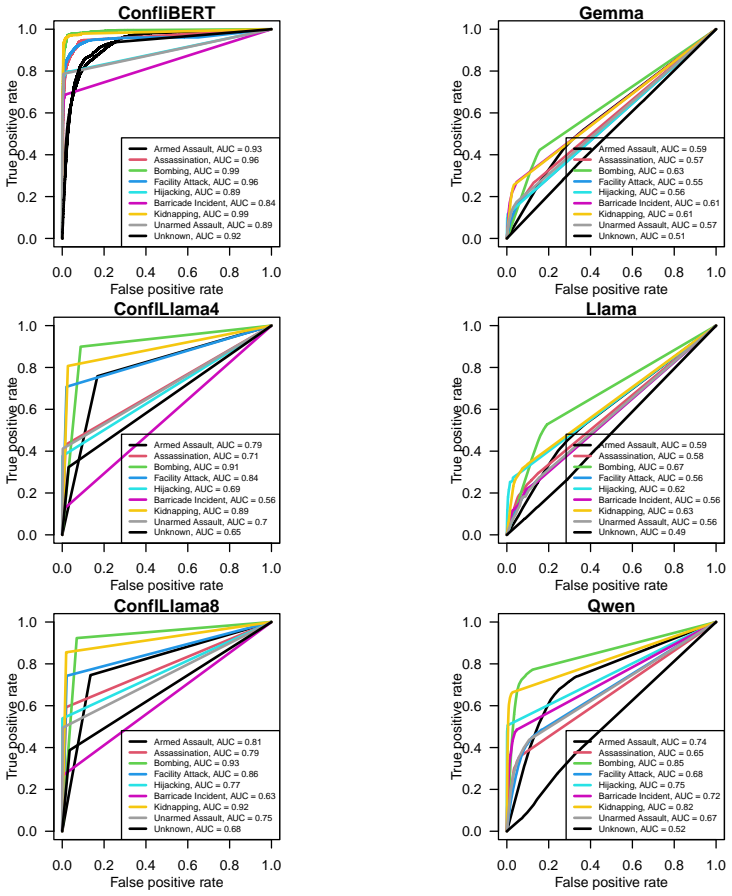
ConfliBERT is a BERT-style encoder pretrained on a curated 33.7 GB corpus of conflict and political-violence text. The paper's central claim is that after task-specific fine-tuning, this relatively small model is more accurate than the much larger generative models Gemma 2 (9B), Llama 3.1 (8B), and Qwen 2.5 (14B) on binary conflict classification, nine-way attack-type classification, and NER on terrorism reports. On the binary BBC task, ConfliBERT's weighted F1 was 0.8706 versus 0.7605 for Gemma 2 and 0.7662 for Llama 3.1, and the larger models essentially failed to detect conflict texts at all. On NER using re3d, ConfliBERT's weighted F1 was 0.5981 versus 0.3987 and 0.3809 for the larger models. On GTD multi-label attack classification, ConfliBERT reached 79.38 percent subset accuracy with the lowest Hamming loss, while taking about 3.5 seconds for classification and 1.4 seconds for NER compared to hundreds of seconds for the generative models.
Load-bearing premise
The comparison is fair: ConfliBERT and ConfLlama were fine-tuned on the task data, while Gemma 2, Llama 3.1, and Qwen 2.5 were evaluated off the shelf with a single hand-written JSON prompt, and if those larger models were fine-tuned with comparable effort the accuracy and speed gaps could narrow or reverse.
Editorial extensions
If this is right
- Conflict researchers can deploy ConfliBERT on conventional hardware to filter and code large news corpora in near-real time, at a small fraction of the compute cost of prompting 8B-14B generative models.
- Event-data pipelines that currently rely on prompting general LLMs can expect higher F1 and better class balance on rare attack types by switching to fine-tuned domain encoders.
- Downstream time-series analyses of terrorism are less likely to be distorted by systematic over- or under-classification of event types, since ConfliBERT's predicted counts track GTD's human-coded counts more closely.
- The comparison provides a replicable baseline for future event-classification models: same datasets, same metrics, and a documented prompt for the generative baselines.
Reading between the lines
- One extension the paper leaves implicit: if the larger generative LLMs were fine-tuned on the same task data with comparable effort, the accuracy gap could narrow or reverse, so a natural next experiment is LoRA fine-tuning of Gemma, Llama, and Qwen on the GTD training split.
- The speed and accuracy pattern likely generalizes beyond conflict: for high-volume text-as-data tasks in other social-science domains, a small domain-pretrained encoder trained on curated text may beat a much larger general model.
- A stronger test of the method would measure downstream inference quality, such as whether changepoint analyses differ when event counts come from ConfliBERT versus human-coded GTD, rather than only token-level accuracy.
- Because the model and evaluation data are public, the comparison can be extended to new languages and event ontologies without the licensing and cost barriers of closed generative models.
Editorial analysis
A structured set of objections, weighed in public.
Referee Report
Summary. This paper reviews ConfliBERT, a BERT-style language model pretrained on a curated 33.7 GB corpus of conflict and political violence texts, and compares it against generative LLMs (Gemma 2, Llama 3.1, Qwen 2.5) on three tasks: binary conflict classification on BBC news, named entity recognition on re3d, and multi-label attack-type classification on Global Terrorism Dataset (GTD) texts. The central claim is that a fine-tuned domain-specific encoder, ConfliBERT, achieves higher accuracy, precision, and recall than much larger general-purpose LLMs on these tasks while being hundreds of times faster. The paper also introduces ConfLlama, a fine-tuned Llama 3.1 8B baseline, and shows that ConfliBERT retains an advantage on the GTD multi-label task even against this fine-tuned generative model.
Significance. If the comparison were fully controlled and reproducible, the result would be practically important: it would show that a small, open, domain-specific encoder can outperform or match much larger generative models at substantially lower cost for event-coding tasks in conflict research. The paper deserves credit for releasing the model publicly, using external benchmark data (BBC, re3d, GTD), including a fine-tuned generative baseline (ConfLlama), and presenting ROC and precision-recall curves rather than relying only on point accuracies. However, the strength of the stated conclusion currently exceeds the evidence: the two primary comparative tables rest on undocumented zero-shot prompts, an unexplained dataset/sample mismatch, and the speed comparison contains an acknowledged hardware incomparability.
major comments (4)
- [§4.2-4.3, Appendix A] The only prompt disclosed in Appendix A is for the GTD multi-label task. The binary classification (BBC) and NER (re3d) evaluations, which anchor the abstract's superiority claim, are reported without the exact instruction strings, output format constraints, or parsing procedures used for Gemma 2 and Llama 3.1. Without these, Tables 1 and 2 are not reproducible, and the zero recall of Gemma 2 for the conflict class could be a prompt artifact rather than a model limitation. Please provide the full prompts, decoding settings, and any post-processing code for all zero-shot evaluations.
- [§4.1 and Table 1] Section 4.1 describes the BBC test set as 735 articles, but Table 1 reports support values of 269 non-conflict and 53 conflict (total 322). Section 4.2 further says Table 1 covers "the BBC News and re3d texts," although re3d is used elsewhere as an NER corpus. This discrepancy makes it impossible to know which dataset, sample, and preprocessing produced the reported numbers. Please state the exact dataset, class distribution, and any subsampling or filtering steps.
- [§5.1 and Table 4] The footnote to Table 4 states that ConflLlama timing measurements were performed on Delta HPC resources and are "not directly comparable" to the other models, yet the text immediately after Table 4 claims that "Processing times were measured on identical hardware configurations to ensure fair comparison." This contradiction affects the relative document speed column for ConflLlama and leaves the speed ranking ambiguous for that model. Please specify which rows are hardware-comparable, or remove ConflLlama from the speed comparison entirely.
- [Abstract, §1, §4.2-4.3, §5] The comparison is asymmetric: ConfliBERT and ConfLlama are fine-tuned on task-specific data, while Gemma 2, Llama 3.1, and Qwen are evaluated zero-shot with a single prompt. The paper itself admits in Section 5 that "some pre-training of the generative LLMs could bring their performance up to or exceeding the performance of ConfliBERT." The abstract nevertheless states the superiority claim without this qualifier. Either add fine-tuned versions of the generative models for the BBC and re3d tasks (as ConfLlama provides for GTD), or explicitly restrict the claim to zero-shot comparisons.
minor comments (6)
- [Abstract, §1] The phrase "ConfliBERT is a LLM" and similar constructions should be "an LLM" for grammatical correctness.
- [Various] The fine-tuned Llama model is named both "ConflLlama" and "ConfLlama" in different places (e.g., §4.1 vs. Table 4); please unify the spelling.
- [§3 vs. §6] Section 3 says ConfliBERT was trained on a 33.7 GB corpus, while Section 6 says about 200 GB of combined training data are invested in ConfliBERT and its Spanish and Arabic variants; clarify the per-model training corpus size.
- [Table 3] The reported maximum memory values for ConfliBERT, Llama 3.1, and Gemma 2 are all near 950 MB, which seems implausible for 8B/9B parameter models; describe how memory was measured and whether this is peak GPU memory per batch rather than model memory.
- [Figure 4 and §5.3] Figure 4 is labeled 2017-2021, but the text says the test period is 2017-2020; make the time span consistent.
- [Appendix A] The sentence "the the original GTD structure" contains a duplicated article; also, the Brown (2020) reference is incomplete and should be replaced with the full NeurIPS citation.
Circularity Check
No circular derivation: the central claims are empirical benchmark results on external, held-out test sets.
full rationale
The paper's central claim is that fine-tuned ConfliBERT outperforms much larger generative LLMs on binary classification, NER, and GTD multi-label event classification. These claims are supported by evaluations on external datasets (BBC, re3d, GTD) with explicit train/test splits: Section 4 reports BBC training and test partitioning (1,490 train, 735 test), and Section 5 states that GTD data from 1970 to 2016 are used to train and data from 2017 to 2020 are used for testing. The reported metrics therefore are not equal by construction to any fitted parameter or any equation in the paper. Self-citations to Hu et al. (2022) establish the model's provenance and earlier comparisons against BERT, but those citations do not force the new numerical outcomes; the new comparisons to Gemma 2, Llama 3.1, and Qwen 2.5 are independent, externally benchmarked results. The appendix discloses the prompt used for the GTD multi-label task, and Section 5 explicitly acknowledges that some pre-training of the generative LLMs could bring their performance up, which is a fair caveat rather than a circular step. The main validity concerns are experimental fairness and reproducibility: the zero-shot generative baselines for the BBC and re3d tasks are not accompanied by the full prompts used, and the comparison is between a fine-tuned domain model and off-the-shelf generalist models. Those are legitimate evaluation-quality concerns, not circularity, because even an unfair prompt would invalidate the comparison empirically rather than make the claim true by definition. No step in the derivation reduces to its own input, so the paper receives a low circularity score.
Assumptions & free parameters
free parameters (3)
- ConfLlama LoRA rank =
8
- ConfLlama learning rate =
2e-4
- ConfliBERT multi-task loss weights =
not reported
assumptions (5)
- domain assumption GTD human-coded attack-type labels are ground truth
- domain assumption BBC and re3d expert labels are correct for binary conflict relevance and NER
- ad hoc to paper Zero-shot prompting with the Appendix A JSON prompt is a fair interface for comparing generative LLMs
- ad hoc to paper Fine-tuning only Llama (ConfLlama) represents the fine-tuned capabilities of the generative LLM family
- domain assumption ConfliBERT training on GTD 1970-2016 makes the 2017-2020 test period out-of-sample
Cite this review
Pith. "Pith review of ConfliBERT: A Language Model for Political Conflict." pith.science (2026). https://pith.science/paper/WT4YGWTI
@misc{pith2026241215060,
  author       = {Pith},
  title        = {Pith review of: ConfliBERT: A Language Model for Political Conflict},
  year         = {2026},
  howpublished = {\url{https://pith.science/paper/WT4YGWTI}},
  note         = {Machine review of arXiv:2412.15060}
}
read the original abstract
Conflict scholars have used rule-based approaches to extract information about political violence from news reports and texts. Recent Natural Language Processing developments move beyond rigid rule-based approaches. We review our recent ConfliBERT language model (Hu et al. 2022) to process political and violence related texts. The model can be used to extract actor and action classifications from texts about political conflict. When fine-tuned, results show that ConfliBERT has superior performance in accuracy, precision and recall over other large language models (LLM) like Google's Gemma 2 (9B), Meta's Llama 3.1 (7B), and Alibaba's Qwen 2.5 (14B) within its relevant domains. It is also hundreds of times faster than these more generalist LLMs. These results are illustrated using texts from the BBC, re3d, and the Global Terrorism Dataset (GTD).
Figures

Reference graph
Works this paper leans on
-
[1]
Alsarra, S., Abdeljaber, L., Yang, W., Zawad, N., Khan, L., Brandt, P., Osorio, J., and D’Orazio, V. (2023). ConfliBERT-Arabic : A pre-trained Arabic language model for politics, conflicts and violence. In Proceedings of the 14th International Conference on Recent Advances in Natural Language Processing , pages 98--108
work page 2023
-
[2]
Althaus, S., Peyton, B., and Shalmon, D. (2022). A T otal E rror A pproach for V alidating E vent D ata. American B ehavioral S cientist , 66(5):603--624
work page 2022
-
[3]
Araci, D. (2019). FinBERT : Financial sentiment analysis with pre-trained language models
work page 2019
-
[4]
T., Halterman, A., Simpson, E., and Schrodt, P
Beieler, J., Brandt, P. T., Halterman, A., Simpson, E., and Schrodt, P. A. (2016). Generating P olitical E vent D ata in N ear R eal T ime: Opportunities and C hallenges. In Alvarez, R. M., editor, Computational S ocial S cience . Cambridge University Press
work page 2016
-
[5]
Beltagy, I., Lo, K., and Cohan, A. (2019). SciBERT : A pretrained language model for scientific text. arXiv preprint arXiv:1903.10676
arXiv 2019
-
[6]
Boschee, E., Lautenschlager, J., O’Brien, S., Shellman, S., Starz, J., and Ward, M. (2015). ICEWS coded event data . Harvard Dataverse , 12
work page 2015
-
[7]
Brandt, P. T. and Sianan, M. (2024). Measurement in event data research. Frontiers in Politcal Science – Political Science Methodologies
work page 2024
-
[8]
Brown, T. B. (2020). Language models are few-shot learners. arXiv preprint arXiv:2005.14165
arXiv 2020
Show all 66 references
-
[9]
Chalkidis, I., Fergadiotis, M., Malakasiotis, P., Aletras, N., and Androutsopoulos, I. (2020). LEGAL-BERT: the M uppets straight out of law school. CoRR , abs/2010.02559
2020 arXiv
-
[10]
Croicu, M. (2024). Deep active learning for data mining from conflict text corpora. arxiv https://arxiv.org/abs/2402.01577
2024 arXiv
-
[11]
Dai, Y., Radford, B., and Halterman, A. (2022). Political E vent C oding as T ext-to- T ext S equence G eneration. In Proceedings of the 5th W orkshop on C hallenges and A pplications of A utomated E xtraction of S ocio-political E vents from T ext ( CASE ) , pages 117--123
2022
-
[12]
F ourth M essage U nderstanding C onference ( MUC -4): Proceedings of a Conference Held in M c L ean, V irginia, J une 16-18, 1992
D efense A dvanced R esearch P rojects A gency S oftware and I ntelligent S ystems T echnology O ffice, editors (1992). F ourth M essage U nderstanding C onference ( MUC -4): Proceedings of a Conference Held in M c L ean, V irginia, J une 16-18, 1992
1992
-
[13]
Devlin, J., Chang, M.-W., Lee, K., and Toutanova, K. (2018). BERT : Pre-training of deep bidirectional transformers for language understanding. arXiv preprint arXiv:1810.04805
2018 arXiv
-
[14]
Relationship and entity extraction evaluation dataset
DSTL (2018). Relationship and entity extraction evaluation dataset. Accessed: 2024-10-23
2018
-
[15]
Dubey, A., Jauhri, A., Pandey, A., Kadian, A., Al-Dahle, A., Letman, A., Mathur, A., Schelten, A., Yang, A., Fan, A., et al. (2024). The Llama 3 herd of models. arXiv preprint arXiv:2407.21783
2024 arXiv
-
[16]
T., Palmer, G., and Schrodt, P
D’Orazio, V., Landis, S. T., Palmer, G., and Schrodt, P. (2014). Separating the wheat from the chaff: Applications of automated document classification using support vector machines. Political Analysis , 22(2):224–242
2014
-
[17]
Gerner, D., Jabr, R., and Schrodt, P. (2002). Conflict and mediation event observations (CAMEO) : A new event data framework for the analysis of foreign policy interactions. International Studies Association, New Orleans
2002
-
[18]
and Cunningham, P
Greene, D. and Cunningham, P. (2006). Practical solutions to the problem of diagonal dominance in kernel document clustering. In Proceedings of the 23rd international conference on Machine learning , pages 377--384
2006
-
[19]
E., and Stewart, B
Grimmer, J., Roberts, M. E., and Stewart, B. M. (2022). Text as data: A new framework for machine learning and the social sciences . Princeton University Press
2022
-
[20]
Gupta, T., Zaki, M., Krishnan, N. M. A., and Mausam (2022). MatSciBERT : A materials domain language model for text mining and information extraction. npj computational materials , 8(1):1--11
2022
-
[21]
Gururangan, S., Marasovi \'c , A., Swayamdipta, S., Lo, K., Beltagy, I., Downey, D., and Smith, N. A. (2020). Don't stop pretraining: Adapt language models to domains and tasks. arXiv preprint arXiv:2004.10964
2020 arXiv
-
[22]
H \"a ffner, S., Hofer, M., Nagl, M., and Walterskirchen, J. (2023). Introducing an interpretable deep learning approach to domain-specific dictionary creation: A use case for conflict prediction. Political Analysis , 31(4):481--499
2023
-
[23]
Halterman, A. (2017). Mordecai: Full T ext G eoparsing and E vent G eocoding. Journal of Open Source Software , 2(9):91
2017
-
[24]
E., Beger, A., Schrodt, P., and Scarborough, G
Halterman, A., Bagozzi, B. E., Beger, A., Schrodt, P., and Scarborough, G. (2023a). PLOVER and POLECAT : A N ew P olitical E vent O ntology and D ataset. SocArXiv
2023
-
[25]
and Radford, B
Halterman, A. and Radford, B. J. (2021). Few- S hot U psampling for P rotest S ize D etection. arXiv preprint arXiv:2105.11260
2021 arXiv
-
[26]
A., Beger, A., Bagozzi, B
Halterman, A., Schrodt, P. A., Beger, A., Bagozzi, B. E., and Scarborough, G. I. (2023b). Creating custom event data without dictionaries: A bag-of-tricks
2023
-
[27]
Hu, Y., Hosseini, M., Skorupa Parolin, E., Osorio, J., Khan, L., Brandt, P., and D ' Orazio, V. (2022). C onfli BERT : A pre-trained language model for political conflict and violence. In Carpuat, M., de Marneffe, M.-C., and Meza Ruiz, I. V., editors, Proceedings of the 2022 C...
2022
-
[28]
Hu, Y., Skorupa Parolin, E., Khan, L., Osorio, J., and D ' Orazio, V. (2024). Leveraging codebook knowledge with NLI and C hat GPT for zero-shot political relation classification. In Ku, L.-W., Martins, A., and Srikumar, V., editors, Proceedings of the 62nd Annual Meeting of t...
2024
-
[29]
Huang, K., Altosaar, J., and Ranganath, R. (2020). ClinicalBERT : Modeling clinical notes and predicting hospital readmission
2020
-
[30]
Huang, R., Cases, I., Jurafsky, D., Condoravdi, C., and Riloff, E. (2016). Distinguishing past, on-going, and future events: The E vent S tatus corpus. In Su, J., Duh, K., and Carreras, X., editors, Proceedings of the 2016 Conference on Empirical Methods in Natural Language Pr...
2016
-
[31]
Hui, B., Yang, J., Cui, Z., Yang, J., Liu, D., Zhang, L., Liu, T., Zhang, J., Yu, B., Lu, K., Dang, K., Fan, Y., Zhang, Y., Yang, A., Men, R., Huang, F., Zheng, B., Miao, Y., Quan, S., Feng, Y., Ren, X., Ren, X., Zhou, J., and Lin, J. (2024). Qwen2.5-coder technical report. ar...
2024 arXiv
-
[32]
B., Chandra, S., Ma, S., Khan, L., and Thuraisingham, B
Imani, M. B., Chandra, S., Ma, S., Khan, L., and Thuraisingham, B. (2017). Focus L ocation E xtraction from P olitical N ews R eports with B ias C orrection. In 2017 IEEE I nternational C onference on B ig D ata ( B ig D ata) , pages 1956--1964. IEEE
2017
-
[33]
B., Khan, L., and Thuraisingham, B
Imani, M. B., Khan, L., and Thuraisingham, B. (2019). Where D id the P olitical N ews E vent H appen? P rimary F ocus L ocation E xtraction in D ifferent L anguages. In 2019 IEEE 5th I nternational C onference on C ollaboration and I nternet C omputing (CIC) , pages 61--70. IEEE
2019
-
[34]
and Dugan, L
LaFree, G. and Dugan, L. (2007). Introducing the Global Terrorism Database . Terrorism and Political Violence
2007
-
[35]
Lang, K. (1995). Newsweeder: Learning to filter netnews. In Prieditis, A. and Russell, S., editors, Machine Learning Proceedings 1995 , pages 331--339. Morgan Kaufmann, San Francisco (CA)
1995
-
[36]
and Hsiang, J
Lee, J.-S. and Hsiang, J. (2019). Patentbert: Patent classification with fine-tuning a pre-trained bert model
2019
-
[37]
and Stoehr, N
Lefebvre, C. and Stoehr, N. (2022). Rethinking the event coding pipeline with prompt entailment. arXiv preprint arXiv:2210.05257
2022 arXiv
-
[38]
Li, X., Wang, Z., Li, D., Khan, L., and Thuraisingham, B. (2022). LPC : A logits and parameter calibration framework for continual learning. In Goldberg, Y., Kozareva, Z., and Zhang, Y., editors, Findings of the Association for Computational Linguistics: EMNLP 2022 , pages 714...
2022
-
[39]
Liu, P., Zhang, L., and Gulla, J. A. (2023). Pre-train, prompt, and recommendation: A comprehensive survey of language modeling paradigm adaptations in recommender systems. Transactions of the Association for Computational Linguistics , 11:1553--1571
2023
-
[40]
Meher, S. (2024). Conflllama: Gtd-finetuned llama-3 8b. Based on Meta's LLaMA-3 8B and GTD Dataset
2024
-
[41]
and Rauh, C
Mueller, H. and Rauh, C. (2021). Forecasting civil conflict along the belt and road: A machine learning approach. Journal of Peace Research
2021
-
[42]
Olsen, H., Simon, \'E ., Velldal, E., and vrelid, L. (2024). Socio-political events of conflict and unrest: A survey of available datasets. In H \"u rriyeto g lu, A., Tanev, H., Thapa, S., and Uludo g an, G., editors, Proceedings of the 7th Workshop on Challenges and Applicati...
2024
-
[43]
T., D'Orazio, V., Zawad, N., and Billah, M
Osorio, J., Alsarra, S., Converse, A., Alshammari, A., Heintze, D., Khan, L., Alatrush, N., Brandt, P. T., D'Orazio, V., Zawad, N., and Billah, M. (2024). Keep it local: Comparing domain-specific LLMs in native and machine translated text using parallel corpora on political co...
2024
-
[44]
and Reyes, A
Osorio, J. and Reyes, A. (2017). Supervised event coding from text written in Spanish : Introducing EVENTUS id. Social Science Computer Review , 35(3):406--416
2017
-
[45]
Osorio, J., Reyes, A., Beltr \'a n, A., and Ahmadzai, A. (2020). Supervised E vent C oding from T ext W ritten in A rabic: I ntroducing H adath. In Proceedings of the W orkshop on A utomated E xtraction of S ocio-political E vents from N ews 2020 , pages 49--56
2020
-
[46]
M., and Smith, N
O’Connor, B., Stewart, B. M., and Smith, N. A. (2013). Learning to extract international relations from political context. Proceedings of the 51st Annual Meeting of the Association for Computational Linguistics , 1:1094--1104
2013
-
[47]
S., Hosseini, M., Hu, Y., Khan, L., Brandt, P
Parolin, E. S., Hosseini, M., Hu, Y., Khan, L., Brandt, P. T., Osorio, J., and D'Orazio, V. (2022). M ulti- C o PED : A M ultilingual M ulti- T ask A pproach for C oding P olitical E vent D ata on C onflict and M ediation D omain. In Proceedings of the 2022 AAAI/ACM C onferenc...
2022
-
[48]
S., Hu, Y., Khan, L., Osorio, J., Brandt, P
Parolin, E. S., Hu, Y., Khan, L., Osorio, J., Brandt, P. T., and D’Orazio, V. (2021). Come-ke: A new transformers based approach for knowledge extraction in conflict and mediation domain. In 2021 IEEE International Conference on Big Data (Big Data) , pages 1449--1459. IEEE
2021
-
[49]
Pavlick, E., Ji, H., Pan, X., and Callison-Burch, C. (2016). The gun violence database: A new task and data set for NLP . In Su, J., Duh, K., and Carreras, X., editors, Proceedings of the 2016 Conference on Empirical Methods in Natural Language Processing , pages 1018--1024, A...
2016
-
[50]
Radford, B. J. (2021). Automated dictionary generation for political eventcoding. Political Science Research and Methods , 9(1):157--171
2021
-
[51]
Santifort, C., Sandler, T., and Brandt, P. T. (2013). Terrorist attack and target diversity: Changepoints and their drivers. Journal of peace research , 50(1):75--90
2013
-
[52]
Schrodt, P. A. (2001). Automated coding of international event data using sparse parsing techniques. In Annual Meeting of the International Studies Association, Chicago . Citeseer
2001
-
[53]
Schrodt, P. A. (2012). Precedents, progress, and prospects in political event data. International Interactions , 38(4):546--569
2012
-
[54]
Schrodt, P. A. and Van Brackle, D. (2020). Automated coding of political event data. Handbook of Research Methods in Political Science and International Relations
2020
-
[55]
A., Yilmaz, O., Gerner, D
Schrodt, P. A., Yilmaz, O., Gerner, D. J., and Hermreck, D. (2008). The CAMEO ( C onflict and M ediation E vent O bservations) actor coding framework . In 2008 Annual Meeting of the International Studies Association
2008
-
[56]
A., and Etzioni, O
Schwartz, R., Dodge, J., Smith, N. A., and Etzioni, O. (2020). Green AI . Communications of the ACM
2020
-
[57]
Shellman, S. M. (2004). Time series intervals and statistical inference: The effects of temporal aggregation on event data analysis. Political Analysis , 12(1):97–104
2004
-
[58]
T., and D'Orazio, V
Solaimani, M., Salam, S., Khan, L., Brandt, P. T., and D'Orazio, V. (2017a). APART : A utomatic P olitical A ctor R ecommendation in real- T ime. In Lee, D., Lin, Y.-R., Osgood, N., and Thomson, R., editors, Social, Cultural, and Behavioral Modeling , pages 342--348, Cham. Spr...
2017
-
[59]
T., and D'Orazio, V
Solaimani, M., Salam, S., Khan, L., Brandt, P. T., and D'Orazio, V. (2017b). Re PAIR : R ecommend P olitical A ctors in R eal-time from N ews W ebsites. In 2017 IEEE I nternational C onference on B ig D ata ( B ig D ata) , pages 1333--1340
2017
-
[60]
Steinert-Threlkeld, Z. C. (2019). The future of event data is images. Sociological Methodology , 49(1):68--75
2019
-
[61]
Strubell, E., Ganesh, A., and McCallum, A. (2019). Energy and policy considerations for deep learning in NLP . arXiv preprint arXiv:1906.02243
2019 arXiv
-
[62]
G., Hardin, C., Bhupatiraju, S., Hussenot, L., Mesnard, T., Shahriari, B., Ram \'e , A., et al
Team Gemma , Riviere, M., Pathak, S., Sessa, P. G., Hardin, C., Bhupatiraju, S., Hussenot, L., Mesnard, T., Shahriari, B., Ram \'e , A., et al. (2024). Gemma 2: Improving open language models at a practical size. arXiv preprint arXiv:2408.00118
2024 arXiv
-
[63]
Wang, Y. (2024). On finetuning large language models. Political Analysis , 32(3):379–383
2024
-
[64]
Wei, J., Tay, Y., Bommasani, R., Raffel, C., Zoph, B., Borgeaud, S., Yogatama, D., Bosma, M., Zhou, D., Metzler, D., et al. (2022). Emergent abilities of large language models. arXiv preprint arXiv:2206.07682
2022 arXiv
-
[65]
W., Palmer, M., Callison-Burch, C., Vondrick, C., Han, J., Roth, D., Chang, S.-F., and Ji, H
Wen, H., Lin, Y., Lai, T., Pan, X., Li, S., Lin, X., Zhou, B., Li, M., Wang, H., Zhang, H., Yu, X., Dong, A., Wang, Z., Fung, Y., Mishra, P., Lyu, Q., Sur \' s, D., Chen, B., Brown, S. W., Palmer, M., Callison-Burch, C., Vondrick, C., Han, J., Roth, D., Chang, S.-F., and Ji, H...
2021
-
[66]
T., and D’Orazio, V
Yang, W., Alsarra, S., Abdeljaber, L., Zawad, N., Delaram, Z., Osorio, J., Khan, L., Brandt, P. T., and D’Orazio, V. (2023). ConfliBERT-Spanish : A pre-trained Spanish language model for political conflict and violence. In 2023 7th IEEE Congress on Information Science and Tech...
2023
Reviewed August 11, 2026 · model on record in the stance chip above.
Discussion (0). Continue with ORCID to comment.