REVIEW 3 major objections 4 minor 77 references
DarkNESS: A skipper-CCD NanoSatellite for Dark Matter Searches
T0 review · 3 major / 4 minor · reviewed 2026-08-07 · deepseek-v4-flash
Pith's one-line read A skipper-CCD CubeSat aims to catch two dark matter signals from orbit.
desk verdict A genuine mission-concept paper: new engineering work with honest caveats, whose DM sensitivity curves rest on an unvalidated LEO background assumption; deserves refereeing. read the letter →
The pith
A machine-rendered reading of the paper's core claim, the machinery that carries it, and where it could break.
The reading
What carries the argument
The central object is the skipper-CCD, a charge-coupled device whose amplifier reads each pixel's charge repeatedly without destroying it, reducing readout noise below one electron. That sub-electron threshold lets the detector count single ionization events, which is what makes both channels possible: dark matter scattering off electrons and X-ray photons. The orbital mechanisms carrying the argument are the dark matter wind from the solar apex, targeted at Cygnus, Earth-shadowing modulation of the event rate as the satellite orbits, and the wide 20-degree field of view toward the Galactic Center, which collects diffuse X-ray flux without focusing optics. A cryocooler keeps the sensors at 170 K to suppress dark current.
What would settle it
Early in the mission, measure the actual low-energy event rate from orbit: if the rate per 10-minute Cygnus exposure substantially exceeds the assumed constant $10^{9}$ events, or varies with orbital phase in a way the modulation model cannot fit, the Fig. 1 discovery reach is falsified; for the X-ray channel, a search that finds no unidentified line at the projected sensitivity in 90 ks would rule out the claimed sterile-neutrino reach.
Extended reading notes
Core claim
The paper's central claim is that a 6U CubeSat carrying four skipper-CCDs with sub-electron noise can probe dark matter parameter space that is inaccessible from the ground. For strongly interacting sub-GeV dark matter, DarkNESS would observe the Cygnus region, where the dark matter wind arrives, and use Earth shadowing during umbral passages to look for a modulated low-energy event rate; with 0.1 gram-month exposure and an assumed constant background of $10^{9}$ events it claims a 5-$\sigma$ discovery reach. For decaying dark matter, it targets the Galactic Center and, with a 90 ks exposure, projects sensitivity to sterile-neutrino dark matter decaying to X-rays that competes with current space observatories. If correct, this is the first orbital deployment of skipper-CCDs and would test both strongly interacting sub-GeV dark matter and the 3.5 keV line question from space.
Load-bearing premise
The load-bearing premise is that the low-energy background in low Earth orbit is known and constant at the level assumed ($10^{9}$ events for the exposure), and that strongly interacting dark matter is a subdominant component with an ultralight dark-photon mediator; if either fails, the projected 5-$\sigma$ reach does not follow.
Editorial extensions
If this is right
- If the sensitivity projections hold, DarkNESS would be the first demonstration of skipper-CCD operation in orbit, qualifying the technology for future low-noise X-ray and single-photon space observatories.
- A measured modulation in the Cygnus low-energy rate would be evidence for strongly interacting sub-GeV dark matter at cross sections above current terrestrial limits.
- A dedicated Galactic Center dataset would provide a new test of the 3.5 keV X-ray line and its sterile-neutrino dark matter interpretation.
- The 0.1 gram-month exposure target implies a concrete observing schedule: 450 ten-minute Cygnus observations split between shadowed and unobstructed regimes, and 600 fifteen-minute Galactic Center exposures.
Reading between the lines
- The real test of the mission is not the detector but the orbital background: if the low-energy hit rate in LEO is higher or varies with orbital phase, the modulation search remains partially robust but the total-rate reach in Fig. 1 would degrade.
- The same sub-electron, wide-field-of-view platform could be repurposed for other diffuse X-ray science, such as mapping the Galactic X-ray background, since the sensor is energy-resolving down to the Fano limit.
- If the background turns out to be dominated by Cherenkov photons from charged particles, the tunable masking strategy could set the effective science exposure, so the 0.1 gram-month figure should be read as an upper-bound sensitivity.
Editorial analysis
A structured set of objections, weighed in public.
Referee Report
Summary. DarkNESS is a 6U CubeSat mission that aims to place skipper-CCDs in low Earth orbit to search for two dark matter signatures: low-energy electron recoils from strongly interacting sub-GeV dark matter via a directional modulation search, and X-ray lines from decaying sterile-neutrino dark matter toward the Galactic Center. The paper describes the scientific objectives, the instrument (four skipper-CCDs, sLTA readout electronics, and a Ricor cryocooler), the orbit analysis demonstrating sufficient viewing windows for both targets, thermal vacuum testing that reached the 170 K operating point, and proton irradiation tests showing amplifier robustness with sub-electron noise retained. It presents projected sensitivity curves in Fig. 1 (strongly interacting sub-GeV DM) and Fig. 2 (sterile neutrino DM decay to X-rays), and reports that a launch opportunity has been secured through Firefly Aerospace's DREAM 2.0 program, with a launch no earlier than mid-2026.
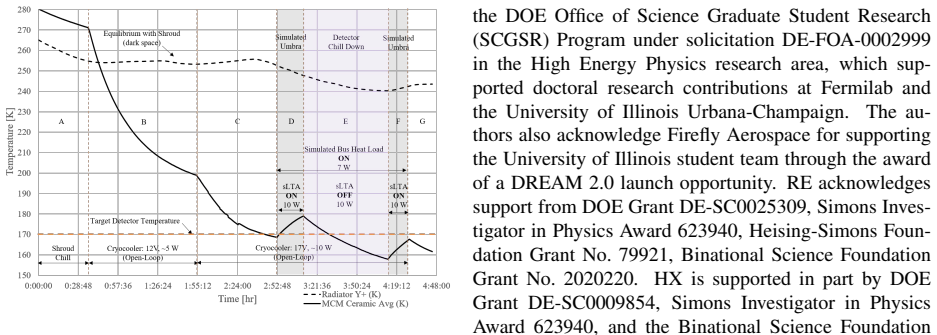
Significance. If the projected sensitivities are realized, DarkNESS would be the first orbital deployment of skipper-CCDs and could probe previously unconstrained regions of the strongly interacting sub-GeV DM parameter space while also contributing to sterile-neutrino DM searches. The engineering feasibility is supported by real preliminary evidence: proton irradiation shows amplifier survival and sub-electron noise retention, orbit simulations show sufficient observation windows for both science goals, and a five-hour thermal vacuum test reached the 170 K operating point. However, the DM discovery projections depend on assumed background levels that are not derived or validated for the orbital environment, and the paper's own Section 3.3 identifies time-varying and accumulating background sources. The mission retains value as a technology demonstration even if the sensitivity projections are treated as conditional on a better-characterized background.
major comments (3)
- [Section 2.1 and Figure 1] The 5σ discovery reach for strongly interacting sub-GeV DM in Fig. 1 rests on the assumption of 10^9 background events constant in time, but this number is not derived, simulated, or justified for the DarkNESS orbit. Section 3.3 identifies Cherenkov photons, radiation-induced single-electron traps, and cosmic-ray ionization as sources of low-energy hits in LEO, and the planned imaging mask is described only as 'tunable' without quantitative characterization. If the on-orbit background is larger or has an orbital-period component (SAA passage, geomagnetic cutoff, day/night variations, trap accumulation), the modulation search and rate-based reach degrade substantially. The authors should either provide a measured or simulated background estimate for the specific orbit and detector, or present the Fig. 1 curves as illustrative projections conditional on that background assumption, with the caveat prominently stated.
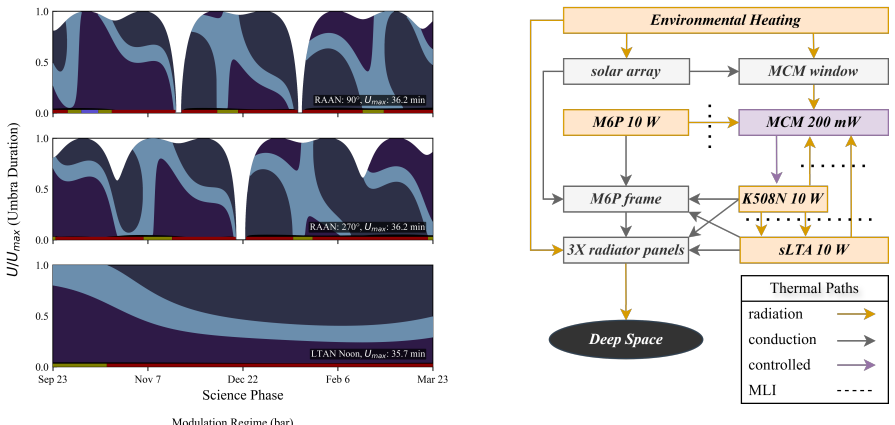
- [Section 5.3/Table 2 vs Section 5.4.2/Table 4] The minimum success criteria in Table 2 require 225 unobstructed Cygnus observations, but the SSO LTAN Noon simulation in Table 4 yields zero unobstructed Cygnus regimes in both analyzed periods, and Section 5.4.2 describes 'unobstructed access is rare' rather than noting that it is absent. Since the final orbit is assigned at manifest and the design is intended to accommodate both orbit domains, the paper should clarify whether the Cygnus science goal can be met in an SSO, or revise the minimum criteria to use attenuated windows as part of the modulation analysis.
- [Section 2.2 and Figure 2] The expected sensitivity to sterile neutrino DM decay in Fig. 2 is based on a Galactic Center background model from Ref. [25] without adapting it to the DarkNESS skipper-CCD in LEO. The paper does not include in this projected limit the LEO particle-induced background in the X-ray band, nor the detector's low-energy event rate from the mechanisms listed in Section 3.3. A quantitative treatment of these backgrounds, or a clear statement that Fig. 2 assumes only the astrophysical background, is needed to assess the claimed 90 ks sensitivity.
minor comments (4)
- [Section 3.2] The statement that one DarkNESS exposure observes a diffuse background flux comparable to 22 XMM EPIC-MOS images does not appear to follow from the quoted FOV (20°) and collecting area (12 cm^2) versus XMM's 30 arcmin FOV and 700 cm^2 area; the ratio of grasp is approximately 27, not 22. Please check the calculation or clarify the comparison.
- [Section 6.1] The laboratory setpoint resistor value is given as 326 Ω, while the in-flight tunable range is stated as 800–1000 Ω; the relationship between these values should be clarified, since a factor-of-three difference is not explained.
- [Sections 4.1 and 4.2] The science phase for Sagittarius is defined as March 20–September 23, 2026, but deployment is scheduled no earlier than mid-2026; the paper should state whether this window is the first opportunity or whether the analysis is repeated for later years.
- [References] References [9] and [74] are the same paper and should be consolidated.
Circularity Check
No significant circularity: the sensitivity projections are explicitly conditional on stated external assumptions, and the mission feasibility work is independently derived.
full rationale
The paper's central sensitivity claims are explicitly conditional rather than circular. Sec. 2.1 states that the 5σ discovery reach in Fig. 1 assumes fχ = 0.01% and 10^9 background events (constant in time), and the Fig. 1 caption repeats these as inputs. Fig. 2's projected limit is stated to assume a Galactic Center background model from Ref. [25]. These are declared modeling assumptions, not fitted parameters or outputs defined by the claimed result, so the 'prediction' is a conditional projection, not a derivation equivalent to its inputs. The strongly interacting sub-GeV DM formalism is cited to the authors' earlier JCAP paper [9]/[74], which is an external published result with its own stated model; citing it as the source of the physics model does not reduce the present mission design to its inputs. The orbit obstruction analysis in Sec. 5 is performed with FreeFlyer and a Python simulation, and the thermal feasibility is supported by laboratory TVAC tests reported in Sec. 6.3; both are independent of the sensitivity curves. No equation in the paper is shown to be equivalent by construction to an input, and no parameter fitted to a subset of data is renamed as a prediction. The fragility of the 10^9-event constant-background assumption is a legitimate scientific risk, but it is a correctness concern, not a circularity. Accordingly, no circular steps are identified.
Assumptions & free parameters
free parameters (3)
- fχ (fractional DM abundance) =
0.01% (assumed)
- LEO low-energy background count =
10^9 events (assumed constant)
- Shielding thickness for reach bands =
~50 nm Al + ~1 µm Si (lower) and 10 µm Si (upper)
assumptions (5)
- domain assumption Strongly interacting sub-GeV DM with an ultralight dark photon mediator can be a subdominant component (fχ ≲ 0.1%) of cosmological DM.
- domain assumption Earth shadowing produces a detectable modulation in the DM flux.
- domain assumption Galactic Center D-factor and diffuse X-ray background model.
- domain assumption Skipper-CCD will maintain sub-electron noise and low dark current in the LEO radiation environment for the mission lifetime.
- standard math Standard orbital mechanics and geopotential models used in FreeFlyer.
Cite this review
Pith. "Pith review of DarkNESS: A skipper-CCD NanoSatellite for Dark Matter Searches." pith.science (2026). https://pith.science/paper/WT5DIGA2
@misc{pith2026250516981,
  author       = {Pith},
  title        = {Pith review of: DarkNESS: A skipper-CCD NanoSatellite for Dark Matter Searches},
  year         = {2026},
  howpublished = {\url{https://pith.science/paper/WT5DIGA2}},
  note         = {Machine review of arXiv:2505.16981}
}
read the original abstract
The Dark matter Nanosatellite Equipped with Skipper Sensors (DarkNESS) deploys a recently developed skipper-CCD architecture with sub-electron readout noise in low Earth orbit (LEO) to investigate potential signatures of dark matter (DM). The mission addresses two interaction channels: electron recoils from strongly interacting sub-GeV DM and X-rays produced through decaying DM. Orbital observations avoid attenuation that limits ground-based measurements, extending sensitivity reach for both channels. The mission proceeds toward launch following laboratory validation of the instrument. A launch opportunity has been secured through Firefly Aerospace's DREAM 2.0 program, awarded to the University of Illinois Urbana-Champaign (UIUC). This will constitute the first use of skipper-CCDs in space and evaluate their suitability for low-noise X-ray and single-photon detection in future space observatories.
Figures


Figures from the paper (10 more)




Reference graph
Works this paper leans on
-
[25]
Searching for keV Sterile Neutrino Dark Matter with X-ray Microcalorimeter Sounding Rockets
E. Figueroa-Feliciano, A.J. Anderson, D. Castro, D.C. Goldfinger, J. Rutherford, M.E. Eckart et al.,Searching for keV Sterile Neutrino Dark Matter with X-Ray Microcalorimeter Sounding Rockets,The Astrophysical Journal814(2015) 82 [1506.05519]
work page Pith review arXiv 2015
-
[1]
Aghanim et al.,Planck 2018 results,Astronomy & Astrophysics641(2020) A6
N. Aghanim et al.,Planck 2018 results,Astronomy & Astrophysics641(2020) A6
work page 2020
-
[2]
A. Arbey and F. Mahmoudi,Dark matter and the early Universe: A review,Progress in Particle and Nuclear Physics119(2021) 103865
work page 2021
-
[3]
D.S. Akerib, P.B. Cushman, C.E. Dahl, R. Ebadi, A. Fan, R.J. Gaitskell et al.,Snowmass2021 cosmic frontier dark matter direct detection to the neutrino fog, 2022
work page 2022
-
[4]
M.C. Clary, K.P. Klaasen, L.M. Snyder and P.K. Wang,800 x 800 Charge-Coupled Device (CCD) Camera For The Galileo Jupiter Orbiter Mission, inRecent Advances in TV Sensors and Systems, C. Freeman, ed., vol. 0203, pp. 98 – 108, International Society for Optics and Photonics, SPIE, 1979, DOI
work page 1979
-
[5]
J.T. Trauger,Sensors for the Hubble Space Telescope Wide Field and Planetary Cameras (1 and 2)., inCCDs in astronomy, G.H. Jacoby, ed., vol. 8 ofAstronomical Society of the Pacific Conference Series, pp. 217–230, Jan., 1990
work page 1990
-
[7]
SENSEI COLLABORATIONcollaboration,First Direct-Detection Results on Sub-GeV Dark Matter Using the SENSEI Detector at SNOLAB,Phys. Rev. Lett.134(2025) 011804
work page 2025
-
[8]
SENSEI collaboration,SENSEI at SNOLAB: Single-Electron Event Rate and Implications for Dark Matter, 2410.18716
Show all 77 references
-
[9]
Emken, R
T. Emken, R. Essig, C. Kouvaris and M. Sholapurkar,Direct Detection of Strongly Interacting Sub-Gev Dark Matter via Electron Recoils,JCAP1909(2019) 070 [1905.06348]
2019 arXiv
-
[10]
P. Du, R. Essig, B.J. Rauscher and H. Xu,Constraints on Strongly-Interacting Dark Matter from the James Webb Space Telescope,2412.13131
-
[11]
Creque-Sarbinowski, L
C. Creque-Sarbinowski, L. Ji, E.D. Kovetz and M. Kamionkowski,Direct Millicharged Dark Matter Cannot Explain the Edges Signal,Phys. Rev.D100(2019) 023528 [1903.09154]
2019 arXiv
-
[12]
Munoz and A
J.B. Munoz and A. Loeb,A small amount of mini-charged dark matter could cool the baryons in the early Universe,Nature557(2018) 684 [1802.10094]
2018 arXiv
-
[13]
Prinz et al.,Search for Millicharged Particles at SLAC,Phys
A.A. Prinz et al.,Search for Millicharged Particles at SLAC,Phys. Rev. Lett.81(1998) 1175 [hep-ex/9804008]
1998 arXiv
-
[14]
Ball et al.,Search for millicharged particles in proton-proton collisions at √s= 13TeV,Phys
A. Ball et al.,Search for millicharged particles in proton-proton collisions at √s= 13TeV,Phys. Rev. D102 (2020) 032002 [2005.06518]
2020
-
[15]
Magill, R
G. Magill, R. Plestid, M. Pospelov and Y .-D. Tsai,Millicharged Particles in Neutrino Experiments,Phys. Rev. Lett.122(2019) 071801 [1806.03310]
2019 arXiv
-
[16]
ARGONEUT collaboration,Improved Limits on Millicharged Particles Using the ArgoNeuT Experiment at Fermilab,Phys. Rev. Lett.124(2020) 131801 [1911.07996]
2020 arXiv
-
[17]
Plestid, V
R. Plestid, V . Takhistov, Y .-D. Tsai, T. Bringmann, A. Kusenko and M. Pospelov,New Constraints on Millicharged Particles from Cosmic-ray Production,Phys. Rev. D102(2020) 115032 [2002.11732]
2020 arXiv
-
[18]
Mahdawi and G.R
M.S. Mahdawi and G.R. Farrar,Constraints on Dark Matter with a Moderately Large and Velocity-Dependent Dm-Nucleon Cross-Section,JCAP1810(2018) 007 [1804.03073]
2018 arXiv
-
[19]
J. Rich, R. Rocchia and M. Spiro,A Search for Strongly Interacting Dark Matter,Phys. Lett.B194(1987) 173
1987
-
[20]
Prabhu and C
A. Prabhu and C. Blanco,Constraints on dark matter-electron scattering from molecular cloud ionization, Physical Review D108(2023) . 16
2023
-
[21]
Drukier, K
A.K. Drukier, K. Freese and D.N. Spergel,Detecting cold dark-matter candidates,Phys. Rev. D33(1986) 3495
1986
-
[22]
Freese, M
K. Freese, M. Lisanti and C. Savage,Colloquium: Annual modulation of dark matter,Reviews of Modern Physics85(2013) 1561–1581
2013
-
[23]
Kouvaris and I.M
C. Kouvaris and I.M. Shoemaker,Daily modulation as a smoking gun of dark matter with significant stopping rate,Physical Review D90(2014)
2014
-
[24]
Boddy, M
K.K. Boddy, M. Lisanti, S.D. McDermott, N.L. Rodd, C. Weniger, Y . Ali-Haïmoud et al.,Astrophysical and Cosmological Probes of Dark Matter, 2022
2022
-
[26]
Foster, M
J.W. Foster, M. Kongsore, C. Dessert, Y . Park, N.L. Rodd, K. Cranmer et al.,Deep Search for Decaying Dark Matter with XMM-Newton Blank-Sky Observations,Phys. Rev. Lett.127(2021) 051101
2021
-
[27]
Dessert, N.L
C. Dessert, N.L. Rodd and B.R. Safdi,The dark matter interpretation of the 3.5-keV line is inconsistent with blank-sky observations,Science367(2020) 1465
2020
-
[28]
Roach, S
B.M. Roach, S. Rossland, K.C.Y . Ng, K. Perez, J.F. Beacom, B.W. Grefenstette et al.,Long-exposure NuSTAR constraints on decaying dark matter in the Galactic halo,Phys. Rev. D107(2023) 023009 [2207.04572]
2023 arXiv
-
[29]
Tamura, R
T. Tamura, R. Iizuka, Y . Maeda, K. Mitsuda and N.Y . Yamasaki,An x-ray spectroscopic search for dark matter in the perseus cluster with suzaku,Publications of the Astronomical Society of Japan67(2015)
2015
-
[30]
Sicilian, N
D. Sicilian, N. Cappelluti, E. Bulbul, F. Civano, M. Moscetti and C.S. Reynolds,Probing the milky way’s dark matter halo for the 3.5 kev line,The Astrophysical Journal905(2020) 146
2020
-
[31]
Adhikari, M
R. Adhikari, M. Agostini, N.A. Ky, T. Araki, M. Archidiacono, M. Bahr et al.,A white paper on kev sterile neutrino dark matter,Journal of Cosmology and Astroparticle Physics2017(2017) 025–025
2017
-
[32]
Bulbul et al.,Detection of an Unidentified Emission Line in the Stacked X-Ray Spectrum of Galaxy Clusters, The Astrophysical Journal789(2014) 13
E. Bulbul et al.,Detection of an Unidentified Emission Line in the Stacked X-Ray Spectrum of Galaxy Clusters, The Astrophysical Journal789(2014) 13
2014
-
[33]
Boyarsky, O
A. Boyarsky, O. Ruchayskiy, D. Iakubovskyi and J. Franse,Unidentified Line in X-Ray Spectra of the Andromeda Galaxy and Perseus Galaxy Cluster,Phys. Rev. Lett.113(2014) 251301 [1402.4119]
2014 arXiv
-
[34]
Abazajian, G.M
K. Abazajian, G.M. Fuller and W.H. Tucker,Direct detection of warm dark matter in the X-ray,Astrophys. J. 562(2001) 593 [astro-ph/0106002]
2001 arXiv
-
[35]
Abazajian,Resonantly Produced 7 keV Sterile Neutrino Dark Matter Models and the Properties of Milky Way Satellites,Phys
K.N. Abazajian,Resonantly Produced 7 keV Sterile Neutrino Dark Matter Models and the Properties of Milky Way Satellites,Phys. Rev. Lett.112(2014) 161303 [1403.0954]
2014 arXiv
-
[36]
Boyarsky, D
A. Boyarsky, D. Iakubovskyi, O. Ruchayskiy and D. Savchenko,Surface brightness profile of the 3.5 keV line in the Milky Way halo,1812.10488
-
[37]
Dessert, J.W
C. Dessert, J.W. Foster, Y . Park and B.R. Safdi,Was There a 3.5 keV Line?,Astrophys. J.964(2024) 185 [2309.03254]
2024 arXiv
-
[38]
the dark matter interpretation of the 3.5 kev line is inconsistent with blank-sky observations
A. Boyarsky, D. Malyshev, O. Ruchayskiy and D. Savchenko,Technical comment on the paper of dessert et al. "the dark matter interpretation of the 3.5 kev line is inconsistent with blank-sky observations", 2020. 10.48550/ARXIV .2004.06601
-
[39]
Sicilian, D
D. Sicilian, D. Lopez, M. Moscetti, E. Bulbul and N. Cappelluti,Constraining Sterile Neutrino Dark Matter in the Milky Way Halo with Swift-XRT,The Astrophysical Journal941(2022) 2 [2208.12271]
2022 arXiv
-
[40]
C.Y . Tan, A. Dekker and A. Drlica-Wagner,Mixed Warm Dark Matter Constraints using Milky Way Satellite Galaxy Counts,arXiv e-prints(2024) arXiv:2409.18917 [2409.18917]. 17
2024 arXiv
-
[41]
SENSEI collaboration,Single-e and single-photon sensitivity with a silicon Skipper CCD,PRL119(2017) [1706.00028]
2017 arXiv
-
[42]
SENSEI collaboration,SENSEI: First Direct-Detection Constraints on sub-GeV DM from a Surface Run,PRL 121(2018) [1804.00088]
2018 arXiv
-
[43]
SENSEI collaboration,SENSEI: Direct-Detection Constraints on Sub-GeV Dark Matter from a Shallow Underground Run Using a Prototype Skipper-CCD,Phys. Rev. Lett.122(2019) 161801 [1901.10478]
2019 arXiv
-
[44]
SENSEI collaboration,SENSEI: Direct-Detection Results on sub-GeV Dark Matter from a New Skipper-CCD, Phys. Rev. Lett.125(2020) 171802 [2004.11378]
2020 arXiv
-
[45]
Barak, I.M
L. Barak, I.M. Bloch, A.M. Botti, M. Cababie, G. Cancelo, L. Chaplinsky et al.,SENSEI: Search for Millicharged Particles produced in the NuMI Beam,arXiv e-prints(2023) arXiv:2305.04964 [2305.04964]
2023 arXiv
-
[46]
DAMIC-M COLLABORATIONcollaboration,Search for Daily Modulation of MeV Dark Matter Signals with DAMIC-M,Phys. Rev. Lett.132(2024) 101006
2024
-
[47]
Aguilar-Arevalo, F
A. Aguilar-Arevalo, F. Alcalde Bessia, N. Avalos, D. Baxter, X. Bertou, C. Bonifazi et al.,The Oscura Experiment,arXiv e-prints(2022) arXiv:2202.10518 [2202.10518]
2022 arXiv
-
[48]
Cervantes-Vergara, S
B.A. Cervantes-Vergara, S. Perez, J. Estrada, A. Botti, C.R. Chavez, F. Chierchie et al.,Skipper-CCD Sensors for the Oscura Experiment: Requirements and Preliminary Tests,arXiv e-prints(2023) arXiv:2304.04401 [2304.04401]
2023 arXiv
-
[49]
Aguilar-Arevalo, N
A.A. Aguilar-Arevalo, N. Avalos, P. Bellino, X. Bertou, C. Bonifazi, A. Botti et al.,Search for reactor-produced millicharged particles with skipper-ccds at the connie and atucha-ii experiments, 2024
2024
-
[50]
Botti, B.A
A.M. Botti, B.A. Cervantes-Vergara, C.R. Chavez, F. Chierchie, A. Drlica-Wagner, J. Estrada et al., Single-Quantum Measurement With a Multiple-Amplifier Sensing Charge-Coupled Device,IEEE Transactions on Electron Devices71(2024) 3732–3738
2024
-
[51]
Sofo-Haro, K
M. Sofo-Haro, K. Donlon, J. Estrada, S. Holland, F. Fahim and C. Leitz,Achieving Single-Electron Sensitivity at Enhanced Speed in Fully Depleted CCDs with Double-Gate MOSFETs,Physical Review Letters133(2024)
2024
-
[52]
A.J. Lapi, M. Sofo-Haro, B.C. Parpillon, A. Birman, G. Fernandez-Moroni, L. Rota et al.,Skipper-in-CMOS: Nondestructive Readout With Subelectron Noise Performance for Pixel Detectors,IEEE Transactions on Electron Devices71(2024) 6843–6849
2024
-
[53]
Cancelo, C
G. Cancelo, C. Chavez, F. Chierchie, J. Estrada, G.F. Moroni, E. Paolini et al.,Low threshold acquisition controller for Skipper charge-coupled devices,Journal of Astronomical Telescopes, Instruments, and Systems7 (2021) 015001 [2004.07599]
2021 arXiv
-
[54]
Holland, D
S. Holland, D. Groom, N. Palaio, R. Stover and M. Wei,Fully depleted, back-illuminated charge-coupled devices fabricated on high-resistivity silicon,IEEE Transactions on Electron Devices50(2003) 225
2003
-
[55]
M. Mok, I. McKinley and A. Mastropietro,Thermal and exported vibration characterization of ricor k508n cryocooler,IOP Conference Series: Materials Science and Engineering755(2020) 012010
2020
-
[56]
Widenhorn, M.M
R. Widenhorn, M.M. Blouke, A. Weber, A. Rest and E. Bodegom,Temperature dependence of dark current in a CCD, inSensors and Camera Systems for Scientific, Industrial, and Digital Photography Applications III, N. Sampat, J. Canosa, M.M. Blouke, J. Canosa and N. Sampat, eds., vol...
2002
-
[57]
Rodrigues, K
D. Rodrigues, K. Andersson, M. Cababie, A. Donadon, A. Botti, G. Cancelo et al.,Absolute measurement of the Fano factor using a Skipper-CCD,Nuclear Instruments and Methods in Physics Research Section A: Accelerators, Spectrometers, Detectors and Associated Equipment1010(2021) 165511
2021
-
[58]
S. Agostinelli et al.,Geant4—a simulation toolkit,Nuclear Instruments and Methods in Physics Research Section A: Accelerators, Spectrometers, Detectors and Associated Equipment506(2003) 250. 18
2003
-
[59]
Janesick,Scientific Charge Coupled Devices, SPIE Publications (2001), 10.1117/3.374903
J.R. Janesick,Scientific Charge Coupled Devices, SPIE Publications (2001), 10.1117/3.374903
2001 doi
-
[60]
Roach, B.A.C
B. Roach, B.A.C. Vergara, S. Perez, A. Drlica-Wagner, J. Estrada and A. Bakshi,Effects of proton irradiation on the performance of skipper ccds, 2024
2024
-
[61]
Bebek, D
C. Bebek, D. Groom, S. Holland, A. Karcher, W. Kolbe, J. Lee et al.,Proton radiation damage in p-channel CCDs fabricated on high-resistivity silicon,IEEE Transactions on Nuclear Science49(2002) 1221
2002
-
[62]
D. Hall, D. Wood, N. Murray, J. Gow, A. Chroneos and A. Holland,In situ trap properties in ccds: the donor level of the silicon divacancy,Journal of Instrumentation12(2017) P01025
2017
-
[63]
Dawson, C
K. Dawson, C. Bebek, J. Emes, S. Holland, S. Jelinsky, A. Karcher et al.,Radiation Tolerance of Fully-Depleted P-Channel CCDs Designed for the SNAP Satellite,IEEE Transactions on Nuclear Science55 (2008) 1725 [0711.2105]
2008 arXiv
-
[64]
Gaido, J
M.E. Gaido, J. Tiffenberg, A. Drlica-Wagner, G. Fernandez-Moroni, B.J. Rauscher, F. Chierche et al., Cherenkov photon background for low-noise silicon detectors in space, inX-Ray, Optical, and Infrared Detectors for Astronomy XI, A.D. Holland and K. Minoglou, eds., p. 97, SPIE...
2024
-
[65]
P. Du, D. Egana-Ugrinovic, R. Essig and M. Sholapurkar,Sources of low-energy events in low-threshold dark-matter and neutrino detectors,Phys. Rev. X12(2022) 011009
2022
-
[66]
Federal Communications Commission,Space Innovation; Mitigation of Orbital Debris in the New Space Age, 2024
2024
-
[67]
Evans, J
N. Evans, J. Sanders and A. Geringer-Sameth,Simple J-factors and D-factors for indirect dark matter detection, Physical Review D93(2016)
2016
-
[68]
Gordon, A
D. Gordon, A. de Witt and C.S. Jacobs,Position and Proper Motion of Sagittarius A* in the ICRF3 Frame from VLBI Absolute Astrometry,The Astronomical Journal165(2023) 49
2023
-
[69]
Stirling, R.E
A.M. Stirling, R.E. Spencer, C.J. de la Force, M.A. Garrett, R.P. Fender and R.N. Ogley,A relativistic jet from Cygnus X-1 in the low/hard X-ray state,Monthly Notices of the Royal Astronomical Society327(2001) 1273
2001
-
[70]
Vallado,Orbit perturbations, inFundamentals of Astrodynamics and Applications, (Hawthorne, CA), pp
D.A. Vallado,Orbit perturbations, inFundamentals of Astrodynamics and Applications, (Hawthorne, CA), pp. 665–703, Microcosm Press (2022)
2022
-
[71]
Prussing and B.A
J.E. Prussing and B.A. Conway,Effects of Earth Oblateness, inOrbital Mechanics, (New York), pp. 199–203, Oxford University Press (2012)
2012
-
[72]
Kaula,Theory of Satellite Geodesy: Applications of Satellites to Geodesy, Blaisdell Publishing Company, Waltham, MA (1966)
W.M. Kaula,Theory of Satellite Geodesy: Applications of Satellites to Geodesy, Blaisdell Publishing Company, Waltham, MA (1966)
1966
-
[73]
M.,Computation of Eclipse Time for Low-Earth Orbiting Small Satellites,International Journal of Aviation, Aeronautics, and Aerospace6(2019)
S.R. M.,Computation of Eclipse Time for Low-Earth Orbiting Small Satellites,International Journal of Aviation, Aeronautics, and Aerospace6(2019)
2019
-
[74]
Emken, R
T. Emken, R. Essig, C. Kouvaris and M. Sholapurkar,Direct detection of strongly interacting sub-GeV dark matter via electron recoils,Journal of Cosmology and Astroparticle Physics2019(2019) 070
2019
-
[75]
Elshaer, A.M.A
A.M. Elshaer, A.M.A. Soliman, M. Kassab, S. Mori and A.A. Hawwash,Thermal control of a small satellite in low earth orbit using phase change materials-based thermal energy storage panel,The Egyptian Journal of Remote Sensing and Space Sciences26(2023) 954
2023
-
[76]
Huang and C.-H
J.-S. Huang and C.-H. Cheng,An efficient theoretical model of rotary-integral Stirling cryocooler validated by experimental testing,Thermal Science and Engineering Progress43(2023) 101996
2023
-
[77]
Grossman, R
G. Grossman, R. Arbesman, Y . Daniel, Y . Man, I. Nachman and V . Segal,Modeling Transient Behavior of an Integral Rotary Cryocooler, inCryocoolers 17, S. Miller and J. R.G. Ross, eds., (Boulder, CO), pp. 293–301, International Cryocooler Conference, Inc., 2012. 19
2012
-
[78]
Regev, I
I. Regev, I. Nachman, D. Livni, S. Riabzev, A. Filis and V . Segal,RICOR development of the next generation highly reliable rotary cryocooler, inTri-Technology Device Refrigeration (TTDR), R.I. Epstein, B.F. Andresen, M.P. Hehlen, I.N. Rühlich, M. Sheik-Bahae and T. Fraser, ed...
2016
Reviewed August 7, 2026 · model on record in the stance chip above.
Discussion (0). Sign in to comment.