REVIEW 2 major objections 5 minor 42 references
Action recognition with spatial-temporal discriminative filter banks
T0 review · 2 major / 5 minor · reviewed 2026-08-14 · deepseek-v4-flash
Pith's one-line read Adding a fine-grained filter-bank head to video CNNs outperforms global pooling and sets state-of-the-art results on Kinetics-400 and Something-Something-V1.
desk verdict Useful low-cost head improvement with solid ablations, but the abstract overclaims state-of-the-art in comparisons that omit SlowFast and mix backbones. read the letter →
The pith
A machine-rendered reading of the paper's core claim, the machinery that carries it, and where it could break.
The reading
What carries the argument
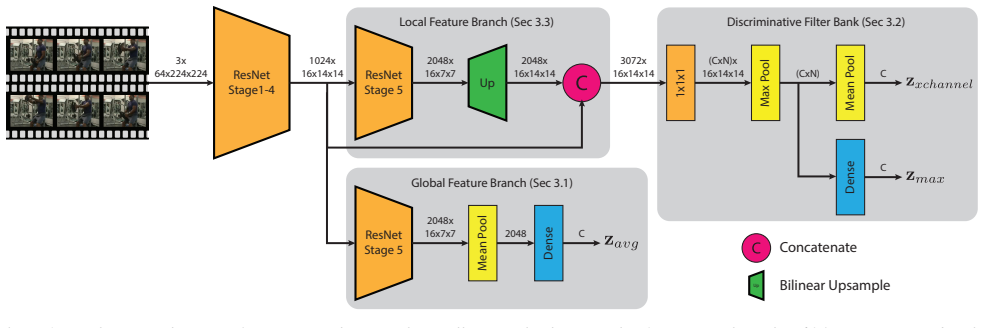
The central object is the discriminative filter bank: a set of $N\cdot C$ filters of shape $1\times1\times1$ (one group per class, with $N=5$ variants per class) applied to the feature volume and followed by global max pooling over space and time, so each filter's output is the maximum activation anywhere in the video. This converts the classifier from "average everything" to "find the one place that matters", and the paper adds a dense layer on top of the pooled filter responses so each class can borrow cues from all other classes' filters. The second piece is the local detail branch: a duplicated final stage with bilinear upsampling and a skip connection from the previous stage, giving the filter bank a higher-resolution feature volume than the global branch uses. The third piece is the joint training loss, which sums softmax cross-entropy losses on the combined output and on each branch independently.
What would settle it
A reader could rerun the Kinetics-400 ablation in table 1 with the local branch's upsampling and skip connection removed: the paper predicts top-1 drops from 68.8 to 68.0 for the 3D model, and if the drop does not appear, the higher-resolution branch is not the mechanism.
Extended reading notes
Core claim
The paper's central claim is that action recognition is a fine-grained recognition problem: classes like "eating a burger" versus "eating a hot-dog", or "dribbling a basketball" versus "shooting a basketball", are separated by localized object, texture, and motion cues that global average pooling washes out. The proposed architecture therefore augments the global-average-pooling branch with two extra classifiers. The discriminative filter bank uses $N\cdot C$ sets of $1\times1\times1$ convolutions (one set per class, $N=5$ variants per class) followed by global max pooling over the feature volume, so each filter's value is the maximum activation of that class's cue anywhere in the video; a dense layer then mixes these pooled responses across all classes. The local detail branch duplicates the final network stage, upsamples the features bilinearly, and adds a skip connection from the previous stage, so the filters see a higher-resolution volume than the global branch. The three branch outputs are summed and trained with a joint loss, and the paper reports that this head alone, without changing the backbone or using optical flow, gives 78.8 top-1 on Kinetics-400 and 53.4 top-1 on Something-Something-V1, both state-of-the-art results in their settings.
Load-bearing premise
The load-bearing premise is that the backbone's final feature maps still contain enough fine-grained spatial-temporal detail for the higher-resolution branches to recover; if the backbone has already discarded that detail, the extra branches cannot create it.
Editorial extensions
If this is right
- Attaching the three-branch head to a 2D TSN network lifts Kinetics-400 top-1 from 73.4 to 74.3, and to a 3D ResNet from 66.8 to 68.8 in the training-time setting, showing the gain is not tied to one backbone family.
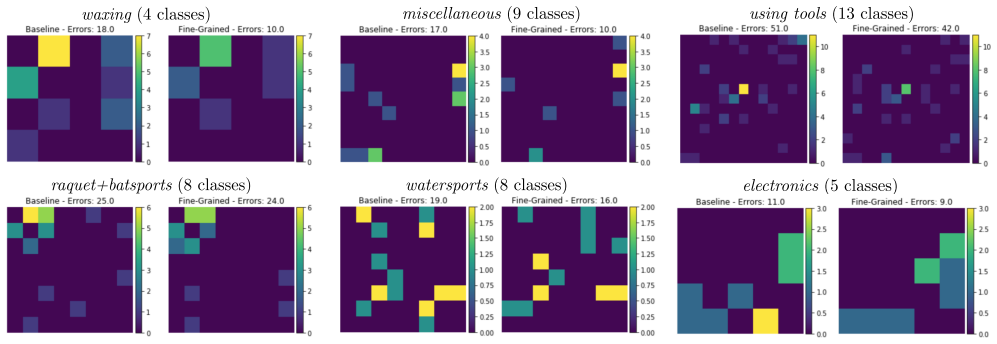
- The gains concentrate on fine-grained meta-categories (waxing +5.5, swimming +5.1, cooking +3.0 top-1), while meta-categories whose classes are already separated by scene, such as racquet sports, improve by only 0.3, supporting the paper's mechanism.
- On Something-Something-V1, the same head improves the ResNet18 baseline from 42.3 to 45.0 top-1, and deeper backbones amplify the benefit (ResNet50 50.1, ResNet152 53.4).
- Because only the classification head changes, the approach is orthogonal to backbone improvements: the authors state it is compatible with methods that increase representational capacity or computational efficiency of the backbone.
Reading between the lines
- A consequence the authors do not explore: the max-pooled filter responses are, in effect, class-specific spatio-temporal attention maps, so the head could be reused for weakly-supervised localization of the distinguishing moments, e.g., to say which frame and region separates "waxing back" from "waxing chest".
- The dramatic scaling with backbone depth on Something-Something-V1 hints that the filter bank's gains may be capacity-limited: on very small backbones the extra branches might compete for parameters, and the paper's tests with ResNet18 do not rule out that a larger global-only head could match them.
- The confusion-pair analysis (e.g., "mopping floor" vs "cleaning floor", "waxing legs" vs "shaving legs") suggests a simple testable extension: build a fine-grained action benchmark from these pairs and use per-pair accuracy rather than top-1 as the metric, which would isolate the exact contribution of local detail.
Signed reviews
Editorial analysis
A structured set of objections, weighed in public.
Referee Report
Summary. The paper proposes a modification to the classification head of action recognition networks, replacing the standard global-average-pooling plus linear classifier with three branches: a global branch, a discriminative filter bank, and a local detail branch. The design is inspired by fine-grained recognition work [31] and aims to improve sensitivity to fine-grained spatiotemporal details. The authors report consistent gains over their baselines on Kinetics-400 and Something-Something-V1, and claim state-of-the-art performance on both benchmarks. The paper includes ablations, per-class confusion analysis, and qualitative visualizations of filter responses.
Significance. Strengths: the paper provides a clean, well-motivated architectural idea that is compatible with existing backbones and adds modest computational overhead; the internal ablations (Table 1) show consistent improvements for both 2D and 3D backbones; the per-class confusion analysis and qualitative filter visualizations provide evidence that the mechanism works as intended. Weaknesses: the headline claim of state-of-the-art performance is not fully supported by the comparison tables, because a leading Kinetics-400 method (SlowFast) is omitted and the Something-Something-V1 best result uses a substantially deeper backbone than existing methods. The paper acknowledges these difficulties but does not resolve them. If the state-of-the-art claim were qualified or the comparisons completed, the contribution would be a useful incremental advance in head design for action recognition.
major comments (2)
- [Sec. 6, Table 4] The abstract and Sec. 6 claim state-of-the-art performance on Kinetics-400, but Table 4 omits SlowFast [8], which is cited in the references and was a leading method on this benchmark at the time of submission. Without this comparison, the 'state-of-the-art' designation is not verifiable from the evidence in the paper. Please add SlowFast (and any other contemporaneous leading methods) to the table, or rephrase the claim to state-of-the-art among the methods actually compared.
- [Sec. 6, Table 5] The state-of-the-art claim for Something-Something-V1 is not supported by the matched experiments. The best result (53.4 Top-1) uses a ResNet152 backbone, whereas all previous methods listed use BN-Inception, ResNet18, or ResNet50; the paper itself states in Sec. 6 that 'some architectures are trivially better than others,' yet the abstract retains an unqualified SoTA claim. In addition, at the matched ResNet18 setting the paper's result (45.0) is below TrajectoryNet with Kinetics-400 pretraining (47.8), a number that appears in the same table but is not addressed in the SoTA statement. The central claim should be qualified to the specific backbone/pre-training settings, or the comparison should be extended to matched configurations.
minor comments (5)
- [Sec. 2, second paragraph] The sentence 'In [39, ?] the temporal modeling is further improved...' contains a literal '?' as a placeholder citation; please supply the missing reference or remove the placeholder.
- [Figure 2] The channel labels are inconsistent with the text: the text says the 1x1x1 convolution produces N·C channels, but the figure shows a 3072-channel tensor; clarify whether 3072 is the concatenated input from the upsampled stage-5 and stage-4 features and label the output channels as C·N.
- [Sec. 4.2, Optimization parameters] The weight decay setting '10e−5' is ambiguous; please write 1e-4 or 1e-5 as intended, and fix the typo 'pre-trainined' in the preceding paragraph.
- [Table 2 and Table 3] The meta-category 'Raquet-Batsports' in Table 2 should be 'Racket-Batsports'; also, the caption of Table 3 should specify that the numbers are counts of validation videos for each confusion pair.
- [Sec. 5.2, Figure 3] The description 'cell (7,5)' is hard to interpret without a legend; please add explicit class axes to the confusion matrices or name the classes corresponding to that cell.
Circularity Check
No significant circularity: filter-bank head imported from external work [31], baseline re-implemented and measured, held-out evaluation; self-cited TSN/TrajectoryNet are non-load-bearing, and the under-supported state-of-the-art wording is a support issue, not circularity.
full rationale
Walking the derivation chain: (1) the motivation that global average pooling destroys fine detail is argued qualitatively in Sec. 3.1 and evidenced empirically by confusion statistics in Sec. 5.2, not by a definition; (2) the discriminative filter bank is adopted from external work [31] (Wang, Morariu, Davis, CVPR 2018), whose authors are disjoint from this paper's authors, so the central architectural idea is not a self-citation and not an ansatz smuggled in by the present authors; (3) the extension to 3D video with upsampling and a local stage-5 branch is new machinery whose components are each ablated in Table 1 with identical backbones and training settings; (4) every headline number is measured on held-out Kinetics-400 and Something-Something-V1 validation sets, and N=5 is a fixed hyperparameter chosen by preliminary experiments, not a fitted value renamed as a prediction. No equation in the paper reduces to its own inputs: the combined loss (Eq. 1) is a sum of standard softmax cross-entropy losses on outputs zavg, zxchannel, and zmax, each computed from learned features, and the baseline (GB) is re-implemented by the authors (TSN One Stream (our impl.) at 73.4 in Table 4; 42.3 in Table 5) rather than taken from cited papers. The self-citations are TSN [28] and TrajectoryNet [39], both co-authored by the present paper's Yuanjun Xiong, but neither is load-bearing: TSN only supplies the sampling/backbone scheme whose numbers are regenerated by the authors' own implementation, and TrajectoryNet appears only as a competitor in a comparison table. I flag, as a support problem rather than circularity, that the abstract's claim 'we obtain state-of-the-art performance on Kinetics-400 and Something-Something-V1' is under-supported: Table 4 omits SlowFast [8] (cited among the references but not tabulated), and Table 5's 'improves over the previous state-of-the art (with the same settings) by 1% in Top-1 accuracy (45.0 vs 44.0, TrajectoryNet [39])' overlooks the same table's TrajectoryNet entry at 47.8 with Kinetics-400 pretraining, while the 53.4 headline uses a ResNet152 backbone against shallower competitors. These are correctness and comparison-fairness concerns, not circularity: no prediction is equivalent by construction to a fitted parameter or to a self-cited theorem, so per the instructions they are weighed here without raising the circularity score.
Assumptions & free parameters
free parameters (1)
- N (number of discriminative filters per class) =
5
assumptions (3)
- domain assumption The backbone's final features retain enough fine-grained spatial-temporal information for fine-grained class discrimination.
- domain assumption ImageNet-pretrained ResNet backbones, inflated or used per-frame, transfer well to video action recognition.
- domain assumption The three classification losses can be minimized jointly with equal weights without harming the global branch.
Cite this review
Pith. "Pith review of Action recognition with spatial-temporal discriminative filter banks." pith.science (2026). https://pith.science/paper/WT7WE7VT
@misc{pith2026190807625,
  author       = {Pith},
  title        = {Pith review of: Action recognition with spatial-temporal discriminative filter banks},
  year         = {2026},
  howpublished = {\url{https://pith.science/paper/WT7WE7VT}},
  note         = {Machine review of arXiv:1908.07625}
}
read the original abstract
Action recognition has seen a dramatic performance improvement in the last few years. Most of the current state-of-the-art literature either aims at improving performance through changes to the backbone CNN network, or they explore different trade-offs between computational efficiency and performance, again through altering the backbone network. However, almost all of these works maintain the same last layers of the network, which simply consist of a global average pooling followed by a fully connected layer. In this work we focus on how to improve the representation capacity of the network, but rather than altering the backbone, we focus on improving the last layers of the network, where changes have low impact in terms of computational cost. In particular, we show that current architectures have poor sensitivity to finer details and we exploit recent advances in the fine-grained recognition literature to improve our model in this aspect. With the proposed approach, we obtain state-of-the-art performance on Kinetics-400 and Something-Something-V1, the two major large-scale action recognition benchmarks.
Figures

Figures from the paper (2 more)


Reference graph
Works this paper leans on
-
[8]
C. Feichtenhofer, H. Fan, J. Malik, and K. He. Slowfast net- works for video recognition. CoRR, 2018
work page 2018
-
[31]
Y . Wang, V . I. Morariu, and L. S. Davis. Learning a discrim- inative filter bank within a cnn for fine-grained recognition. IEEE Conference on Computer Vision and Pattern Recogni- tion, 2018. 2, 3
work page 2018
-
[1]
J. Assfalg, M. Bertini, A. Del Bimbo, W. Nunziati, and P. Pala. Soccer highlights detection and recognition us- ing hmms. In Proceedings. IEEE International Conference on Multimedia and Expo , volume 1, pages 825–828. IEEE,
-
[2]
J. Carreira and A. Zisserman. Quo vadis, action recognition? a new model and the Kinetics dataset. In IEEE Conference on Computer Vision and Pattern Recognition, 2017. 1, 2, 3, 4, 8
work page 2017
-
[3]
H.-T. Chen, C.-L. Chou, W.-J. Tsai, S.-Y . Lee, and J.-Y . Yu. Extraction and representation of human body for pitching style recognition in broadcast baseball video. In 2011 IEEE International Conference on Multimedia and Expo, pages 1–
work page 2011
-
[4]
T. Chen, M. Li, Y . Li, M. Lin, N. Wang, M. Wang, T. Xiao, B. Xu, C. Zhang, and Z. Zhang. Mxnet: A flexible and effi- cient machine learning library for heterogeneous distributed systems. In arXiv preprint arXiv:1512.01274, 2015. 4
arXiv 2015
-
[5]
Y . Chen, Y . Kalantidis, S. Yan, and J. Feng. Multi-fiber net- works for video recognition. In European Conference on Computer Vision, 2018. 2, 8
work page 2018
-
[6]
J. Deng, W. Dong, R. Socher, L.-J. Li, K. Li, and L. Fei- Fei. Imagenet: A large-scale hierarchical image database. In IEEE Conference on Computer Vision and Pattern Recogni- tion, 2009. 1, 2, 4
work page 2009
Show all 42 references
-
[7]
A. A. Efros, A. C. Berg, G. Mori, and J. Malik. Recognizing action at a distance. In null, page 726. IEEE, 2003. 2
2003
-
[9]
Feichtenhofer, A
C. Feichtenhofer, A. Pinz, and A. Zisserman. Convolutional two-stream network fusion for video action recognition. In IEEE Conference on Computer Vision and Pattern Recogni- tion, 2016
2016
-
[10]
Fernando, E
B. Fernando, E. Gavves, J. M. Oramas, A. Ghodrati, and T. Tuytelaars. Modeling video evolution for action recogni- tion. In Proceedings of the IEEE Conference on Computer Vision and Pattern Recognition, pages 5378–5387, 2015. 2
2015
-
[11]
Goyal, S
R. Goyal, S. E. Kahou, V . Michalski, J. Materzynska, S. Westphal, H. Kim, V . Haenel, I. Fr ¨und, P. Yianilos, M. Mueller-Freitag, F. Hoppe, C. Thurau, I. Bax, and R. Memisevic. The ”something something” video database for learning and evaluating visual common sense. In IEEE ...
2017
-
[12]
K. He, X. Zhang, S. Ren, and J. Sun. Deep residual learning for image recognition. IEEE Conference on Computer Vision and Pattern Recognition, pages 770–778, 2016. 1, 4
2016
-
[13]
G. V . Horn, O. Mac Aodha, Y . Song, A. Shepard, H. Adam, P. Perona, and S. J. Belongie. The inaturalist challenge 2017 dataset. CoRR, abs/1707.06642, 2017. 2
2017 arXiv
-
[14]
S. Ji, W. Xu, M. Yang, and K. Yu. 3d convolutional neural networks for human action recognition. IEEE Transactions of Pattern Analysis and Machine Intelligence , 35(1):221– 231, 2013. 1, 2
2013
-
[15]
W. Kay, J. Carreira, K. Simonyan, B. Zhang, C. Hillier, S. Vijayanarasimhan, F. Viola, T. Green, T. Back, A. Nat- sev, M. Suleyman, and A. Zisserman. The kinetics human action video dataset. CoRR, 2017. 2, 4, 5
2017
-
[16]
Krause, M
J. Krause, M. Stark, J. Deng, and L. Fei-Fei. 3d object rep- resentations for fine-grained categorization. In 4th Interna- tional IEEE Workshop on 3D Representation and Recogni- tion (3dRR-13), Sydney, Australia, 2013. 2
2013
-
[17]
C. Lea, A. Reiter, R. Vidal, and G. D. Hager. Segmen- tal spatiotemporal cnns for fine-grained action segmentation. In European Conference on Computer Vision, pages 36–52. Springer, 2016. 2
2016
-
[18]
Y . Li, N. Wang, J. Liu, and X. Hou. Factorized bilinear mod- els for image recognition. IEEE International Conference on Computer Vision, 2017. 2
2017
-
[19]
T.-Y . Lin, A. RoyChowdhury, and S. Maji. Bilinear cnns for fine-grained visual recognition. IEEE Transactions of Pattern Analysis and Machine Intelligence, 2017. 2
2017
-
[20]
D. J. Patterson, D. Fox, H. Kautz, and M. Philipose. Fine- grained activity recognition by aggregating abstract object usage. In Ninth IEEE International Symposium on Wearable Computers (ISWC’05), pages 44–51. IEEE, 2005. 2
2005
-
[21]
Rohrbach, S
M. Rohrbach, S. Amin, M. Andriluka, and B. Schiele. A database for fine grained activity detection of cooking ac- tivities. In 2012 IEEE Conference on Computer Vision and Pattern Recognition, pages 1194–1201. IEEE, 2012. 2
2012
-
[22]
Rohrbach, A
M. Rohrbach, A. Rohrbach, M. Regneri, S. Amin, M. An- driluka, M. Pinkal, and B. Schiele. Recognizing fine- grained and composite activities using hand-centric features and script data. International Journal of Computer Vision , 119(3):346–373, 2016. 2
2016
-
[23]
Simonyan and A
K. Simonyan and A. Zisserman. Two-stream convolutional networks for action recognition in videos. In Advances on Neural Information Processing Systems, 2014. 2, 8
2014
-
[24]
Singh, T
B. Singh, T. K. Marks, M. Jones, O. Tuzel, and M. Shao. A multi-stream bi-directional recurrent neural network for fine- grained action detection. In Proceedings of the IEEE Con- ference on Computer Vision and Pattern Recognition, pages 1961–1970, 2016. 2
1961
-
[25]
D. Tran, L. Bourdev, R. Fergus, L. Torresani, and M. Paluri. Learning spatiotemporal features with 3d convolutional net- works. In Proceedings of the IEEE international conference on computer vision, pages 4489–4497, 2015. 2
2015
-
[26]
D. Tran, H. Wang, L. Torresani, J. Ray, Y . LeCun, and M. Paluri. A closer look at spatiotemporal convolutions for action recognition. IEEE Conference on Computer Vision and Pattern Recognition, 2018. 2, 8
2018
-
[27]
Tsunoda, Y
T. Tsunoda, Y . Komori, M. Matsugu, and T. Harada. Foot- ball action recognition using hierarchical lstm. In Proceed- ings of the IEEE Conference on Computer Vision and Pattern Recognition Workshops, pages 99–107, 2017. 2
2017
-
[28]
L. Wang, Y . Xiong, Z. Wang, Y . Qiao, D. Lin, X. Tang, and L. Van Gool. Temporal segment networks for action recog- nition in videos. IEEE Transactions of Pattern Analysis and Machine Intelligence, 2018. 1, 2, 3, 4, 8
2018
-
[29]
X. Wang, R. B. Girshick, A. Gupta, and K. He. Non-local neural networks. IEEE Conference on Computer Vision and Pattern Recognition, 2018. 1, 2, 4, 8
2018
-
[30]
Wang and A
X. Wang and A. Gupta. Videos as space-time region graphs. In European Conference on Computer Vision, 2018. 8
2018
-
[32]
Welinder, S
P. Welinder, S. Branson, T. Mita, C. Wah, F. Schroff, S. Be- longie, and P. Perona. Caltech-UCSD Birds 200. Technical Report CNS-TR-2010-001, California Institute of Technol- ogy, 2010. 2
2010
-
[33]
S. Xie, C. Sun, J. Huang, Z. Tu, and K. Murphy. Rethinking spatiotemporal feature learning: Speed-accuracy trade-offs in video classification. In European Conference on Com- puter Vision, 2018. 1, 2, 8
2018
-
[34]
L. Yang, P. Luo, C. Change Loy, and X. Tang. A large-scale car dataset for fine-grained categorization and verification. In CVPR, pages 3973–3981, 2015. 2
2015
-
[35]
Zhang, T
H. Zhang, T. Xu, M. Elhoseiny, X. Huang, S. Zhang, A. El- gammal, and D. Metaxas. Spda-cnn: Unifying semantic part detection and abstraction for fine-grained recognition. In CVPR, 2016. 2
2016
-
[36]
Zhang, J
N. Zhang, J. Donahue, R. Girshick, and T. Darrell. Part- based r-cnns for fine-grained category detection. In Eu- ropean conference on computer vision , pages 834–849. Springer, 2014. 2
2014
-
[37]
B. Zhao, J. Feng, X. Wu, and S. Yan. A survey on deep learning-based fine-grained object classification and seman- tic segmentation. International Journal of Automation and Computing, 14(2):119–135, 2017. 2
2017
-
[38]
B. Zhao, X. Wu, J. Feng, Q. Peng, and S. Yan. Diversified vi- sual attention networks for fine-grained object classification. IEEE Transactions on Multimedia, 19(6):1245–1256, 2017. 2
2017
-
[39]
Y . Zhao, Y . Xiong, and D. Lin. Trajectory convolution for action recognition. In Advances on Neural Information Pro- cessing Systems. 2018. 2, 8
2018
-
[40]
Zheng, J
H. Zheng, J. Fu, T. Mei, and J. Luo. Learning multi-attention convolutional neural network for fine-grained image recog- nition. In Proceedings of the IEEE international conference on computer vision, pages 5209–5217, 2017. 2
2017
-
[41]
B. Zhou, A. Andonian, A. Oliva, and A. Torralba. Temporal relational reasoning in videos. In European Conference on Computer Vision, 2018. 8
2018
-
[42]
Zolfaghari, K
M. Zolfaghari, K. Singh, and T. Brox. Eco: Efficient con- volutional network for online video understanding. In Euro- pean Conference on Computer Vision, 2018. 8
2018
Reviewed August 14, 2026 · model on record in the stance chip above.
Discussion (0). Continue with ORCID to comment.