REVIEW 4 major objections 5 minor 46 references
Generative AI for Urban Design: A Stepwise Approach Integrating Human Expertise with Multimodal Diffusion Models
T0 review · 4 major / 5 minor · reviewed 2026-08-07 · deepseek-v4-flash
Pith's one-line read A three-stage ControlNet diffusion framework, with human review points between stages, generates urban design diagrams that are more realistic, more instruction-compliant, and more diverse than GAN baselines or end-to-end diffusion…
desk verdict A genuinely useful stepwise ControlNet framework for urban design with careful train/test separation, but the compliance-extraction pipeline is unspecified and the human-in-the-loop claim is untested, so the headline comparisons need verification. read the letter →
The pith
A machine-rendered reading of the paper's core claim, the machinery that carries it, and where it could break.
The reading
What carries the argument
The carrying mechanism is ControlNet, an architecture that adds a trainable copy of a pre-trained Stable Diffusion network alongside a locked copy so that text prompts and image-based structural constraints jointly guide the denoising process. In this paper it is deployed as three separate ControlNet models, one per design stage, with Stage 1 taking site constraints (water, railways, major roads) and outputting road and land use maps, Stage 2 taking that map and outputting building footprints and heights, and Stage 3 rendering the combined layout into satellite-style imagery. The dual-network control mechanism is what lets the authors condition generation on both planning metrics and spatial context, while the staged decomposition is what creates intermediate decision points for human review.
What would settle it
A user study in which professional planners review and refine Stage 1 and Stage 2 outputs, compared against the identical pipeline run completely automatically: if the human-refined branch is not significantly better on fidelity, instruction compliance, or stakeholder acceptance, the paper's central motivation collapses.
Extended reading notes
Core claim
The central claim is that a stepwise, human-in-the-loop ControlNet framework—three sequential diffusion-based generators, each conditioned on an image constraint and a text prompt describing land use composition, road density, building height mix, and open space—produces urban design diagrams that are more realistic, more compliant with human instructions, and more diverse than GAN-based baselines or a single end-to-end diffusion pass. On held-out test sites in NYC and Chicago, the stepwise framework reaches FID 49.76 at Stage 2 versus 74.70 for the end-to-end variant, achieves R² of 0.92 for road density and 0.87 for building height in NYC, and generates multiple plausible spatial configurations under identical constraints. The paper further claims the staged structure matches established top-down urban design practice, giving designers review points at which they can select, edit, and refine outputs before the next stage.
Load-bearing premise
The load-bearing premise is that a human designer can usefully review, edit, and steer the intermediate stage outputs, but the paper asserts this without ever running a user study or any experiment with human participants.
Editorial extensions
If this is right
- A stepwise diffusion pipeline beats an end-to-end diffusion pipeline even when both use ControlNet, with large gains in FID (49.76 vs 74.70) and instruction-compliance R².
- Text prompts specifying land use percentages, road density, building height mix, and open space ratio are sufficient to steer diffusion outputs to quantitatively match the targets on held-out sites.
- Diffusion-based ControlNet generation outperforms GAN-based Pix2Pix baselines on visual fidelity and instruction compliance across all three stages in both NYC and Chicago.
- The framework can transfer urban design style across cities, so a model trained on Chicago produces Chicago-like grid patterns when applied to NYC sites.
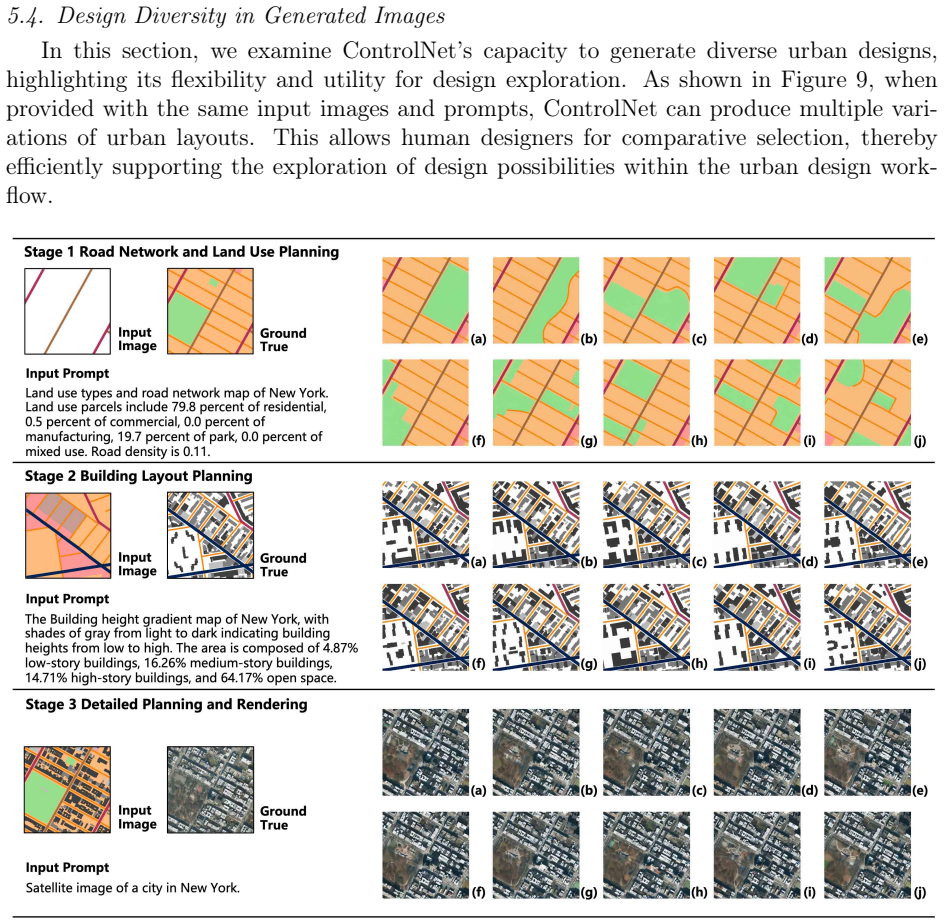
- Generating multiple design alternatives under the same constraints gives designers a pool of plausible layouts to compare and refine, rather than a single automated output.
Reading between the lines
- The paper's defining benefit—human expertise integrated at each stage—is asserted but never experimentally tested, so a direct user study comparing human-refined outputs with the same pipeline run fully automatically is the natural next test.
- The instruction-compliance metrics are computed by extracting land use, road, and building quantities from generated images, but the extraction procedure is not described; publishing and validating that extraction would let others reproduce the reported R² values.
- The staged design means each intermediate output is a standardized diagram that could be swapped or edited independently, a property the paper shows qualitatively but does not formalize as a modular design interface.
- The cross-city transfer results suggest the model learns city-specific design vocabularies, such as grid orientation and building-height variation, but a quantitative transfer metric (for example, FID between transferred outputs and target-city ground truth) would strengthen that visual observation.
Editorial analysis
A structured set of objections, weighed in public.
Referee Report
Summary. The paper proposes a three-stage, stepwise generative framework for urban design built on ControlNet/Stable Diffusion, in which road/land-use planning, building layout, and detailed rendering are generated sequentially from image constraints and text prompts, with human review described as possible at each stage. The authors construct a dataset from NYC and Chicago, train separate ControlNet models per stage, and evaluate fidelity (FID), instruction compliance (RMSE/MAE/R²), and diversity (visual inspection), comparing against Pix2Pix, a metric-enhanced Pix2Pix, ChatGPT-4o, and an end-to-end ControlNet variant. The central claim is that the stepwise framework outperforms GAN-based and end-to-end baselines on visual fidelity, instruction compliance, and design diversity, while preserving human control through iterative refinement.
Significance. If the central claims hold, this is a valuable application of controllable diffusion models to urban design, since the staged decomposition matches how practitioners actually work and the open code and public data sources support reproducibility. The paper also provides a useful comparison against a same-backbone end-to-end variant, which is important for isolating the benefit of the stepwise structure. The main contributions are conditional, however: the instruction-compliance advantage depends on an unspecified metric-extraction pipeline that could systematically favor clean, color-separated stage outputs; the human-in-the-loop benefit is asserted but never tested; and the diversity claim is supported only by selected qualitative examples. These gaps prevent the paper, in its current form, from fully establishing its stated contributions.
major comments (4)
- [§3.3, Tables 2–4] The instruction-compliance evaluation never specifies how road density, land use proportions, open space, and building height are extracted from generated RGB diagrams. The text says outputs are 'compared' to target metrics, but it does not describe the color-to-class mapping, pixel-counting or segmentation procedure, thresholds, or any validation against vector-derived ground truth. This is load-bearing because the headline stepwise-versus-end-to-end advantage (Table 4: road density R²=0.92 vs 0.44; open space 0.91 vs 0.48) could be inflated if the extractor handles clean, color-separated stepwise maps more accurately than the noisier, mixed/composite end-to-end outputs. Please specify the extraction pipeline in full and demonstrate that it is unbiased across model outputs, for example by showing extraction accuracy on held-out vector ground truth and on manually labeled samples of each model's outputs.
- [§1, §3.2.2, §6] The framework's defining benefit, human expertise integrated at each stage, is central to the motivation but is never tested: all experiments run the pipeline automatically, with no user study, no human refinement step, and no comparison between human-in-the-loop and fully automatic generation. Sections 1 and 6 claim that the stepwise approach 'allows for better human intervention' and 'preserving human control,' but no experimental evidence supports this. Please either add a user study or an ablation (for example, simulated human edits or expert review of intermediate outputs) that actually evaluates the human-in-the-loop component, or explicitly reframe the paper's claims to describe human control as a design feature rather than a demonstrated advantage.
- [§5.4, §6] Design diversity is assessed only by visual inspection of a small set of selected examples (Figure 9), with no quantitative diversity metric, no baseline comparison, and no statistical summary. The conclusion that the framework 'outperforms baseline models and end-to-end approaches across all three dimensions' is therefore not supported for the diversity dimension. Please add a quantitative diversity measure (for example, pairwise image dissimilarity in feature space, or diversity of extracted road/building metrics across generated samples) and compare it against the baselines, or soften the claim to state that diversity was evaluated qualitatively.
- [Table 4, §5.3] The stepwise-versus-end-to-end comparison reports only aggregate FID and R² values, with no city breakdown, no sample size, and no variance or significance testing. It is also unclear whether the comparison is based on one combined test map or on the full held-out test sets of both cities. Since the end-to-end variant is a new model introduced for this comparison, please report per-city and per-grid statistics, the number of test samples, and confidence intervals or a significance test for both FID and compliance metrics before concluding that stepwise is superior.
minor comments (5)
- [Tables 1 and 4] FID scores are reported as single point estimates without variance or sample size; given that FID can be noisy, please add bootstrapped confidence intervals or repeated-sample standard deviations.
- [§3.3] The entropy-weighted land use R² is not defined: the units over which R² is computed, the entropy formula, and the weighting scheme should be specified precisely so the reported values are interpretable and reproducible.
- [Table 3] In the NYC open-space row, metric-enhanced Pix2Pix achieves R²=0.92, which is higher than ControlNet's 0.91; the text in §5.2.2 says 'the two models perform similarly,' but it should also acknowledge that the metric-enhanced baseline numerically outperforms ControlNet on this metric.
- [§5.5] The urban transferability section is purely qualitative, based on selected examples; if transferability is intended as a supported contribution, please add quantitative measurements (for example, fidelity or compliance metrics for cross-city models) or frame it explicitly as an illustrative exploration.
- [References] A few reference formatting issues appear, such as 'iSSN' in the Flach et al. entry and inconsistent arXiv identifiers; these should be cleaned for publication.
Circularity Check
No significant circularity: the stepwise ControlNet comparisons are empirical benchmark evaluations, and the only self-citation is a peripheral literature-review mention.
full rationale
The paper's central claims are empirical benchmark results. It trains ControlNet models conditioned on image constraints and text prompts, and then compares FID, RMSE, MAE, and R² against Pix2Pix, metric-enhanced Pix2Pix, and an end-to-end ControlNet variant. The text prompts are constructed from ground-truth design metrics, and instruction compliance is measured against those same target metrics; this is a standard supervised evaluation of whether the generated image encodes the requested metric values, not a fitted parameter renamed as a prediction, because the generated image is the predicted output and can fail to match the prompt. The stepwise-versus-end-to-end comparison uses the same conditioning variables and measures compliance on the respective outputs; the unspecified metric-extraction pipeline in Section 3.3 and the potential parsing artifacts in Tables 2-4 are validity and reproducibility risks, not circular reductions. The paper's own stated limitations in Section 6, such as the lack of explicit mechanisms for qualitative, context-driven principles, and the untested human-in-the-loop claim in Sections 3.2.2 and 5.4, are scope limitations rather than circular derivations. The only self-citation is Zhuang et al. (2024) in Section 2.2, cited as an example of diffusion models applied to geographical data transformation; it is not load-bearing for the framework's derivation or evaluation. No equation or claim reduces to its own input by construction, so the appropriate finding is no significant circularity.
Assumptions & free parameters
free parameters (6)
- Grid size =
450 m x 450 m
- Land use categories =
residential, commercial, manufacturing, park, mixed-use
- Building height thresholds =
Jenks Natural Breaks per city
- Data augmentation shift =
one-third and two-thirds tile shifts, 9x data
- Entropy weighting =
sample weights proportional to land use entropy
- Model hyperparameters =
learning rate 1e-5, batch size 2, SD_locked=False
assumptions (6)
- domain assumption ControlNet can learn the mapping from site-constraint images and text prompts to urban design diagrams.
- domain assumption FID computed against real images is a valid measure of urban design visual fidelity.
- domain assumption Instruction compliance can be measured by comparing generated images with prompt metrics such as land use shares, road density, and building height shares.
- domain assumption A 450 m grid tile is a meaningful unit for urban design and aligns with the 15-minute city concept.
- domain assumption OpenStreetMap, city open data, and Mapbox imagery are spatially consistent and complete enough for training and evaluation.
- domain assumption The five-category land use taxonomy and three-category building height classes capture the design-relevant variation across cities.
Cite this review
Pith. "Pith review of Generative AI for Urban Design: A Stepwise Approach Integrating Human Expertise with Multimodal Diffusion Models." pith.science (2026). https://pith.science/paper/WTWD4CSR
@misc{pith2026250524260,
  author       = {Pith},
  title        = {Pith review of: Generative AI for Urban Design: A Stepwise Approach Integrating Human Expertise with Multimodal Diffusion Models},
  year         = {2026},
  howpublished = {\url{https://pith.science/paper/WTWD4CSR}},
  note         = {Machine review of arXiv:2505.24260}
}
read the original abstract
Urban design is a multifaceted process that demands careful consideration of site-specific constraints and collaboration among diverse professionals and stakeholders. The advent of generative artificial intelligence (GenAI) offers transformative potential by improving the efficiency of design generation and facilitating the communication of design ideas. However, most existing approaches are not well integrated with human design workflows. They often follow end-to-end pipelines with limited control, overlooking the iterative nature of real-world design. This study proposes a stepwise generative urban design framework that integrates multimodal diffusion models with human expertise to enable more adaptive and controllable design processes. Instead of generating design outcomes in a single end-to-end process, the framework divides the process into three key stages aligned with established urban design workflows: (1) road network and land use planning, (2) building layout planning, and (3) detailed planning and rendering. At each stage, multimodal diffusion models generate preliminary designs based on textual prompts and image-based constraints, which can then be reviewed and refined by human designers. We design an evaluation framework to assess the fidelity, compliance, and diversity of the generated designs. Experiments using data from Chicago and New York City demonstrate that our framework outperforms baseline models and end-to-end approaches across all three dimensions. This study underscores the benefits of multimodal diffusion models and stepwise generation in preserving human control and facilitating iterative refinements, laying the groundwork for human-AI interaction in urban design solutions.
Figures


Figures from the paper (7 more)



Reference graph
Works this paper leans on
-
[1]
author Albert, A. , author Strano, E. , author Kaur, J. , and author González, M. ( year 2018 ). title Modeling Urbanization Patterns with Generative Adversarial Networks . In booktitle IGARSS 2018 - 2018 IEEE International Geoscience and Remote Sensing Symposium \/ (pp. pages 2095--2098 ). https://ieeexplore.ieee.org/document/8518032/?arnumber=8518032. :...
-
[2]
author Alidoust, S. , and author Huang, W. ( year 2022 ). title Master Planned Communities for Healthy Living : A Systematic Literature Review . journal Urban Policy and Research \/ , volume 40 \/ , pages 142--160 . https://doi.org/10.1080/08111146.2022.2057945. :10.1080/08111146.2022.2057945
-
[3]
author Allen-Dumas, M. R. , author Wheelis, A. R. , author Sweet-Breu, L. T. , author Anantharaj, J. , and author Kurte, K. R. ( year 2022 ). title Generative adversarial networks for ensemble projections of future urban morphology . In booktitle Proceedings of the 5th ACM SIGSPATIAL International Workshop on Advances in Resilient and Intelligent Cities \...
-
[4]
author Asaad, M. , author Khalifa, M. , and author Abd Elrahman, A. S. ( year 2020 ). title Bridging the Gap Between Theory and Practice in the Urban Design Process : Towards Multidisciplinary Success Considerations . In editor H. Bougdah , editor A. Versaci , editor A. Sotoca , editor F. Trapani , editor M. Migliore , and editor N. Clark (Eds.), booktitl...
work page 2017
-
[5]
author Batty, M. ( year 2013 ). title The New Science of Cities \/ . publisher MIT Press
work page 2013
-
[6]
author Berthelot, D. , author Raffel, C. , author Roy, A. , and author Goodfellow, I. ( year 2018 ). title Understanding and Improving Interpolation in Autoencoders via an Adversarial Regularizer . http://arxiv.org/abs/1807.07543. :10.48550/arXiv.1807.07543
-
[7]
author Cai, D. ( year 2024 ). title Enhancing capabilities of generative models through VAE - GAN integration: A review . journal Applied and Computational Engineering \/ , volume 67 \/ , pages 239--246 . https://www.ewadirect.com/proceedings/ace/article/view/14698. :10.54254/2755-2721/67/2024MA0070. note TLDR: This review explores the integration of Vari...
-
[8]
author Cantrell, B. , and author Michaels, W. ( year 2014 ). title Digital Drawing for Landscape Architecture : Contemporary Techniques and Tools for Digital Representation in Site Design \/ . publisher John Wiley & Sons
work page 2014
Show all 46 references
-
[9]
( year 2021 )
author Carmona, M. ( year 2021 ). title Public Places Urban Spaces : The Dimensions of Urban Design \/ . ( edition 3rd ed.). address New York : publisher Routledge . :10.4324/9781315158457
2021 doi
-
[10]
, author White, T
author Creswell, A. , author White, T. , author Dumoulin, V. , author Arulkumaran, K. , author Sengupta, B. , and author Bharath, A. A. ( year 2018 ). title Generative Adversarial Networks : An Overview . journal IEEE Signal Processing Magazine \/ , volume 35 \/ , pages 53--65...
2018
-
[11]
, and author Nichol, A
author Dhariwal, P. , and author Nichol, A. ( year 2021 ). title Diffusion Models Beat GANs on Image Synthesis . In booktitle Advances in Neural Information Processing Systems \/ (pp. pages 8780--8794 ). publisher Curran Associates, Inc. volume volume 34 . https://proceedings....
2021
-
[12]
, author Schlesinger, D
author Flach, B. , author Schlesinger, D. , and author Shekhovtsov, A. ( year 2024 ). title Symmetric Equilibrium Learning of VAEs . In booktitle Proceedings of The 27th International Conference on Artificial Intelligence and Statistics \/ (pp. pages 3214--3222 ). publisher PM...
2024
-
[13]
, author Vernez-Moudon, A
author Giles-Corti, B. , author Vernez-Moudon, A. , author Reis, R. , author Turrell, G. , author Dannenberg, A. L. , author Badland, H. , author Foster, S. , author Lowe, M. , author Sallis, J. F. , author Stevenson, M. , and author Owen, N. ( year 2016 ). title City planning...
2016 doi
-
[14]
, author Weinmann, M
author Hartmann, S. , author Weinmann, M. , author Wessel, R. , and author Klein, R. ( year 2017 ). title StreetGAN : towards road network synthesis with generative adversarial networks \/ . publisher Václav Skala - UNION Agency . http://dspace5.zcu.cz/handle/11025/29554
2017
-
[15]
, author Jain, A
author Ho, J. , author Jain, A. , and author Abbeel, P. ( year 2020 ). title Denoising Diffusion Probabilistic Models . In booktitle Advances in Neural Information Processing Systems \/ (pp. pages 6840--6851 ). publisher Curran Associates, Inc. volume volume 33 . https://proce...
2020
-
[16]
, author Ma, J
author Jiang, F. , author Ma, J. , author Webster, C. , author Chiaradia, A. , author Zhou, Y. , author Zhao, Z. , and author Zhang, X. ( year 2024 a ). title Generative urban design: A systematic review on problem formulation, design generation, and decision-making . journal ...
2024
-
[17]
, author Ma, J
author Jiang, F. , author Ma, J. , author Webster, C. , author Wang, W. , and author Cheng, J. ( year 2024 b ). title Automated site planning using CAIN - GAN model . journal Automation in Construction \/ , volume 159 \/ , pages 105286 . https://linkinghub.elsevier.com/retriev...
2024
-
[18]
, author Ma, J
author Jiang, F. , author Ma, J. , author Webster, C. J. , author Li, X. , and author Gan, V. J. ( year 2023 ). title Building layout generation using site-embedded GAN model . journal Automation in Construction \/ , volume 151 \/ , pages 104888 . https://linkinghub.elsevier.c...
2023
-
[19]
, author Li, M
author Jiang, H. , author Li, M. , author Witte, P. , author Geertman, S. , and author Pan, H. ( year 2025 ). title Urban chatter: Exploring the potential of chatgpt-like and generative ai in enhancing planning support . journal Cities \/ , volume 158 \/ , pages 105701
2025
-
[20]
, author Gao, S
author Kang, Y. , author Gao, S. , and author Roth, R. E. ( year 2019 ). title Transferring multiscale map styles using generative adversarial networks . journal International Journal of Cartography \/ , volume 5 \/ , pages 115--141 . https://www.tandfonline.com/doi/full/10.10...
2019
- [21]
-
[22]
, author Yang, Y
author Li, H. , author Yang, Y. , author Chang, M. , author Chen, S. , author Feng, H. , author Xu, Z. , author Li, Q. , and author Chen, Y. ( year 2022 ). title SRDiff : Single image super-resolution with diffusion probabilistic models . journal Neurocomputing \/ , volume 479...
2022 doi
-
[23]
, author Danelljan, M
author Lugmayr, A. , author Danelljan, M. , author Romero, A. , author Yu, F. , author Timofte, R. , and author Van Gool, L. ( year 2022 ). title RePaint : Inpainting Using Denoising Diffusion Probabilistic Models . (pp. pages 11461--11471 ). https://openaccess.thecvf.com/cont...
2022
-
[24]
( year 1964 )
author Lynch, K. ( year 1964 ). title The Image of the City \/ . publisher MIT Press
1964
-
[25]
, and author Larson, K
author Noyman, A. , and author Larson, K. ( year 2020 ). title A deep image of the city: Generative urban-design visualization . In booktitle Proceedings of the 11th annual symposium on simulation for architecture and urban design \/ (pp. pages 1--8 )
2020
-
[26]
( year 2016 )
author Oliveira, V. ( year 2016 ). title Urban Morphology \/ . The Urban Book Series . address Cham : publisher Springer International Publishing . http://link.springer.com/10.1007/978-3-319-32083-0. :10.1007/978-3-319-32083-0
2016 doi
- [27]
-
[28]
, author No, W
author Park, C. , author No, W. , author Choi, J. , and author Kim, Y. ( year 2023 ). title Development of an AI advisor for conceptual land use planning . journal Cities \/ , volume 138 \/ , pages 104371 . https://www.sciencedirect.com/science/article/pii/S026427512300183X. :...
2023
-
[29]
author Quan, S. J. ( year 2022 ). title Urban- GAN : An artificial intelligence-aided computation system for plural urban design . journal Environment and Planning B: Urban Analytics and City Science \/ , volume 49 \/ , pages 2500--2515 . https://doi.org/10.1177/23998083221100...
2022 doi
- [30]
-
[31]
, author Solé-Ribalta, A
author Rhoads, D. , author Solé-Ribalta, A. , and author Borge-Holthoefer, J. ( year 2023 ). title The inclusive 15-minute city: Walkability analysis with sidewalk networks . journal Computers, Environment and Urban Systems \/ , volume 100 \/ , pages 101936 . https://linkinghu...
2023
-
[32]
, author Blattmann, A
author Rombach, R. , author Blattmann, A. , author Lorenz, D. , author Esser, P. , and author Ommer, B. ( year 2022 ). title High- Resolution Image Synthesis With Latent Diffusion Models . (pp. pages 10684--10695 ). https://openaccess.thecvf.com/content/CVPR2022/html/Rombach_H...
2022
-
[33]
, author Chan, W
author Saharia, C. , author Chan, W. , author Chang, H. , author Lee, C. , author Ho, J. , author Salimans, T. , author Fleet, D. , and author Norouzi, M. ( year 2022 a ). title Palette: Image -to- Image Diffusion Models . In booktitle Special Interest Group on Computer Graphi...
2022
-
[34]
, author Chan, W
author Saharia, C. , author Chan, W. , author Saxena, S. , author Li, L. , author Whang, J. , author Denton, E. L. , author Ghasemipour, K. , author Gontijo Lopes, R. , author Karagol Ayan, B. , author Salimans, T. , author Ho, J. , author Fleet, D. J. , and author Norouzi, M....
2022
-
[35]
, and author Cao, J
author Saxena, D. , and author Cao, J. ( year 2021 ). title Generative Adversarial Networks ( GANs ): Challenges , Solutions , and Future Directions . journal ACM Comput. Surv. \/ , volume 54 \/ , pages 63:1--63:42 . https://dl.acm.org/doi/10.1145/3446374. :10.1145/3446374
2021 doi
-
[36]
, author Liu, C
author Shen, J. , author Liu, C. , author Ren, Y. , and author Zheng, H. ( year 2020 ). title Machine Learning Assisted Urban Filling . (pp. pages 679--688 ). address Bangkok, Thailand . http://papers.cumincad.org/cgi-bin/works/paper/caadria2020_054. :10.52842/conf.caadria.2020.2.679
2020 doi
-
[37]
, author Lee, H
author Sohn, K. , author Lee, H. , and author Yan, X. ( year 2015 ). title Learning Structured Output Representation using Deep Conditional Generative Models . In booktitle Advances in Neural Information Processing Systems \/ . publisher Curran Associates, Inc. volume volume 2...
2015
-
[38]
, author Liu, K
author Wang, D. , author Liu, K. , author Johnson, P. , author Sun, L. , author Du, B. , and author Fu, Y. ( year 2021 ). title Deep Human -guided Conditional Variational Generative Modeling for Automated Urban Planning . In booktitle 2021 IEEE International Conference on Data...
2021
-
[39]
, author Wu, L
author Wang, D. , author Wu, L. , author Zhang, D. , author Zhou, J. , author Sun, L. , and author Fu, Y. ( year 2023 a ). title Human- Instructed Deep Hierarchical Generative Learning for Automated Urban Planning . journal Proceedings of the AAAI Conference on Artificial Inte...
2023 doi
-
[40]
, author Jiang, Y
author Wang, Z. , author Jiang, Y. , author Lu, Y. , author Shen, Y. , author He, P. , author Chen, W. , author Wang, Z. , and author Zhou, M. ( year 2023 b ). title In- Context Learning Unlocked for Diffusion Models . http://arxiv.org/abs/2305.01115. :10.48550/arXiv.2305.01115
-
[41]
, author Ding, N
author Weng, M. , author Ding, N. , author Li, J. , author Jin, X. , author Xiao, H. , author He, Z. , and author Su, S. ( year 2019 ). title The 15-minute walkable neighborhoods: Measurement , social inequalities and implications for building healthy communities in urban Chin...
2019 doi
-
[42]
, and author Biljecki, F
author Wu, A. , and author Biljecki, F. ( year 2022 ). title GANmapper : geographical data translation . journal International Journal of Geographical Information Science \/ , volume 36 \/ , pages 1394--1422 . https://www.tandfonline.com/doi/abs/10.1080/13658816.2022.2041643. ...
2022
-
[43]
, author Du, J
author Ye, X. , author Du, J. , and author Ye, Y. ( year 2022 ). title MasterplanGAN : Facilitating the smart rendering of urban master plans via generative adversarial networks . journal Environment and Planning B: Urban Analytics and City Science \/ , volume 49 \/ , pages 79...
2022 doi
-
[44]
, author Rao, A
author Zhang, L. , author Rao, A. , and author Agrawala, M. ( year 2023 ). title Adding Conditional Control to Text -to- Image Diffusion Models . In booktitle 2023 IEEE / CVF International Conference on Computer Vision ( ICCV ) \/ (pp. pages 3813--3824 ). address Paris, France...
2023
-
[45]
, author Li, H
author Zhou, F. , author Li, H. , author Hu, R. , author Wu, S. , author Feng, H. , author Du, Z. , and author Xu, L. ( year 2024 ). title ControlCity : A Multimodal Diffusion Model Based Approach for Accurate Geospatial Data Generation and Urban Morphology Analysis . http://a...
2024 doi
-
[46]
, author Wang, Q
author Zhuang, D. , author Wang, Q. , author Zheng, Y. , author Guo, X. , author Wang, S. , author Koutsopoulos, H. N. , and author Zhao, J. ( year 2024 ). title Advancing Transportation Mode Share Analysis with Built Environment : Deep Hybrid Models with Urban Road Network . ...
Reviewed August 7, 2026 · model on record in the stance chip above.
Discussion (0). Sign in to comment.