REVIEW 4 major objections 4 minor 1 cited by
Prompt Smart, Pay Less: Cost-Aware APO for Real-World Applications
T0 review · 4 major / 4 minor · reviewed 2026-08-06 · deepseek-v4-flash
Pith's one-line read A hybrid of two prompt optimizers matches OPRO's accuracy at roughly 18% lower API cost.
desk verdict Useful real-world cost data, but the headline APE-OPRO-vs-OPRO parity rests on a modified OPRO baseline and no significance tests. read the letter →
The pith
A machine-rendered reading of the paper's core claim, the machinery that carries it, and where it could break.
The reading
What carries the argument
The machinery is the warm-start schedule: APE's semantic-similarity generator creates short variants of the initial system prompt, macro-F1 scoring on the training subset selects the top three, and those become the initial entries of the OPRO metaprompt that asks the optimizer to write a new, higher-scoring prompt. The paper's token-cost formula, which sums the optimizer's and scorer's input and output tokens in every iteration, is what converts this trajectory difference into the roughly 18% dollar saving.
What would settle it
Rerun the comparison with a larger training sample per label (for example, sixteen examples per label instead of four) and with bootstrapped random splits; the central claim is falsified if APE-OPRO no longer matches OPRO's test weighted F1, or if the 18% cost gap shrinks to within run-to-run variance. A cheaper, direct check is to plot token counts for iterations 1–3 of both methods: if OPRO's first-iteration prompt is not substantially longer, the proposed warm-start mechanism is not what saves the money.
Extended reading notes
Core claim
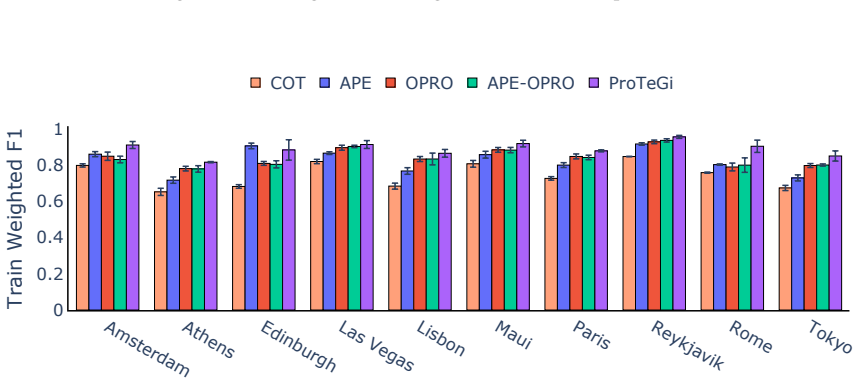
The paper's central claim is that APE-OPRO matches OPRO's performance while significantly reducing API costs by about 18% on average across ten destinations, with the gap reaching nearly 2x for Amsterdam. The mechanism is initialization: APE-OPRO begins with semantically similar variants of a base instruction, scores them on a tiny training set with macro F1, and feeds the top three into OPRO's metaprompt, so the optimizer sees short, structured exemplars from iteration one. Plain OPRO starts from a bare metaprompt and immediately writes long prompts with elaborate label definitions, so its token count spikes early and stays high. The paper also argues ProTeGi is the strongest absolute performer at lower API cost but longer execution time, and reports that increasing depth or breadth beyond 5 iterations or 5 prompts yields diminishing or negative returns, and that APE—but not the other methods—is sensitive to label formatting.
Load-bearing premise
The whole cost-performance comparison assumes that macro F1 on a training set of at most four examples per label (about 50–75 products per destination) reliably predicts which prompt will maximize weighted F1 on the test set; if a few idiosyncratic training examples dominate selection, both the reported rankings and the 18% figure are split artifacts.
Editorial extensions
If this is right
- A team already running OPRO can expect the same weighted F1 with about 18% lower API spend by switching to the APE-OPRO initialization, and the saving is largest exactly where OPRO's first-iteration prompts are most verbose.
- The default 10-iteration, 10-prompt configuration is probably over-spending: single-run ablations show 5 iterations and 5 prompts usually suffice, with further depth or breadth increasing cost 2–3x without consistent gains.
- If ProTeGi's wall-clock time is acceptable, it should be the first choice on cost-performance grounds, since it posts the highest test weighted F1 while staying cheaper than OPRO and APE-OPRO.
- Label formatting should be fixed before optimization starts, because APE's final prompts omit label definitions and are measurably affected by hyphen, number, or letter prefixes despite instructions to ignore position.
Reading between the lines
- The paper leaves untested whether the warm-start benefit transfers to other OPRO-style tasks; a fair test is to run OPRO with a single short, well-scored prompt as its first candidate and see if the cost gap closes.
- The 18% figure is likely split-dependent: because macro F1 is computed on at most four examples per label, a bootstrap across random training samples would reveal whether the cost-performance ranking is stable or driven by a handful of idiosyncratic products.
- APE's formatting sensitivity hints that, without label definitions, positional cues are the only disambiguating signal the model can use; a probe comparing APE with and without label definitions under identical formatting would separate formatting effects from definition effects.
- The flat, destination-specific taxonomy is proprietary, but the cost-geometry claim could be checked on any category-rich public dataset with single-label multiclass structure.
Editorial analysis
A structured set of objections, weighed in public.
Referee Report
Summary. This paper reports an empirical comparison of four automatic prompt optimization methods (APE, OPRO, ProTeGi, and the proposed APE-OPRO hybrid, plus a CoT baseline) on a proprietary single-label multiclass product classification task at Viator. Cost is computed from token counts and list prices using Eq. (2). The headline claim is that APE-OPRO matches OPRO's test weighted F1 while cutting API cost by ~18%; ProTeGi is reported as the strongest performer per dollar, and depth/breadth ablations plus label-formatting sensitivity analyses are presented.
Significance. If the headline claims are supported, the paper would be a useful practitioner-oriented contribution: it attacks a realistic multiclass setting rather than binary benchmarks, proposes a simple hybrid that is easy to implement, and models API cost transparently. The authors also provide five-run variance estimates for the main comparison and report label-formatting sensitivity, which is an interesting behavioral observation. However, the central comparison is weakened by the modified OPRO baseline and the lack of statistical tests, and the proprietary data/code are not released, so the quantitative conclusions are hard to audit and generalize.
major comments (4)
- [Section 4.5.3, Section 5.2, Figures 5-6] The OPRO baseline is not the published OPRO algorithm: exemplars are removed from the metaprompt and the history is truncated to the top 3 prompts instead of the original 20. Both changes reduce the cost of the baseline and are likely to reduce its performance, so the observed 'match' and the ~18% cost gap may be artifacts of comparing APE-OPRO against a weakened OPRO variant. A comparison with the original OPRO configuration, or ablations of the two modifications, is required to support the headline claim.
- [Abstract and Section 5.2] The statements 'OPRO incurs 18% higher costs' and 'APE-OPRO reduces API costs by ~18%' are arithmetically inconsistent: if OPRO's cost is 18% above APE-OPRO's, then APE-OPRO's cost is about 15.25% below OPRO's. The paper should report the cost ratio with a clear reference direction and use the resulting percentage consistently.
- [Section 5.3, Figure 7] The performance-parity claim rests on five runs per destination for only three destinations, and no significance or equivalence test is reported. With standard deviations of roughly 0.02-0.04, the observed mean differences between APE-OPRO and OPRO may be within noise; the authors should report paired differences, confidence intervals, or an equivalence test (e.g., TOST) with a pre-specified margin to substantiate 'matches performance'.
- [Sections 4.2-4.3 and 5.4] Prompt selection uses macro F1 on training sets of 48-75 examples with at most four examples per label. For rare labels, a single misclassification changes macro F1 substantially, so the selected prompt and the resulting cost ranking could be dominated by a few training examples. The paper should report bootstrap or repeated-split stability of the selection and of the APE-OPRO vs OPRO gap, or at least discuss this limitation explicitly in the main text.
minor comments (4)
- [Template placeholders] The manuscript retains ACM template placeholders such as the CCS Concepts 'Do Not Use This Code' line, the 2018 copyright notice, and the generic conference name; these should be replaced or removed.
- [Figures 18-21] Several captions in Appendix A.8 and A.9 contain duplicated axis labels (e.g., 'Depth Depth Depth') or placeholder text such as 'Caption'; these should be cleaned up.
- [Sections 5.5 and 5.6] The depth and breadth ablations use a single run per configuration, so the conclusion that 'smaller depths may suffice' is not backed by variance estimates; this should be stated as a preliminary observation rather than a firm finding.
- [Appendix A.6] There are two sections titled 'APE-OPRO best Prompt for Lisbon' with different prompts; the authors should clarify which run or configuration each prompt corresponds to, or merge them under distinct headings.
Circularity Check
No circularity: all quantitative claims are empirical measurements against external baselines; no derivation reduces to its own inputs.
full rationale
This paper makes no mathematical derivation that could be circular. Its central claims are empirical: 'APE-OPRO matches OPRO's performance while significantly reducing API costs by ~18%' is supported by measured macro-F1 selection on a training split followed by held-out weighted F1 evaluation, and by token-count cost accounting in Eq. (2) using list prices. The method definitions (APE, OPRO, ProTeGi, APE-OPRO) come from external prior work; the few citations to [6] and [11] are used for background or for a reported execution-time property, not as load-bearing justification of this paper's results. The 'hybrid' APE-OPRO is defined operationally (APE-style initialization, then OPRO-style metaprompt iterations) rather than derived from a premise that already contains the conclusion. The only concerns a reader might raise are baseline fairness (Section 4.5.3 modifies OPRO by removing exemplars and using top-3 instead of top-20 prompts) and the inconsistent phrasing of the 18% figure (Abstract: '18% improvement over OPRO'; Section 5.2: 'OPRO incurs 18% higher costs'); these are correctness and interpretation concerns, not circularity, because the cost and F1 numbers are measured, not constructed to equal each other. Accordingly no circular step can be quoted and no reduction by construction can be exhibited, so the circularity score is 0.
Assumptions & free parameters
free parameters (4)
- optimization depth (iterations) =
10
- breadth (prompts per iteration) =
10
- top-k selected prompts =
3
- ProTeGi mini-batch size D_mini =
D_train/2
assumptions (4)
- domain assumption Token pricing from OpenAI is linear and additive as in Equation 2.
- domain assumption Macro F1 on the small training set is a valid prompt-selection criterion.
- domain assumption Human labels from two annotators (Cohen's kappa=0.81) are ground truth.
- domain assumption The three destinations Rome, Amsterdam, and Lisbon are representative of the full set of ten.
Cite this review
Pith. "Pith review of Prompt Smart, Pay Less: Cost-Aware APO for Real-World Applications." pith.science (2026). https://pith.science/paper/WU37FGKT
@misc{pith2026250715884,
  author       = {Pith},
  title        = {Pith review of: Prompt Smart, Pay Less: Cost-Aware APO for Real-World Applications},
  year         = {2026},
  howpublished = {\url{https://pith.science/paper/WU37FGKT}},
  note         = {Machine review of arXiv:2507.15884}
}
abstract
Prompt design is a critical factor in the effectiveness of Large Language Models (LLMs), yet remains largely heuristic, manual, and difficult to scale. This paper presents the first comprehensive evaluation of Automatic Prompt Optimization (APO) methods for real-world, high-stakes multiclass classification in a commercial setting, addressing a critical gap in the existing literature where most of the APO frameworks have been validated only on benchmark classification tasks of limited complexity. We introduce APE-OPRO, a novel hybrid framework that combines the complementary strengths of APE and OPRO, achieving notably better cost-efficiency, around $18\%$ improvement over OPRO, without sacrificing performance. We benchmark APE-OPRO alongside both gradient-free (APE, OPRO) and gradient-based (ProTeGi) methods on a dataset of ~2,500 labeled products. Our results highlight key trade-offs: ProTeGi offers the strongest absolute performance at lower API cost but higher computational time as noted in~\cite{protegi}, while APE-OPRO strikes a compelling balance between performance, API efficiency, and scalability. We further conduct ablation studies on depth and breadth hyperparameters, and reveal notable sensitivity to label formatting, indicating implicit sensitivity in LLM behavior. These findings provide actionable insights for implementing APO in commercial applications and establish a foundation for future research in multi-label, vision, and multimodal prompt optimization scenarios.
Figures


Figures from the paper (19 more)




Forward citations
Cited by 1 Pith paper
-
One Mask to Rule Them All: On Hidden Facts after Editing and How to Find Them
ROME and MEMIT knowledge edits share a common weight subset isolable by a compact binary mask that reverses ~70–80% of edits and is necessary for editing success.
Reference graph
Works this paper leans on
-
[1]
Jean-Yves Audibert and Sébastien Bubeck. 2010. Best arm identification in multi- armed bandits. In COLT-23th Conference on learning theory-2010 . 13–p
work page 2010
-
[2]
Sarkar Snigdha Sarathi Das, Ryo Kamoi, Bo Pang, Yusen Zhang, Caiming Xiong, and Rui Zhang. 2024. GReaTer: Gradients over Reasoning Makes Smaller Lan- guage Models Strong Prompt Optimizers. arXiv preprint arXiv:2412.09722 (2024)
work page Pith review arXiv 2024
-
[3]
Chrisantha Fernando, Dylan Banarse, Henryk Michalewski, Simon Osindero, and Tim Rocktäschel. 2023. Promptbreeder: Self-referential self-improvement via prompt evolution. arXiv preprint arXiv:2309.16797 (2023)
arXiv 2023
-
[4]
Han He, Qianchu Liu, Lei Xu, Chaitanya Shivade, Yi Zhang, Sundararajan Srini- vasan, and Katrin Kirchhoff. 2025. CriSPO: Multi-aspect critique-suggestion- guided automatic prompt optimization for text generation. In Proceedings of the AAAI Conference on Artificial Intelligence , Vol. 39. 24014–24022
work page 2025
-
[5]
Shanu Kumar, Akhila Yesantarao Venkata, Shubhanshu Khandelwal, Bishal Santra, Parag Agrawal, and Manish Gupta. 2024. SCULPT: Systematic Tuning of Long Prompts. arXiv preprint arXiv:2410.20788 (2024)
work page Pith review arXiv 2024
-
[6]
Reid Pryzant, Dan Iter, Jerry Li, Yin Tat Lee, Chenguang Zhu, and Michael Zeng
-
[7]
Xinyu Tang, Xiaolei Wang, Wayne Xin Zhao, Siyuan Lu, Yaliang Li, and Ji-Rong Wen. 2025. Unleashing the potential of large language models as prompt opti- mizers: Analogical analysis with gradient-based model optimizers. In Proceedings of the AAAI Conference on Artificial Intelligence , Vol. 39. 25264–25272
work page 2025
-
[8]
Zeliang Tong, Zhuojun Ding, and Wei Wei. 2025. EvoPrompt: Evolving Prompts for Enhanced Zero-Shot Named Entity Recognition with Large Language Models. In Proceedings of the 31st International Conference on Computational Linguistics . 5136–5153
work page 2025
Show all 34 references
-
[9]
Xinyuan Wang, Chenxi Li, Zhen Wang, Fan Bai, Haotian Luo, Jiayou Zhang, Nebojsa Jojic, Eric P Xing, and Zhiting Hu. 2023. Promptagent: Strategic planning with language models enables expert-level prompt optimization. arXiv preprint arXiv:2310.16427 (2023)
2023 arXiv
-
[10]
Jason Wei, Xuezhi Wang, Dale Schuurmans, Maarten Bosma, Fei Xia, Ed Chi, Quoc V Le, Denny Zhou, et al. 2022. Chain-of-thought prompting elicits reasoning in large language models. Advances in neural information processing systems 35 (2022), 24824–24837
2022
-
[11]
Chengrun Yang, Xuezhi Wang, Yifeng Lu, Hanxiao Liu, Quoc V Le, Denny Zhou, and Xinyun Chen. 2023. Large language models as optimizers. arXiv preprint arXiv:2309.03409 (2023)
2023 arXiv
-
[12]
Muchen Yang, Moxin Li, Yongle Li, Zijun Chen, Chongming Gao, Junqi Zhang, Yangyang Li, and Fuli Feng. 2024. Dual-Phase Accelerated Prompt Optimization. arXiv preprint arXiv:2406.13443 (2024)
2024 arXiv
-
[13]
Qinyuan Ye, Maxamed Axmed, Reid Pryzant, and Fereshte Khani. 2023. Prompt engineering a prompt engineer. arXiv preprint arXiv:2311.05661 (2023)
2023 arXiv
-
[14]
differentiation
Mert Yuksekgonul, Federico Bianchi, Joseph Boen, Sheng Liu, Zhi Huang, Carlos Guestrin, and James Zou. 2024. Textgrad: Automatic" differentiation" via text. arXiv preprint arXiv:2406.07496 (2024)
2024 arXiv
-
[15]
Chenrui Zhang, Lin Liu, Jinpeng Wang, Chuyuan Wang, Xiao Sun, Hongyu Wang, and Mingchen Cai. 2023. Prefer: Prompt ensemble learning via feedback-reflect- refine. arXiv preprint arXiv:2308.12033 (2023)
2023 arXiv
-
[16]
Lechen Zhang, Tolga Ergen, Lajanugen Logeswaran, Moontae Lee, and David Jurgens. 2024. SPRIG: Improving Large Language Model Performance by System Prompt Optimization. arXiv preprint arXiv:2410.14826 (2024)
2024 arXiv
-
[17]
Yongchao Zhou, Andrei Ioan Muresanu, Ziwen Han, Keiran Paster, Silviu Pitis, Harris Chan, and Jimmy Ba. 2022. Large language models are human-level prompt engineers. In The Eleventh International Conference on Learning Representations . Conference acronym ’XX, June 03–05, 2018...
2022
-
[19]
label":
label 3 Treat all labels as equally likely and independent of their position in the list. You must carefully read the product description and select the single most fitting label. A.3.3 Initial system prompt formatting with alphabets. Prompt Smart, Pay Less: Cost-Aware APO for...
2018
-
[20]
- Give no weight to minor inclusions, bonus features, or background settings that do not determine the product’s main appeal
**Core Essence Principle:** - Identify the single activity, environment, or thematic purpose that dominates the product’s itinerary and is most likely to constitute a guest’s primary motivation, memory, or engagement. - Give no weight to minor inclusions, bonus features, or ba...
-
[21]
Which activity do you observe them most immersed in over 70
**Temporal Immersion Hypothesis:** - Imagine following a guest with a hidden camera. Which activity do you observe them most immersed in over 70
-
[22]
Trip Report
**“Trip Report” Test:** - If you asked guests, “What was the main thing you did or enjoyed on this tour?” The answer they give—*in the singular*—reveals the correct label
-
[23]
Combo Experience Tour
**Exclusion Tactic:** - Explicitly rule out labels made inapplicable by unique features such as transport method, physical setting (urban/rural/water), temporal context (seasonal, event), or the guest’s role (observer, participant, creator). - Reserve “Combo Experience Tour” a...
-
[24]
indispensability factor
**Disambiguation Matrix:** - When faced with multi-element tours, ascertain which label has the highest “indispensability factor”: If removed, would the product seem pointless or lose its marketable essence?
-
[25]
extras
**Assign Exactly One Label:** - Select the label that matches the real locus of guest participation, not any supporting or incidental features. — **Ultra-Precise, Disambiguated Label Definitions** - **Amsterdam City Exploration by Land** - *Defining Feature:* Guests traverse a...
2018
-
[26]
Dissect the product’s description for all explicit actions, locations, and promises
-
[27]
memory snapshot
Visualize the key “memory snapshot” a participant would treasure
-
[28]
Dominance Test
Apply the “Dominance Test”: If only one element could remain, which would it be?
-
[29]
Golden Rules
Use provided label definitions, especially their “Golden Rules” and “Unique Exclusions” to resolve ambiguous cases
-
[30]
star scene
Assign only the label name—no explanation, no variations, no additional commentary. — **EXCLUSIVE LABEL DEFINITIONS (with Golden Rules & Unique Exclusions):** - **Aerial Scenic Viewing** - *Golden Rule*: Experience revolves around physically flying over landscapes/cityscapes (...
2018
-
[31]
label":
A sunset cruise for city views and snacks: "label": "City Sightseeing Cruises"
-
[32]
label":
Multi-day featuring Sintra and a separate day in Fatima: "label": "Combo Experience Tour"
-
[33]
label":
Guided tour centering on historic UNESCO castles: "label": "Iconic Sites Tour"
-
[34]
label":
Sintra-focused palaces/gardens tour with a short coastal visit: "label": "Sintra Day Tours" Before outputting, carefully go through each step and strictly select the ONE most fitting label. Prompt Smart, Pay Less: Cost-Aware APO for Real-World Applications Conference acronym ’...
2018
-
[2023]
gradient descent
Automatic prompt optimization with" gradient descent" and beam search. arXiv preprint arXiv:2305.03495 (2023)
2023 arXiv
Reviewed August 6, 2026 · model on record in the stance chip above.
Discussion (0). Sign in to comment.