Cluster-based Message-Passing (CluMP) Optimization for Complex QUBO Problems
Pith reviewed 2026-06-27 03:54 UTC · model grok-4.3
The pith
CluMP uses belief-propagation-guided cluster updates to reach lower energies in frustrated QUBO problems than single-spin dynamics.
A machine-rendered reading of the paper's core claim, the machinery that carries it, and where it could break.
Core claim
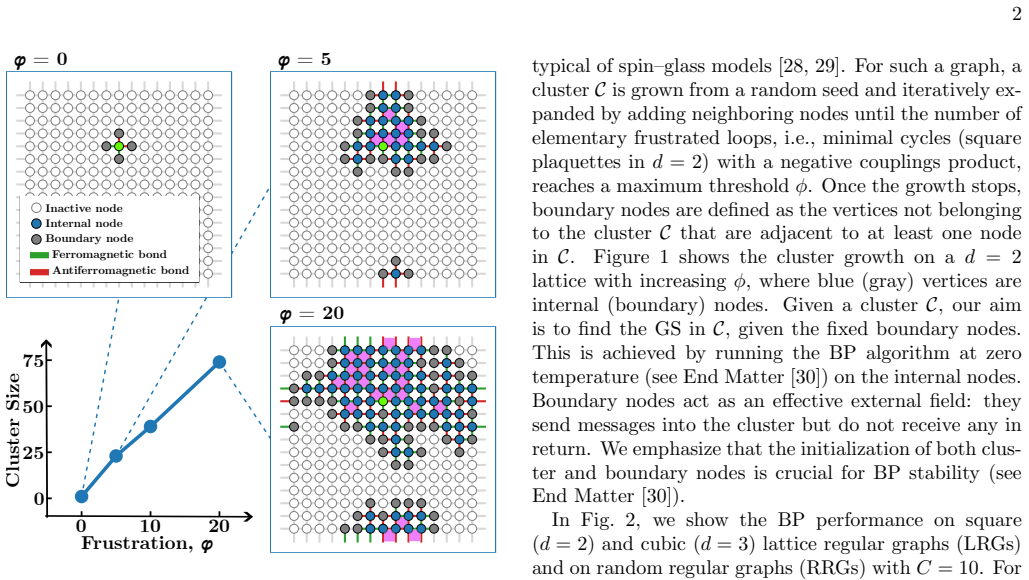
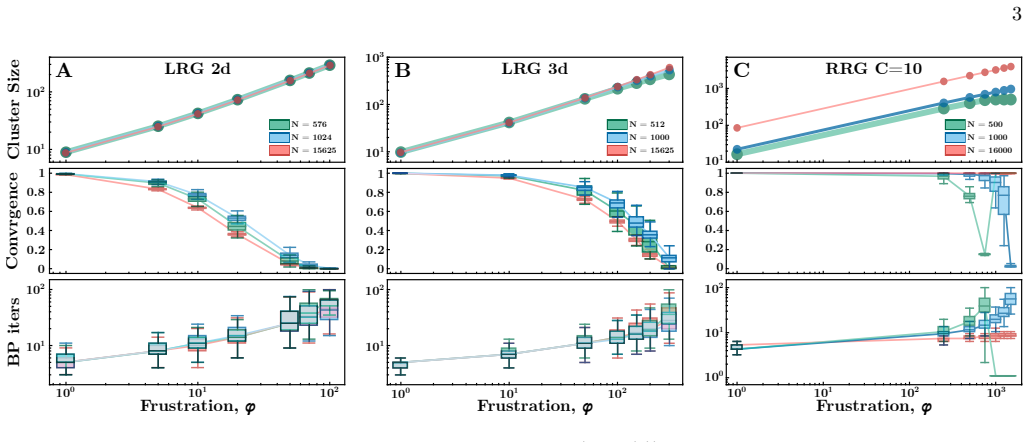
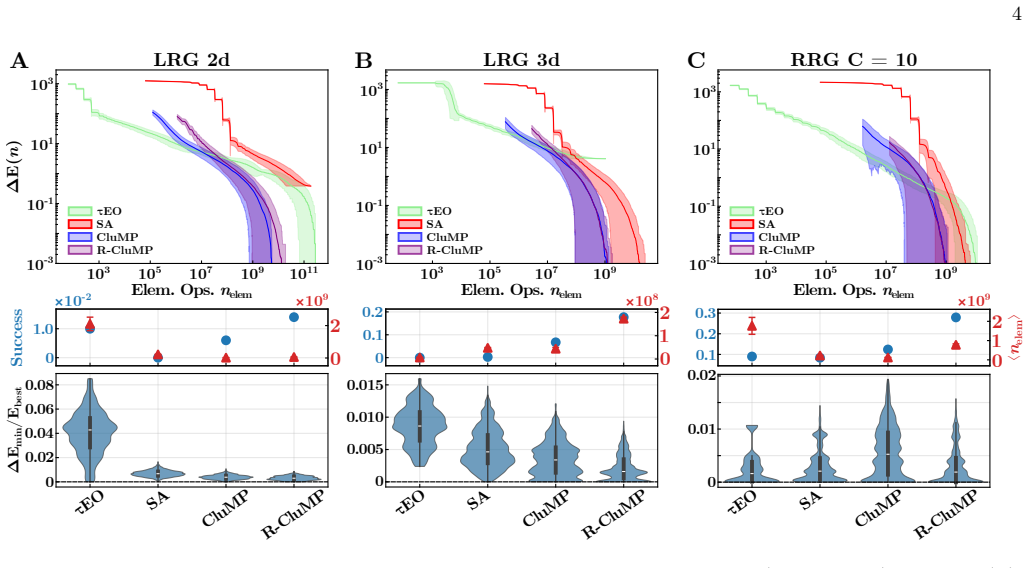
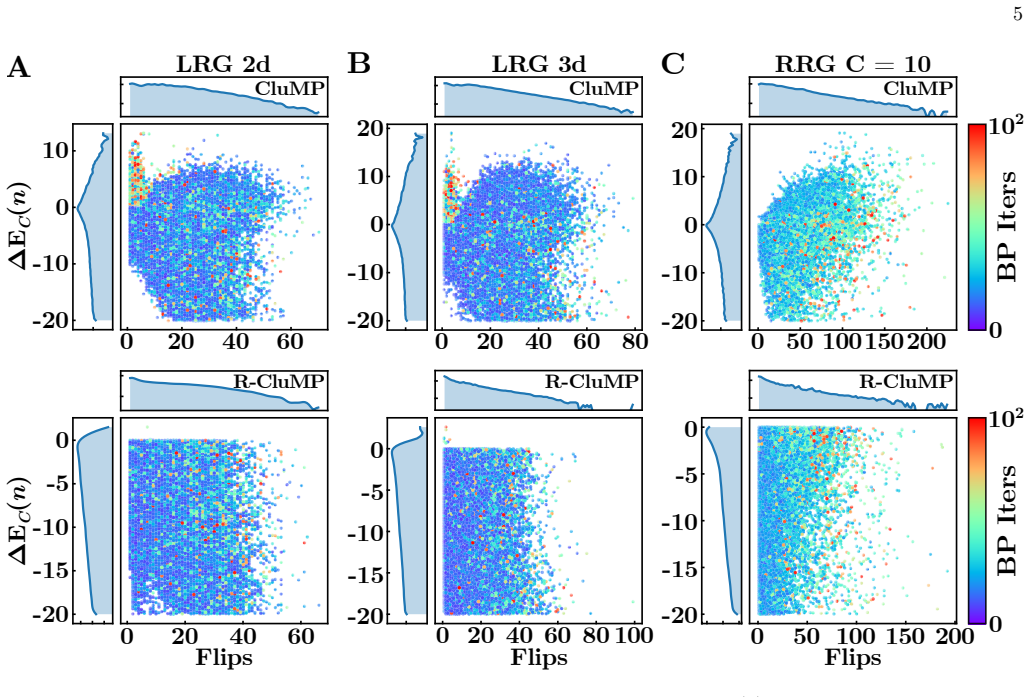
CluMP performs collective updates on connected clusters of spins using information from Belief Propagation. By controlling the amount of frustration within clusters, CluMP enables BP convergence on large subgraphs and proposes nonlocal rearrangements involving up to hundreds of spins in a single move. Benchmarks against state-of-the-art local-update heuristics on spin-glass models defined on random regular graphs and lattice regular graphs in two and three dimensions show that cluster moves consistently bypass local trapping and reach lower energies with fewer effective operations than single-spin dynamics.
What carries the argument
Cluster-based Message-Passing (CluMP) that selects frustration-controlled clusters and runs belief propagation to generate collective spin rearrangements on sparse graphs.
If this is right
- Cluster moves bypass local trapping in spin-glass models on random regular graphs and on 2D and 3D lattices.
- The method reaches lower energies with fewer effective operations than single-spin dynamics.
- Frustration-tolerant cluster updates can be implemented efficiently on sparse graphs.
- The CluMP framework supplies a scalable strategy for large-scale combinatorial optimization and inference problems where medium- and long-range correlations dominate.
Where Pith is reading between the lines
- The same cluster-selection logic might be combined with other message-passing or sampling schemes to handle even denser or time-varying graphs.
- Because the method works on both random regular and lattice topologies, it could transfer to grid-structured problems such as image denoising or lattice protein folding.
- If the cluster-construction heuristic can be made fully local and parallel, CluMP becomes a candidate for distributed or hardware-accelerated solvers.
- The performance gain on three-dimensional lattices suggests the approach may help with optimization tasks whose correlation length exceeds a few lattice spacings.
Load-bearing premise
That keeping frustration low inside selected clusters lets belief propagation converge reliably on large subgraphs without creating new trapping mechanisms.
What would settle it
On a fixed large spin-glass instance with known ground-state energy, run CluMP and a tuned single-spin heuristic to the same computational budget and check whether CluMP ever returns a higher energy or requires more total spin flips.
Figures
read the original abstract
Quadratic Unconstrained Boolean Optimization (QUBO) problems are widespread in both industrial applications and scientific studies. A QUBO problem corresponds to the optimization of a system of Ising spins defined on a generally sparse and heterogeneous graph. When the QUBO problem contains conflicting requests, the corresponding Ising system is frustrated, generating a complex energy landscape, which is hard to explore and optimize. Despite extensive algorithmic and hardware developments, finding low-energy configurations in these systems remains challenging (e.g., local-update heuristics typically become trapped in metastable states), especially when the (possibly frustrated) interactions generate extended correlated domains. We introduce CluMP (Cluster-based Message-Passing), an algorithm that performs collective updates on connected clusters of spins using information from Belief Propagation (BP). By controlling the amount of frustration within clusters, CluMP enables BP convergence on large subgraphs and proposes nonlocal rearrangements involving up to hundreds of spins in a single move. We benchmark CluMP against state-of-the-art local-update heuristics on spin-glass models defined on several graph topologies, including random regular graphs and lattice regular graphs in two and three dimensions. Cluster moves consistently bypass local trapping and reach lower energies with fewer effective operations than single-spin dynamics. These results demonstrate that frustration-tolerant cluster updates can be implemented efficiently on sparse graphs. The CluMP framework provides a scalable strategy for large-scale combinatorial optimization and inference problems, where exploiting medium- and long-range correlations is key to navigating complex energy landscapes.
Editorial analysis
A structured set of objections, weighed in public.
Referee Report
Summary. The manuscript introduces CluMP, a cluster-based message-passing algorithm for QUBO optimization on sparse, heterogeneous graphs. It selects connected clusters of spins, controls frustration within them to enable Belief Propagation convergence on large subgraphs, and performs nonlocal collective updates. Benchmarks on spin-glass models defined on random regular graphs and 2D/3D lattice graphs claim that these cluster moves consistently reach lower energies with fewer effective operations than single-spin local-update heuristics by bypassing metastable traps.
Significance. If the performance claims hold under detailed scrutiny, the work offers a practical advance for navigating complex energy landscapes in frustrated systems by exploiting medium-range correlations via controlled clusters. This is relevant to both combinatorial optimization and inference tasks on sparse graphs. The empirical focus on standard spin-glass instances across multiple topologies is a positive aspect, though the absence of parameter-free derivations or machine-checked elements limits the strength of the contribution relative to purely theoretical advances.
major comments (2)
- [Numerical Experiments] Numerical Experiments section: the central claim that cluster moves reach lower energies with fewer operations lacks reported error bars, number of independent runs per instance, graph-size distribution, and explicit definition of 'effective operations'; without these, the statistical significance of the reported gap versus local heuristics cannot be assessed and the cross-topology consistency claim is unsupported.
- [CluMP Algorithm] CluMP Algorithm section (cluster construction and frustration control): the key assumption that controlling frustration within clusters enables reliable BP convergence on large subgraphs without introducing new trapping mechanisms is stated at a high level but is not accompanied by quantitative convergence diagnostics, failure-rate analysis, or ablation on frustration thresholds; this is load-bearing for the performance advantage.
minor comments (2)
- [Abstract] Abstract: the term 'effective operations' is used in the performance claim but is only defined later; moving a brief definition to the abstract would improve readability.
- [Numerical Experiments] Figure captions in the benchmark section: several panels comparing energy vs. operations do not label the different heuristics or include legend entries for CluMP variants, reducing clarity.
Simulated Author's Rebuttal
We thank the referee for their careful reading and constructive comments on our manuscript. We address the two major comments point by point below. Where the comments identify missing details that strengthen the presentation, we agree to incorporate revisions.
read point-by-point responses
-
Referee: [Numerical Experiments] Numerical Experiments section: the central claim that cluster moves reach lower energies with fewer operations lacks reported error bars, number of independent runs per instance, graph-size distribution, and explicit definition of 'effective operations'; without these, the statistical significance of the reported gap versus local heuristics cannot be assessed and the cross-topology consistency claim is unsupported.
Authors: We agree that the Numerical Experiments section requires additional statistical information to support the performance claims. In the revised manuscript we will add error bars on all reported metrics (computed over independent runs), explicitly state the number of independent runs performed per instance, provide the distribution of graph sizes tested, and give a precise definition of 'effective operations' (total BP message updates normalized by graph size). These additions will allow readers to assess statistical significance and cross-topology consistency. revision: yes
-
Referee: [CluMP Algorithm] CluMP Algorithm section (cluster construction and frustration control): the key assumption that controlling frustration within clusters enables reliable BP convergence on large subgraphs without introducing new trapping mechanisms is stated at a high level but is not accompanied by quantitative convergence diagnostics, failure-rate analysis, or ablation on frustration thresholds; this is load-bearing for the performance advantage.
Authors: We acknowledge that quantitative diagnostics would better substantiate the role of frustration control. In the revised CluMP Algorithm section we will add convergence diagnostics (e.g., BP residual norms and iteration counts per cluster), report failure rates as a function of cluster size and frustration threshold, and include an ablation study varying the frustration threshold to show its effect on both convergence reliability and final energies. These results will be presented alongside the existing algorithmic description. revision: yes
Circularity Check
No significant circularity detected
full rationale
The manuscript introduces the CluMP algorithm as a heuristic combining Belief Propagation with cluster updates for QUBO/spin-glass optimization. All load-bearing claims are empirical performance comparisons on random-regular and lattice graphs; no first-principles derivations, parameter fits renamed as predictions, or self-citation chains that reduce the central result to its own inputs appear in the abstract or surrounding context. The method is presented as a practical construction whose validity is tested externally via benchmarks rather than by algebraic identity with its assumptions.
Axiom & Free-Parameter Ledger
Reference graph
Works this paper leans on
-
[1]
National Center for HPC, Big Data and Quantum Computing
partially addresses the problem by constructing frustration-free clusters whose GS can be computed ex- actly, while freezing the remainder of the system. Ex- tensions based on Belief Propagation (BP) [24] en- able finite-temperature sampling, but remain confined to frustration-free clusters. Introducing frustration typi- cally causes BP to lose convergenc...
Pith/arXiv arXiv 2026
-
[2]
Lucas, Ising formulations of many np problems, Front
A. Lucas, Ising formulations of many np problems, Front. Phys.2, 74887 (2014)
2014
-
[3]
Barahona, On the computational complexity of ising spin glass models, J
F. Barahona, On the computational complexity of ising spin glass models, J. Phys. A: Math. Gen.15, 3241 (1982)
1982
-
[4]
Metropolis, A
N. Metropolis, A. W. Rosenbluth, M. N. Rosenbluth, A. H. Teller, and E. Teller, Equation of state calcula- tions by fast computing machines, J. Chem. Phys.21, 1087 (1953)
1953
-
[5]
W. K. Hastings, Monte carlo sampling methods using markov chains and their applications, Biometrika57, 97 (1970)
1970
-
[6]
Kirkpatrick, C
S. Kirkpatrick, C. Gelatt, and M. Vecchi, Optimization by simulated annealing, Science220, 671 (1983)
1983
-
[7]
Boettcher, Extremal optimization: heuristics via co- evolutionary avalanches, Comput
S. Boettcher, Extremal optimization: heuristics via co- evolutionary avalanches, Comput. Sci. Eng.2, 75 (2000)
2000
-
[8]
Boettcher,New optimization algorithms in physics (Wiley Online Library, 2004) Chap
S. Boettcher,New optimization algorithms in physics (Wiley Online Library, 2004) Chap. 11
2004
-
[9]
M. C. Angelini and F. Ricci-Tersenghi, Monte carlo al- gorithms are very effective in finding the largest inde- pendent set in sparse random graphs, Physical Review E 100, 013302 (2019)
2019
-
[10]
Caracciolo, A
S. Caracciolo, A. Hartmann, S. Kirkpatrick, and M. Weigel, Simulated annealing, optimization, searching for ground states, inSpin Glass Theory and Far Beyond: Replica Symmetry Breaking After 40 Years(World Sci- entific, 2023) pp. 1–20
2023
-
[11]
M. C. Angelini and F. Ricci-Tersenghi, Limits and per- formances of algorithms based on simulated annealing in solving sparse hard inference problems, Physical Review X13, 021011 (2023)
2023
-
[12]
M. C. Angelini, M. Avila-Gonz´ alez, F. D’Amico, D. Machado, R. Mulet, and F. Ricci-Tersenghi, Algorith- mic thresholds in combinatorial optimization depend on the time scaling, Phys. Rev. X16, 011045 (2026)
2026
-
[13]
R. H. Swendsen and J.-S. Wang, Nonuniversal critical dynamics in monte carlo simulations, Phys. Rev. Lett. 58, 86 (1987)
1987
-
[14]
Wolff, Collective monte carlo updating for spin sys- tems, Phys
U. Wolff, Collective monte carlo updating for spin sys- tems, Phys. Rev. Lett.62, 361 (1989)
1989
-
[15]
Wang and R
J.-S. Wang and R. H. Swendsen, Cluster monte carlo al- gorithms, Physica A Stat. Mech. Appl.167, 565 (1990)
1990
-
[16]
C. M. Fortuin and P. W. Kasteleyn, On the random- cluster model: I. introduction and relation to other mod- els, Physica57, 536 (1972)
1972
-
[17]
Coniglio and W
A. Coniglio and W. Klein, Clusters and ising critical droplets: a renormalisation group approach, J. Phys. A Math. Gen.13, 2775 (1980)
1980
-
[18]
Kandel and E
D. Kandel and E. Domany, General cluster monte carlo dynamics, Phys. Rev. B43, 8539 (1991)
1991
-
[19]
Cataudella, A
V. Cataudella, A. Coniglio, L. De Arcangelis, and F. di Liberto, Cluster formulation for frustrated spin models, Physica A Stat. Mech. Appl.192, 167 (1993)
1993
-
[20]
M¨ unster and M
L. M¨ unster and M. Weigel, Cluster percolation in the two-dimensional ising spin glass, Physical Review E107, 054103 (2023)
2023
-
[21]
Houdayer, A cluster monte carlo algorithm for 2- dimensional spin glasses, Eur
J. Houdayer, A cluster monte carlo algorithm for 2- dimensional spin glasses, Eur. Phys. J. B22, 479 (2001)
2001
-
[22]
Houdayer and A
J. Houdayer and A. K. Hartmann, Low-temperature be- havior of two-dimensional gaussian ising spin glasses, Phys. Rev. B70, 014418 (2004)
2004
-
[23]
M. Bernaschi, L. A. Fern´ andez, I. G.-A. Pemart´ ın, V. Mart´ ın-Mayor, G. Parisi, and F. Ricci-Tersenghi, Low energy excitations in a long prism geometry: computing the lower critical dimension of the ising spin glass (2026), arXiv:2601.07926
arXiv 2026
-
[24]
A. K. Hartmann, Cluster-exact approximation of spin glass groundstates, Phys. A: Stat. Mech. Appl.224, 480 (1996)
1996
-
[25]
Decelle and F
A. Decelle and F. Krzakala, Belief-propagation-guided monte-carlo sampling, Phys. Rev. B89, 214421 (2014)
2014
-
[26]
Lage-Castellanos, R
A. Lage-Castellanos, R. Mulet, F. Ricci-Tersenghi, and T. Rizzo, Inference algorithm for finite-dimensional spin glasses: Belief propagation on the dual lattice, Phy. Rev. E84, 046706 (2011)
2011
-
[27]
J. R. Finˇ zgar, A. Kerschbaumer, M. J. Schuetz, C. B. Mendl, and H. G. Katzgraber, Quantum-informed recur- sive optimization algorithms, PRX Quantum5, 020327 (2024)
2024
-
[28]
P. J. Eder, A. Kerschbaumer, J. R. Finˇ zgar, R. A. Med- ina, M. J. Schuetz, H. G. Katzgraber, S. Braun, and C. B. Mendl, Quantum-guided cluster algorithms for combina- torial optimization, in2025 IEEE QCE, Vol. 1 (IEEE,
-
[29]
Castellani and A
T. Castellani and A. Cavagna, Spin-glass theory for pedestrians, J. Stat. Mech.: Theory Exp.2005(05), P05012
2005
-
[30]
Parisi, Spin glasses and fragile glasses: Statics, dy- namics, and complexity, Proc
G. Parisi, Spin glasses and fragile glasses: Statics, dy- namics, and complexity, Proc. Natl. Acad. Sci. U.S.A. 103, 7948 (2006)
2006
-
[31]
See the End Matter for a brief description of the belief propagation update equations at zero temperature and the algorithm initialization
-
[32]
Lucibello, F
C. Lucibello, F. Morone, G. Parisi, F. Ricci-Tersenghi, and T. Rizzo, Finite-size corrections to disordered ising models on random regular graphs, Phys. Rev. E90, 012146 (2014)
2014
-
[34]
Liang and W
F. Liang and W. H. Wong, Evolutionary monte carlo: ap- plications to c p model sampling and change point prob- lem, Stat. Sin. , 317 (2000)
2000
-
[35]
For other values ofVthe optimalϕis unchanged for LRGs and should be scaled byVfor RRGs
-
[36]
Boettcher and A
S. Boettcher and A. Percus, Nature’s way of optimizing, Artif. Intell.119, 275 (2000)
2000
-
[37]
Boettcher and A
S. Boettcher and A. G. Percus, Optimization with ex- tremal dynamics, complexity8, 57 (2002)
2002
-
[38]
Rissone, Cluster-based message-passing (clump) optimization in rugged energy landscapes - code, https://github.com/PaoloRiss1/CluMP-optimization (2026)
P. Rissone, Cluster-based message-passing (clump) optimization in rugged energy landscapes - code, https://github.com/PaoloRiss1/CluMP-optimization (2026)
2026
-
[39]
See Supplemental Material at [URL will be inserted by publisher] for additional information about the CluMP performance on RRGs with low connectivity and integer couplings
-
[40]
While completing this work, a new proposal to use the Houdayer cluster move has been shown effective ind= 3 [43]
-
[41]
Dominguez, A
E. Dominguez, A. Lage-Castellanos, R. Mulet, F. Ricci- Tersenghi, and T. Rizzo, Characterizing and improv- ing generalized belief propagation algorithms on the 2d edwards–anderson model, Journal of Statistical Mechan- ics: Theory and Experiment2011, P12007 (2011)
2011
-
[42]
Lage-Castellanos, R
A. Lage-Castellanos, R. Mulet, and F. Ricci-Tersenghi, Message passing and monte carlo algorithms: Connecting fixed points with metastable states, Europhysics Letters 107, 57011 (2014)
2014
-
[43]
P. Rissone, Cluster-based message-passing (clump) optimization in rugged energy landscapes - data, https://doi.org/10.5281/zenodo.19048237 (2026)
-
[44]
C. Chilin, E. Marinari, V. Mart´ ın-Mayor, G. Parisi, J. J. Ruiz-Lorenzo, and D. Yllanes, Cluster moves with an entropic reservoir accelerate low-temperature simu- lations of three-dimensional spin glasses, arXiv preprint arXiv:2605.25872 (2026)
Pith/arXiv arXiv 2026
-
[45]
M´ ezard and G
M. M´ ezard and G. Parisi, The cavity method at zero temperature, J. Stat. Phys.111, 1 (2003)
2003
-
[46]
Perugini and F
G. Perugini and F. Ricci-Tersenghi, Improved belief prop- agation algorithm finds many bethe states in the random- field ising model on random graphs, Phys. Rev. E97, 012152 (2018). END MATTER Belief Propagation: Update Equations at Zero Temperature Belief Propagation (BP) is an iterative message-passing algorithm that aims at solving the self-consistency...
2018
-
[47]
Machta, Population annealing with weighted averages: A monte carlo method for rough free-energy landscapes, Phys
J. Machta, Population annealing with weighted averages: A monte carlo method for rough free-energy landscapes, Phys. Rev. E82, 026704 (2010)
2010
-
[48]
M´ ezard, G
M. M´ ezard, G. Parisi, and M. A. Virasoro,Spin glass theory and beyond: An Introduction to the Replica Method and Its Applications, Vol. 9 (World Scientific Publishing Company, 1987)
1987
-
[49]
A. K. Hartmann, Ground-state landscape of j ising spin glasses, The European Physical Journal B-Condensed Matter and Complex Systems8, 619 (1999)
1999
discussion (0)
Sign in with ORCID, Apple, or X to comment. Anyone can read and Pith papers without signing in.