REVIEW 2 major objections 3 minor 7 references
Note on "Experimental Measurement of Quantum Metric Tensor and Related Topological Phase Transition with a Superconducting Qubit"
T0 review · 2 major / 3 minor · reviewed 2026-08-14 · deepseek-v4-flash
Pith's one-line read The Euler characteristic of the ground-state manifold is exactly 4 for all $|h|$, so it cannot characterize the topological phase transition.
desk verdict Useful correction of a published PRL, but the new χ=4 is a degree-weighted count rather than the Euler characteristic of the ray manifold, so the constancy claim is convention-dependent. read the letter →
The pith
A machine-rendered reading of the paper's core claim, the machinery that carries it, and where it could break.
The reading
What carries the argument
The machinery is the Gauss–Bonnet theorem for manifolds with boundary, $\chi = \frac{1}{2\pi}\left(\int_M K\,dA + \int_{\partial M} k_g\,dl\right)$, where $K$ is the Gaussian curvature, $k_g$ is the geodesic curvature of the boundary, and the boundary term had been omitted in the earlier calculation. The paper computes the quantum metric for the two-band model, identifies the image of the normalized Bloch vector $\hat{d}$ as a spherical cap of angular radius $\tilde{\theta}_0$ for $|h|>1$, and evaluates both integrals on four identical disks to obtain $\chi=4$. This converts a non-integer bulk result into a topological invariant.
What would settle it
Take $h=2$ and directly evaluate the right-hand side of Eq. (14) using the metric in Eq. (9), but with a triangulation or cell decomposition of the actual image of $\hat{d}$ rather than assuming four disjoint disks; if the image is not four disjoint disks, the boundary integral will not equal the value needed to make $\chi=4$. Alternatively, compute the Euler characteristic from an explicit CW decomposition of the image for a sequence of $h$ values and check whether it is constant.
Extended reading notes
Core claim
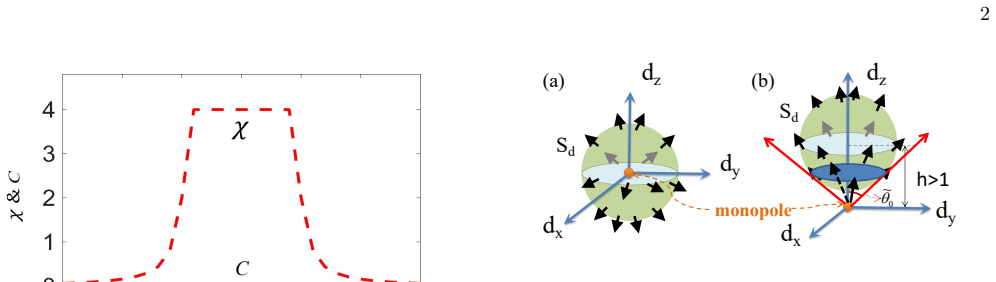
The central claim is that the Euler characteristic number of the ground-state manifold is exactly 4 for all values of the parameter $h$, including $|h|>1$, after the boundary contribution is included. For $|h|<1$ the unit Bloch vectors run over the Bloch sphere twice, giving $\chi=4$. For $|h|>1$ they sweep only a spherical cap $S$ four times; the correct manifold is four disks, each with $\chi=1$, and the earlier bulk-only calculation missed the boundary term. The note concludes that because $\chi=4$ on both sides of $|h|=1$, the Euler characteristic does not signal the topological phase transition in this model.
Load-bearing premise
The calculation assumes that for $|h|>1$ the four sheets of the ground-state map are four separate disks with a smooth circular boundary, so each contributes $\chi=1$; if the sheets overlap or the boundary degenerates, the corrected value need not be 4.
Editorial extensions
If this is right
- The non-integer $\chi$ values reported for $|h|>1$ in the experimental paper and in the related work are an artifact of dropping the boundary term; the true value is the integer 4.
- The Euler characteristic gives no jump at $|h|=1$, so it is not a suitable topological order parameter for this model, matching the fact that the Chern number is zero on both sides.
- For $|h|>1$, the quantum-state manifold is topologically four disks rather than a sphere, so the integral over the bulk curvature alone cannot be interpreted as a topological number.
- The corrected $\chi=4$ holds for all $h$, reinforcing that the model's two phases have the same state-manifold topology even though the distribution of curvature over the manifold changes.
Reading between the lines
- The note does not say this, but the same boundary-correction mechanism should apply to any two-band model whose normalized Bloch vectors trace a proper subset of the Bloch sphere, so bulk-only Euler-characteristic calculations in that setting deserve re-examination.
- The note does not discuss it, but the constancy of $\chi$ suggests that local geometric quantities, such as the integrated absolute curvature or the quantum metric itself, may carry more information about the phase change than $\chi$ does.
- This is an extension: a superconducting-qubit experiment could reconstruct the quantum metric at several $|h|>1$ values, extract the cap radius $\tilde{\theta}_0$, and directly verify that the boundary term restores $\chi=4$.
Signed reviews
Editorial analysis
A structured set of objections, weighed in public.
Referee Report
Summary. This note re-examines the Euler characteristic number χ reported for a two-band superconducting-qubit model in Tan et al., PRL 122, 210401 (2019). The authors observe that for |h|>1 the previously computed χ is non-integer, which they attribute to the ground-state Bloch vectors covering only a cap of the Bloch sphere instead of the full sphere. They argue that the correct treatment requires adding a boundary contribution via the Gauss-Bonnet formula for a manifold with boundary. After doing so, they claim χ=4 for all |h|, so that χ cannot serve as an order parameter for the topological phase transition at |h|=1.
Significance. If the claim were correct, it would constitute a useful correction to the literature and would clarify a conceptual point about the Euler number of Bloch-state manifolds. The note correctly identifies that the non-integer result arises from the image of the ground-state map being a proper subset of the sphere for |h|>1, and it correctly computes the boundary term for a spherical cap. However, the central step—that the quantum-state manifold for |h|>1 is equivalent to four disjoint disks—is asserted without proof and appears to be inconsistent with the topology of the actual ray manifold. The note's conclusion is therefore not robust, and the proposed 'correction' does not follow from the standard Gauss-Bonnet theorem applied to the quantum-state manifold.
major comments (2)
- [Eq. (19) and Fig. 3(b)] The claim that the state manifold for |h|>1 is 'equivalent to four disks' is the load-bearing step of the note, but it is not justified and appears to be incorrect for the actual manifold of rays. The image of the map (kx,ky) → |u_-(kx,ky)> in CP^1 is a single cap S (a disk), whose Euler characteristic is χ(S)=1. Multiplying the Gauss-Bonnet integral for the cap by the 4-to-1 degree of the parametrization yields 4×χ(S)=4, but this is not the Euler characteristic of any manifold; it is a degree-weighted integral. The same applies to the factor 2 in the |h|<1 case, where the image is S^2 but the parametrization is 2-to-1, giving 2×χ(S^2)=4. The conclusion that χ is constant across |h|=1 therefore depends on assigning the Euler characteristic to the covering multiplicity rather than to the image manifold, and the note does not provide a physical or mathematical justification for that convention.
- [Transition from Eq. (7) to Eq. (19)] The derivation silently changes the integration domain. Equation (7) is written as an integral over the parameter space M (the Brillouin-zone torus with coordinates kx,ky), and the original non-integer result comes from integrating the pullback metric over that domain. In Eq. (19), the authors instead integrate over the image cap S with the round metric and then multiply by 4. The Gauss-Bonnet theorem applies to the manifold over which the integral is performed; replacing the parameter space by its image and inserting a multiplicity factor is an ad hoc regularization, not a consequence of the theorem. A rigorous treatment would need to show how the degeneracy locus of the pullback metric is handled on the torus itself, or else explicitly redefine the quantity being computed.
minor comments (3)
- [Eq. (13)] The chain of equalities in Eq. (13) formally evaluates to 2 for a single cover of the sphere, not 4. The factor 2 from the double cover of the Bloch sphere is introduced only in the following paragraph; the equation should state explicitly that it refers to a single sheet, or include the multiplicity factor in the formula.
- [Eq. (15)] Equation (15) has typographical errors: it should read ds² = g11 dλ1² + 2g12 dλ1 dλ2 + g22 dλ2², not 'dλ1 + ... + dλ2 dλ2'.
- [Abstract and summary] The phrase 'the Euler characteristic number should be effectively associated with the manifold of a disk' is in tension with the final value χ=4; if the manifold is a disk, its Euler characteristic is 1, so the note should either use a different name for the computed quantity or explain why the disk's Euler characteristic is not the relevant invariant.
Circularity Check
No significant circularity: the corrected χ=4 follows from the explicit d-hat map and the boundary Gauss-Bonnet formula, with no fitted parameter, renamed prediction, or load-bearing self-citation.
full rationale
The note's derivation is self-contained. It starts from the explicit Hamiltonian (Eqs. 1-5), writes the quantum metric and its determinant (Eqs. 9-10), and then applies the standard Gauss-Bonnet formula for manifolds with boundary (Eq. 14), using textbook formulas for geodesic curvature (Eqs. 16-17). The two key inputs are geometric facts about the map dhat(k): for |h|<1 the unit vectors cover the Bloch sphere twice, and for |h|>1 they cover a spherical cap four times (Fig. 3 and Eq. 19). Neither fact is fitted from the desired χ; both are checkable properties of the explicit map in Eqs. 3-5 and 12. The factor 4 in Eq. (19) is the covering multiplicity of that map, not a parameter adjusted to force an answer. The conclusion χ=4 follows algebraically once one accepts the four-disk decomposition; whether that decomposition is the physically correct definition of the ray manifold is a mathematical/conventional question, not a circularity. The paper cites its own prior PRL [1] and Ma et al. [2] for the method being corrected and for the non-integer intermediate result, but the corrected result does not rest on those citations: the boundary contribution is computed from the metric and standard differential geometry. There is no fitted input called a prediction, no uniqueness theorem imported from the authors, and no ansatz smuggled in solely by citation. The main potential weakness, the unproved four-disk decomposition, would be a correctness or definitional issue rather than a circular reduction, so the appropriate circularity score is 0.
Assumptions & free parameters
assumptions (5)
- standard math Gauss-Bonnet theorem including boundary term: χ = (1/2π)(∫_M K dA + ∫_∂M k_g dl)
- domain assumption For a two-level gapped system, √detg = |F_μν|/2
- standard math The projective Hilbert space of a two-level system is CP^1 = S^2 with Fubini-Study metric, Euler characteristic 2, and Gaussian curvature K=4 for radius 1/2
- ad hoc to paper For |h|>1, the unit Bloch vectors cover a cap of the sphere four times, and this manifold is equivalent to four disks
- domain assumption After changing to spherical coordinates (θ~,φ), the quantum metric takes the round form diag(1/4, sin²θ~/4)
Cite this review
Pith. "Pith review of Note on "Experimental Measurement of Quantum Metric Tensor and Related Topological Phase Transition with a Superconducting Qubit"." pith.science (2026). https://pith.science/paper/WU5VG3DI
@misc{pith2026190806462,
  author       = {Pith},
  title        = {Pith review of: Note on "Experimental Measurement of Quantum Metric Tensor and Related Topological Phase Transition with a Superconducting Qubit"},
  year         = {2026},
  howpublished = {\url{https://pith.science/paper/WU5VG3DI}},
  note         = {Machine review of arXiv:1908.06462}
}
abstract
In the paper [X. Tan et al., Phys. Rev. Lett. 122, 210401 (2019)], we have studied the Euler characteristic number $\chi$ for a two-band model; However, the calculated $\chi$ there is not an integer when the parameter $|h|>1$ and then may not be considered as a suitable topological number for the system. In this note, we find that the Bloch vectors of the ground state for $|h|>1$ do not cover the whole Bloch sphere and thus the Euler characteristic number should be effectively associated with the manifold of a disk, rather than a sphere. After taking into account the boundary contribution, we derive the correct Euler characteristic number. Unfortunately, the Euler characteristic number does not change when crossing the critical points $|h|=1$ and thus can not be used to characterize the topological phase transition of the present model.
Figures

Reference graph
Works this paper leans on
-
[1]
X. Tan, D.-W. Zhang, Z. Yang, J. Chu, Y.-Q. Zhu, D. Li, X. Yang, S. Song, Z. Han, Z. Li, Y. Dong, H.-F. Yu, H. Yan, S.-L. Zhu, and Y. Yu, Experimental Measurement of Quantum Metric Tensor and Related Topological Phase Transition with a Superconducting Qubit, Phys. Rev. Lett. 122, 210401 (2019)
work page 2019
-
[2]
Y.-Q. Ma, S. Chen, H. Fan, and W.-M. Liu, Abelian and non-Abelian quantum geometric tensor, Phys. Rev. B 81 ,
- [3]
-
[4]
J. P. Provost and G. Vallee, Riemannian structure on manifolds of quantum states, Commun. Math. Phys. 76 , 289 (1980)
work page 1980
-
[5]
A. N. Grigorenko, Geometry of projective Hilbert space, Phys. Rev. A 46 , 7292 (1992)
work page 1992
-
[6]
M. Kolodrubetz, V. Gritsev, and A. Polkovnikov, Classifying and measuring geometry of a quantum ground state manifold, Phys. Rev. B 88 , 064304 (2013)
work page 2013
-
[7]
Kreyszig, Differential Geometry (University of Toronto Press, Toronto, 1959)
E. Kreyszig, Differential Geometry (University of Toronto Press, Toronto, 1959)
work page 1959
Reviewed August 14, 2026 · model on record in the stance chip above.
Discussion (0). Continue with ORCID to comment.