REVIEW 4 major objections 5 minor 10 references
Unraveling the Hidden Dynamical Structure in Recurrent Neural Policies
T0 review · 4 major / 5 minor · reviewed 2026-08-03 · deepseek-v4-flash
Pith's one-line read Recurrent policies execute long-horizon tasks by converging to stable limit cycles, and the geometry of those cycles preserves the relational structure of behaviors.
desk verdict The empirical finding that trained recurrent policies often form low-dimensional loops and that loop geometry tracks behavior is worth attention, but the paper dresses a conditional fixed-point result as a universal law and its own appendix shows exceptions. read the letter →
The pith
A machine-rendered reading of the paper's core claim, the machinery that carries it, and where it could break.
The reading
What carries the argument
The central object is the hybrid dynamical system (HDS) defined on the joint state x_t = (s_t, h_t), where h_t is the policy's hidden state and s_t the environment state, with episodic resets treated as discrete jump events. The paper models the agent-environment loop as a stroboscopic map over one episode period, and proves via the Banach fixed-point theorem that if the recurrent update is strictly contractive on a forward-invariant region and the input is T-periodic, a unique globally attracting T-periodic orbit exists. The empirical side uses finite-time Lyapunov indicators to identify contraction, the periodically-kicked-drive protocol with an action-consistency filter to isolate self-su
What would settle it
Compute finite-time Lyapunov indicators from many optimized recurrent policies on episodic tasks (not just one orbit per setting) and test whether hidden-state trajectories close with small residual; if a sizable fraction of converged policies show persistently positive exponents (divergence) or closure residuals far above numerical precision, the claimed universality of limit cycles would fail. A second sharp test: in the same tasks with episodic resets removed, if the limit cycles persist unchanged, the periodically-kicked-drive mechanism is not the cause; if they disappear, the causal role
Extended reading notes
Core claim
The paper's central claim is that optimized recurrent policies, treated with their environment as a single hybrid dynamical system over the joint state (environment state, hidden neural state), converge to attracting limit cycles. The episodic reset structure acts as a periodically kicked drive that entrains the contractive recurrent dynamics into a unique stable periodic orbit; an action-consistency filter confirms these orbits are self-sustaining, producing exactly the actions that generate their own driving observations. Beyond existence, the paper shows structural isomorphism: the manifold of neural limit cycles preserves the relational geometry of behaviors, as measured by canonical cor
Load-bearing premise
The proof depends on the trained policy's hidden-state update being strictly contractive (Lipschitz constant < 1) on a forward-invariant region of state space, with exactly T-periodic effective inputs; contractivity is verified only locally along a single GRU orbit, not derived from the learning objective or the network architecture.
Editorial extensions
If this is right
- Robustness of recurrent policies becomes a direct consequence of attractor structure: perturbations transverse to the limit cycle decay, so environmental noise and internal drift are actively suppressed.
- Fast adaptation in meta-RL can be explained as traversing a learned manifold of limit cycles, where the relational geometry of behaviors supports interpolation to novel task instances.
- The limit cycle provides a phase coordinate that persists over long time scales, giving a stable substrate for long-horizon coordination and episodic memory maintenance.
- The action-consistency filter offers a concrete test for whether a network has truly learned a closed-loop strategy as opposed to passively echoing periodic inputs.
- The theory predicts that non-episodic or non-periodic tasks should recruit different attractor types (fixed points, invariant manifolds, or chaotic regimes), while preserving the same isomorphism principle.
Reading between the lines
- Editorial inference: the structural isomorphism implies a metric embedding of behavior into neural space; if it holds generally, one could intentionally steer behavior by interpolating or extrapolating along the neural manifold, a form of zero-shot skill design.
- Editorial inference: the contractivity-based proof suggests a training objective could explicitly encourage contraction in the hidden dynamics, potentially making the limit-cycle regime and its generalization benefits more reliable across architectures.
- Editorial inference: the cross-individual alignment seen in biological motor control may be explained by this same mechanism—shared physical tasks impose shared behavioral geometry, so optimized neural manifolds converge to similar shapes—making the paper's framework a candidate bridge between artificial and biological motor learning.
- Editorial inference: the high-dimensional canonical correlation alignment, if replicated in larger models, would offer a practical diagnostic: collapses in correlation spectra could indicate when a recurrent policy loses its learned geometry and becomes brittle.
Editorial analysis
A structured set of objections, weighed in public.
Referee Report
Summary. The paper studies hidden-state dynamics of recurrent neural policies trained under an RL^2-style episodic protocol across maze navigation and Procgen tasks, with PPO and evolution strategies, and RNN/GRU/Mamba architectures. It claims that optimized recurrent policies consistently settle into stable limit cycles in a joint agent-environment hybrid dynamical system, driven by episodic resets as a periodically-kicked drive, and that the geometry of these neural limit cycles preserves the relational geometry of physical behaviors. Support includes FTLI distributions, perturbation recovery experiments, an action-consistency-filtered limit-cycle library, CCA alignment, and counterfactual injection tests, plus a contraction-mapping theorem.
Significance. If the universality claim holds, the paper provides a mechanistic account of robustness and generalization in recurrent policies, connecting trained RNNs to classical dynamical systems and biological motor-control findings. The empirical scope is broad, and the paper includes valuable controls (action-constrained random baselines, BPF hyperparameter sweeps, counterfactual lesions). The central weakness is that the theoretical premise of strict contractivity is not established for the driven dynamics, and the paper's own appendices document counterexamples to the 'always settle' claim. With appropriate qualifications and additional verification, the findings could be an important step toward interpretable recurrent-policy dynamics.
major comments (4)
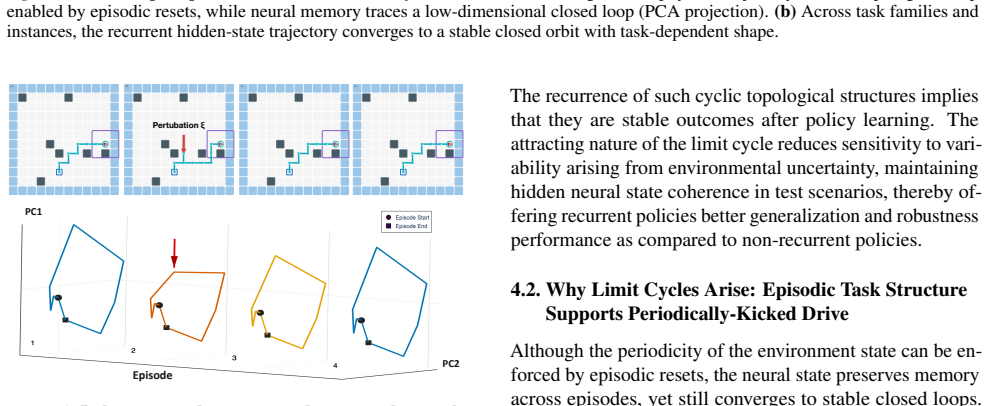
- [§4.1 / App. F] The claim 'adapted recurrent agents always settle into stable periodic loopy structures' (§4.1) is contradicted by the paper's own Appendix F: in Bossfight and Bigfish, perturbations induce prolonged excursions and only partial re-stabilization for some seeds. This suggests the universal statement is too strong. Report the proportion of seeds/tasks that reach stable cycles within the rollout horizon, characterize the non-settling cases, and qualify the scope of the claim.
- [App. D, Thm D.6] Theorem D.6 assumes a forward-invariant strictly contractive region C (Def D.2) for the driven recurrence ht+1=fθ(ut,ht). This premise is not verified. Appendix C evaluates the Jacobian of the un-driven vector field tanh(W_rec h+b)-h (Eq. 4) at 50 states along one GRU orbit, which (i) drops the input term in Eq. (1) and (ii) yields local spectral information, not a global Lipschitz constant on C. The theorem is a Banach fixed-point consequence and is vacuous without a contractivity certificate. Provide driven-input contractivity bounds on a constructed region, or derive them from the architecture/training objective.
- [App. G / §5] The limit-cycle library is built by PKD replaying observation sequences from the same behaviors whose BPFs are then compared in CCA, after filtering for action consistency. This selection step can induce artificial correspondence between neural cycles and behaviors, since only cycles consistent with those behaviors are retained. Report how many of the N=100,000 seeds survive ACF, assess whether the CCA alignment persists for unfiltered entrained cycles, and evaluate canonical correlations with cross-validation on held-out behaviors.
- [Fig. 5, App. F] The FTLI distributions in Fig. 5 are computed only on the converged regime and therefore certify local stability along the orbit, not a basin of attraction. Appendix F itself shows slow re-convergence in several environments. The paper should clearly state that FTLI-based stability is a local, time-window-dependent measure and cannot by itself justify the 'always settle' claim.
minor comments (5)
- [§4.1] Text says 'Time Lyapunov Indicator (FTLI)' but the acronym stands for 'Finite-Time Lyapunov Indicator' as defined in §2.2; please unify terminology.
- [Fig. 4 caption] Typo: 'Pertubation' should be 'Perturbation'.
- [App. D proof] In the proof of Theorem D.6, the reference to 'Lemma 1' should be 'Lemma D.5'.
- [Algorithm 2] The convergence threshold ε is left unspecified; give its value and how it depends on hidden-state scale.
- [App. J.1] The distance-matrix correlations (R = 0.9542, etc.) would benefit from confidence intervals or a null distribution, given the sample size.
Circularity Check
Limit-cycle 'prediction' relies on a contractivity premise verified on the very limit cycle it is invoked to explain.
-
fitted input called prediction
[Section 4.2; Appendix C (Eq. 4-6); Appendix D (Definitions D.2-D.3, Theorem D.6)]
"The recurrent policy exhibits the required dissipative properties: local linearization analysis confirms that the operational orbit lies within a strictly contractive region of the phase space (Appendix C). This local evidence, combined with the negatively centered FTLI distribution (Figure 5), indicates that the periodic forcing provided by the observation sequence effectively entrains the hidden state into a stable limit cycle (Figure 6 (right))."
Theorem D.6 derives the limit cycle from the premise of a forward-invariant strictly contractive region C (Definitions D.2-D.3). The only support for that premise is Appendix C, which samples '50 neural states along its limit cycle' and finds negative Jacobian eigenvalues of the input-free field (Eq. 4: tanh(W_rec h+b)-h). Thus the orbit whose existence is to be explained is used to certify the premise, and the premise is then invoked to explain that same orbit. Moreover, Eq. (4) omits the input term that Definition D.2's fθ(u,·) includes, so the verified object differs from the premise. The 'prediction' of the limit cycle is therefore an in-sample restatement of stability measured on the cycle itself.
full rationale
The paper's central empirical findings—closed-loop periodic loops, negative FTLI, and perturbation recovery—are genuine measurements and are not circular per se. However, the theoretical derivation in Appendix D is partially circular: Theorem D.6 is a standard Banach fixed-point consequence of assuming a forward-invariant strictly contractive region, but the premise is 'verified' on the very limit cycle the theorem is supposed to explain, and the verification uses an input-free local Jacobian that does not match Definition D.2's forced dynamics fθ(u,·). This makes the claim 'adapted recurrent agents always settle into stable periodic loopy structures' rest, in part, on an assumption that is inferred from the phenomenon rather than established independently. The structural-isomorphism claim in Section 5 is less problematic: although limit cycles are extracted by replaying each behavior's observations and filtering for action consistency (Appendix G), the random control in Appendix K explicitly shows that action-matching alone yields spectral collapse, so the high CCA alignment is not purely by construction. The paper's own limitations (Section 7.2) and Appendix F (Bossfight/Bigfish long transients) weaken the universality claim but are honesty caveats rather than circularity. Overall, partial circularity is present in the theoretical support, while the empirical core retains substantial independent content.
Assumptions & free parameters
free parameters (5)
- BPF effective radius R_eff (baseline) =
not specified numerically; swept 0.5x-1.5x in Appendix L
- FTLI horizon K and perturbation scale =
K=1000; epsilon unspecified
- ACF warmup K, closure threshold epsilon, population N =
K=1000, N=100000, epsilon unspecified
- PCA/CCA component counts (kx, ky, kcca) =
not fully specified in main text; Algorithm 4 leaves them as hyperparameters
- Top-K in counterfactual test =
K unspecified in main text (Appendix M)
assumptions (5)
- ad hoc to paper There exists a forward-invariant, strictly contractive region C for the recurrent policy dynamics (Def D.2-D.3).
- domain assumption The effective input sequence to the recurrent policy is exactly T-periodic (Def D.1).
- domain assumption The joint agent-environment system is a hybrid dynamical system with a jump set D resetting st while preserving ht (Eq. 2).
- domain assumption BPF Euclidean distance approximates the transport cost / Wasserstein distance between trajectories.
- domain assumption Stochasticity in environment transitions can be treated as small perturbations around a deterministic nominal orbit.
Cite this review
Pith. "Pith review of Unraveling the Hidden Dynamical Structure in Recurrent Neural Policies." pith.science (2026). https://pith.science/paper/WU7E66XR
@misc{pith2026260201196,
  author       = {Pith},
  title        = {Pith review of: Unraveling the Hidden Dynamical Structure in Recurrent Neural Policies},
  year         = {2026},
  howpublished = {\url{https://pith.science/paper/WU7E66XR}},
  note         = {Machine review of arXiv:2602.01196}
}
read the original abstract
Recurrent neural policies are widely used in partially observable control and meta-RL tasks. Their abilities to maintain internal memory and adapt quickly to unseen scenarios have offered them unparalleled performance when compared to non-recurrent counterparts. However, until today, the underlying mechanisms for their superior generalization and robustness performance remain poorly understood. In this study, by analyzing the hidden state domain of recurrent policies learned over a diverse set of training methods, model architectures, and tasks, we find that stable cyclic structures consistently emerge during interaction with the environment. Such cyclic structures share a remarkable similarity with \textit{limit cycles} in dynamical system analysis, if we consider the policy and the environment as a joint hybrid dynamical system. Moreover, we uncover that the geometry of such limit cycles also has a structured correspondence with the policies' behaviors. These findings offer new perspectives to explain many nice properties of recurrent policies: the emergence of limit cycles stabilizes both the policies' internal memory and the task-relevant environmental states, while suppressing nuisance variability arising from environmental uncertainty; the geometry of limit cycles also encodes relational structures of behaviors, facilitating easier skill adaptation when facing non-stationary environments.
Figures


Figures from the paper (20 more)


Reference graph
Works this paper leans on
-
[1]
(Forward invariance) For anyh∈ Cand any admissible inputu, we have fθ(u, h)∈ C
-
[2]
URL https://arxiv.org/abs/2005. 06247. Raghu, M., Gilmer, J., Yosinski, J., and Sohl-Dickstein, J. SVCCA: Singular vector canonical correlation anal- ysis for deep learning dynamics and interpretability. In Advances in Neural Information Processing Systems, vol- ume 30, 2017. Rakelly, K., Zhou, A., Quillen, D., Finn, C., and Levine, S. Efficient off-polic...
arXiv 2005
-
[3]
Due to the contractive nature of the trained network, most trajectories will collapse onto stable manifolds
Entrainment:We apply the observation sequence Oseq as a repeated external drive to these states for a sufficient warmup period (e.g., 1,000 steps). Due to the contractive nature of the trained network, most trajectories will collapse onto stable manifolds
-
[4]
To address concerns regarding high-dimensional closure, we explicitly measure theClosure Error δ=∥h T −h 0∥2
Convergence & Consistency Check:After entrainment, we first discard trajectories that have not converged to a periodic orbit. To address concerns regarding high-dimensional closure, we explicitly measure theClosure Error δ=∥h T −h 0∥2. We find that for retained candidates, δ is concentrated at the magnitude of 10−5, confirming that these are genuine perio...
-
[5]
Definition D.3(Dissipative Policy Dynamics (Restricted)).Let ht ∈R n be the policy memory state evolving according to ht+1 =f θ(ut, ht)
(Local contractivity) There exists a norm∥ · ∥and a constant0< λ <1such that for allh, h′ ∈ Cand any inputu, ∥fθ(u, h)−fθ(u, h′)∥ ≤λ∥h−h′∥. Definition D.3(Dissipative Policy Dynamics (Restricted)).Let ht ∈R n be the policy memory state evolving according to ht+1 =f θ(ut, ht). We assume that there exists a contractive region C ⊂Rn such that the dynamics ar...
-
[6]
PKD Extraction:We first record a ground-truth trajectory of length T (the period) from the agent’s interaction with the environment, extracting the cyclic observation sequenceO seq and the target action sequenceA target
-
[7]
Large-Scale Probing:We initialize a large population of random hidden states ( N= 100,000 ) to broadly sample the basins of attraction in the neural state space
-
[10]
radiance field
Filtering:Finally, we check the readout constraint: does the neural state at each step of the cycle decode to the correct action inA target? Only cycles satisfying both convergence and action consistency are retained. The detailed algorithm is provided in Algorithm 2. Distinguishing Learned Dynamics from Trivial Resets.The emergence of these self-sustaini...
Show all 10 references
-
[2020]
9 Unraveling the Hidden Dynamical Structure in Recurrent Neural Policies Duan, Y ., Schulman, J., Chen, X., Bartlett, P
URL https://proceedings.mlr.press/ v119/cobbe20a.html. 9 Unraveling the Hidden Dynamical Structure in Recurrent Neural Policies Duan, Y ., Schulman, J., Chen, X., Bartlett, P. L., Sutskever, I., and Abbeel, P. RL 2: Fast reinforcement learn- ing via slow reinforcement learning...
2016 arXiv
-
[3328]
URL https://proceedings
PMLR, 2017. URL https://proceedings. mlr.press/v70/sundararajan17a.html. Sussillo, D. and Barak, O. Opening the black box: Low- dimensional dynamics in high-dimensional recurrent neu- ral networks.Neural Computation, 25(3):626–649, 2013. doi: 10.1162/NECO a 00409. Team, A., Ba...
2017 arXiv
Reviewed August 3, 2026 · model on record in the stance chip above.
Discussion (0). Continue with ORCID to comment.