REVIEW 3 major objections 2 minor 5 cited by
TibetCPR: A Multimodal Tactile Feedback System to Enhance Cardiopulmonary Resuscitation Training in High-Altitude Regions of Tibet
T0 review · 3 major / 2 minor · reviewed 2026-06-27 · grok-4.3
Pith's one-line read A multimodal feedback system enables self-guided CPR training that stabilizes compression rhythm and depth in lay users without instructor support.
desk verdict This is a modest but coherent field deployment of existing multimodal CPR feedback ideas to Tibetan lay users, with a small randomized trial showing gains. read the letter →
The pith
A machine-rendered reading of the paper's core claim, the machinery that carries it, and where it could break.
The reading
What carries the argument
Depth-driven electrotactile feedback paired with rhythm-driven visual cues in a Tibetan-language narrative, serving as a self-guided calibration reference.
What would settle it
A follow-up study in which the experimental group fails to show greater stabilization of rhythm and depth compared to the control group during the 10-minute session or on the post-test.
Extended reading notes
Core claim
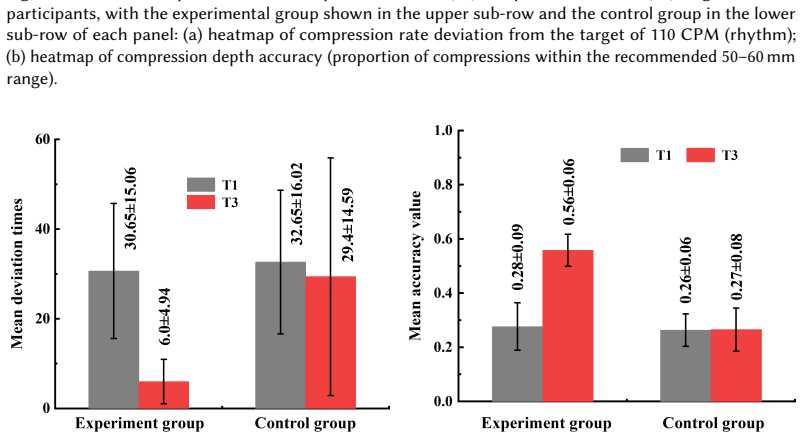
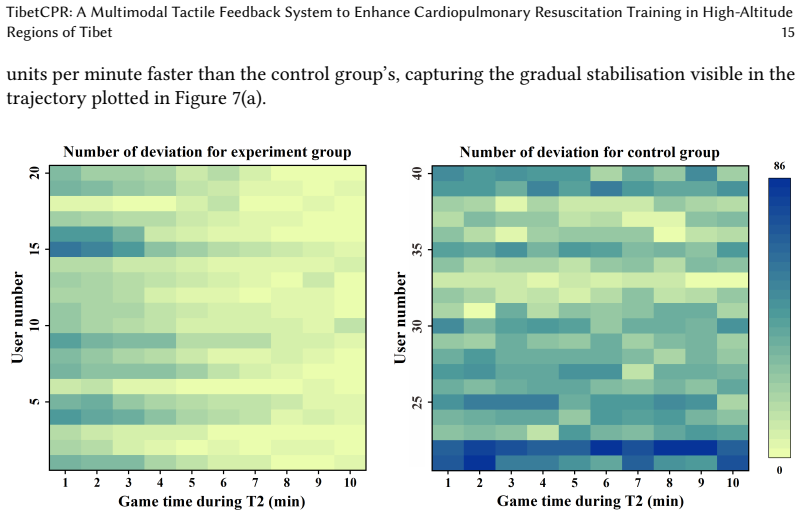
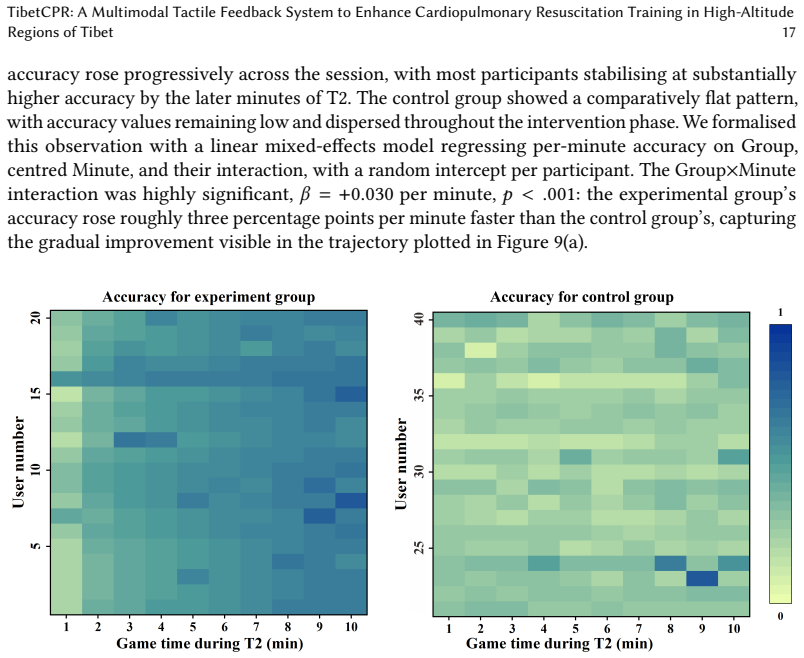
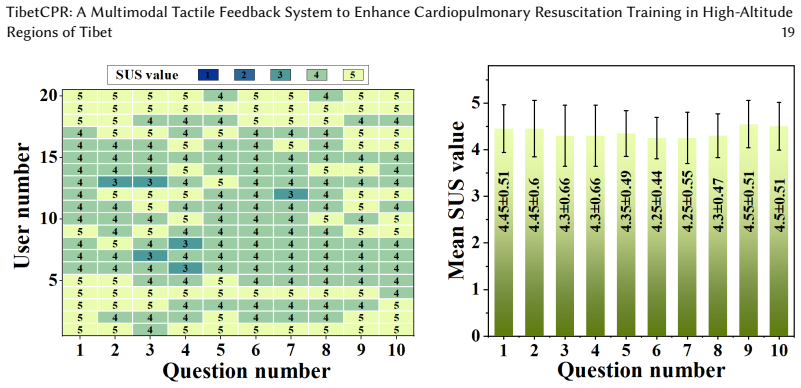
In a randomized study with 40 lay community members, the experimental group using TibetCPR demonstrated progressive minute-by-minute stabilization of CPR rhythm and depth over 10 minutes, substantially exceeding an unguided control group, with these gains transferring to an unscaffolded one-minute post-test. Participants found the feedback legible through bodily action, and the system achieved high usability scores.
Load-bearing premise
The electrotactile and visual feedback remains legible and actionable through participants' bodily action without any instructor mediation or explanatory guidance.
Editorial extensions
If this is right
- Progressive improvement in rhythm and depth stabilization during the intervention.
- Transfer of skills to post-test without feedback.
- High system usability as measured by SUS score of 84.3.
- Three design principles: feedback as calibration reference, matching modality to behavior's temporal structure, and autonomous interpretability as prerequisite.
Reading between the lines
- This approach could extend to other medical or skill-training scenarios in remote or low-resource settings where instructor access is limited.
- The emphasis on autonomous interpretability suggests potential for broader deployment in culturally diverse populations.
- Matching feedback granularity to behavior timing may apply to other embodied tasks like physical therapy or sports training.
Signed reviews
Editorial analysis
A structured set of objections, weighed in public.
Referee Report
Summary. The manuscript presents TibetCPR, a low-cost multimodal CPR training system combining depth-driven electrotactile feedback with rhythm-driven visual cues embedded in a Tibetan-language narrative. It reports a randomized study (n=40 lay participants aged 19-56) in which the experimental group exhibited progressive minute-by-minute stabilization of compression rhythm and depth over a 10-minute intervention, substantially outperforming an unguided-practice control, with transfer to an unscaffolded 1-minute post-test. Qualitative data indicated the feedback was legible through bodily action, and system usability was high (SUS=84.3). The authors synthesize three design principles for self-guided embodied training.
Significance. If the quantitative results prove robust, the work offers practical significance for HCI applications in health training within resource-constrained, high-altitude settings with fragmented instruction and heterogeneous learner backgrounds. It supplies direct evidence for autonomous interpretability of embodied feedback and articulates transferable principles that could inform other self-guided physical-skill systems.
major comments (3)
- [Abstract and Results] Abstract and Results: The abstract and results sections report progressive stabilization and substantial outperformance of the control but supply no statistical details (p-values, effect sizes, confidence intervals, error bars, or exact metrics for rhythm/depth stabilization and baseline comparisons). This information is load-bearing for the central claim of measurable self-guided improvement.
- [Methods and Study Design] Methods and Study Design: With n=40 and post-hoc derivation of the three design principles, the manuscript provides insufficient detail on confound handling (prior CPR experience, altitude effects, linguistic/educational heterogeneity) and exact randomization/baseline procedures; these omissions limit support for generalization to the target population.
- [Discussion] Discussion: The claim that electrotactile/visual feedback remains legible and actionable without instructor mediation rests primarily on qualitative accounts; a quantitative breakdown of performance variance or error patterns during fully unguided segments would directly test the weakest assumption.
minor comments (2)
- [Introduction] Define 'stabilisation' of rhythm and depth with explicit operational criteria (e.g., variance thresholds) to support replication.
- [Figures] Add error bars and participant-level variability to all minute-by-minute performance plots.
Simulated Author's Rebuttal
We thank the referee for their constructive comments, which highlight opportunities to strengthen the statistical reporting, methodological transparency, and evidential basis for our claims. We address each major comment below and specify the revisions planned for the next version of the manuscript.
read point-by-point responses
-
Referee: [Abstract and Results] Abstract and Results: The abstract and results sections report progressive stabilization and substantial outperformance of the control but supply no statistical details (p-values, effect sizes, confidence intervals, error bars, or exact metrics for rhythm/depth stabilization and baseline comparisons). This information is load-bearing for the central claim of measurable self-guided improvement.
Authors: We agree that the lack of statistical details in the abstract and results limits the strength of the central claim. In the revised manuscript we will add p-values, effect sizes, confidence intervals, and error bars (or equivalent visualizations) for all key comparisons of rhythm and depth stabilization, including minute-by-minute changes within the experimental group and between-group differences at baseline and post-test. revision: yes
-
Referee: [Methods and Study Design] Methods and Study Design: With n=40 and post-hoc derivation of the three design principles, the manuscript provides insufficient detail on confound handling (prior CPR experience, altitude effects, linguistic/educational heterogeneity) and exact randomization/baseline procedures; these omissions limit support for generalization to the target population.
Authors: We accept that additional methodological detail is required. The revised manuscript will expand the methods section to describe the randomization procedure (block randomization with sealed envelopes), baseline measurement protocol, screening for prior CPR experience via questionnaire, and steps taken to accommodate linguistic and educational heterogeneity (Tibetan-language materials and on-site translation). We will also add an explicit limitations paragraph addressing the modest sample size and post-hoc nature of the design principles, while noting that the study was designed as an initial feasibility evaluation in the target setting. revision: partial
-
Referee: [Discussion] Discussion: The claim that electrotactile/visual feedback remains legible and actionable without instructor mediation rests primarily on qualitative accounts; a quantitative breakdown of performance variance or error patterns during fully unguided segments would directly test the weakest assumption.
Authors: We agree that a quantitative complement to the qualitative accounts would directly address the assumption of autonomous interpretability. In the revised discussion we will report a quantitative breakdown of rhythm and depth variance, as well as error patterns (e.g., deviation from target ranges), during the unscaffolded one-minute post-test, comparing these metrics to the final minutes of the guided intervention to demonstrate skill transfer without ongoing feedback. revision: yes
Circularity Check
Purely empirical study; no derivations, equations, or self-referential predictions
full rationale
The manuscript reports a randomized controlled user study (n=40) comparing the TibetCPR system against unguided practice, with direct measurements of minute-by-minute stabilization, post-test transfer, qualitative legibility reports, and SUS scores. No equations, fitted parameters, or mathematical derivations appear; the three design principles are synthesized from the empirical outcomes rather than derived from prior self-citations or ansatzes. The central claim rests on observable participant data and does not reduce to any input by construction.
Assumptions & free parameters
Cite this review
Pith. "Pith review of TibetCPR: A Multimodal Tactile Feedback System to Enhance Cardiopulmonary Resuscitation Training in High-Altitude Regions of Tibet." pith.science (2026). https://pith.science/paper/WUCPVORJ
@misc{pith2026260607765,
  author       = {Pith},
  title        = {Pith review of: TibetCPR: A Multimodal Tactile Feedback System to Enhance Cardiopulmonary Resuscitation Training in High-Altitude Regions of Tibet},
  year         = {2026},
  howpublished = {\url{https://pith.science/paper/WUCPVORJ}},
  note         = {Machine review of arXiv:2606.07765}
}
read the original abstract
High-quality cardiopulmonary resuscitation (CPR) requires stable control of compression rhythm and depth, yet most training systems presuppose instructor mediation, repeated practice, and explanatory guidance-assumptions that do not hold in the Tibet Autonomous Region, where instruction is fragmented and learners' linguistic and educational backgrounds are heterogeneous. We present TibetCPR, a low-cost, self-guided CPR training system that pairs depth-driven electrotactile feedback with rhythm-driven visual cues within a Tibetan-language narrative. In a randomised study with 40 lay community members aged 19--56, the experimental group showed progressive minute-by-minute stabilisation of rhythm and depth across a 10-minute intervention, substantially exceeding an unguided-practice control, with gains transferring to an unscaffolded one-minute post-test. Qualitative accounts described the feedback as legible through participants' bodily action, and usability was high (SUS = 84.3). We synthesise three transferable design principles for self-guided embodied training: feedback as a calibration reference, not an immediate corrector; modality temporal granularity matched to behaviour's temporal structure; and autonomous interpretability as a deployment prerequisite, not an after-effect of usability.
Figures


Figures from the paper (7 more)



Forward citations
Cited by 5 Pith papers
-
Living Inside the Black Box: Behavioral Probing and Adaptation in Mandatory Wearable Sensing
Mandatory electronic-monitoring wearers build risk-oriented “sensor literacy under constraint” through probing, producing domain-specific flexibility or over-contraction and residual calculation habits after removal.
-
Between Knowledge and Care: A Mixed-Methods Evaluation of Generative AI for T2DM Self-Management from Patient and Physician Perspectives
Generative AI aids T2DM self-management on facts and lifestyle but fails on meds and emotion; patients and physicians converge on role limits, emotional gaps, and personalization needs, informing four design directions.
-
"Everyone Says Them": Deception Typologies, Probabilistic Trust, and Grassroots Safety Knowledge Among Gay Dating App Users in China
Interviews with 22 participants identify a typology of deception on Chinese gay dating apps and document probabilistic trust strategies and community-shared risk knowledge.
-
Wearing Trust: How Older Adults Calibrate Reliance on Health Wearables Through Bodily Experience and Everyday Use
Interviews with 31 older adults show they judge wearable trustworthiness from visible and bodily cues because true sensor quality is hidden, a mismatch the paper calls the observability gap.
-
Reading the Same Data Differently: Interpretive Labor Across System Boundaries in Electronic Monitoring
Interviews reveal interpretive misalignment in EM systems where supervised individuals and authorities reason differently about the same data streams due to asymmetric access.
Reference graph
Works this paper leans on
-
[1]
Benjamin S Abella, Jason P Alvarado, Helge Myklebust, Dana P Edelson, Anne Barry, Nicholas O’Hearn, Terry L Vanden Hoek, and Lance B Becker. 2005. Quality of cardiopulmonary resuscitation during in-hospital cardiac arrest. Jama293, 3 (2005), 305–310
2005
-
[2]
Shahna Ali, Manazir Athar, and Syed Moied Ahmed. 2019. A randomised controlled comparison of video versus instructor-based compression only life support training.Indian Journal of Anaesthesia63, 3 (2019), 188–193
2019
-
[3]
Kang An, Lin Zhang, Runjuan Qiao, Caizheng Li, Qian Zhong, Yiru Ma, Xin Rao, Tingrui Mao, Feng Liu, Qiang Zhuo, et al. 2022. Training needs and curriculum of continuing medical education among general practitioners in Tibet, China: a cross-sectional survey.Frontiers in Public Health10 (2022), 914847
2022
-
[4]
Misuk An, Youngmee Kim, and Won-Kyung Cho. 2019. Effect of smart devices on the quality of CPR training: a systematic review.Resuscitation144 (2019), 145–156. TibetCPR: A Multimodal Tactile Feedback System to Enhance Cardiopulmonary Resuscitation Training in High-Altitude Regions of Tibet 27
2019
-
[5]
2012.Thematic analysis.American Psychological Association
Virginia Braun and Victoria Clarke. 2012.Thematic analysis.American Psychological Association
2012
- [6]
-
[7]
Shuheng Cao et al. 2022. Multi-channel medical image segmentation method in Hessian domain. InMedical Imaging 2022: Computer-Aided Diagnosis, Vol. 12033. SPIE
2022
-
[8]
Rosalind Case, Susie Cartledge, Josine Siedenburg, Karen Smith, Lahn Straney, Bill Barger, Judith Finn, and Janet E Bray. 2018. Identifying barriers to the provision of bystander cardiopulmonary resuscitation (CPR) in high-risk regions: A qualitative review of emergency calls.Resuscitation129 (2018), 43–47
2018
Show all 78 references
-
[9]
Ling Chen, Jie Liu, Zhihui Zheng, and Sangphel Yeshi. 2021. Needs and difficulties of Tibetan rural health care workers participating in professional training.Australian Journal of Rural Health29, 4 (2021)
2021
-
[10]
Meng Chen, Yue Wang, Xuan Li, Lina Hou, Yufeng Wang, Jie Liu, and Fei Han. 2017. Public knowledge and attitudes towards bystander cardiopulmonary resuscitation in China.BioMed research international2017, 1 (2017), 3250485
2017
-
[11]
Ruiqi Chen, Qingyang He, Hanxi Bao, Jung Choi, and Xin Tong. 2025. GestoBrush: Facilitating Graffiti Artists’ Digital Creation Experiences through Embodied AR Interactions. InProceedings of the 18th International Symposium on Visual Information Communication and Interaction. 1–9
2025
-
[12]
Ruiqi Chen, Shuhe Wang, Xuhai Xu, Lan Wei, Yuling Sun, and Xin Tong. 2023. Design and Evaluation of a VR Therapy for Patients with Mild Cognitive Impairment and Dementia: Perspectives from Patients and Stakeholders. In2023 IEEE Conference on Virtual Reality and 3D User Interfa...
2023
-
[13]
Tzu-Sang Chen, Pei-Lun Hsieh, Chien Chien Tung, Chao-Hsin Wu, and Yu-Chieh Cheng. 2023. Evaluation of registered nurses’ interprofessional emergency care competence through the gamification of cardiopulmonary resuscitation training: a cross-sectional study.BMC medical educatio...
2023
-
[14]
Adam Cheng, David J Magid, Marc Auerbach, Farhan Bhanji, Blair L Bigham, Audrey L Blewer, Katie N Dainty, Emily Diederich, Yiqun Lin, Marion Leary, et al. 2020. Part 6: resuscitation education science: 2020 American Heart Association guidelines for cardiopulmonary resuscitatio...
2020
-
[15]
Pengfei Cheng, Yangxi Huang, Pengyu Yang, Haizhen Wang, Baichao Xu, Chaoran Qu, and Hua Zhang. 2024. The effects of serious games on cardiopulmonary resuscitation training and education: systematic review with meta-analysis of randomized controlled trials.JMIR Serious Games12,...
2024
-
[16]
David P de Sena, Daniela D Fabrício, Vinícius D da Silva, Luiz Carlos Bodanese, and Alexandre R Franco. 2019. Compar- ative evaluation of video-based on-line course versus serious game for training medical students in cardiopulmonary resuscitation: a randomised trial.PloS one1...
2019
-
[17]
Hy Doan, Shahabedin Tavasoli, Gang Seo, Hyung-Soon Park, Hangue Park, and Jinsook Roh. 2025. Electro-tactile modulation of muscle activation and intermuscular coordination in the human upper extremity.Scientific Reports15, 1 (2025), 2559
2025
-
[18]
David Drummond, Paul Delval, Sonia Abdenouri, Jennifer Truchot, Pierre-François Ceccaldi, Patrick Plaisance, Alice Hadchouel, and Antoine Tesnière. 2017. Serious game versus online course for pretraining medical students before a simulation-based mastery learning course on car...
2017
-
[19]
Nino Fijačko, Ruth Masterson Creber, Lucija Gosak, Gregor Štiglic, Dominic Egan, Brian Chaka, Nika Debeljak, Matej Strnad, and Pavel Skok. 2021. Evaluating quality, usability, evidence-based content, and gamification features in mobile learning apps designed to teach children ...
2021
-
[20]
Sarah Victoria Gentry, Andrea Gauthier, Beatrice L’Estrade Ehrstrom, David Wortley, Anneliese Lilienthal, Lorainne Tu- dor Car, Shoko Dauwels-Okutsu, Charoula K Nikolaou, Nabil Zary, James Campbell, et al. 2019. Serious gaming and gamification education in health professions: ...
2019
-
[21]
Jan-Thorsten Gräsner, Jan Wnent, Johan Herlitz, Gavin D Perkins, Rolf Lefering, Ingvild Tjelmeland, Rudolph W Koster, Siobhán Masterson, Fernando Rossell-Ortiz, Holger Maurer, et al. 2020. Survival after out-of-hospital cardiac arrest in Europe-Results of the EuReCa TWO study....
2020
-
[22]
Sofía Guridi, Mauranen Henry, Pouta Emmi, Semjonova Guna, Desale Tewelde Kahsay, Souza Leite Clayton, Riitta Rosio, Laura-Maria Peltonen, Sanna Salanterä, Xiao Yu, et al. 2024. A proof-of-concept study on smart gloves for real-time chest compression performance monitoring.IEEE...
2024
-
[23]
Helen Hambly and Reza Rajabiun. 2021. Rural broadband: Gaps, maps and challenges.Telematics and Informatics60 (2021), 101565
2021
-
[24]
Andrew W Harris and Peter J Kudenchuk. 2018. Cardiopulmonary resuscitation: the science behind the hands.Heart 104, 13 (2018), 1056–1061. 28 Meng et al
2018
-
[25]
Ingela Hasselqvist-Ax, Gabriel Riva, Johan Herlitz, Mårten Rosenqvist, Jacob Hollenberg, Per Nordberg, Mattias Ringh, Martin Jonsson, Christer Axelsson, Jonny Lindqvist, et al. 2015. Early cardiopulmonary resuscitation in out-of-hospital cardiac arrest.New England Journal of M...
2015
-
[26]
Qingyang He, Weicheng Zheng, Hanxi Bao, Ruiqi Chen, and Xin Tong. 2023. Exploring designers’ perceptions and practices of collaborating with generative AI as a co-creative agent in a multi-stakeholder design process: Take the domain of avatar design as an example. InProceeding...
2023
-
[27]
Heinz Hegi, Jakob Heitz, and Ralf Kredel. 2023. Sensor-based augmented visual feedback for coordination training in healthy adults: a scoping review.Frontiers in sports and active living5 (2023), 1145247
2023
-
[28]
Kiichi Hirota. 2021. Hypoxia-dependent signaling in perioperative and critical care medicine.Journal of anesthesia35, 5 (2021), 741–756
2021
-
[29]
T Hooper and Adrian Mellor. 2011. Cardiovascular physiology at high altitude.BMJ Military Health157, 1 (2011), 23–28
2011
-
[30]
Seong A Jeon, Hansol Chang, Sun Young Yoon, Nayeong Hwang, Kyunga Kim, Hee Yoon, Sung Yeon Hwang, Tae Gun Shin, Won Chul Cha, and Taerim Kim. 2021. Effectiveness of smartwatch guidance for high-quality infant cardiopulmonary resuscitation: a simulation study.Medicina57, 3 (2021), 193
2021
-
[31]
Desale Tewelde Kahsay, Miretta Tommila, Laura-Maria Peltonen, Eliisa Löyttyniemi, Yu Xiao, Henry Mauranen, and Sanna Salanterä. 2026. A Comparison Between a Resuscitation Glove and Standard Manual Compressions on the Quality of Cardiovascular Resuscitation: Manikin-Based Rando...
2026
-
[32]
Ata Khaledi, Raziyeh Ghafouri, Sima Zohari Anboohi, Malihe Nasiri, and Mohsen Ta’atizadeh. 2024. Comparison of gamification and role-playing education on nursing students’ cardiopulmonary resuscitation self-efficacy.BMC Medical Education24, 1 (2024), 231
2024
-
[33]
Jo Kramer-Johansen, Helge Myklebust, Lars Wik, Bob Fellows, Leif Svensson, Hallstein Sørebø, and Petter Andreas Steen. 2006. Quality of out-of-hospital cardiopulmonary resuscitation with real time automated feedback: a prospective interventional study.Resuscitation71, 3 (2006)...
2006
-
[34]
Hee Soon Lee, Kicheol You, Jin Pyeong Jeon, Chulho Kim, and Sungeun Kim. 2021. The effect of video-instructed versus audio-instructed dispatcher-assisted cardiopulmonary resuscitation on patient outcomes following out of hospital cardiac arrest in Seoul.Scientific Reports11, 1...
2021
-
[35]
Seohu Lee, Seongkwan Jang, and Youngsu Cha. 2024. Soft wearable thermo+ touch haptic interface for virtual reality. iScience27, 12 (2024)
2024
-
[36]
Zhaohua Liang, Zhilin Wang, Renjie Cao, and Yining Zhang. 2026. Mira-Embeddings-V1: Domain-Adapted Semantic Reranking for Recruitment via LLM-Synthesized Data. arXiv:2604.17738 [cs.CL] https://arxiv.org/abs/2604.17738
2026 arXiv
-
[37]
Yiqun Lin, Andrew Lockey, Aaron Donoghue, Robert Greif, Andrea Cortegiani, Barbara Farquharson, Fahad Javaid Siddiqui, Arna Banerjee, Tasuku Matsuyama, Adam Cheng, et al. 2025. Use of CPR Feedback Devices in Resuscitation Training: A Systematic Review and meta-analysis of rand...
2025
-
[38]
Christian Lins, Björn Friedrich, Andreas Hein, and Sebastian Fudickar. 2022. An evolutionary approach to continuously estimate CPR quality parameters from a wrist-worn inertial sensor.Health and Technology12, 1 (2022), 161–173
2022
-
[39]
Qingyun Liu, Haican Liu, Li Shi, Mingyu Gan, Xiuqin Zhao, Liang-Dong Lyu, Howard E Takiff, Kanglin Wan, and Qian Gao. 2021. Local adaptation of Mycobacterium tuberculosis on the Tibetan Plateau.Proceedings of the National Academy of Sciences118, 17 (2021), e2017831118
2021
-
[40]
Lin Lu, Jiayao Zhang, Yi Xie, Fei Gao, Song Xu, Xinghuo Wu, Zhewei Ye, et al. 2020. Wearable health devices in health care: narrative systematic review.JMIR mHealth and uHealth8, 11 (2020), e18907
2020
-
[41]
Peter A Meaney, Bentley J Bobrow, Mary E Mancini, Jim Christenson, Allan R de Caen, Farhan Bhanji, Benjamin S Abella, Monica E Kleinman, Dana P Edelson, Robert A Berg, et al . 2013. Cardiopulmonary resuscitation quality: improving cardiac resuscitation outcomes both inside and...
2013
-
[42]
Øyvind Meinich-Bache, Kjersti Engan, Tonje Søraas Birkenes, and Helge Myklebust. 2018. Real-time chest compression quality measurements by smartphone camera.Journal of Healthcare Engineering2018, 1 (2018), 6241856
2018
-
[43]
Yibo Meng, Guangrui Fan, Bingyi Liu, Yingfangzhong Sun, Ruiqi Chen, and Haipeng Mi. 2026. Engagement Is Not Transfer: A Withdrawal Study of a Consumer Social Robot with Autistic Children at Home.arXiv preprint arXiv:2604.02642(2026)
2026 arXiv
-
[44]
Yibo Meng, Bingyi Liu, Ruiqi Chen, and Yan Guan. 2026. Misty Forest VR: Turning Real ADHD Attention Patterns into Shared Momentum for Youth Collaboration. InProceedings of the Extended Abstracts of the 2026 CHI Conference on Human Factors in Computing Systems. 1–7
2026
-
[45]
Karolina Mikołajczak, Karolina Czerwińska, Witold Pilecki, Rafał Poręba, Paweł Gać, and Małgorzata Poręba. 2021. The impact of temporary stay at high altitude on the circulatory system.Journal of Clinical Medicine10, 8 (2021), 1622. TibetCPR: A Multimodal Tactile Feedback Syst...
2021
-
[46]
Preetha Moorthy, Lina Weinert, Christina Schüttler, Laura Svensson, Brita Sedlmayr, Julia Müller, Till Nagel, et al
-
[47]
Attributes, methods, and frameworks used to evaluate wearables and their companion mHealth apps: scoping review.JMIR mHealth and uHealth12, 1 (2024), e52179
2024
-
[48]
Michele Musiari, Andrea Saporito, Samuele Ceruti, Maira Biggiogero, Martina Iattoni, Andrea Glotta, Laura Cantini, Xavier Capdevila, and Tiziano Cassina. 2021. Can a glove-coach technology significantly increase the efficacy of cardiopulmonary resuscitation on non-healthcare p...
2021
-
[49]
Hajime Narahara, Masafumi Kimura, Takashi Suto, Hiroyuki Saito, Masaru Tobe, Chizu Aso, Fumio Nishihara, and Shigeru Saito. 2012. Effects of cardiopulmonary resuscitation at high altitudes on the physical condition of untrained and unacclimatized rescuers.Wilderness & Environm...
2012
-
[50]
Abel Nicolau, Inês Jorge, Pedro Vieira-Marques, and Carla Sa-Couto. 2024. Influence of training with corrective feedback devices on cardiopulmonary resuscitation skills acquisition and retention: systematic review and meta-analysis.JMIR medical education10 (2024), e59720
2024
-
[51]
Martín Otero-Agra, Roberto Barcala-Furelos, Iker Besada-Saavedra, Lucía Peixoto-Pino, Santiago Martínez-Isasi, and Antonio Rodríguez-Núñez. 2019. Let the kids play: gamification as a CPR training methodology in secondary school students. A quasi-experimental manikin simulation...
2019
-
[52]
Ashish R Panchal, Jason A Bartos, José G Cabañas, Michael W Donnino, Ian R Drennan, Karen G Hirsch, Peter J Kudenchuk, Michael C Kurz, Eric J Lavonas, Peter T Morley, et al. 2020. Part 3: adult basic and advanced life support: 2020 American Heart Association guidelines for car...
2020
-
[53]
Pariwat Phungoen, Songwoot Promto, Sivit Chanthawatthanarak, Sawitree Maneepong, Korakot Apiratwarakul, Praew Kotruchin, and Thapanawong Mitsungnern. 2020. Precourse preparation using a serious smartphone game on advanced life support knowledge and skills: randomized controlle...
2020
-
[54]
VS Raghav Hari Krishna, Jeonghee Kim, Shuo-Hsiu Chang, Yoonsuck Choe, and Hangue Park. 2024. Proportional sway-based electrotactile feedback improves lateral standing balance.Frontiers in Neuroscience18 (2024), 1249783
2024
-
[55]
Gaurav Rao, David W Savage, Gabrielle Erickson, Nathan Kyryluk, Pawan Lingras, and Vijay Mago. 2025. Enhancing Cardiopulmonary Resuscitation Quality Using a Smartwatch: Neural Network Approach for Algorithm Development and Validation.JMIR mHealth and uHealth13 (2025), e57469
2025
-
[56]
Michelle R Rauzi, Rachael B Akay, Swapna Balakrishnan, Christi Piper, Denise Gobert, and Alicia Flach. 2024. Current State of Connected Sensor Technologies Used During Rehabilitation Care: Protocol for a Scoping Review.JMIR Research Protocols13, 1 (2024), e60496
2024
-
[57]
Rachen Ravichandran, James L Patton, and Hangue Park. 2024. Electrotactile proprioception training improves finger control accuracy and potential mechanism is proprioceptive recalibration.Scientific Reports14, 1 (2024), 26568
2024
-
[58]
Marine Riou, Stephen Ball, Kay L O’Halloran, Austin Whiteside, Teresa A Williams, and Judith Finn. 2018. Hijacking the dispatch protocol: When callers pre-empt their reason-for-the-call in emergency calls about cardiac arrest.Discourse Studies20, 5 (2018), 666–687
2018
-
[59]
Federico Semeraro, Floriana Taggi, Gaetano Tammaro, Guglielmo Imbriaco, Luca Marchetti, and Erga L Cerchiari. 2011. iCPR: a new application of high-quality cardiopulmonary resuscitation training.Resuscitation82, 4 (2011), 436–441
2011
-
[60]
Hüseyin Sevil, Volga Bastan, Esma Gültürk, Imad El Majzoub, and Erkan Göksu. 2021. Effect of smartphone applications on cardiopulmonary resuscitation quality metrics in a mannequin study: A randomized trial.Turkish Journal of Emergency Medicine21, 2 (2021), 56–61
2021
-
[61]
Roland Sigrist, Georg Rauter, Robert Riener, and Peter Wolf. 2013. Augmented visual, auditory, haptic, and multimodal feedback in motor learning: a review.Psychonomic bulletin & review20, 1 (2013), 21–53
2013
-
[62]
Yeongtak Song, Youngjoon Chee, Jaehoon Oh, Chiwon Ahn, and Tae Ho Lim. 2016. Smartwatches as chest compression feedback devices: A feasibility study.Resuscitation103 (2016), 20–23
2016
-
[63]
Ian G Stiell, Siobhan P Brown, James Christenson, Sheldon Cheskes, Graham Nichol, Judy Powell, Blair Bigham, Laurie J Morrison, Jonathan Larsen, Erik Hess, et al . 2012. What is the role of chest compression depth during out-of-hospital cardiac arrest resuscitation?Critical ca...
2012
-
[64]
T Alexander Swain, Melitta A McNarry, and Kelly A Mackintosh. 2024. Assessing and enhancing movement quality using wearables and consumer technologies: Thematic analysis of expert perspectives.JMIR Formative Research8, 1 (2024), e56784
2024
-
[65]
Akylbek Sydykov, Argen Mamazhakypov, Abdirashit Maripov, Djuro Kosanovic, Norbert Weissmann, Hossein Arde- schir Ghofrani, Akpay Sh Sarybaev, and Ralph Theo Schermuly. 2021. Pulmonary hypertension in acute and chronic high altitude maladaptation disorders.International journal...
2021
-
[66]
Shota Tanaka, Kyoko Tsukigase, Takahiro Hara, Ryo Sagisaka, Helge Myklebust, Tonje Soraas Birkenes, Hiroyuki Takahashi, Ayana Iwata, Yutaro Kidokoro, Momoyo Yamada, et al. 2019. Effect of real-time visual feedback device ‘Quality Cardiopulmonary Resuscitation (QCPR) Classroom’...
2019
-
[67]
Yun Teng, Yunxuan Li, Liya Xu, Fanyu Chen, Hailiu Chen, Ling Jin, Jimei Chen, Jingjing Huang, and Gang Xu. 2020. Awareness, knowledge and attitudes towards cardiopulmonary resuscitation among people with and without heart disease relatives in South China: a cross-sectional sur...
2020
-
[68]
Jose Gonzalez Vargas and Wenwei Yu. 2008. Audio aided electro-tactile perception training for finger posture biofeedback. In2008 30th Annual International Conference of the IEEE Engineering in Medicine and Biology Society. IEEE, 4230–4233
2008
-
[69]
Steeven Villa, Finn Jacob Eliyah Krammer, Yannick Weiss, Robin Welsch, and Thomas Kosch. 2025. Understanding the Influence of Electrical Muscle Stimulation on Motor Learning: Enhancing Motor Learning or Disrupting Natural Progression?. InProceedings of the 2025 CHI Conference ...
2025
-
[70]
Hui Wang, Chen Tang, Zonghui Dang, A Yong, Lijun Liu, Suxia Wang, and Minghui Zhao. 2022. Clinicopathological characteristics of high-altitude polycythemia-related kidney disease in Tibetan inhabitants.Kidney International102, 1 (2022), 196–206
2022
-
[71]
Christopher X Wong, Alex Brown, Dennis H Lau, Sumeet S Chugh, Christine M Albert, Jonathan M Kalman, and Prashanthan Sanders. 2019. Epidemiology of sudden cardiac death: global and regional perspectives.Heart, Lung and Circulation28, 1 (2019), 6–14
2019
-
[72]
Gonghuan Yang, Yu Wang, Yixin Zeng, George F Gao, Xiaofeng Liang, Maigeng Zhou, Xia Wan, Shicheng Yu, Yuhong Jiang, Mohsen Naghavi, et al. 2013. Rapid health transition in China, 1990–2010: findings from the Global Burden of Disease Study 2010.The lancet381, 9882 (2013), 1987–2015
2013
-
[73]
Haihong Yang, Guan Yang, Meiling Xu, Yuanyuan Zhao, Shengdong He, Qiwu Wang, Yi Wen, Chen Huang, Jianping Wu, Chao Ren, et al. 2022. Impact of high altitude on the incidence of postoperative venous thromboembolism and its genetic susceptibility: a meta-analysis and systematic ...
2022
-
[74]
Sen Yang, Huaxin Zhao, Hanzhi Zhang, Junpeng Wang, Hua Jin, Kyle Stirling, Xuhua Ge, Le Ma, Zhen Pu, Xiaomin Niu, et al. 2024. Current status and continuing medical education need for general practitioners in Tibet, China: a cross-sectional study.BMC Medical Education24, 1 (2024), 265
2024
-
[75]
Keyi Zeng, Jingyang Lin, Ruiqi Chen, RAY LC, Pan Hui, and Xin Tong. 2025. Parental Perceptions of Children’s d/Deaf Identity Shaping Technology Use: A Qualitative Study on Communication Technologies in Mixed-hearing Families. In Proceedings of the Extended Abstracts of the CHI...
2025
-
[76]
Zhenhao Zhang, Ye Shi, Lingxiao Yang, Suting Ni, Qi Ye, and Jingya Wang. 2025. OpenHOI: Open-World Hand-Object Interaction Synthesis with Multimodal Large Language Model. arXiv:2505.18947 [cs.CV] https://arxiv.org/abs/2505. 18947
2025
-
[77]
Zhongan Zhang, Xu Zheng, Kai An, Yunfan He, Tong Wang, Ruizhu Zhou, Qilin Zheng, Mingfu Nuo, Jun Liang, and Jianbo Lei. 2022. Current status of the health information technology industry in China from the China Hospital Information Network Conference: cross-sectional study of ...
2022
-
[78]
Ke Zhao, Ruiqi Chen, Xiaziyu Zhang, Chenxi Wang, Siling Chen, Xiaoguang Wang, Yujue Wang, and Xin Tong. 2025. Immersive biography: Supporting intercultural empathy and understanding for displaced cultural objects in virtual reality. InProceedings of the 2025 CHI Conference on ...
2025
Reviewed June 27, 2026 · model on record in the stance chip above.
Discussion (0). Continue with ORCID to comment.