REVIEW 2 major objections 6 minor 261 references
Very Large Telescope observations of interstellar comet 3I/ATLAS III: High-resolution monitoring of CN and forbidden oxygen emission across the perihelion passage with ESPRESSO
T0 review · 2 major / 6 minor · reviewed 2026-08-01 · deepseek-v4-flash
Pith's one-line read Monitoring of interstellar comet 3I/ATLAS shows its coma shifting from carbon-dioxide-rich to water-dominated as it approached the Sun.
desk verdict Valuable 3I/ATLAS dataset with honest hedging, but the CN slope systematic is under-quantified and the CometSpec posterior filter likely shrinks error bars and inflates the evidence for asymmetry. read the letter →
The pith
A machine-rendered reading of the paper's core claim, the machinery that carries it, and where it could break.
The reading
What carries the argument
The load-bearing diagnostic is the forbidden-oxygen green-to-red ratio: the 5578 Å line is fed by photodissociation of H2O, CO2, and CO, while the 6302/6365 Å red doublet is driven mainly by H2O, so G/R serves as an indirect CO2/H2O proxy whose decline tracks the heating of subsurface ices. Production rates come from CometSpec, a fluorescence model that solves Einstein rate equations for the CN B-X violet band including the Swings effect and rotational-collisional coupling, then converts column densities with a Haser model (a two-scale-length description of parent-daughter outflow) under assumed scale lengths and an outflow velocity. Piecewise power laws with continuity at perihelion, compar
What would settle it
Measure the HCN parent and CN daughter simultaneously with matched fields of view across the same heliocentric range: if the CN/HCN ratio breaks the Haser-model expectation, or if direct infrared CO2/H2O ratios diverge from the G/R-derived proxy at matched apertures, the chemical-evolution narrative would need revision.
Extended reading notes
Core claim
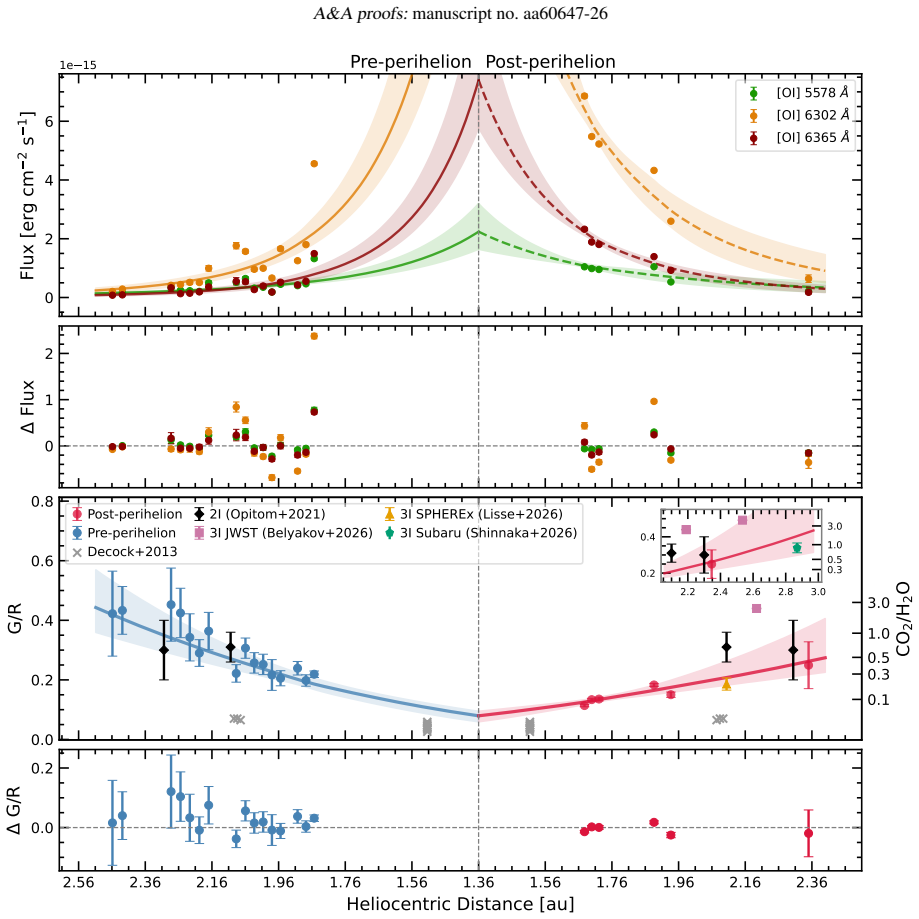
The central discovery is that 3I/ATLAS's coma chemistry tracks heliocentric distance: the green-to-red ratio of the forbidden oxygen lines declines monotonically from ~0.42 at 2.4 au to ~0.114 at perihelion, signaling that water's contribution to the oxygen emission grows as CO2 sublimation fades. An asymmetric piecewise power-law fit, with independent pre- and post-perihelion slopes and continuity at perihelion, is strongly preferred over a symmetric fit, matching the delayed water sublimation predicted by thermal-inertia models. CN is detected on 18 of 22 useful nights, and its pre-perihelion slope is -4.62 ± 1.25; the scatter around the smooth power law is unresolved and attributed to a m
Load-bearing premise
All quantitative production rates rest on treating 3I's gas outflow as if it followed solar-system comet scale lengths and the standard r_h^-0.5 velocity law; the paper itself notes the measured HCN outflow velocity is about half of that, which would halve Q_CN, so if that discrepancy reflects a genuinely different outflow the absolute rates and the fitted CN slope would shift.
Editorial extensions
If this is right
- 3I/ATLAS is not compositionally inert: its coma shifts from CO2-rich to H2O-dominated within a few tenths of an au of perihelion, so single-epoch characterization of an interstellar object can miss its dominant volatile.
- The near-perihelion G/R of 0.114 and CO2/H2O proxy of about 0.06 place 3I near the water-dominated end, comparable to 2I/Borisov and above the locus of typical solar-system comets at the same distances.
- The pre-perihelion CN power-law index is consistent with solar-system comets, so at least this volatile-release behavior is not exotic.
- Post-perihelion log(Q_C2/Q_CN) in the range -0.79 to -0.10 places 3I near the carbon-chain-depleted boundary, revising earlier pre-perihelion classifications.
- The measured red-doublet ratio of 2.97 ± 0.03 matches the theoretical branching ratio, validating the flux calibration and the clean separation of cometary and telluric lines.
Reading between the lines
- If the G/R trend is generic for interstellar comets, a modest number of optical spectra across a perihelion passage could rank an ISO's volatile budget without infrared access; a testable prediction is that direct infrared CO2/H2O measurements from other observatories should track the G/R decline when apertures are matched.
- Because the paper shows that absolute Q_CN depends sensitively on the assumed outflow velocity (halving the velocity to a measured value halves Q_CN), the power-law slope is more secure than the normalization; coordinated HCN and CN campaigns could decide whether HCN is CN's sole parent and recalibrate the assumed scale lengths.
- The unexplained scatter in CN residuals is a target for future work: phase-folding at the three candidate rotation periods shows no coherent pattern, but a denser, longer-baseline campaign could test rotationally modulated outgassing or discrete outbursts.
- The agreement between the fiber-B column density and the Haser-model prediction is an internal check of the adopted scale lengths; repeating that check at several heliocentric distances would convert a single validation into a systematic calibration of outflow physics in CO2-rich comae.
Signed reviews
Editorial analysis
A structured set of objections, weighed in public.
Referee Report
Summary. The paper presents VLT/ESPRESSO high-resolution spectroscopy of interstellar comet 3I/ATLAS on 23 nights spanning r_h = 1.67–2.45 au, covering both branches of the perihelion passage. The authors fit the CN B–X (0,0) band with a new public package, CometSpec, to derive production rates Q_CN, and model the three forbidden [O I] lines to obtain the green-to-red (G/R) ratio and a CO2/H2O proxy. The main reported results are: a pre-perihelion CN power-law index b_pre = −4.62 ± 1.25; a G/R ratio declining from ~0.42 ± 0.14 at r_h ≈ 2.4 au to ~0.114 ± 0.004 near perihelion; a strongly preferred asymmetric (pre/post) piecewise power-law fit for the oxygen lines; a CO2/H2O proxy ranging from ~0.06 to ~1.06; and detections of Ni I, Fe I, C2, and CH. The paper emphasizes that 3I/ATLAS evolves from a CO2-rich coma to a H2O-dominated coma near perihelion, consistent with delayed subsurface heating. The data, fits, and CometSpec are publicly released.
Significance. If correct, this is the most detailed high-resolution spectroscopic monitoring of an interstellar comet across perihelion, and it provides an important empirical constraint on the volatile evolution of ISOs. The public release of CometSpec and the reduced spectra is a substantial methodological contribution. The paper includes several strong internal consistency checks: the measured red-doublet ratio F6302/F6365 = 2.97 ± 0.03 agrees with the theoretical relativistic value; the fiber-B Haser-model column density agrees with a direct fluorescence fit; and the geocentric velocity residuals from the [O I] lines are at the ~200 m/s level. However, the central CN power-law index and the significance of the oxygen asymmetry depend on modeling assumptions that are not fully stress-tested, as detailed below.
major comments (2)
- [§5.1, Fig. 7, §4.3] The robustness test for the CN power-law index b_pre = −4.62 ± 1.25 does not actually probe the slope. In the Haser model, Q_CN is linearly proportional to the outflow velocity for fixed column density and aperture, so multiplying v by a constant shifts the intercept in log Q–log r but leaves the exponent unchanged. The two lighter lines in Fig. 7 therefore do not bracket b_pre. The exponent is instead sensitive to the heliocentric dependence of v(r) and of the parent/daughter scale lengths, both assumed to scale as r^−2 in §4.3. If, for example, v is approximately constant (as measured for HCN by Cordiner et al. 2026) or the scale lengths have a different r-dependence, the conversion from column density to Q_CN carries an r-dependent term that directly shifts b_pre. The paper acknowledges this qualitatively (§5.1) but does not quantify it; the statement that 'relative values remain cons
- [App. A, §5.2, Table 2] The iterative posterior filter in CometSpec deliberately reduces the reported uncertainties: App. A states that when the filter is enabled, 'the reported uncertainties describe the dispersion within the high-probability core and are, therefore, smaller than those derived from the full posterior.' This affects the quoted per-epoch [O I] fluxes and G/R values, and consequently the BIC comparison that underlies the central claim of a 'strongly preferred' asymmetric oxygen fit (ΔBIC = 105, 2011, 277 in §5.2). Because BIC depends on the data uncertainties, artificially small error bars inflate the ΔBIC. Moreover, the pre- and post-perihelion exponents in Table 2 are formally consistent within their bootstrap uncertainties, which is in tension with a ΔBIC of hundreds. The authors should either report the BIC comparison using unfiltered posterior uncertainties or demonstrate explicitly that the
minor comments (6)
- [§4.2] Typo: 'an the posterior distributions' should read 'and the posterior distributions'.
- [Throughout] The notation for the forbidden oxygen lines is inconsistent: '[Oi]' appears in the abstract and many places, while '[O I]' is the standard notation. Please unify.
- [Fig. 7 caption] The caption says the two lighter lines 'bracket the systematic uncertainty introduced by the model assumptions,' but as noted in the major comment they only test a constant velocity scaling. Please rephrase to avoid overstating the test.
- [Table E.2] The CO2/H2O column is left blank for the first four rows with a note 'omitted as they are closer to the asymptotic value.' This is unclear; please explain the criterion or provide the values with caveats.
- [§4.6.1] The sentence 'the limit of −0.18 defined by A’Hearn et al. (1995) to classify a comet as C2-depleted comes from narrow-band photometry' would benefit from explicitly stating that the comparison with the current fiber-based measurement is therefore indirect.
- [§7 / Data availability] The CometSpec code is on GitHub, but there is no version tag or archival DOI. A Zenodo DOI for the exact version used would improve reproducibility.
Circularity Check
No significant circularity: results are derived from new ESPRESSO line fluxes under stated external model assumptions; self-citations are contextual, not load-bearing.
full rationale
The central claims rest on new spectroscopic measurements, not on imported conclusions. CN column densities come from MCMC fluorescence fits to the observed B2Sigma+-X2Sigma+ band; Q_CN is then obtained with a standard Haser model using adopted solar-system scale lengths and outflow velocity, with the paper explicitly stating these are assumptions and that values should be taken as relative rather than absolute (Sect. 4.3). The fitted pre-perihelion exponent b_pre=-4.62 is therefore a fit to new data under stated, externally sourced parameters, not a quantity defined by the fit. The G/R ratio is measured directly from the [OI] line fluxes, and its mapping to a CO2/H2O proxy uses published photodissociation rates and branching ratios (Decock et al. 2013; Bhardwaj & Raghuram 2012; Slanger et al. 2006); this is an interpretive calibration, not a self-definition. The asymmetry in the oxygen fits is selected by BIC on the observed fluxes, and the consistency with thermal-inertia models cites both same-group (Puzia et al. 2025) and independent (Yaginuma et al. 2026) work; the prediction is not the input of the fit. The same-group citations (Rahatgaonkar et al. 2025, Puzia et al. 2025) are contextual prior observations/models and are not used to force the conclusions. The one notable limitation is methodological, not circular: the Fig. 7 test that doubles/halves the outflow velocity changes only the intercept of the Haser conversion, not the fitted slope, so it does not bracket b_pre's sensitivity to r-dependent v or scale-length scaling; the paper itself acknowledges the potential r-dependence of v in Sect. 5.1. This is an uncertainty/robustness gap, not a case of the derivation reducing to its inputs. Data and software are publicly released for independent re-analysis.
Assumptions & free parameters
free parameters (5)
- CN power-law exponent b_pre =
-4.62 (+1.25/-1.22)
- CN piecewise-fit perihelion normalization Q_peri =
log Q_peri = 26.57 (+0.24/-0.26)
- [OI] line pre/post power-law exponents =
a_pre=-4.52/-7.22/-7.33; a_post=-3.35/-5.51/-5.67 for 5578/6302/6365 Å
- [OI] line normalizations c =
2.24e-15, 2.05e-14, 7.40e-15 erg cm^-2 s^-1
- Per-epoch CometSpec fit parameters (logN, T_kin, f_col, FWHM_L, Δv) =
varies per night
assumptions (8)
- domain assumption Haser-model parent/daughter scale lengths for CN (1.3×10^4 km parent, 2.1×10^5 km daughter at 1 au, scaled r^-2) apply to 3I
- domain assumption Outflow velocity v=0.85 r_h^-0.5 km/s describes gas expansion
- domain assumption HCN is the dominant parent of CN
- domain assumption Kurucz solar irradiance is a valid proxy for the actual solar flux and is constant over the campaign
- domain assumption G/R ratio converts to CO2/H2O via Bhardwaj & Raghuram (2012) effective production rates, Slanger et al. (2006) branching ratio, and negligible CO contribution
- domain assumption Fluorescence equilibrium rate equations with optically thin coma and single f_col collision scaling apply
- standard math Linear algebra solution of Mx=b yields normalized level populations
- domain assumption Telluric and cometary [OI] line profiles can be separated with two Voigt components sharing Lorentzian width
Cite this review
Pith. "Pith review of Very Large Telescope observations of interstellar comet 3I/ATLAS III: High-resolution monitoring of CN and forbidden oxygen emission across the perihelion passage with ESPRESSO." pith.science (2026). https://pith.science/paper/WUY3YSTO
@misc{pith2026260715355,
  author       = {Pith},
  title        = {Pith review of: Very Large Telescope observations of interstellar comet 3I/ATLAS III: High-resolution monitoring of CN and forbidden oxygen emission across the perihelion passage with ESPRESSO},
  year         = {2026},
  howpublished = {\url{https://pith.science/paper/WUY3YSTO}},
  note         = {Machine review of arXiv:2607.15355}
}
abstract
3I/ATLAS is only the third known interstellar object to traverse the Solar System. We obtained high-resolution ($R\simeq 140000$) spectroscopy of 3I/ATLAS on 23 nights with VLT/ESPRESSO ($r_{h}=1.67-2.45$au). CN production rates were derived by fitting the $B^2\Sigma^+-X^2\Sigma^+$ band, using CometSpec, a publicly released Python package for flexible fluorescence modeling. The three forbidden [OI] lines were modeled to derive the green-to-red (G/R) flux ratio and a CO$_2$/H$_2$O proxy. We fit $Q_{CN}=a(r_{h}/1\text{au})^b$ to the production rate versus heliocentric distance relation. The pre-perihelion CN power-law index is $b_{pre}=-4.62^{+1.25}_{-1.22}$, within the range observed for solar-system comets. The CN residuals about the smooth model show substantial scatter that we attribute to a combination of systematics and possible physical drivers that the present cadence cannot disentangle. The G/R ratio decreases from $\sim 0.42\pm 0.14$ at $r_{h}\simeq 2.4$au to $\sim 0.114 \pm 0.004$ near perihelion. The asymmetric piecewise oxygen fit is strongly preferred over the symmetric one, consistent with thermal-inertia models, although denser post-perihelion sampling would be needed to confirm this. The CO$_2$/H$_2$O proxy spans $\sim 0.06-1.06$ and is comparable to the values reported by Subaru/HDS and SPHEREx, and to those measured for 2I/Borisov. We additionally identify NiI and FeI, and report post-perihelion production rates for C$_2$ and CH. Our high-resolution monitoring of 3I/ATLAS reveals a CO$_2$-rich coma that becomes progressively H$_2$O-dominated near perihelion, with a G/R asymmetry consistent with delayed H$_2$O sublimation predicted by thermal-inertia models. Together with the public release of CometSpec and the reduced data, these results provide both an empirical reference and a methodological framework for the next generation of interstellar-object monitoring campaigns.
Figures


Figures from the paper (5 more)


Reference graph
Works this paper leans on
-
[1]
F., Millis , R
A'Hearn , M. F., Millis , R. C., Schleicher , D. O., Osip , D. J., & Birch , P. V. 1995, , 118, 223
1995
-
[2]
T., Opitom , C., Fitzsimmons , A., et al
Bannister , M. T., Opitom , C., Fitzsimmons , A., et al. 2020, arXiv e-prints, arXiv:2001.11605
arXiv 2020
-
[3]
T., et al
Belyakov, M., Wong, I., Bolin, B. T., et al. 2026, , 1001, L11
2026
-
[4]
& Haider , S
Bhardwaj , A. & Haider , S. A. 2002, Advances in Space Research, 29, 745
2002
-
[5]
& Raghuram , S
Bhardwaj , A. & Raghuram , S. 2012, , 748, 13
2012
-
[6]
2026, , 708, L16
Biver , N., Bockel \'e e-Morvan , D., Moreno , R., et al. 2026, , 708, L16
2026
-
[7]
2015, , 197, 47
Bockel \'e e-Morvan , D., Calmonte , U., Charnley , S., et al. 2015, , 197, 47
2015
-
[8]
L., A'Hearn , M
Bodewits , D., Farnham , T. L., A'Hearn , M. F., et al. 2014, , 786, 48
2014
Show all 261 references
-
[9]
W., Feldman , P
Bodewits , D., Noonan , J. W., Feldman , P. D., et al. 2020, Nature Astronomy, 4, 867
2020
-
[10]
& Minor Planet Center
Borisov, G. & Minor Planet Center . 2019, MPEC 2019-R106: COMET C/2019 Q4 (Borisov) , Minor Planet Electronic Circular
2019
-
[11]
J., Neff , B., Loch , S
Bromley , S. J., Neff , B., Loch , S. D., et al. 2021, , 2, 228
2021
-
[12]
J., Noonan , J
Bromley , S. J., Noonan , J. W., Cochran , A. L., et al. 2024, , 528, 7358
2024
-
[13]
Brooke , J. S. A., Ram , R. S., Western , C. M., et al. 2014, , 210, 23
2014
-
[14]
2021, , 656, A160
Cambianica , P., Cremonese , G., Munaretto , G., et al. 2021, , 656, A160
2021
-
[15]
L., Barker , E
Cochran , A. L., Barker , E. S., & Gray , C. L. 2012, , 218, 144
2012
-
[16]
Cochran , A. L. & Schleicher , D. G. 1993, , 105, 235
1993
-
[17]
Combi , M. R. & Delsemme , A. H. 1980, , 237, 641
1980
-
[18]
R., M \"a kinen , J
Combi , M. R., M \"a kinen , J. T. T., Bertaux , J.-L., et al. 2013, , 225, 740
2013
-
[19]
Combi , M. R. & McCrosky , R. E. 1991, , 91, 270
1991
-
[20]
A., Milam , S
Cordiner , M. A., Milam , S. N., Biver , N., et al. 2020, Nature Astronomy, 4, 861
2020
-
[21]
A., Roth , N
Cordiner , M. A., Roth , N. X., Kelley , M. S. P., et al. 2025, , 991, L43
2025
-
[22]
A., Roth , N
Cordiner , M. A., Roth , N. X., Micheli , M., et al. 2026, arXiv e-prints, arXiv:2603.06911
2026
-
[23]
M., Kuan , Y.-J., Charnley , S
Coulson , I. M., Kuan , Y.-J., Charnley , S. B., et al. 2026, , 546, stag063
2026
-
[24]
R., Licandro , J., et al
de la Fuente Marcos , R., Alarcon , M. R., Licandro , J., et al. 2025, , 700, L9
2025
-
[25]
2013, , 555, A34
Decock , A., Jehin , E., Hutsem \'e kers , D., & Manfroid , J. 2013, , 555, A34
2013
-
[26]
2015, , 573, A1
Decock , A., Jehin , E., Rousselot , P., et al. 2015, , 573, A1
2015
-
[27]
2025, Minor Planet Electronic Circulars, 2025-N12
Denneau , L., Siverd , R., Tonry , J., et al. 2025, Minor Planet Electronic Circulars, 2025-N12
2025
-
[28]
& Feldman , P
Festou , M. & Feldman , P. D. 1981, , 103, 154
1981
-
[29]
& Johnson , J
Fink , U. & Johnson , J. R. 1984, , 89, 1565
1984
-
[30]
J., et al
Fitzsimmons , A., Hainaut , O., Meech , K. J., et al. 2019, , 885, L9
2019
-
[31]
2018, Nature Astronomy, 2, 133
Fitzsimmons , A., Snodgrass , C., Rozitis , B., et al. 2018, Nature Astronomy, 2, 133
2018
-
[32]
W., Lang , D., & Goodman , J
Foreman-Mackey , D., Hogg , D. W., Lang , D., & Goodman , J. 2013, , 125, 306
2013
-
[33]
2005, , 53, 1243
Fray , N., B \'e nilan , Y., Cottin , H., Gazeau , M.-C., & Crovisier , J. 2005, , 53, 1243
2005
-
[34]
M., et al
Freudling , W., Romaniello , M., Bramich , D. M., et al. 2013, , 559, A96
2013
-
[35]
& Marty , B
F \"u ri , E. & Marty , B. 2015, Nature Geoscience, 8, 515
2015
-
[36]
E., Mendoza , C., & Zeippen , C
Galavis , M. E., Mendoza , C., & Zeippen , C. J. 1997, , 123, 159
1997
-
[37]
2024, in Comets III, ed
G \"o tz , C., Deca , J., Mandt , K., & Volwerk , M. 2024, in Comets III, ed. K. J. Meech , M. R. Combi , D. Bockel \'e e-Morvan , S. N. Raymond , & M. E. Zolensky , 543--574
2024
-
[38]
Hall , L. A. & Anderson , G. P. 1991, , 96, 12,927
1991
-
[39]
Hanuschik , R. W. 2003, , 407, 1157
2003
-
[40]
1957, Bulletin de la Societe Royale des Sciences de Liege, 43, 740
Haser , L. 1957, Bulletin de la Societe Royale des Sciences de Liege, 43, 740
1957
-
[41]
J., Dorsey , R
Hopkins , M. J., Dorsey , R. C., Forbes , J. C., et al. 2025, , 990, L30
2025
-
[42]
Huebner , W. F. & Mukherjee , J. 2015, , 106, 11
2015
-
[43]
2021, , 652, L1
Hutsem \'e kers , D., Manfroid , J., Jehin , E., Opitom , C., & Moulane , Y. 2021, , 652, L1
2021
-
[44]
2026, , 706, A43
Hutsem \'e kers , D., Manfroid , J., Jehin , E., et al. 2026, , 706, A43
2026
-
[45]
2003, Earth Moon and Planets, 92, 465
Jewitt , D. 2003, Earth Moon and Planets, 92, 465
2003
-
[46]
2022, , 931, 24
Kawakita, H. 2022, , 931, 24
2022
-
[47]
2026, , 1000, L60
Kawakita , H., Tsujimoto , K., Shinnaka , Y., et al. 2026, , 1000, L60
2026
-
[48]
2004, , 601, 1152
Kawakita , H., Watanabe , J.-i., Furusho , R., et al. 2004, , 601, 1152
2004
-
[49]
Knight , M. M. & Schleicher , D. G. 2013, , 222, 691
2013
-
[50]
Ralchenko , Reader, J., & and NIST ASD Team
Kramida, A., Yu. Ralchenko , Reader, J., & and NIST ASD Team . 2024, NIST Atomic Spectra Database (ver. 5.12), [Online]. Available: https://physics.nist.gov/asd [2016, January 31]. National Institute of Standards and Technology, Gaithersburg, MD
2024
-
[51]
Kurucz , R. L. 2005, Mem. Soc. Astron. Italiana Suppl., 8, 189
2005
-
[52]
C., La Forgia , F., et al
Lazzarin , M., Mura , A. C., La Forgia , F., et al. 2026, , 998, L30
2026
-
[53]
W., Lee , C.-H., Gerdes , D
Lin , H. W., Lee , C.-H., Gerdes , D. W., et al. 2020, , 889, L30
2020
-
[54]
M., Bach, Y
Lisse, C. M., Bach, Y. P., Bryan, S., et al. 2025, RNAAS, 9, 242
2025
-
[55]
M., Bach , Y
Lisse , C. M., Bach , Y. P., Bryan , S. A., et al. 2026, RNAAS, 10, 26
2026
-
[56]
& A'Hearn , M
Magnani , L. & A'Hearn , M. F. 1986, , 302, 477
1986
-
[57]
2021, , 593, 372
Manfroid , J., Hutsem \'e kers , D., & Jehin , E. 2021, , 593, 372
2021
-
[58]
2009, , 503, 613
Manfroid , J., Jehin , E., Hutsem \'e kers , D., et al. 2009, , 503, 613
2009
-
[59]
McGlynn , T. A. & Chapman , R. D. 1989, , 346, L105
1989
-
[60]
J., Chanover , N
McKay , A. J., Chanover , N. J., Morgenthaler , J. P., et al. 2013, , 222, 684
2013
-
[61]
J., Cochran , A
McKay , A. J., Cochran , A. L., Dello Russo , N., & DiSanti , M. A. 2020, , 889, L10
2020
-
[62]
J., Cochran , A
McKay , A. J., Cochran , A. L., DiSanti , M. A., et al. 2015, , 250, 504
2015
-
[63]
J., Kelley , M
McKay , A. J., Kelley , M. S. P., Cochran , A. L., et al. 2016, , 266, 249
2016
-
[64]
K., Syme , A.-M., Borsovszky , J., et al
McKemmish , L. K., Syme , A.-M., Borsovszky , J., et al. 2020, , 497, 1081
2020
-
[65]
J., Weryk , R., Micheli , M., et al
Meech , K. J., Weryk , R., Micheli , M., et al. 2017, , 552, 378
2017
-
[66]
J., et al
Micheli , M., Farnocchia , D., Meech , K. J., et al. 2018, , 559, 223
2018
-
[67]
2019, The Journal of Open Source Software, 4, 1426
Mommert , M., Kelley , M., de Val-Borro , M., et al. 2019, The Journal of Open Source Software, 4, 1426
2019
-
[68]
2023, , 670, A159
Moulane , Y., Jehin , E., Manfroid , J., et al. 2023, , 670, A159
2023
-
[69]
W., Stern , S
Noonan , J. W., Stern , S. A., Feldman , P. D., et al. 2018, , 156, 16
2018
-
[70]
2021, , 650, L19
Opitom , C., Jehin , E., Hutsem \'e kers , D., et al. 2021, , 650, L19
2021
-
[71]
2025, , 544, L31
Opitom , C., Snodgrass , C., Jehin , E., et al. 2025, , 544, L31
2025
-
[72]
T., Bhandare , A., et al
'Oumuamua ISSI Team , Bannister , M. T., Bhandare , A., et al. 2019, Nature Astronomy, 3, 594
2019
-
[73]
2021, , 645, A96
Pepe , F., Cristiani , S., Rebolo , R., et al. 2021, , 645, A96
2021
-
[74]
Persson , S. E. 2022, , 134, 075001
2022
-
[75]
Pierce , D. M. & Cochran , A. L. 2021, , 2, 19
2021
-
[76]
H., Rahatgaonkar , R., Carvajal , J
Puzia , T. H., Rahatgaonkar , R., Carvajal , J. P., Nayak , P. K., & Luco , B. 2025, , 990, L27
2025
-
[77]
& Bhardwaj , A
Raghuram , S. & Bhardwaj , A. 2013, , 223, 91
2013
-
[78]
& Bhardwaj , A
Raghuram , S. & Bhardwaj , A. 2014, , 566, A134
2014
-
[79]
P., Puzia , T
Rahatgaonkar , R., Carvajal , J. P., Puzia , T. H., et al. 2025, , 995, L34
2025
-
[80]
2022, , 30, 7
Romano , D. 2022, , 30, 7
2022
-
[81]
X., Cordiner , M
Roth , N. X., Cordiner , M. A., Bockel \'e e-Morvan , D., et al. 2026, , 999, L32
2026
-
[82]
M., Burger , M
Rousselot , P., Hill , S. M., Burger , M. H., et al. 2000, , 146, 263
2000
-
[83]
E., Lin , H
Salazar Manzano , L. E., Lin , H. W., Taylor , A. G., et al. 2025, , 993, L23
2025
-
[84]
2025, , 702, L3
Santana-Ros , T., Ivanova , O., Mykhailova , S., et al. 2025, , 702, L3
2025
-
[85]
G., Millis , R
Schleicher , D. G., Millis , R. L., Osip , D. J., & Birch , P. V. 1991, , 94, 511
1991
-
[86]
G., Millis , R
Schleicher , D. G., Millis , R. L., Thompson , D. T., et al. 1990, , 100, 896
1990
-
[87]
Z., Micheli , M., Farnocchia , D., et al
Seligman , D. Z., Micheli , M., Farnocchia , D., et al. 2025, , 989, L36
2025
-
[88]
Serra-Ricart , M., Licandro , J., & Alarcon , M. R. 2026, , 705, L3
2026
-
[89]
2026, , 171, 281
Shinnaka , Y., Tsujimoto , K., Kawakita , H., et al. 2026, , 171, 281
2026
-
[90]
G., Cosby , P
Slanger , T. G., Cosby , P. C., Sharpee , B. D., Minschwaner , K. R., & Siskind , D. E. 2006, Journal of Geophysical Research (Space Physics), 111, A12318
2006
-
[91]
S., Brooke , J
Sneden , C., Lucatello , S., Ram , R. S., Brooke , J. S. A., & Bernath , P. 2014, , 214, 26
2014
-
[92]
Storey , P. J. & Zeippen , C. J. 2000, , 312, 813
2000
-
[93]
L., Denneau , L., Heinze , A
Tonry , J. L., Denneau , L., Heinze , A. N., et al. 2018, , 130, 064505
2018
-
[94]
van Hoof , P. A. M. 2018, Galaxies, 6, 63
2018
-
[95]
Xing , Z., Bodewits , D., Noonan , J., & Bannister , M. T. 2020, , 893, L48
2020
-
[96]
G., & Seligman, D
Yaginuma, A., Taylor, A. G., & Seligman, D. Z. 2026, , 546, stag162
2026
-
[97]
Ye , Q.-Z., Zhang , Q., Kelley , M. S. P., & Brown , P. G. 2017, , 851, L5
2017
-
[98]
N., Szab \'o , I., Pyatenko , E., & Tennyson , J
Yurchenko , S. N., Szab \'o , I., Pyatenko , E., & Tennyson , J. 2018, , 480, 3397
2018
- [99]
-
[100]
, keywords =
Preperihelion CN Production Rate of Interstellar Comet 3I/ATLAS. , keywords =. doi:10.3847/2041-8213/ae3dd7 , adsurl =
-
[101]
doi:10.1006/icar.1995.1190 , journal =
1995
- [102]
-
[103]
doi:10.1146/annurev-astro-091918-104409 , eprint =
, keywords =. doi:10.1146/annurev-astro-091918-104409 , eprint =
-
[104]
doi:10.1016/0016-7037(89)90286-X , journal =
-
[105]
doi:10.1126/science.1086711 , journal =
-
[106]
doi:10.1029/94JA02936 , journal =
- [107]
-
[108]
and Davis, M
Belyakov, Matthew and Wong, Ian and Bolin, Bryce T. and Davis, M. Ryleigh and Bromley, Steven J. and Lisse, Carey M. and Brown, Michael E. , doi =. The Volatile Inventory of 3I/ATLAS as Seen with JWST/MIRI , url =. , month =. 2026 , bdsk-url-1 =
2026
-
[109]
, keywords =
MoLLIST: Molecular Line Lists, Intensities and Spectra. , keywords =. doi:10.1016/j.jqsrt.2019.106687 , adsurl =
2019
-
[110]
doi:10.1038/nature15707 , journal =
-
[111]
doi:10.1006/icar.1996.0061 , journal =
1996
-
[112]
doi:10.1016/S0273-1177(02)00006-6 , journal =
-
[113]
arXiv , author =:1203.0723 , journal =
doi:10.1088/0004-637X/748/1/13 , eid =. arXiv , author =:1203.0723 , journal =
-
[114]
arXiv , author =:1603.05006 , journal =
doi:10.1051/0004-6361/201528041 , eid =. arXiv , author =:1603.05006 , journal =
-
[115]
Comets III , date-added =
-
[116]
, keywords =
Perihelion observations of interstellar comet 3I/ATLAS with the IRAM 30-m telescope. , keywords =. doi:10.1051/0004-6361/202659316 , adsurl =
- [117]
-
[118]
doi:10.1007/s11214-015-0156-9 , journal =
-
[119]
doi:10.1006/icar.1998.5916 , journal =
1998
-
[120]
, keywords =
The Evolving Activity of the Dynamically Young Comet C/2009 P1 (Garradd). , keywords =. doi:10.1088/0004-637X/786/1/48 , archivePrefix =. 1403.0092 , primaryClass =
2009 arXiv
-
[121]
arXiv , author =:1607.05632 , journal =
doi:10.3847/0004-6256/152/5/130 , eid =. arXiv , author =:1607.05632 , journal =
-
[122]
doi:10.1038/s41550-020-1095-2 , eprint =
Nature Astronomy , keywords =. doi:10.1038/s41550-020-1095-2 , eprint =
-
[123]
Borisov, G. and. 2019 , bdsk-url-1 =
2019
-
[124]
arXiv , author =:2106.04701 , journal =
doi:10.3847/PSJ/ac2dff , eid =. arXiv , author =:2106.04701 , journal =
-
[125]
doi:10.1093/mnras/stae456 , journal =
- [126]
- [127]
-
[128]
arXiv , author =:1208.5998 , journal =
doi:10.1088/2041-8205/759/2/L37 , eid =. arXiv , author =:1208.5998 , journal =
-
[129]
arXiv , author =:1403.7143 , keywords =
Protostars and Planets VI , doi =. arXiv , author =:1403.7143 , keywords =
-
[130]
doi:10.1038/349393a0 , journal =
-
[131]
Dissociative Electron Attachment to HCN, HCCH and HCCCN , url =
Chourou, S T and Orel, A E , doi =. Dissociative Electron Attachment to HCN, HCCH and HCCCN , url =. Journal of Physics: Conference Series , month =. 2011 , bdsk-url-1 =
2011
-
[132]
doi:10.1006/icar.1993.1121 , journal =
1993
-
[133]
, keywords =
Thirty years of cometary spectroscopy from McDonald Observatory. , keywords =. doi:10.1016/j.icarus.2011.12.010 , archivePrefix =. 1112.4770 , primaryClass =
2011 arXiv
-
[134]
doi:10.1016/0019-1035(91)90024-N , journal =
-
[135]
doi:10.1086/157910 , journal =
-
[136]
, year = 2013, month = jul, volume =
Water production rate of Comet C/2009 P1 (Garradd) throughout the 2011-2012 apparition: Evidence for an icy grain halo. , year = 2013, month = jul, volume =. doi:10.1016/j.icarus.2013.04.030 , adsurl =
2009 doi
-
[137]
doi:10.1038/s41550-020-1087-2 , eprint =
Nature Astronomy , keywords =. doi:10.1038/s41550-020-1087-2 , eprint =
-
[138]
arXiv , author =:2508.18209 , journal =
doi:10.3847/2041-8213/ae0647 , eid =. arXiv , author =:2508.18209 , journal =
-
[139]
arXiv , author =:2603.06911 , journal =
doi:10.48550/arXiv.2603.06911 , eid =. arXiv , author =:2603.06911 , journal =
-
[140]
, keywords =
JCMT detection of HCN emission from 3I/ATLAS at 2.1 au. , keywords =. doi:10.1093/mnras/stag063 , archivePrefix =. 2510.02817 , primaryClass =
-
[141]
arXiv , author =:1210.0842 , journal =
doi:10.1051/0004-6361/201220414 , eid =. arXiv , author =:1210.0842 , journal =
-
[142]
arXiv , author =:1409.6249 , journal =
doi:10.1051/0004-6361/201424403 , eid =. arXiv , author =:1409.6249 , journal =
-
[143]
, keywords =
Assessing interstellar comet 3I/ATLAS with the 10.4 m Gran Telescopio Canarias and the Two-meter Twin Telescope. , keywords =. doi:10.1051/0004-6361/202556439 , archivePrefix =. 2507.12922 , primaryClass =
-
[144]
doi:10.48377/MPEC/2025-N12 , journal =
2025 doi
-
[145]
, keywords =
Examination of Fragment Species in the Comae of Several Comets Using an Integral Field Unit Spectrograph. , keywords =. doi:10.3847/PSJ/abd037 , adsurl =
-
[146]
Comets II , editor =
-
[147]
arXiv , author =:1506.01203 , journal =
doi:10.1051/0004-6361/201525925 , eid =. arXiv , author =:1506.01203 , journal =
-
[148]
doi:10.1086/113660 , journal =
-
[149]
doi:10.1038/s41550-017-0361-4 , eprint =
Nature Astronomy , keywords =. doi:10.1038/s41550-017-0361-4 , eprint =
-
[150]
arXiv , author =:1909.12144 , journal =
doi:10.3847/2041-8213/ab49fc , eid =. arXiv , author =:1909.12144 , journal =
- [151]
-
[152]
doi:10.1016/j.pss.2005.06.005 , journal =
2005 doi
-
[153]
arXiv , author =:1311.5411 , journal =
doi:10.1051/0004-6361/201322494 , eid =. arXiv , author =:1311.5411 , journal =
-
[154]
doi:10.1038/ngeo2451 , journal =
-
[155]
arXiv , author =:1512.04291 , journal =
doi:10.1051/0004-6361/201527579 , eid =. arXiv , author =:1512.04291 , journal =
-
[156]
arXiv , author =:1610.07286 , journal =
doi:10.1051/0004-6361/201629269 , eid =. arXiv , author =:1610.07286 , journal =
-
[157]
doi:10.1051/aas:1997344 , journal =
-
[158]
, keywords =
High-resolution solar spectrum between 2000 and 3100 A. , keywords =. doi:10.1029/91JD01111 , adsurl =
2000 doi
-
[159]
doi:10.1051/0004-6361:20030885 , journal =
-
[160]
doi:10.1038/nature10519 , journal =
-
[161]
Bulletin de la Societe Royale des Sciences de Liege , month = jan, pages =
- [162]
-
[163]
arXiv , author =:1401.1630 , journal =
doi:10.1051/0004-6361/201322832 , eid =. arXiv , author =:1401.1630 , journal =
-
[164]
arXiv , author =:1911.06676 , journal =
doi:10.1051/0004-6361/201936750 , eid =. arXiv , author =:1911.06676 , journal =
1911 arXiv
-
[165]
arXiv , author =:2601.16983 , journal =
doi:10.48550/arXiv.2601.16983 , eid =. arXiv , author =:2601.16983 , journal =
-
[166]
arXiv , author =:2507.05318 , journal =
doi:10.3847/2041-8213/adfbf4 , eid =. arXiv , author =:2507.05318 , journal =
-
[167]
, keywords =
Photoionization and photodissociation rates in solar and blackbody radiation fields. , keywords =. doi:10.1016/j.pss.2014.11.022 , adsurl =
2014 doi
-
[168]
arXiv , author =:2107.05932 , journal =
doi:10.1051/0004-6361/202141554 , eid =. arXiv , author =:2107.05932 , journal =
-
[169]
arXiv , author =:2509.26053 , journal =
doi:10.1051/0004-6361/202557484 , eid =. arXiv , author =:2509.26053 , journal =
- [170]
-
[171]
doi:10.1007/s11038-009-9322-y , journal =
-
[172]
doi:10.1126/science.278.5335.90 , journal =
-
[173]
doi:10.1023/B:MOON.0000031961.88202.60 , journal =
-
[174]
Photodissociation Rate, Excess Energy, and Kinetic Total Energy Release for the Photolysis of H2O Producing O(1S) by Solar UV Radiation Field , url =
Kawakita, Hideyo , doi =. Photodissociation Rate, Excess Energy, and Kinetic Total Energy Release for the Photolysis of H2O Producing O(1S) by Solar UV Radiation Field , url =. , month =. 2022 , bdsk-url-1 =
2022
-
[175]
, keywords =
Spin Temperatures of Ammonia and Water Molecules in Comets. , keywords =. doi:10.1086/380579 , adsurl =
- [176]
-
[177]
, keywords =
The highly unusual outgassing of Comet 103P/Hartley 2 from narrowband photometry and imaging of the coma. , keywords =. doi:10.1016/j.icarus.2012.06.004 , archivePrefix =. 1206.1318 , primaryClass =
2012 arXiv
-
[178]
doi:10.1111/j.1365-2966.2011.18621.x , eprint =
, keywords =. doi:10.1111/j.1365-2966.2011.18621.x , eprint =
2011
-
[179]
doi:10.5067/TSIS/TIM/ , eid =
-
[180]
Mem. Soc. Astron. Italiana Suppl. , keywords =
-
[181]
doi:10.1103/PhysRev.52.843 , journal =
-
[182]
doi:10.1007/s11038-016-9481-6 , journal =
-
[183]
arXiv , author =:1912.06161 , journal =
doi:10.3847/2041-8213/ab6bd9 , eid =. arXiv , author =:1912.06161 , journal =
-
[184]
arXiv , author =:1904.09175 , journal =
doi:10.1051/0004-6361/201935554 , eid =. arXiv , author =:1904.09175 , journal =
1904 arXiv
-
[185]
Lisse, C. M. and Bach, Y. P. and Bryan, S. and Crill, B. P. and Cukierman, A. and Dor. SPHEREx Discovery of Strong Water Ice Absorption and an Extended Carbon Dioxide Coma in 3I/ATLAS , url =. 2025 , bdsk-url-1 =. doi:10.3847/2515-5172/ae0293 , journal =
2025 doi
-
[186]
arXiv , author =:2601.06759 , journal =
doi:10.3847/2515-5172/ae3f95 , eid =. arXiv , author =:2601.06759 , journal =
-
[187]
doi:10.1086/375492 , journal =
-
[188]
doi:10.1086/164006 , journal =
-
[189]
doi:10.1051/0004-6361/200911859 , eprint =
, keywords =. doi:10.1051/0004-6361/200911859 , eprint =
-
[190]
doi:10.1038/s41586-021-03435-0 , journal =
-
[191]
doi:10.1126/science.1204656 , journal =
-
[192]
, keywords =
CH in stellar atmospheres: an extensive linelist. , keywords =. doi:10.1051/0004-6361/201423956 , archivePrefix =. 1410.4005 , primaryClass =
-
[193]
doi:10.1086/185590 , journal =
-
[194]
doi:10.1016/j.icarus.2012.06.020 , journal =
2012 doi
-
[195]
doi:10.1016/j.icarus.2014.12.023 , eprint =
, keywords =. doi:10.1016/j.icarus.2014.12.023 , eprint =
2014 doi
-
[196]
doi:10.1016/j.icarus.2015.11.004 , eprint =
, keywords =. doi:10.1016/j.icarus.2015.11.004 , eprint =
2015 doi
-
[197]
arXiv , author =:1910.12785 , journal =
doi:10.3847/2041-8213/ab64ed , eid =. arXiv , author =:1910.12785 , journal =
-
[198]
, keywords =
An update to the MARVEL data set and ExoMol line list for ^ 12 C _ 2. , keywords =. doi:10.1093/mnras/staa1954 , archivePrefix =. 2009.04618 , primaryClass =
2009 arXiv
-
[199]
doi:10.1038/nature25020 , journal =
-
[200]
doi:10.1126/science.279.5357.1707 , journal =
-
[201]
doi:10.1006/icar.1998.6022 , journal =
1998
-
[202]
doi:10.1093/mnras/254.4.693 , journal =
-
[203]
doi:10.1038/s41586-018-0254-4 , journal =
-
[204]
doi:10.1086/497123 , journal =
-
[205]
doi:10.1086/167444 , journal =
-
[206]
doi:10.21105/joss.01426 , eid =
The Journal of Open Source Software , keywords =. doi:10.21105/joss.01426 , eid =
-
[207]
arXiv , author =:2301.10954 , journal =
doi:10.1051/0004-6361/202244779 , eid =. arXiv , author =:2301.10954 , journal =
-
[208]
arXiv , author =:2202.03521 , journal =
doi:10.1051/0004-6361/202142922 , eid =. arXiv , author =:2202.03521 , journal =
-
[209]
, year = 1987, month = nov, volume =
The Ortho-Para Ratio of Water Vapor in Comet p/ Halley. , year = 1987, month = nov, volume =
1987
-
[210]
Protostars and Planets VII , editor =
-
[211]
arXiv , author =:1806.06948 , journal =
doi:10.3847/1538-3881/aac432 , eid =. arXiv , author =:1806.06948 , journal =
-
[212]
doi:10.1038/s41550-019-0816-x , eprint =
Nature Astronomy , keywords =. doi:10.1038/s41550-019-0816-x , eprint =
-
[213]
arXiv , author =:2106.04431 , journal =
doi:10.1051/0004-6361/202141245 , eid =. arXiv , author =:2106.04431 , journal =
- [214]
-
[215]
arXiv , author =:2603.07187 , journal =
doi:10.48550/arXiv.2603.07187 , eid =. arXiv , author =:2603.07187 , journal =
-
[216]
doi:10.1086/152300 , journal =
-
[217]
arXiv , author =:2010.00316 , journal =
doi:10.1051/0004-6361/202038306 , eid =. arXiv , author =:2010.00316 , journal =
2010 arXiv
- [218]
-
[219]
arXiv , author =:2508.02777 , journal =
doi:10.3847/2041-8213/adfa0b , eid =. arXiv , author =:2508.02777 , journal =
-
[220]
doi:10.1016/j.icarus.2012.11.032 , eprint =
, keywords =. doi:10.1016/j.icarus.2012.11.032 , eprint =
2012 doi
-
[221]
arXiv , author =:1405.0375 , journal =
doi:10.1051/0004-6361/201321921 , eid =. arXiv , author =:1405.0375 , journal =
-
[222]
arXiv , author =:2508.18382 , journal =
doi:10.3847/2041-8213/ae1cbc , eid =. arXiv , author =:2508.18382 , journal =
-
[223]
doi:10.1051/0004-6361:20021550 , journal =
-
[224]
arXiv , author =:2210.04350 , journal =
doi:10.1007/s00159-022-00144-z , eid =. arXiv , author =:2210.04350 , journal =
-
[225]
, keywords =
CH _ 3 OH and HCN in Interstellar Comet 3I/ATLAS Mapped with the ALMA Atacama Compact Array: Distinct Outgassing Behaviors and a Remarkably High CH _ 3 OH/HCN Production Rate Ratio. , keywords =. doi:10.3847/2041-8213/ae433b , archivePrefix =. 2511.20845 , primaryClass =
-
[226]
arXiv , author =:2603.20445 , journal =
doi:10.48550/arXiv.2603.20445 , eid =. arXiv , author =:2603.20445 , journal =
-
[227]
arXiv , author =:1501.01141 , journal =
doi:10.1051/0004-6361/201425113 , eid =. arXiv , author =:1501.01141 , journal =
-
[228]
, year = 2000, month = jul, volume =
Theoretical Modeling of the C _ 2 Fluorescence Spectrum in Comet Hale-Bopp. , year = 2000, month = jul, volume =. doi:10.1006/icar.2000.6383 , adsurl =
2000
- [229]
-
[230]
arXiv , author =:2311.05700 , journal =
doi:10.1051/0004-6361/202348027 , eid =. arXiv , author =:2311.05700 , journal =
-
[231]
arXiv , author =:2509.01647 , journal =
doi:10.3847/2041-8213/ae1232 , eid =. arXiv , author =:2509.01647 , journal =
-
[232]
, keywords =
Temporal evolution of the third interstellar comet 3I/ATLAS: Spin, color, spectra, and dust activity. , keywords =. doi:10.1051/0004-6361/202556717 , archivePrefix =. 2508.00808 , primaryClass =
-
[233]
doi:10.1086/115570 , journal =
-
[234]
, keywords =
Comet Levy (1990c): Groundbased photometric results. , keywords =. doi:10.1016/0019-1035(91)90244-N , adsurl =
-
[235]
arXiv , author =:2507.02757 , journal =
doi:10.3847/2041-8213/adf49a , eid =. arXiv , author =:2507.02757 , journal =
-
[236]
arXiv , author =:2512.12819 , journal =
doi:10.1051/0004-6361/202558072 , eid =. arXiv , author =:2512.12819 , journal =
- [237]
-
[238]
doi:10.1093/mnras/stw2410 , journal =
- [239]
-
[240]
, keywords =
A Postperihelion Constraint on the CO _ 2 /H _ 2 O Ratio of Interstellar Comet 3I/ATLAS from [O I] Forbidden Lines. , keywords =. doi:10.3847/1538-3881/ae578d , adsurl =
-
[241]
doi:10.1029/2006JA011972 , eid =
Journal of Geophysical Research (Space Physics) , keywords =. doi:10.1029/2006JA011972 , eid =
-
[242]
arXiv , author =:1408.3828 , journal =
doi:10.1088/0067-0049/214/2/26 , eid =. arXiv , author =:1408.3828 , journal =
-
[243]
doi:10.1086/148023 , journal =
-
[244]
doi:10.1046/j.1365-8711.2000.03184.x , journal =
2000
-
[245]
arXiv , author =:1405.3268 , journal =
doi:10.1088/0004-637X/791/1/1 , eid =. arXiv , author =:1405.3268 , journal =
- [246]
-
[247]
Galaxies , keywords =
Recent Development of the Atomic Line List. Galaxies , keywords =. doi:10.3390/galaxies6020063 , adsurl =
-
[248]
arXiv , author =:1802.02841 , journal =
doi:10.1051/0004-6361/201731898 , eid =. arXiv , author =:1802.02841 , journal =
-
[249]
doi:10.1086/152681 , journal =
-
[250]
doi:10.1088/0034-4885/62/2/002 , journal =
- [251]
- [252]
-
[253]
doi:10.1086/166064 , journal =
-
[254]
doi:10.1086/167312 , journal =
-
[255]
arXiv , author =:2001.04865 , journal =
doi:10.3847/2041-8213/ab86be , eid =. arXiv , author =:2001.04865 , journal =
-
[256]
Potential thermal profiles of the third interstellar object 3I/ATLAS , url =
Yaginuma, Atsuhiro and Taylor, Aster G and Seligman, Darryl Z , doi =. Potential thermal profiles of the third interstellar object 3I/ATLAS , url =. , month =. 2026 , bdsk-url-1 =. https://academic.oup.com/mnras/article-pdf/546/4/stag162/66537789/stag162.pdf , issn =
2026
-
[257]
arXiv , author =:1712.02810 , journal =
doi:10.1051/0004-6361/201732100 , eid =. arXiv , author =:1712.02810 , journal =
-
[258]
doi:10.1038/ncomms15298 , eid =
Nature Communications , month = may, pages =. doi:10.1038/ncomms15298 , eid =
-
[259]
arXiv , author =:1711.02320 , journal =
doi:10.3847/2041-8213/aa9a34 , eid =. arXiv , author =:1711.02320 , journal =
-
[260]
, keywords =
ExoMol line lists XXXI: spectroscopy of lowest eights electronic states of C _ 2. , keywords =. doi:10.1093/mnras/sty2050 , archivePrefix =. 1812.07116 , primaryClass =
-
[261]
doi:10.1086/312388 , journal =
Reviewed August 1, 2026 · model on record in the stance chip above.
Discussion (0). Continue with ORCID to comment.