Boosting lattice polarization Mixing the perspectives of geometry optimization and cell-augmentation
Pith reviewed 2026-06-26 16:08 UTC · model grok-4.3
The pith
Topology optimization designs mechanical lattices with strong polarization up to three-count edge state mismatch.
A machine-rendered reading of the paper's core claim, the machinery that carries it, and where it could break.
Core claim
Mixing geometry optimization and cell augmentation through topology optimization produces mechanical lattices with strong topological polarization. The method incorporates band and mode morphological properties to guide the search, unlocking configurations outside traditional Maxwell lattice families. The optimized results identify a new class of augmented kagome trusses that preserve polarization while meeting robustness requirements, with theory, simulations, and experiments (laser vibrometry and static tests) all showing agreement up to a three-count edge state mismatch.
What carries the argument
Topology optimization algorithm driven by band and mode morphological properties, which both generates polarized finite structures and supplies connectivity blueprints for new ideal Maxwell trusses.
If this is right
- Polarized metamaterial configurations become systematically designable beyond a few hand-crafted ideal lattices.
- Robustness against edge perturbations must be checked separately from the optimization outcome.
- Augmented kagome geometry supplies a concrete family of Maxwell trusses with extreme polarization.
- Theory, simulations, and experiments agree on the achieved polarization signatures for the examined cases.
Where Pith is reading between the lines
- The same optimization loop could be repeated with different morphological drivers to target other topological features such as protected wave paths.
- The connectivity pattern extracted from the TO lattices may suggest additional periodic trusses whose polarization can be verified analytically without further optimization.
- Applying the framework to three-dimensional unit cells would test whether the polarization boost scales while preserving Maxwell constraints.
Load-bearing premise
Configurations obtained from finite optimized lattices translate back to ideal periodic lattices while retaining polarization strength and robustness to edge morphology changes.
What would settle it
An augmented kagome truss fabricated and tested under controlled edge perturbations that shows polarization signatures falling below a three-count mismatch or losing agreement with the predicted band structure would falsify the central claim.
Figures
read the original abstract
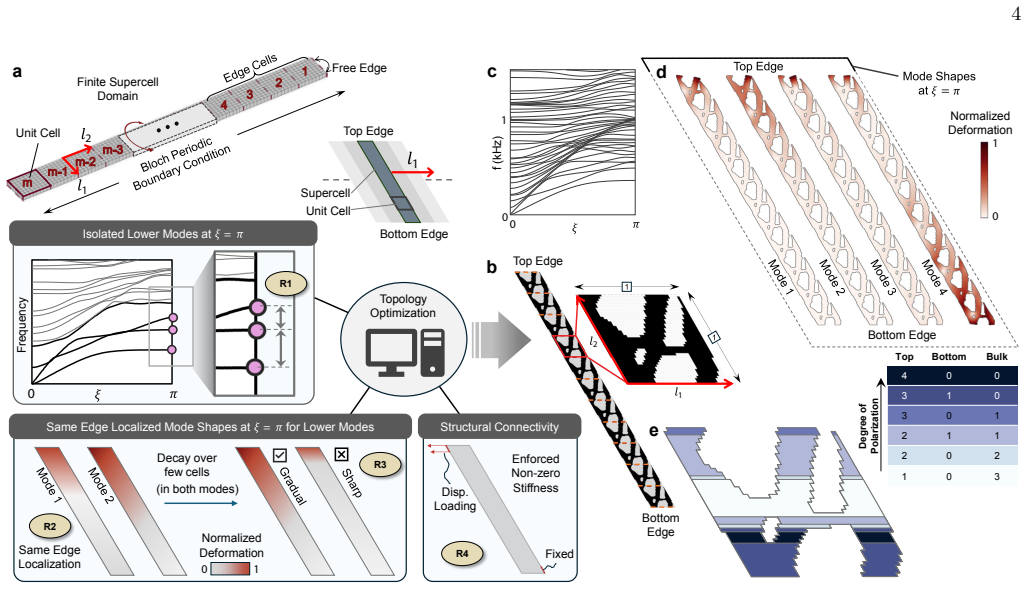
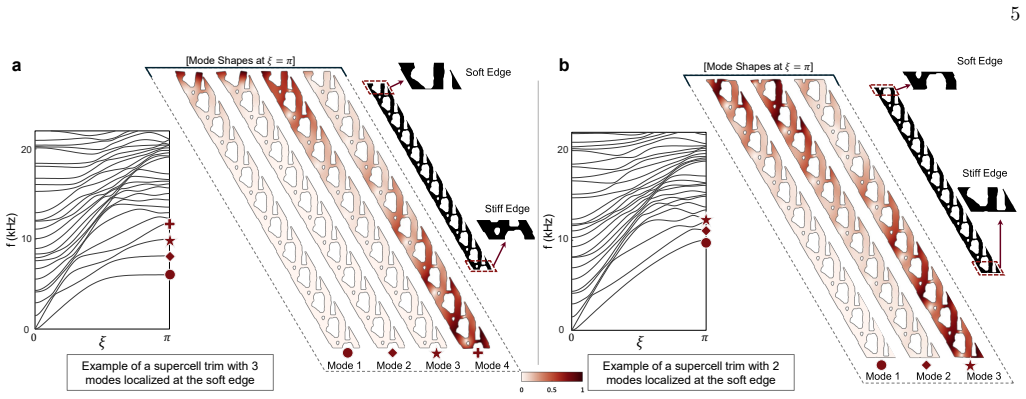
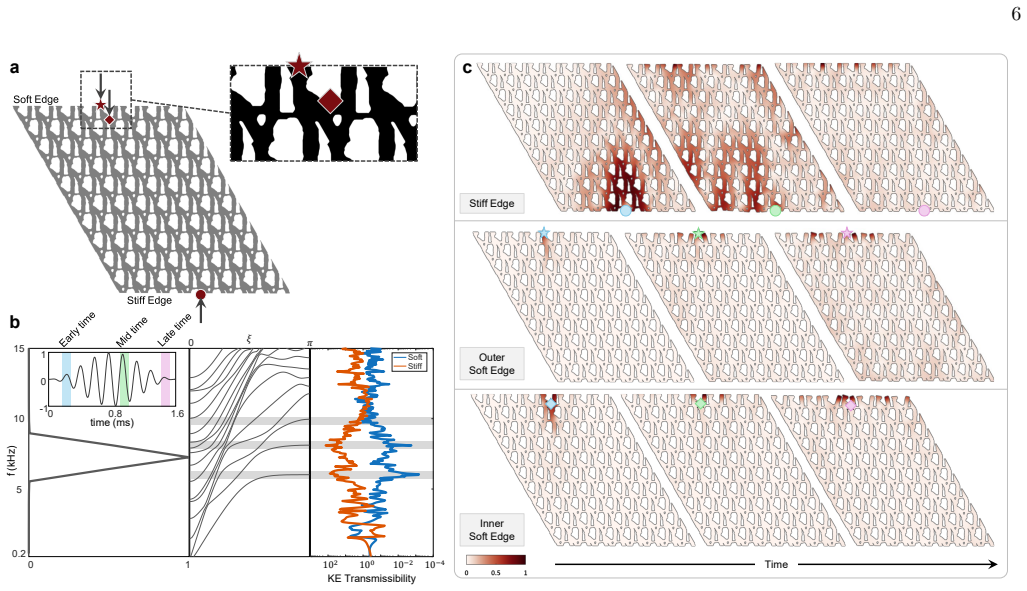
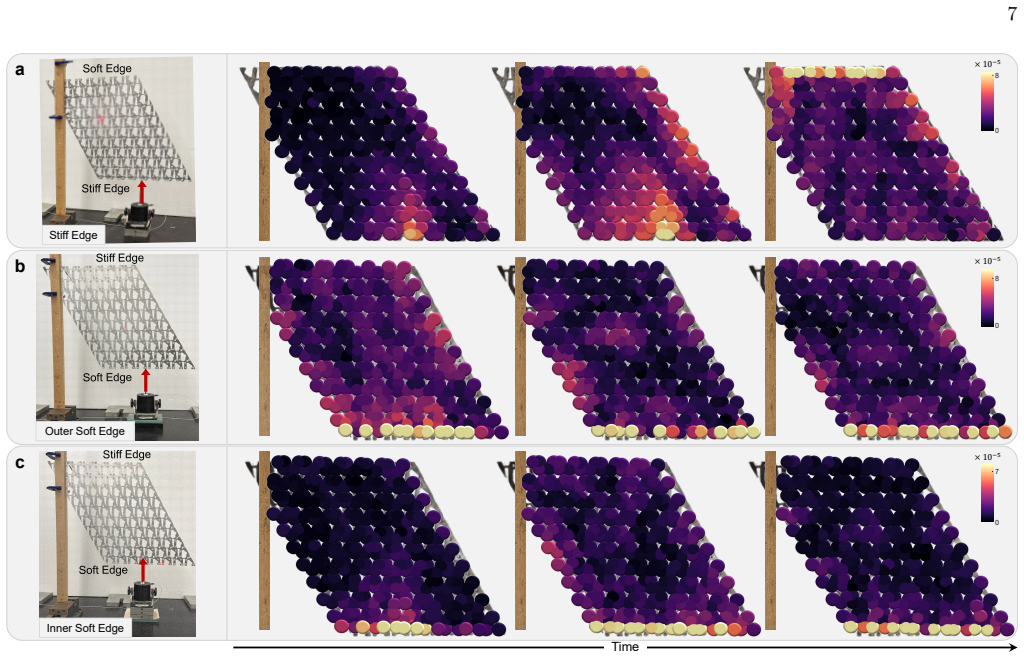
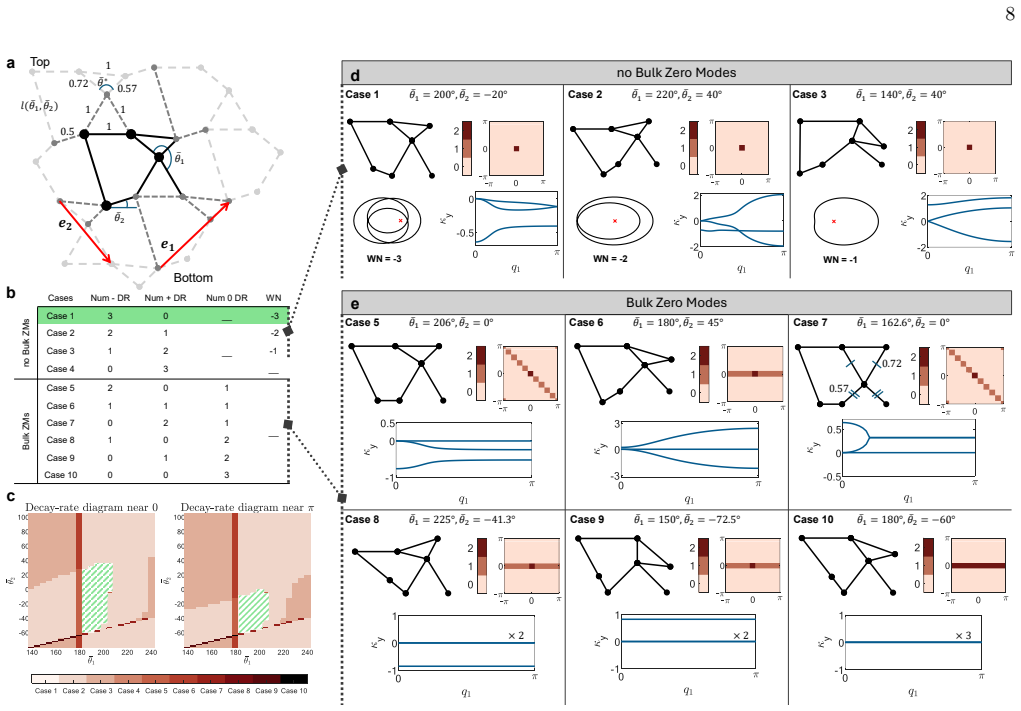
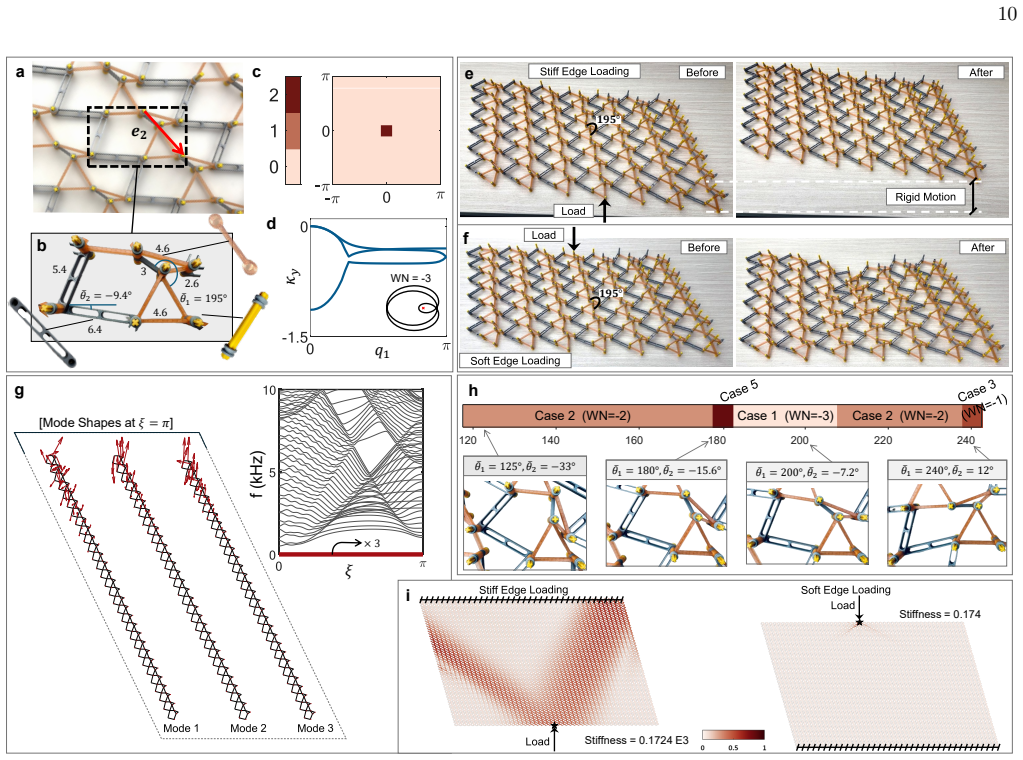
Topologically polarized mechanical metamaterials enjoy a special built-in asymmetry that manifests as a preferred localization of edge states on selected edges. While this property has been shown for a few ideal Maxwell lattices, we currently lack systematic criteria to design families of structural systems exhibiting polarization. Here, we propose a framework to design polarized structural configurations enabled by topology optimization (TO), using both band and mode morphological properties as drivers of the optimization algorithm. Through the lens of TO, we are able to tap into a vast design space, unlocking geometric freedom far beyond what is achievable with canonical lattice architectures. At the same time, we elucidate important criteria that need to be satisfied, beyond the optimization outcome, to ensure robustness of the achieved polarization against perturbations of the edge morphology. These results provide the inspiration to loop back into the realm of ideal lattices in search of new configurations characterized by extreme polarization. The peculiar shape and connectivity of the TO-generated lattice offer a blueprint for identifying a new family of Maxwell trusses based on augmented kagome geometry. We demonstrate the achievement of strong polarization signatures up to a three-count edge state mismatch. For all the cases studied, we show agreement between theory, simulations, and experiments, which include laser vibrometry wave measurements on a waterjet-cut specimen and static tests on a 3D-printed prototype.
Editorial analysis
A structured set of objections, weighed in public.
Referee Report
Summary. The manuscript proposes a topology optimization (TO) framework for designing topologically polarized mechanical metamaterials, using band and mode morphological properties to drive the optimization. It reports achieving strong polarization signatures with up to a three-count edge-state mismatch in the resulting structures, demonstrates consistency between theory, simulations, and experiments (laser vibrometry on waterjet-cut specimens and static tests on 3D-printed prototypes), and argues that the TO geometries provide a blueprint for a new family of ideal Maxwell trusses based on augmented kagome geometry.
Significance. If the extrapolation from TO-optimized finite geometries to periodic ideal lattices can be shown to preserve polarization and edge robustness, the work would offer a systematic route to expand the design space for polarized metamaterials beyond a few canonical Maxwell lattices, with potential for identifying configurations with extreme polarization properties.
major comments (2)
- [Abstract] Abstract: The central claim that the TO-generated lattice 'offer[s] a blueprint for identifying a new family of Maxwell trusses based on augmented kagome geometry' with 'extreme polarization' is load-bearing for the paper's contribution beyond TO specimens. However, the abstract and results explicitly state that all validations (theory, simulations, and experiments) are performed on the finite TO specimens; no explicit mapping, construction, or verification is provided showing that the idealization step preserves the three-count edge-state mismatch and the robustness criteria against edge perturbations that the abstract itself identifies as necessary.
- [Discussion of ideal lattices] The section discussing the loop back to ideal lattices: The paper notes that the results 'provide the inspiration to loop back into the realm of ideal lattices in search of new configurations characterized by extreme polarization,' yet the skeptic concern is valid here—the assumption that the peculiar shape and connectivity translate while satisfying isostatic and topological conditions in the periodic setting is not demonstrated, leaving the new-family claim unsupported by the reported evidence.
minor comments (1)
- [Abstract] Abstract: Claims of agreement between theory, simulations, and experiments (including specific methods like laser vibrometry) are stated without any quantitative metrics, error bars, or polarization measures, which reduces verifiability even though this is a presentation issue rather than a load-bearing flaw.
Simulated Author's Rebuttal
We thank the referee for the detailed and constructive report. The comments correctly identify that our validations are confined to finite TO specimens and that the mapping to periodic ideal lattices is not explicitly constructed or verified. We address each point below and will revise the manuscript accordingly to ensure claims remain precisely supported by the reported evidence.
read point-by-point responses
-
Referee: [Abstract] Abstract: The central claim that the TO-generated lattice 'offer[s] a blueprint for identifying a new family of Maxwell trusses based on augmented kagome geometry' with 'extreme polarization' is load-bearing for the paper's contribution beyond TO specimens. However, the abstract and results explicitly state that all validations (theory, simulations, and experiments) are performed on the finite TO specimens; no explicit mapping, construction, or verification is provided showing that the idealization step preserves the three-count edge-state mismatch and the robustness criteria against edge perturbations that the abstract itself identifies as necessary.
Authors: We agree that the abstract language overstates the current evidence. The TO geometries supply a concrete connectivity pattern that suggests an augmented-kagome route, but we have not constructed or validated the corresponding periodic Maxwell lattice. We will revise the abstract to replace 'offer a blueprint for identifying a new family' with 'suggest a possible route toward new families' and will add an explicit statement that preservation of the three-count mismatch and edge robustness under idealization remains to be demonstrated. revision: yes
-
Referee: [Discussion of ideal lattices] The section discussing the loop back to ideal lattices: The paper notes that the results 'provide the inspiration to loop back into the realm of ideal lattices in search of new configurations characterized by extreme polarization,' yet the skeptic concern is valid here—the assumption that the peculiar shape and connectivity translate while satisfying isostatic and topological conditions in the periodic setting is not demonstrated, leaving the new-family claim unsupported by the reported evidence.
Authors: The referee is correct: the manuscript assumes but does not demonstrate that the observed connectivity can be realized as an isostatic, topologically polarized periodic lattice. The discussion is intended only as an inspirational pointer. We will revise the relevant paragraph to state explicitly that a rigorous periodic construction satisfying Maxwell conditions and confirming the polarization count lies outside the present scope and constitutes a natural direction for follow-up work. revision: yes
Circularity Check
No circularity; derivation is self-contained
full rationale
The paper drives topology optimization using band and mode morphological properties as explicit inputs, generates finite configurations, validates polarization on those TO specimens via simulation and experiment, and then presents the resulting geometries as inspiration for a new ideal-lattice family. No step reduces a claimed prediction or uniqueness result to a fitted parameter, self-citation, or definitional equivalence; the extrapolation to augmented kagome lattices is offered as a post-hoc blueprint rather than a load-bearing derivation that collapses into the optimization inputs.
Axiom & Free-Parameter Ledger
Reference graph
Works this paper leans on
-
[1]
Calladine and S
C. Calladine and S. Pellegrino, International Journal of Solids and Structures27, 505 (1991)
1991
-
[2]
J.-H. Lee, J. P. Singer, and E. L. Thomas, Advanced Materials24, 4782 (2012)
2012
-
[3]
Babaee, J
S. Babaee, J. Shim, J. C. Weaver, E. R. Chen, N. Patel, and K. Bertoldi, Advanced Materials25, 5044 (2013)
2013
-
[4]
Rafsanjani and D
A. Rafsanjani and D. Pasini, Extreme Mechanics Letters 9, 291 (2016)
2016
-
[5]
K. Bertoldi, V. Vitelli, J. Christensen, and M. van Hecke, Nature Reviews Materials2(2017), 10.1038/na- trevmats.2017.66
work page doi:10.1038/na- 2017
-
[6]
B. Deng, S. Yu, A. E. Forte, V. Tournat, and K. Bertoldi, Proceedings of the National Academy of Sciences117, 31002 (2020)
2020
-
[7]
L. M. Nash, D. Kleckner, A. Read, V. Vitelli, A. M. Turner, and W. T. M. Irvine, Proceedings of the Na- tional Academy of Sciences112, 14495 (2015)
2015
-
[8]
C. He, X. Ni, H. Ge, X.-C. Sun, Y.-B. Chen, M.-H. Lu, X.-P. Liu, and Y.-F. Chen, Nature Physics12, 1124 (2016)
2016
-
[9]
S. H. Mousavi, A. B. Khanikaev, and Z. Wang, Nature Communications6, 8682 (2015)
2015
-
[10]
S.-Y. Yu, C. He, Z. Wang, F.-K. Liu, X.-C. Sun, Z. Li, H.-Z. Lu, M.-H. Lu, X.-P. Liu, and Y.-F. Chen, Nature Communications9, 3072 (2018)
2018
-
[11]
M. Yan, J. Lu, F. Li, W. Deng, X. Huang, J. Ma, and Z. Liu, Nature Materials17, 993 (2018)
2018
-
[12]
J. Vila, R. K. Pal, and M. Ruzzene, Phys. Rev. B96, 134307 (2017)
2017
-
[13]
R. K. Pal and M. Ruzzene, New Journal of Physics19, 025001 (2017)
2017
-
[14]
C. L. Kane and T. C. Lubensky, Nature Physics10, 39 (2014)
2014
-
[15]
Azizi, S
P. Azizi, S. Sarkar, K. Sun, and S. Gonella, Phys. Rev. Lett.130, 156101 (2023)
2023
-
[16]
Azizi, S
P. Azizi, S. Sarkar, K. Sun, and S. Gonella, Phys. Rev. 12 B110, L060102 (2024)
2024
-
[17]
J. C. Maxwell, The London, Edinburgh, and Dublin Philosophical Magazine and Journal of Science27, 294 (1864)
-
[18]
Calladine, International Journal of Solids and Struc- tures14, 161 (1978)
C. Calladine, International Journal of Solids and Struc- tures14, 161 (1978)
1978
-
[19]
Mao and T
X. Mao and T. C. Lubensky, Annual Review of Con- densed Matter Physics9, 413 (2018)
2018
-
[20]
D. J. Jacobs and M. F. Thorpe, Phys. Rev. Lett.75, 4051 (1995)
1995
-
[21]
Zhang and X
L. Zhang and X. Mao, New Journal of Physics20, 063034 (2018)
2018
-
[22]
Paulose, A
J. Paulose, A. S. Meeussen, and V. Vitelli, Proceedings of the National Academy of Sciences112, 7639 (2015)
2015
-
[23]
K. Sun, A. Souslov, X. Mao, and T. C. Lubensky, Pro- ceedings of the National Academy of Sciences109, 12369 (2012)
2012
-
[24]
T. C. Lubensky, C. L. Kane, X. Mao, A. Souslov, and K. Sun, Reports on Progress in Physics78, 073901 (2015)
2015
-
[25]
Azizi and S
P. Azizi and S. Gonella, Phys. Rev. Appl.22, 034001 (2024)
2024
-
[26]
D. Z. Rocklin, New Journal of Physics19, 065004 (2017)
2017
-
[27]
D. Zhou, L. Zhang, and X. Mao, Phys. Rev. Lett.120, 068003 (2018)
2018
-
[28]
Zunker and S
W. Zunker and S. Gonella, Extreme Mechanics Letters 46, 101344 (2021)
2021
-
[29]
D. Z. Rocklin, B. G.-g. Chen, M. Falk, V. Vitelli, and T. C. Lubensky, Phys. Rev. Lett.116, 135503 (2016)
2016
-
[30]
Stenull and T
O. Stenull and T. C. Lubensky, Phys. Rev. Lett.122, 248002 (2019)
2019
-
[31]
J. Ma, D. Zhou, K. Sun, X. Mao, and S. Gonella, Phys. Rev. Lett.121, 094301 (2018)
2018
-
[32]
Charara, K
M. Charara, K. Sun, X. Mao, and S. Gonella, Phys. Rev. Applied16, 064011 (2021)
2021
-
[33]
Charara, J
M. Charara, J. McInerney, K. Sun, X. Mao, and S. Gonella, Proceedings of the National Academy of Sci- ences119, e2208051119 (2022)
2022
-
[34]
M. P. Bendsøe and N. Kikuchi, Computer Methods in Applied Mechanics and Engineering71, 197–224 (1988)
1988
-
[35]
M. P. Bendsøe and O. Sigmund,Topology Optimization (Springer Berlin Heidelberg, 2004)
2004
-
[36]
C. Wang, Z. Zhao, M. Zhou, O. Sigmund, and X. S. Zhang, Structural and Multidisciplinary Optimization 64, 2827–2880 (2021)
2021
-
[37]
Sigmund and J
O. Sigmund and J. S. Jensen, Philosophical Transactions of the Royal Society A361, 1001 (2003)
2003
-
[38]
Dalklint, M
A. Dalklint, M. Wallin, K. Bertoldi, and D. Tortorelli, Journal of the Mechanics and Physics of Solids163, 104849 (2022)
2022
-
[39]
J. Liu and S. Li, Structural and Multidisciplinary Opti- mization67(2024), 10.1007/s00158-024-03885-w
-
[40]
H.-W. Dong, C. Shen, Z. Liu, S.-D. Zhao, Z. Ren, C.-X. Liu, X. He, S. A. Cummer, Y.-S. Wang, D. Fang, and L. Cheng, Materials Today (2024), 10.1016/j.mattod.2024.09.012
-
[41]
K. Wang, Y. Liu, and B. Wang, Physica B: Condensed Matter571, 263–272 (2019)
2019
-
[42]
Y. Luo and Y. Li, Advanced Theory and Simulations5 (2022), 10.1002/adts.202100620
-
[43]
Q. Wu, J. He, W. Chen, Q. Li, and S. Liu, Computer Methods in Applied Mechanics and Engineering412, 116071 (2023)
2023
-
[44]
S. L. Vatanabe, G. H. Paulino, and E. C. N. Silva, The Journal of the Acoustical Society of America136, 494–501 (2014)
2014
-
[45]
Z. Jia, Y. Bao, Y. Luo, D. Wang, X. Zhang, and Z. Kang, International Journal of Mechanical Sciences270, 109107 (2024)
2024
-
[46]
R. E. Christiansen and O. Sigmund, Structural and Mul- tidisciplinary Optimization54, 469–482 (2016)
2016
-
[47]
R. E. Christiansen, F. Wang, and O. Sigmund, Physical Review Letters122(2019), 10.1103/phys- revlett.122.234502
-
[48]
Nanthakumar, X
S. Nanthakumar, X. Zhuang, H. S. Park, C. Nguyen, Y. Chen, and T. Rabczuk, Journal of the Mechanics and Physics of Solids125, 550–571 (2019)
2019
-
[49]
Y. Chen, F. Meng, and X. Huang, Mechanical Systems and Signal Processing146, 107054 (2021)
2021
-
[50]
Y. Lu and H. S. Park, Physical Review B103(2021), 10.1103/physrevb.103.064308
-
[51]
R. E. Christiansen, F. Wang, O. Sigmund, and S. Stobbe, Nanophotonics8, 1363–1369 (2019)
2019
-
[52]
Zhuang, C
X. Zhuang, C. Nguyen, S. Nanthakumar, L. Chamoin, Y. Jin, and T. Rabczuk, Materials & Design219, 110760 (2022)
2022
-
[53]
J. Zhang, F. Wang, O. Sigmund, L. Gao, and R. E. Christiansen, Science China Physics, Mechanics & Astronomy65(2022), 10.1007/s11433-021-1854-2
-
[54]
J. Luo, Z. Du, H. Chen, X. Ding, C. Liu, W. Zhang, and X. Guo, Journal of the Mechanics and Physics of Solids 176, 105325 (2023)
2023
-
[55]
Azizi, R
P. Azizi, R. D. Kundu, W. Li, K. Sun, X. S. Zhang, and S. Gonella, Proceedings of the National Academy of Sciences122, e2506787122 (2025)
2025
-
[56]
D. Z. Rocklin, S. Zhou, K. Sun, and X. Mao, Nature Communications8(2017), 10.1038/ncomms14201
-
[57]
E. Riva, D. E. Quadrelli, G. Cazzulani, and F. Braghin, Journal of Applied Physics124, 164903 (2018)
2018
-
[58]
Charara and S
M. Charara and S. Gonella, Phys. Rev. B108, L020301 (2023)
2023
-
[59]
S. Guo, Q. Yin, R. Huang, W. Qiu, and T. Zhou, Applied Physics Letters127, 073102 (2025)
2025
-
[60]
Svanberg, International Journal for Numerical Meth- ods in Engineering24, 359–373 (1987)
K. Svanberg, International Journal for Numerical Meth- ods in Engineering24, 359–373 (1987)
1987
-
[61]
R. B. Nelson, AIAA Journal14, 1201–1205 (1976)
1976
-
[62]
Lee, G.-H
I.-W. Lee, G.-H. Jung, and J.-W. Lee, Journal of Sound and Vibration195, 17–32 (1996)
1996
-
[63]
L. Xue, G. Wen, H. Wang, and J. Liu, Computer Meth- ods in Applied Mechanics and Engineering391, 114560 (2022). 13 Boosting lattice polarization Mixing the perspectives of geometry optimization and cell-augmentation: Supplementary Information I. P AR TIALL Y POLARIZED AND NON-ROBUST OPTIMIZED DESIGNS Bulk leakage Rebalancing of edge-localization Same edge...
2022
discussion (0)
Sign in with ORCID, Apple, or X to comment. Anyone can read and Pith papers without signing in.