NGPS: Structure-Preserving Self-Supervised Denoising via Neighbor-Guided Patch Sampling
Pith reviewed 2026-06-26 06:26 UTC · model grok-4.3
The pith
NGPS enables self-supervised denoising from misaligned neighboring slices without registration
A machine-rendered reading of the paper's core claim, the machinery that carries it, and where it could break.
Core claim
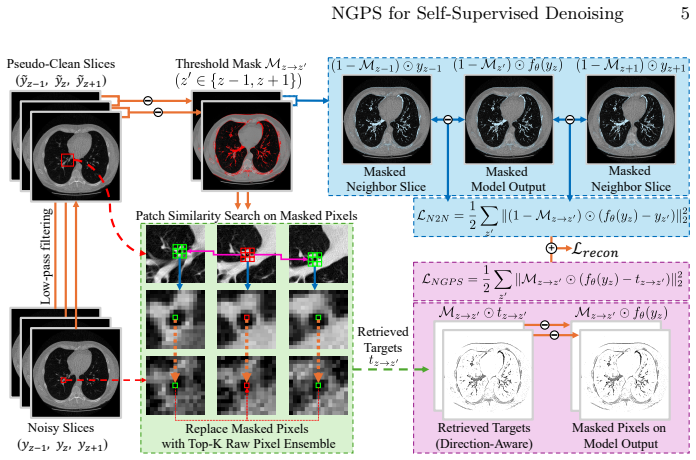
NGPS constructs local pseudo targets without a learned registration module. For each masked location, it searches a local neighborhood for structurally similar candidate patches using a simple guide image (e.g., fast bilateral filtering), while retrieving the supervision signal directly from the raw noisy neighbor at the matched coordinates.
What carries the argument
Neighbor-Guided Patch Sampling, which matches patches on a noise-attenuated guide image and retrieves raw signals from neighboring slices at matched coordinates.
If this is right
- Exploits neighboring evidence around high-frequency boundaries that would otherwise be masked.
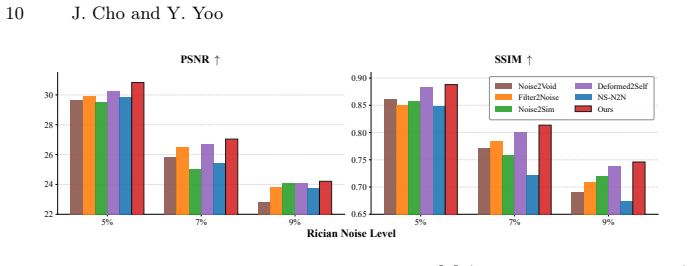
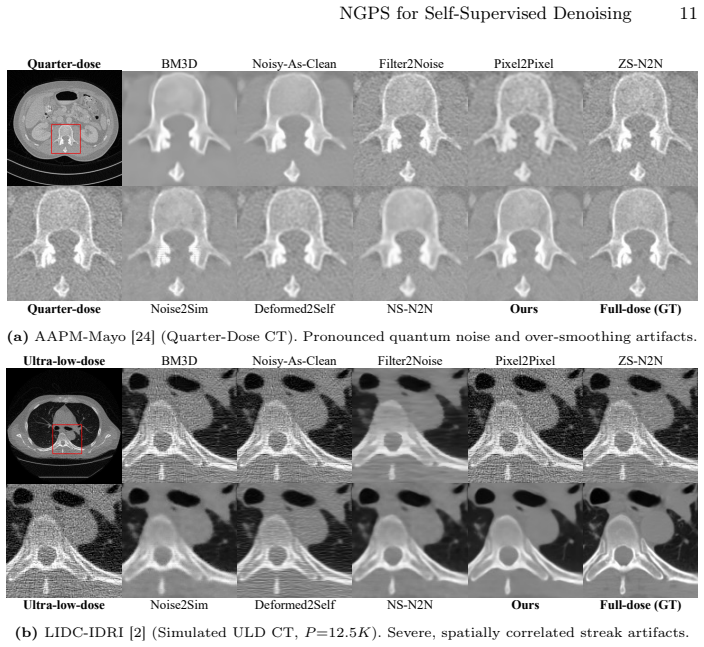
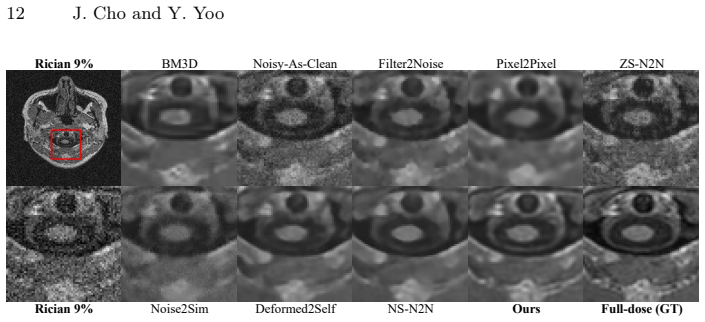
- Achieves better fidelity and structure preservation in evaluated CT and MRI settings without registration learning.
- Provides a lightweight alternative for building supervision under local misalignment.
Where Pith is reading between the lines
- The method could be tested on real clinical datasets with natural misalignments to validate the guide image assumption.
- It may inspire similar decoupling strategies in other self-supervised tasks involving misaligned data.
- Potential reduction in model complexity by avoiding registration networks.
Load-bearing premise
A simple non-learned guide image such as fast bilateral filtering is sufficient to reliably locate structurally similar patches despite noise and local misalignment.
What would settle it
A comparison where the guide image matching fails under strong misalignment and leads to lower performance than standard masking methods.
Figures
read the original abstract
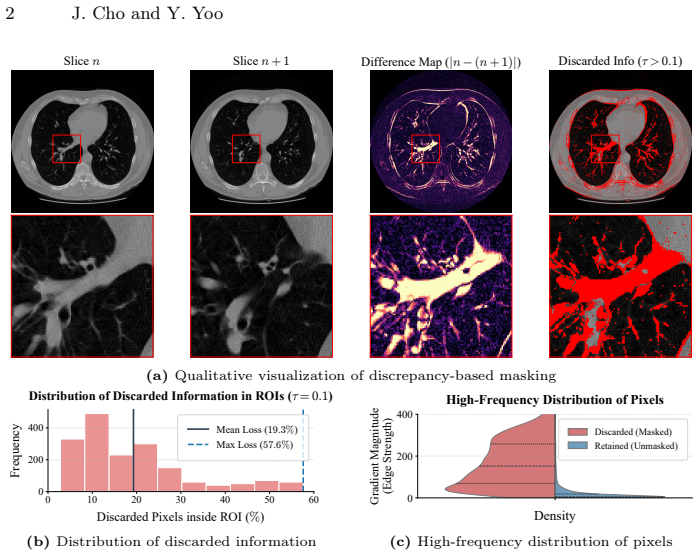
Neighboring-slice self-supervised denoising is attractive for volumetric medical imaging, yet inter-slice misalignment breaks anatomical correspondence and often yields ghosting and blurred margins when adjacent slices are used naively as targets. We propose Neighbor-Guided Patch Sampling (NGPS), a lightweight framework that constructs neighboring supervision under local inter-slice misalignment without explicit registration. To avoid learning from misleading targets, prior methods commonly mask discrepant regions, but this stabilizes training at the cost of leaving a non-trivial portion of neighboring evidence unexploited, particularly around high-frequency anatomical boundaries. NGPS addresses this by decoupling structure matching from signal retrieval: for each masked location, it searches a local neighborhood for structurally similar candidate patches using a simple guide image (e.g., fast bilateral filtering), while retrieving the supervision signal directly from the raw noisy neighbor at the matched coordinates. By matching on a noise-attenuated guide while retrieving raw values from neighboring slices, NGPS constructs local pseudo targets without a learned registration module. Across the evaluated CT and synthetic-Rician MRI settings, NGPS improves fidelity and structure-sensitive metrics. Code is available at https://github.com/cv-cho/NGPS .
Editorial analysis
A structured set of objections, weighed in public.
Referee Report
Summary. The paper introduces Neighbor-Guided Patch Sampling (NGPS), a lightweight self-supervised denoising framework for volumetric medical imaging. It addresses inter-slice misalignment by decoupling structure matching (performed on a non-learned guide image such as bilateral filtering) from raw-signal retrieval (taken directly from the noisy neighbor at matched coordinates). This avoids both explicit registration modules and the information loss from masking discrepant regions. The authors claim that NGPS yields improvements in fidelity and structure-sensitive metrics on CT and synthetic-Rician MRI data, with code released publicly.
Significance. If the experimental claims hold, NGPS would provide a practical, registration-free route to exploit neighboring-slice supervision in misaligned clinical volumes. The conceptual separation of guide-based matching from raw-value retrieval is clean and avoids learned components, which could reduce training complexity. Public code availability supports reproducibility and is a positive factor in the assessment.
major comments (1)
- [Abstract] Abstract: the central claim that 'NGPS improves fidelity and structure-sensitive metrics' across CT and synthetic-Rician MRI settings is presented without any quantitative results, baseline comparisons, ablation studies, or description of how inter-slice misalignment was simulated. This absence makes it impossible to verify whether the data support the claim and is load-bearing for the paper's contribution.
Simulated Author's Rebuttal
We thank the referee for the constructive feedback on the abstract. We agree that the central claim requires supporting quantitative detail to be verifiable from the abstract alone and will revise the manuscript accordingly.
read point-by-point responses
-
Referee: [Abstract] Abstract: the central claim that 'NGPS improves fidelity and structure-sensitive metrics' across CT and synthetic-Rician MRI settings is presented without any quantitative results, baseline comparisons, ablation studies, or description of how inter-slice misalignment was simulated. This absence makes it impossible to verify whether the data support the claim and is load-bearing for the paper's contribution.
Authors: We agree that the abstract should be self-contained and will revise it to include representative quantitative results (e.g., PSNR/SSIM gains on the evaluated CT and synthetic-Rician MRI datasets), a brief statement of the misalignment simulation protocol, and reference to the main baselines and ablations. These details already appear in Sections 4 and 5 of the manuscript; the revision will simply surface the key numbers and simulation description in the abstract itself. No other changes to the technical contribution are required. revision: yes
Circularity Check
No significant circularity
full rationale
The provided abstract and description present NGPS as a procedural framework that decouples structure matching (via a non-learned guide image) from raw-signal retrieval to construct pseudo-targets. No equations, derivations, fitted parameters, or self-citations are shown that reduce any claimed result to its inputs by construction. The method is described directly in terms of its algorithmic steps without mathematical self-reference or load-bearing prior results from the same authors. This is the expected outcome for a methods paper focused on implementation rather than theoretical derivation.
Axiom & Free-Parameter Ledger
axioms (1)
- domain assumption Local neighborhoods around corresponding locations contain structurally similar patches even under inter-slice misalignment.
Reference graph
Works this paper leans on
-
[1]
Andreozzi, E., Pirozzi, M.A., Fratini, A., Cesarelli, G., Cesarelli, M., Bifulco, P.: A novel image quality assessment index for edgeaware noise reduction in low-dose fluoroscopy: Preliminary results. In: Int. Conf. e-Health Bioeng. (EHB). pp. 1–5 (2020)
2020
-
[2]
Medical Physics38(2), 915–931 (2011)
Armato III, S.G., McLennan, G., Bidaut, L., McNitt-Gray, M.F., Meyer, C.R., Reeves, A.P., Clarke, L.P.: The lung image database consortium (lidc) and image database resource initiative (idri): A completed reference database of lung nodules on ct scans. Medical Physics38(2), 915–931 (2011)
2011
-
[3]
In: ICML
Batson, J., Royer, L.: Noise2self: Blind denoising by self-supervision. In: ICML. pp. 524–533 (2019)
2019
-
[4]
org/ixi-dataset/(2018)
Biomedical Image Analysis Group: IXI dataset.https://brain- development. org/ixi-dataset/(2018)
2018
-
[5]
In: CVPR
Buades, A., Coll, B., Morel, J.M.: A non-local algorithm for image denoising. In: CVPR. vol. 2, pp. 60–65 (2005)
2005
-
[6]
Cesarelli, M., Bifulco, P., Cerciello, T., Romano, M., Paura, L.: X-ray fluoroscopy noise modeling for filter design. Int. J. Comput. Assist. Radiol. Surg.8(2), 269–278 (2013)
2013
-
[7]
Chambolle, A.: An algorithm for total variation minimization and applications. J. Math. Imaging Vis.20(1), 89–97 (2004)
2004
-
[8]
Imaging36(12), 2524–2535 (2017)
Chen, H., Zhang, Y., Kalra, M.K., Lin, F., Chen, Y., Liao, P., Wang, G.: Low-dose ctwitharesidualencoder-decoderconvolutionalneuralnetwork.IEEETrans.Med. Imaging36(12), 2524–2535 (2017)
2017
-
[9]
In: European Conference on Computer Vision
Chen, L., Chu, X., Zhang, X., Sun, J.: Simple baselines for image restoration. In: European Conference on Computer Vision. pp. 17–33. Springer (2022)
2022
-
[10]
IEEE TIP16(8), 2080–2095 (2007)
Dabov, K., Foi, A., Katkovnik, V., Egiazarian, K.: Image denoising by sparse 3-d transform-domain collaborative filtering. IEEE TIP16(8), 2080–2095 (2007)
2080
-
[11]
arXiv preprint arXiv:2504.00264 (2025)
Demir, B., Liu, Y., Chen, X., Chen, E.Z., Zhao, L., Mailhe, B., Sun, S.: Diffdenoise: self-supervised medical image denoising with conditional diffusion models. arXiv preprint arXiv:2504.00264 (2025)
arXiv 2025
-
[12]
Advances in neural information processing systems33, 16293–16303 (2020)
Fadnavis, S., Batson, J., Garyfallidis, E.: Patch2self: Denoising diffusion mri with self-supervised learning. Advances in neural information processing systems33, 16293–16303 (2020)
2020
-
[13]
Fourati, W., Kammoun, F., Bouhlel, M.S.: Medical image denoising using wavelet thresholding. J. Test. Eval.33(5), 364–369 (2005)
2005
-
[14]
In: CVPR
Huang, T., Li, S., Jia, X., Lu, H., Liu, J.: Neighbor2neighbor: Self-supervised de- noising from single noisy images. In: CVPR. pp. 14781–14790 (2021)
2021
-
[15]
IEEE Trans
Jeon, S.Y., Wang, S., Wang, A.S., Gold, G.E., Choi, J.H.: Unsupervised training of a dynamic context-aware deep denoising framework for low-dose fluoroscopic imaging. IEEE Trans. Instrum. Meas. (2025)
2025
-
[16]
In: CVPR
Krull, A., Buchholz, T.O., Jug, F.: Noise2void-learning denoising from single noisy images. In: CVPR. pp. 2129–2137 (2019)
2019
-
[17]
Biomedical Signal Processing and Control38, 74–85 (2017)
Lee, M.S., Park, S.W., Lee, S.Y., Kang, M.G.: Motion-adaptive 3d nonlocal means filter based on stochastic distance for low-dose x-ray fluoroscopy. Biomedical Signal Processing and Control38, 74–85 (2017)
2017
-
[18]
In: ICML
Lehtinen, J., Munkberg, J., Hasselgren, J., Laine, S., Karras, T., Aittala, M., Aila, T.: Noise2Noise: Learning image restoration without clean data. In: ICML. pp. 2971–2980 (2018) 16 J. Cho and Y. Yoo
2018
-
[19]
IEEE Trans
Li, M., Hsu, W., Xie, X., Cong, J., Gao, W.: Sacnn: Self-attention convolutional neural network for low-dose ct denoising with self-supervised perceptual loss net- work. IEEE Trans. Med. Imaging39(7), 2289–2301 (2020)
2020
-
[20]
IEEE Trans
Luo,Y.,Majoe,S.,Kui,J.,Qi,H.,Pushparajah,K.,Rhode,K.:Ultra-densedenois- ing network: application to cardiac catheter-based x-ray procedures. IEEE Trans. Biomed. Eng.68(9), 2626–2636 (2020)
2020
-
[21]
IEEE TPAMI47(6), 4614–4629 (2025)
Ma, Q., Jiang, J., Zhou, X., Liang, P., Liu, X., Ma, J.: Pixel2Pixel: A pixelwise approach for zero-shot single image denoising. IEEE TPAMI47(6), 4614–4629 (2025)
2025
-
[22]
Manjon,J.V.,Carbonell-Caballero,J.,Lull,J.J.,Garcia-Marti,G.,Marti-Bonmati, L., Robles, M.: Mri denoising using non-local means. Med. Image Anal.12(4), 514– 523 (2008)
2008
-
[23]
In: Proceedings of the IEEE/CVF Conference on Computer Vision and Pattern Recognition (CVPR)
Mansour, Y., Heckel, R.: Zero-Shot Noise2Noise: Efficient image denoising without any data. In: Proceedings of the IEEE/CVF Conference on Computer Vision and Pattern Recognition (CVPR). pp. 14018–14027 (2023)
2023
-
[24]
Medical Physics44(10), e339–e352 (2017)
McCollough, C.H., Bartley, A.C., Carter, R.E., Chen, B., Drees, T.A., Edwards, P., Fletcher, J.G.: Low-dose ct for the detection and classification of metastatic liver lesions: Results of the 2016 low dose ct grand challenge. Medical Physics44(10), e339–e352 (2017)
2016
-
[25]
IEEE Trans
Niu, C., Li, M., Fan, F., Wu, W., Guo, X., Lyu, Q., Wang, G.: Noise suppression with similarity-based self-supervised deep learning. IEEE Trans. Med. Imaging 42(6), 1590–1602 (2023)
2023
-
[26]
IEEE Trans
Ravishankar, S., Bresler, Y.: Mr image reconstruction from highly undersampled k-space data by dictionary learning. IEEE Trans. Med. Imaging30(5), 1028–1041 (2011)
2011
-
[27]
In: MICCAI
Ronneberger, O., Fischer, P., Brox, T.: U-net: Convolutional networks for biomed- ical image segmentation. In: MICCAI. pp. 234–241 (2015)
2015
-
[28]
Biomedical Signal Processing and Control61, 102036 (2020)
Sagheer, S.V.M., George, S.N.: A review on medical image denoising algorithms. Biomedical Signal Processing and Control61, 102036 (2020)
2020
-
[29]
Siddiqui, M.S.R., Eliasof, M., Haber, E.: Graph flow matching: Enhancing image generationwithneighbor-awareflowfields.In:ProceedingsoftheAAAIConference on Artificial Intelligence. vol. 40, pp. 25463–25471 (March 2026)
2026
-
[30]
arXiv preprint arXiv:2504.13519 (2025)
Sun, Y., Schneider, L.S., Mei, S., Wang, J., Hu, G., Gu, M., Ye, C., Wagner, F., Song, L., Bayer, S., Maier, A.: Filter2Noise: Interpretable self-supervised single- image denoising for low-dose ct with attention-guided bilateral filtering. arXiv preprint arXiv:2504.13519 (2025)
arXiv 2025
-
[31]
In: CVPR
Ulyanov, D., Vedaldi, A., Lempitsky, V.: Deep image prior. In: CVPR. pp. 9446– 9454 (2018)
2018
-
[32]
IEEE TIP13(4), 600–612 (2004)
Wang, Z., Bovik, A.C., Sheikh, H.R., Simoncelli, E.P.: Image quality assessment: From error visibility to structural similarity. IEEE TIP13(4), 600–612 (2004)
2004
-
[33]
In: CVPR
Wang, Z., Liu, J., Li, G., Han, H.: Blind2unblind: Self-supervised image denoising with visible blind spots. In: CVPR. pp. 2027–2036 (2022)
2027
-
[34]
Nature Methods15(12), 1090–1097 (2018)
Weigert, M., Schmidt, U., Boothe, T., Müller, A., Dibrov, A., Jain, A., Wilhelm, B., Schmidt, D., Broaddus, C., Culley, S., Rocha-Martins, M., Segovia-Miranda, F., Norden, C., Henriques, R., Zerial, M., Solimena, M., Rink, J., Tomancak, P., Royer, L., Jug, F., Myers, E.W.: Content-aware image restoration: pushing the limits of fluorescence microscopy. Nat...
2018
-
[35]
In: Advances in Neural Information Processing Systems (NeurIPS)
Xie, Y., Wang, Z., Ji, S.: Noise2same: Optimizing a self-supervised bound for im- age denoising. In: Advances in Neural Information Processing Systems (NeurIPS). vol. 33, pp. 20320–20330 (2020) NGPS for Self-Supervised Denoising 17
2020
-
[36]
In: MICCAI
Xu, J., Adalsteinsson, E.: Deformed2Self: Self-supervised denoising for dynamic medical imaging. In: MICCAI. pp. 25–35 (2021)
2021
-
[37]
IEEE TIP29, 9316–9329 (2020)
Xu, J., Huang, Y., Cheng, M.M., Liu, L., Zhu, F., Xu, Z., Shao, L.: Noisy-as-clean: Learning self-supervised denoising from corrupted image. IEEE TIP29, 9316–9329 (2020)
2020
-
[38]
IEEE TIP23(2), 684–695 (2014)
Xue, W., Zhang, L., Mou, X., Bovik, A.C.: Gradient magnitude similarity devia- tion: A highly efficient perceptual image quality index. IEEE TIP23(2), 684–695 (2014)
2014
-
[39]
IEEE TIP26(7), 3142–3155 (2017)
Zhang, K., Zuo, W., Chen, Y., Meng, D., Zhang, L.: Beyond a gaussian denoiser: Residual learning of deep cnn for image denoising. IEEE TIP26(7), 3142–3155 (2017)
2017
-
[40]
IEEE TIP20(8), 2378–2386 (2011)
Zhang, L., Zhang, L., Mou, X., Zhang, D.: FSIM: A feature similarity index for image quality assessment. IEEE TIP20(8), 2378–2386 (2011)
2011
-
[41]
Zhou, L., Zhou, Z., Huang, X., Wang, H., Zhang, X., Li, G.: Neighboring Slice Noise2Noise: Self-supervised medical image denoising from single noisy image vol- ume. arXiv preprint arXiv:2411.10831 (2024) 18 Supplementary Material S1 Detailed Implementation Details Algorithm S1Neighbor-Guided Patch Sampling (NGPS) Input:Noisy volumey∈R H×W×D, Denoiserf θ P...
arXiv 2024
discussion (0)
Sign in with ORCID, Apple, or X to comment. Anyone can read and Pith papers without signing in.