REVIEW 2 major objections 6 minor 2 references
Interpretability in Deep Time Series Models Demands Semantic Alignment
T0 review · 2 major / 6 minor · reviewed 2026-08-03 · deepseek-v4-flash
Pith's one-line read Time series AI is interpretable only when it thinks in human concepts
desk verdict A genuinely useful position paper on semantic alignment for time series, but Eq. (5) is secretly a determinism assumption that the authors never flag. read the letter →
The pith
A machine-rendered reading of the paper's core claim, the machinery that carries it, and where it could break.
The reading
What carries the argument
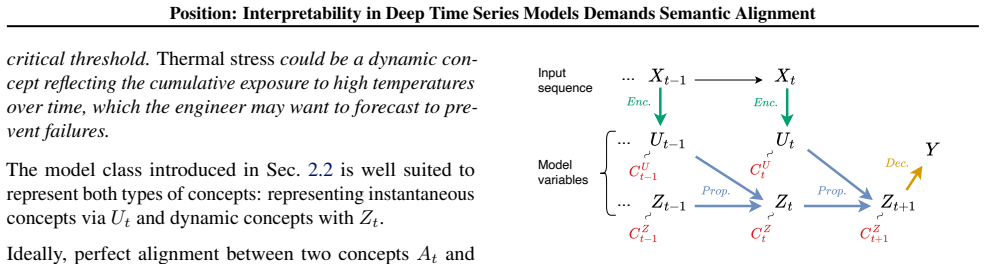
Definition 1 (semantic alignment of concepts) is the load-bearing object: it requires P(Ut=CUt|X≤t)=1 and P(Zt+1=CZt+1|X≤t)=1, turning 'interpretable' into a probabilistic equality between model variables and human concepts rather than a human judgment about explanations. The temporal clause—that alignment must be preserved one step ahead under propagation—is what distinguishes the time-series setting from static concept-bottleneck models. Definition 2 (semantic alignment of mechanisms) makes mechanism interpretability a constraint-satisfaction problem: a mechanism is aligned if its conditional distribution belongs to the user-specified admissible set. Together these definitions provide the
What would settle it
In a real forecasting application, ask domain experts to label the intended concept (say, 'thermal stress') at many timesteps and test whether experts agree with each other and with their own past labels, and whether a model whose states align at time t continues to align at t+1. If experts' labels drift or agree poorly, the probabilistic equality in Definition 1 cannot be satisfied; if a model that fails the equality is still judged interpretable by its users, the definition is too strong.
Extended reading notes
Core claim
The paper's central claim is a definition. A deep time series model is semantically aligned when (i) the encoder's representations Ut equal instantaneous human concepts CUt with probability one given the observed past, and (ii) the propagated state Zt+1 equals the dynamic concept CZt+1 with probability one given the observed past. The second condition—preservation of alignment under temporal evolution—is the constraint with no analogue in static settings; without it, a representation that matches the intended concept at time t can silently become an unrelated concept at time t+1. The paper pairs this with a definition of mechanism alignment: a mechanism is aligned when the conditional distri
Load-bearing premise
The load-bearing premise is that human reasoning about a domain can be modeled as random variables whose semantics remain stable over time, so that 'does the model's state equal the human concept?' is a well-defined yes/no question at every step.
Editorial extensions
If this is right
- Users can intervene on aligned models in concept space: correcting a concept value at time t updates all future concept estimates, enabling temporally consistent counterfactuals and targeted mechanism repair without retraining.
- Aligned concepts enable formal verification (model checking) and fairness analysis, because internal states correspond to explicit domain-relevant properties that can be checked and traced over time.
- Omitting the propagation supervision term allows concept drift: per-step concept accuracy is not enough to keep alignment from decaying as the model steps forward.
- Residual pathways that process unconstrained representations in parallel with the concept space let semantically aligned models retain the expressivity of black boxes, so interpretability and accuracy need not trade off.
- By the paper's own comparison table, existing paradigms—attention, saliency, surrogates, counterfactuals, prototypes, linearized dynamics, and most physics-informed or symbolic models—fail at least one of the two alignment conditions, so none of them qualifies as making time series models semantically interpretable.
Reading between the lines
- A practical corollary the paper does not spell out: alignment can be measured continuously, for example as the expected distance between model states and expert-labelled concept trajectories, so the definition could be turned into a benchmark metric rather than a yes/no criterion.
- The assumption of temporally stable concept semantics is likely the practical bottleneck; in domains with regime shifts, concepts like 'recession' or 'overheating' change meaning, so Definition 1 would require explicitly modelling concept drift, not just model dynamics.
- The intervention story (correct a concept value and roll the dynamics forward) presupposes that learned propagation mechanisms are causal, not merely predictive; enforcing alignment of conditional distributions may not be enough for genuine counterfactual reasoning.
- By making interpretability a property of the model rather than the explanation, the definition shifts research effort from post-hoc analysis to annotation: scalable collection of expert concept labels over time becomes the enabling resource, possibly via automated or language-model-assisted annotation workflows.
Signed reviews
Editorial analysis
A structured set of objections, weighed in public.
Referee Report
Summary. The paper is a position paper arguing that interpretability of deep time series models should be defined by semantic alignment (SA): internal variables and mechanisms should correspond to human-meaningful concepts, and this correspondence must be preserved under temporal evolution. It formalizes SA in Definition 1 (concepts) and Definition 2 (mechanisms), proposes a blueprint extending concept bottleneck models to time series via source concepts, temporal and spatio-temporal propagation mechanisms, and a three-term training objective, and discusses implications for trust, intervention, counterfactuals, and interaction with symbolic knowledge. An extended appendix reviews existing post-hoc and intrinsic interpretability paradigms and classifies them against SA.
Significance. If the central formal notion were fully operational, the paper would make a useful contribution: it isolates semantic from structural opacity in a time-series context, introduces a temporal invariance requirement absent from static concept-based models, and offers a concrete architectural template. The writing is clear and the literature review is broad; Table 1 is a useful synthesis. As a position paper, it does not provide empirical demonstrations, and several statements are explicitly speculative; that is appropriate for the genre. The value of the paper currently hinges on whether Definition 1 can be made to apply to the probabilistic settings the paper itself motivates. With that repair, the paper would be a good anchor for future work.
major comments (2)
- [Sec. 3.2, Definition 1, Eq. (5)] The definition requires C^Z_{t+1} to be σ(X≤t)-measurable and P(Z_{t+1}=C^Z_{t+1}|X≤t)=1 a.s. Combined with the model class in Eq. (2), where Z_{t+1} is computed from X≤t, this forces every dynamic concept to be an a.s. deterministic function of the observed past. But Sec. 3.1 defines concepts as general stochastic processes, and the motivating applications (physiological or financial signals with noise or unobserved drivers) have dynamic concepts with irreducible aleatoric uncertainty given X≤t. For such concepts, P(Z_{t+1}=C^Z_{t+1}|X≤t)<1 for every model in the class, so Definition 1 is not operational for the very probabilistic forecasting problems the paper sets up in Sec. 2.1. Observation 3.1 addresses only temporal stability of semantics, not σ(X≤t)-measurability. Please either restate alignment distributionally (e.g., P(Z_{t+1}|X≤t)=P(C^Z_{t+1}|X≤t)) or explicitly restrict Defini
- [Sec. 3.2, Definition 2] Definition 2 is a placeholder: it asserts P(V|V') ∈ M^h_{V|V'}, but M^h_{V|V'} is not constructed, verified, or exemplified. As written, any mechanism can be declared aligned for a suitable choice of M^h, so the definition carries no formal content and cannot be falsified. The surrounding text says human knowledge often specifies only constraints, but it does not say how those constraints become M^h. The paper should either specify a concrete construction (e.g., M^h as the set of distributions satisfying a list of monotonicity, sparsity, or physics constraints) or explicitly state that Definition 2 is a schema to be instantiated per domain. As it stands, the claimed separation of variable alignment and mechanism alignment is not yet a definition.
minor comments (6)
- [Sec. 4.3] The loss equation uses L_spatial and L_temporal, but the bullets define L_concept and L_prop. The notation should be harmonized.
- [Observation 3.1] The sentence 'This is not a limitation' is too strong; stable semantics is a substantive assumption. It should be phrased as an explicit assumption, and the relaxation mentioned should be described as a limitation.
- [Sec. 2.2] The text says U_t and Z_t are realizations of stochastic processes, but Eqs. (1)-(2) present them as deterministic functions of x≤t. Please clarify whether stochasticity comes only from the input process or also from model-internal randomness.
- [Sec. 3.2] The assertion that omitting Eq. (5) 'could lead the SA to decay exponentially over time' is unsubstantiated. If it is a conjecture, mark it as such; if it is a theorem, provide a statement and proof sketch.
- [Table 1] The legend uses ✓/∼/✗ but the criteria for 'partially satisfies' are not defined. Add a sentence or footnote explaining how partial satisfaction is judged.
- [Definition 1] The phrase 'aligned with C^U_t and C^Z_t, respectively' could be ambiguous because condition (ii) uses C^Z_{t+1}; consider aligning the notation consistently.
Circularity Check
No circularity: semantic alignment is defined relative to external human concepts and the blueprint is supervised from those concepts; self-citations are background only.
full rationale
This is a position paper, not a derivation with fitted parameters or empirical predictions. The central Definition 1 (Eqs. 4–5) ties interpretability to equality with externally specified human concepts C^U_t and C^Z_{t+1}; the subsequent blueprint (Sec. 4.3) enforces this via supervision L_concept and L_prop, which is the opposite of internal circularity. The paper does not claim to predict anything from its own definitions: the temporal condition (Eq. 5) is introduced as a normative requirement ('must be preserved under temporal evolution'), not derived from Eq. (4). The cited prior work by the same authors (e.g., Barbiero et al. 2025, De Felice et al. 2025, Dominici et al. 2025) appears only as context or as independent support for concept-based models and is not load-bearing for the definition. There is a genuine formal-scope concern, correctly identified by the skeptic: Definition 1 assumes C^Z_{t+1} is σ(X≤t)-measurable and demands P(Z_{t+1}=C^Z_{t+1}|X≤t)=1 a.s., which is unsatisfiable for stochastic dynamic concepts. But that is a limitation and operationality issue, not circularity: it does not make the definition's output equivalent to its input. Observation 3.1's claim that stable semantics 'is not a limitation' is an acknowledged assumption, not a hidden circular step. Therefore no circular step can be quoted and exhibited; score 0.
Assumptions & free parameters
assumptions (4)
- domain assumption Human reasoning can be formalized as operating over random variables (concepts).
- domain assumption The semantics of human concepts remain consistent over time.
- domain assumption The model's latent variables (Ut, Zt) exist as stochastic processes.
- domain assumption Concept annotations can be obtained at sufficient scale.
Cite this review
Pith. "Pith review of Interpretability in Deep Time Series Models Demands Semantic Alignment." pith.science (2026). https://pith.science/paper/WWZJFNVV
@misc{pith2026260202239,
  author       = {Pith},
  title        = {Pith review of: Interpretability in Deep Time Series Models Demands Semantic Alignment},
  year         = {2026},
  howpublished = {\url{https://pith.science/paper/WWZJFNVV}},
  note         = {Machine review of arXiv:2602.02239}
}
read the original abstract
Deep time series models continue to improve predictive performance, yet their deployment remains limited by their black-box nature. In response, existing interpretability approaches in the field keep focusing on explaining the internal model computations, without addressing whether they align or not with how a human would reason about the studied phenomenon. Instead, we state interpretability in deep time series models should pursue semantic alignment: predictions should be expressed in terms of variables that are meaningful to the end user, mediated by spatial and temporal mechanisms that admit user-dependent constraints. In this paper, we formalize this requirement and state that, once established, semantic alignment must be preserved under temporal evolution: a constraint with no analog in static settings. Provided with this definition, we outline a blueprint for semantically aligned deep time series models, identify properties that support trust, and discuss implications for model design.
Figures


Reference graph
Works this paper leans on
-
[2024]
From a semantic alignment perspective, this introduces an additional failure mode compared to feature attribution methods
fall into this category. From a semantic alignment perspective, this introduces an additional failure mode compared to feature attribution methods. Not only are explanations expressed in terms of input-level features or latent representations rather than domain-level concepts, but they are also mediated by an approximate model that effectively adds an add...
2021
-
[2025]
Accessed: 2026-01-29. Guidotti, R., Monreale, A., Spinnato, F., Pedreschi, D., and Giannotti, F. Explaining any time series classifier. In 2020 IEEE second international conference on cognitive machine intelligence (CogMI), pp. 167–176. IEEE, 2020. Hauser, M., Gunn, S., Saab Jr, S., and Ray, A. State-space representations of deep neural networks.Neural co...
arXiv 2026
Reviewed August 3, 2026 · model on record in the stance chip above.
Discussion (0). Continue with ORCID to comment.