REVIEW 2 major objections 5 minor 37 references
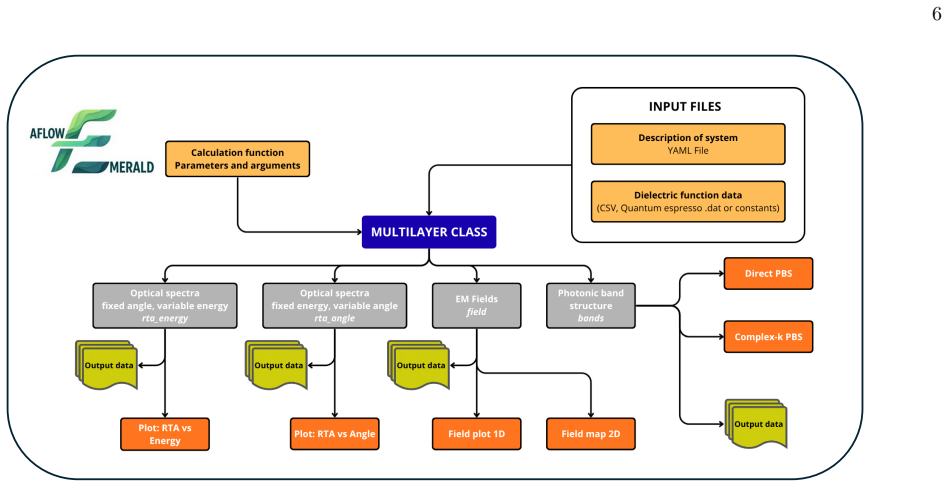
AFLOW-EMERALD: ElectroMagnetic modes EngineeRing in Advanced LayereD materials
T0 review · 2 major / 5 minor · reviewed 2026-08-15 · deepseek-v4-flash
Pith's one-line read The paper presents an open-source electromagnetic solver that computes optical spectra, field maps, and complex-k photonic band structures of layered metamaterials within one framework.
desk verdict A genuinely useful open-source tool for layered metamaterial simulations, with one load-bearing assumption (Eq. 24) that needs a derivation or a caveat before the mode-labeling claims can be trusted. read the letter →
The pith
A machine-rendered reading of the paper's core claim, the machinery that carries it, and where it could break.
The reading
What carries the argument
The machinery is the scattering-matrix method with auxiliary zero-thickness vacuum gaps inserted between physical layers, giving each layer a self-contained scattering matrix; the layer matrices are cascaded through the star product into a global S-matrix. Plane-wave expansion treats the infinite periodic problem, and for absorbing dispersive media the code uses an inverse-dispersion, complex-k formulation that solves for $\beta_z$ at fixed frequency instead of solving for frequency at fixed wavevector. Laterally patterned layers enter through rigorous coupled-wave analysis, which expands fields and permittivity in Floquet-Bloch harmonics, and the finite-stack mode selector is the quantization rule $k_z = \ell\pi/(N\Lambda_z)$, whose isolines are drawn over the band-structure map to mark excitable resonances.
What would settle it
A concrete check is to take Ag/TiO2 stacks with $N=2,4,6,8$ periods, compute full-field magnetic profiles at the energies where the quantization rule predicts resonance crossings, and count the field nodes inside the stack. If the node counts do not follow the predicted mode order, or if the predicted crossings do not line up with dips in the reflectance spectrum, the quantization rule is the point of failure.
Extended reading notes
Core claim
The central discovery claimed is that a single modular implementation can treat finite and infinite layered structures on equal footing: the scattering-matrix method gives numerically stable reflectance, transmittance, absorptance, and field maps for realistic finite stacks, while plane-wave expansion, extended to a complex-k inverse-dispersion formulation, gives the Bloch modes of the corresponding infinite periodic medium. The two sides are connected by a finite-stack quantization condition, $k_z = \ell\pi/(N\Lambda_z)$ for $\ell=1,\dots,N$, which selects which Bloch modes a stack of $N$ periods can actually support. Overlaying these $k_z$ isolines with the in-plane momenta supplied by a grating labels each resonance, for instance identifying a reflectance dip as a volume plasmon-polariton of a given order, and the field profiles confirm the mode order by the number of nodes. The paper argues that with this link, spectra, near-field maps, and band dispersion form one interpretable description for designing layered metamaterial devices.
Load-bearing premise
The load-bearing premise is that in a finite stack of $N$ periods the allowed longitudinal wavevectors are exactly the discrete values $k_z = \ell\pi/(N\Lambda_z)$ for $\ell=1,\dots,N$; the paper states this rule without derivation and uses it to label which resonances are excited and what order they have. If the rule is approximate, the mode assignments would be wrong even if every computed spectrum were correct.
Editorial extensions
If this is right
- Finite multilayer spectra can be computed without the exponential instability of transfer-matrix methods, even when layers are thick, lossy, or strongly impedance-mismatched.
- Complex-k band maps with grating harmonics and $k_z$ isolines overlaid identify which surface and volume plasmon-polariton modes a given finite stack can excite and assign each mode an order.
- Because material data can be imported from experiment, literature, or first-principles calculations through a simple YAML workflow, the same geometry can be tested with different dielectric models.
- Angle-resolved reflectance reproduces the measured surface-plasmon resonance angle for the air/silver interface, supporting use of the code for experimental design.
- Released as open-source, modular software, the solver is positioned for integration into larger design pipelines for photonic crystals, plasmonic multilayers, and hyperbolic metamaterials.
Reading between the lines
- A natural test beyond the paper's examples is to compare the predicted mode orders from the quantization rule against full-field node counts across different numbers of periods; this would reveal whether the rule is exact or merely a convenient approximation.
- The same framework could be extended to anisotropic, magneto-optical, or nonlinear layers by replacing the scalar permittivity with a tensor or field-dependent response, which the modular architecture appears to allow.
- The reported speed of about 0.03 seconds per energy point suggests a high-throughput screening use that the paper does not yet demonstrate.
- The isoline-plus-grating-harmonic picture offers an inverse-design route: tune grating period, filling factor, and stack thickness so that a chosen grating harmonic crosses a chosen $k_z$ isoline at the target energy.
Signed reviews
Editorial analysis
A structured set of objections, weighed in public.
Referee Report
Summary. The manuscript describes AFLOW-EMERALD, an open-source Python/MATLAB package for simulating electromagnetic propagation in finite and periodic layered structures. The code combines a scattering-matrix method (SMM) with rigorous coupled-wave analysis (RCWA) for laterally patterned systems and plane-wave expansion (PWE) with a complex-k formulation for photonic bandstructures of dispersive, lossy media. A YAML workflow imports dielectric data from experimental, literature, or first-principles sources. The paper presents three examples: a TiO2/SiO2 photonic crystal (RTA spectra and bands), a Ag/TiO2 hyperbolic metamaterial with a grating coupler (RTA, fields, complex-k bands), and an air/Ag surface plasmon polariton (angle-resolved reflectance compared with experiment). The finite-stack mode identification relies on a proposed resonance quantization rule, Eq. (24), which is used to overlay volume-plasmon-polariton (VPP) mode isolines and to label mode orders in the field profiles.
Significance. If the implementation is correct, AFLOW-EMERALD would be a practically useful open-source tool that connects realistic finite-stack optics with infinite-periodic bandstructure analysis, including complex-k dispersion in lossy media. The paper's strengths include the modular architecture, the use of external dielectric datasets with no parameter fitting, the demonstration of a Kretschmann SPP reflectance minimum that matches experimental data, and the public availability of the code. The main advertised capabilities beyond standard RTA, however, rest on the finite-stack quantization rule of Eq. (24), which is asserted without derivation or validation, and the paper lacks independent benchmarks for the RCWA, PWE, and complex-k solvers. These gaps are significant because the central claim is that the released code reliably supports material-geometry co-design.
major comments (2)
- [Section IV.B.4, Eq. (24) and Section V.D] The finite-stack quantization rule is introduced without derivation or citation and contains an indexing inconsistency. Eq. (24) states k_z = ℓπ/(NΛ_z) for ℓ = 1,...,N, but the surrounding text and Figure 7b refer to "first five k_z resonance values (m = 0–4)" for N = 6, with "mode index m ranging from 0 to N–1." These two prescriptions are different: Eq. (24) excludes m = 0 and includes ℓ = N, whereas the text and figure exclude ℓ = N and include m = 0. Moreover, for the lossy, dispersive Ag/TiO2 system used in Section V.D, k_z is complex; the real-part isolines given by Eq. (24) need not coincide with the actual resonances of a finite stack. In the lossless case, the finite-stack condition is sin(N k_z Λ_z) = 0, which gives real k_z = mπ/(NΛ_z) for integer m, not the set in Eq. (24). Because this rule is used to overlay the VPP isolines in Figure 7b and to label the mode in Figure 6b as a first-order VPP, the advertised "which mode is excited" analysis is not reliable as presented. The authors should provide a derivation or correct the condition, fix the indexing, and demonstrate with RTA spectra and field profiles that the isolines track the resonances in the lossy case.
- [Section V and Section IV.C] The external validation is limited to a single experimental comparison: the air/Ag SPP reflectance dip at one angle and energy in Figure 5. No analytic benchmark (e.g., Fresnel reflection from a single slab), no independent-solver comparison for the RCWA grating calculation or the complex-k PWE bandstructure, and no convergence study with respect to the plane-wave truncation parameter (halfnpw) are provided. The performance claims in Section IV.C (0.03 s per energy point, 10–100 minutes for 2D PBS maps, up to one order-of-magnitude GPU speedup, memory below 1–2 GB) are stated without hardware details, basis sizes, or convergence criteria. For a software paper whose central claim is that the released code correctly and stably implements these solvers for design use, these gaps should be filled: analytic checks, comparisons with established codes or published grating efficiencies, and convergence tests with respect to basis size.
minor comments (5)
- [Figure 7 caption] The word "Bruillouin" in the inset label is misspelled; it should be "Brillouin."
- [Section IV.B.4] The text says "For a stack of N layers," but Section V.D uses N = 6 bilayers (periods). Clarify whether N is the number of periods or the number of individual layers, since Eq. (24) depends on this distinction through Λ_z.
- [Section IV.C] For reproducibility, the performance measurements should specify the processor, memory, MATLAB engine version, and the convergence criterion used to select the plane-wave basis size in each reported timing.
- [Section IV.A] The interpolation of dielectric-function data is described only as "polynomial interpolation"; specify the polynomial order and the treatment of data points outside the supplied energy range.
- [Data and Code Availability] The repository is given as a GitHub URL without a version tag or DOI; a versioned release would improve reproducibility of the specific results shown in the manuscript.
Circularity Check
No circularity: the SMM/PWE/RCWA implementation is derived from Maxwell's equations with external dielectric data and validated against external experiments; the only questionable assumption (Eq. 24) is a non-circular modeling rule.
full rationale
AFLOW-EMERALD's central outputs (RTA spectra, field profiles, complex-k bands) do not reduce to their inputs by construction. No parameter is fitted to a target spectrum: the dielectric functions of TiO2, SiO2, Ag, and Au come from literature/experimental sources (Refs. 32, 33, 35, 37), and the SPP validation compares computed reflectance to experimental data (Ref. 36). The complex-k bandstructure uses a standard inverse-dispersion PWE formulation (Refs. 27, 28) rather than a self-derived uniqueness theorem. Self-citation [18] appears only as an example application ('The code has been successfully used for a broad class of systems... [18]') and is not used to justify the accuracy of the solvers; it is not load-bearing. Eq. (24), the finite-stack quantization k_z = l*pi/(N*Lambda_z), is introduced without derivation or citation and is used to overlay VPP isolines in Fig. 7b and to discuss mode order; however, this is an unverified modeling assumption, not a circular step. The RTA spectra and field profiles that define the resonances are computed by the SMM independently of Eq. (24), so the mode labels are not statistically forced by a fitted parameter. The indexing mismatch (Eq. 24 says l=1,...,N while the text says m=0,...,N-1) is an internal correctness concern, not circularity. Therefore the derivation chain is self-contained and no circular reduction is exhibited.
Assumptions & free parameters
assumptions (6)
- standard math Maxwell's equations in the frequency domain with harmonic time dependence e^{-i omega t}
- standard math Bloch's theorem: fields and dielectric function are periodic in-plane and expanded as Fourier series
- domain assumption The scattering-matrix construction with auxiliary zero-thickness vacuum gaps yields neighbor-independent, stable layer scattering matrices
- domain assumption The inverse-dispersion complex-k method, solving at fixed frequency with a Bloch wavevector component as eigenvalue, correctly handles dispersive and absorbing media
- ad hoc to paper Finite-stack resonance quantization rule, Eq. (24), k_z = l*pi/(N*Lambda_z)
- domain assumption Truncation of the plane-wave basis at a finite number of harmonics yields converged and correct spectra
Cite this review
Pith. "Pith review of AFLOW-EMERALD: ElectroMagnetic modes EngineeRing in Advanced LayereD materials." pith.science (2026). https://pith.science/paper/WX2HHIUR
@misc{pith2026260803759,
  author       = {Pith},
  title        = {Pith review of: AFLOW-EMERALD: ElectroMagnetic modes EngineeRing in Advanced LayereD materials},
  year         = {2026},
  howpublished = {\url{https://pith.science/paper/WX2HHIUR}},
  note         = {Machine review of arXiv:2608.03759}
}
read the original abstract
Layered and periodically patterned heterostructures underpin advanced optical, photonic, and plasmonic (meta)materials, whose rational design demands electromagnetic solvers that are both numerically robust and tightly linked to the underlying material properties. Here, we present AFLOW-EMERALD (ElectroMagnetic modes EngineeRing in Advanced LayereD materials), an open-source, modular, Python-based computational framework for simulating electromagnetic wave propagation in finite and periodic layered (meta)materials. Built around a unified object-oriented architecture, AFLOW-EMERALD combines a numerically stable scattering-matrix method with plane-wave expansion and extends to rigorous coupled-wave analysis for laterally patterned structures such as gratings. The software computes optical spectra, spatial field distributions, and photonic band structures, including complex-k dispersion in lossy, dispersive media. A streamlined YAML workflow allows users to seamlessly import dielectric function datasets from experimental, literature, or first-principles sources. Owing to its modular design, AFLOW-EMERALD is readily extensible and suitable for integration into computational materials-design pipelines, providing a practical platform for the coupled material-geometry engineering of dielectric photonic crystals, plasmonic multilayers, hyperbolic metamaterials, and more complex architectures supporting, e.g., surface and volume plasmon-polariton modes.
Figures


Figures from the paper (4 more)


Reference graph
Works this paper leans on
-
[1]
Shamim, A
S. Shamim, A. S. Mohsin, M. M. Rahman, and M. B. H. Bhuian,Recent advances in the metamaterial and metasurface-based biosensor in the gigahertz, tera- hertz, and optical frequency domains, Heliyon10, e33272 (2024)
2024
-
[2]
D. Lee, W. W. Chen, L. Wang, Y.-C. Chan, and W. Chen,Data-driven design for metamaterials and mul- tiscale systems: A review, Adv. Mater.36, 2305254 (2024)
2024
-
[3]
A. Moradi,Theory of Electrostatic Waves in Hyper- bolic Metamaterials,Springer Series in Optical Sciences, vol. 245 (Springer, Cham, 2023), doi:10.1007/978-3-031- 48596-1
-
[4]
S. V. Zhukovsky, O. Kidwai, and J. E. Sipe,Physical nature of volume plasmon polaritons in hyperbolic meta- materials, Opt. Exp.21, 14982–14987 (2013)
2013
-
[5]
J. D. Joannopoulos, S. G. Johnson, J. N. Winn, and R. D. Meade,Photonic Crystals: Molding the Flow of Light (Princeton University Press, Princeton, NJ, 2008), 2nd edn., doi:10.1515/9781400828241
-
[6]
P. Apell and O. Hunderi,Optical properties of superlat- tices, inHandbook of Optical Constants of Solids, edited by E. D. Palik (Academic Press, Burlington, 1997), pp. 97–124, doi:10.1016/B978-0-08-055630-7.50008-0
-
[7]
I. I. Smolyaninov,Hyperbolic Metamaterials, 2053–2571 (Morgan & Claypool Publishers, IOP Publishing Lim- ited, 2018), doi:10.1088/978-1-6817-4565-7. 15
-
[8]
Poddubny, I
A. Poddubny, I. Iorsh, P. Belov, and Y. Kivshar,Hyper- bolic metamaterials, Nat. Photonics7, 948–957 (2013)
2013
Show all 37 references
-
[9]
K. V. Sreekanth, A. De Luca, and G. Strangi,Excitation of volume plasmon polaritons in metal-dielectric meta- materials using 1D and 2D diffraction gratings, J. Opt. 16, 105103 (2014)
2014
-
[10]
Kidwai, S
O. Kidwai, S. V., and J. E. Sipe,Effective-medium approach to planar multilayer hyperbolic metamaterials: Strengths and limitations, Phys. Rev. A85, 053842 (2012)
2012
-
[11]
N. P. K. Cotter, T. W. Preist, and J. R. Sambles, Scattering-matrix approach to multilayer diffraction, J. Opt. Soc. Am. A12, 1097–1103 (1995)
1995
-
[12]
R. C. Rumpf,Improved formulation of scattering matri- ces for semi-analytical methods that is consistent with convention, Prog. Electromagn. Res. B35, 241–261 (2011)
2011
-
[13]
De Bruijn and E
Y. De Bruijn and E. O. Hiltunen,Complex band structure for subwavelength evanescent waves, Stud. Appl. Math. 154, e70022 (2025)
2025
-
[14]
Li and L.-L
Z.-Y. Li and L.-L. Lin,Photonic band structures solved by a plane-wave-based transfer-matrix method, Phys. Rev. E 67, 046607 (2003)
2003
-
[15]
M. Born, E. Wolf, A. B. Bhatia, P. C. Clemmow, D. Ga- bor, A. R. Stokes, A. M. Taylor, P. A. Wayman, and W. L. Wilcock,Principles of Optics: Electromagnetic Theory of Propagation, Interference and Diffraction of Light(Cambridge University Press, 1999), 7 edn., doi: 10.1017/CBO...
1999 doi
-
[16]
D. W. Berreman,Optics in stratified and anisotropic me- dia: 4×4-matrix formulation, J. Opt. Soc. Am. A62, 502–510 (1972)
1972
-
[17]
M. G. Moharam and T. K. Gaylord,Rigorous coupled- wave analysis of planar-grating diffraction, J. Opt. Soc. Am. A71, 811–818 (1981)
1981
-
[18]
Campanaro, L
S. Campanaro, L. Bursi, S. Curtarolo, and A. Calzo- lari,Terahertz volume plasmon-polariton modulation in all-dielectric hyperbolic metamaterials, Adv. Opt. Mater. 14, e02680 (2026)
2026
-
[19]
Curtarolo, G
S. Curtarolo, G. L. W. Hart, M. Buongiorno Nardelli, N. Mingo, S. Sanvito, and O. Levy,The high-throughput highway to computational materials design, Nat. Mater. 12, 191–201 (2013)
2013
-
[20]
Divilov, H
S. Divilov, H. Eckert, S. D. Thiel, S. D. Griesemer, R. Friedrich, N. H. Anderson, M. J. Mehl, D. Hicks, M. Esters, N. Hotz, X. Campilongo, A. Calzolari, and S. Curtarolo,AFLOW4: Heading Toward Disorder, High Entropy Alloys Mater.3, 178–187 (2025)
2025
-
[21]
Toher, C
C. Toher, C. Oses, J. J. Plata, D. Hicks, F. Rose, O. Levy, M. de Jong, M. Asta, M. Fornari, M. Buongiorno Nardelli, and S. Curtarolo,Combining the AFLOW GIBBS and elastic libraries to efficiently and robustly screen thermomechanical properties of solids, Phys. Rev. Mater.1, 0...
2017
-
[22]
Calzolari, C
A. Calzolari, C. Oses, C. Toher, M. Esters, X. Campi- longo, S. P. Stepanoff, D. E. Wolfe, and S. Curtarolo, Plasmonic high-entropy carbides, Nat. Commun.13, 5993 (2022)
2022
-
[23]
Divilov, S
S. Divilov, S. D. Griesemer, R. C. Koennecker, M. J. Am- mendola, A. C. Zettel, H. Eckert, J. R. Shallenberger, X. Campilongo, W. G. Fahrenholtz, A. Calzolari, D. E. Wolfe, and S. Curtarolo,Variable-temperature plasmonic high-entropy carbides, High Entropy Alloys Mater.3, 273–...
2025
-
[24]
Divilov, H
S. Divilov, H. Eckert, D. Hicks, C. Oses, C. Toher, R. Friedrich, M. Esters, M. J. Mehl, A. C. Zettel, Y. Led- erer, E. Zurek, J.-P. Maria, D. W. Brenner, X. Campi- longo, S. Filipovic, W. G. Fahrenholtz, C. J. Ryan, C. M. DeSalle, R. J. Crealese, D. E. Wolfe, A. Calzolari, an...
2024
-
[25]
M. G. Moharam, E. B. Grann, D. A. Pommet, and T. K. Gaylord,Formulation for stable and efficient implemen- tation of the rigorous coupled-wave analysis of binary gratings, J. Opt. Soc. Am. A12, 1068–1076 (1995)
1995
-
[26]
Li,Use of Fourier series in the analysis of discontin- uous periodic structures, J
L. Li,Use of Fourier series in the analysis of discontin- uous periodic structures, J. Opt. Soc. Am. A13, 1870– 1876 (1996)
1996
-
[27]
Figotin and I
A. Figotin and I. Vitebskiy,Electromagnetic unidirec- tionality in magnetic photonic crystals, Phys. Rev. B74, 155128 (2006)
2006
-
[28]
M. V. Rybin and M. F. Limonov,Inverse dispersion method for calculation of complex photonic band dia- grams, Phys. Rev. A96, 013839 (2017)
2017
-
[29]
S. G. Johnson and J. D. Joannopoulos,Block-iterative frequency-domain methods for Maxwell’s equations in a planewave basis, Opt. Express8, 173–190 (2001)
2001
-
[30]
Redheffer,Inequalities for a matrix Riccati equation, Indiana Univ
R. Redheffer,Inequalities for a matrix Riccati equation, Indiana Univ. Math. J. pp. 349–367 (1959)
1959
-
[31]
Giannozzi, S
P. Giannozzi, S. Baroni, N. Bonini, M. Calandra, R. Car, C. Cavazzoni, D. Ceresoli, G. L. Chiarotti, M. Cococ- cioni, I. Dabo, A. D. Corso, S. de Gironcoli, S. Fabris, G. Fratesi, R. Gebauer, U. Gerstmann, C. Gougoussis, A. Kokalj, M. Lazzeri, L. Martin-Samos, N. Marzari, F. M...
2009
-
[32]
Franta, D
D. Franta, D. Necas, I. Ohl´ ıdal, and A. Giglia,Dis- persion model for optical thin films applicable in wide spectral range, inOptical Systems Design 2015: Op- tical Fabrication, Testing, and Metrology V, edited by A. Duparr´ e and R. Geyl, International Society for Op- tics ...
2015 doi
-
[33]
Franta, D
D. Franta, D. Necas, I. Ohl´ ıdal, and A. Giglia,Op- tical characterization of SiO2 thin films using univer- sal dispersion model over wide spectral range, inOpti- cal Micro- and Nanometrology VI, edited by C. Gorecki, A. K. Asundi, and W. Osten, International Society for Opti...
2016 doi
-
[34]
Ferrari, C
L. Ferrari, C. Wu, D. Lepage, X. Zhang, and Z. Liu, Hyperbolic metamaterials and their applications, Prog. Quantum Electron.40, 1–40 (2015)
2015
-
[35]
Ciesielski, L
A. Ciesielski, L. Skowronski, M. Trzcinski, and T. Szo- plik,Controlling the optical parameters of self-assembled silver films with wetting layers and annealing, Appl. Surf. Sci.421, 349–356 (2017)
2017
-
[36]
Takagi, S
K. Takagi, S. V. Nair, R. Watanabe, K. Seto, T. Kobayashi, and E. Tokunaga,Surface plasmon polari- ton resonance of gold, silver, and copper studied in the kretschmann geometry: Dependence on wavelength, angle of incidence, and film thickness, J. Phys. Soc. Japan86, 124721 (2017). 16
2017
-
[37]
P. B. Johnson and R. W. Christy,Optical Constants of the Noble Metals, Phys. Rev. B6, 4370–4379 (1972)
1972
Reviewed August 15, 2026 · model on record in the stance chip above.
Discussion (0). Continue with ORCID to comment.