REVIEW 4 major objections 6 minor 1 cited by
Just Noticeable Difference for Large Multimodal Models
T0 review · 4 major / 6 minor · reviewed 2026-08-06 · deepseek-v4-flash
Pith's one-line read Current large multimodal models have measurable visual blind spots, and this paper quantifies them as a just noticeable difference (LMM-JND) using a new 489k-stimulus dataset.
desk verdict The first systematic JND measurement for LMMs is real work with a useful dataset, but the filter that defines every threshold needs validation before the numbers are trusted. read the letter →
The pith
A machine-rendered reading of the paper's core claim, the machinery that carries it, and where it could break.
The reading
What carries the argument
The central object is LMM-JND, defined as the minimal stimulus change such that the model's response to a reference-image pair first differs from its response to the previous pair in a sequential paired-comparison ladder; the paper measures the 1st JND and also locates higher-order redundancy zones. The pipeline that carries the argument works by presenting an anchor image and progressively more distorted images, requiring the model to emit a predefined flag token plus an analysis, discarding outputs where the flag and analysis are semantically inconsistent according to a natural-language-inference filter, and applying a sliding-window regularizer of width 3 so a single unstable positive response does not count as a JND. The Minimum Response Variation (MRV) then averages, over all reference images, the smallest distortion level at which the filtered response flips. The VPA-JND dataset supplies the stimulus ladders: seven low-level distortions, two content-injection families including masks and watermarks, and 3D field-of-view changes generated in an optical simulator.
What would settle it
Take the models whose invalid-response rate exceeds 80%, relabel their discarded outputs by human judges, and recompute MRV from the relabeled responses; if thresholds drop or model rankings flip substantially, the NLI filter, rather than the visual system, set the measured just noticeable difference.
Extended reading notes
Core claim
On the paper's own terms, the central discovery is that LMM-JND exists and is large. The best model, Gemini 2.0 Flash, reaches an average 1st-JND of 12.73 across all stimuli, while humans need levels of roughly 12.11 on low-level distortions excluding banding, 1.44 on content injection, and 1.48 on 3D field-of-view changes, making humans 26.2%, 89.0%, and 40.8% more sensitive respectively. The paper interprets these results as evidence that state-of-the-art LMMs fall significantly short of human-level visual performance, particularly at detecting injected or tampered content, and that this creates security risks because sub-threshold edits can alter what a model receives without altering its output. It also finds that perceptual thresholds correlate with the parameter ratio of the language backbone to the vision backbone, and that Qwen2.5-VL-3B, a small model, beats many larger ones on blur, JPEG, watermark, and distance detection.
Load-bearing premise
The whole measurement treats a model as having seen a difference only when its written answer contains the expected yes/no token and a separate text-comprehension model agrees with that token; outputs that are garbled, self-contradictory, or incomplete are discarded, so the measured thresholds depend on a language filter rather than on vision alone.
Editorial extensions
If this is right
- Below-threshold distortions are invisible to the tested LMMs in the paper's setup, so LMM-JND can define a perceptual-lossless compression level for model inputs; on a 14-subtask VQA test, JPEG compression below the threshold left GPT-4o and Gemini 2.0 Flash responses unchanged while saving bits.
- Content injection is the largest blind spot: the best model needs about 8.4 to 20.4 of the 50 distortion levels to notice masks, QR-code watermarks, and text watermarks, whereas humans need roughly 1.0 to 1.7 levels, so manipulated images can pass unnoticed.
- LMM-JND is task-dependent and non-transitive, so evaluating it requires sequential paired comparisons rather than a single global threshold.
- Scale alone does not predict acuity: Qwen2.5-VL-3B outperforms much larger models on blur, JPEG, watermark, and distance tasks, while many small models fail to respond at all and show 1st JND near the maximum distortion level.
- Models with lower language-to-vision parameter ratios tend to have finer perceptual granularity, suggesting that enlarging the vision backbone, once the language backbone is large enough, is a promising direction for improving visual acuity.
Reading between the lines
- Beyond the paper's claims, the same thresholding logic could become a red-team audit tool: probe a deployed model with a fixed stimulus ladder and report its MRV as a security specification, since sub-threshold tampering would be invisible to that model.
- The paper's NLI-based filter probably mixes language ability into a supposedly visual measure; a testable extension is to compare text-based MRV against embedding-distance thresholds from the frozen vision encoder alone to separate visual acuity from verbal reporting ability.
- The language-to-vision backbone ratio correlation is suggestive rather than causal; a direct test would hold the language backbone fixed and scale only the vision encoder across several sizes to see whether perceptual thresholds drop monotonically.
- The same sequential paired-comparison protocol should transfer to audio or video inputs as long as the model can compare two samples, making LMM-JND a unified modality-wide sensitivity metric.
Editorial analysis
A structured set of objections, weighed in public.
Referee Report
Summary. The paper proposes LMM-JND, a notion of just noticeable difference for large multimodal models (LMMs), defined as the minimal stimulus change at which an LMM's response to a paired comparison first changes. It introduces the VPA-JND dataset of 21,598 reference images and 489,065 stimuli covering low-level distortions, content injection, and 3D field-of-view changes, and evaluates 16 open-source and 4 proprietary LMMs. The authors report that humans outperform the best LMM by 26.2%, 89.0%, and 40.8% on the low-level, content-injection, and 3D FoV perspectives respectively, argue for a correlation between the language/vision backbone scale ratio and perceptual thresholds, and demonstrate downstream uses in homogeneity testing and LMM-JND-guided JPEG compression.
Significance. The dataset and evaluation protocol are substantial assets: the coverage of 12 stimulus types, 20 models, and 489k stimuli is far larger than prior machine-JND studies, and the release of code and data will enable further work. The qualitative conclusion that current LMMs have systematically coarser visual discrimination than humans is plausible and receives independent support from the spot-the-difference results (Sec. 6.2, Fig. 11) and the visual-encoder cosine-similarity analysis (Sec. 3, Fig. 4). If the measurement pipeline is validated, LMM-JND would be a useful benchmark for perceptual acuity, robustness, and security evaluation. However, the exact threshold values, model rankings, and headline percentage gaps are currently only as reliable as the response-validity filter used to compute them.
major comments (4)
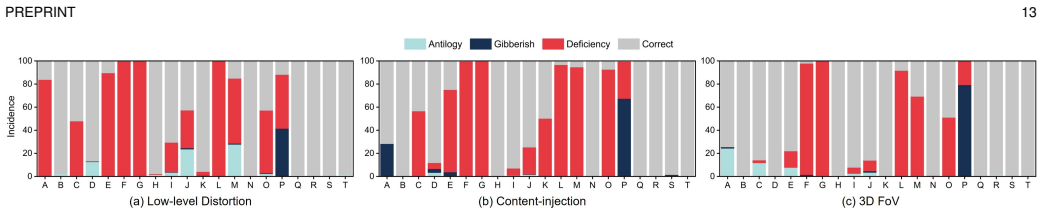
- [Sec. 4.2, Algorithm 1 and Eq. (8)] The response-validity filter is load-bearing for every LMM-JND value in Table 5. In Algorithm 1, a stimulus is counted as perceived only when f+ is present in the flag tokens and NLI(Raux, G|Q) is True; all other outputs, including f- answers, antilogy, gibberish, and deficiency, simply cause the search to continue and are therefore treated as 'not perceived'. Since Fig. 12 reports invalid-response rates above 80% for several models (e.g., the DeepSeek-VL2 family, Qwen2-VL-2B/7B, and LLaVA-OneVision-0.5B/7B), their Table 5 thresholds may substantially reflect output-format compliance rather than visual sensitivity. In addition, the NLI acceptance threshold is never stated, and BART-MNLI is applied to long, mixed flag+analysis generations without any validation against human judgments; both false accepts and false rejects are possible. I request a human audit of a stratified sample of accepted/rejected responses, a report of the NLI threshold, and a sensitivity analysis varying that threshold, since the per-model magnitudes and rankings in Table 5 all depend on this step.
- [Sec. 6.2, Table 5 and Sec. 6.1] The headline human-vs-LMM gaps (26.2%, 89.0%, and 40.8%) and the model rankings are point estimates without any uncertainty quantification. LMM outputs are stochastic, and the human thresholds come from only 12 campus participants, yet no confidence intervals, bootstrap estimates, or significance tests are reported. This is particularly important for statements such as 'Gemini 2.0 Flash surpasses the other proprietary LMMs by a substantial margin' and for the claim that the best LMM approaches human level on angle and distance tasks. Please provide per-model and per-stimulus confidence intervals, or at least a bootstrap analysis, and report the number of repeated trials used for each Table 5 cell.
- [Sec. 4.2, Eq. (6) and Sec. 6.5, Tables 8-9] The homogeneity claim in Section 6.5 is partly circular. Since LMM-JND is defined in Eq. (6) as the first level at which the response changes, the statement 'changes below the LMM-JND do not change the response' is true by construction for the same distortion and same query. The genuinely empirical content of Section 6.5 is instead the cross-distortion additivity test: whether combinations of below-threshold distortions from different dimensions remain imperceptible. The paper should be rephrased to distinguish this definitional property from the empirical finding, and the tables should be interpreted as additivity tests rather than as evidence for a newly discovered 'homogeneous property' of LMMs.
- [Sec. 6.4, Fig. 18 and Tab. 7] The claimed 'notable correlation' between the language/vision backbone parameter ratio and the 1st JND is not supported by the reported statistics. The evidence consists of four model families, each with only two to three sizes, and the comparison confounds language-backbone type, training data, visual-token count, and release date. No correlation coefficient, confidence interval, or significance test is given for Fig. 18, and the 'golden ratio' language in the text is an overinterpretation of a fitted curve. Please report formal correlations with uncertainty, control for the confounds above, and temper the architectural-design conclusions accordingly.
minor comments (6)
- [Sec. 3, Eq. (1)] The text says the contrast parameter k is set to '[5 : 0.5 : 50] (which means values ranging from 5 to 0.5 with 50 levels)', which is inconsistent both with the bracket notation and with the reported distortion levels; please clarify the range, step, and number of levels.
- [Table 5 and Eq. (8)] The convention for models with no detected positive response is not stated; Table 5 uses entries like '>50' and '>100', but Eq. (8) takes a minimum over a set that may be empty. Please define the convention explicitly.
- [Fig. 14 and Sec. 6.3] The caption of Fig. 14 reports 'Comparative errors (%) w.r.t. the width of the regularizer', but the text in Sec. 6.3 refers to 'response length' when citing Fig. 14; please align the caption, the panel labels, and the text.
- [Eq. (7) and Algorithm 1] Equation (7) defines G using both f+ and f-, but Algorithm 1 only tests for f+; please explain how negative answers and multiple-choice formats are processed in the actual implementation.
- [Tab. 1 and Sec. 5] The number of distortion types is reported inconsistently: the abstract says 12 distortion types, Table 1 says 'Combination14', and Table 5 lists three content-injection columns (Mask, watermark QR, watermark text) while the text describes two content-injection patterns; please reconcile these counts.
- [Tab. 6 and Sec. 6.2] Please state how the PSNR and SSIM values at the 1st JND are computed, since these values are used to support the claim that the blur column shows higher structural fidelity at the JND point.
Circularity Check
Central thresholds and human-vs-model comparisons are empirical; only the homogeneity framing restates the JND definition.
-
self definitional
[Sec. 6.5 (Homogeneous Property Test), closing paragraph]
"Through these experiments, we demonstrate that the generated LMM-JND possesses similar homogeneity characteristics to HVS-JND, i.e., distortions below the LMM-JND threshold can be tolerated by the LMM."
Equation (6) defines LMM-JND as the first level XN at which M(X0,Xk) ~= M(X0,Xk-1) ceases to hold, and Algorithm 1 scans levels until the flag+NLI criterion first fires. Hence 'changes below LMM-JND do not change the response' is entailed by the definition and the algorithm for the same image, distortion dimension, and query; asserting it as a demonstrated property is a restatement rather than an empirical result. The surrounding cross-distortion contamination experiments (Tabs. 8-9) do test whether sub-threshold distortions in different dimensions combine to cross threshold and are not tautological, so this step is only partially circular and is not load-bearing for the headline human-vs-model thresholds.
full rationale
The paper's central quantitative claims are measurements, not fitted predictions: MRV/LMM-JND values in Tab. 5 are obtained by the defined pipeline (Eqs. 6-8, Algorithm 1), and the human thresholds come from a separate subjective study. The headline gaps (26.2%, 89.0%, 40.8%) compare these measured quantities; any protocol mismatch between human and LMM measurement is a validity concern, not circularity. The compression experiments in Sec. 6.6 are a genuine transfer test: Rrc on MME VQA tasks is not forced to be zero by Eq. 8, and indeed Qwen2.5-VL-7B shows nonzero response changes at its near-MRV JPEG level, so the zero Rrc for GPT-4o and Gemini is an empirical result. The language/vision backbone correlation (Fig. 18) is a descriptive observation, and the paper explicitly conditions its conclusion on 'a sufficiently large language backbone to ensure low response error,' acknowledging the language-output confound rather than hiding it. The self-citations that appear (e.g., BAND-2k [48], InternVL2.5 [63], Q-Bench [80]) supply datasets, models, or prompt designs; they are not invoked as uniqueness theorems or as the sole justification for the paper's central claims. The only definitional element found is the homogeneity statement in Sec. 6.5, which re-states the defining property of LMM-JND for the single-distortion case; because the paper's main findings do not depend on that tautology, the overall circularity is low.
Assumptions & free parameters
free parameters (2)
- sliding window width w =
3
- NLI consistency threshold =
not specified
assumptions (4)
- domain assumption An LMM must natively support multi-image input for the JND determination to be valid.
- domain assumption The BART model trained on MultiNLI reliably detects semantic contradictions between an LMM's flag token and its analysis.
- domain assumption Human JND measurements from 12 campus participants with normal eyesight represent human-level perception for comparison.
- domain assumption The Weber-Fechner law justifies scaling mask size in logarithmic-like steps.
Cite this review
Pith. "Pith review of Just Noticeable Difference for Large Multimodal Models." pith.science (2026). https://pith.science/paper/WX7F77GK
@misc{pith2026250700490,
  author       = {Pith},
  title        = {Pith review of: Just Noticeable Difference for Large Multimodal Models},
  year         = {2026},
  howpublished = {\url{https://pith.science/paper/WX7F77GK}},
  note         = {Machine review of arXiv:2507.00490}
}
read the original abstract
Just noticeable difference (JND), the minimum change that the human visual system (HVS) can perceive, has been studied for decades. Although recent work has extended this line of research into machine vision, there has been a scarcity of studies systematically exploring its perceptual boundaries across multiple tasks and stimulus types, particularly in the current era of rapidly advancing large multimodal models (LMMs), where studying the multifaceted capabilities of models has become a mainstream focus. Moreover, the perceptual defects of LMMs are not investigated thoroughly, resulting in potential security issues and suboptimal response efficiency. In this paper, we take an initial attempt and demonstrate that there exist significant visual blind spots in current LMMs. To systemically quantify this characteristic, we propose a new concept, {\bf LMM-JND}, together with its determination pipeline. Targeting uncovering the behavior commonalities in HVS-aligned visual perception tasks, we delve into several LMM families and construct a large-scale dataset, named VPA-JND, which contains 21.5k reference images with over 489k stimuli across 12 distortion types, to facilitate LMM-JND studies. VPA-JND exposes areas where state-of-the-art LMMs, including GPT-4o and the InternVL2.5 series, struggle with basic comparison queries and fall significantly short of human-level visual performance. We further explore the effects of vision and language backbones and find a notable correlation between their design philosophy that may instruct the future refinement of LMMs for their visual acuity. Together, our research underscores the significance of LMM-JND as a unique perspective for studying LMMs, and predictable LMM-JND is crucial for security concerns. This work will be available at https://github.com/zijianchen98/LMM-JND.
Figures


Figures from the paper (16 more)




Forward citations
Cited by 1 Pith paper
-
PictOBI-20k: Unveiling Large Multimodal Models in Visual Decipherment for Pictographic Oracle Bone Characters
PictOBI-20k, a new 15k-question benchmark, shows top large multimodal models reach only 53.7% accuracy at matching oracle bone pictographs to object photos, with vision encoders often outperforming the full models.
Reference graph
Works this paper leans on
-
[1]
Qwen2-vl: Enhancing vision-language model’s perception of the world at any resolution,
P . Wang, S. Bai, S. Tan, S. Wang, Z. Fan, J. Bai, K. Chen, X. Liu, J. Wang, W. Ge et al. , “Qwen2-vl: Enhancing vision-language model’s perception of the world at any resolution,” arXiv preprint arXiv:2409.12191, 2024
arXiv 2024
-
[2]
Learning to describe differ- ences between pairs of similar images,
H. Jhamtani and T. Berg-Kirkpatrick, “Learning to describe differ- ences between pairs of similar images,” in Proceedings of the 2018 Conference on Empirical Methods in Natural Language Processing, 2018, pp. 4024–4034
2018
-
[3]
Introducing llama 3.2,
Meta, “Introducing llama 3.2,” https://www.llama.com, 2024, accessed: 2024-11-30
2024
-
[4]
Claude opus 4,
Anthropic, “Claude opus 4,” https://www.anthropic.com/claude/ opus, 2025, accessed: 2025-06-22
2025
-
[5]
Deepseek-vl2: Mixture-of-experts vision-language models for advanced multimodal understanding,
Z. Wu, X. Chen, Z. Pan, X. Liu, W. Liu, D. Dai, H. Gao, Y. Ma, C. Wu, B. Wang et al., “Deepseek-vl2: Mixture-of-experts vision-language models for advanced multimodal understanding,” arXiv preprint arXiv:2412.10302, 2024
arXiv 2024
-
[6]
Just recognizable distortion for machine vision oriented image and video coding,
Q. Zhang, S. Wang, X. Zhang, S. Ma, and W. Gao, “Just recognizable distortion for machine vision oriented image and video coding,” International Journal of Computer Vision, vol. 129, no. 10, pp. 2889– 2906, 2021
2021
-
[7]
The unreasonable effectiveness of deep features as a perceptual metric,
R. Zhang, P . Isola, A. A. Efros, E. Shechtman, and O. Wang, “The unreasonable effectiveness of deep features as a perceptual metric,” in Proceedings of the IEEE conference on computer vision and pattern recognition, 2018, pp. 586–595
2018
-
[8]
Signal compression based on models of human perception,
N. Jayant, J. Johnston, and R. Safranek, “Signal compression based on models of human perception,” Proceedings of the IEEE, vol. 81, no. 10, pp. 1385–1422, 1993
1993
Show all 91 references
-
[9]
Promptrobust: Towards evaluating the robustness of large language models on adversarial prompts,
K. Zhu, J. Wang, J. Zhou, Z. Wang, H. Chen, Y. Wang, L. Yang, W. Ye, Y. Zhang, N. Gonget al., “Promptrobust: Towards evaluating the robustness of large language models on adversarial prompts,” in Proceedings of the 1st ACM Workshop on Large AI Systems and Models with Privacy a...
2023
-
[10]
Image quality assessment: from error visibility to structural similarity,
Z. Wang, A. C. Bovik, H. R. Sheikh, and E. P . Simoncelli, “Image quality assessment: from error visibility to structural similarity,” IEEE transactions on image processing , vol. 13, no. 4, pp. 600–612, 2004
2004
-
[11]
Study of subjective and objective naturalness assessment of ai-generated images,
Z. Chen, W. Sun, H. Wu, Z. Zhang, J. Jia, R. Huang, X. Min, G. Zhai, and W. Zhang, “Study of subjective and objective naturalness assessment of ai-generated images,” IEEE Transactions on Circuits and Systems for Video Technology, vol. 35, no. 4, pp. 3573–3588, 2025
2025
-
[12]
Intro- ducing gemini 2.0: our new ai model for the agentic era,
S. Pichai, D. Hassabis, and K. Kavukcuoglu, “Intro- ducing gemini 2.0: our new ai model for the agentic era,” https://blog.google/technology/google-deepmind/ google-gemini-ai-update-december-2024/#ceo-message, 2024, accessed: 2025-3-24
2024
-
[13]
Ansys speos design & validation of optical systems,
Ansys, “Ansys speos design & validation of optical systems,” https: //www.ansys.com/products/optics/ansys-speos, 2025, accessed: 2025-1-5
2025
-
[14]
Thinking in space: How multimodal large language models see, remember, and recall spaces,
J. Yang, S. Yang, A. W. Gupta, R. Han, L. Fei-Fei, and S. Xie, “Thinking in space: How multimodal large language models see, remember, and recall spaces,” arXiv preprint arXiv:2412.14171, 2024
2024 arXiv
-
[15]
Jnd modeling: Approaches and applications,
Z. Chen and H. Liu, “Jnd modeling: Approaches and applications,” in 2014 19th International Conference on Digital Signal Processing . IEEE, 2014, pp. 827–830
2014
-
[16]
Shapellm: Universal 3d object understanding for embodied interaction,
Z. Qi, R. Dong, S. Zhang, H. Geng, C. Han, Z. Ge, L. Yi, and K. Ma, “Shapellm: Universal 3d object understanding for embodied interaction,” in European Conference on Computer Vision. Springer, 2025, pp. 214–238
2025
-
[17]
Kadid-10k: A large-scale artificially distorted iqa database,
H. Lin, V . Hosu, and D. Saupe, “Kadid-10k: A large-scale artificially distorted iqa database,” in 2019 Eleventh International Conference on Quality of Multimedia Experience (QoMEX). IEEE, 2019, pp. 1–3
2019
-
[18]
Deep learning based just noticeable difference and perceptual quality prediction models for compressed video,
Y. Zhang, H. Liu, Y. Yang, X. Fan, S. Kwong, and C. J. Kuo, “Deep learning based just noticeable difference and perceptual quality prediction models for compressed video,” IEEE Transactions on Circuits and Systems for Video Technology, vol. 32, no. 3, pp. 1197– 1212, 2021
2021
-
[19]
Just noticeable difference for images with decomposition model for separating edge and textured regions,
A. Liu, W. Lin, M. Paul, C. Deng, and F. Zhang, “Just noticeable difference for images with decomposition model for separating edge and textured regions,” IEEE Transactions on Circuits and Systems for Video Technology, vol. 20, no. 11, pp. 1648–1652, 2010. PREPRINT 18
2010
-
[20]
A medical multimodal large language model for future pandemics,
F. Liu, T. Zhu, X. Wu, B. Yang, C. You, C. Wang, L. Lu, Z. Liu, Y. Zheng, X. Sun et al., “A medical multimodal large language model for future pandemics,” NPJ Digital Medicine, vol. 6, no. 1, p. 226, 2023
2023
-
[21]
Drivegpt4: Interpretable end-to-end autonomous driving via large language model,
Z. Xu, Y. Zhang, E. Xie, Z. Zhao, Y. Guo, K.-Y. K. Wong, Z. Li, and H. Zhao, “Drivegpt4: Interpretable end-to-end autonomous driving via large language model,” IEEE Robotics and Automation Letters , 2024
2024
-
[22]
Measuring contrast sensitivity,
D. G. Pelli and P . Bex, “Measuring contrast sensitivity,” Vision research, vol. 90, pp. 10–14, 2013
2013
-
[23]
High and low contrast acuity and clinical contrast sensitivity tested in a normal population,
B. Brown and J. E. Lovie-Kitchin, “High and low contrast acuity and clinical contrast sensitivity tested in a normal population,” Optometry and vision science, vol. 66, no. 7, pp. 467–473, 1989
1989
-
[24]
Luminance-model-based dct quantization for color image compression,
A. J. Ahumada Jr and H. A. Peterson, “Luminance-model-based dct quantization for color image compression,” in Human vision, visual processing, and digital display III, vol. 1666. SPIE, 1992, pp. 365–374
1992
-
[25]
Spatio-temporal just noticeable distortion profile for grey scale image/video in dct domain,
Z. Wei and K. N. Ngan, “Spatio-temporal just noticeable distortion profile for grey scale image/video in dct domain,”IEEE Transactions on Circuits and Systems for Video Technology, vol. 19, no. 3, pp. 337–346, 2009
2009
-
[26]
A wavelet visible difference predictor,
A. P . Bradley, “A wavelet visible difference predictor,” IEEE Transactions on image processing, vol. 8, no. 5, pp. 717–730, 1999
1999
-
[27]
Toward top- down just noticeable difference estimation of natural images,
Q. Jiang, Z. Liu, S. Wang, F. Shao, and W. Lin, “Toward top- down just noticeable difference estimation of natural images,” IEEE Transactions on Image Processing, vol. 31, pp. 3697–3712, 2022
2022
-
[28]
A novel dct-based jnd model for luminance adaptation effect in dct frequency,
S.-H. Bae and M. Kim, “A novel dct-based jnd model for luminance adaptation effect in dct frequency,” IEEE Signal Processing Letters, vol. 20, no. 9, pp. 893–896, 2013
2013
-
[29]
Separate visual pathways for perception and action,
M. A. Goodale and A. D. Milner, “Separate visual pathways for perception and action,” Trends in neurosciences, vol. 15, no. 1, pp. 20–25, 1992
1992
-
[30]
Magicbrush: A manually annotated dataset for instruction-guided image editing,
K. Zhang, L. Mo, W. Chen, H. Sun, and Y. Su, “Magicbrush: A manually annotated dataset for instruction-guided image editing,” Advances in Neural Information Processing Systems, vol. 36, pp. 31 428– 31 449, 2023
2023
-
[31]
Joint luminance-chrominance learning for image debanding,
Z. Chen, W. Sun, J. Jia, R. Huang, F. Lu, Y. Chen, X. Min, G. Zhai, and W. Zhang, “Joint luminance-chrominance learning for image debanding,” IEEE Transactions on Circuits and Systems for Video Technology, 2025
2025
-
[32]
Algorithmic optimiza- tions in the hmax model targeted for efficient object recognition,
A. W. Bitar, M. M. Mansour, and A. Chehab, “Algorithmic optimiza- tions in the hmax model targeted for efficient object recognition,” in Computer Vision, Imaging and Computer Graphics Theory and Applications: 10th International Joint Conference, VISIGRAPP 2015, Berlin, Germany...
2015
-
[33]
Cortico-cortical feedback engages active dendrites in visual cortex,
M. Fis ¸ek, D. Herrmann, A. Egea-Weiss, M. Cloves, L. Bauer, T.- Y. Lee, L. E. Russell, and M. H ¨ausser, “Cortico-cortical feedback engages active dendrites in visual cortex,” Nature, vol. 617, no. 7962, pp. 769–776, 2023
2023
-
[34]
The human visual cortex,
K. Grill-Spector and R. Malach, “The human visual cortex,” Annu. Rev. Neurosci., vol. 27, no. 1, pp. 649–677, 2004
2004
-
[35]
Mmmu: A massive multi-discipline multimodal understanding and reasoning benchmark for expert agi,
X. Yue, Y. Ni, K. Zhang, T. Zheng, R. Liu, G. Zhang, S. Stevens, D. Jiang, W. Ren, Y. Sun et al., “Mmmu: A massive multi-discipline multimodal understanding and reasoning benchmark for expert agi,” in Proceedings of the IEEE/CVF Conference on Computer Vision and Pattern Recogn...
2024
-
[36]
How do the two visual streams interact with each other?
A. D. Milner, “How do the two visual streams interact with each other?” Experimental brain research, vol. 235, pp. 1297–1308, 2017
2017
-
[37]
Obi-bench: Can lmms aid in study of ancient script on oracle bones?
Z. Chen, T. Chen, W. Zhang, and G. Zhai, “Obi-bench: Can lmms aid in study of ancient script on oracle bones?” arXiv preprint arXiv:2412.01175, 2024
2024 arXiv
-
[38]
Transfer learning for just noticeable difference estimation,
Y. Mao, J. Wu, X. Wang, L. Li, and W. Dong, “Transfer learning for just noticeable difference estimation,” Information Sciences, vol. 648, p. 119575, 2023
2023
-
[39]
Visual jnd: A perceptual measurement in video coding,
D. Yuan, T. Zhao, Y. Xu, H. Xue, and L. Lin, “Visual jnd: A perceptual measurement in video coding,” IEEE Access , vol. 7, pp. 29 014–29 022, 2019
2019
-
[40]
A perceptually tuned subband image coder based on the measure of just-noticeable-distortion profile,
C.-H. Chou and Y.-C. Li, “A perceptually tuned subband image coder based on the measure of just-noticeable-distortion profile,” IEEE Transactions on circuits and systems for video technology, vol. 5, no. 6, pp. 467–476, 1995
1995
-
[41]
Perceptual video coding for machines via satisfied machine ratio modeling,
Q. Zhang, S. Wang, X. Zhang, C. Jia, Z. Wang, S. Ma, and W. Gao, “Perceptual video coding for machines via satisfied machine ratio modeling,” IEEE Transactions on Pattern Analysis and Machine Intelligence, vol. 46, no. 12, pp. 7651–7668, 2024
2024
-
[42]
Just noticeable difference for deep machine vision,
J. Jin, X. Zhang, X. Fu, H. Zhang, W. Lin, J. Lou, and Y. Zhao, “Just noticeable difference for deep machine vision,” IEEE Transactions on Circuits and Systems for Video Technology, vol. 32, no. 6, pp. 3452–3461, 2022
2022
-
[43]
Bband index: A no-reference banding artifact predictor,
Z. Tu, J. Lin, Y. Wang, B. Adsumilli, and A. C. Bovik, “Bband index: A no-reference banding artifact predictor,” in ICASSP 2020-2020 IEEE International Conference on Acoustics, Speech and Signal Processing (ICASSP). IEEE, 2020, pp. 2712–2716
2020
-
[44]
Methodology for the subjective assessment of the quality of television pictures,
R. BT, “Methodology for the subjective assessment of the quality of television pictures,” International Telecommunication Union, vol. 4, p. 19, 2002
2002
-
[45]
A broad-coverage challenge corpus for sentence understanding through inference,
A. Williams, N. Nangia, and S. Bowman, “A broad-coverage challenge corpus for sentence understanding through inference,” in Proceedings of the 2018 Conference of the North American Chapter of the Association for Computational Linguistics: Human Language Technologies, Volume 1 ...
2018
-
[46]
Bart: Denoising sequence-to-sequence pre-training for natural language generation, translation, and comprehension,
M. Lewis, Y. Liu, N. Goyal, M. Ghazvininejad, A. Mohamed, O. Levy, V . Stoyanov, and L. Zettlemoyer, “Bart: Denoising sequence-to-sequence pre-training for natural language generation, translation, and comprehension,” in Proceedings of the 58th Annual Meeting of the Associatio...
2020
-
[47]
Fs-band: A frequency-sensitive banding detector,
Z. Chen, W. Sun, Z. Zhang, R. Huang, F. Lu, X. Min, G. Zhai, and W. Zhang, “Fs-band: A frequency-sensitive banding detector,” in 2024 IEEE International Symposium on Circuits and Systems (ISCAS). IEEE, 2024, pp. 1–5
2024
-
[48]
Band-2k: Banding artifact noticeable database for banding detection and quality assessment,
Z. Chen, W. Sun, J. Jia, F. Lu, Z. Zhang, J. Liu, R. Huang, X. Min, and G. Zhai, “Band-2k: Banding artifact noticeable database for banding detection and quality assessment,” IEEE Transactions on Circuits and Systems for Video Technology, vol. 34, no. 7, pp. 6347–6362, 2024
2024
-
[49]
Videoset: A large-scale compressed video quality dataset based on jnd measurement,
H. Wang, I. Katsavounidis, J. Zhou, J. Park, S. Lei, X. Zhou, M.- O. Pun, X. Jin, R. Wang, X. Wang et al., “Videoset: A large-scale compressed video quality dataset based on jnd measurement,” Journal of Visual Communication and Image Representation, vol. 46, pp. 292–302, 2017
2017
-
[50]
Statistical study on perceived jpeg image quality via mcl-jci dataset construction and analysis,
L. Jin, J. Y. Lin, S. Hu, H. Wang, P . Wang, I. Katsavounidis, A. Aaron, and C.-C. J. Kuo, “Statistical study on perceived jpeg image quality via mcl-jci dataset construction and analysis,” Electronic Imaging, vol. 2016, no. 13, pp. 1–9, 2016
2016
-
[51]
Just noticeable distortion profile inference: A patch-level structural visibility learning approach,
X. Shen, Z. Ni, W. Yang, X. Zhang, S. Wang, and S. Kwong, “Just noticeable distortion profile inference: A patch-level structural visibility learning approach,” IEEE Transactions on Image Processing, vol. 30, pp. 26–38, 2020
2020
-
[52]
Audio–video collaborative jnd estimation model for multimedia applications,
N. Sheng, H. Yin, H. Wang, L. Mo, Y. Liu, X. Huang, J. Lin, and X. Tang, “Audio–video collaborative jnd estimation model for multimedia applications,” Journal of Visual Communication and Image Representation, vol. 103, p. 104254, 2024
2024
-
[53]
E. H. Weber, EH Weber on the tactile senses. Psychology Press, 1996
1996
-
[54]
On the robustness of large multimodal models against image adversarial attacks,
X. Cui, A. Aparcedo, Y. K. Jang, and S.-N. Lim, “On the robustness of large multimodal models against image adversarial attacks,” in Proceedings of the IEEE/CVF Conference on Computer Vision and Pattern Recognition, 2024, pp. 24 625–24 634
2024
-
[55]
Eyes wide shut? exploring the visual shortcomings of multimodal llms,
S. Tong, Z. Liu, Y. Zhai, Y. Ma, Y. LeCun, and S. Xie, “Eyes wide shut? exploring the visual shortcomings of multimodal llms,” in Proceedings of the IEEE/CVF Conference on Computer Vision and Pattern Recognition, 2024, pp. 9568–9578
2024
-
[56]
Visionzip: Longer is better but not necessary in vision language models,
S. Yang, Y. Chen, Z. Tian, C. Wang, J. Li, B. Yu, and J. Jia, “Visionzip: Longer is better but not necessary in vision language models,” in Proceedings of the Computer Vision and Pattern Recognition Conference, 2025, pp. 19 792–19 802
2025
-
[57]
Learning to predict object-wise just recognizable distortion for image and video compression,
Y. Zhang, H. Lin, J. Sun, L. Zhu, and S. Kwong, “Learning to predict object-wise just recognizable distortion for image and video compression,” IEEE Transactions on Multimedia, vol. 26, pp. 5925– 5938, 2023
2023
-
[58]
Deep learning-based picture-wise just noticeable distortion prediction model for image compression,
H. Liu, Y. Zhang, H. Zhang, C. Fan, S. Kwong, C.-C. J. Kuo, and X. Fan, “Deep learning-based picture-wise just noticeable distortion prediction model for image compression,” IEEE Transactions on Image Processing, vol. 29, pp. 641–656, 2019
2019
-
[59]
Large-scale crowdsourced subjective assessment of picturewise just noticeable difference,
H. Lin, G. Chen, M. Jenadeleh, V . Hosu, U.-D. Reips, R. Hamzaoui, and D. Saupe, “Large-scale crowdsourced subjective assessment of picturewise just noticeable difference,” IEEE transactions on circuits and systems for video technology, vol. 32, no. 9, pp. 5859–5873, 2022
2022
-
[60]
Internvl3: Exploring advanced training and test-time recipes for open-source multimodal models,
J. Zhu, W. Wang, Z. Chen, Z. Liu, S. Ye, L. Gu, H. Tian, Y. Duan, W. Su, J. Shao et al. , “Internvl3: Exploring advanced training and test-time recipes for open-source multimodal models,” arXiv preprint arXiv:2504.10479, 2025. PREPRINT 19
2025 arXiv
-
[61]
N. B. Carlson, D. Kurtz, and C. Hines, Clinical procedures for ocular examination. McGraw-Hill Education, 2016
2016
-
[62]
Gaia: Rethinking action quality assessment for ai-generated videos,
Z. Chen, W. Sun, Y. Tian, J. Jia, Z. Zhang, W. Jiarui, R. Huang, X. Min, G. Zhai, and W. Zhang, “Gaia: Rethinking action quality assessment for ai-generated videos,” in Advances in Neural Information Processing Systems, vol. 37, 2024, pp. 40 111–40 144
2024
-
[63]
Expanding performance boundaries of open- source multimodal models with model, data, and test-time scaling,
Z. Chen, W. Wang, Y. Cao, Y. Liu, Z. Gao, E. Cui, J. Zhu, S. Ye, H. Tian, Z. Liu et al., “Expanding performance boundaries of open- source multimodal models with model, data, and test-time scaling,” arXiv preprint arXiv:2412.05271, 2024
2024 arXiv
-
[64]
On the foundations of vision modeling: I. weber’s law and weberized tv restoration,
J. Shen, “On the foundations of vision modeling: I. weber’s law and weberized tv restoration,” Physica D: Nonlinear Phenomena, vol. 175, no. 3-4, pp. 241–251, 2003
2003
-
[65]
Mme: A comprehensive evaluation benchmark for multimodal large language models,
C. Fu, P . Chen, Y. Shen, Y. Qin, M. Zhang, X. Lin, J. Yang, X. Zheng, K. Li, X. Sun et al., “Mme: A comprehensive evaluation benchmark for multimodal large language models,” arXiv preprint arXiv:2306.13394, 2023
2023 arXiv
-
[66]
Qwen2.5-vl technical report,
S. Bai, K. Chen, X. Liu, J. Wang, W. Ge, S. Song, K. Dang, P . Wang, S. Wang, J. Tang, H. Zhong, Y. Zhu, M. Yang, Z. Li, J. Wan, P . Wang, W. Ding, Z. Fu, Y. Xu, J. Ye, X. Zhang, T. Xie, Z. Cheng, H. Zhang, Z. Yang, H. Xu, and J. Lin, “Qwen2.5-vl technical report,” 2025. [Onli...
2025 arXiv
-
[67]
Smolvlm - small yet mighty vision language model,
A. Marafioti, M. Noyan, M. Farr ´e, E. Bakouch, and P . Cuenca, “Smolvlm - small yet mighty vision language model,” https:// huggingface.co/blog/smolvlm, 2024, accessed: 2025-02-23
2024
-
[68]
The first comprehensive dataset with multiple distortion types for visual just-noticeable differences,
Y. Liu, J. Jin, Y. Xue, and W. Lin, “The first comprehensive dataset with multiple distortion types for visual just-noticeable differences,” in 2023 IEEE International Conference on Image Processing (ICIP). IEEE, 2023, pp. 2820–2824
2023
-
[69]
Picture- level just noticeable difference for symmetrically and asymmetri- cally compressed stereoscopic images: Subjective quality assess- ment study and datasets,
C. Fan, Y. Zhang, H. Zhang, R. Hamzaoui, and Q. Jiang, “Picture- level just noticeable difference for symmetrically and asymmetri- cally compressed stereoscopic images: Subjective quality assess- ment study and datasets,” Journal of Visual Communication and Image Representatio...
2019
-
[70]
Measure and prediction of hevc perceptually lossy/lossless boundary qp values,
Q. Huang, H. Wang, S. C. Lim, H. Y. Kim, S. Y. Jeong, and C.-C. J. Kuo, “Measure and prediction of hevc perceptually lossy/lossless boundary qp values,” in 2017 data compression conference (DCC) . IEEE, 2017, pp. 42–51
2017
-
[71]
A survey on multimodal large language models,
S. Yin, C. Fu, S. Zhao, K. Li, X. Sun, T. Xu, and E. Chen, “A survey on multimodal large language models,” National Science Review, vol. 11, no. 12, p. nwae403, 11 2024. [Online]. Available: https://doi.org/10.1093/nsr/nwae403
2024 doi
-
[72]
Progress and opportunities in modelling just-noticeable difference (jnd) for multimedia,
W. Lin and G. Ghinea, “Progress and opportunities in modelling just-noticeable difference (jnd) for multimedia,” IEEE Transactions on Multimedia, vol. 24, pp. 3706–3721, 2021
2021
-
[73]
Jpeg aic-3 dataset: towards defining the high quality to nearly visually lossless quality range,
M. Testolina, V . Hosu, M. Jenadeleh, D. Lazzarotto, D. Saupe, and T. Ebrahimi, “Jpeg aic-3 dataset: towards defining the high quality to nearly visually lossless quality range,” in 2023 15th International Conference on Quality of Multimedia Experience (QoMEX). IEEE, 2023, pp. 55–60
2023
-
[74]
The r3vival dataset: Repository of room responses and 360 videos of a variable acoustics lab,
F. Klein and S. V . A. Gar´ı, “The r3vival dataset: Repository of room responses and 360 videos of a variable acoustics lab,” in ICASSP 2023-2023 IEEE International Conference on Acoustics, Speech and Signal Processing (ICASSP). IEEE, 2023, pp. 1–5
2023
-
[75]
Jnd- pano: Database for just noticeable difference of jpeg compressed panoramic images,
X. Liu, Z. Chen, X. Wang, J. Jiang, and S. Kowng, “Jnd- pano: Database for just noticeable difference of jpeg compressed panoramic images,” in Advances in Multimedia Information Processing– PCM 2018: 19th Pacific-Rim Conference on Multimedia, Hefei, China, September 21-22, 201...
2018
-
[76]
Per- ceptual visual signal compression and transmission,
H. R. Wu, A. R. Reibman, W. Lin, F. Pereira, and S. S. Hemami, “Per- ceptual visual signal compression and transmission,” Proceedings of the IEEE, vol. 101, no. 9, pp. 2025–2043, 2013
2025
-
[77]
Survey of visual just noticeable difference estimation,
J. Wu, G. Shi, and W. Lin, “Survey of visual just noticeable difference estimation,” Frontiers of Computer Science , vol. 13, pp. 4–15, 2019
2019
-
[78]
Qwen-vl: A versatile vision-language model for understanding, localization, text reading, and beyond,
J. Bai, S. Bai, S. Yang, S. Wang, S. Tan, P . Wang, J. Lin, C. Zhou, and J. Zhou, “Qwen-vl: A versatile vision-language model for understanding, localization, text reading, and beyond,” arXiv preprint arXiv:2308.12966, vol. 1, no. 2, p. 3, 2023
2023 arXiv
-
[79]
From just noticeable differences to image quality,
A. Ak, A. Pastor, and P . Le Callet, “From just noticeable differences to image quality,” in Proceedings of the 2nd Workshop on Quality of Experience in Visual Multimedia Applications, 2022, pp. 23–28
2022
-
[80]
Q-bench: A benchmark for general- purpose foundation models on low-level vision,
H. Wu, Z. Zhang, E. Zhang, C. Chen, L. Liao, A. Wang, C. Li, W. Sun, Q. Yan, G. Zhai et al., “Q-bench: A benchmark for general- purpose foundation models on low-level vision,” in The Twelfth International Conference on Learning Representations, 2024
2024
-
[81]
Mm- llms: Recent advances in multimodal large language models,
D. Zhang, Y. Yu, J. Dong, C. Li, D. Su, C. Chu, and D. Yu, “Mm- llms: Recent advances in multimodal large language models,” arXiv preprint arXiv:2401.13601, 2024
2024 arXiv
-
[82]
Multimodal large language models: A survey,
J. Wu, W. Gan, Z. Chen, S. Wan, and S. Y. Philip, “Multimodal large language models: A survey,” in 2023 IEEE International Conference on Big Data (BigData). IEEE, 2023, pp. 2247–2256
2023
-
[83]
Mcl-jcv: a jnd- based h. 264/avc video quality assessment dataset,
H. Wang, W. Gan, S. Hu, J. Y. Lin, L. Jin, L. Song, P . Wang, I. Katsavounidis, A. Aaron, and C.-C. J. Kuo, “Mcl-jcv: a jnd- based h. 264/avc video quality assessment dataset,” in 2016 IEEE international conference on image processing (ICIP). IEEE, 2016, pp. 1509–1513
2016
-
[84]
Pattern complexity-based jnd estimation for quantization water- marking,
W. Wan, J. Wang, J. Li, L. Meng, J. Sun, H. Zhang, and J. Liu, “Pattern complexity-based jnd estimation for quantization water- marking,” Pattern Recognition Letters, vol. 130, pp. 157–164, 2020
2020
-
[85]
Image quality assessment using the ssim and the just noticeable difference paradigm,
J. R. Flynn, S. Ward, J. Abich, and D. Poole, “Image quality assessment using the ssim and the just noticeable difference paradigm,” in Engineering Psychology and Cognitive Ergonomics. Understanding Human Cognition: 10th International Conference, EPCE 2013, Held as Part of HCI...
2013
-
[86]
Hierarchical predictive coding-based jnd estimation for image compression,
H. Wang, L. Yu, J. Liang, H. Yin, T. Li, and S. Wang, “Hierarchical predictive coding-based jnd estimation for image compression,” IEEE Transactions on Image Processing, vol. 30, pp. 487–500, 2020
2020
-
[87]
Sg-jnd: Semantic-guided just noticeable distortion predictor for image compression,
L. Cao, W. Sun, X. Min, J. Jia, Z. Zhang, Z. Chen, Y. Zhu, L. Liu, Q. Chen, J. Chen et al. , “Sg-jnd: Semantic-guided just noticeable distortion predictor for image compression,” in 2024 IEEE International Conference on Image Processing (ICIP). IEEE, 2024, pp. 1139–1145
2024
-
[88]
Gemini 1.5: Unlocking multimodal understanding across millions of tokens of context,
M. Reid, N. Savinov, D. Teplyashin, D. Lepikhin, T. Lillicrap, J.-b. Alayrac, R. Soricut, A. Lazaridou, O. Firat, J. Schrittwieser et al., “Gemini 1.5: Unlocking multimodal understanding across millions of tokens of context,” arXiv preprint arXiv:2403.05530, 2024
2024 arXiv
-
[89]
Hello gpt-4o,
OpenAI, “Hello gpt-4o,” https://openai.com/index/hello-gpt-4o/, 2024, accessed: 2024-08-27
2024
-
[90]
Gemini 2.5: Updates to our family of thinking models,
S. B. Mallick and L. Kilpatrick, “Gemini 2.5: Updates to our family of thinking models,” https://developers.googleblog.com/ en/gemini-2-5-thinking-model-updates/, 2025, accessed: 2025-06- 21
2025
-
[91]
Llava-onevision: Easy visual task transfer,
B. Li, Y. Zhang, D. Guo, R. Zhang, F. Li, H. Zhang, K. Zhang, P . Zhang, Y. Li, Z. Liu et al., “Llava-onevision: Easy visual task transfer,” arXiv preprint arXiv:2408.03326, 2024
2024 arXiv
Reviewed August 6, 2026 · model on record in the stance chip above.
Discussion (0). Sign in to comment.