REVIEW 4 major objections 5 minor 1 cited by
Dual-Modality Representation Learning for Molecular Property Prediction
T0 review · 4 major / 5 minor · reviewed 2026-08-10 · deepseek-v4-flash
Pith's one-line read This paper claims that fusing graph and SMILES molecular representations with multi-head cross-attention achieves the best overall performance on eight MoleculeNet property prediction benchmarks.
desk verdict A plausible incremental fusion model whose 'best overall performance' claim rests on an uncontrolled comparison; the internal ablation is sound but the headline needs re-running baselines under a common protocol. read the letter →
The pith
A machine-rendered reading of the paper's core claim, the machinery that carries it, and where it could break.
The reading
What carries the argument
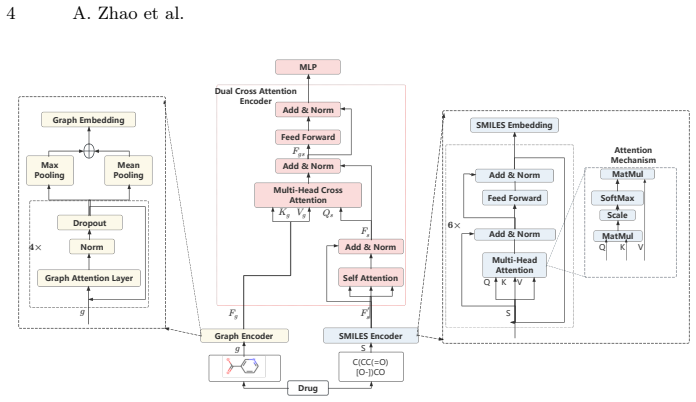
The central mechanism is the Dual-Modality Cross-Attention Encoder, which fuses a graph embedding $F_g$ and a SMILES embedding $F_s$ by forming queries from $F_s$ and keys and values from $F_g$, computing $\text{softmax}(Q_s K_g^\top/\sqrt{d})V_g$ per attention head and concatenating heads. Because the SMILES sequence asks questions of the graph representation, and the gradient of the joint loss flows back through both branches, each modality learns to serve the other. The cross-attention block sits on top of a deliberately simple GAT branch (four layers) and a pretrained ChemBERTa transformer, so the fusion mechanism itself is the main new ingredient the paper isolates.
What would settle it
Re-run all ten baselines and DMCA with one identical 0.8/0.2 split and seed per dataset on the eight MoleculeNet datasets, then recompute the median normalized-AUC rank and average RMSE; DMCA's claimed best overall rank is falsified if it no longer leads on classification or no longer places second on regression.
Extended reading notes
Core claim
On its own terms, the paper establishes that a multi-head cross-attention fusion of graph attention network (GAT) embeddings and ChemBERTa SMILES embeddings outperforms either branch alone on every one of the eight datasets, and outperforms the ten baselines in the aggregate classification ranking (median of per-dataset min-max normalized AUC) while coming second in average regression RMSE. The closest multi-modality baseline, MMSG, edges out DMCA on two of the three regression datasets, but DMCA leads in the overall classification ranking and on the ESOL regression task. The paper interprets this as evidence that cross-attention lets the two modalities correct each other's blind spots: GNNs capture local functional groups but miss long-range interactions, while Transformers capture global sequence structure but miss explicit topology such as rings.
Load-bearing premise
The comparison assumes that baseline numbers taken from other publications are directly comparable to DMCA's numbers under the same data-splitting conditions, which the authors explicitly note may not hold, and that reducing ClinTox to a single label preserves the benchmark's meaning.
Editorial extensions
If this is right
- DMCA beats both of its own branches alone on all eight datasets, isolating the cross-attention fusion as the source of the gain.
- Among the top classification methods, three are multi-modality-based, supporting the broader premise that combining graph and SMILES views helps.
- Because the SMILES branch is a pretrained encoder and the GNN branch is shallow, the fusion adds little computational overhead relative to a full Transformer, making it a lightweight recipe for multi-modality learning.
- If the proposed rank score is accepted as the aggregate metric, DMCA's median normalized AUC is the best across the five classification datasets.
Reading between the lines
- The rank-score metric (median of min-max normalized AUCs) rewards coverage: a method that skips datasets is penalized, so DMCA's top rank partly reflects that it reported results on all eight datasets; re-running the ranking with identical dataset coverage for all methods could change the order.
- The cross-attention fusion is agnostic to which branch serves as the query; swapping the roles would test whether SMILES-as-query is essential or just convenient.
- A natural stress test is to corrupt one modality or feed mismatched graph/SMILES pairs to see how much DMCA's performance degrades, which would quantify how much of the gain is genuine complementarity versus ensemble averaging.
- The ClinTox simplification to a single label discards the rare contradictory label pairs, exactly the cases a drug-safety model should flag; a multi-task variant might retain the benefit without losing that signal.
Editorial analysis
A structured set of objections, weighed in public.
Referee Report
Summary. The paper proposes DMCA, a dual-modality architecture that fuses a GAT-based graph encoder with a ChemBERTa-based SMILES encoder via multi-head cross-attention, and evaluates it on eight MoleculeNet datasets: five classification tasks (BBBP, BACE, ClinTox, HIV, SIDER) and three regression tasks (ESOL, FreeSolv, Lipophilicity). The central claim is that DMCA achieves the best overall classification performance (via a custom rank score) and the second-best average regression RMSE, with ablations showing that the fused model outperforms each single-modality branch.
Significance. The architecture is simple, lightweight, and the ablation study is internally valid: under the same training protocol, DMCA outperforms both the ChemBERTa-only and GAT-only branches across the eight datasets, which is a useful contribution and provides evidence that cross-attention fusion of graph and SMILES modalities can be effective. However, the headline 'best overall performance' claim is not currently supported by the evidence because it rests on comparing DMCA's numbers against baseline numbers harvested from different publications under different evaluation protocols, including a modified ClinTox task. The custom rank score and the regression average both need stronger justification or controlled comparisons. If the claims are revised to a more modest scope and the external comparison is either controlled or explicitly downgraded, the paper would be a reasonable benchmark addition for multimodal molecular representation learning.
major comments (4)
- [4.3] The central claim of 'best overall performance' depends on baseline numbers obtained directly from the respective publications, and the authors concede that 'previous researchers might have used different data splitting strategies.' Since DMCA is evaluated with a random 0.8/0.2 split, while several cited baselines (e.g., Hu et al., GROVER, MolCLR, GEM, GraphMVP) commonly use scaffold splits in MoleculeNet, the comparison is uncontrolled and the observed advantage could be an artifact of the split rather than model quality. To support the headline claim, either re-run all baselines under the identical split protocol, or explicitly limit the claim to the internally consistent ablation study and state that external comparisons are not head-to-head.
- [4.1] The ClinTox dataset is reduced from its standard two-label task (FDA_APPROVED and CT_TOX) to a single-label task, based on the correlation between the two labels. Baseline AUCs reported in the literature are computed on the original two-label task, typically as the average of per-task ROC-AUCs. By discarding the second label, DMCA is evaluated on a different target than the baselines, making the numbers non-comparable. Please provide DMCA results under the standard two-label ClinTox protocol, or exclude ClinTox from the rank score and re-compute the ranking.
- [5] The rank score is defined as the median of min-max normalized AUCs per dataset. This aggregation is ad hoc and is sensitive to the set of methods included on each dataset: MMSG lacks results on two classification datasets, so its median is computed over three values while other methods have five, and the min-max normalization denominator differs per dataset depending on which methods are present. The paper does not justify why the median of normalized AUCs is the appropriate aggregate, nor does it test whether the final ranking changes under alternative aggregations such as average rank or average normalized AUC. Please provide such a sensitivity analysis and explicitly handle missing data.
- [Table 1] The regression comparison uses average RMSE across three datasets, but the values in Table 1 are collected from different publications with different splits, and the GraphMVP row averages only two datasets (FreeSolv is missing). Several entries lack standard deviations (e.g., ST, GraphMVP), so it is impossible to assess whether DMCA's second-place average is statistically distinguishable from the other methods. Complete the table with standard deviations for all entries, report the number of datasets used in each average, and restrict any claims of 'second overall' to a head-to-head comparison under a single protocol.
minor comments (5)
- [1] The sentence 'a molecular by applying a set of predefined rules' appears to contain a typo; 'molecular' should likely be 'molecule.'
- [5] In the paragraph discussing the two methods, 'we have a light-weighted model' should be 'we have a lightweight model,' and 'brach' should be 'branch.'
- [A1] The appendix title 'Summery of node features' should be 'Summary of node features.'
- [References] Reference [12] is cited for 'graph normalization' in Section 3.1, but the cited paper is on batch normalization; please clarify the connection or cite an appropriate graph normalization source.
- [4.2] The paper states that the SMILES encoder has an output dimension of 767, which equals the vocabulary size; please clarify whether 767 is the hidden dimension or the token embedding dimension, since the transformer output dimension and vocabulary size are usually distinct.
Circularity Check
No significant circularity: the paper's claims are empirical benchmark results, not derivations that reduce to their inputs.
full rationale
The paper proposes DMCA, a dual-modality cross-attention architecture, and evaluates it on eight MoleculeNet datasets against baselines whose numbers are taken from their original publications. There is no fitted parameter that is later renamed as a prediction, and no equation in Sections 3.1–3.3 defines the output in terms of the evaluation metric. The classification 'best overall performance' is obtained through an explicit rank score defined as the median of min-max normalized AUC values (Section 5); this is a self-contained aggregation rule, not a construction that forces DMCA to win, since the rank score could in principle favor another method. The regression claim is a direct average RMSE comparison in which MMSG is ranked first and DMCA second, so the reported ranking is not guaranteed by construction. The authors honestly state in Section 4.3 that 'previous researchers might have used different data splitting strategies,' and they modify ClinTox to a single-label task; these are threats to the validity of the comparison, not circularity. The ablation study comparing DMCA against its own ChemBERTa and GAT branches is internally valid. No load-bearing self-citations or imported uniqueness theorems appear; references to prior work are context and baselines. Therefore the derivation chain is not circular, and the appropriate score is 0.
Assumptions & free parameters
free parameters (4)
- Number of cross-attention heads =
13
- Number of GAT layers =
4
- Hidden dimension of the cross-attention module =
767
- Training hyperparameters =
not reported
assumptions (5)
- domain assumption Graph and SMILES representations of a molecule provide complementary information that improves prediction when combined.
- domain assumption ChemBERTa, pretrained on ZINC, transfers useful SMILES representations to MoleculeNet tasks.
- domain assumption MoleculeNet labels and the 80/20 split used here are correct and representative.
- ad hoc to paper The custom rank score, the median of min-max normalized AUCs, is a meaningful aggregate across datasets.
- ad hoc to paper The ClinTox dataset can be reduced to a single label without changing the meaning of the benchmark.
Cite this review
Pith. "Pith review of Dual-Modality Representation Learning for Molecular Property Prediction." pith.science (2026). https://pith.science/paper/WXQXTWGI
@misc{pith2026250106608,
  author       = {Pith},
  title        = {Pith review of: Dual-Modality Representation Learning for Molecular Property Prediction},
  year         = {2026},
  howpublished = {\url{https://pith.science/paper/WXQXTWGI}},
  note         = {Machine review of arXiv:2501.06608}
}
read the original abstract
Molecular property prediction has attracted substantial attention recently. Accurate prediction of drug properties relies heavily on effective molecular representations. The structures of chemical compounds are commonly represented as graphs or SMILES sequences. Recent advances in learning drug properties commonly employ Graph Neural Networks (GNNs) based on the graph representation. For the SMILES representation, Transformer-based architectures have been adopted by treating each SMILES string as a sequence of tokens. Because each representation has its own advantages and disadvantages, combining both representations in learning drug properties is a promising direction. We propose a method named Dual-Modality Cross-Attention (DMCA) that can effectively combine the strengths of two representations by employing the cross-attention mechanism. DMCA was evaluated across eight datasets including both classification and regression tasks. Results show that our method achieves the best overall performance, highlighting its effectiveness in leveraging the complementary information from both graph and SMILES modalities.
Figures

Forward citations
Cited by 1 Pith paper
-
HSA-Net: Hierarchical and Structure-Aware Framework for Efficient and Scalable Molecular Language Modeling
HSA-Net improves molecular language modeling by adaptively switching between cross-attention and Mamba projectors across GNN layers and fusing the results with a sparse mixture-of-experts.
Reference graph
Works this paper leans on
-
[1]
IEEE transactions on pattern analysis and machine intelligence 41(2), 423–443 (2018)
Baltrušaitis, T., Ahuja, C., Morency, L.P.: Multimodal machine learning: A survey and taxonomy. IEEE transactions on pattern analysis and machine intelligence 41(2), 423–443 (2018)
work page 2018
-
[2]
arXiv preprint arXiv:2111.02358 (2021)
Bao, H., Wang, W., Dong, L., Liu, Q., Mohammed, O.K., Aggarwal, K., Som, S., Wei, F.: Vlmo: Unified vision-language pre-training with mixture-of-modality- experts. arXiv preprint arXiv:2111.02358 (2021)
arXiv 2021
-
[3]
arXiv preprint arXiv:2010.09885 (2020)
Chithrananda, S., Grand, G., Ramsundar, B.: Chemberta: Large-scale self- supervised pretraining for molecular property prediction. arXiv preprint arXiv:2010.09885 (2020)
arXiv 2020
-
[4]
npj Computational Materials8(1), 59 (2022)
Choudhary, K., DeCost, B., Chen, C., Jain, A., Tavazza, F., Cohn, R., Park, C.W., Choudhary, A., Agrawal, A., Billinge, S.J., et al.: Recent advances and applications of deep learning methods in materials science. npj Computational Materials8(1), 59 (2022)
work page 2022
-
[5]
arXiv preprint arXiv:1810.04805 (2018)
Devlin,J.,Chang,M.W.,Lee,K.,Toutanova,K.:Bert:Pre-trainingofdeepbidirec- tional transformers for language understanding. arXiv preprint arXiv:1810.04805 (2018)
arXiv 2018
-
[6]
arXiv preprint arXiv:2011.13230 (2020)
Fabian, B., Edlich, T., Gaspar, H., Segler, M., Meyers, J., Fiscato, M., Ahmed, M.: Molecular representation learning with language models and domain-relevant auxiliary tasks. arXiv preprint arXiv:2011.13230 (2020)
arXiv 2020
-
[7]
Nature Machine Intelligence4(2), 127–134 (2022)
Fang, X., Liu, L., Lei, J., He, D., Zhang, S., Zhou, J., Wang, F., Wu, H., Wang, H.: Geometry-enhaned molecular representation learning for property prediction. Nature Machine Intelligence4(2), 127–134 (2022)
work page 2022
-
[8]
In: International conference on machine learning
Gilmer, J., Schoenholz, S.S., Riley, P.F., Vinyals, O., Dahl, G.E.: Neural message passing for quantum chemistry. In: International conference on machine learning. pp. 1263–1272. PMLR (2017)
2017
Show all 43 references
-
[9]
In: Proceedings of the 60th Annual Meeting of the Association for Computational Linguistics
Guo, Z., Sharma, P., Martinez, A., Du, L., Abraham, R.: Multilingual molecular representation learning via contrastive pre-training. In: Proceedings of the 60th Annual Meeting of the Association for Computational Linguistics. pp. 3441 –3453. ACL (2022)
2022
-
[10]
arXiv preprint arXiv:1911.04738 (2019)
Honda, S., Shi, S., Ueda, H.R.: Smiles transformer: Pre-trained molecular finger- print for low data drug discovery. arXiv preprint arXiv:1911.04738 (2019)
2019 arXiv
-
[11]
arXiv preprint arXiv:1905.12265 (2019)
Hu,W.,Liu,B.,Gomes,J.,Zitnik,M.,Liang,P.,Pande,V.,Leskovec,J.:Strategies for pre-training graph neural networks. arXiv preprint arXiv:1905.12265 (2019)
2019 arXiv
-
[12]
In: International conference on machine learning
Ioffe, S., Szegedy, C.: Batch normalization: Accelerating deep network training by reducing internal covariate shift. In: International conference on machine learning. pp. 448–456. pmlr (2015)
2015
-
[13]
Journal of chemical information and modeling45(1), 177–182 (2005)
Irwin, J.J., Shoichet, B.K.: Zinc- a free database of commercially available com- pounds for virtual screening. Journal of chemical information and modeling45(1), 177–182 (2005)
2005
-
[14]
In: International Conference on Machine Learning
Jia, C., Yang, Y., Xia, Y., Chen, Y.T., Parekh, Z., Pham, H., Le, Q., Sung, Y.H., Li, Z., Duerig, T.: Scaling up visual and vision-language representation learning with noisy text supervision. In: International Conference on Machine Learning. pp. 4904–4916. PMLR (2021)
2021
-
[15]
Methods179, 65–72 (2020)
Jo, J., Kwak, B., Choi, H.S., Yoon, S.: The message passing neural networks for chemical property prediction on smiles. Methods179, 65–72 (2020)
2020
-
[16]
nature596(7873), 583–589 (2021) 12 A
Jumper, J., Evans, R., Pritzel, A., Green, T., Figurnov, M., Ronneberger, O., Tunyasuvunakool, K., Bates, R., Žídek, A., Potapenko, A., et al.: Highly accurate protein structure prediction with alphafold. nature596(7873), 583–589 (2021) 12 A. Zhao et al
2021
-
[17]
In: International Conference on Machine Learning
Kim, W., Son, B., Kim, I.: Vilt: Vision-and-language transformer without convolu- tion or region supervision. In: International Conference on Machine Learning. pp. 5583–5594. PMLR (2021)
2021
-
[18]
arXiv preprint arXiv:1609.02907 (2016)
Kipf, T.N., Welling, M.: Semi-supervised classification with graph convolutional networks. arXiv preprint arXiv:1609.02907 (2016)
2016 arXiv
-
[19]
Nucleic acids research44(D1), D1075–D1079 (2016)
Kuhn, M., Letunic, I., Jensen, L.J., Bork, P.: The sider database of drugs and side effects. Nucleic acids research44(D1), D1075–D1079 (2016)
2016
-
[20]
Wireless Communications and Mobile Computing 2021, 1–7 (2021)
Li, J., Jiang, X.: Mol-bert: an effective molecular representation with bert for molecular property prediction. Wireless Communications and Mobile Computing 2021, 1–7 (2021)
2021
-
[21]
Advances in neural information processing systems34, 9694–9705 (2021)
Li,J.,Selvaraju,R.,Gotmare,A.,Joty,S.,Xiong,C.,Hoi,S.C.H.:Alignbeforefuse: Vision and language representation learning with momentum distillation. Advances in neural information processing systems34, 9694–9705 (2021)
2021
-
[22]
In: Proceedings of the AAAI conference on artificial intelligence
Li, Q., Han, Z., Wu, X.M.: Deeper insights into graph convolutional networks for semi-supervised learning. In: Proceedings of the AAAI conference on artificial intelligence. vol. 32, pp. 3538–3545 (2018)
2018
-
[23]
arXiv preprint arXiv:2110.07728 (2021)
Liu, S., Wang, H., Liu, W., Lasenby, J., Guo, H., Tang, J.: Pre-training molecular graph representation with 3d geometry. arXiv preprint arXiv:2110.07728 (2021)
2021 arXiv
-
[24]
Mullard,A.:Newdrugscostus2.6billiontodevelop.Naturereviewsdrugdiscovery (2014)
2014
-
[25]
In: International conference on machine learning
Radford, A., Kim, J.W., Hallacy, C., Ramesh, A., Goh, G., Agarwal, S., Sastry, G., Askell, A., Mishkin, P., Clark, J., et al.: Learning transferable visual models from natural language supervision. In: International conference on machine learning. pp. 8748–8763. PMLR (2021)
2021
-
[26]
Advances in neural information processing systems 33, 12559–12571 (2020)
Rong, Y., Bian, Y., Xu, T., Xie, W., Wei, Y., Huang, W., Huang, J.: Self-supervised graph transformer on large-scale molecular data. Advances in neural information processing systems 33, 12559–12571 (2020)
2020
-
[27]
Advances in neural information pro- cessing systems 30 (2017)
Vaswani,A.,Shazeer,N.,Parmar,N.,Uszkoreit,J.,Jones,L.,Gomez,A.N.,Kaiser, Ł., Polosukhin, I.: Attention is all you need. Advances in neural information pro- cessing systems 30 (2017)
2017
-
[28]
arXiv preprint arXiv:1710.10903 (2017)
Veličković, P., Cucurull, G., Casanova, A., Romero, A., Lio, P., Bengio, Y.: Graph attention networks. arXiv preprint arXiv:1710.10903 (2017)
2017 arXiv
-
[29]
In: Proceedings of the 10th ACM international conference on bioinformatics, computational biology and health informatics
Wang, S., Guo, Y., Wang, Y., Sun, H., Huang, J.: Smiles-bert: large scale un- supervised pre-training for molecular property prediction. In: Proceedings of the 10th ACM international conference on bioinformatics, computational biology and health informatics. pp. 429–436 (2019)
2019
-
[30]
Nature Machine Intelligence4(3), 279–287 (2022)
Wang, Y., Wang, J., Cao, Z., Barati Farimani, A.: Molecular contrastive learning of representations via graph neural networks. Nature Machine Intelligence4(3), 279–287 (2022)
2022
-
[31]
Weininger, D.: Smiles, a chemical language and information system. 1. introduction to methodology and encoding rules. Journal of chemical information and computer sciences 28(1), 31–36 (1988)
1988
-
[32]
In: Proceedings of the 2020 conference on empirical methods in natural language processing: system demonstrations
Wolf, T., Debut, L., Sanh, V., Chaumond, J., Delangue, C., Moi, A., Cistac, P., Rault, T., Louf, R., Funtowicz, M., et al.: Transformers: State-of-the-art natural language processing. In: Proceedings of the 2020 conference on empirical methods in natural language processing: s...
2020
-
[33]
IEEE/ACM Transactions on Com- putational Biology and Bioinformatics (2023) Dual-Modality Representation Learning for Molecular Property Prediction 13
Wu, T., Tang, Y., Sun, Q., Xiong, L.: Molecular joint representation learning via multi-modal information of smiles and graphs. IEEE/ACM Transactions on Com- putational Biology and Bioinformatics (2023) Dual-Modality Representation Learning for Molecular Property Prediction 13
2023
-
[34]
Chemical science 9(2), 513–530 (2018)
Wu, Z., Ramsundar, B., Feinberg, E.N., Gomes, J., Geniesse, C., Pappu, A.S., Leswing, K., Pande, V.: Moleculenet: a benchmark for molecular machine learning. Chemical science 9(2), 513–530 (2018)
2018
-
[35]
Xu, K., Hu, W., Leskovec, J., Jegelka, S.: How powerful are graph neural networks? arXiv preprint arXiv:1810.00826 (2018)
2018 arXiv
-
[36]
Biomolecules13(3), 503 (2023)
Xu, L., Pan, S., Xia, L., Li, Z.: Molecular property prediction by combining lstm and gat. Biomolecules13(3), 503 (2023)
2023
-
[37]
IEEE Transactions on Pattern Analysis and Machine Intelligence45(10), 12113– 12132 (2023)
Xu, P., Zhu, X., Clifton, D.A.: Multimodal Learning With Transformers: A Survey. IEEE Transactions on Pattern Analysis and Machine Intelligence45(10), 12113– 12132 (2023). https://doi.org/10.1109/TPAMI.2023.3275156
2023
-
[38]
bioRxiv pp
Xue, D., Zhang, H., Xiao, D., Gong, Y., Chuai, G., Sun, Y., Tian, H., Wu, H., Li, Y., Liu, Q.: X-mol: large-scale pre-training for molecular understanding and diverse molecular analysis. bioRxiv pp. 2020–12 (2020)
2020
-
[39]
Journal of chemical information and modeling59(8), 3370–3388 (2019)
Yang, K., Swanson, K., Jin, W., Coley, C., Eiden, P., Gao, H., Guzman-Perez, A., Hopper, T., Kelley, B., Mathea, M., et al.: Analyzing learned molecular representa- tions for property prediction. Journal of chemical information and modeling59(8), 3370–3388 (2019)
2019
-
[40]
Pattern Recognition 128, 108659 (2022)
Ye, X.b., Guan, Q., Luo, W., Fang, L., Lai, Z.R., Wang, J.: Molecular substructure graph attention network for molecular property identification in drug discovery. Pattern Recognition 128, 108659 (2022)
2022
-
[41]
Integrating Materials and Manufacturing Innovation13(1), 36–52 (2024)
Yue, W., Tripathi, P.K., Ponon, G., Ualikhankyzy, Z., Brown, D.W., Clausen, B., Strantza, M., Pagan, D.C., Willard, M.A., Ernst, F., et al.: Phase identification in synchrotron x-ray diffraction patterns of ti–6al–4v using computer vision and deep learning. Integrating Materia...
2024
-
[42]
Applied Sciences9(8), 1526 (2019)
Zemouri, R., Zerhouni, N., Racoceanu, D.: Deep learning in the biomedical appli- cations: Recent and future status. Applied Sciences9(8), 1526 (2019)
2019
-
[43]
In: Proceedings of the 29th ACM SIGKDD Conference on Knowledge Discovery and Data Mining
Zhu, J., Xia, Y., Qin, T., Zhou, W., Li, H., Liu, T.Y.: Dual-view molecule pre- training. In: Proceedings of the 29th ACM SIGKDD Conference on Knowledge Discovery and Data Mining. pp. 3615–3627. ACM (2023) 14 A. Zhao et al. Appendix A1. Summery of node features T able A1.Node ...
2023
Reviewed August 10, 2026 · model on record in the stance chip above.
Discussion (0). Continue with ORCID to comment.