REVIEW 3 major objections 4 minor 22 references
Beyond Correlation: Towards Causal Large Language Model Agents in Biomedicine
T0 review · 3 major / 4 minor · reviewed 2026-08-07 · deepseek-v4-flash
Pith's one-line read The paper argues that biomedical AI's next step is causal LLM agents that plan interventions and integrate multimodal data with formal causal inference.
desk verdict A clear, honest agenda paper that maps the causal-LLM-agent space in biomedicine well, but leaves the identifiability gap — how an agent would check MR/DML/PC assumptions — untouched. read the letter →
The pith
A machine-rendered reading of the paper's core claim, the machinery that carries it, and where it could break.
The reading
What carries the argument
The central object is the causal LLM agent: an agentic workflow in which a foundation model plans and executes a cycle of retrieving data, generating hypotheses, invoking formal causal inference tools, and consulting knowledge graphs, with each step auditable. The load-bearing mechanism is the synergistic loop between the LLM and external structure: the LLM converts narrative and unstructured inputs into analyzable graphs and hypotheses, while knowledge graphs ground the reasoning and formal causal methods verify the claims. This loop is what would convert correlational pattern matching into intervention-based causal inference.
What would settle it
A direct test would be to deploy an implemented causal LLM agent and a plain LLM on the same observational dataset with a known ground-truth intervention effect and compare their ability to recover the correct causal estimate; if the agent shows no significant gain over the plain LLM, the integration premise fails. A second concrete check is whether any current agent outperforms established causal discovery software on standard pairwise causal discovery benchmarks.
Extended reading notes
Core claim
The central claim is that the barrier to reliable biomedical AI is not model scale but causal grounding. The paper proposes that an LLM agent should be designed around intervention-based reasoning, with the model orchestrating external causal tools, querying structured knowledge graphs, and ingesting multimodal patient and experimental data, so that its outputs are causal claims rather than statistical associations. It identifies Mendelian randomization, debiased machine learning, and constraint-based discovery like the PC algorithm as the formal methods to be wrapped in agentic workflows. The paper frames this as a necessary convergence, arguing that standalone LLMs hallucinate and cannot distinguish cause from effect, while standalone formal methods lack the breadth and flexibility of language models.
Load-bearing premise
The paper assumes that combining a language model with knowledge graphs, causal tools, and multimodal data in one agent will yield reliable causal reasoning rather than a more elaborate form of correlation matching.
Editorial extensions
If this is right
- Automated causal discovery pipelines could scan literature and genetic data to propose exposure-outcome links faster than manual review.
- Real-world evidence could be generated at scale from electronic medical records by converting unstructured text into analyzable causal graphs.
- Personalized medicine could shift from population-average guidelines to N-of-1 causal models built from an individual's wearable, EHR, and genomic data.
- Explainable diagnostic support could distinguish causes from symptoms and comorbidities using patient-specific causal models.
- Drug discovery cycles could shorten by prioritizing experiments based on causal plausibility rather than correlation.
Reading between the lines
- A testable extension beyond the paper: the same agent architecture could be evaluated on clinical trial design, where the agent proposes a randomization scheme and the evaluator checks whether the proposed analysis is causally identified.
- The paper's 'causal blindness' claim implies a benchmark design: compare LLM performance before and after a task-specific fine-tune; if fine-tuning alone closes the gap, the need for external tools is weaker than the paper assumes.
- If the causal-agent vision is realized, a natural next step is to treat the agent's reasoning as a scientific claim subject to preregistration and adversarial review, mirroring the paper's suggestion that agents be scrutinized like scientists.
Editorial analysis
A structured set of objections, weighed in public.
Referee Report
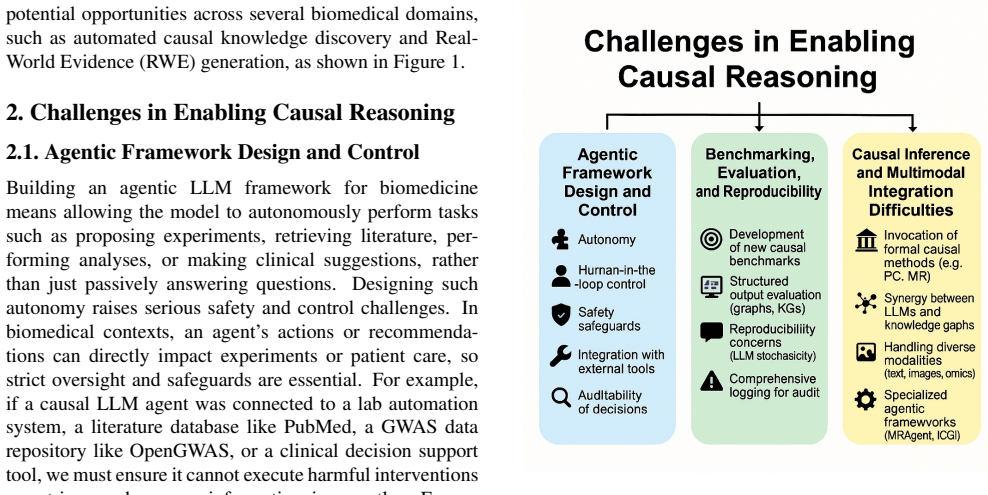
Summary. This position paper argues that current LLMs are correlation-based and lack causal understanding, and it proposes a research agenda for 'causal LLM agents' that integrate LLMs with knowledge graphs, formal causal inference tools, and multimodal data. It identifies four challenge areas (agentic framework design, benchmarking and evaluation, causal and multimodal integration, and the data ecosystem) and three opportunity areas (drug discovery, personalized medicine, public health and epidemiology). The paper presents no experiments or implemented system; it is explicitly a vision and agenda statement.
Significance. If the proposed integration were realized and validated, the agenda could have substantial impact on biomedical hypothesis generation, real-world evidence generation, and personalized medicine. The paper's strengths are that it explicitly frames open challenges, does not overstate empirical results, and grounds its discussion in a set of recent component systems (MRAgent, Causal Agent, ICGI, MATMCD). However, the central claim rests on an unexamined assumption that combining these components preserves the validity of causal inference; the paper itself notes the lack of standardized evaluation and the unvalidated nature of narrative-to-graph conversion, so the opportunities in Section 3 should be read as hypotheses rather than demonstrated capabilities.
major comments (3)
- [§2.3, §4] The load-bearing premise, stated most directly in §2.3 and reinforced in §4 where 'synergistic integration appears paramount,' is that an LLM agent invoking formal causal tools (MR, DML, PC) will produce valid causal conclusions. The manuscript does not address the identifiability assumptions on which these tools depend: MR requires valid instruments satisfying relevance, independence, and exclusion restriction; DML requires unconfoundedness and overlap; PC requires Markov and faithfulness assumptions and the absence of hidden common causes. The paper provides no mechanism by which the agent would verify these assumptions, no sensitivity analysis, and no discussion of how literature-derived graph priors might bias causal search. Because the abstract and §3 claim these agents 'infer cause-and-effect,' this is a load-bearing gap rather than a presentation issue. I ask the authors to add a substantive discussion of assumption checking, validation against benchmark data with known ground-truth causal structure, and audit procedures for violations.
- [§3, §2.2] The opportunities in §3 are presented as near-term capabilities, but the cited systems cover only components and none demonstrates end-to-end reliable causal reasoning. For example, MRAgent automates MR workflows but does not establish that the resulting MR estimates are assumption-valid; ICGI combines causal prompting with DML but does not validate unconfoundedness; MATMCD integrates modalities but is not evaluated for causal correctness. §2.2 itself states that 'standardized protocols are lacking' and §2.3 flags narrative-to-graph conversion as 'unvalidated,' yet downstream causal conclusions would inherit errors from such conversions. The paper should either explicitly label the opportunities in §3 as open research hypotheses or provide a validation roadmap with concrete benchmarks and success criteria.
- [§2.1, §2.3] The safety and control discussion in §2.1 treats control and causal inference as separate concerns, but they interact directly: if an agent executes an MR or DML analysis on invalid instruments or confounded data, the resulting confident but wrong causal output is itself a safety failure in biomedical decision support. The paper should connect the control challenge to the causal-validity challenge, for example by requiring the agent to report uncertainty and assumption checks before acting on causal conclusions, and by discussing how permission gating or human oversight would apply to the execution of causal analyses rather than only to physical interventions.
minor comments (4)
- [§2.1, §3.1] The text contains the typo 'GW AS' instead of 'GWAS' in two places, including 'OpenGW AS'; please correct these to 'GWAS' and 'OpenGWAS'.
- [§2.2] In the sentence mentioning 'T ¨ubingen pairs,' the umlaut and spacing are corrupted; the intended name is 'Tübingen pairs'.
- [§1] In the opening paragraph, the phrase 'Correlation is not causation – a mantra especially critical in biomedical research [11]' would read more clearly if the citation were placed immediately after the quoted mantra.
- [References] Several references use inconsistent formatting, including occasional 'et al.' truncation and workshop names without complete venue details; please normalize all entries to the journal's reference style.
Circularity Check
No significant circularity: this is a position/vision paper with no derived result that reduces to its own inputs or to load-bearing self-citations.
full rationale
The paper is a position paper: it proposes a research agenda for 'causal LLM agents' in biomedicine, but it contains no formal derivation, no equations, no fitted parameters, and no implemented system whose output is compared with its own input. The central claim is that integrating LLMs with knowledge graphs, formal causal tools (e.g., MR, DML, PC), and multimodal data inside agentic frameworks could move biomedicine beyond correlation-based AI. That claim is presented as a vision and supported by external examples (MRAgent, Causal Agent, ICGI, MATMCD, etc.), not derived by construction from any definition or fit. The authors do cite their own prior work ([1]-[4]) in supporting roles: as examples of agentic frameworks for hypothesis generation, multi-agent evaluation, and a drug-cell interaction vision system. However, none of these self-citations is load-bearing for the causal-inference claim; they are illustrative references for component capabilities. The paper itself flags the key open problems (safe control in Section 2.1, lack of standardized evaluation in Section 2.2, and unvalidated narrative-to-graph conversion in Section 2.3), which further shows that the authors are not presenting a completed derivation. There is no step where a 'prediction' or 'first-principles result' reduces to its own input, no uniqueness theorem imported from the authors' own prior work, and no ansatz smuggled in via self-citation. The vision may be optimistic or empirically undersupported, but that is a correctness or feasibility concern, not circularity. Therefore the appropriate finding is no significant circularity.
Assumptions & free parameters
assumptions (4)
- domain assumption LLMs lack true causal understanding and mostly learn correlations.
- domain assumption Combining LLMs with knowledge graphs, formal causal tools, and agentic orchestration will yield reliable causal reasoning.
- domain assumption Agentic frameworks can be made safe, auditable, and controllable while retaining autonomy.
- domain assumption Large-scale multimodal biomedical datasets are or will be available for training and validation.
invented entities (1)
-
Causal LLM agent
Cite this review
Pith. "Pith review of Beyond Correlation: Towards Causal Large Language Model Agents in Biomedicine." pith.science (2026). https://pith.science/paper/WXT2UH52
@misc{pith2026250516982,
  author       = {Pith},
  title        = {Pith review of: Beyond Correlation: Towards Causal Large Language Model Agents in Biomedicine},
  year         = {2026},
  howpublished = {\url{https://pith.science/paper/WXT2UH52}},
  note         = {Machine review of arXiv:2505.16982}
}
read the original abstract
Large Language Models (LLMs) show promise in biomedicine but lack true causal understanding, relying instead on correlations. This paper envisions causal LLM agents that integrate multimodal data (text, images, genomics, etc.) and perform intervention-based reasoning to infer cause-and-effect. Addressing this requires overcoming key challenges: designing safe, controllable agentic frameworks; developing rigorous benchmarks for causal evaluation; integrating heterogeneous data sources; and synergistically combining LLMs with structured knowledge (KGs) and formal causal inference tools. Such agents could unlock transformative opportunities, including accelerating drug discovery through automated hypothesis generation and simulation, enabling personalized medicine through patient-specific causal models. This research agenda aims to foster interdisciplinary efforts, bridging causal concepts and foundation models to develop reliable AI partners for biomedical progress.
Figures

Reference graph
Works this paper leans on
-
[1]
Drug discovery agent: An automated vision detection system for drug-cell interactions
Adib Bazgir and Yuwen Zhang. Drug discovery agent: An automated vision detection system for drug-cell interactions. In 1st CVPR Workshop on Computer Vision For Drug Dis- covery (CVDD): Where are we and What is Beyond?, 2025. 4
work page 2025
-
[4]
Agentichypothesis: A sur- vey on hypothesis generation using llm systems
Adib Bazgir, Yuwen Zhang, et al. Agentichypothesis: A sur- vey on hypothesis generation using llm systems. In Towards Agentic AI for Science: Hypothesis Generation, Comprehen- sion, Quantification, and Validation, 2025. 1, 4
work page 2025
-
[2]
Adib Bazgir, Yuwen Zhang, et al. Proteinhypothesis: A physics-aware chain of multi-agent rag llm for hypothesis generation in protein science. In Towards Agentic AI for Sci- ence: Hypothesis Generation, Comprehension, Quantifica- tion, and Validation, 2025. 2, 4
work page 2025
-
[3]
Adib Bazgir, Yuwen Zhang, et al. Matagent: A human-in- the-loop multi-agent llm framework for accelerating the ma- terial science discovery cycle. In AI for Accelerated Materi- als Design-ICLR 2025, 2025. 2
work page 2025
-
[5]
Testing and evaluation of health care applications of large language models: a systematic review
Suhana Bedi, Yutong Liu, Lucy Orr-Ewing, Dev Dash, Sanmi Koyejo, Alison Callahan, Jason A Fries, Michael Wornow, Akshay Swaminathan, Lisa Soleymani Lehmann, et al. Testing and evaluation of health care applications of large language models: a systematic review. JAMA, 2024. 2
work page 2024
-
[6]
Empowering biomedical discovery with ai agents
Shanghua Gao, Ada Fang, Yepeng Huang, Valentina Giunchiglia, Ayush Noori, Jonathan Richard Schwarz, Yasha Ektefaie, Jovana Kondic, and Marinka Zitnik. Empowering biomedical discovery with ai agents. Cell, 187(22):6125– 6151, 2024. 2, 4
work page 2024
-
[7]
Javier Gonz ´alez, Cliff Wong, Zelalem Gero, Jass Bagga, Risa Ueno, Isabel Chien, Eduard Oravkin, Emre Kiciman, Aditya Nori, Roshanthi Weerasinghe, et al. Trialscope: a unifying causal framework for scaling real-world evidence generation with biomedical language models. arXiv preprint arXiv:2311.01301, 2023. 1, 3
arXiv 2023
-
[8]
Causal agent based on large language model
Kairong Han, Kun Kuang, Ziyu Zhao, Junjian Ye, and Fei Wu. Causal agent based on large language model. arXiv preprint arXiv:2408.06849, 2024. 1, 3, 4
arXiv 2024
Show all 22 references
-
[9]
Causal reasoning and large language models: Open- ing a new frontier for causality
Emre Kiciman, Robert Ness, Amit Sharma, and Chenhao Tan. Causal reasoning and large language models: Open- ing a new frontier for causality. Transactions on Machine Learning Research, 2023. 1, 2, 3
2023
-
[10]
A generalist medical language model for disease diagnosis assistance
Xiaohong Liu, Hao Liu, Guoxing Yang, Zeyu Jiang, Shuguang Cui, Zhaoze Zhang, Huan Wang, Liyuan Tao, Yongchang Sun, Zhu Song, et al. A generalist medical language model for disease diagnosis assistance. Nature Medicine, pages 1–11, 2025. 1, 2, 3, 4
2025
-
[11]
Molecular causality in the advent of foundation models
Sebastian Lobentanzer, Pablo Rodriguez-Mier, Stefan Bauer, and Julio Saez-Rodriguez. Molecular causality in the advent of foundation models. Molecular Systems Biology , 20(8): 848–858, 2024. 1
2024
-
[12]
A large-scale vision-language dataset derived from open scientific liter- ature to advance biomedical generalist ai
Alejandro Lozano, Min Woo Sun, James Burgess, Jeffrey J Nirschl, Christopher Polzak, Yuhui Zhang, Liangyu Chen, Jeffrey Gu, Ivan Lopez, Josiah Aklilu, et al. A large-scale vision-language dataset derived from open scientific liter- ature to advance biomedical generalist ai. ar...
2025 arXiv
-
[13]
Chris Ludlow. Investigating the capability of large language models to identify causal relations in psychiatric case stud- ies: A methodological proof of concept for the analysis of psychological case formulations. LLMs and Psychiatric Cases, 2025. 1, 2, 3
2025
-
[14]
Foundation models for generalist medi- cal artificial intelligence
Michael Moor, Oishi Banerjee, Zahra Shakeri Hossein Abad, Harlan M Krumholz, Jure Leskovec, Eric J Topol, and Pranav Rajpurkar. Foundation models for generalist medi- cal artificial intelligence. Nature, 616(7956):259–265, 2023. 1
2023
-
[15]
Synergistic joint model of knowledge graph and llm for enhancing xai-based clinical decision support systems
Chaelim Park, Hayoung Lee, Seonghee Lee, and Okran Jeong. Synergistic joint model of knowledge graph and llm for enhancing xai-based clinical decision support systems. Mathematics, 13(6):949, 2025. 1, 3
2025
-
[16]
Medg-krp: Medical graph knowledge representation probing
Gabriel R Rosenbaum, Lavender Yao Jiang, Ivaxi Sheth, Jaden Stryker, Anton Alyakin, Daniel Alexander Alber, Nicolas K Goff, Young Joon Fred Kwon, John Mark- ert, Mustafa Nasir-Moin, et al. Medg-krp: Medical graph knowledge representation probing. arXiv preprint arXiv:2412.1098...
2024 arXiv
-
[17]
Exploring multi-modal integration with tool-augmented llm agents for precise causal discovery
ChengAo Shen, Zhengzhang Chen, Dongsheng Luo, Dongkuan Xu, Haifeng Chen, and Jingchao Ni. Exploring multi-modal integration with tool-augmented llm agents for precise causal discovery. arXiv preprint arXiv:2412.13667,
-
[18]
Xingqiao Wang, Xiaowei Xu, Zhichao Liu, and Weida Tong. Bidirectional encoder representations from transformers-like large language models in patient safety and pharmacovigi- lance: A comprehensive assessment of causal inference im- plications. Experimental Biology and Medicin...
1908
-
[19]
Causality for large language models
Anpeng Wu, Kun Kuang, Minqin Zhu, Yingrong Wang, Yu- jia Zheng, Kairong Han, Baohong Li, Guangyi Chen, Fei Wu, and Kun Zhang. Causality for large language models. arXiv preprint arXiv:2410.15319, 2024. 3
2024 arXiv
-
[20]
Mragent: an llm-based automated agent for causal knowledge discovery in disease via mendelian randomiza- tion
Wei Xu, Gang Luo, Weiyu Meng, Xiaobing Zhai, Keli Zheng, Ji Wu, Yanrong Li, Abao Xing, Junrong Li, Zhifan Li, et al. Mragent: an llm-based automated agent for causal knowledge discovery in disease via mendelian randomiza- tion. Briefings in Bioinformatics, 26(2):bbaf140, 2025....
2025
-
[21]
Chatdiet: Empowering personalized nutrition-oriented food recommender chatbots through an llm-augmented frame- work
Zhongqi Yang, Elahe Khatibi, Nitish Nagesh, Mahyar Ab- basian, Iman Azimi, Ramesh Jain, and Amir M Rahmani. Chatdiet: Empowering personalized nutrition-oriented food recommender chatbots through an llm-augmented frame- work. Smart Health, 32:100465, 2024. 1, 4
2024
-
[22]
Cancer gene identification through integrating causal prompting large language model with omics data–driven causal inference
Haolong Zeng, Chaoyi Yin, Chunyang Chai, Yuezhu Wang, Qi Dai, and Huiyan Sun. Cancer gene identification through integrating causal prompting large language model with omics data–driven causal inference. Briefings in Bioinfor- matics, 26(2):624, 2025. 1, 2, 3, 4
2025
Reviewed August 7, 2026 · model on record in the stance chip above.
Discussion (0). Continue with ORCID to comment.