REVIEW 3 major objections 4 minor 79 references
Quantum states supported by matroids
T0 review · 3 major / 4 minor · reviewed 2026-08-01 · deepseek-v4-flash
Pith's one-line read The paper claims a structural correspondence between quantum states and matroids: for states whose support is a matroid's base collection, genuine multipartite entanglement is governed by matroid connectivity, and Z-measurements act as matr
desk verdict A genuinely new matroid-to-quantum dictionary, but the central lemma connecting irreducibility to GME is false, so the main theorems need repair; the framework looks salvageable. read the letter →
The pith
A machine-rendered reading of the paper's core claim, the machinery that carries it, and where it could break.
The reading
What carries the argument
The load-bearing tool is the generating polynomial of a quantum state: the multiaffine polynomial whose monomials are the computational basis states in the support, with amplitudes as coefficients. The paper uses two lemmas to connect quantum and combinatorial notions: a state is genuinely entangled if and only if its generating polynomial is irreducible, and a multiaffine polynomial whose support is the set of bases of a connected matroid is irreducible. Matroid connectivity, deletion/contraction, and duality then carry the entanglement, measurement, and duality results.
What would settle it
The 3-qubit state |100⟩ has generating polynomial x1, which is irreducible over the complex numbers, yet the state factors as |1⟩⊗|00⟩ and is therefore not genuinely entangled. This directly contradicts the 'irreducible implies genuinely entangled' half of Lemma 9, the step that carries Theorem 1 and the sufficiency half of Theorem 2. A similar test is |0⟩⊗(|10⟩+|01⟩), whose polynomial x2+x3 is irreducible while the state is a product across the partition {1}|{2,3}.
Extended reading notes
Core claim
The paper's central discovery is a correspondence between quantum entanglement and matroid structure. For a state whose support is exactly the collection of bases of a matroid, the paper claims that the combinatorial property of matroid connectivity controls genuine multipartite entanglement: connectedness of the supporting matroid is sufficient for such a state to be genuinely entangled, and for the uniform superposition over all bases it is necessary and sufficient. The same dictionary maps a Z-basis measurement on one qubit to deletion (outcome 0) or contraction (outcome 1), so any sequence of Z-measurements yields a matroid minor of the original supporting matroid. Finally, applying X⊗n
Load-bearing premise
The argument leans on the equivalence between genuine entanglement and irreducibility of the generating polynomial — specifically, the direction that says an irreducible generating polynomial forces the state to be genuinely entangled; if that equivalence has exceptions, the connected-matroid-suffices claims lose their proof.
Editorial extensions
If this is right
- Every matroid-base state over a connected matroid is guaranteed genuinely entangled, giving W states, Dicke states, and uniform matroid superpositions a uniform combinatorial certificate of GME.
- For matroid-base states, disconnection of the matroid certifies biseparability, so whether such a state is genuinely entangled can be decided by a purely combinatorial test on the matroid, independent of amplitudes.
- Z-basis measurements on a matroid-supported state preserve the matroid-supported form: outcome 0 deletes the measured element and outcome 1 contracts it, so any sequence of Z-measurements yields a state supported on a matroid minor.
- The X⊗n dual of a matroid-supported state is supported on the dual matroid, and the dual of a matroid-base state is the base state of the dual matroid; genuine entanglement is preserved under this duality.
- Matroid duality and connectivity are linked, so the connectedness of a state's supporting matroid and the connectedness of its dual matroid are equivalent.
Reading between the lines
- If the correspondence is robust, entanglement measures of matroid-base states become indirect probes of matroid connectivity, and matroid algorithms could certify GME without ever writing down the state.
- A testable extension is to scan all matroids on small ground sets and compare connectedness against the genuine entanglement of their base states; this would separate the combinatorial criterion from artifacts of the polynomial lemma.
- Because the proof hinges on a polynomial irreducibility lemma, a conservative refinement would restrict the claimed criterion to states whose generating polynomials satisfy a nondegeneracy condition, and test whether the connected-matroid characterization survives on that class.
Editorial analysis
A structured set of objections, weighed in public.
Referee Report
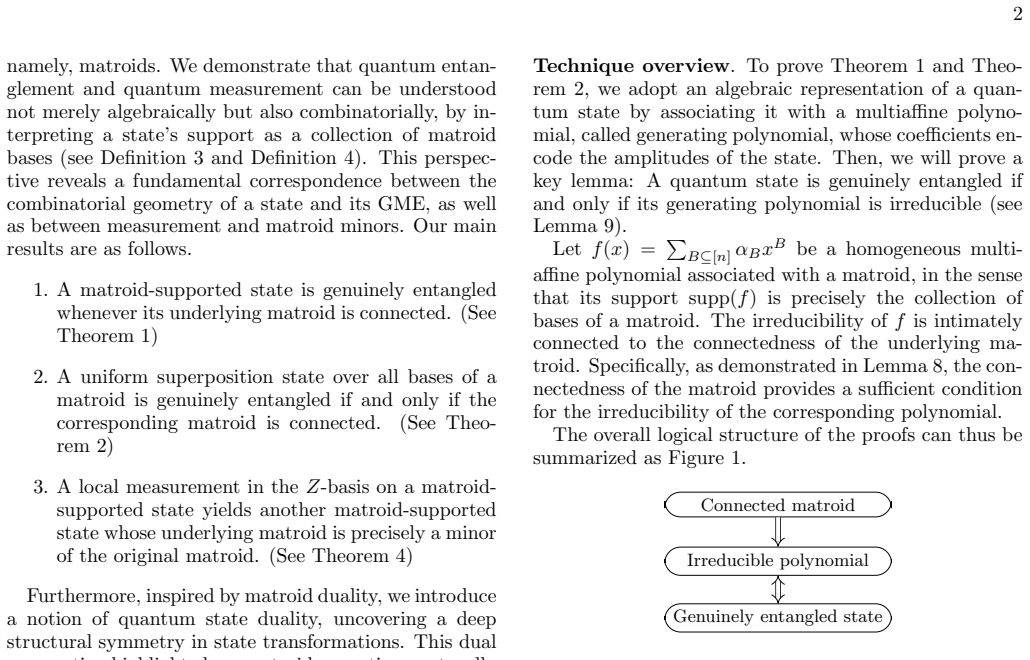
Summary. The paper introduces matroid-supported quantum states and matroid-base states, associating to each n-qubit state a multiaffine generating polynomial whose support is the set of bases of a matroid. It claims: (i) any matroid-supported state whose supporting matroid is connected is genuinely multipartite entangled (Theorem 1); (ii) a uniform superposition over all bases of a matroid is GME iff the matroid is connected (Theorem 2); (iii) Z-basis measurements produce matroid-supported states whose supporting matroid is a minor (Theorem 4); and (iv) a 'dual state' defined by X^{⊗n} corresponds to matroid duality (Propositions 5–7). The proof strategy is to connect matroid connectivity to polynomial irreducibility and then to GME via Lemma 9.
Significance. The proposed combinatorial characterization is attractive and, if established, would give a coefficient-independent sufficient condition for GME in matroid-supported states and a complete characterization for matroid-base states. The measurement–minor correspondence is elegant and appears essentially correct. The paper also contains useful examples, including Example 5, which correctly shows that a disconnected supporting matroid does not preclude GME. However, the central algebraic bridge, Lemma 9, is false as stated, and the complex-coefficient extension of Lemma 8 is not justified. These are load-bearing issues for Theorems 1–2, so the paper cannot be accepted in its present form, although the main theorems may be salvageable by a direct support-factorization argument.
major comments (3)
- [Section III.A, Lemma 9] Lemma 9 states that a quantum state is genuinely entangled iff its generating polynomial is irreducible. The converse direction is false. For |ψ⟩=|1⟩⊗|00⟩, g_ψ(x)=x_1, which is irreducible over C, yet the state is biseparable under the partition {1}|{2,3}. Even within the matroid-supported class, |φ⟩=|0⟩⊗(|10⟩+|01⟩) has support {{2},{3}}, which is the set of bases of the matroid U_{0,1}⊕U_{1,2} on [3], and g_φ(x)=x_2+x_3 is irreducible while |φ⟩ is a product across {1}|{2,3}. Since Theorem 1 is proved by composing Lemma 8 with Lemma 9, and Theorem 2's sufficiency relies on Theorem 1, the proof framework in Figure 1 does not go through. The statements of Theorems 1–2 may still be true and repairable, e.g. by showing that a biseparable matroid-supported state has support of the form X×Y and hence a disconnected supporting matroid, but that argument is not in the manuscript.
- [Section III.A, Lemma 8] Lemma 8 asserts that a multiaffine polynomial whose support is the bases of a connected matroid is irreducible over C, citing [36, Prop. 4.6] for real coefficients and claiming that the result holds over complex coefficients 'without requiring any changes to the proof.' This is not self-evident: real irreducibility does not imply complex irreducibility in general. No proof of the complex-coefficient extension is supplied. Since Lemma 8 is the only route from connectedness to irreducibility used in Theorem 1, this is a second load-bearing gap in the proof. A support-based factorization argument would avoid this issue entirely.
- [Section III.B, Theorem 2] The necessity direction of Theorem 2 uses Lemma 9 to infer irreducibility of the generating polynomial from GME. Although that particular implication is true (it is the contrapositive of reducible⇒biseparable), the proof as written relies on the false equivalence stated in Lemma 9, so it is not valid within the manuscript's logical framework. Moreover, the sufficiency direction depends on Theorem 1, whose proof is invalid for the reasons above. The theorem may be true, but the presented proof needs to be rebuilt on a sound lemma.
minor comments (4)
- [Definition 12, Eq. (15)] The definition of the dual state is missing the complement on the basis label. X^{⊗n}|S⟩ = |E\S⟩ (or |\bar S⟩), so |ψ⟩^* should be written as ∑_S α_S |E\S⟩, not ∑_S α_S |S⟩. The same omission appears in Eq. (17)–(18) of Proposition 6, where the state is rewritten as a sum over B(M*) without changing the basis label; the conclusion is true but the displayed algebra is incorrect.
- [Section III.A, Lemma 9 proof] The direction labels (⇐) and (⇒) in the proof are confusing: the first part proves biseparable⇒reducible, and the second proves reducible⇒biseparable. More importantly, the reducible⇒biseparable argument implicitly assumes that both factors are non-constant; the counterexample |100⟩ arises precisely because one factor may be the constant polynomial 1.
- [Corollary 3 and Section IV.B] Minor typos: 'unifom matroid' should be 'uniform matroid'; 'matriods' should be 'matroids'; the phrase 'affine homogeneous polynomial' in Section III should be 'multiaffine homogeneous polynomial'.
- [Lemma 10] The notation B_e and B^e is introduced informally. It would help to define B_e = {B∈B : e∉B} and B^e = {B∈B : e∈B} explicitly before the proof, and to state the loop/coloop edge cases, since Definition 8 treats those separately.
Circularity Check
No circular derivation: central claims rest on external [36] results, not self-citations. The false Lemma 9 and unproved complex-coefficient extension are correctness/rigor defects, not circularity.
full rationale
The paper's derivation chain is: Definition 3/4 (matroid-supported and matroid-base states) -> generating polynomial Eq. (8) -> Lemma 7/8 from external [36] -> Lemma 9 (GME iff irreducible) -> Theorem 1/2. No parameter is fitted and no 'prediction' is statistically forced. Lemma 7 and Lemma 8 are cited to Choe-Oxley-Sokal-Wagner [36], external prior work, and are the load-bearing algebraic inputs; the authors' own prior papers appear only in related-work/discussion (e.g., [24-26], [43,51,55-59,61]) and are not used in the proof of the main theorems. The equivalence in Lemma 9 is not circular: it is a proposed mathematical characterization and its proof uses the identity g_{psi_A ⊗ psi_B}=g_{psi_A} g_{psi_B}; even though the converse is false (e.g., |100> has generating polynomial x1, irreducible, but is biseparable; |0>⊗(|10>+|01>) has generating polynomial x2+x3, irreducible, but is not GME), that is a mathematical error, not a reduction of the theorem to its own input. Likewise, the assertion in Section III.A that [36, Prop 4.6] extends to complex coefficients 'without requiring any changes to the proof' is an omitted proof/unsupported claim, but it is not a self-citation or a fitted-input circularity. The measurement-minor results and duality propositions are direct computations from the definitions and external matroid facts. Therefore, while the paper's proof framework (Figure 1) is invalid as stated, the invalidity is a correctness problem, not circular reasoning; the circularity score is minimal.
Assumptions & free parameters
assumptions (5)
- standard math Lemma 7: factorization of a multiaffine polynomial into two polynomials forces a partition of variables into disjoint sets (cited from [36], Lemma 4.7).
- domain assumption Lemma 8: a multiaffine polynomial whose support is the bases of a connected matroid is irreducible; cited from [36, Prop 4.6] for real coefficients and asserted to extend to complex coefficients without proof.
- domain assumption The states under study are assumed already known to be matroid-supported; the paper states 'we assume that we already know it is a matroid-supported state' (Section II.A).
- domain assumption Projective Z-basis measurements on distinct qubits commute (Fact 2 in Theorem 4 proof).
- domain assumption Definition of genuine multipartite entanglement as not biseparable under any bipartition (Definition 1); factor states need not be normalized and n=1 is treated vacuously.
Cite this review
Pith. "Pith review of Quantum states supported by matroids." pith.science (2026). https://pith.science/paper/WXVQ47Z7
@misc{pith2026260715548,
  author       = {Pith},
  title        = {Pith review of: Quantum states supported by matroids},
  year         = {2026},
  howpublished = {\url{https://pith.science/paper/WXVQ47Z7}},
  note         = {Machine review of arXiv:2607.15548}
}
abstract
In this work, we establish a structural correspondence between quantum states and matroid theory. This connection demonstrates that key properties of quantum states, including entanglement and measurement, can be characterized in purely combinatorial terms via matroids, despite the apparent conceptual distance between these two fields. Using this framework, we show that a matroid-supported state is genuinely entangled when its underlying matroid is connected. Moreover, a uniform superposition over all bases of a matroid is genuinely entangled if and only if the matroid is connected. We also demonstrate that a local measurement in the $Z$-basis on such a state yields another matroid-supported state, whose underlying matroid is a minor of the original one. Inspired by matroid duality, we further propose a notion of quantum state duality, uncovering a deep structural symmetry in state transformations.
Figures


Figures from the paper (1 more)

Reference graph
Works this paper leans on
-
[36]
Kulkarni and M
R. Kulkarni and M. Santha, Query complexity of ma- troids, inInternational Conference on Algorithms and Complexity(Springer, 2013) pp. 300–311
2013
-
[3]
(See Theorem 4) Furthermore, inspired by matroid duality, we introduce a notion of quantum state duality, uncovering a deep structural symmetry in state transformations
A local measurement in theZ-basis on a matroid- supported state yields another matroid-supported state whose underlying matroid is precisely a minor of the original matroid. (See Theorem 4) Furthermore, inspired by matroid duality, we introduce a notion of quantum state duality, uncovering a deep structural symmetry in state transformations. This dual per...
-
[1]
(See Theorem 1)
A matroid-supported state is genuinely entangled whenever its underlying matroid is connected. (See Theorem 1)
-
[2]
(See Theo- rem 2)
A uniform superposition state over all bases of a matroid is genuinely entangled if and only if the corresponding matroid is connected. (See Theo- rem 2)
-
[4]
(See Propo- sition 5)
A quantum state is genuinely entangled if and only if its dual state is genuinely entangled. (See Propo- sition 5)
-
[5]
(See Proposition 6 and Proposition 7) B
The dual state of a matroid-supported state is a matroid-supported state supported by the dual ma- troid of the original matroid. (See Proposition 6 and Proposition 7) B. T echnique Entanglement, Irreducibility , and Connected- ness. The notions of quantum entanglement, polynomial irreducibility, and matroid connectedness share a unify- ing theme — indeco...
-
[6]
Bell states:|Φ ±⟩= 1√ 2 (|00⟩ ± |11⟩),|Ψ±⟩= 1√ 2 (|01⟩ ± |10⟩)
-
[7]
GHZ states:|GHZ n⟩= 1√ 2 (|0⟩⊗n +|1⟩ ⊗n)withn≥ 3being an integer
Show all 79 references
-
[8]
W states:|W n⟩= 1√n Pn i=1 |0· · ·01i0· · ·0⟩with n≥3being an integer, where1 i denotes that the i-th qubit is in state1
-
[9]
Their supports are:
Dicke states:|D n k ⟩= 1q ( n k) P S⊆[n]:|S|=k |S⟩with n, kbeing positive integers and1≤k≤n−1. Their supports are:
-
[10]
supp(|Φ ±⟩) ={∅,{1,2}}, supp(|Ψ ±⟩) = {{1},{2}}
-
[11]
supp(|GHZ n⟩) ={∅,{1,2, . . . , n}}
-
[12]
supp(|W n⟩) ={{i}:i∈[n]}
-
[13]
arbitrary
supp(|D n k ⟩) ={S⊆[n] :|S|=k}. GME is a subtle and multifaceted phenomenon, whose mathematical characterization reveals a complex inter- play between amplitude coefficients and their underly- ing structure. When the effect of these coefficients is disregarded, GME typically r...
1931
-
[14]
Einstein, B
A. Einstein, B. Podolsky, and N. Rosen, Can quantum- mechanical description of physical reality be considered complete?, Physical review47, 777 (1935)
1935
-
[15]
Schr¨ odinger, Discussion of probability relations be- tween separated systems, inMathematical Proceedings of the Cambridge Philosophical Society, Vol
E. Schr¨ odinger, Discussion of probability relations be- tween separated systems, inMathematical Proceedings of the Cambridge Philosophical Society, Vol. 31 (Cambridge University Press, 1935) pp. 555–563
1935
-
[16]
J. S. Bell, On the einstein podolsky rosen paradox, Physics Physique Fizika1, 195 (1964)
1964
-
[17]
Aspect, P
A. Aspect, P. Grangier, and G. Roger, Experimental real- ization of einstein-podolsky-rosen-bohm gedankenexper- iment: a new violation of bell’s inequalities, Physical re- view letters49, 91 (1982)
1982
-
[18]
Horodecki, P
R. Horodecki, P. Horodecki, M. Horodecki, and K. Horodecki, Quantum entanglement, Reviews of mod- ern physics81, 865 (2009)
2009
-
[19]
Bengtsson and K
I. Bengtsson and K. ˙Zyczkowski,Geometry of quantum states: an introduction to quantum entanglement(Cam- bridge university press, 2017)
2017
-
[20]
Raussendorf, D
R. Raussendorf, D. E. Browne, and H. J. Briegel, Measurement-based quantum computation on cluster states, Physical review A68, 022312 (2003)
2003
-
[21]
Q. Zhao, Y. Zhou, and A. M. Childs, Entanglement ac- celerates quantum simulation, Nature Physics , 1 (2025)
2025
-
[22]
Karlsson and M
A. Karlsson and M. Bourennane, Quantum teleportation using three-particle entanglement, Physical Review A58, 4394 (1998)
1998
-
[23]
Yin, Y.-H
J. Yin, Y.-H. Li, S.-K. Liao, M. Yang, Y. Cao, L. Zhang, J.-G. Ren, W.-Q. Cai, W.-Y. Liu, S.-L. Li,et al., Entanglement-based secure quantum cryptography over 1,120 kilometres, Nature582, 501 (2020)
2020
-
[24]
Makuta and R
O. Makuta and R. Augusiak, Self-testing maximally- dimensional genuinely entangled subspaces within the stabilizer formalism, New Journal of Physics23, 043042 (2021)
2021
-
[25]
Makuta and R
O. Makuta and R. Augusiak, All genuinely entangled stabilizer subspaces are multipartite fully nonlocal, npj Quantum Information11, 144 (2025)
2025
-
[26]
A. W. Chin, S. F. Huelga, and M. B. Plenio, Quantum metrology in non-markovian environments, Physical re- view letters109, 233601 (2012)
2012
-
[27]
Demkowicz-Dobrza´ nski and L
R. Demkowicz-Dobrza´ nski and L. Maccone, Using entan- glement against noise in quantum metrology, Physical re- view letters113, 250801 (2014)
2014
-
[28]
S. Cao, B. Wu, F. Chen, M. Gong, Y. Wu, Y. Ye, C. Zha, H. Qian, C. Ying, S. Guo,et al., Generation of genuine entanglement up to 51 superconducting qubits, Nature 619, 738 (2023)
2023
-
[29]
Whitney, On the abstract properties of linear depen- dence, inHassler Whitney Collected Papers(Springer,
H. Whitney, On the abstract properties of linear depen- dence, inHassler Whitney Collected Papers(Springer,
-
[30]
Nakasawa, Zur axiomatik der linearen abh¨ angigkeit
T. Nakasawa, Zur axiomatik der linearen abh¨ angigkeit. i, Science Reports of the Tokyo Bunrika Daigaku, Section A2, 235 (1935)
1935
-
[31]
Shepherd and M
D. Shepherd and M. J. Bremner, Temporally unstruc- tured quantum computation, Proceedings of the Royal Society A: Mathematical, Physical and Engineering Sci- ences465, 1413 (2009)
2009
-
[32]
Shepherd, Binary matroids and quantum probability distributions, arXiv preprint arXiv:1005.1744 (2010)
D. Shepherd, Binary matroids and quantum probability distributions, arXiv preprint arXiv:1005.1744 (2010)
2010 arXiv
-
[33]
R. L. Mann, Simulating quantum computations with tutte polynomials, npj Quantum Information7, 141 (2021)
2021
-
[34]
Sarvepalli and R
P. Sarvepalli and R. Raussendorf, Matroids and quantum-secret-sharing schemes, Physical Review A—Atomic, Molecular, and Optical Physics81, 052333 (2010)
2010
-
[35]
M. Amy, D. Maslov, and M. Mosca, Polynomial-time t- depth optimization of clifford+ t circuits via matroid par- titioning, IEEE Transactions on Computer-Aided Design of Integrated Circuits and Systems33, 1476 (2014)
2014
-
[37]
Huang, S
X. Huang, S. Zhang, and L. Li, Quantum algorithms for learning hidden strings with applications to matroid problems, Theoretical Computer Science981, 114255 (2024)
2024
-
[38]
Huang, J
X. Huang, J. Luo, and L. Li, Quantum speedup and limi- tations on matroid property problems, Frontiers of Com- puter Science18, 184905 (2024)
2024
-
[39]
Huang, S
X. Huang, S. Feng, and L. Li, Quantum and classical query complexities for determining connectedness of ma- troids, Journal of Computer and System Sciences157, 103758 (2026)
2026
-
[40]
Gurvits, Classical deterministic complexity of ed- monds’ problem and quantum entanglement, inProceed- ings of the thirty-fifth annual ACM symposium on Theory of computing(2003) pp
L. Gurvits, Classical deterministic complexity of ed- monds’ problem and quantum entanglement, inProceed- ings of the thirty-fifth annual ACM symposium on Theory of computing(2003) pp. 10–19
2003
-
[41]
Gurvits, Classical complexity and quantum entangle- ment, Journal of Computer and System Sciences69, 448 (2004)
L. Gurvits, Classical complexity and quantum entangle- ment, Journal of Computer and System Sciences69, 448 (2004)
2004
-
[42]
Sarvepalli and R
P. Sarvepalli and R. Raussendorf, Local equivalence, surface-code states, and matroids, Physical Review 12 A—Atomic, Molecular, and Optical Physics82, 022304 (2010)
2010
-
[43]
Sarvepalli, Quantum codes and symplectic matroids, in2014 IEEE International Symposium on Information Theory(IEEE, 2014) pp
P. Sarvepalli, Quantum codes and symplectic matroids, in2014 IEEE International Symposium on Information Theory(IEEE, 2014) pp. 1076–1080
2014
-
[44]
M. Hein, J. Eisert, and H. J. Briegel, Multiparty en- tanglement in graph states, Physical Review A—Atomic, Molecular, and Optical Physics69, 062311 (2004)
2004
-
[45]
Rossi, M
M. Rossi, M. Huber, D. Bruß, and C. Macchiavello, Quantum hypergraph states, New Journal of Physics15, 113022 (2013)
2013
-
[46]
Bethe, On the theory of metals, i
H. Bethe, On the theory of metals, i. eigenvalues and eigenfunctions of a linear chain of atoms, inSelected Works Of Hans A Bethe: (With Commentary)(World Scientific, 1997) pp. 155–183
1997
-
[47]
Oxley,Matroid theory, 2nd ed., Oxford Graduate Texts in Mathematics, Vol
J. Oxley,Matroid theory, 2nd ed., Oxford Graduate Texts in Mathematics, Vol. 21 (Oxford University Press, Ox- ford, 2011) pp. xiv+684
2011
-
[48]
D. J. A. Welsh,Matroid theory, L. M. S. Monographs, No. 8 (Academic Press [Harcourt Brace Jovanovich, Publish- ers], London-New York, 1976) pp. xi+433
1976
-
[49]
Y.-B. Choe, J. G. Oxley, A. D. Sokal, and D. G. Wagner, Homogeneous multivariate polynomials with the half- plane property, Advances in Applied Mathematics32, 88 (2004)
2004
-
[50]
M. A. Nielsen and I. L. Chuang,Quantum computation and quantum information(Cambridge university press, 2010)
2010
-
[51]
Monras, G
A. Monras, G. Adesso, S. M. Giampaolo, G. Gualdi, G. B. Davies, and F. Illuminati, Entanglement quan- tification by local unitary operations, Physical Review A—Atomic, Molecular, and Optical Physics84, 012301 (2011)
2011
-
[52]
V. V. Shende, S. S. Bullock, and I. L. Markov, Synthesis of quantum logic circuits, inProceedings of the 2005 Asia and South Pacific Design Automation Conference(2005) pp. 272–275
2005
-
[53]
X. Sun, G. Tian, S. Yang, P. Yuan, and S. Zhang, Asymp- totically optimal circuit depth for quantum state prepa- ration and general unitary synthesis, IEEE Transactions on Computer-Aided Design of Integrated Circuits and Systems42, 3301 (2023)
2023
-
[54]
Yuan and S
P. Yuan and S. Zhang, Optimal (controlled) quantum state preparation and improved unitary synthesis by quantum circuits with any number of ancillary qubits, Quantum7, 956 (2023)
2023
-
[55]
Zhang, T
X.-M. Zhang, T. Li, and X. Yuan, Quantum state preparation with optimal circuit depth: Implementations and applications, Physical Review Letters129, 230504 (2022)
2022
-
[56]
Li and J
L. Li and J. Luo, Nearly optimal circuit size for sparse quantum state preparation, in52nd International Col- loquium on Automata, Languages, and Programming (ICALP 2025)(Schloss Dagstuhl–Leibniz-Zentrum f¨ ur Informatik, 2025) pp. 113–1
2025
-
[57]
B¨ artschi and S
A. B¨ artschi and S. Eidenbenz, Deterministic prepara- tion of dicke states, inInternational Symposium on Fun- damentals of Computation Theory(Springer, 2019) pp. 126–139
2019
-
[58]
Yuan and S
P. Yuan and S. Zhang, Depth-efficient quantum circuit synthesis for deterministic dicke state preparation, arXiv preprint arXiv:2505.15413 (2025)
2025 arXiv
-
[59]
Recski, On partitional matroids with applications, Coll
A. Recski, On partitional matroids with applications, Coll. Math. Soc. J. Bolyai10, 1169 (1973)
1973
-
[60]
Raveh and R
D. Raveh and R. I. Nepomechie, Deterministic bethe state preparation, Quantum8, 1510 (2024)
2024
-
[61]
R. M. Farias, T. O. Maciel, G. Camilo, R. Lin, S. Ramos- Calderer, and L. Aolita, Quantum encoder for fixed- Hamming-weight subspaces, Physical Review Applied 23, 044014 (2025)
2025
-
[62]
R. Mao, G. Tian, and X. Sun, Toward optimal circuit size for sparse quantum state preparation, Physical Review A 110, 032439 (2024)
2024
-
[63]
Y. Li, G. Tian, X. He, and X. Sun, Preparation of hamming-weight-preserving quantum states with log- depth quantum circuits, arXiv preprint arXiv:2508.14470 (2025)
2025 arXiv
-
[64]
Luo and L
J. Luo and L. Li, Optimal circuit size for fixed-hamming- weight quantum states preparation, arXiv preprint arXiv:2508.17197 (2025)
2025 arXiv
-
[65]
Aharonov, A
D. Aharonov, A. Ambainis, J. Kempe, and U. Vazirani, Quantum walks on graphs, inProceedings of the thirty- third annual ACM symposium on Theory of computing (2001) pp. 50–59
2001
-
[66]
Ambainis, Quantum walks and their algorithmic ap- plications, International Journal of Quantum Informa- tion1, 507 (2003)
A. Ambainis, Quantum walks and their algorithmic ap- plications, International Journal of Quantum Informa- tion1, 507 (2003)
2003
-
[67]
S. E. Venegas-Andraca, Quantum walks: a comprehen- sive review, Quantum Information Processing11, 1015 (2012)
2012
-
[68]
G. Li, J. Luo, S. Feng, and L. Li, Deterministic quantum search on all laplacian integral graphs, Advanced Quan- tum Technologies9, e00606 (2026)
2026
-
[69]
Q. Wang, Y. Jiang, S. Feng, and L. Li, Unifying quantum spatial search, state transfer, and uniform sampling on graphs, Physical Review A111, 042608 (2025)
2025
-
[70]
Li and L
G. Li and L. Li, Unbounded quantum-classical separation in sample complexity for sphere center finding, Informa- tion and Computation , 105361 (2025)
2025
-
[71]
Li and L
G. Li and L. Li, Derandomization of quantum algorithm for triangle finding, Information and Computation304, 105295 (2025)
2025
-
[72]
Y. Xu, D. Zhang, and L. Li, Robust quantum walk search without knowing the number of marked vertices, Physical Review A106, 052207 (2022)
2022
-
[73]
A. M. Childs, R. Cleve, E. Deotto, E. Farhi, S. Gutmann, and D. A. Spielman, Exponential algorithmic speedup by a quantum walk, inProceedings of the thirty-fifth annual ACM symposium on Theory of computing(2003) pp. 59– 68
2003
-
[74]
G. Li, L. Li, and J. Luo, Recovering the original sim- plicity: succinct and deterministic quantum algorithm for the welded tree problem, inProceedings of the 2024 Annual ACM-SIAM Symposium on Discrete Algorithms (SODA)(SIAM, 2024) pp. 2454–2480
2024
-
[75]
Feder and M
T. Feder and M. Mihail, Balanced matroids, inProceed- ings of the twenty-fourth annual ACM symposium on Theory of computing(1992) pp. 26–38
1992
-
[76]
Anari, S
N. Anari, S. O. Gharan, and C. Vinzant, Log-concave polynomials, entropy, and a deterministic approximation algorithm for counting bases of matroids, in2018 IEEE 59th Annual Symposium on Foundations of Computer Science (FOCS)(IEEE, 2018) pp. 35–46
2018
-
[77]
Anari, K
N. Anari, K. Liu, S. O. Gharan, and C. Vinzant, Log- concave polynomials ii: high-dimensional walks and an fpras for counting bases of a matroid, inProceedings of the 51st Annual ACM SIGACT Symposium on Theory of Computing(2019) pp. 1–12. 13
2019
-
[78]
Anari and M
N. Anari and M. Derezi´ nski, Isotropy and log-concave polynomials: Accelerated sampling and high-precision counting of matroid bases, in2020 IEEE 61st An- nual Symposium on Foundations of Computer Science (FOCS)(IEEE, 2020) pp. 1331–1344
2020
-
[79]
X. Chen, H. Guo, X. Zhang, and Z. Zou, Near-linear time samplers for matroid independent sets with applications, Approximation, Randomization, and Combinatorial Op- timization. Algorithms and Techniques (2024)
2024
Reviewed August 1, 2026 · model on record in the stance chip above.
Discussion (0). Sign in to comment.