REVIEW 1 major objections 5 minor 58 references
Efficient accessible bounds to the classical capacity of quantum channels
T0 review · 1 major / 5 minor · reviewed 2026-08-14 · deepseek-v4-flash
Pith's one-line read A few local measurements certify a lower bound on any quantum channel's classical capacity
desk verdict Sound and useful: a d^2-measurement lower bound for classical capacity, but the experimental 'accessible' claim needs a finite-sample error analysis. read the letter →
The pith
A machine-rendered reading of the paper's core claim, the machinery that carries it, and where it could break.
The reading
What carries the argument
The load-bearing identity is $\mathrm{Tr}[(A \otimes B^T)(\mathcal{E} \otimes I_R)|\varphi^+\rangle\langle\varphi^+|] = \frac{1}{d}\mathrm{Tr}[A\,\mathcal{E}(B)]$, which converts local measurements of $X_i \otimes X_i^T$ on the entangled state into the channel's transition probabilities. The classical optimization of the mutual information $I^{(i)}$ over the input prior is performed with the Blahut–Arimoto recursion, guaranteeing convergence to the optimal prior for each measured basis. The detection bound is then $C_{\rm DET} = \max_i I^{(i)}$, and the paper shows this quantity satisfies $C \ge C_1 \ge C_{\rm DET}$, where $C_1$ is the Holevo capacity.
What would settle it
Run the protocol on a channel whose Holevo capacity is known analytically but whose optimal ensemble is nonorthogonal (e.g., a qubit channel violating pseudoclassicality), using finite measurement statistics, and check whether the estimated $C_{\rm DET}$ ever exceeds the known $C_1$; exceeding it would invalidate the bound as an experimental guarantee. Alternatively, add a small depolarizing noise to the reference system and observe whether the reconstructed probabilities break the assumptions of the trace identity.
Extended reading notes
Core claim
For any completely positive trace-preserving quantum channel $\mathcal{E}$ on a $d$-dimensional system, the authors construct a quantity $C_{\rm DET} = \max_i I^{(i)}$ from conditional probabilities $p^{(i)}(m|n) = \langle \varphi^{(i)}_m | \mathcal{E}(|\varphi^{(i)}_n \rangle \langle \varphi^{(i)}_n|) | \varphi^{(i)}_m \rangle$, which are obtained by measuring local observables $X_i \otimes X_i^T$ on a maximally entangled state and using the identity (3). They prove the chain $C(\mathcal{E}) \ge C_1(\mathcal{E}) \ge C_{\rm DET}$, establishing $C_{\rm DET}$ as an experimentally accessible lower bound to the classical capacity. The bound improves monotonically as more observables are measured, and for important qubit-channel classes — all unital qubit channels and pseudoclassical nonunital channels — it saturates to the Holevo capacity, so the certification is tight in those cases.
Load-bearing premise
The detection scheme presupposes a noiseless reference system and ideal projective measurements; under real finite statistics the reconstructed conditional probabilities are noisy, and the paper does not analyze how statistical overestimates could make the detected bound exceed the true capacity.
Editorial extensions
If this is right
- For a completely unknown qubit or qutrit channel, the protocol certifies a lower bound on classical capacity using only 1 to $d^2-1$ local measurement settings, whereas full process tomography requires $d^4$ parameters.
- For all unital qubit channels the detected bound is tight: $C_{\rm DET} = C_1 = C$.
- For nonunital qubit channels satisfying the pseudoclassicality condition — the shift vector parallel to a principal axis and a sufficiently thin ellipsoid — the detected bound again equals the Holevo capacity.
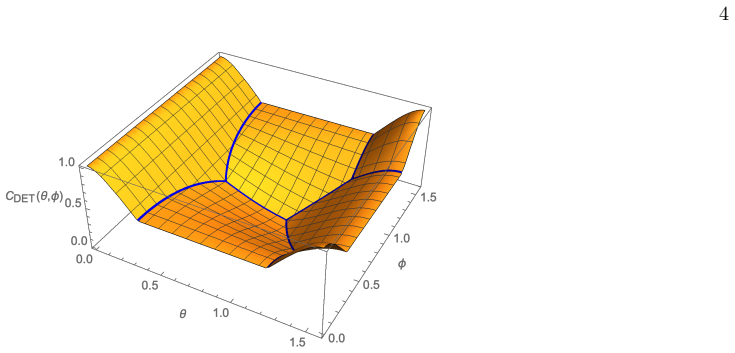
- When the measurement bases are badly matched to the unknown channel, the bound can be loose; for a dephasing channel on an unknown basis the worst-case detected capacity is $1-H(2p/3)$, illustrating the trade-off between basis choice and tightness.
- The protocol outputs an explicit encoding (input states and prior probabilities) that achieves the detected lower bound, so it can be directly used to implement a communication scheme.
Reading between the lines
- Because $C_{\rm DET}$ is a maximum over measured bases and optimized priors, finite measurement statistics can in principle push the estimated value above the true capacity; a rigorous experimental protocol would need to report confidence intervals or use a penalized estimator.
- The same local correlation measurements could be reused to certify other capacity-like quantities, such as a lower bound on the private classical capacity via the known inequality chain, though this may be considerably looser.
- An adaptive strategy that chooses the next observable $X_i$ based on previously estimated transition probabilities could approach the Holevo capacity with fewer measurement settings than a fixed set of bases.
- Applying the method to random measurement bases for high-dimensional channels could give a statistical estimate of how many bases are needed to get close to the Holevo capacity, since the bound is monotonically nondecreasing with added bases.
Signed reviews
Editorial analysis
A structured set of objections, weighed in public.
Referee Report
Summary. The paper proposes a method to obtain a lower bound on the classical capacity of an unknown quantum channel without full process tomography. The scheme prepares a maximally entangled state, applies the channel to the system half, measures local observables of the form X_i ⊗ X_i^T, and reconstructs conditional probabilities p^(i)(m|n) using the identity in Eq. (3). From these probabilities one computes I^(i), the capacity of the induced classical binary/dit channel, and defines C_DET as the maximum over i. The chain C ≥ C1 ≥ C_DET in Eq. (5) is the central result. The paper then derives explicit formulas for Pauli channels, generalized amplitude-damping channels, stretched-damping channels, extremal qubit channels, a qutrit V-shaped decay channel, dephasing on an unknown basis, and Pauli channels followed by an unknown phase rotation, using both analytic and numerical (Blahut–Arimoto) optimization.
Significance. The mathematical core is a clean and correct inequality: for exact conditional probabilities, the mutual information achievable with any fixed orthonormal input ensemble and output measurement is a lower bound on the Holevo capacity, and hence on the classical capacity. The identity in Eq. (3) provides a practical way to extract these conditional probabilities with local measurements. If the paper's protocol is implemented with rigorous statistical treatment, it would offer a valuable experimental tool for certifying a guaranteed lower bound on classical capacity for completely unknown channels, complementing the authors' earlier QDET bound for quantum capacity. The examples are well chosen and demonstrate that the bound is often tight, sometimes exactly equal to the true capacity.
major comments (1)
- [Detection strategy, Eq. (5)] The derivation of Eq. (5) is sound for exact conditional probabilities p^(i)(m|n), but the paper's claim that the method provides an 'experimentally accessible bound' is not justified under finite statistics. In practice the probabilities are estimated from a finite number of trials, and the estimated C_DET is a maximum over i and over the input prior. Because the capacity of a classical discrete memoryless channel is a convex function of its transition matrix, Jensen's inequality gives E[C(p-hat)] ≥ C(p), so the plug-in estimate is biased upward. For a zero-capacity channel, any statistical noise produces a positive estimated bound with high probability. The paper does not provide a confidence-interval construction, a one-sided test, or a sample-complexity bound. Without such a correction, the protocol does not certify a lower bound in a real experiment. I recommend adding a paragraph (or a short section) that either gives a finite-size confidence-interval procedure or explicitly states that the bound applies to ideal probabilities and that a rigorous statistical extension is needed.
minor comments (5)
- [Supplemental Material, Eq. (A.3)] The definition of z in Eq. (A.3) is ambiguous in the typeset text: it should read z = 2^{(H[ϵ0]−H[ϵ1])/(1−ϵ0−ϵ1)}, with the parentheses in the exponent made explicit.
- [Eq. (12) and surrounding text] The statement that C = C1 = CDET for Pauli channels rests on additivity of the Holevo capacity for unital qubit channels, but the cited reference [46] is not the standard theorem for qubit additivity; the authors should cite King's theorem on additivity for all qubit channels (or for unital qubit channels specifically) to make the justification precise.
- [Generalized amplitude-damping example, Eq. (17)] The claim 'We numerically checked that the maximum is always achieved by the first term in Eq. (17)' is a strong statement over the full parameter range; a brief analytic argument or a plot of the difference would make the example more convincing.
- [Extremal qubit channels, Eq. (A.8)] Similarly, the numerical check that the first term in Eq. (A.8) is always the maximizer is reported without supporting data; a short proof or figure would strengthen the example.
- [General remarks] The phrase 'number of local measurements that scales at most as d^2' should be clarified: each measurement setting X_i ⊗ X_i^T yields d^2 joint probabilities, so d^2 settings produce d^4 numbers, which is already enough for full process tomography. The advantage of the method is that a smaller number of settings still yields a nontrivial bound; this distinction should be stated explicitly to avoid a misleading scalability claim.
Circularity Check
No significant circularity: C_DET is an independent lower bound derived from standard Holevo inequalities.
full rationale
The derivation of Eq. (5) is self-contained and not circular. The detection bound C_DET is defined as max_i I^(i), where I^(i) is the mutual information of the conditional probability matrix p^(i)(m|n) reconstructed from local measurements. The chain C(E) >= C1(E) >= C_DET follows from the Holevo-Schumacher-Westmoreland theorem and from the fact that any mutual information achievable with orthogonal encodings and fixed output measurements is a valid lower bound on C1; neither side of the inequality is defined in terms of the other. The measurement reconstruction uses the identity Tr[(A⊗B^T)(E⊗I_R)|φ^+⟩⟨φ^+|] = (1/d) Tr[A E(B)], which is a standard mathematical identity, not an assumption equivalent to the target result. Self-citations to the authors' earlier QDET method (Refs. [24-27]) are contextual: the paper explicitly notes QDET gives a bound on C but is 'in general very loose', and the new C_DET bound is constructed independently from conditional probabilities and classical optimization. Benchmarks against known Holevo capacities use externally established results on additivity and pseudoclassical channels. There is no fitted parameter renamed as a prediction and no self-citation invoked to forbid alternatives. The only caveat is finite-sample bias in estimating p^(i)(m|n), which is an experimental certification issue, not circularity in the mathematical derivation.
Assumptions & free parameters
assumptions (3)
- domain assumption The channel is a memoryless completely positive trace-preserving map; the classical capacity is the regularized limit of Holevo capacities and the single-letter Holevo capacity C1 is a lower bound on C.
- domain assumption The identity Tr[(A⊗B^T)(E⊗I_R)|φ+><φ+|] = 1/d Tr[A E(B)] in Eq. (3) holds, requiring a noiseless reference system and a fixed basis for the transpose.
- standard math The Blahut-Arimoto algorithm converges to the global maximum of mutual information over the input prior for a fixed transition matrix.
Cite this review
Pith. "Pith review of Efficient accessible bounds to the classical capacity of quantum channels." pith.science (2026). https://pith.science/paper/WYYER7YD
@misc{pith2026190801614,
  author       = {Pith},
  title        = {Pith review of: Efficient accessible bounds to the classical capacity of quantum channels},
  year         = {2026},
  howpublished = {\url{https://pith.science/paper/WYYER7YD}},
  note         = {Machine review of arXiv:1908.01614}
}
read the original abstract
We present a method to detect lower bounds to the classical capacity of quantum communication channels by means of few local measurements (i.e. without complete process tomography), reconstruction of sets of conditional probabilities, and classical optimisation. The method does not require any a priori information about the channel. We illustrate its performance for significant forms of noisy channels.
Figures


Figures from the paper (3 more)


Reference graph
Works this paper leans on
-
[1]
M. A. Nielsen and I. L. Chuang, Quantum Information and Communication (Cambridge, Cambridge University Press, 2000)
work page 2000
-
[2]
That is, the channel Φ produces the affine mapping⃗ r↦→ Λ⃗ r+⃗t. Via local unitary operations acting before and after the map, the transformation matrices Λ and⃗t may be brought to the form Λ = λ1 0 0 0 λ2 0 0 0 λ3 , ⃗t = t1 t2 t3 , (9) namely, an arbitrary qubit channel Φ may be expressed as Φ = ΓU◦Φ⃗t,Λ◦ΓV , where ΓU and ΓV are unitary chann...
-
[3]
A. S. Holevo, Prob. Inf. Transm. 9, 177 (1973)
work page 1973
- [4]
-
[5]
A. S. Holevo, IEEE. Trans. Inf. Theory 44, 269 (1998)
work page 1998
-
[6]
H. Imai, M. Hachimori, M. Hamada, H. Kobayashi and K. Matsumoto, Proceedings of the 2nd Japanese- Hungarian Symposium on Discrete Mathematics and Its Applications, p. 60 (Budapest, 2001)
work page 2001
-
[7]
S. Osawa and H. Nagaoka, IEICE Trans. on Fundamen- tals of Electronics, Communications and Computer Sci- ences E84, 2583 (2001)
work page 2001
-
[8]
M. Hayashi, H. Imai, K. Matsumoto, M. B. Ruskai, and T. Shimono, Quantum Inf. Comput. 5, 13 (2005)
work page 2005
Show all 58 references
-
[9]
Sutter, D
T. Sutter, D. Sutter, P. M. Esfahani, and J. Lygeros, IEEE Trans. Inf. Theory 61, 1649 (2016)
2016
-
[10]
Sutter, T
D. Sutter, T. Sutter, P. M. Esfahani, and R. Renner, IEEE Trans. Inf. Theory 62, 578 (2016)
2016
-
[11]
I. L. Chuang and M. A. Nielsen, Journal of Modern Op- tics 44, 2455 (1997)
1997
-
[12]
J. F. Poyatos, J. I. Cirac, and P. Zoller, Phys. Rev. Lett. 78, 390 (1997)
1997
-
[13]
M. F. Sacchi, Phys. Rev. A 63, 054104 (2001)
2001
-
[14]
G. M. D’Ariano and P. Lo Presti, Phys. Rev. Lett. 86, 4195 (2001)
2001
-
[15]
Altepeter, D
J. Altepeter, D. Branning, E. Jeffrey, T. Wei, P. Kwiat, R. Thew, J. OBrien, M. Nielsen, and A. White, Phys. Rev. Lett. 90, 193601 (2003)
2003
-
[16]
J. L. O’Brien, G. J. Pryde, A. Gilchrist, D. F. V. James, N. K. Langford, T. C. Ralph, and A. G. White, Phys. Rev. Lett. 93, 080502 (2004)
2004
-
[17]
S. H. Myrskog, J. K. Fox, M. W. Mitchell, and A. M. Steinberg, Phys. Rev. A 72, 013615 (2005)
2005
-
[18]
Riebe, K
M. Riebe, K. Kim, P. Schindler, T. Monz, P. O. Schmidt, T. K. K¨ orber, W. H¨ ansel, H. H¨ affner, C. F. Roos, and R. Blatt, Phys. Rev. Lett. 97, 220407 (2006)
2006
-
[19]
Mohseni, A
M. Mohseni, A. T. Rezakhani, and D. A. Lidar, Phys. Rev. A 77, 032322 (2008)
2008
-
[20]
Bongioanni, L
I. Bongioanni, L. Sansoni, F. Sciarrino, G. Vallone, and P. Mataloni, Phys. Rev. A 82, 042307 (2010)
2010
-
[21]
Y. Sagi, I. Almog, and N. Davidson, Phys. Rev. Lett. 105, 053201 (2010)
2010
-
[22]
Macchiavello and M
C. Macchiavello and M. Rossi, Phys. Rev. A 88, 042335 (2013)
2013
-
[23]
Orieux, L
A. Orieux, L. Sansoni, M. Persechino, P. Mataloni, M. Rossi, and C. Macchiavello, Phys. Rev. Lett.111, 220501 (2013)
2013
-
[24]
Chruscinski, C
D. Chruscinski, C. Macchiavello, and S. Maniscalco, Phys. Rev. Lett. 118, 080404 (2017)
2017
-
[25]
Macchiavello and M
C. Macchiavello and M. F. Sacchi, Phys. Rev. Lett. 116, 140501 (2016)
2016
-
[26]
Macchiavello and M
C. Macchiavello and M. F. Sacchi, Phys. Rev. A 94, 052333 (2016)
2016
-
[27]
Cuevas, M
A. Cuevas, M. Proietti, M. A. Ciampini, S. Duranti, P. Mataloni, M. F. Sacchi, and C. Macchiavello, Phys. Rev. Lett. 119, 100502 (2017)
2017
-
[28]
Macchiavello and M
C. Macchiavello and M. F. Sacchi, Phys. Rev. A 97, 012303 (2018)
2018
-
[29]
M. E. Shirokov, Prob. Inf. Transm. 48, 85 (2012)
2012
-
[30]
C. A. Fuchs, Phys. Rev. Lett. 79, 1162 (1997)
1997
-
[31]
A. S. Holevo, Russian Math. Surveys 53, 1295 (1998)
1998
-
[32]
King and M
C. King and M. B. Ruskai, J. Math. Phys. 42, 87 (2001)
2001
-
[33]
G. M. D’Ariano, P. Lo Presti, and M. F. Sacchi, Phys. Lett. A 272, 32 (2000)
2000
-
[34]
Dall’Arno, G
M. Dall’Arno, G. M. D’Ariano, and M. F. Sacchi, Phys. Rev. A 83, 062304 (2011)
2011
-
[35]
R. E. Blahut, IEEE Trans. on Inf. Theory 18, 460 (1972)
1972
-
[36]
R. G. Gallager, Information Theory and Reliable Com- munication (John Wiley & Sons, 1968)
1968
-
[37]
Arimoto, IEEE Trans
S. Arimoto, IEEE Trans. on Inf. Theory 18, 14 (1972)
1972
-
[38]
G. M. D’Ariano and M. F. Sacchi, Opt. Commun. 149, 152 (1998)
1998
-
[39]
T. M. Cover and J. A. Thomas, Elements of Information Theory (Wiley & Sons, New Jersey, 2006)
2006
-
[40]
G. M. D’Ariano, P. Perinotti, and M. F. Sacchi, J. Opt. B 6, S487 (2004)
2004
-
[41]
ur Rehman, Y
J. ur Rehman, Y. Jeong, J. San Kim, and H. Shin, Sci- entific Reports 8, 17457 (2018)
2018
-
[42]
ur Rehman, Y
J. ur Rehman, Y. Jeong, and H. Shin, Phys. Rev. A 99, 042312 (2019)
2019
-
[43]
King and M
C. King and M. B. Ruskai, IEEE Trans. Info. Theory 47, 192 (2001)
2001
-
[44]
M. B. Ruskai, S. Szarek, and E. Werner, Lin. Alg. Appl. 347, 159 (2002)
2002
-
[45]
Fujiwara and P
A. Fujiwara and P. Algoet, Phys. Rev. A59, 3290 (1999)
1999
-
[46]
Braun, O
D. Braun, O. Giraud, I. Nechita, C. Pellegrini, and M. ˇZnidaric, J. Phys. A 47, 135302 (2014)
2014
-
[47]
C. King, J. Math. Phys. 43, 4641 (2002)
2002
-
[48]
Fujiwara and H
A. Fujiwara and H. Nagaoka, IEEE Trans. Inf. Theory 44,1071 (1998)
1998
-
[49]
Hayashi, Quantum Information Theory: An Introduc- tion (Springer, Berlin, 2006)
M. Hayashi, Quantum Information Theory: An Introduc- tion (Springer, Berlin, 2006)
2006
-
[50]
C. King, M. Nathanson, and M. B. Ruskai, Phys. Rev. 1 Lett. 88, 057901 (2002)
2002
-
[51]
D. W. Berry, Phys. Rev. A 71, 032334 (2005)
2005
-
[52]
Daems, Phys
D. Daems, Phys. Rev. Lett. 102, 180503 (2009)
2009
-
[53]
C. A. Fuchs and C. M. Caves, Phys. Rev. Lett. 73, 3047 (1994)
1994
-
[54]
C. J. Myatt, B. E. King, Q. A. Turchette, C. A. Sack- ett, D. Kielpinski, W. M. Itano, C. Monroe, and D. J. Wineland, Nature 403, 269 (2000)
2000
-
[55]
Q. A. Turchette, C. J. Myatt, B. E. King, C. A. Sack- ett, D. Kielpinski, W. M. Itano, C. Monroe, and D. J. Wineland, Phys. Rev. A 62, 053807 (2000)
2000
-
[56]
Uhlmann, J
A. Uhlmann, J. Phys. A 34, 7047 (2001)
2001
-
[57]
Giovannetti and R
V. Giovannetti and R. Fazio, Phys. Rev. A 71, 032314 (2005)
2005
-
[58]
Ch¸ eci´ nska and K
A. Ch¸ eci´ nska and K. W´ odkiewicz, Phys. Rev. A 76, 052306 (2007). SUPPLEMENT AL MA TERIAL Capacity for classical binary asymmetric channels Without loss of generality we can fix the labeling of zeros and ones in a classical binary channel such that 0≤ϵ0≤ 1 2, ϵ0≤ ϵ1, and ϵ0...
2007
Reviewed August 14, 2026 · model on record in the stance chip above.
Discussion (0). Continue with ORCID to comment.