REVIEW 3 major objections 5 minor 87 references
Comparison of wave-structure interaction dynamics of a submerged cylindrical point absorber with three degrees of freedom using potential flow and computational fluid dynamics models
T0 review · 3 major / 5 minor · reviewed 2026-08-14 · deepseek-v4-flash
Pith's one-line read Potential-flow models for submerged wave-energy buoys overpredict heave and surge amplitudes, predict almost no pitch, and miss the slow drift that fully resolved CFD captures.
desk verdict Useful but uneven CFD-vs-potential-flow study; the slow-drift and 'optimal' damping claims need more support before the headline conclusions hold. read the letter →
The pith
A machine-rendered reading of the paper's core claim, the machinery that carries it, and where it could break.
The reading
What carries the argument
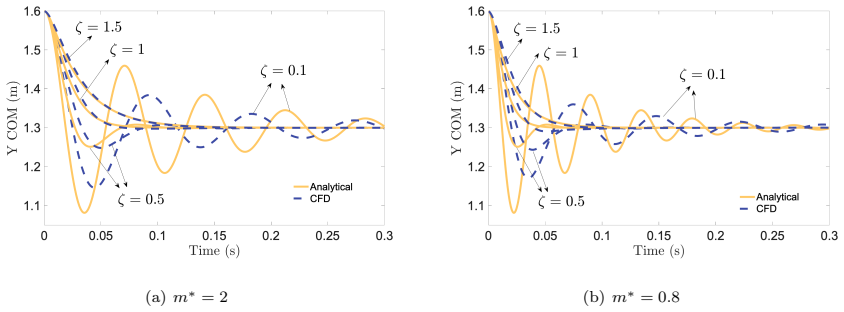
The argument is carried by a comparison between two motion models of the same tethered buoy. The potential-flow side is the Cummins equation, a time-domain integro-differential equation in which the fluid memory of radiated waves enters as a convolution of a radiation impulse response function with the body velocity; the paper approximates that convolution in state-space form. The CFD side is the fictitious domain Brinkman penalization method, a fully Eulerian technique that treats the solid as a region of vanishing permeability inside the fluid mesh, which lets the same PTO stiffness, damping, and torque act directly on the body. A third piece of machinery is the PTO and mooring model itself: a linear spring-damper tether that resists heave, surge, and pitch and converts the absorbed mechanical power to a damping term $b_{PTO}(d\Delta l/dt)^2$. The comparison is completed by forcing the two models with different wave inputs, fifth-order Stokes waves in the CFD tank and first-order Airy excitation in the potential model, which is also the point where the two models are not driven identically.
What would settle it
Force both models with identical wave kinematics: feed the fifth-order Stokes free-surface elevation and velocity field into the Cummins model, or run a fully nonlinear potential-flow solver, and compare the mean surge drift and the heave and surge amplitudes. If the potential model then reproduces the CFD drift, the claimed viscous origin of the drift is wrong; if the drift gap persists, the claim is supported. A physical wave-tank experiment with the same buoy, tether stiffness, and damping, measuring mean drift over many wave periods, would settle the same question.
Extended reading notes
Core claim
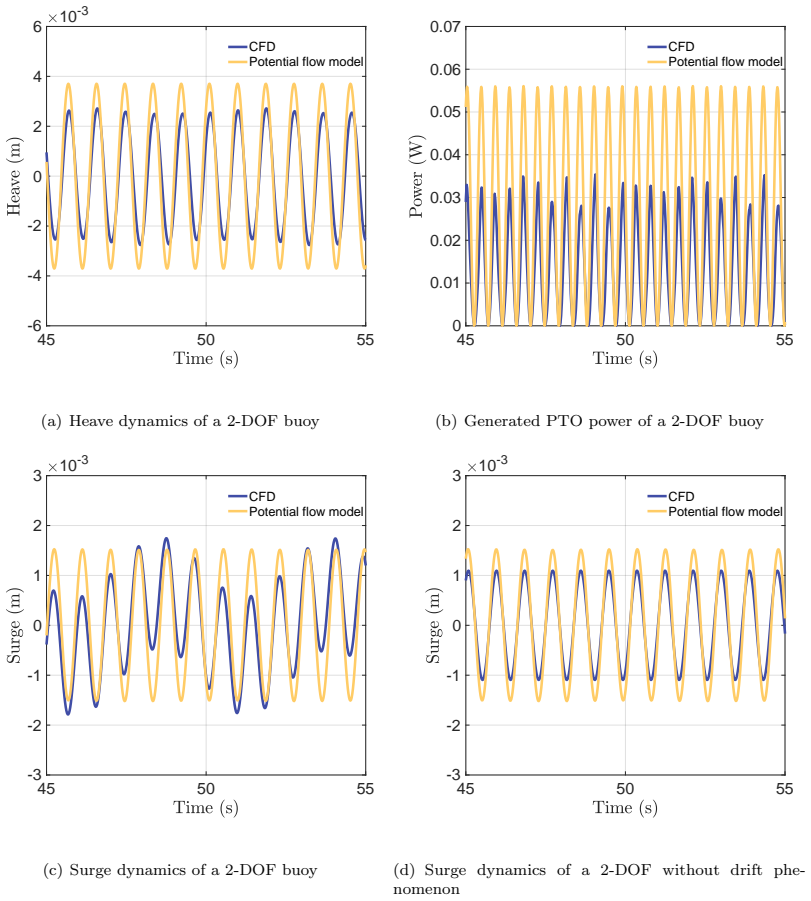
On the paper's own terms, the discovery is that the time-domain Cummins potential-flow model, despite being the standard fast tool for wave-energy converter design, gives a systematically different picture of a fully submerged cylindrical point absorber than fully resolved Navier-Stokes simulation. For the same buoy, tether, and wave, the potential model overpredicts heave and surge oscillation amplitudes and predicts an insignificant pitch angle, because the pressure forces on an axisymmetric body pass through its center of mass and linear theory has weak cross-mode coupling. The CFD model additionally shows a slow surge drift that the potential model under-predicts at the small wave-steepness parameter $ka$ of the test, and this drift is important for mooring design. In the CFD parametric study, the paper finds that reactive-control PTO damping $B_{33}(\omega)$ from linear theory is sub-optimal for moderate and high wave steepness; raising the damping coefficient improves absorption efficiency at all tested frequencies. It also finds that lower buoy density raises permanent PTO and mooring tension and shifts the resonance period range, and that absorption efficiency decreases as wave height increases.
Load-bearing premise
The comparison assumes the two models see the same wave, but the CFD model is driven by a fifth-order Stokes wave while the potential model is driven by a simpler linear wave, so part of the difference could come from the wave description rather than from viscosity.
Editorial extensions
If this is right
- If the central claim is right, linear BEM/Cummins models overestimate heave and surge amplitudes and the associated PTO power, so motion and load estimates from these models are not conservative for engineering design.
- Mooring systems designed from potential-flow drift predictions would be under-sized, because the slow surge drift that sets the tether's mean load is largely invisible to linear theory.
- Reactive-control PTO damping should be treated as a lower bound for moderate and steep waves; the CFD results show that a damping coefficient several times larger than $B_{33}(\omega)$ improves absorption efficiency across the tested frequency range.
- Buoy density is a design variable with structural consequences: lower density increases permanent tether tension and shifts the resonance period range, so density and PTO stiffness must be chosen together.
- Absorption efficiency degrades with increasing wave height, implying either larger PTO and device sizing or deliberate efficiency-cost trade-offs for energetic sea states.
Reading between the lines
- The paper does not isolate whether the slow-drift difference is caused by viscosity alone or by the different wave-order inputs, fifth-order Stokes in the CFD tank versus first-order Airy in the potential model; forcing the Cummins model with the fifth-order Stokes kinematics would settle that.
- The insignificant-pitch conclusion is specific to an axisymmetric body under pressure forces that pass through the center of mass; for non-axisymmetric hulls or PTO geometries that apply torque, the pitch mode could matter even at small steepness.
- An obvious testable extension is to repeat the parametric study in three dimensions or in irregular waves, where the drift and vortex-shedding patterns found here in two dimensions may change quantitatively.
- The efficiency gain from raising PTO damping above $B_{33}(\omega)$ is probably device- and sea-state-specific; a useful next step would be a response-surface sweep over stiffness and damping for each wave height to map how far the optimum moves.
Signed reviews
Editorial analysis
A structured set of objections, weighed in public.
Referee Report
Summary. The manuscript compares a linear potential-flow model based on the Cummins equation with a fully resolved CFD model based on fictitious-domain Brinkman penalization (FD/BP) for a submerged cylindrical point absorber with heave, surge, and pitch degrees of freedom. The comparison is performed for one, two, and three DOFs, and the paper reports that the potential model over-predicts heave and surge amplitudes, produces negligible pitch, and misses a slow surge drift that the CFD model captures. The paper then uses the CFD model to vary PTO stiffness and damping, buoy density, and wave height, concluding that PTO coefficients from linear theory are suboptimal for moderate-to-steep waves, that low-density buoys increase PTO and mooring tension, and that absorption efficiency decreases with wave height. The authors present this as the first application of the FD/BP method to wave-energy devices.
Significance. If fully substantiated, the results would be practically significant for wave-energy converter design: linear BEM/Cummins models would be non-conservative for motion amplitude, drift, and mooring loads, and would misguide PTO tuning in steeper waves. The paper has genuine strengths: the FD/BP formulation is described in detail, the solver is based on the open-source IBAMR library, the damped-oscillator tests provide analytical validation, and a grid-convergence study is included for heave. However, the evidence for the most consequential claims is incomplete, and one ingredient of the potential-flow model is unreported, so the main comparison is not yet reproducible.
major comments (3)
- [§2.1, Eqs. (12)–(14)] The values of the viscous drag coefficients Cx, Cy, and Cθ in the Cummins model are never given, even though these coefficients are part of the potential-flow model that is compared against CFD. Without them the comparison in Figs. 11–13 cannot be reproduced, and the claimed over-prediction of heave and surge amplitudes may depend on how these empirical coefficients were chosen. Please report the values, cite their source, and show the sensitivity of the Cummins results to them.
- [§4.2, Fig. 12(c)] The statement that the CFD model 'is able to capture' slow surge drift reliably is not supported by the evidence presented. The only wave-driven grid-convergence test is for heave amplitude (Sec. 3.6.2, Fig. 10); the drift signal in Fig. 12(c) is of order millimeters over a few seconds and is exactly the kind of low-frequency quantity sensitive to numerical tank effects, including the top-boundary artifacts and bottom no-slip layer that the authors acknowledge in Sec. 4.4. In addition, the CFD is forced by fifth-order Stokes waves while the Cummins model uses first-order Airy excitation; because drift is a nonlinear wave property, part of the difference could reflect wave-model order rather than viscous versus potential modeling. Please provide drift convergence with spatial resolution, tank length, and damping-zone length, or an independent experimental or benchmark confirmation, before claiming reliable drift capture.
- [§5.1, Fig. 19] The paper calls bPTO = 80.64 N·s/m the 'optimal control damping' and uses it to claim that linear-theory PTO coefficients are sub-optimal, but no optimization sweep is shown; the text states only that further increases 'did not enhance the performance significantly (data not shown).' This makes the optimality claim effectively in-sample: the value was selected from the same CFD efficiency curves used to demonstrate the improvement. At most the data support the weaker statement that a fourfold larger damping improves efficiency for the tested frequencies. Please show the bPTO sweep or an optimization procedure, or revise the claim accordingly.
minor comments (5)
- [§5.1] The unit of bPTO is written as 'N·m/s' both in the optimal-control bullet list and in the paragraph following Fig. 19; the correct unit for a translational PTO damper is N·s/m, and the text should be corrected.
- [Fig. 16 caption] The caption lists 'T = 0.909 m' for the wave period; this should be seconds, not meters.
- [§3.6.2] The grid-convergence statement would be more convincing if it reported the converged heave amplitude values and a convergence rate rather than a visual comparison; the visual agreement in Fig. 10 is suggestive but not quantified.
- [Data availability statement] The data availability statement points to the IBAMR repository, which contains code rather than the results behind Figs. 11–21; please either deposit the actual simulation data or clarify that code, not data, is shared.
- [§4.2, Fig. 12(d)] The high-pass filter used to remove slow drift from the CFD surge signal is not described in terms of cutoff frequency and filter order; without this information the 'drift-free' surge amplitude comparison in Fig. 12(d) is not fully reproducible.
Circularity Check
CFD-vs-potential comparison is an independent benchmark, but the 'optimal' bPTO=80.64 claim is selected from the same CFD data used to demonstrate it.
-
fitted input called prediction
[Sec. 5.1, 'PTO coefficients', Fig. 19]
"Optimal control coefficients: kPTO =ω2 (M +A33(ω)) and bPTO = 80.64 N· m/s. ... This optimal value of bPTO increases the absorption efficiency of the buoy for all wave frequencies, which suggests that the reactive control damping coefficients predicted by the linear wave theory do not lead to an optimal performance. Further increasing bPTO value did not enhance the performance of the converter significantly (data not shown)."
bPTO=80.64 is not obtained from an independent optimization; it is the same damping value already fixed in the baseline heave-validation and model-comparison runs (Secs. 3.6.2 and 4). The 'improvement' is then demonstrated by running the same CFD solver at this pre-selected value and comparing with the linear-theory value B33(ω). Thus the optimality claim is in-sample: the value is labelled 'optimal' from the data that also serves as the evidence, and the statement that further increases do not help is not shown. This does not invalidate the potential-vs-CFD comparison, but it makes the 'linear theory is sub-optimal / higher damping is better' conclusion a post-hoc selection rather than an independent prediction.
full rationale
The central wave-structure comparison is not circular: the Cummins/potential-flow side is built from AQWA BEM (added mass, radiation damping, Froude-Krylov) plus a standard quadratic drag model, while the CFD side is a direct Navier-Stokes FD/BP solution; the two models are solved with independent discretizations and compared against each other. Validation of the CFD framework against the damped-oscillator analytical solution and heave grid convergence is presented, and references [58,73] (Bhalla et al.; Nangia et al.) are prior work by the same group but only supplement, rather than replace, that validation. The slow-drift reliability claim is not drift-specific converged in the paper, but that is an evidence gap—a correctness risk—not a circular reduction. The main circularity-adjacent issue is the 'optimal' bPTO=80.64 claim in Sec. 5.1: the value is selected from the same CFD campaign that is used to demonstrate its superiority, so the 'optimization' is in-sample. I therefore set score 4: the central comparison has independent content, but one advertised conclusion ('optimal control coefficients' / linear-theory sub-optimality) is partly manufactured from the same simulations.
Assumptions & free parameters
free parameters (3)
- bPTO = 80.64 N·s/m ('optimal control' damping) =
80.64 N·s/m
- kPTO = 1995.2 N/m (fixed PTO stiffness) =
1995.2 N/m
- Viscous drag coefficients Cx, Cy, Cθ in the Cummins model =
Not reported
assumptions (4)
- standard math Cummins equation with state-space radiation memory (Eq. 7) is a valid time-domain representation of linear potential-flow hydrodynamics for this buoy.
- domain assumption Fifth-order Stokes waves generated in the numerical wave tank match the intended incident wave field, and first-order Airy wave excitation is the correct forcing for the Cummins model.
- domain assumption The PTO can be represented as a linear tether spring-damper along the instantaneous tether direction, as in Eqs. (10)-(11), in both the Cummins and FD/BP models.
- domain assumption The FD/BP permeability κ=O(10^-8) and stair-step surface force integration in Eqs. (37)-(38) give converged rigid-body dynamics at the chosen medium grid resolution.
Cite this review
Pith. "Pith review of Comparison of wave-structure interaction dynamics of a submerged cylindrical point absorber with three degrees of freedom using potential flow and computational fluid dynamics models." pith.science (2026). https://pith.science/paper/WZBH6FIB
@misc{pith2026190804981,
  author       = {Pith},
  title        = {Pith review of: Comparison of wave-structure interaction dynamics of a submerged cylindrical point absorber with three degrees of freedom using potential flow and computational fluid dynamics models},
  year         = {2026},
  howpublished = {\url{https://pith.science/paper/WZBH6FIB}},
  note         = {Machine review of arXiv:1908.04981}
}
read the original abstract
In this paper we compare the heave, surge, and pitch dynamics of a submerged cylindrical point absorber, simulated using potential flow and fully-resolved computational fluid dynamics (CFD) models. The potential flow model is based on the time-domain Cummins equation, whereas the CFD model uses the fictitious domain Brinkman penalization (FD/BP) technique. The submerged cylinder is tethered to the seabed using a power take-off (PTO) unit which restrains the heave, surge, and pitch motions of the converter, and absorbs energy from all three modes. It is demonstrated that the potential theory over-predicts the amplitudes of heave and surge motions, whereas it results in an insignificant pitch for a fully-submerged axisymmetric converter. It also under-estimates the slow drift of the buoy, which the CFD model is able to capture reliably. Further, we use fully-resolved CFD simulations to study the performance of a three degrees of freedom (DOF) cylindrical buoy under varying PTO coefficients, mass density of the buoy, and incoming wave heights. It is demonstrated that the PTO coefficients predicted by the linear potential theory are sub-optimal for waves of moderate and high steepness. The wave absorption efficiency improves significantly when higher than the predicted value of the PTO damping is selected. Simulations with different mass densities of the buoy show that converters with low mass densities have an increased tension in their PTO and mooring lines. Moreover, the mass density also influences the range of resonance periods of the device. Finally, simulations with different wave heights show that at higher heights, the wave absorption efficiency of the converter decreases and a large portion of available wave power remains unabsorbed.
Figures


Figures from the paper (18 more)








Reference graph
Works this paper leans on
-
[1]
K. Gunn, C. Stock-Williams, Quantifying the global wave power resource, Renewable Energy 44 (2012) 296–304
2012
-
[2]
Evans, D
D. Evans, D. Jeffrey, S. Salter, J. Taylor, Submerged cylinder wave energy device: theory and experi- ment, Applied Ocean Research 1 (1) (1979) 3–12
1979
-
[3]
Falnes, J
J. Falnes, J. Hals, Heaving buoys, point absorbers and arrays, Philosophical Transactions of the Royal Society A: Mathematical, Physical and Engineering Sciences 370 (1959) (2012) 246–277
1959
-
[4]
C. G. Soares, J. Bhattacharjee, M. Tello, L. Pietra, Review and classification of wave energy converters, in: Maritime engineering and technology, CRC Press, 2012, pp. 599–608
2012
-
[5]
A. S. Sirigu, F. Gallizio, G. Giorgi, M. Bonfanti, G. Bracco, G. Mattiazzo, Numerical and Experi- mental Identification of the Aerodynamic Power Losses of the ISWEC, Journal of Marine Science and Engineering 8 (49) (2020) 1–25
2020
-
[6]
S. A. Sirigu, M. Bonfanti, E. Begovic, C. Bertorello, P. Dafnakis, G. Bracco, G. Mattiazzo, Experi- mental Investigation of Mooring System on a Wave Energy Converter in Operating and Extreme Wave Conditions, Journal of Marine Science and Engineering 8 (180) (2020) 1–31
2020
-
[7]
Vissio, D
G. Vissio, D. Val´ erio, G. Bracco, P. Beir˜ ao, N. Pozzi, G. Mattiazzo, ISWEC linear quadratic regulator oscillating control, Renewable energy 103 (2017) 372–382
2017
-
[8]
A. Poullikkas, Technology prospects of wave power systems, Electronic Journal of Energy & Environment 2 (1) (2014) 47–69
work page 2014
Show all 87 references
-
[9]
van Rij, Y.-H
J. van Rij, Y.-H. Yu, K. Edwards, M. Mekhiche, Ocean power technology design optimization, Interna- tional Journal of Marine Energy 20 (2017) 97–108
2017
-
[10]
Y.-H. Yu, Y. Li, Reynolds-Averaged Navier–Stokes simulation of the heave performance of a two-body floating-point absorber wave energy system, Computers & Fluids 73 (2013) 104–114
2013
-
[11]
Sergiienko, A
N. Sergiienko, A. Rafiee, B. Cazzolato, B. Ding, M. Arjomandi, Feasibility study of the three-tether axisymmetric wave energy converter, Ocean Engineering 150 (2018) 221–233
2018
-
[12]
Rafiee, J
A. Rafiee, J. Fi´ evez, Numerical prediction of extreme loads on the CETO wave energy converter, in: 11th European Wave and Tidal Energy Conference (EWTEC). Nantes, France, 2015
2015
-
[13]
Sergiienko, B
N. Sergiienko, B. Cazzolato, B. Ding, P. Hardy, M. Arjomandi, Performance comparison of the floating and fully submerged quasi-point absorber wave energy converters, Renewable Energy 108 (2017) 425– 437. 27
2017
-
[14]
Paasch, K
R. Paasch, K. Ruehl, J. Hovland, S. Meicke, Wave energy: a Pacific perspective, Philosophical Trans- actions of the Royal Society A: Mathematical, Physical and Engineering Sciences 370 (1959) (2012) 481–501
1959
-
[15]
L. S. P. da Silva, T. P. Tancredi, B. Ding, N. Sergiienko, H. M. Morishita, COBEM-2017-1253 Fully Submerged Point Absorber in Santa Catarina, Brazil-A Feasibility Study
2017
-
[16]
Dafnakis, M
P. Dafnakis, M. Bonfanti, S. A. Sirigu, G. Bracco, G. Mattiazzo, A submerged point absorber wave energy converter for the Meditterranean Sea, in: Proceedings of the 13rd European Wave and Tidal Energy Conference, 2019
2019
-
[17]
Mattiazzo, State of the Art and Perspectives of Wave Energy in the Mediterranean Sea: Backstage of ISWEC, Frontiers in Energy Research 7 (2019) 114
G. Mattiazzo, State of the Art and Perspectives of Wave Energy in the Mediterranean Sea: Backstage of ISWEC, Frontiers in Energy Research 7 (2019) 114
2019
-
[18]
Tˆ etu, F
A. Tˆ etu, F. Ferri, M. Kramer, J. Todalshaug, Physical and mathematical modeling of a wave energy converter equipped with a negative spring mechanism for phase control, Energies 11 (9) (2018) 2362
2018
-
[19]
B. Ding, B. S. Cazzolato, M. Arjomandi, P. Hardy, B. Mills, Sea-state based maximum power point tracking damping control of a fully submerged oscillating buoy, Ocean Engineering 126 (2016) 299–312
2016
-
[20]
S. A. Sirigu, M. Bonfanti, P. Dafnakis, G. Bracco, G. Mattiazzo, S. Brizzolara, Pitch Resonance Tuning Tanks: A novel technology for more efficient wave energy harvesting, in: OCEANS 2018 MTS/IEEE Charleston, IEEE, 2018, pp. 1–8
2018
-
[21]
Davidson, R
J. Davidson, R. Costello, Efficient Nonlinear Hydrodynamic Models for Wave Energy Converter De- sign—A Scoping Study, Journal of Marine Science and Engineering 8 (1) (2020) 35
2020
-
[22]
E. B. Agamloh, A. K. Wallace, A. Von Jouanne, Application of fluid–structure interaction simulation of an ocean wave energy extraction device, Renewable Energy 33 (4) (2008) 748–757
2008
-
[23]
Penalba, G
M. Penalba, G. Giorgi, J. V. Ringwood, Mathematical modelling of wave energy converters: a review of nonlinear approaches, Renewable and Sustainable Energy Reviews 78 (2017) 1188–1207
2017
-
[24]
Ghasemi, M
A. Ghasemi, M. Anbarsooz, A. Malvandi, A. Ghasemi, F. Hedayati, A nonlinear computational modeling of wave energy converters: A tethered point absorber and a bottom-hinged flap device, Renewable energy 103 (2017) 774–785
2017
-
[25]
Anbarsooz, M
M. Anbarsooz, M. Passandideh-Fard, M. Moghiman, Numerical simulation of a submerged cylindrical wave energy converter, Renewable Energy 64 (2014) 132–143
2014
-
[26]
Z. Shen, D. Wan, P. M. Carrica, Dynamic overset grids in OpenFOAM with application to KCS self- propulsion and maneuvering, Ocean Engineering 108 (2015) 287–306
2015
-
[27]
P. M. Carrica, R. V. Wilson, R. W. Noack, F. Stern, Ship motions using single-phase level set with dynamic overset grids, Computers & fluids 36 (9) (2007) 1415–1433
2007
-
[28]
Z. Hou, T. Sun, X. Quan, G. Zhang, Z. Sun, Z. Zong, Large eddy simulation and experimental investi- gation on the cavity dynamics and vortex evolution for oblique water entry of a cylinder, Applied Ocean Research 81 (2018) 76–92
2018
-
[29]
A. L. Facci, M. Porfiri, S. Ubertini, Three-dimensional water entry of a solid body: A computational study, Journal of Fluids and Structures 66 (2016) 36–53
2016
-
[30]
Hsieh, A
C.-M. Hsieh, A. Sau, R. R. Hwang, W. Yang, Nonlinear interaction and wave breaking with a submerged porous structure, Physics of Fluids 28 (12) (2016) 126601
2016
-
[31]
Y. Kim, C. S. Peskin, Penalty immersed boundary method for an elastic boundary with mass, Physics of Fluids 19 (5) (2007) 053103
2007
-
[32]
Kumar, G
M. Kumar, G. Natarajan, Diffuse interface immersed boundary method for low mach number flows with heat transfer in enclosures, Physics of Fluids 31 (8) (2019) 083601. 28
2019
-
[33]
Walayat, N
K. Walayat, N. Talat, S. Jabeen, K. Usman, M. Liu, Sedimentation of general shaped particles using a multigrid fictitious boundary method, Physics of Fluids 32 (6) (2020) 063301
2020
-
[34]
N. A. Patankar, P. Singh, D. D. Joseph, R. Glowinski, T.-W. Pan, A new formulation of the distributed Lagrange multiplier/fictitious domain method for particulate flows, International Journal of Multiphase Flow 26 (9) (2000) 1509–1524
2000
-
[35]
Sharma, N
N. Sharma, N. A. Patankar, A fast computation technique for the direct numerical simulation of rigid particulate flows, Journal of Computational Physics 205 (2) (2005) 439–457
2005
-
[36]
Angot, C.-H
P. Angot, C.-H. Bruneau, P. Fabrie, A penalization method to take into account obstacles in incom- pressible viscous flows, Numerische Mathematik 81 (4) (1999) 497–520
1999
-
[37]
Carbou, P
G. Carbou, P. Fabrie, et al., Boundary layer for a penalization method for viscous incompressible flow, Advances in Differential equations 8 (12) (2003) 1453–1480
2003
-
[38]
Bergmann, A
M. Bergmann, A. Iollo, Modeling and simulation of fish-like swimming, Journal of Computational Physics 230 (2) (2011) 329–348
2011
-
[39]
L. H. Holthuijsen, Waves in oceanic and coastal waters, Cambridge University Press, 2010
2010
-
[40]
R. G. Dean, R. A. Dalrymple, Water wave mechanics for engineers and scientists, Vol. 2, World Scientific Publishing Company, 1991
1991
-
[41]
Giorgi, J
G. Giorgi, J. V. Ringwood, Computationally efficient nonlinear Froude–Krylov force calculations for heaving axisymmetric wave energy point absorbers, Journal of Ocean Engineering and Marine Energy 3 (1) (2017) 21–33
2017
-
[42]
S. A. Sirigu, Iowec: a novel wave-climate adaptable technology (2019)
2019
-
[43]
ANSYS AQWA theory manual (2014)
2014
-
[44]
Lee, WAMIT theory manual, Massachusetts Institute of Technology, Department of Ocean Engi- neering, 1995
C.-H. Lee, WAMIT theory manual, Massachusetts Institute of Technology, Department of Ocean Engi- neering, 1995
1995
-
[45]
Cummins, The impulse response function and ship motions, Tech
W. Cummins, The impulse response function and ship motions, Tech. rep., David Taylor Model Basin Washington DC (1962)
1962
-
[46]
Ogilvie, Recent progress in the understanding and prediction of ship motions, David Taylor Model Basin, Washington, DC, Tech
T. Ogilvie, Recent progress in the understanding and prediction of ship motions, David Taylor Model Basin, Washington, DC, Tech. Rep (1964)
1964
-
[47]
Giorgi, J
G. Giorgi, J. V. Ringwood, Articulating parametric resonance for an OWC spar buoy in regular and irregular waves, Journal of Ocean Engineering and Marine Energy 4 (4) (2018) 311–322
2018
-
[48]
Giorgi, J
G. Giorgi, J. V. Ringwood, Analytical Formulation of Nonlinear Froude-Krylov Forces for Surging- Heaving-Pitching Point Absorbers, in: ASME 2018 37th International Conference on Ocean, Offshore and Arctic Engineering, Madrid, 2018
2018
-
[49]
Z. Yu, J. Falnes, State-space modelling of a vertical cylinder in heave, Applied Ocean Research 17 (5) (1995) 265–275
1995
-
[50]
Jefferys, Simulation of wave power devices, Applied Ocean Research 6 (1) (1984) 31–39
E. Jefferys, Simulation of wave power devices, Applied Ocean Research 6 (1) (1984) 31–39
1984
-
[51]
C. J. Damaren, Time-domain floating body dynamics by rational approximation of the radiation impedance and diffraction mapping, Ocean Engineering 27 (6) (2000) 687–705
2000
-
[52]
McCabe, A
A. McCabe, A. Bradshaw, M. Widden, A time-domain model of a floating body using transforms, in: 6th European Wave and Tidal Energy Conference, 2005, pp. 281–288
2005
-
[53]
Cl´ ement, Identification de la fonction de green de l’hydrodynamique transitoire par des modeles continus, Proc
A. Cl´ ement, Identification de la fonction de green de l’hydrodynamique transitoire par des modeles continus, Proc. 5` emes Journ´ ees de l’Hydrodyn (1995) 319–332. 29
1995
-
[54]
Perez, T
T. Perez, T. I. Fossen, Joint Identification of Infinite-Frequency Added Mass and Fluid-Memory Models of Marine Structures, Modeling, Identification and Control 29 (3) (2008) 93
2008
-
[55]
P´ erez, T
T. P´ erez, T. I. Fossen, Time-vs. frequency-domain identification of parametric radiation force models for marine structures at zero speed, Modeling, Identification and Control: A Norwegian Research Bulletin 29 (1) (2008) 1–19
2008
-
[56]
Taghipour, T
R. Taghipour, T. Perez, T. Moan, Hybrid frequency–time domain models for dynamic response analysis of marine structures, Ocean Engineering 35 (7) (2008) 685–705
2008
-
[57]
Roessling, J
A. Roessling, J. Ringwood, Finite order approximations to radiation forces for wave energy applications, Renewable energies offshore 359 (2015)
2015
-
[58]
A. P. S. Bhalla, N. Nangia, P. Dafnakis, G. Bracco, G. Mattiazzo, Simulating water-entry/exit problems using Eulerian-Lagrangian and fully-Eulerian fictitious domain methods within the open-source IBAMR library, Applied Ocean Research 94 (2020) 101932
2020
-
[59]
IBAMR: An adaptive and distributed-memory parallel implementation of the immersed boundary method, https://github.com/IBAMR/IBAMR
-
[60]
R. D. Hornung, S. R. Kohn, Managing application complexity in the SAMRAI object-oriented frame- work, Concurrency Comput Pract Ex 14 (5) (2002) 347–368
2002
-
[61]
SAMRAI: Structured Adaptive Mesh Refinement Application Infrastructure, http://www.llnl.gov/ CASC/SAMRAI
-
[62]
Balay, W
S. Balay, W. D. Gropp, L. C. McInnes, B. F. Smith, Efficient management of parallelism in object oriented numerical software libraries, in: E. Arge, A. M. Bruaset, H. P. Langtangen (Eds.), Modern Software Tools in Scientific Computing, Birkh¨ auser Press, 1997, pp. 163–202
1997
-
[63]
Balay, S
S. Balay, S. Abhyankar, M. F. Adams, J. Brown, P. Brune, K. Buschelman, L. Dalcin, V. Eijkhout, W. D. Gropp, D. Kaushik, M. G. Knepley, L. C. McInnes, K. Rupp, B. F. Smith, S. Zampini, H. Zhang, PETSc users manual, Tech. Rep. ANL-95/11 - Revision 3.6, Argonne National Laborato...
2015
-
[64]
Balay, S
S. Balay, S. Abhyankar, M. F. Adams, J. Brown, P. Brune, K. Buschelman, L. Dalcin, V. Eijkhout, W. D. Gropp, D. Kaushik, M. G. Knepley, L. C. McInnes, K. Rupp, B. F. Smith, S. Zampini, H. Zhang, PETSc Web page, http://www.mcs.anl.gov/petsc (2015). URL http://www.mcs.anl.gov/petsc
2015
-
[65]
Nangia, B
N. Nangia, B. E. Griffith, N. A. Patankar, A. P. S. Bhalla, A robust incompressible Navier-Stokes solver for high density ratio multiphase flows, Journal of Computational Physics 390 (2019) 548–594
2019
-
[66]
Min, On reinitializing level set functions, Journal of Computational Physics 229 (8) (2010) 2764–2772
C. Min, On reinitializing level set functions, Journal of Computational Physics 229 (8) (2010) 2764–2772
2010
-
[67]
Son, A level set method for incompressible two-fluid flows with immersed solid boundaries, Numerical Heat Transfer, Part B 47 (5) (2005) 473–489
G. Son, A level set method for incompressible two-fluid flows with immersed solid boundaries, Numerical Heat Transfer, Part B 47 (5) (2005) 473–489
2005
-
[68]
M. Cai, A. Nonaka, J. B. Bell, B. E. Griffith, A. Donev, Efficient variable-coefficient finite-volume Stokes solvers, Communications in Computational Physics 16 (5) (2014) 1263–1297
2014
-
[69]
B. E. Griffith, An accurate and efficient method for the incompressible Navier-Stokes equations using the projection method as a preconditioner, Journal of Computational Physics 228 (20) (2009) 7565–7595
2009
-
[70]
A. P. S. Bhalla, R. Bale, B. E. Griffith, N. A. Patankar, A unified mathematical framework and an adaptive numerical method for fluid-structure interaction with rigid, deforming, and elastic bodies, J Comput Phys 250 (1) (2013) 446–476. doi:10.1016/j.jcp.2013.04.033. URL http://li...
2013 doi
-
[71]
W. J. Rider, J. A. Greenough, J. R. Kamm, Accurate monotonicity-and extrema-preserving methods through adaptive nonlinear hybridizations, Journal of Computational Physics 225 (2) (2007) 1827–1848
2007
-
[72]
Gazzola, O
M. Gazzola, O. V. Vasilyev, P. Koumoutsakos, Shape optimization for drag reduction in linked bodies using evolution strategies, Computers & Structures 89 (11-12) (2011) 1224–1231
2011
-
[73]
Nangia, N
N. Nangia, N. A. Patankar, A. P. S. Bhalla, A DLM immersed boundary method based wave-structure interaction solver for high density ratio multiphase flows, Journal of Computational Physics 398 (2019) 108804
2019
-
[74]
S. S. Rao, F. F. Yap, Mechanical vibrations, Vol. 4, Prentice hall Upper Saddle River, 2011
2011
-
[75]
J. Lee, J. Kim, H. Choi, K.-S. Yang, Sources of spurious force oscillations from an immersed boundary method for moving-body problems, Journal of computational physics 230 (7) (2011) 2677–2695
2011
-
[76]
Nobile, L
F. Nobile, L. Formaggia, A stability analysis for the arbitrary Lagrangian Eulerian formulation with finite elements, East-West Journal of Numerical Mathematics 7 (ARTICLE) (1999) 105–132
1999
-
[77]
Causin, J.-F
P. Causin, J.-F. Gerbeau, F. Nobile, Added-mass effect in the design of partitioned algorithms for fluid–structure problems, Computer methods in applied mechanics and engineering 194 (42-44) (2005) 4506–4527
2005
-
[78]
Burman, M
E. Burman, M. A. Fern´ andez, Stabilization of explicit coupling in fluid–structure interaction involving fluid incompressibility, Computer Methods in Applied Mechanics and Engineering 198 (5-8) (2009) 766–784
2009
-
[79]
J. W. Banks, W. D. Henshaw, D. W. Schwendeman, Q. Tang, A stable partitioned FSI algorithm for rigid bodies and incompressible flow. Part I: Model problem analysis, Journal of Computational Physics 343 (2017) 432–468
2017
-
[80]
D. A. Serino, J. W. Banks, W. D. Henshaw, D. W. Schwendeman, A stable added-mass partitioned (AMP) algorithm for elastic solids and incompressible flow, Journal of Computational Physics 399 (2019) 108923
2019
-
[81]
J. D. Fenton, A fifth-order Stokes theory for steady waves, Journal of waterway, port, coastal, and ocean engineering 111 (2) (1985) 216–234
1985
-
[82]
Le M´ ehaut´ e, An introduction to hydrodynamics and water waves, Springer Science & Business Media, 2013
B. Le M´ ehaut´ e, An introduction to hydrodynamics and water waves, Springer Science & Business Media, 2013
2013
-
[83]
Falnes, Ocean waves and oscillating systems: linear interactions including wave-energy extraction, Cambridge university press, 2002
J. Falnes, Ocean waves and oscillating systems: linear interactions including wave-energy extraction, Cambridge university press, 2002
2002
-
[84]
S. K. Chakrabarti, Steady drift force on vertical cylinder-viscous vs. potential, Applied ocean research 6 (2) (1984) 73–82
1984
-
[85]
Faizal, M
M. Faizal, M. R. Ahmed, Y.-H. Lee, A design outline for floating point absorber wave energy converters, Advances in Mechanical Engineering 6 (2014) 846097
2014
-
[86]
B. W. Schubert, W. S. Robertson, B. S. Cazzolato, M. H. Ghayesh, Linear and nonlinear hydrodynamic models for dynamics of a submerged point absorber wave energy converter, Ocean Engineering 197 (2020) 106828
2020
-
[87]
Y.-H. Yu, N. Tom, D. Jenne, Numerical analysis on hydraulic power take-off for wave energy con- verter and power smoothing methods, in: International Conference on Offshore Mechanics and Arctic Engineering, Vol. 51319, American Society of Mechanical Engineers, 2018, p. V010T09A043. 31
2018
Reviewed August 14, 2026 · model on record in the stance chip above.
Discussion (0). Continue with ORCID to comment.