UV completion of 2D Ising CFT:a golden E₈ massless S-matrix
Pith reviewed 2026-06-30 09:07 UTC · model grok-4.3
The pith
Exactly four UV completions exist for the 2D Ising CFT with E8 spectrum via higher TbarT deformations.
A machine-rendered reading of the paper's core claim, the machinery that carries it, and where it could break.
Core claim
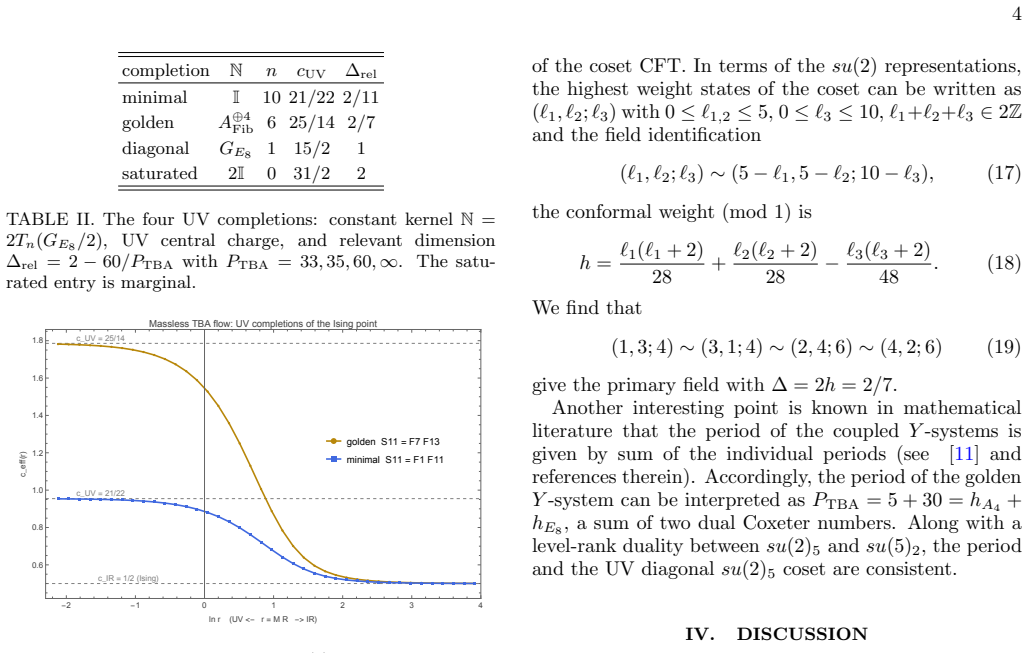
We present a full classification of UV complete QFTs that RG flow to the 2D Ising CFT by solving the bootstrap equations for massless right-left S-matrices. For the Ising model with E8 spectrum, we find exactly four completions, arising from higher TbarT-type deformations, including a previously unknown golden flow whose UV fixed point is a diagonal su(2) coset CFT (c=25/14) along Delta_rel=2/7. A universal Fibonacci/E8 structure governs the R-L adjacency matrices and the Y-system periods, so that the E8 symmetry persists across all RG scales.
What carries the argument
The bootstrap equations for massless right-left S-matrices that classify the UV completions while preserving a universal Fibonacci/E8 structure.
If this is right
- The E8 symmetry persists across all RG scales.
- Exactly four completions arise from higher TbarT-type deformations for the E8 spectrum.
- The golden flow reaches the su(2) coset CFT with c=25/14 along Delta_rel=2/7.
- The R-L adjacency matrices and Y-system periods are governed by the Fibonacci/E8 structure.
Where Pith is reading between the lines
- If the classification holds, similar bootstrap methods could classify UV completions for other 2D CFTs with known spectra.
- The persistence of E8 symmetry across scales may indicate an underlying algebraic connection between the UV and IR theories.
- Generalizing higher TbarT deformations might uncover flows between additional coset models and minimal models.
Load-bearing premise
The bootstrap equations for massless right-left S-matrices suffice to deliver a full classification of every UV complete QFT that RG flows to the 2D Ising CFT.
What would settle it
Finding a solution to the S-matrix bootstrap equations outside the four identified completions, or showing that the golden flow does not connect to a CFT with central charge 25/14.
Figures
read the original abstract
We present a full classification of UV complete QFTs that RG flow to the 2D Ising CFT by solving the bootstrap equations for massless right--left S-matrices. For the Ising model with E_8 spectrum, we find exactly four completions, arising from higher-T\bar T-type deformations, including a previously unknown ``golden flow'' whose UV fixed point is a diagonal su(2) coset CFT (c=25/14) along \Delta_{\rm rel}=2/7. A universal Fibonacci/E_8 structure governs the R--L adjacency matrices and the Y-system periods, so that the E_8 symmetry persists across all RG scales.
Editorial analysis
A structured set of objections, weighed in public.
Referee Report
Summary. The manuscript claims a complete classification of all UV-complete QFTs that RG-flow to the 2D Ising CFT, obtained by solving the bootstrap equations for massless right-left S-matrices. For the E8 spectrum it reports exactly four such completions arising from higher-TTbar-type deformations, one of which is a previously unknown 'golden flow' whose UV fixed point is a diagonal su(2) coset CFT with c=25/14 along Delta_rel=2/7. A universal Fibonacci/E8 structure is asserted to govern the R-L adjacency matrices and Y-system periods at all scales.
Significance. If the bootstrap equations are shown to be both necessary and sufficient and the explicit solutions are provided, the result would constitute a notable advance in the classification of integrable deformations of the Ising model. The persistence of the E8 structure across RG scales and the identification of the golden flow to the c=25/14 coset would supply concrete, falsifiable predictions for the spectrum of UV completions.
major comments (2)
- [Abstract] Abstract: the central claim that solving the bootstrap equations yields exactly four completions is stated without any explicit bootstrap equations, adjacency matrices, numerical solutions, or verification steps. This prevents assessment of whether the Fibonacci/E8 structure is independently derived or follows tautologically from the E8 spectrum input.
- [Abstract / main text] The manuscript asserts that the massless R-L S-matrix bootstrap equations suffice to deliver a full classification of every UV-complete QFT that flows to the Ising CFT. No argument is given that rules out additional integrable or non-integrable deformations outside the higher-TTbar ansatz, rendering the exhaustiveness assumption unverified.
Simulated Author's Rebuttal
We thank the referee for their careful reading and valuable comments on our manuscript. We address the major comments point by point below, clarifying the content of the full paper and indicating revisions to improve accessibility and precision of the claims.
read point-by-point responses
-
Referee: [Abstract] Abstract: the central claim that solving the bootstrap equations yields exactly four completions is stated without any explicit bootstrap equations, adjacency matrices, numerical solutions, or verification steps. This prevents assessment of whether the Fibonacci/E8 structure is independently derived or follows tautologically from the E8 spectrum input.
Authors: The abstract is a concise summary of the results. The explicit massless right-left S-matrix bootstrap equations, the R-L adjacency matrices, the Y-system periods, and the numerical solutions verifying the four completions (including the golden flow) are derived and presented in detail in Sections 3 and 4 of the manuscript. The Fibonacci/E8 structure is obtained by solving the bootstrap equations with the E8 spectrum as input; it is not assumed a priori. To facilitate assessment from the abstract, we will add a brief outline of the bootstrap setup and a reference to the relevant sections. revision: partial
-
Referee: [Abstract / main text] The manuscript asserts that the massless R-L S-matrix bootstrap equations suffice to deliver a full classification of every UV-complete QFT that flows to the Ising CFT. No argument is given that rules out additional integrable or non-integrable deformations outside the higher-TTbar ansatz, rendering the exhaustiveness assumption unverified.
Authors: The massless R-L S-matrix bootstrap equations are formulated generally for integrable theories with factorized scattering and the given spectrum. Within this framework, the higher-TTbar-type deformations provide the systematic ansatz used to generate and solve for all UV completions, yielding exactly four solutions for the E8 case. The method inherently applies to integrable QFTs; non-integrable deformations do not admit a factorized S-matrix of this type and are outside the scope. We will revise the introduction and abstract to explicitly delimit the classification to integrable UV completions obtained via this bootstrap procedure. revision: partial
Circularity Check
No circularity: classification derived from bootstrap equations with E8 input
full rationale
The paper states it classifies UV completions by solving the bootstrap equations for massless right-left S-matrices given the E8 spectrum of the Ising model. The abstract presents the Fibonacci/E8 structure as a result that emerges from this solution process and persists across scales, not as an input definition or fitted parameter renamed as prediction. No self-citation load-bearing steps, ansatz smuggling, or self-definitional reductions are exhibited in the provided text. The derivation chain is presented as independent equation-solving rather than tautological with the target classification. This is the normal non-circular outcome for a bootstrap analysis.
Axiom & Free-Parameter Ledger
axioms (2)
- domain assumption The E8 spectrum corresponds to the massive deformation of the 2D Ising CFT
- domain assumption Massless right-left S-matrices and their bootstrap equations classify all UV completions
Reference graph
Works this paper leans on
-
[1]
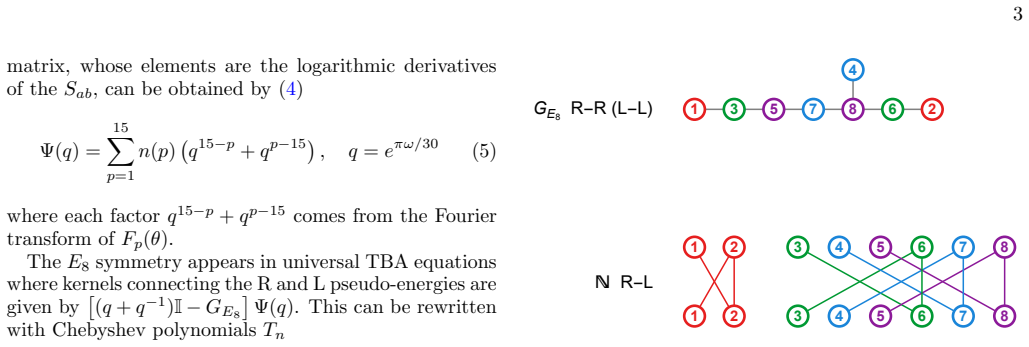
= 8Y b=1 (1 +Y R b )(GE8)ab (1 + 1/Y L b )Nab ,(11) 1 3 5 7 8 6 2 4 1 2 1 2 3 4 5 6 7 8 3 4 5 6 7 8 GE8 R-R(L-L) R-L FIG. 1. Top: the mass-orderedE 8 adjacency graph, with node labels denoting the particle mass ordering. Bottom: the golden R–L coupling graph in the same mass-ordered basis. The colored links indicate the four Fibonacci blocks associ- ated...
2026
-
[2]
On the classification of UV com- pletions of integrableT Tdeformations of CFT,
C. Ahn and A. LeClair, “On the classification of UV com- pletions of integrableT Tdeformations of CFT,” JHEP 08(2022), 179 [arXiv:2205.10905 [hep-th]]
-
[3]
On space of integrable quantum field theories
F. A. Smirnov and A. B. Zamolodchikov, “On space of integrable quantum field theories,” Nucl. Phys. B915 (2017), 363-383 [arXiv:1608.05499 [hep-th]]
work page internal anchor Pith review Pith/arXiv arXiv 2017
-
[4]
$T \bar{T}$-deformed 2D Quantum Field Theories
A. Cavagli` a, S. Negro, I. M. Sz´ ecs´ enyi and R. Tateo, “T¯T- deformed 2D Quantum Field Theories,” JHEP10(2016), 112 [arXiv:1608.05534 [hep-th]]
work page internal anchor Pith review Pith/arXiv arXiv 2016
-
[5]
Integrals of Motion and S Ma- trix of the (Scaled) T=T(c) Ising Model with Magnetic Field,
A. B. Zamolodchikov, “Integrals of Motion and S Ma- trix of the (Scaled) T=T(c) Ising Model with Magnetic Field,” Int. J. Mod. Phys. A4(1989), 4235
1989
-
[6]
Quantum criticality in an Ising chain: experimental evidence for emergent E8 symmetry
R. Coldea, D. A. Tennant, E. M. Wheeler, E. Wawrzyn- ska, D. Prabhakaran, M. Telling, K. Habicht, P. Smeibidl and K. Kiefer, “Quantum Criticality in an Ising Chain: Experimental Evidence for Emergent E(8) Symmetry,” Science327(2010), 177-180 [arXiv:1103.3694 [cond- mat.str-el]]
work page internal anchor Pith review Pith/arXiv arXiv 2010
-
[7]
From Tricritical Ising to Criti- cal Ising By Thermodynamic Bethe ansatz,
Al. B. Zamolodchikov, “From Tricritical Ising to Criti- cal Ising By Thermodynamic Bethe ansatz,” Nucl. Phys. B358(1991), 524
1991
-
[8]
RG flows from super-Liouville theory to critical Ising model,
C. Ahn, C. Kim, C. Rim, and Al.B. Zamolodchikov, “RG flows from super-Liouville theory to critical Ising model,” Phys. Lett.B541(2002), 194
2002
-
[9]
Deformation of the Ising model and its ultra- violet completion,
A. LeClair, “Deformation of the Ising model and its ultra- violet completion,” J. Stat. Mech.2111(2021), 113104 [arXiv:2107.02230]
-
[10]
Thermodynamic Bethe Ansatz forG k ⊗ Gℓ/Gk+ℓ coset models perturbed by theirϕ 1,1,Adj operator,
F. Ravanini, “Thermodynamic Bethe Ansatz forG k ⊗ Gℓ/Gk+ℓ coset models perturbed by theirϕ 1,1,Adj operator,” Phys. Lett.B282(1992) 73, [arXiv:hep- th/9202020]
-
[11]
Massless S-matrix bootstraps and RG flows,
C. Ahn, “Massless S-matrix bootstraps and RG flows,” JHEP12(2025), 103 [arXiv:2509.20740 [hep-th]]
-
[12]
The classification of Zamolodchikov periodic quivers
P. Galashin and P. Pylyavskyy, “The classification of Zamolodchikov periodic quivers,” Amer. J. Math.141, 447 (2019), [arXiv:1603.03942 [math.CO]]
work page internal anchor Pith review Pith/arXiv arXiv 2019
-
[13]
i Supplemental Material (SM) UV completion of 2D Ising CFT: a goldenE 8 masslessS-matrix Changrim Ahn and Minkyoo Kim S1
See Supplemental Material below for Saturation bounds, Inversion relations, the numerical TBA results, and the coset branching spectrum. i Supplemental Material (SM) UV completion of 2D Ising CFT: a goldenE 8 masslessS-matrix Changrim Ahn and Minkyoo Kim S1. SATURATION BOUNDS FORE 8 BOOTSTRAPS The mass-orderedE 8 spectrum, given by the components of the P...
discussion (0)
Sign in with ORCID, Apple, or X to comment. Anyone can read and Pith papers without signing in.