Profiling the Effective Limits of Error Mitigation via Circuit Replication
Pith reviewed 2026-06-26 16:33 UTC · model grok-4.3
The pith
Circuit replication trades some QAOA inference accuracy for sharply lower result variability under simulated noise.
A machine-rendered reading of the paper's core claim, the machinery that carries it, and where it could break.
Core claim
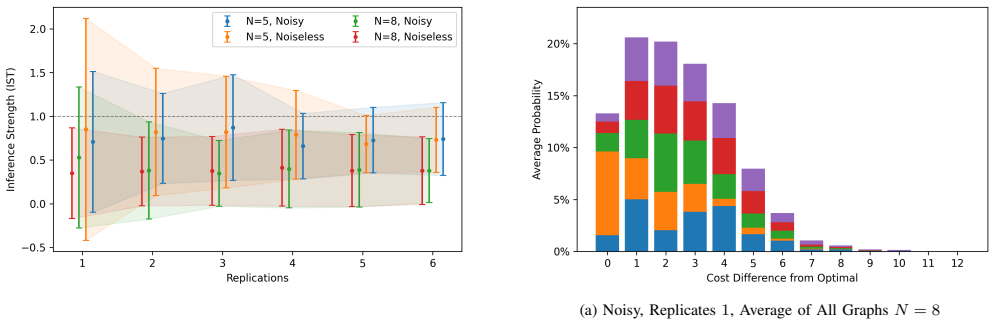
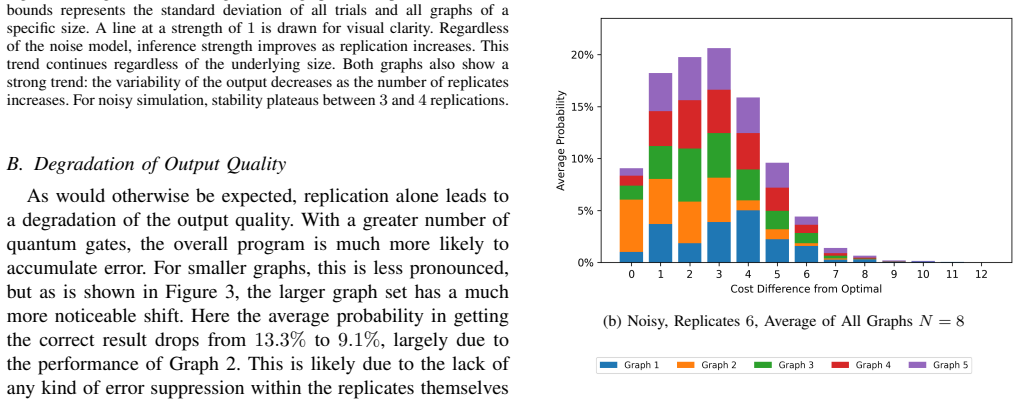
By running QAOA Maxcut circuits with one to six replications under real-world noise profiles, the authors record that replication lowers both inference strength and outcome spread, with the variability reduction being larger for small graphs and the accuracy cost being larger for big graphs; they conclude that replication can therefore serve as a low-overhead supplement to other mitigation methods precisely when workloads are deep and highly variable.
What carries the argument
Circuit replication applied to QAOA Maxcut circuits, measured by changes in inference strength and standard deviation under simulated noise.
If this is right
- Replication can be added to existing mitigation pipelines to reduce total resource cost while retaining some error suppression.
- The benefit-to-cost ratio of replication improves for workloads whose native variability is already high.
- The number of replicates needed saturates quickly for small instances but must be chosen carefully for larger ones.
Where Pith is reading between the lines
- The same replication schedule could be tested on other variational algorithms whose cost landscapes are similarly sensitive to depth.
- Hardware-specific calibration of replicate count might further improve the observed trade-off once real-device data replace the simulated profiles.
- Pairing replication with post-processing techniques such as symmetry verification could offset part of the inference-strength loss.
Load-bearing premise
The noise profiles and QAOA implementations used in the experiments match the behavior that would appear on actual current-era quantum hardware.
What would settle it
Running identical replicated and unreplicated QAOA Maxcut circuits on real quantum processors and checking whether the measured shifts in inference strength and standard deviation match the simulated percentages.
Figures
read the original abstract
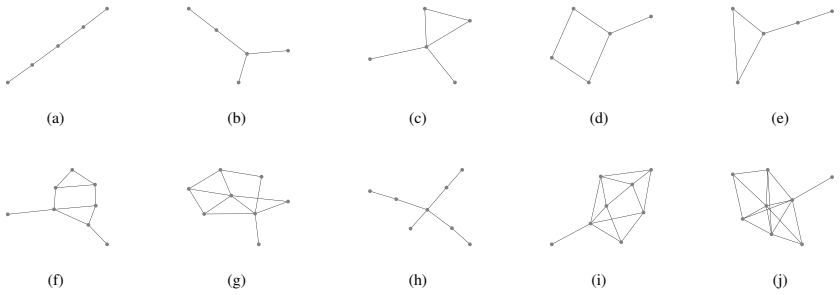
Current era quantum computers continue to grow in both capability and capacity. Despite these advancements, errors induced by environmental noise severely limit practical applicability. Current research into error mitigation and correction to bridge the gap between current-era quantum computers and the execution of noise-sensitive workloads. These methods have significant performance and resource overheads, thereby greatly limiting the real-world benefits of their use. Circuit replication, as a naive form of error mitigation, is not new and has largely been ignored given the resource constraints of current quantum hardware. However, its simplicity is attractive as a means to supplement modern methods, reducing the overall performance overhead while still preserving error-mitigation capabilities. In this paper, we profile the effects of simple circuit replication under real-world noise profiles to better establish replication's limits as a supplemental mitigation strategy. Quantum Approximate Optimization Algorithm (QAOA) for the Maxcut problem is explored for the analysis. For small graphs, we found that the average inference strength decreases by approximately 21.8% while the average standard deviation decreases by 108.8% compared to 6 replicates. For larger graphs, inference strength decreases by 35.4% while the average standard deviation decreased only 20.5%. Fewer replications did not affect smaller graphs, but degraded inference strength, with comparable benefits to standard deviation in larger graphs. These results show that replication has potential uses as a supplemental mitigation strategy for large-depth, highly variable workloads.
Editorial analysis
A structured set of objections, weighed in public.
Referee Report
Summary. The paper empirically profiles circuit replication as a supplemental error mitigation strategy for QAOA applied to Maxcut under real-world noise profiles. It reports that with 6 replicates, small graphs show ~21.8% decrease in average inference strength and ~108.8% decrease in average standard deviation, while larger graphs show ~35.4% and ~20.5% decreases respectively; fewer replicates degrade inference strength on larger graphs but preserve some standard deviation benefits. The central claim is that replication has potential as a supplemental mitigation approach for large-depth, highly variable workloads.
Significance. If the numerical results are robustly supported by detailed methodology, the work would provide concrete profiling data on a low-overhead technique that could complement existing error mitigation methods, particularly for variable QAOA instances. The empirical focus on inference strength and standard deviation metrics offers falsifiable trends that could guide practical decisions on replication depth.
major comments (2)
- [Abstract] Abstract: The reported percentage changes (21.8%, 35.4%, 108.8%, 20.5%) are presented without any accompanying details on experimental setup, including QAOA depth p, graph sizes, number of shots, noise model source or calibration, error bars, data exclusion criteria, or statistical methods. This absence makes it impossible to assess whether the central numerical claims are supported by the data.
- The headline result on replication for large-depth workloads rests on the assumption that the employed 'real-world noise profiles' accurately represent current-era hardware behavior. No verification of model fidelity, device calibration data, or comparison to hardware runs is described, leaving open whether the observed trends are artifacts of the chosen simulator noise rather than general behavior.
minor comments (1)
- [Abstract] Abstract contains an incomplete sentence: 'Current research into error mitigation and correction to bridge the gap between current-era quantum computers and the execution of noise-sensitive workloads.'
Simulated Author's Rebuttal
We thank the referee for the constructive feedback. We address each major comment below, agreeing where revisions are needed to improve clarity and explicitly noting limitations where the work is simulation-focused.
read point-by-point responses
-
Referee: [Abstract] Abstract: The reported percentage changes (21.8%, 35.4%, 108.8%, 20.5%) are presented without any accompanying details on experimental setup, including QAOA depth p, graph sizes, number of shots, noise model source or calibration, error bars, data exclusion criteria, or statistical methods. This absence makes it impossible to assess whether the central numerical claims are supported by the data.
Authors: We agree that the abstract would be strengthened by including key experimental parameters to support the reported percentages. The full manuscript details these in the Methods section (QAOA depth p=3 for small graphs and p=5 for large graphs; small graphs with 4-8 nodes, large with 15-25 nodes; 8192 shots per circuit; noise models from IBM Qiskit based on device calibration data; standard error of the mean for variability; no data exclusion applied; averages over 50 random graph instances). We will revise the abstract to concisely reference p, representative graph sizes, shot count, and the statistical approach used for the averages. revision: yes
-
Referee: The headline result on replication for large-depth workloads rests on the assumption that the employed 'real-world noise profiles' accurately represent current-era hardware behavior. No verification of model fidelity, device calibration data, or comparison to hardware runs is described, leaving open whether the observed trends are artifacts of the chosen simulator noise rather than general behavior.
Authors: The noise profiles are taken directly from publicly available IBM device calibration data via Qiskit Aer, which is a standard approach for such profiling studies. However, the manuscript does not include explicit model fidelity checks against hardware or direct hardware execution comparisons, as the focus is on controlled simulation to isolate replication effects. We will add a Methods subsection describing the exact calibration data sources and a Limitations paragraph acknowledging that the trends are specific to the simulated noise models, without claiming direct hardware equivalence. revision: partial
Circularity Check
No circularity: empirical profiling study with no derivations or self-referential reductions.
full rationale
The paper is an empirical profiling study of circuit replication on QAOA-Maxcut instances under noise profiles. No equations, derivations, fitted parameters, or self-citations are presented that reduce any claimed result to its own inputs by construction. The central claims are direct observations from simulation runs (e.g., percentage drops in inference strength and standard deviation), not predictions derived from prior fits or uniqueness theorems. Self-citation load-bearing, ansatz smuggling, or renaming of known results are absent. The noise-profile fidelity concern raised in the skeptic note is a question of external validity, not circularity.
Axiom & Free-Parameter Ledger
Reference graph
Works this paper leans on
-
[1]
The bitter truth about gate-based quantum algorithms in the nisq era,
F. Leymann and J. Barzen, “The bitter truth about gate-based quantum algorithms in the nisq era,” Quantum Science and Technology, vol. 5, no. 4, p. 044007, sep 2020. [Online]. Available: https: //doi.org/10.1088/2058-9565/abae7d
-
[2]
Refining quantum fidelity: approaches in quantum error correction,
V . S. Thakur, A. Kumar, and K. Dev, “Refining quantum fidelity: approaches in quantum error correction,” Quantum Information Processing, vol. 24, no. 7, p. 190, Jun 2025. [Online]. Available: https://doi.org/10.1007/ s11128-025-04809-3
2025
-
[3]
Error mitigation in the nisq era: Applying measurement error mitigation techniques to enhance quantum circuit performance,
M. U. Khan, M. A. Kamran, W. R. Khan, M. M. Ibrahim, M. U. Ali, and S. W. Lee, “Error mitigation in the nisq era: Applying measurement error mitigation techniques to enhance quantum circuit performance,” Mathematics, vol. 12, no. 14, 2024. [Online]. Available: https://www.mdpi.com/2227-7390/12/14/2235
2024
-
[4]
A. Zhang, H. Xie, Y . Gao, J.-N. Yang, Z. Bao, Z. Zhu, and et. al., “Demonstrating quantum error mitigation on logical qubits,”Nature Communications, vol. 17, no. 1, p. 1021, Dec 2025. [Online]. Available: https://doi.org/10.1038/s41467-025-67768-4
-
[5]
A. Nath and A. Kuhnle, “A benchmark for maximum cut: Towards standardization of the evaluation of learned heuristics for combinatorial optimization,” 2024. [Online]. Available: https://arxiv.org/abs/2406.11897
arXiv 2024
-
[6]
Noise tailoring for scalable quantum computation via randomized compiling,
J. J. Wallman and J. Emerson, “Noise tailoring for scalable quantum computation via randomized compiling,”Phys. Rev. A, vol. 94, p. 052325, Nov
-
[7]
Available: https://link.aps.org/doi/10
[Online]. Available: https://link.aps.org/doi/10. 1103/PhysRevA.94.052325
-
[8]
Dynamical decoupling for superconducting qubits: A performance survey,
N. Ezzell, B. Pokharel, L. Tewala, G. Quiroz, and D. A. Lidar, “Dynamical decoupling for superconducting qubits: A performance survey,”Phys. Rev. Appl., vol. 20, p. 064027, Dec 2023. [Online]. Available: https: //link.aps.org/doi/10.1103/PhysRevApplied.20.064027
-
[9]
T. Giurgica-Tiron, Y . Hindy, R. LaRose, A. Mari, and W. J. Zeng, “Digital zero noise extrapolation for quantum error mitigation,” in2020 IEEE International Conference on Quantum Computing and Engineering (QCE). IEEE, Oct. 2020, p. 306–316. [Online]. Available: http://dx.doi.org/10.1109/QCE49297.2020.00045
-
[10]
Probabilistic error cancellation with sparse pauli–lindblad models on noisy quantum processors,
E. van den Berg, Z. K. Minev, A. Kandala, and K. Temme, “Probabilistic error cancellation with sparse pauli–lindblad models on noisy quantum processors,” Nature Physics, vol. 19, no. 8, pp. 1116–1121, Aug 2023. [Online]. Available: https://doi.org/10.1038/ s41567-023-02042-2
2023
-
[11]
S. S. Tannu and M. Qureshi, “Ensemble of diverse mappings: Improving reliability of quantum computers by orchestrating dissimilar mistakes,” inProceedings of the 52nd Annual IEEE/ACM International Symposium on Microarchitecture, ser. MICRO-52. New York, NY , USA: Association for Computing Machinery, 2019, p. 253–265. [Online]. Available: https://doi.org/1...
arXiv 2019
-
[12]
Replication-based quantum annealing error mitigation,
H. Djidjev, “Replication-based quantum annealing error mitigation,” inProceedings of the 21st ACM International Conference on Computing Frontiers, ser. CF ’24. New York, NY , USA: Association for Computing Machinery, 2024, p. 215–223. [Online]. Available: https://doi.org/10.1145/3649153.3649200
-
[13]
Improving the reliability of quantum circuits by evolving heterogeneous ensembles,
O. Parry, J. Clark, and P. McMinn, “Improving the reliability of quantum circuits by evolving heterogeneous ensembles,” 2024. [Online]. Available: https://arxiv.org/ abs/2409.09103
arXiv 2024
-
[14]
Quantum computing with Qiskit,
A. Javadi-Abhari, M. Treinish, K. Krsulich, C. J. Wood, J. Lishman, J. Gacon, S. Martiel, P. D. Nation, L. S. Bishop, A. W. Cross, B. R. Johnson, and J. M. Gambetta, “Quantum computing with Qiskit,” 2024
2024
-
[15]
The ibm quantum heavy hex lattice
IBM, “The ibm quantum heavy hex lattice.” [Online]. Available: https://www.ibm.com/quantum/blog/ heavy-hex-lattice
-
[16]
Algorithmic theory of qubit routing,
T. Ito, N. Kakimura, N. Kamiyama, Y . Kobayashi, and Y . Okamoto, “Algorithmic theory of qubit routing,” 2023. [Online]. Available: https://arxiv.org/abs/2305.02059
arXiv 2023
-
[17]
Improving quantum computation by optimized qubit routing,
F. Wagner, A. Bärmann, F. Liers, and M. Weis- senbäck, “Improving quantum computation by optimized qubit routing,”Journal of Optimization Theory and Applications, vol. 197, no. 3, pp. 1161–1194, May 2023. [Online]. Available: http://dx.doi.org/10.1007/s10957-023-02229-w
-
[18]
Lightsabre: A lightweight and enhanced sabre algorithm,
H. Zou, M. Treinish, K. Hartman, A. Ivrii, and J. Lishman, “Lightsabre: A lightweight and enhanced sabre algorithm,” 2024. [Online]. Available: https: //arxiv.org/abs/2409.08368
arXiv 2024
-
[19]
A quantum approximate optimization algorithm,
E. Farhi, J. Goldstone, and S. Gutmann, “A quantum approximate optimization algorithm,” 2014. [Online]. Available: https://arxiv.org/abs/1411.4028
Pith/arXiv arXiv 2014
-
[20]
Quantum optimization using variational algorithms on near-term quantum devices,
N. Moll, P. Barkoutsos, L. S. Bishop, J. M. Chow, A. Cross, D. J. Egger, and et. al, “Quantum optimization using variational algorithms on near-term quantum devices,”Quantum Science and Technology, vol. 3, no. 3, p. 030503, Jun. 2018. [Online]. Available: http://dx.doi.org/10.1088/2058-9565/aab822
-
[21]
R. M. Karp,Reducibility among combinatorial problems. Univ. of California, 1972
1972
-
[22]
M. R. Garey and D. S. Johnson,Computers and in- tractability: A guide to the theory of NP-completeness. Freeman, 2009
2009
-
[23]
Optimization, approximation, and complexity classes,
C. H. Papadimitriou and M. Yannakakis, “Optimization, approximation, and complexity classes,”Journal of Computer and System Sciences, vol. 43, no. 3, pp. 425–440, 1991. [Online]. Available: https://www. sciencedirect.com/science/article/pii/002200009190023X
arXiv 1991
-
[24]
A variational qubit-efficient maxcut heuristic algorithm,
Y . Tene-Cohen, T. Kelman, O. Lev, and A. Makmal, “A variational qubit-efficient maxcut heuristic algorithm,” npj Quantum Information, vol. 12, no. 1, p. 50, Feb 2026. [Online]. Available: https://doi.org/10.1038/ s41534-026-01186-2
2026
discussion (0)
Sign in with ORCID, Apple, or X to comment. Anyone can read and Pith papers without signing in.