REVIEW 2 major objections 5 minor 1 cited by
This paper demonstrates that machine-learning anomaly detectors trained without labeled signal examples can pull rare boosted top quarks out of 138 fb⁻¹ of LHC collisions, and that five such model-agnostic methods all exceed the sensitivity
Reviewed by Pith at T0; open to challenge. T0 means a machine referee read the full paper against a public rubric. the ladder, T0–T4 →
T0 review · deepseek-v4-flash
2026-08-03 14:22 UTC pith:WZVWKJQZ
load-bearing objection A careful, genuinely useful CMS methods paper with a real data-level comparison of modern anomaly detectors; the only notable gap is the missing closure test for mass sculpting in the sideband-based methods. the 2 major comments →
Machine-learning techniques for model-independent searches in dijet final states
The pith
A machine-rendered reading of the paper's core claim, the machinery that carries it, and where it could break.
Core claim
The paper's central claim is that machine-learning anomaly detection can serve as a practical, model-independent search strategy for new particles decaying to a pair of large-radius jets. Using 138 fb⁻¹ of 13 TeV proton-proton collisions, the authors deploy five methods—a variational autoencoder with quantile regression, two weakly supervised classifiers (CWoLa Hunting and Tag N' Train), a generative-model-based classifier (CATHODE, plus a b-tagging variant), and a semi-supervised method that uses signal priors (QUAK). Every anomaly-detection method is shown to improve sensitivity over an inclusive resonance search for a 2-prong and a 3-prong benchmark signal, while no single method dominate
What carries the argument
The load-bearing mechanism is the unlabeled likelihood-ratio estimator. Under weak supervision, a classifier is trained to tell apart events from the signal region (data that may contain signal) and events from background sidebands in the dijet invariant mass. Because the signal-region density is a mixture of background and signal, the learned score is monotonically related to the optimal signal-to-background ratio, so no signal labels are needed. To prevent the classifier from learning mass-dependent features and sculpting a fake bump, the methods reweight jet transverse momentum, combine per-jet scores through percentiles, use quantile regression for the autoencoder approach, or interpolat
Load-bearing premise
The sidebands are a good model for the signal-region background: specifically, the jet-substructure features used by the classifier must be statistically independent of the mass variable after the decorrelation measures, otherwise the tagger can sculpt an artificial bump and create a false signal.
What would settle it
Run the weakly supervised tagger on a background-only control dataset (for example the high-rapidity-difference sideband) and inspect the selected-event mass distribution: a resonant bump there would mean the decorrelation failed. A complementary decisive test is to inject a known small signal into simulated collisions, retrain the tagger exactly as described, and verify that the measured signal-selection efficiency and final significance improvement over the inclusive search match the quoted values; if the tagger does not beat the inclusive search for both benchmark signals, the paper's centr
If this is right
- A single search can cover a wide range of unknown resonance masses by training the tagger in overlapping mass windows rather than committing to one theory.
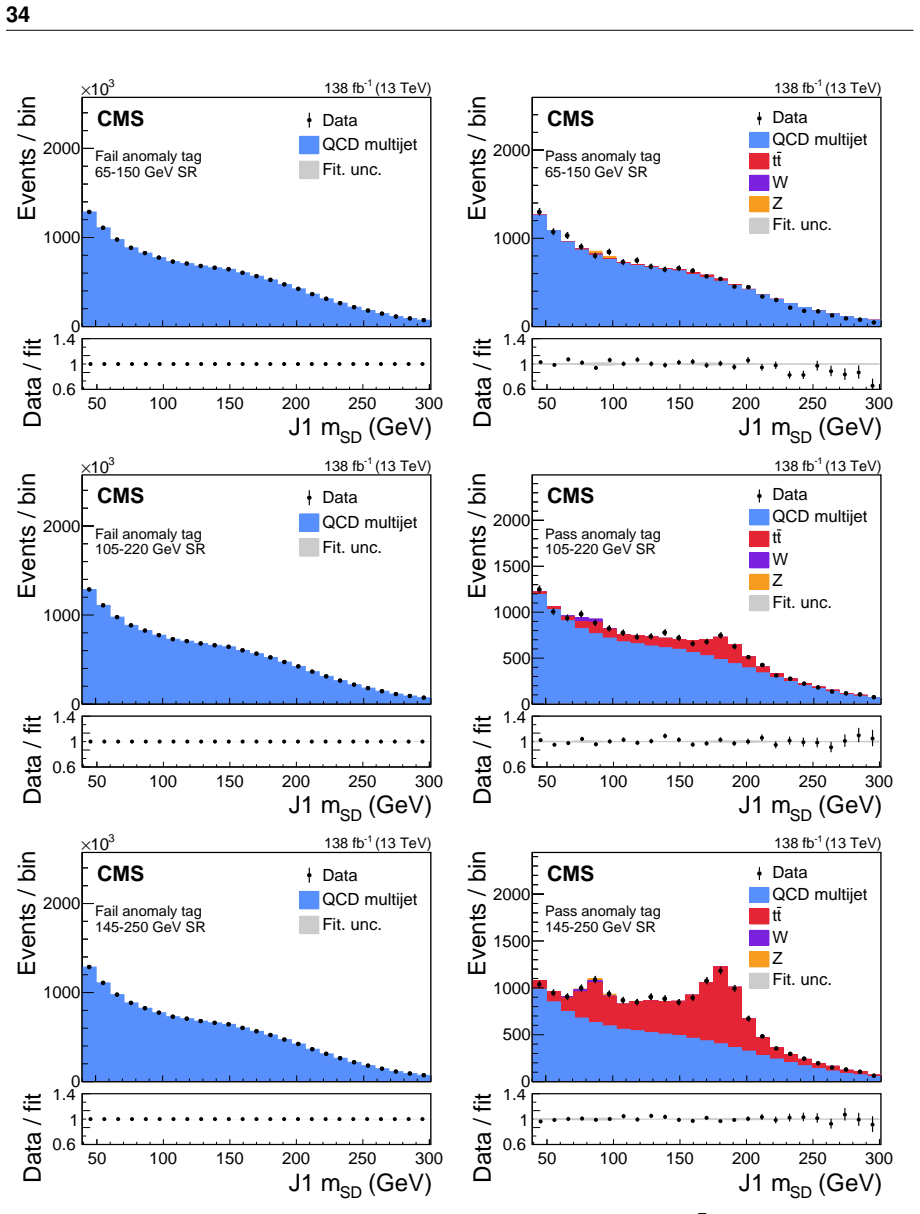
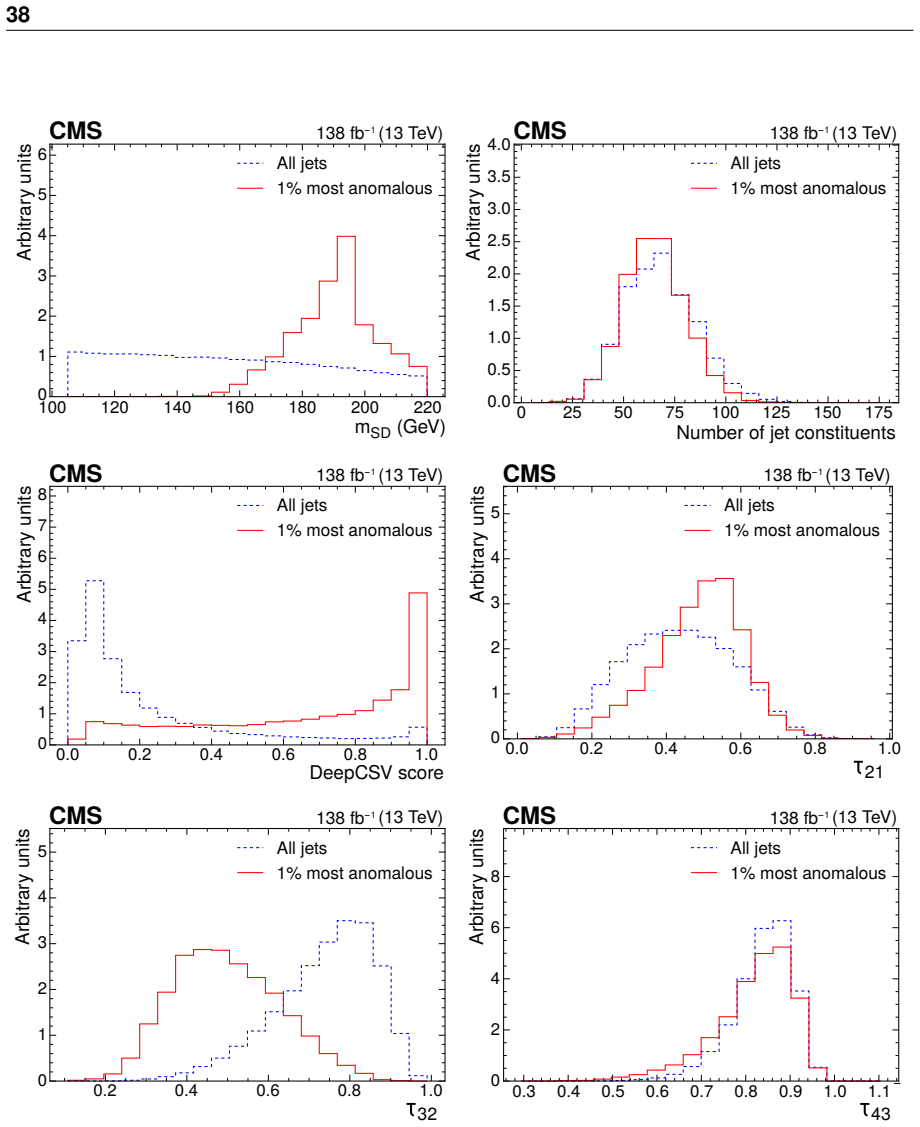
- Weakly supervised anomaly detection works on real data, not only simulation: recovering boosted top quarks in roughly 1% abundance validates the approach on actual collision events.
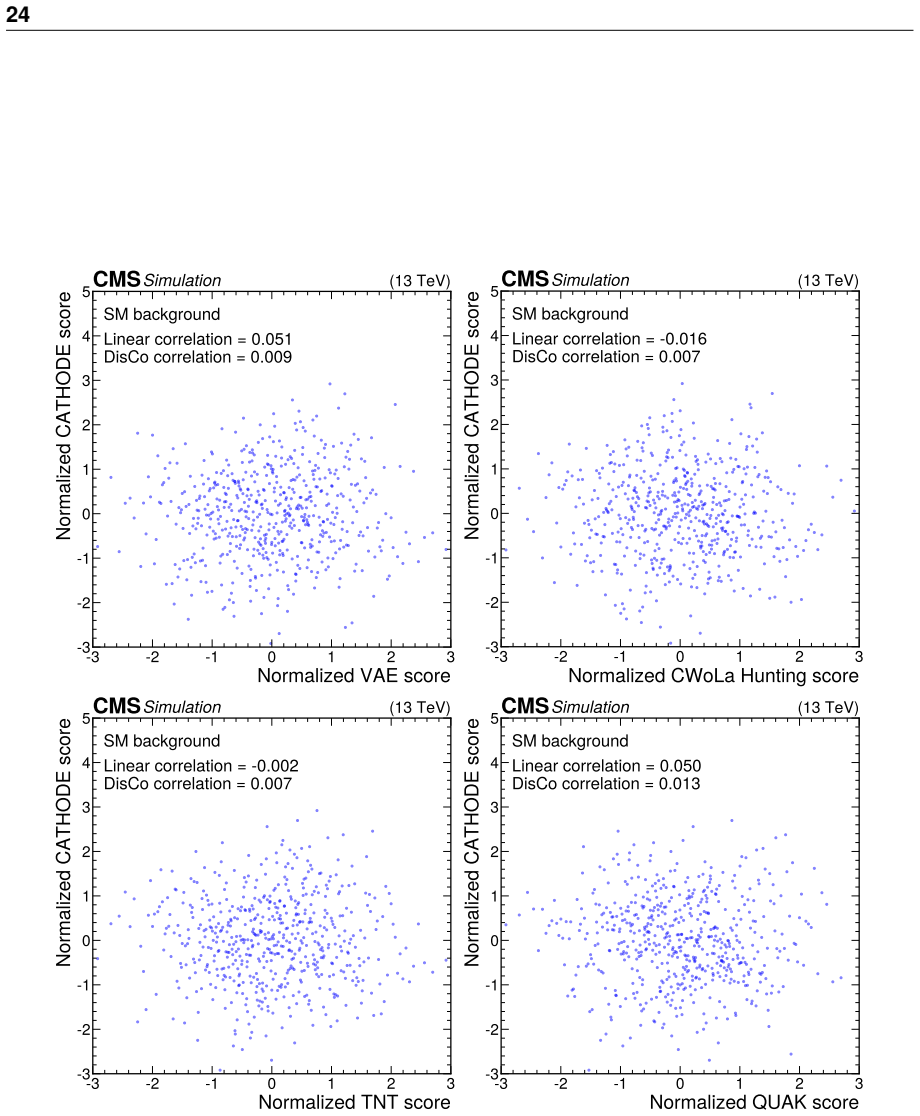
- Because anomaly scores across methods are weakly correlated, combining selections from different methods is a promising route to higher generic sensitivity, as the paper itself points out.
- Input-feature choice, not just the algorithm, sets the achievable gain; uninformative features can actively hurt weakly supervised classifiers, so feature curation is part of the method.
- A model-agnostic tagger can be repurposed from a resonant dijet search to a nonresonant pair-production search by switching the mass variable and reusing the same weakly supervised machinery.
Where Pith is reading between the lines
- The same sideband-plus-generative-model recipe could be reused for nonresonant searches in other final states, where no sharp invariant-mass peak exists; the top-quark validation is implicitly a proof of concept for such searches.
- Combining the weakly correlated anomaly scores—for example through a simple ensemble or a learned fusion—is a direct next step the paper does not develop; it could recover signals that any single method misses.
- The released simulated dataset with full substructure and systematic variations lets other researchers benchmark new taggers against these five baselines, accelerating progress without needing detector access.
- If these techniques generalize to higher-pileup running conditions, the same model-agnostic framework could become a standard first-pass search run before model-specific analyses are performed.
Editorial analysis
A structured set of objections, weighed in public.
Referee Report
Summary. This paper describes the five machine-learning anomaly-detection techniques used in the CMS model-agnostic dijet search of Ref. [6]: VAE-QR (unsupervised), CWoLa Hunting, TNT, and CATHODE (weakly supervised), and QUAK (semi-supervised). Using 138 fb^-1 of 13 TeV CMS data and simulation, the paper compares the methods' sensitivity on a suite of BSM benchmark signals, studies complementarity of their anomaly scores, and investigates the role of input-feature choice. It also validates weakly supervised anomaly detection in real data by identifying boosted hadronically decaying top quarks, where the best model achieves a significance improvement only about 15% below a fully supervised classifier. A central methodological requirement is that the selection must not sculpt the m_jj spectrum; the paper describes explicit decorrelation countermeasures for the weakly supervised methods.
Significance. If the results hold, the paper provides one of the first multi-method, model-agnostic anomaly-detection studies on LHC collision data, with a compelling real-data validation. The strengths are the use of data sidebands for training, five-fold cross-validation, explicit decorrelation measures, a detailed signal-efficiency uncertainty procedure via repeated injection and selective retraining, a public companion dataset on Zenodo, and an honest comparison against supervised classifiers. The top-quark identification result in Section 7 is significant and supports the viability of weak supervision in a realistic hadronic channel.
major comments (2)
- [Section 5.2.1 and 5.2.2] The paper asserts that the per-jet pT reweighting 'has been shown to mitigate mass sculpting effects' (Section 5.2.1), but no supporting evidence or citation is provided in this manuscript. For CWoLa Hunting and TNT, no background-only closure test is shown demonstrating that the m_jj distribution after the anomaly selection is statistically consistent with the inclusive QCD background. Figure 5 provides such a test only for VAE-QR. Since the weakly supervised methods rely on m_jj sidebands to model the background, residual feature-m_jj correlations could cause the classifier to sculpt an artificial bump. This is a load-bearing point for the claim in Section 6.1 that all anomaly detection methods increase sensitivity. Please add a closure test (e.g., the selected m_jj spectrum compared to the inclusive spectrum in simulated background-only events) or explicitly cite the location of such
- [Section 5.2.3] CATHODE's background model is a conditional normalizing flow trained on sidebands and interpolated into the signal region. The manuscript states that this correctly accounts for correlations between x and m_jj, but no validation of the interpolation is shown. In particular, there is no closure test demonstrating that the generated background samples in the SR match observed data or an independent background simulation, nor that the selected m_jj spectrum after applying CATHODE's anomaly score is unchanged. Such a test would be analogous to Fig. 5 for VAE-QR and is needed to support the method's use in the resonant search.
minor comments (5)
- [Section 5.2.1] The phrase 'has been shown to mitigate mass sculpting effects' needs a reference or a brief explanation of the supporting study; as written it is an unsubstantiated assertion.
- [Section 5.3] The definition of the signed L5 norm, ||x||_5 = (x1^5 + ... + x6^5)^{1/5}, is ambiguous when the normalizing-flow NLL scores can be negative. Please specify whether absolute values are taken or clarify the handling of negative inputs.
- [Section 7.2] Typo: 'In the t t the signal, separate contributions...' should read 'In the tt signal, separate contributions...'.
- [Figure 9] The horizontal axis extends to negative cross sections. If this is intentional to show the zero-cross-section behavior, please add a note; otherwise consider starting the axis at zero for clarity.
- [Section 8] The summary states that the tt study 'constitutes a validation of resonant anomaly detection in collider data.' The tt validation uses a nonresonant split strategy applied to one jet's mass while scoring the other jet, explicitly avoiding sculpting. It does not exercise the m_jj sideband interpolation central to the resonant dijet search. The wording should be softened to 'validation of weakly supervised anomaly detection' or explicitly distinguish the nonresonant validation from the resonant search.
Circularity Check
No significant circularity: methods are benchmarked against injected signals and an independent data-based top-quark validation; QUAK's signal prior is explicitly disclosed and not used to mask model-agnostic claims.
full rationale
I walked the derivation chain of the paper. The central sensitivity claims (Section 6.1) are established by injecting benchmark signals into simulated background and running the full anomaly-detection pipeline, including training, event selection, and signal extraction; this is a genuine test, not a fit renamed as a prediction. The weakly supervised methods (CWoLa Hunting, TNT, CATHODE) do not use signal samples during training, so their improved sensitivity relative to the inclusive search is not forced by construction. QUAK is explicitly labeled semi-supervised and the paper states that targeted searches use the specific signal being tested as a prior, while also showing a generic QUAK variant; this is disclosed oracle-like benchmarking, not a hidden circularity. The data validation in Section 7.2 is independent of the resonant m_jj search: the weak tagger is applied to one randomly assigned jet (J2) while the signal is extracted from the other jet's soft-drop mass (J1), and the result is compared in simulation to a fully supervised classifier trained with the same features. The claim that the best weak model is only ~15% worse than the supervised classifier is therefore an external benchmark, not an equivalence to training inputs. The VAE-QR quantile regression is designed to produce a constant selection fraction; the resulting similarity of the m_jj shapes is a consistency check of that construction, not a prediction claimed as derived from first principles. Self-citations to Ref. [6] provide the parent search context and some fitting/limit-setting details, but no load-bearing uniqueness or ansatz is imported from that reference, and the method descriptions and top-quark validation are self-contained in this manuscript. The paper does state the sideband-decorrelation requirement for weak supervision and notes that the pT reweighting 'has been shown to mitigate mass sculpting effects' without showing the closure test in this paper; that is a validation gap and a potential correctness risk, but it is not a circular derivation. No step in the paper reduces a claimed result to its own input by definition or by self-citation.
Axiom & Free-Parameter Ledger
free parameters (4)
- Anomaly-score selection efficiencies per signal region =
1% (SRs up to B3), 3% (A4–B5), 5% (above); 0.1% in ttbar validation
- Quantile regression thresholds q =
10%, 5%, 1%
- QUAK signal-prior grouping daughter masses =
80, 170, 400 GeV in six combinations
- Signal mass windows for ttbar validation =
m_SD windows 65–150, 105–220, 145–250 GeV
axioms (3)
- domain assumption The background-only distribution of jet-substructure features in the signal region can be accurately estimated from m_jj sidebands (after reweighting or conditional generation).
- domain assumption The simulated signal and background Monte Carlo samples accurately describe the physics and detector response.
- domain assumption Neural network generalization: models trained on finite samples generalize to the full population (i.i.d. assumption).
read the original abstract
Anomaly detection methods used in a recent search for new phenomena by CMS at the CERN LHC are presented. The methods use machine learning to detect anomalous jets produced in the decay of new massive particles without depending on a specific theory model. The effectiveness of these approaches in enhancing sensitivity to various signal samples is studied and compared using data collected in proton-proton collisions at a center-of-mass energy of 13 TeV. In an example analysis, the capabilities of anomaly detection methods are further demonstrated by identifying large-radius jets consistent with Lorentz-boosted hadronically decaying top quarks in a model-agnostic framework.
Figures






Forward citations
Cited by 1 Pith paper
-
Kitchen Sink Anomaly Detection
A combined kitchen sink observable set of Energy Flow Polynomials and subjettiness variables outperforms standard baselines in sensitivity to a wide range of resonant signals, with new public benchmarks released and a...
Reference graph
Works this paper leans on
-
[1]
The ATLAS Experiment at the CERN Large Hadron Collider
ATLAS Collaboration, “The ATLAS Experiment at the CERN Large Hadron Collider”, J. Instrum.3(2008) S08003,doi:10.1088/1748-0221/3/08/S08003
-
[2]
The CMS experiment at the CERN LHC
CMS Collaboration, “The CMS experiment at the CERN LHC”,J. Instrum.3(2008) S08004,doi:10.1088/1748-0221/3/08/S08004
-
[3]
Particle Data Group, S. Navas et al., “Review of particle physics”,Phys. Rev. D110 (2024) 030001,doi:10.1103/PhysRevD.110.030001
-
[4]
The LHC Olympics 2020 a community challenge for anomaly detection in high energy physics
G. Kasieczka et al., “The LHC Olympics 2020 a community challenge for anomaly detection in high energy physics”,Rept. Prog. Phys.84(2021) 124201, doi:10.1088/1361-6633/ac36b9
-
[5]
Machine learning for anomaly detection in particle physics
V . Belis, P . Odagiu, and T. K. Aarrestad, “Machine learning for anomaly detection in particle physics”,Rev. Phys.12(2024) 100091, doi:10.1016/j.revip.2024.100091
arXiv 2024
-
[6]
CMS Collaboration, “Model-agnostic search for dijet resonances with anomalous jet substructure in proton–proton collisions at √s=13 TeV”,Rept. Prog. Phys.88(2025) 067802,doi:10.1088/1361-6633/add762
-
[7]
D0 Collaboration, “Search for new physics in eµX data at DØ using SLEUTH: A quasi-model-independent search strategy for new physics”,Phys. Rev. D62(2000) 092004,doi:10.1103/PhysRevD.62.092004
-
[8]
A quasi model independent search for new physics at large transverse momentum
D0 Collaboration, “A quasi model independent search for new physics at large transverse momentum”,Phys. Rev. D64(2001) 012004, doi:10.1103/PhysRevD.64.012004
-
[9]
A quasi model independent search for new highp t physics at D0
D0 Collaboration, “A quasi model independent search for new highp t physics at D0”, Phys. Rev. Lett.86(2001) 3712,doi:10.1103/PhysRevLett.86.3712
-
[10]
A general search for new phenomena at HERA
H1 Collaboration, “A general search for new phenomena at HERA”,Phys. Lett. B674 (2009) 257,doi:10.1016/j.physletb.2009.03.034
-
[11]
A General search for new phenomena in ep scattering at HERA
H1 Collaboration, “A General search for new phenomena in ep scattering at HERA”, Phys. Lett. B602(2004) 14,doi:10.1016/j.physletb.2004.09.057
-
[12]
Model-independent and quasi-model-independent search for new physics at CDF
CDF Collaboration, “Model-independent and quasi-model-independent search for new physics at CDF”,Phys. Rev. D78(2008) 012002, doi:10.1103/PhysRevD.78.012002
-
[13]
Model-independent global search for new high-p(T) physics at CDF
CDF Collaboration, “Model-independent global search for new high-p(T) physics at CDF”, 2007.doi:10.2172/922303. 42
-
[14]
Global search for new physics with 2.0 fb −1 at CDF
CDF Collaboration, “Global search for new physics with 2.0 fb −1 at CDF”,Phys. Rev. D 79(2009) 011101,doi:10.1103/PhysRevD.79.011101
-
[15]
MUSiC: a model-unspecific search for new physics in proton–proton collisions at √s=13 TeV
CMS Collaboration, “MUSiC: a model-unspecific search for new physics in proton–proton collisions at √s=13 TeV”,Eur. Phys. J. C81(2021) 629, doi:10.1140/epjc/s10052-021-09236-z
-
[16]
ATLAS Collaboration, “A strategy for a general search for new phenomena using data-derived signal regions and its application within the ATLAS experiment”,Eur. Phys. J. C79(2019) 120,doi:10.1140/epjc/s10052-019-6540-y
-
[17]
Dijet resonance search with weak supervision using√s=13 TeVppcollisions in the ATLAS detector
ATLAS Collaboration, “Dijet resonance search with weak supervision using√s=13 TeVppcollisions in the ATLAS detector”,Phys. Rev. Lett.125(2020) 131801, doi:10.1103/PhysRevLett.125.131801
-
[18]
ATLAS Collaboration, “Weakly supervised anomaly detection for resonant new physics in the dijet final state using proton-proton collisions at √s=13 TeV with the ATLAS detector”, 2025.arXiv:2502.09770
arXiv 2025
-
[19]
T. Aarrestad et al., “The dark machines anomaly score challenge: Benchmark data and model independent event classification for the Large Hadron Collider”,SciPost Phys. 12(2022) 043,doi:10.21468/SciPostPhys.12.1.043
-
[20]
J. A. Aguilar-Saavedra, J. Collins, and R. K. Mishra, “A generic anti-QCD jet tagger”,J. High Energy Phys.2017(2017), no. 11, 163,doi:10.1007/JHEP11(2017)163
-
[21]
Classifying anomalies through outer density estimation
A. Hallin et al., “Classifying anomalies through outer density estimation”,Phys. Rev. D 106(2022) 055006,doi:10.1103/PhysRevD.106.055006
-
[22]
Classification without labels: Learning from mixed samples in high energy physics
E. M. Metodiev, B. Nachman, and J. Thaler, “Classification without labels: Learning from mixed samples in high energy physics”,J. High Energy Phys.2017(2017), no. 10, 174,doi:10.1007/JHEP10(2017)174
-
[23]
Extending the search for new resonances with machine learning
J. H. Collins, K. Howe, and B. Nachman, “Extending the search for new resonances with machine learning”,Phys. Rev. D99(2019) 014038, doi:10.1103/PhysRevD.99.014038
-
[24]
Boosting mono-jet searches with model-agnostic machine learning
T. Finke, M. Kr ¨amer, M. Lipp, and A. M¨uck, “Boosting mono-jet searches with model-agnostic machine learning”,J. High Energy Phys.2022(2022), no. 08, 15, doi:10.1007/JHEP08(2022)015
-
[25]
Anomaly detection with density estimation
B. Nachman and D. Shih, “Anomaly detection with density estimation”,Phys. Rev. D 101(2020) 075042,doi:10.1103/PhysRevD.101.075042
-
[26]
CURTAINs for your sliding window: Constructing unobserved regions by transforming adjacent intervals
J. A. Raine, S. Klein, D. Sengupta, and T. Golling, “CURTAINs for your sliding window: Constructing unobserved regions by transforming adjacent intervals”,Front. Big Data6 (2023) 899345,doi:10.3389/fdata.2023.899345
arXiv 2023
-
[27]
S. Klein, J. A. Raine, and T. Golling, “Flows for flows: Training normalizing flows between arbitrary distributions with maximum likelihood estimation”, 2022. arXiv:2211.02487
Pith/arXiv arXiv 2022
-
[28]
CURTAINs flows for flows: Constructing unobserved regions with maximum likelihood estimation
D. Sengupta, S. Klein, J. A. Raine, and T. Golling, “CURTAINs flows for flows: Constructing unobserved regions with maximum likelihood estimation”,SciPost Phys. 17(2024) 046,doi:10.21468/SciPostPhys.17.2.046. References 43
-
[29]
Improving new physics searches with diffusion models for event observables and jet constituents
D. Sengupta et al., “Improving new physics searches with diffusion models for event observables and jet constituents”,J. High Energy Phys.2024(2024), no. 04, 109, doi:10.1007/JHEP04(2024)109
-
[30]
High-dimensional and permutation invariant anomaly detection
V . Mikuni and B. Nachman, “High-dimensional and permutation invariant anomaly detection”,SciPost Phys.16(2024) 062,doi:10.21468/SciPostPhys.16.3.062
-
[31]
Flow-enhanced transportation for anomaly detection
T. Golling, S. Klein, R. Mastandrea, and B. Nachman, “Flow-enhanced transportation for anomaly detection”,Phys. Rev. D107(2023) 096025, doi:10.1103/PhysRevD.107.096025
-
[32]
Improving variational autoencoders for new physics detection at the LHC with normalizing flows
P . Jawahar et al., “Improving variational autoencoders for new physics detection at the LHC with normalizing flows”,Front. Big Data5(2022) 803685, doi:10.3389/fdata.2022.803685
arXiv 2022
-
[33]
Particle graph autoencoders and differentiable, learned energy mover’s distance
S. Tsan et al., “Particle graph autoencoders and differentiable, learned energy mover’s distance”, in35th Conference on Neural Information Processing Systems. 2021. arXiv:2111.12849
Pith/arXiv arXiv 2021
-
[34]
Autoencoders for unsupervised anomaly detection in high energy physics
T. Finke et al., “Autoencoders for unsupervised anomaly detection in high energy physics”,J. High Energy Phys.2021(2021), no. 06, 161, doi:10.1007/JHEP06(2021)161
-
[35]
GAN-AE: an anomaly detection algorithm for new physics search in LHC data
L. Vaslin, V . Barra, and J. Donini, “GAN-AE: an anomaly detection algorithm for new physics search in LHC data”,Eur. Phys. J. C83(2023) 1008, doi:10.1140/epjc/s10052-023-12169-4
-
[36]
Triggering dark showers with conditional dual auto-encoders
L. Anzalone et al., “Triggering dark showers with conditional dual auto-encoders”, Mach. Learn. Sci. T ech.5(2024) 035064,doi:10.1088/2632-2153/ad652b
-
[37]
Variational autoencoders for new physics mining at the Large Hadron Collider
O. Cerri et al., “Variational autoencoders for new physics mining at the Large Hadron Collider”,J. High Energy Phys.2019(2019), no. 05, 036, doi:10.1007/JHEP05(2019)036
-
[38]
Better latent spaces for better autoencoders
B. M. Dillon, T. Plehn, C. Sauer, and P . Sorrenson, “Better latent spaces for better autoencoders”,SciPost Phys.11(2021) 061, doi:10.21468/SciPostPhys.11.3.061
-
[39]
Variational autoencoders for anomalous jet tagging
T. Cheng et al., “Variational autoencoders for anomalous jet tagging”,Phys. Rev. D107 (2023) 016002,doi:10.1103/PhysRevD.107.016002
-
[40]
A normalized autoencoder for LHC triggers
B. M. Dillon et al., “A normalized autoencoder for LHC triggers”,SciPost Phys. Core6 (2023) 074,doi:10.21468/SciPostPhysCore.6.4.074
-
[41]
Combining outlier analysis algorithms to identify new physics at the LHC
M. van Beekveld et al., “Combining outlier analysis algorithms to identify new physics at the LHC”,J. High Energy Phys.2021(2021), no. 09, 024, doi:10.1007/JHEP09(2021)024
-
[42]
Semi-supervised anomaly detection—towards model-independent searches of new physics
M. Kuusela et al., “Semi-supervised anomaly detection—towards model-independent searches of new physics”,J. Phys. Conf. Ser.368(2012) 012032, doi:10.1088/1742-6596/368/1/012032
-
[43]
E. Govorkova et al., “Autoencoders on field-programmable gate arrays for real-time, unsupervised new physics detection at 40 MHz at the Large Hadron Collider”,Nature Mach. Intell.4(2022) 154,doi:10.1038/s42256-022-00441-3. 44
-
[44]
Online-compatible unsupervised nonresonant anomaly detection
V . Mikuni, B. Nachman, and D. Shih, “Online-compatible unsupervised nonresonant anomaly detection”,Phys. Rev. D105(2022) 055006, doi:10.1103/PhysRevD.105.055006
-
[45]
New physics agnostic selections for new physics searches
K. A. Wo ´zniak et al., “New physics agnostic selections for new physics searches”,EPJ Web Conf.245(2020) 06039,doi:10.1051/epjconf/202024506039
arXiv 2020
-
[46]
Adversarially learned anomaly detection on CMS open data: re-discovering the top quark
O. Knapp et al., “Adversarially learned anomaly detection on CMS open data: re-discovering the top quark”,Eur. Phys. J. Plus136(2021) 236, doi:10.1140/epjp/s13360-021-01109-4
-
[47]
Wasserstein normalized autoencoder for anomaly detection
CMS Collaboration, “Wasserstein normalized autoencoder for anomaly detection”, 2025.arXiv:2510.02168. Submitted toMach. Learn.: Sci. and T ech
Pith/arXiv arXiv 2025
-
[48]
Searching for new physics with deep autoencoders
M. Farina, Y. Nakai, and D. Shih, “Searching for new physics with deep autoencoders”, Phys. Rev. D101(2020) 075021,doi:10.1103/PhysRevD.101.075021
-
[49]
T. Heimel, G. Kasieczka, T. Plehn, and J. M. Thompson, “QCD or what?”,SciPost Phys. 6(2019) 030,doi:10.21468/SciPostPhys.6.3.030
-
[50]
ATLAS Collaboration, “Anomaly detection search for new resonances decaying into a Higgs boson and a generic new particleXin hadronic final states using √s=13 TeVpp collisions with the ATLAS detector”,Phys. Rev. D108(2023) 052009, doi:10.1103/PhysRevD.108.052009
-
[51]
ATLAS Collaboration, “Search for new phenomena in two-body invariant mass distributions using unsupervised machine learning for anomaly detection at√s=13 tev with the ATLAS Detector”,Phys. Rev. Lett.132(2024) 081801, doi:10.1103/PhysRevLett.132.081801
-
[52]
ATLAS Collaboration, “Search for new physics in final states with semi-visible jets or anomalous signatures using the ATLAS detector”, 2025.arXiv:2505.01634
Pith/arXiv arXiv 2025
-
[53]
Auto-encoding variational Bayes
D. P . Kingma and M. Welling, “Auto-encoding variational Bayes”, 2014. arXiv:1312.6114
Pith/arXiv arXiv 2014
-
[54]
CMS ECAL Collaboration, “Autoencoder-based anomaly detection system for online data quality monitoring of the CMS electromagnetic calorimeter”,Comput. Softw. Big Sci.8(2024) 11,doi:10.1007/s41781-024-00118-z
-
[55]
Machine and deep learning applications in particle physics
D. Bourilkov, “Machine and deep learning applications in particle physics”,Int. J. Mod. Phys. A34(2020) 1930019,doi:10.1142/S0217751X19300199
-
[56]
CMS Collaboration, “Measurement of the t ¯tb¯b production cross section in the all-jet final state in pp collisions at √s=13 TeV”,Phys. Lett. B803(2020) 135285, doi:10.1016/j.physletb.2020.135285
arXiv 2020
-
[57]
Isolating Unisolated Upsilons with Anomaly Detection in CMS Open Data
R. Gambhir, R. Mastandrea, B. Nachman, and J. Thaler, “Isolating Unisolated Upsilons with Anomaly Detection in CMS Open Data”,Phys. Rev. Lett.135(2025) 021902, doi:10.1103/vvv3-5kkl
-
[58]
Development of the CMS detector for the CERN LHC Run 3
CMS Collaboration, “Development of the CMS detector for the CERN LHC Run 3”,J. Instrum.19(2024) P05064,doi:10.1088/1748-0221/19/05/P05064. References 45
-
[59]
Performance of the CMS Level-1 trigger in proton-proton collisions at √s=13 TeV
CMS Collaboration, “Performance of the CMS Level-1 trigger in proton-proton collisions at √s=13 TeV”,J. Instrum.15(2020) P10017, doi:10.1088/1748-0221/15/10/P10017
-
[60]
CMS Collaboration, “The CMS trigger system”,J. Instrum.12(2017) P01020, doi:10.1088/1748-0221/12/01/P01020
-
[61]
Performance of the CMS high-level trigger during LHC run 2
CMS Collaboration, “Performance of the CMS high-level trigger during LHC run 2”,J. Instrum.19(2024) P11021,doi:10.1088/1748-0221/19/11/P11021
-
[62]
Electron and photon reconstruction and identification with the CMS experiment at the CERN LHC
CMS Collaboration, “Electron and photon reconstruction and identification with the CMS experiment at the CERN LHC”,J. Instrum.16(2021) P05014, doi:10.1088/1748-0221/16/05/P05014
-
[63]
CMS Collaboration, “Performance of the CMS muon detector and muon reconstruction with proton-proton collisions at √s=13 TeV”,J. Instrum.13(2018) P06015, doi:10.1088/1748-0221/13/06/P06015
-
[64]
Description and performance of track and primary-vertex reconstruction with the CMS tracker
CMS Collaboration, “Description and performance of track and primary-vertex reconstruction with the CMS tracker”,J. Instrum.9(2014) P10009, doi:10.1088/1748-0221/9/10/P10009
-
[65]
Technical proposal for the Phase-II upgrade of the Compact Muon Solenoid
CMS Collaboration, “Technical proposal for the Phase-II upgrade of the Compact Muon Solenoid”, CMS Technical Proposal CERN-LHCC-2015-010, CMS-TDR-15-02, 2015
2015
-
[66]
Particle-flow reconstruction and global event description with the CMS detector
CMS Collaboration, “Particle-flow reconstruction and global event description with the CMS detector”,J. Instrum.12(2017) P10003, doi:10.1088/1748-0221/12/10/P10003
-
[67]
The anti-kT jet clustering algorithm
M. Cacciari, G. P . Salam, and G. Soyez, “The anti-kT jet clustering algorithm”,J. High Energy Phys.2008(2008), no. 04, 063,doi:10.1088/1126-6708/2008/04/063
-
[68]
M. Cacciari, G. P . Salam, and G. Soyez, “FastJet user manual”,Eur. Phys. J. C72(2012) 1896,doi:10.1140/epjc/s10052-012-1896-2
-
[69]
Pileup mitigation at CMS in 13 TeV data
CMS Collaboration, “Pileup mitigation at CMS in 13 TeV data”,J. Instrum.15(2020) P09018,doi:10.1088/1748-0221/15/09/P09018
-
[70]
Pileup per particle identification
D. Bertolini, P . Harris, M. Low, and N. Tran, “Pileup per particle identification”,J. High Energy Phys.2014(2014), no. 10, 59,doi:10.1007/JHEP10(2014)059
-
[71]
Jet energy scale and resolution in the CMS experiment in pp collisions at 8 TeV
CMS Collaboration, “Jet energy scale and resolution in the CMS experiment in pp collisions at 8 TeV”,J. Instrum.12(2017) P02014, doi:10.1088/1748-0221/12/02/P02014
-
[72]
Precision luminosity measurement in proton-proton collisions at√s=13 TeV in 2015 and 2016 at CMS
CMS Collaboration, “Precision luminosity measurement in proton-proton collisions at√s=13 TeV in 2015 and 2016 at CMS”,Eur. Phys. J. C81(2021) 800, doi:10.1140/epjc/s10052-021-09538-2
-
[73]
CMS luminosity measurement for the 2017 data-taking period at√s= 13 TeV
CMS Collaboration, “CMS luminosity measurement for the 2017 data-taking period at√s= 13 TeV”, CMS Physics Analysis Summary CMS-PAS-LUM-17-004, 2018
2017
-
[74]
CMS luminosity measurement for the 2018 data-taking period at√s= 13 TeV
CMS Collaboration, “CMS luminosity measurement for the 2018 data-taking period at√s= 13 TeV”, CMS Physics Analysis Summary CMS-PAS-LUM-18-002, 2019. 46
2018
-
[75]
A. J. Larkoski, S. Marzani, G. Soyez, and J. Thaler, “Soft drop”,J. High Energy Phys. 2014(2014), no. 05, 146,doi:10.1007/JHEP05(2014)146
-
[76]
Identifying boosted objects with N-subjettiness
J. Thaler and K. Van Tilburg, “Identifying boosted objects with N-subjettiness”,J. High Energy Phys.2011(2011), no. 03, 015,doi:10.1007/JHEP03(2011)015
-
[77]
Identification of heavy-flavour jets with the CMS detector in pp collisions at 13 TeV
CMS Collaboration, “Identification of heavy-flavour jets with the CMS detector in pp collisions at 13 TeV”,J. Instrum.13(2018) P05011, doi:10.1088/1748-0221/13/05/P05011
-
[78]
Identifying boosted new physics with non-isolated leptons
C. Brust et al., “Identifying boosted new physics with non-isolated leptons”,J. High Energy Phys.2015(2015), no. 04, 079,doi:10.1007/JHEP04(2015)079
-
[79]
J. Alwall et al., “The automated computation of tree-level and next-to-leading order differential cross sections, and their matching to parton shower simulations”,J. High Energy Phys.2014(2014), no. 07, 079,doi:10.1007/JHEP07(2014)079
-
[80]
J. Alwall et al., “Comparative study of various algorithms for the merging of parton showers and matrix elements in hadronic collisions”,Eur. Phys. J. C53(2008) 473, doi:10.1140/epjc/s10052-007-0490-5
discussion (0)
Sign in with ORCID, Apple, or X to comment. Anyone can read and Pith papers without signing in.