An arc-search BFGS algorithm for unconstrained nonlinear optimization problems
Pith reviewed 2026-06-28 13:54 UTC · model grok-4.3
The pith
An arc-search BFGS algorithm improves computational efficiency over robust BFGS for unconstrained nonlinear optimization while preserving convergence properties.
A machine-rendered reading of the paper's core claim, the machinery that carries it, and where it could break.
Core claim
The paper claims that the arc-search BFGS algorithm achieves global convergence, fast local convergence, and a superlinear convergence rate for both convex and non-convex unconstrained nonlinear optimization problems under mild assumptions, while improving computational efficiency compared to the robust BFGS method, as verified through numerical experiments and performance comparisons.
What carries the argument
The arc-search technique applied within the BFGS quasi-Newton framework, which searches along a curved path rather than a straight line to select step lengths.
If this is right
- The algorithm applies to both convex and non-convex problems where classical BFGS can fail.
- It maintains the superlinear convergence rate of the prior robust BFGS.
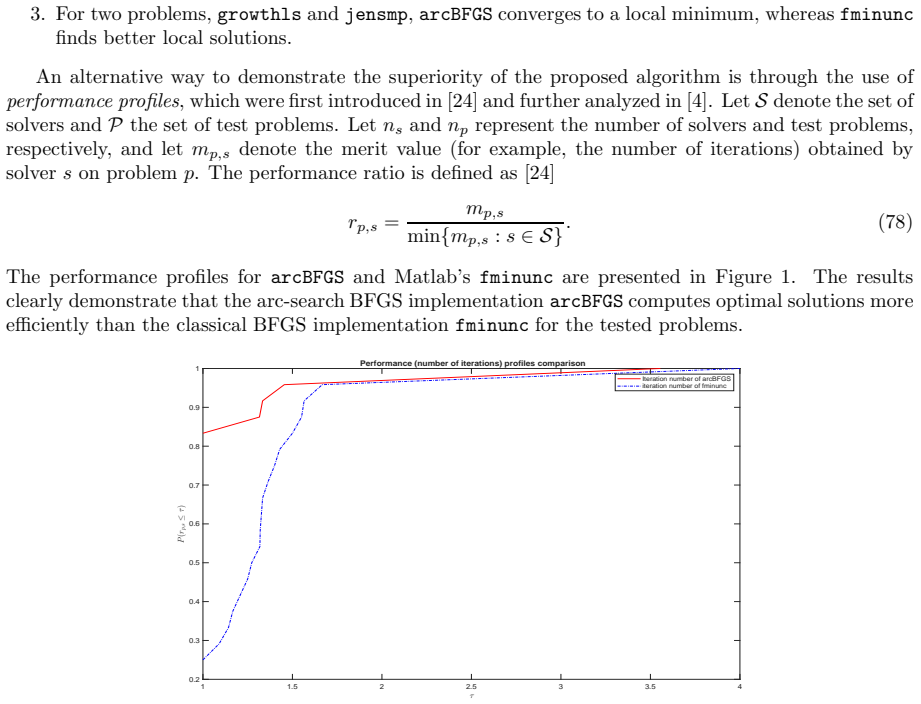
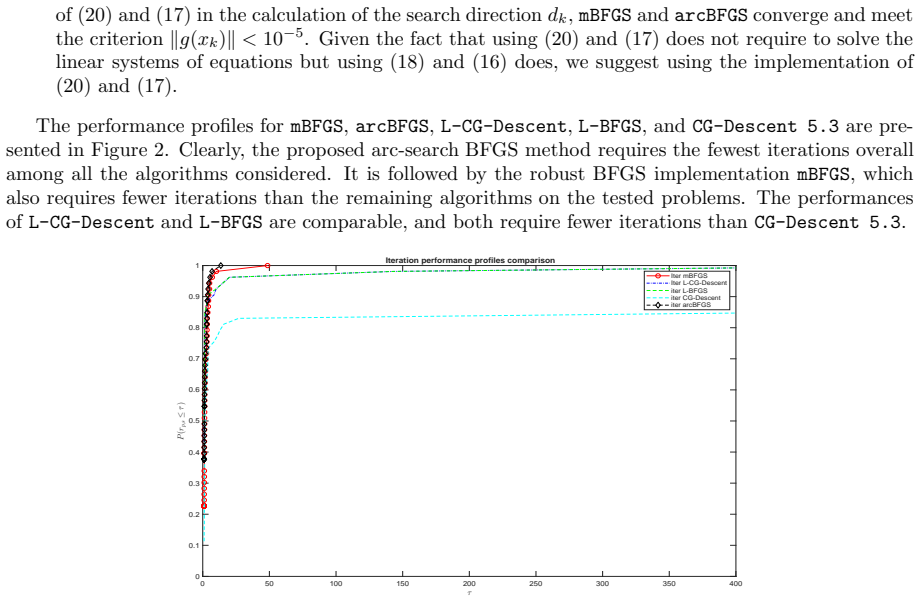
- Numerical tests demonstrate better performance than state-of-the-art methods.
- The same mild assumptions suffice for all stated convergence results.
Where Pith is reading between the lines
- Efficiency gains may allow the method to handle larger problem instances in applications such as parameter estimation.
- The arc-search idea could be tested on other quasi-Newton updates to check for similar speedups.
- If the numerical advantages hold on broader benchmark suites, the method may reduce overall solver runtime in repeated optimization tasks.
Load-bearing premise
The arc-search modification preserves the global convergence, fast local convergence, and superlinear rate of the robust BFGS under the same mild assumptions.
What would settle it
A set of standard test problems where the arc-search BFGS requires more function evaluations than the robust BFGS or fails to converge on a non-convex instance that the robust version solves.
Figures
read the original abstract
The classical BFGS algorithm performs excellently for convex optimization problems. However, for non-convex problems, the classical BFGS method may fail to converge reliably. To overcome this limitation, researchers have developed modified BFGS methods that are applicable to both convex and non-convex optimization problems. Among these methods, a robust BFGS algorithm has been shown to achieve global convergence and fast local convergence, with a superlinear convergence rate, for both convex and non-convex nonlinear optimization problems under mild assumptions. In this paper, we propose an arc-search BFGS algorithm that aims to further improve the computational efficiency of the robust BFGS method while preserving its desirable convergence properties. Numerical experiments are carried out, and performance comparisons between the proposed algorithm and state-of-the-art algorithms are reported to demonstrate the advantages of the arc-search BFGS algorithm.
Editorial analysis
A structured set of objections, weighed in public.
Referee Report
Summary. The paper proposes an arc-search BFGS algorithm for unconstrained nonlinear optimization that aims to improve computational efficiency over a previously published robust BFGS method while preserving its global convergence, fast local convergence, and superlinear rate under the same mild assumptions, for both convex and non-convex problems. Numerical experiments comparing the new algorithm to state-of-the-art methods are reported to demonstrate its advantages.
Significance. If the preservation of convergence properties holds, the work would be significant as an efficiency improvement to a robust BFGS variant already applicable to non-convex problems under mild assumptions; the numerical experiments provide concrete performance comparisons that strengthen the practical contribution.
major comments (1)
- [Convergence analysis section] Convergence analysis (likely §3 or §4): the central claim that the arc-search modification preserves global convergence, fast local convergence, and superlinear rate of the robust BFGS under identical mild assumptions is asserted in the abstract and introduction but lacks any derivation, proof sketch, or explicit verification that the arc-search step maintains the key assumptions (e.g., those ensuring the update matrix remains positive definite or satisfies the Wolfe conditions). This is load-bearing for the main contribution.
Simulated Author's Rebuttal
We thank the referee for the detailed and constructive report. The single major comment is addressed point-by-point below. We agree that additional explicit verification is warranted and will revise the manuscript accordingly.
read point-by-point responses
-
Referee: [Convergence analysis section] Convergence analysis (likely §3 or §4): the central claim that the arc-search modification preserves global convergence, fast local convergence, and superlinear rate of the robust BFGS under identical mild assumptions is asserted in the abstract and introduction but lacks any derivation, proof sketch, or explicit verification that the arc-search step maintains the key assumptions (e.g., those ensuring the update matrix remains positive definite or satisfies the Wolfe conditions). This is load-bearing for the main contribution.
Authors: We acknowledge that the manuscript asserts preservation of the convergence properties of the robust BFGS but does not supply an explicit derivation or proof sketch verifying that the arc-search step maintains the requisite conditions (positive definiteness of the BFGS update and satisfaction of the Wolfe conditions). A brief statement that the arc-search direction is constructed to remain consistent with the line-search case appears in the algorithm description, yet this is insufficient for the load-bearing claim. We will add a dedicated subsection (new §3.3) containing a proof sketch that (i) the arc-search direction satisfies the same curvature and descent conditions used in the robust BFGS analysis, (ii) the BFGS update remains positive definite under the mild assumptions already stated, and (iii) the global and superlinear convergence theorems therefore carry over verbatim. The revision will be limited to this verification and will not alter any existing theorems or assumptions. revision: yes
Circularity Check
No significant circularity
full rationale
The manuscript proposes an arc-search variant of a robust BFGS method whose global and local convergence properties are taken from a prior, separately published result. No derivation step inside the present paper reduces a claimed prediction or uniqueness statement to a fitted parameter or to a self-citation chain that itself depends on the target result. Numerical comparisons are reported as external evidence. The derivation chain is therefore self-contained against external benchmarks.
Axiom & Free-Parameter Ledger
axioms (1)
- domain assumption Mild assumptions under which the robust BFGS achieves global and superlinear convergence
Reference graph
Works this paper leans on
-
[1]
(1955), 173-184
http://www.orfe.princeton.edu/ rvdb/ampl/nlmodels/index.html, 2014. (1955), 173-184
2014
-
[2]
C. G. Broyden, The convergence of a class of double-rank minimiz ation algorithms, Journal of the Institute of Mathematics and Its Applications, 6: 76–90, 1970
1970
-
[3]
C. F. Dai, Convergence properties of the BFGS algorithm, SIAM J ournal of optimization, 13(3), (2002), 693-701
2002
-
[4]
Dolan and J.J
E.D. Dolan and J.J. More. Benchmarking optimization software with performance profiles. Mathe- matical Programming, Vol. 91, (2002), pp. 201-213
2002
-
[5]
Fletcher, A new approach to variable metric algorithms, Compu ter Journal, 13 (3): 317–322, 1970
R. Fletcher, A new approach to variable metric algorithms, Compu ter Journal, 13 (3): 317–322, 1970. 229(1), (2013), 29-36
1970
-
[6]
Goldfarb, A Family of Variable Metric Updates Derived by Variatio nal Means”, Mathematics of Computation, 24 (109): 23–26, 1970
D. Goldfarb, A Family of Variable Metric Updates Derived by Variatio nal Means”, Mathematics of Computation, 24 (109): 23–26, 1970
1970
-
[7]
G. H. Golub and C. F. Van Loan, Matrix Computations, The Johns H opkins University press, Balti- more, (1989)
1989
-
[8]
W. W. Hager and H. Zhang, http://www.math.ufl.edu/ hager/CG/r esults6.0.txt
-
[9]
W. W. Hager and H. Zhang, The limited memory conjugate gradient method, SIAM Journal of Optimization, 23(4), (2013), 2150-2168
2013
-
[10]
W. W. Hager and H. Zhang, A new conjugate gradient method wit h guaranteed descent and an efficient line search, SIAM Journal Optimization, 16, (2005), pp. 17 0-192
2005
-
[11]
Iida, and M
E. Iida, and M. Yamashita, An infeasible interior-point arc-sear ch method with Nesterov’s restarting strategy for linear programming problems, Computational Optimiza tion and Applications, 88(2), 643- 676, 2024
2024
-
[12]
Kheirfam, An arc-search interior point method in the N∞ neighborhood for symmetric optimiza- tion
B. Kheirfam, An arc-search interior point method in the N∞ neighborhood for symmetric optimiza- tion. Fundamenta Informaticae, 146(3), 255-269, 2016
2016
-
[13]
Kheirfam, M
B. Kheirfam, M. Moslemi, On the extension of an arc-search inte rior-point algorithm for semidefinite optimization, Numerical Algebra, Control & Optimization, 8, 261-27 5, 2018
2018
-
[14]
Kheirfam, N
B. Kheirfam, N. Osmanpour, and M. Keyanpour, An arc-searc h infeasible interior-point method for semidefinite optimization with the negative infinity neighborhood. Numerical Algorithms, 88(1), 143-163, 2021
2021
-
[15]
Li and M
D.H. Li and M. Fukushima, A modified BFGS method and its global co nvergence in nonconvex minimization, Journal of Computational and Applied Mathematics, 19 , pp. 15-35, 2001
2001
-
[16]
X. Li, B. Li, and Z. Wang, Modified BFGS algorithm with particular de scent condition for nonconvex functions, Optimization Letters, 2026. 23
2026
-
[17]
Luenberger and Y
D.G. Luenberger and Y. Ye, Linear and nonlinear programming, R eading, MA: Addison-wesley, 1984
1984
-
[18]
More and D
J. More and D. J. Thuente, On line search algorithms with guaran teed sufficient decrease, Technical Report MCS-P153-0590, Mathematics and Computer Science Divisio n, Argonne National Laboratory, (1990)
1990
-
[19]
Nocedal, Updating quasi-Newton matrices with limited storage , Mathematics of Computation, 35, (1980), pp
J. Nocedal, Updating quasi-Newton matrices with limited storage , Mathematics of Computation, 35, (1980), pp. 773-782
1980
-
[20]
Nocedal and S
J. Nocedal and S. Wright, Numerical Optimization, Springer-Ve rlag, New York, (1999)
1999
-
[21]
Pirhaji, M
M. Pirhaji, M. Zangiabadi, H. Mansouri, A corrector-predictor arc search interior-point algorithm for symmetric optimization. Acta Mathematica Scientia, 38(4), 126 9-1284,2018)
2018
-
[22]
M. S. Shahraki and A. Delavarkhalafi, An arc-search predicto r-corrector infeasible-interior-point algorithm for P*(k)-SCLCPs. Numerical Algorithms, 83(4), 1555- 1575, 2020
2020
-
[23]
D. F. Shanno, Conditioning of quasi-Newton methods for funct ion minimization”, Mathematics of Computation, 24 (111): 647–656, 1970
1970
-
[24]
Tits and Y
A.L. Tits and Y. Yang, Globally convergent algorithms for robust pole assignment by state feedback, IEEE transactions on Automatic Control, Vol. 41, (1996), pp. 143 2-1452
1996
-
[25]
Todd, The many facets of linear programming
M.J. Todd, The many facets of linear programming. Mathematica l programming, 91(3), pp.417-43, 2002
2002
-
[26]
Wolfe, Convergence conditions for ascent methods, SIAM R eview, 11(2), (1969), 226-235
P. Wolfe, Convergence conditions for ascent methods, SIAM R eview, 11(2), (1969), 226-235
1969
-
[27]
Wolfe, Convergence conditions for ascent methods II: som e corrections, SIAM Review, 13(2), (1971), 185-188
P. Wolfe, Convergence conditions for ascent methods II: som e corrections, SIAM Review, 13(2), (1971), 185-188
1971
-
[28]
S. J. Wright, Primal-dual interior-point methods, SIAM, 1997
1997
-
[29]
Yamashita, E
M. Yamashita, E. Iida, and Y. Yang, An infeasible interior-point a rc-search algorithm for nonlinear constrained optimizatio”, Numerical Algorithms, 89, , 249-275, 20 22
-
[30]
X. Yang, H. Liu, Y. Zhang, An arc-search infeasible-interior-p oint method for symmetric optimization in a wide neighborhood of the central path, Optimization Letters, 1 1(1), 135-152, 2017
2017
-
[31]
Yang, A polynomial arc-search interior-point algorithm for c onvex quadratic programming, Eu- ropean Journal of Operational Research, 215(1), pp
Y. Yang, A polynomial arc-search interior-point algorithm for c onvex quadratic programming, Eu- ropean Journal of Operational Research, 215(1), pp. 25–38, 2 011
-
[32]
Y. Yang, A globally and quadratically convergent algorithm with effi cient implementation for non- convex unconstrained optimization, Computational and Applied Mat hematics, 34(3), pp.1219–1236, 2015
2015
-
[33]
Yang, Two computationally efficient polynomial-iteration infeas ible interior-point algorithms for linear programming, Numerical Algorithms, Vol
Y. Yang, Two computationally efficient polynomial-iteration infeas ible interior-point algorithms for linear programming, Numerical Algorithms, Vol. 79, pp. 957–992, 20 18
-
[34]
Yang, Arc-Search Techniques for Interior-Point Methods , CRC Press, Boca Raton, FL 2020
Y. Yang, Arc-Search Techniques for Interior-Point Methods , CRC Press, Boca Raton, FL 2020
2020
-
[35]
Yang, A robust BFGS algorithm for unconstrained nonlinear o ptimization problems, Optimiza- tion, 73(3), pp.851-873, 2024
Y. Yang, A robust BFGS algorithm for unconstrained nonlinear o ptimization problems, Optimiza- tion, 73(3), pp.851-873, 2024
2024
-
[36]
Yang, An arc-search interior-point algorithm for nonlinear c onstrained optimization, Compu tational Optimization and Applications, 90(3), 969-995, 2025
Y. Yang, An arc-search interior-point algorithm for nonlinear c onstrained optimization, Compu tational Optimization and Applications, 90(3), 969-995, 2025
2025
-
[37]
G. Yuan, Y. Qin, and R. Huang, Global convergence of a modified BFGS method with simultaneous correction of direction and step size. Int. J. Appl. Comput. Math 9 , 61 (2023). 24
2023
-
[38]
B. Yuan, M. Zhang, Z. Huang, A wide neighborhood primal-dual in terior-point algorithm with arc- search for linear complementarity problems. J. Nonlinear Funct. An al. Article ID, 31, 2018
2018
-
[39]
G. Yuan, X. Zhao, K. Liu, and X. Chen, An adaptive projection B FGS method for nonconvex unconstrained optimization problems, Numerical Algorithms, 95, pp . 1747–1767, 2024
2024
-
[40]
Zhang, A globally convergent BFGS method for nonconvex min imization without line searches, Optimization Methods and Software, 20(6), pp
L. Zhang, A globally convergent BFGS method for nonconvex min imization without line searches, Optimization Methods and Software, 20(6), pp. 737-747, 2005
2005
-
[41]
Zhang, K
M. Zhang, K. Huang, and Y. Lv, A wide neighborhood arc-searc h interior-point algorithm for convex quadratic programming with box constraints and linear constraints . Optimization and Engineering, 23(2), 1117-1137, 2022
2022
-
[42]
Zhang, B
M. Zhang, B. Yuan, Y. Zhou, X. Luo, and Z. Huang, A primal-dua l interior-point algorithm with arc-search for semidefinite programming. Optimization Letters, 1 3(5), 1157-1175, 2019
2019
-
[43]
Zoutendijk, Nonlinear programming, computational method s, in Integer and Nonlinear Program- ming, J
G. Zoutendijk, Nonlinear programming, computational method s, in Integer and Nonlinear Program- ming, J. Abadie, ed., North Holland, Amsterdam, (1970), 37-86. 25
1970
discussion (0)
Sign in with ORCID, Apple, or X to comment. Anyone can read and Pith papers without signing in.