REVIEW 4 major objections 5 minor 57 references
Wind-Informed Rapid Flight-Planning in Complex Urban Topologies via Machine Learning and Experimental Validation
T0 review · 4 major / 5 minor · reviewed 2026-08-14 · deepseek-v4-flash
Pith's one-line read A machine-learning surrogate trained on CFD can predict urban wind fields fast enough that a cost-minimizing pathfinder can route drones around hazardous flow, and wind-tunnel flights show these flow-informed paths displace less and fly…
desk verdict Integrated surrogate-plus-planner pipeline with a clean Scenario 1 hardware demonstration, but the Scenario 2 safety gain rests on post hoc weight tuning. read the letter →
The pith
A machine-rendered reading of the paper's core claim, the machinery that carries it, and where it could break.
The reading
What carries the argument
The central object is the flight challenge metric $F(x,y,z) = w_1(w_2\tilde{G} + \tilde{k})^2 + w_3 D + w_4 D(w_2\tilde{G} + \tilde{k}) + w_0$, where $\tilde{G}$ and $\tilde{k}$ are the min-max normalized velocity-gradient magnitude and turbulent kinetic energy, $D$ is the Gaussian obstacle-proximity penalty, and the $w$ terms are hand-set weights. This scalar field converts a flow prediction into a cost map that encodes shear layers, turbulence, and structure proximity, and it is what makes the pathfinder produce wind-aware routes. The second load-bearing component is a U-Net surrogate that maps a signed-distance encoding of building geometry plus incident wind speed to volumetric three-component velocity and TKE predictions, with a reported test error of 8.71 percent normalized $\ell^2$. A Dijkstra pathfinder then minimizes accumulated $F$ along the route.
What would settle it
A concrete test is to fly several different planned paths through a region whose surrogate-predicted flight challenge is low but whose CFD field shows a sharp shear layer, then measure displacement and angular velocity; if a low-challenge path consistently produces large deviations, the metric's ranking is wrong. The paper's Scenario 2 is already an instance: before weight tuning, the surrogate-informed path crossed the near wake and displaced 6.7 cm, worse than the 5.5 cm naive path. A systematic version would scan a grid of metric weights and check whether the lowest-displacement path aligns with the lowest predicted challenge across multiple geometries.
Extended reading notes
Core claim
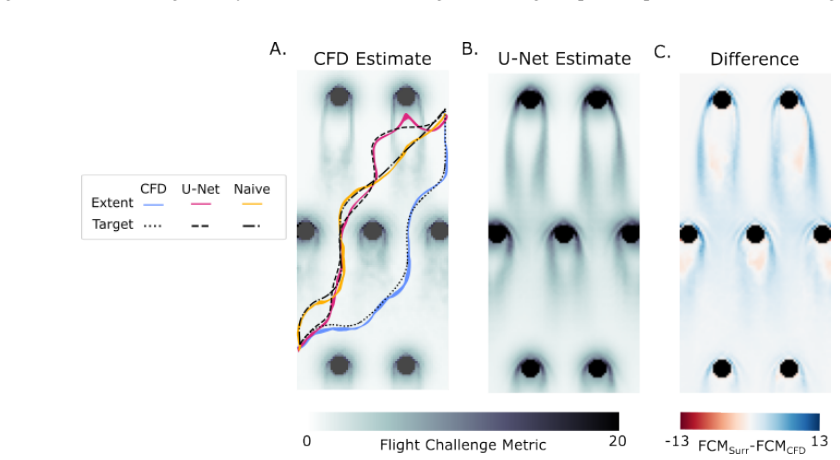
The paper's central claim is that a flow-informed trajectory generated from a surrogate-predicted wind field is safer and more stable than a flow-naive shortest path. In the first obstacle geometry, the surrogate-informed and CFD-informed paths produced mean displacements of 7.4 cm and 7.7 cm, respectively, while the naive path averaged 18.8 cm and showed trial-to-trial scatter and collisions. In the second geometry, the unadjusted surrogate-informed path passed through a near-wake shear layer and underperformed the naive baseline (6.7 cm versus 5.5 cm), but after increasing the velocity-gradient weight in the flight challenge metric, the surrogate-informed path achieved 4.9 cm mean displacement, beating the 5.5 cm naive path. The authors attribute the need for tuning to oversmoothing in the surrogate's predicted fields.
Load-bearing premise
The load-bearing premise is that the hand-tuned flight challenge metric, evaluated on surrogate-predicted time-averaged wind velocity and turbulence fields, correctly ranks aerodynamic hazard for the test vehicle; if the weights or the surrogate's smoothed fields misrank a dangerous shear zone as benign, the planned 'safe' path is not actually safe.
Editorial extensions
If this is right
- Wind-aware planning reduces mean trajectory displacement by more than a factor of two relative to a wind-naive baseline in the tested urban-like geometry.
- The flight challenge metric's correlation with accumulated displacement and angular velocity supports its use as a planning cost rather than only a post-flight diagnostic.
- A surrogate trained once on CFD can be reused for new geometries and wind speeds without new full-scale simulations, keeping planning fast enough for near-real-time use.
- The metric's weights need case-by-case tuning when the surrogate output is smoother than CFD; the paper shows one such adjustment recovering performance in the second scenario.
Reading between the lines
- The oversmoothing failure seen in Scenario 2 suggests a testable comparison: adversarially trained or generative surrogates that sharpen wakes should make the fixed-weight metric rank shear layers correctly, removing the manual tuning step.
- Because the challenge metric is vehicle-agnostic, a natural extension is to replace the fixed weights with vehicle-specific disturbance-response models, so a heavy, slow aircraft and a light, fast one get different routes through the same wind field.
- The same pipeline could be inverted to define conservative 'no-fly' zones for a fleet with minimum performance guarantees rather than a single trajectory, which would be a direct path to certification-style safety envelopes.
- A stronger experimental test would fly the same geometries at several incident wind speeds and with the surrogate retrained on higher-resolution data, to see whether the Scenario 2 shear-layer mis-ranking disappears as prediction sharpness improves.
Editorial analysis
A structured set of objections, weighed in public.
Referee Report
Summary. The paper proposes an end-to-end pipeline for wind-aware flight planning: a U-Net surrogate trained on 3392 time-averaged Lattice-Boltzmann flow fields predicts three-dimensional velocity and TKE from building geometry and incident wind; a hand-specified 'flight challenge' scalar field (Eq. 1) combines normalized velocity-gradient magnitude, normalized TKE, and obstacle proximity with weights w0-w4; Dijkstra's algorithm then finds a minimum-cost path. The system is demonstrated in a fan-array wind tunnel on two model urban geometries, comparing surrogate-informed, CFD-informed, and flow-naive trajectories, with three trials per condition. In Scenario 1 the CFD- and surrogate-informed paths have mean displacements of 7.7 cm and 7.4 cm versus 18.8 cm for the naive path. In Scenario 2 the default surrogate-informed path has mean displacement 6.7 cm, worse than the naive path's 5.5 cm; after increasing the velocity-gradient weight w2 in Eq. (1), the surrogate-informed path achieves 4.9 cm. The authors conclude that the flow-informed approach reduces undesired vehicle displacement and improves flight stability.
Significance. If the central claim were established by a prospective, statistically adequate experiment, this would be a meaningful practical demonstration of machine-learning-based wind-aware flight planning in a physical urban-like environment. The paper's strengths include the full-stack validation, the use of a 3D U-Net with a quantified holdout error of 8.71%, and explicit comparison against both CFD-informed and flow-naive baselines. However, the Scenario 2 default result directly contradicts the abstract's claim, the reported improvement is obtained only after post hoc adjustment of the flight-challenge weights, and no uncertainty quantification is provided for any of the displacement means. As presented, the load-bearing evidence is therefore not yet convincing; a prospective evaluation with fixed or cross-validated weights and quantitative error bars is needed. The work is honest about its limitations, but those limitations currently affect the main empirical claim.
major comments (4)
- [Section 3.1.2, Eq. (1)] With the weights set as described in Section 3.1.2, the surrogate-informed trajectory in Scenario 2 has a mean displacement of 6.7 cm, which is worse than the flow-naive path's 5.5 cm; this contradicts the abstract's claim that the flow-informed approach reduces undesired vehicle displacement. The reported 4.9 cm value is obtained only after increasing w2 following the observed failure, so the same experimental outcome is used both to motivate the re-weighting and to measure the improvement. This is a post hoc fit rather than a prospective comparison. The authors should provide a prospective test with weights fixed before the flight experiments, or a cross-validation in which weights are selected on a separate calibration scenario and then evaluated on held-out flight data.
- [Section 2.2, Section 3.1] Only three trials per condition are reported, with no standard deviations, confidence intervals, or significance tests. In Scenario 2 the relevant differences are small (5.4 vs 5.5 cm and 4.9 vs 5.5 cm) relative to the spread visible in Figure 8a, so the claimed advantage could easily be sampling noise. The authors should report per-trial displacement values, error bars on all mean displacements, and an appropriate statistical comparison such as a bootstrap or permutation test for the pairwise differences.
- [Section 3.1.2, Section 4] The paper attributes the surrogate-informed path's wake crossing to 'overly smooth predictions' and 'artificially inflated flight challenge values' downstream, but no quantitative link is established between the surrogate's prediction error and the resulting path. The difference map in Figure 8c is qualitative, and the text later concedes that tuning 'does not fix the underlying cause.' Without an analysis of which flow-field error component (velocity magnitude, velocity gradient, TKE, or their spatial location) caused the path to cross the shear layer, the conclusion that the surrogate model is the main limiting factor is not supported; the sensitivity of the planned path to plausible surrogate errors should be checked directly.
- [Section 2.1, Eq. (1)] The flight challenge metric depends on five manually set weights w0-w4, but the paper does not report the actual weight values, the range of values explored, or a sensitivity analysis. Since the weights are adjusted after observing experimental outcomes, it is impossible to determine how much of the reported improvement reflects the metric formulation rather than the flight planner or the surrogate. The authors should state the exact weights used for each reported trajectory and provide a sensitivity analysis over a plausible weight range showing that the Scenario 1 and Scenario 2 conclusions are robust to reasonable variations in the weights.
minor comments (5)
- [Abstract, Figure 1] The abstract and Figure 1 caption refer to 'time-resolved flow fields,' but the surrogate is trained and evaluated on time-averaged velocity and TKE fields; please use consistent terminology throughout.
- [Introduction] There is a typo 'UA V' in the Introduction; also, the hyphenation of 'Lattice-Boltzmann' is inconsistent in a few places.
- [Figure 6] The accumulated flight challenge metric in Figure 6 is computed from the CFD-generated field even for the surrogate-informed trajectory; please define how the accumulation is performed and clarify why the surrogate-informed trajectory is evaluated on the CFD field rather than the surrogate field.
- [Section 2.1, Eq. (1)] The normalization of the obstacle proximity D is not specified. Please state how the Gaussian-convolved distance field is normalized so that the weight w3 and w4 terms are dimensionally and numerically comparable to the normalized flow terms.
- [Section 1, Related Work] The claim of being the 'first real-world demonstration' of wind-aware flight planning should be tempered: Habib et al. [2026] report micro-UAV experiments with wind-adaptive planning around box fans, and Achermann et al. [2024] field-tested a volumetric wind predictor aboard a UAV. The novelty statement should distinguish the present large-fan-array urban-obstacle setting from these prior experimental demonstrations.
Circularity Check
Scenario 2's flow-informed advantage is established only after post hoc re-weighting of the flight-challenge metric on the same experimental outcome; Scenario 1 remains an independent check.
-
fitted input called prediction
[Section 3.1.2, Equation (1), Figure 9]
"The parameters used to this point were set manually using the CFD based flight challenge metric fields. By slightly adjusting the weight of the magnitude of the velocity gradient relative to TKE in the flight challenge metric formulation (increasing w2 in Equation 1), the surrogate-informed path follows a trajectory similar to that of the CFD-informed approach... With this adjustment, the surrogate-informed and CFD-informed trajectories have average displacements of 4.9 cm and 5.3 cm, respectively (the flow-naive path is unchanged, with average displacement of 5.5 cm)."
The load-bearing Scenario 2 comparison is not a prospective test. With the original weights, the surrogate-informed path crossed a near-wake shear layer and had 6.7 cm mean displacement versus 5.5 cm for the flow-naive path. Only after observing that failure was w2 increased, and the rerun's 4.9 cm value is then presented as the flow-informed improvement. The weight w2 is therefore effectively fit to the outcome of the same experiment used to validate the pipeline; the reported 'prediction' reduces to a post hoc re-weighting of Eq. 1. The Discussion's admission that tuning 'does not fix the underlying cause' confirms the fix was empirical. Scenario 1 supplies independent evidence, so the circularity is partial.
full rationale
The paper's pipeline is largely self-contained: the surrogate is trained on CFD data with a held-out test error of 8.71%, the path planner minimizes the flight-challenge cost defined in Eq. 1, and Scenario 1 provides an independent, untuned comparison in which CFD- and surrogate-informed paths achieve mean displacements of 7.7 cm and 7.4 cm versus 18.8 cm for the naive path. The circularity is concentrated in Scenario 2: the default metric failed, the authors responded by adjusting w2, and then used the adjusted run as evidence for the safety improvement. That is a fitted parameter presented as validation, not a prospective prediction. Self-citations (e.g., Renn et al. 2026 for U-Net suitability and smoothing behavior) are not load-bearing for the central empirical claim, since independent U-Net references and the Scenario 1 benchmark carry the argument. The honest non-circular core is Scenario 1 plus the surrogate holdout evaluation; the Scenario 2 improvement claim is partially circular and should be reported as exploratory rather than confirmatory.
Assumptions & free parameters
free parameters (1)
- Flight challenge weights w0, w1, w2, w3, w4 =
Set manually; w2 increased in Scenario 2
assumptions (4)
- domain assumption Lattice-Boltzmann simulations at 4 m uniform resolution produce time-averaged urban wind fields accurate enough to train the surrogate.
- domain assumption Time-averaged velocity magnitude gradient and TKE, combined with obstacle proximity, capture the hazard experienced by a small quadrotor.
- domain assumption The atmospheric boundary layer inlet profile (Richards-Hoxey) applies to all simulated urban geometries.
- domain assumption The incident wind in experiments (5 m/s, aligned with the x-axis) matches the CFD and surrogate model input condition.
Cite this review
Pith. "Pith review of Wind-Informed Rapid Flight-Planning in Complex Urban Topologies via Machine Learning and Experimental Validation." pith.science (2026). https://pith.science/paper/WZYMVRSO
@misc{pith2026260810309,
  author       = {Pith},
  title        = {Pith review of: Wind-Informed Rapid Flight-Planning in Complex Urban Topologies via Machine Learning and Experimental Validation},
  year         = {2026},
  howpublished = {\url{https://pith.science/paper/WZYMVRSO}},
  note         = {Machine review of arXiv:2608.10309}
}
read the original abstract
Advanced air mobility operations hold the potential to enhance and expand regional transportation of both people and goods in populated areas. However, hazardous flight conditions arising from interactions between wind and the built environment remain a significant challenge for aerial vehicles in urban settings. This work proposes a novel framework towards safe flight planning of aerial vehicles in windy urban environments. A learning-based surrogate model is trained to rapidly predict flow fields from readily available information such as building geometry and incident wind. This surrogate prediction is used to calculate a volumetric flight challenge scalar field based on critical flow parameters and proximity to structures. A safe, flow-informed flight trajectory is then identified through a cost-minimizing pathfinder. The complete system is demonstrated experimentally through flight tests of a micro aerial vehicle through a model urban geometry placed in a large fan-array wind tunnel. Comparing this approach to trajectories generated without knowledge of the wind field, we find the flow-informed approach reduces undesired vehicle displacement and improves flight stability. This work is among the first practical demonstrations of safe, wind-aware methodologies for advanced air mobility in urban environments.
Figures


Figures from the paper (6 more)



Reference graph
Works this paper leans on
-
[1]
Corridor design and separation definition in advanced air mobility: Systematic literature review
Evgenii Vinogradov, Debashisha Mishra, Mariam Ali Askar Alobeidli, Jamal Khaled Al Ali, Ahmed Saleh Alshehhi, Jennifer Simonjan, and Enrico Natalizio. Corridor design and separation definition in advanced air mobility: Systematic literature review. IEEE Open Journal of Intelligent Transportation Systems, 2026
work page 2026
-
[2]
Advanced air mobility: Opportunities and challenges deploying evtols for air ambulance service
Rohit Goyal and Adam Cohen. Advanced air mobility: Opportunities and challenges deploying evtols for air ambulance service. Applied Sciences, 12 0 (3): 0 1183, 2022
work page 2022
-
[3]
Advanced air mobility: Innovations, applications, challenges, and future potential
Waleed Raza, Justus Renkhoff, Olayemi Ogirimah, Gurvir Kaur Bawa, and Richard S Stansbury. Advanced air mobility: Innovations, applications, challenges, and future potential. Journal of Air Transportation, 33 0 (2): 0 169--187, 2025
work page 2025
-
[4]
Ten questions concerning the use of drones in urban environments
Simon Watkins, Jane Burry, Abdulghani Mohamed, Matthew Marino, Samuel Prudden, Alex Fisher, Nicola Kloet, Timothy Jakobi, and Reece Clothier. Ten questions concerning the use of drones in urban environments. Building and Environment, 167: 0 106458, 2020
work page 2020
-
[5]
Physics and modeling of large flow disturbances: discrete gust encounters for modern air vehicles
Anya R Jones, Oksan Cetiner, and Marilyn J Smith. Physics and modeling of large flow disturbances: discrete gust encounters for modern air vehicles. Annual Review of Fluid Mechanics, 54 0 (1): 0 469--493, 2022
work page 2022
-
[6]
Gusts encountered by flying vehicles in proximity to buildings
Abdulghani Mohamed, Matthew Marino, Simon Watkins, Justin Jaworski, and Anya Jones. Gusts encountered by flying vehicles in proximity to buildings. Drones, 7 0 (1): 0 22, 2023
work page 2023
-
[7]
Urban morphology and wind effects on uav flight risks: A cfd-based risk mapping framework
Xiaotian Geng and Zhonghua Gou. Urban morphology and wind effects on uav flight risks: A cfd-based risk mapping framework. Sustainable Cities and Society, page 107396, 2026
work page 2026
-
[8]
Turbulence-aware uav path planning in urban environments
Enrique Aldao Pensado, Gabriel Fontenla Carrera, Fernando Veiga L \'o pez, Higinio Gonz \'a lez Jorge, and Elena Mart \' n Ortega. Turbulence-aware uav path planning in urban environments. In 2024 International Conference on Unmanned Aircraft Systems (ICUAS), pages 280--285. IEEE, 2024
work page 2024
Show all 57 references
-
[9]
Estimating the impacts of the wind field size, wind speed, turbulence, and no-fly zones on unmanned aerial vehicle flights in urban areas
Ziyong Cao, Xuelin Zhang, AU Weerasuriya, Zhijun Wang, and Jianping Guo. Estimating the impacts of the wind field size, wind speed, turbulence, and no-fly zones on unmanned aerial vehicle flights in urban areas. Physics of Fluids, 38 0 (1), 2026
2026
-
[11]
Machine learning for fluid mechanics
Steven L Brunton, Bernd R Noack, and Petros Koumoutsakos. Machine learning for fluid mechanics. Annual review of fluid mechanics, 52 0 (1): 0 477--508, 2020
2020
-
[12]
Machine learning for urban wind simulation: A comprehensive review
Ilker Karadag, Danny Smyl, and Patrick Kastner. Machine learning for urban wind simulation: A comprehensive review. Available at SSRN 6484578, 2026
2026
-
[13]
Evaluating a deep learning-based surrogate model for predicting wind distribution in urban microclimate design
Houzhi Wang, Wei Ma, Jianlei Niu, and Ruoyu You. Evaluating a deep learning-based surrogate model for predicting wind distribution in urban microclimate design. Building and Environment, 269: 0 112426, 2025
2025
-
[14]
Fastflow: Ai for fast urban wind velocity prediction
Shi Jer Low, Venugopalan SG Raghavan, Harish Gopalan, Jian Cheng Wong, Justin Yeoh, and Chin Chun Ooi. Fastflow: Ai for fast urban wind velocity prediction. In 2022 IEEE International Conference on Data Mining Workshops (ICDMW), pages 147--154. IEEE, 2022
2022
-
[15]
From large-eddy simulations to deep learning: A u-net model for fast urban canopy flow predictions
Themistoklis Vargiemezis and Catherine Gorl \'e . From large-eddy simulations to deep learning: A u-net model for fast urban canopy flow predictions. Sustainable Cities and Society, page 107005, 2025
2025
-
[16]
Fourier neural operator for real-time simulation of 3d dynamic urban microclimate
Wenhui Peng, Shaoxiang Qin, Senwen Yang, Jianchun Wang, Xue Liu, and Liangzhu Leon Wang. Fourier neural operator for real-time simulation of 3d dynamic urban microclimate. Building and Environment, 248: 0 111063, 2024
2024
-
[18]
Learning local urban wind flow fields from range sensing
Spencer Folk, John Melton, Benjamin WL Margolis, Mark Yim, and Vijay Kumar. Learning local urban wind flow fields from range sensing. IEEE Robotics and Automation Letters, 9 0 (9): 0 7413--7420, 2024
2024
-
[19]
Stable fluids
Jos Stam. Stable fluids. In Seminal Graphics Papers: Pushing the Boundaries, Volume 2, pages 779--786. ACM, 2023
2023
-
[20]
Spencer Folk, John Melton, Benjamin W. L. Margolis, Mark Yim, and Vijay Kumar. Towards safe and energy-efficient real-time motion planning in windy urban environments. In 2025 IEEE International Conference on Robotics and Automation (ICRA), pages 2787--2793, 2025. doi:10.1109/...
2025
-
[21]
Reconstructing fine-scale 3d wind fields with terrain-informed machine learning
Chensen Lin, Ruian Tie, Shihong Yi, Dongqing Liu, Xiaohui Zhong, Zixin Hu, and Hao Li. Reconstructing fine-scale 3d wind fields with terrain-informed machine learning. Nature Communications, 2026
2026
-
[22]
Windseer: real-time volumetric wind prediction over complex terrain aboard a small uncrewed aerial vehicle
Florian Achermann, Thomas Stastny, Bogdan Danciu, Andrey Kolobov, Jen Jen Chung, Roland Siegwart, and Nicholas Lawrance. Windseer: real-time volumetric wind prediction over complex terrain aboard a small uncrewed aerial vehicle. Nature Communications, 15 0 (1): 0 3507, 2024
2024
-
[23]
Hybrid cfd-deep learning approach for urban wind flow predictions and risk-aware uav path planning
Gonzalo Veiga-Pi \ n eiro, Enrique Aldao-Pensado, and Elena Mart \' n-Ortega. Hybrid cfd-deep learning approach for urban wind flow predictions and risk-aware uav path planning. Drones, 9 0 (11): 0 791, 2025
2025
-
[26]
Xlb: A differentiable massively parallel lattice boltzmann library in python
Mohammadmehdi Ataei and Hesam Salehipour. Xlb: A differentiable massively parallel lattice boltzmann library in python. Computer Physics Communications, 300: 0 109187, 2024
2024
-
[27]
Appropriate boundary conditions for computational wind engineering models using the k- turbulence model
PJ Richards and RP Hoxey. Appropriate boundary conditions for computational wind engineering models using the k- turbulence model. Journal of wind engineering and industrial aerodynamics, 46: 0 145--153, 1993
1993
-
[28]
Learning turbulent flows with generative models for super resolution and sparse flow reconstruction
Vivek Oommen, Siavash Khodakarami, Aniruddha Bora, Zhicheng Wang, and George Em Karniadakis. Learning turbulent flows with generative models for super resolution and sparse flow reconstruction. Nature Communications, 17 0 (1): 0 3707, 2026
2026
-
[29]
Frontiers in Handwriting Recognition (ICFHR), 2014 14th International Conference on , pages=
Real-time segmentation of on-line handwritten arabic script , author=. Frontiers in Handwriting Recognition (ICFHR), 2014 14th International Conference on , pages=. 2014 , organization=
2014
-
[30]
Soft Computing and Pattern Recognition (SoCPaR), 2014 6th International Conference of , pages=
Fast classification of handwritten on-line Arabic characters , author=. Soft Computing and Pattern Recognition (SoCPaR), 2014 6th International Conference of , pages=. 2014 , organization=
2014
-
[31]
arXiv preprint arXiv:1804.09028 , year=
Estimate and Replace: A Novel Approach to Integrating Deep Neural Networks with Existing Applications , author=. arXiv preprint arXiv:1804.09028 , year=
-
[32]
Building and Environment , volume=
Ten questions concerning the use of drones in urban environments , author=. Building and Environment , volume=. 2020 , publisher=
2020
-
[33]
Applied Sciences , volume=
Advanced air mobility: Opportunities and challenges deploying eVTOLs for air ambulance service , author=. Applied Sciences , volume=. 2022 , publisher=
2022
-
[34]
PeerJ , volume=
scikit-image: image processing in Python , author=. PeerJ , volume=. 2014 , publisher=
2014
-
[35]
Preiss* and Wolfgang H\"onig* and Gaurav S
James A. Preiss* and Wolfgang H\"onig* and Gaurav S. Sukhatme and Nora Ayanian , title =. 2017 , url =. doi:10.1109/ICRA.2017.7989376 , note =
2017
-
[36]
IEEE Open Journal of Intelligent Transportation Systems , year=
Corridor Design and Separation Definition in Advanced Air Mobility: Systematic Literature Review , author=. IEEE Open Journal of Intelligent Transportation Systems , year=
-
[37]
Annual review of fluid mechanics , volume=
Machine learning for fluid mechanics , author=. Annual review of fluid mechanics , volume=. 2020 , publisher=
2020
-
[38]
Available at SSRN 6484578 , year=
Machine Learning for Urban Wind Simulation: A Comprehensive Review , author=. Available at SSRN 6484578 , year=
-
[39]
Annual Review of Fluid Mechanics , volume=
Physics and modeling of large flow disturbances: discrete gust encounters for modern air vehicles , author=. Annual Review of Fluid Mechanics , volume=. 2022 , publisher=
2022
-
[40]
Drones , volume=
Gusts encountered by flying vehicles in proximity to buildings , author=. Drones , volume=. 2023 , publisher=
2023
-
[41]
Nature Communications , volume=
Learning turbulent flows with generative models for super resolution and sparse flow reconstruction , author=. Nature Communications , volume=. 2026 , publisher=
2026
-
[42]
arXiv preprint arXiv:2512.14725 , year=
Generative Urban Flow Modeling: From Geometry to Airflow with Graph Diffusion , author=. arXiv preprint arXiv:2512.14725 , year=
-
[43]
Nature Communications , volume=
WindSeer: real-time volumetric wind prediction over complex terrain aboard a small uncrewed aerial vehicle , author=. Nature Communications , volume=. 2024 , publisher=
2024
-
[44]
Nature Communications , year=
Reconstructing fine-scale 3D wind fields with terrain-informed machine learning , author=. Nature Communications , year=
-
[45]
Building and Environment , volume=
Fourier neural operator for real-time simulation of 3D dynamic urban microclimate , author=. Building and Environment , volume=. 2024 , publisher=
2024
-
[46]
Building and Environment , volume=
Evaluating a deep learning-based surrogate model for predicting wind distribution in urban microclimate design , author=. Building and Environment , volume=. 2025 , publisher=
2025
-
[47]
2022 IEEE International Conference on Data Mining Workshops (ICDMW) , pages=
FastFlow: AI for fast urban wind velocity prediction , author=. 2022 IEEE International Conference on Data Mining Workshops (ICDMW) , pages=. 2022 , organization=
2022
-
[48]
Seminal Graphics Papers: Pushing the Boundaries, Volume 2 , publisher=
Stable fluids , author=. Seminal Graphics Papers: Pushing the Boundaries, Volume 2 , publisher=
-
[49]
Folk, Spencer and Melton, John and Margolis, Benjamin W. L. and Yim, Mark and Kumar, Vijay , booktitle=. Towards Safe and Energy-Efficient Real-Time Motion Planning in Windy Urban Environments , year=
-
[50]
IEEE Robotics and Automation Letters , volume=
Learning local urban wind flow fields from range sensing , author=. IEEE Robotics and Automation Letters , volume=. 2024 , publisher=
2024
-
[51]
Journal of Air Transportation , volume=
Advanced air mobility: Innovations, applications, challenges, and future potential , author=. Journal of Air Transportation , volume=. 2025 , publisher=
2025
-
[52]
Journal of wind engineering and industrial aerodynamics , volume=
Appropriate boundary conditions for computational wind engineering models using the k- turbulence model , author=. Journal of wind engineering and industrial aerodynamics , volume=. 1993 , publisher=
1993
-
[53]
Physics of Fluids , volume=
Estimating the impacts of the wind field size, wind speed, turbulence, and no-fly zones on unmanned aerial vehicle flights in urban areas , author=. Physics of Fluids , volume=. 2026 , publisher=
2026
-
[54]
Proceedings of the AAAI conference on artificial intelligence , volume=
Film: Visual reasoning with a general conditioning layer , author=. Proceedings of the AAAI conference on artificial intelligence , volume=
-
[55]
Computer Physics Communications , volume=
XLB: A differentiable massively parallel lattice Boltzmann library in Python , author=. Computer Physics Communications , volume=. 2024 , publisher=
2024
-
[56]
Sustainable Cities and Society , pages=
Urban morphology and wind effects on UAV flight risks: A CFD-based risk mapping framework , author=. Sustainable Cities and Society , pages=. 2026 , publisher=
2026
-
[57]
2024 International Conference on Unmanned Aircraft Systems (ICUAS) , pages=
Turbulence-aware UAV path planning in urban environments , author=. 2024 International Conference on Unmanned Aircraft Systems (ICUAS) , pages=. 2024 , organization=
2024
-
[58]
arXiv preprint arXiv:2603.09194 , year=
WESPR: Wind-adaptive Energy-Efficient Safe Perception & Planning for Robust Flight with Quadrotors , author=. arXiv preprint arXiv:2603.09194 , year=
-
[59]
arXiv preprint arXiv:2606.10848 , year=
Data-driven surrogate models for forecasting experimentally measured fluid flows , author=. arXiv preprint arXiv:2606.10848 , year=
-
[60]
Drones , volume=
Hybrid CFD-Deep Learning Approach for Urban Wind Flow Predictions and Risk-Aware UAV Path Planning , author=. Drones , volume=. 2025 , publisher=
2025
-
[61]
Sustainable Cities and Society , pages=
From large-eddy simulations to deep learning: A U-net model for fast urban canopy flow predictions , author=. Sustainable Cities and Society , pages=. 2025 , publisher=
2025
Reviewed August 14, 2026 · model on record in the stance chip above.
Discussion (0). Continue with ORCID to comment.