REVIEW 3 major objections 5 minor 1 cited by
RaCalNet: Radar Calibration Network for Sparse-Supervised Metric Depth Estimation
T0 review · 3 major / 5 minor · reviewed 2026-08-06 · deepseek-v4-flash
Pith's one-line read A two-module network turns sparse, noisy radar points into metric anchors, letting sparse LiDAR supervision replace dense LiDAR supervision in radar-camera depth estimation.
desk verdict The core idea—sparse-supervised radar recalibration plus monocular metric alignment—is worth taking seriously, but the paper's headline numbers don't survive arithmetic, and the only clean public-benchmark win rests on an undisclosed, unreleased ground-truth correction. read the letter →
The pith
A machine-rendered reading of the paper's core claim, the machinery that carries it, and where it could break.
The reading
What carries the argument
The load-bearing object is the affine relationship in inverse-depth space between the frozen monocular network's prediction $\hat{d}_m$ and the metric depth $d_{\mathrm{radar}}$ of a refined radar anchor: $\frac{1}{d_{\mathrm{radar}}} = \alpha \hat{d}_m + \beta$. The Metric Depth Optimization module solves this globally by regularized least squares, then refits $(\alpha_c, \beta_c)$ independently inside each K-means cluster of pixels (clustered by normalized image coordinates and log depth), and finally applies edge-aware Gaussian smoothing outside depth-discontinuity masks. This alignment machinery does the actual work of converting relative monocular depth into metric depth. The Radar Recalibration module is the other half: it supplies the anchors by learning per-point confidence and pixel displacement with cross-modal self/cross-attention between radar features and image patches, supervised by single-frame sparse LiDAR.
What would settle it
Render or capture a test scene with wide depth variation concentrated in a single K-means cluster (e.g., a long corridor seen at an angle), run the metric depth optimization with and without per-cluster affine fitting, and measure whether the cluster-wise residual error follows the affine model; if residuals are systematically biased by depth, the affine assumption fails.
Extended reading notes
Core claim
On its own terms, the paper's central discovery is that noise and misprojection in 4D radar points are learnable, and that once learned, the cleaned radar points are sufficient to put metric scale on an otherwise scale-ambiguous monocular depth network. The Radar Recalibration module outputs, for each projected radar point, a confidence score and a 2D displacement, trained against sparse LiDAR via binary cross-entropy and smooth L1 losses; points below a confidence threshold are discarded. The Metric Depth Optimization module then takes the surviving points and solves $1/d_{\mathrm{radar}} = \alpha \hat{d}_m + \beta$ by regularized least squares, filters unreliable monocular predictions by a searched inverse-depth threshold, refits the affine map per K-means cluster, and smooths non-edge regions. With this pipeline the paper reports RMSE reductions of 35.08%, 29.12%, and 27.27% over the strongest baseline on the corrected ZJU-4DRadarCam test split at 50m/70m/80m, and reductions of 46.24%, 43.42%, and 40.06% on its real-world campus dataset, all while using roughly 1% of the LiDAR supervision density of the dense-supervised comparison.
Load-bearing premise
The affine-inverse-depth assumption: the frozen monocular network's inverse depth is assumed to be linearly related to true metric inverse depth, both across the whole image and within each cluster; if the network's errors are not affine, the least-squares alignment will bias the predicted metric depth.
Editorial extensions
If this is right
- Radar-camera depth estimation can be trained with single-frame sparse LiDAR, cutting supervision density to roughly 1% and removing the need for multi-frame LiDAR accumulation and interpolation.
- Refined radar anchors convert any frozen monocular inverse-depth network into metric depth through test-time optimization, so metric accuracy can be added to relative-depth models without retraining them.
- The radar recalibration transfers across different radar and LiDAR hardware, as demonstrated by the move from the ZJU platform to the proprietary ZF FRGen21 platform.
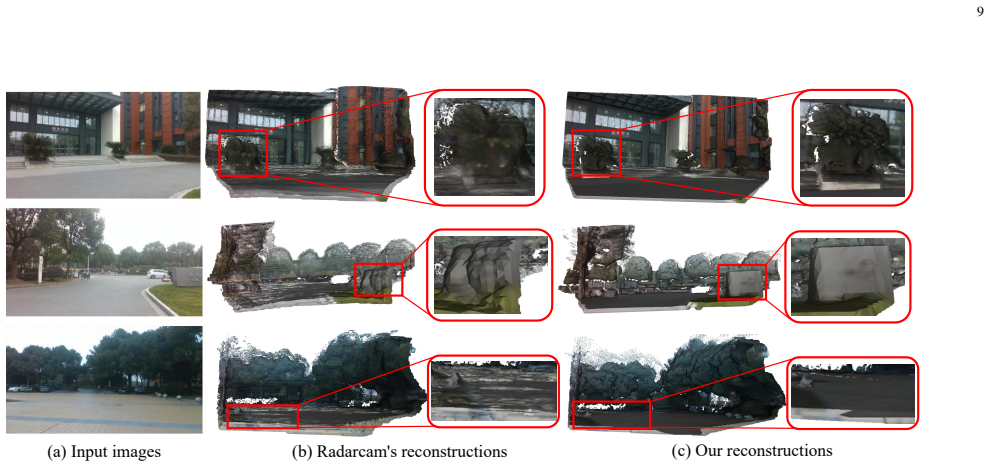
- Depth maps with accurate scale improve downstream 3D reconstruction quality compared to dense-supervised depth, as shown with the FrozenRecon reconstruction framework.
- On 3D radar data lacking elevation information the method is not directly applicable, but the paper notes that elevation inference and multi-view consistency could extend it to such sensors.
Reading between the lines
- The global-plus-cluster affine alignment is a generic calibration recipe: any scale-ambiguous depth network could be metrically grounded by the same two-step least-squares routine given sparse metric anchors, not just radar ones (e.g., sparse LiDAR, ToF, or visual-inertial points).
- The cluster-wise affine refinement effectively fits a piecewise-linear model to the monocular network's error surface; performance could degrade in scenes with very few valid radar points, an edge case the paper does not stress-test.
- The ZJU ground-truth correction implies that published comparisons on that dataset may have been distorted by extrinsic misalignment; if the correction becomes standard, existing baseline numbers could shift, altering leaderboards on that benchmark.
- A testable extension is to feed the learned confidence and displacement heads with raw radar from a third sensor type and measure whether recalibration transfers without retraining, which would reveal whether the model learns radar-specific artifacts or generic misprojection patterns.
Signed reviews
Editorial analysis
A structured set of objections, weighed in public.
Referee Report
Summary. RaCalNet proposes a radar-camera depth estimation framework that avoids dense LiDAR supervision. A Radar Recalibration module, trained with sparse single-frame LiDAR, predicts per-point confidence scores and pixel displacements for raw 4D radar projections, producing refined sparse depth anchors. A Metric Depth Optimization module then aligns frozen monocular inverse-depth predictions to these anchors via global affine least squares, K-means cluster-wise affine refinement, and edge-aware smoothing. The paper reports state-of-the-art results on the ZJU-4DRadarCam dataset after correcting its ground-truth extrinsics, and large RMSE reductions on a proprietary real-world dataset, alongside ablations and a downstream 3D reconstruction demonstration.
Significance. If substantiated, the sparse-supervision result would be practically significant: reducing supervision density to roughly 1% of dense LiDAR methods while retaining metric accuracy could lower data collection cost for radar-camera depth estimation. The modular design, with sparse LiDAR supervising radar recalibration rather than depth directly, is a reasonable and interesting idea, and the ablation study in Table IV gives some evidence that both screening and displacement refinement contribute. However, the reported quantitative evidence is internally inconsistent, and the public-dataset superiority depends on an under-specified, unreleased ground-truth correction, which prevents verification of the central claims.
major comments (3)
- [Section IV-C, IV-D, Abstract] The reported RMSE reductions are not consistent with the tables. In Section IV-C the text claims reductions of 35.08%, 29.12%, and 27.27% at 50m, 70m, and 80m, but Table II yields (1 - 2137.652/3408.806) = 37.3%, (1 - 2358.958/3719.426) = 36.6%, and (1 - 2479.008/3831.740) = 35.3%. In Section IV-D the text claims 46.24%, 43.42%, and 40.06%, but Table III gives 38.8% (50m), 36.4% (70m), and 34.9% (80m). The abstract's 34.89% figure matches only the 80m row of Table III, not the text. Because these percentages are the headline quantitative contribution, this discrepancy undermines the paper's central claim.
- [Section IV-C, Table I, Fig. 4] The claimed state-of-the-art result on ZJU depends entirely on a ground-truth correction that is not adequately specified or released. On the original evaluation (Table I), RaCalNet has lower RMSE and SqRel than Radarcam but worse MAE, AbsRel, and δ1; it is not clearly superior. The corrected evaluation (Table II) appears only after "optimizing the extrinsic parameters and reprojecting the LiDAR data," with no objective function, no initialization, no details of which extrinsics were adjusted, and no release of the corrected ground truth. Since the paper's public-benchmark advantage is not reproducible without this correction, the evidence cannot be independently checked.
- [Section III-B, Eqs. (11) and (14)] The Metric Depth Optimization module assumes that the frozen monocular network's inverse depth is related to true metric inverse depth by an affine transformation, both globally in Eq. (11) and per cluster in Eq. (14). This is a load-bearing assumption: if the monocular model has non-affine inverse-depth errors, the least-squares fits will be biased, and the bias will propagate into the final metric depth. The paper does not test this assumption separately, for example by comparing fitted residuals on held-out radar points against a more flexible calibration model, so the robustness of the core optimization step is unverified.
minor comments (5)
- [Section IV-C, Fig. 5] The text says "Fig. 5 presents visual comparisons organized in five rows," but the figure caption and displayed content show three rows: input images, depth estimations, and error maps.
- [References] Reference [34] contains a typo: "PProceedings of the IEEE Conference" should be "Proceedings of the IEEE Conference."
- [Throughout] The baseline name is inconsistently spelled as both "Radarcam" and "RadarCam"; the paper should use one consistent form.
- [Algorithm 1] The cluster-count heuristic uses the symbol Nvalid, but Nvalid is not defined in Algorithm 1 or the surrounding text; it should be defined explicitly (the reader can infer it is the number of valid radar points, but this should be stated).
- [Section IV-C] The phrase "the strongest-performing baseline" is ambiguous in the corrected-dataset comparison, and the name "DPT+Var+RC-Net" for Radarcam is introduced without definition or reference to a specific configuration.
Circularity Check
No significant circularity: RaCalNet's sparse-supervised pipeline is evaluated against held-out LiDAR ground truth, and the reported reductions do not reduce to fitted parameters by construction.
full rationale
RaCalNet's derivation chain is self-contained with respect to circularity. The Radar Recalibration module is trained on projected sparse LiDAR labels (Eqs. 4-10) and evaluated on held-out frames; the Metric Depth Optimization (Eqs. 11-14, Algorithm 1) fits an affine transform of a frozen monocular inverse-depth map to raw or refined radar measurements at test time, which is a standard sparse-metric-anchor alignment rather than a renamed fit of the evaluation label. The only sense in which the output is forced to the input is that the aligned depth equals radar depth at radar-projected pixels, but the reported RMSE is computed against LiDAR ground truth over all valid pixels, so the central benchmark result is not the fit by construction. The paper's few self-citations ([24]-[26], [32]-[33]) appear only in related-work or motivation contexts and do not carry the load of any theorem or result. The post-hoc correction of the ZJU ground truth and the mismatch between the claimed RMSE reductions (e.g., 35.08%, 29.12%, 27.27% in Section IV-C) and recomputations from Table II are serious reproducibility and correctness concerns, but they are not circularity: the corrected benchmark is external to the method's equations. No load-bearing step reduces to its own input, so no circular step is flagged.
Assumptions & free parameters
free parameters (7)
- confidence threshold τ (Eq. 3) =
not reported
- depth consistency threshold τ(p) (Eq. 5) =
0.5 m / 0.75 m / 1.0 m by range bands
- minimum LiDAR count η (Eq. 4) =
3
- sliding window sizes h×w and h*×w* =
not reported
- regularization weight λ (Eq. 11) =
not reported
- edge mask threshold τ (Algorithm 1) =
not reported
- cluster count heuristic (Algorithm 1) =
k = min(8, max(2, floor(Nvalid/500)))
assumptions (5)
- domain assumption The frozen monocular inverse depth is affine-related to metric inverse depth, globally and per cluster.
- domain assumption Sparse single-frame LiDAR projections provide accurate metric ground truth for training the recalibration module.
- ad hoc to paper The optimized extrinsic parameters and reprojected LiDAR are the true alignment for ZJU-4DRadarCam.
- domain assumption Radar points that pass the confidence threshold and receive displacement correction are reliable metric anchors.
- domain assumption Video Depth Anything (frozen) provides a structurally reliable scale-ambiguous inverse depth.
Cite this review
Pith. "Pith review of RaCalNet: Radar Calibration Network for Sparse-Supervised Metric Depth Estimation." pith.science (2026). https://pith.science/paper/X2DAA4ZW
@misc{pith2026250615560,
  author       = {Pith},
  title        = {Pith review of: RaCalNet: Radar Calibration Network for Sparse-Supervised Metric Depth Estimation},
  year         = {2026},
  howpublished = {\url{https://pith.science/paper/X2DAA4ZW}},
  note         = {Machine review of arXiv:2506.15560}
}
read the original abstract
Dense depth estimation using millimeter-wave radar typically requires dense LiDAR supervision, generated via multi-frame projection and interpolation, for guiding the learning of accurate depth from sparse radar measurements and RGB images. However, this paradigm is both costly and data-intensive. To address this, we propose RaCalNet, a novel framework that eliminates the need for dense supervision by using sparse LiDAR to supervise the learning of refined radar measurements, resulting in a supervision density of merely around 1\% compared to dense-supervised methods. RaCalNet is composed of two key modules. The Radar Recalibration module performs radar point screening and pixel-wise displacement refinement, producing accurate and reliable depth priors from sparse radar inputs. These priors are then used by the Metric Depth Optimization module, which learns to infer scene-level scale priors and fuses them with monocular depth predictions to achieve metrically accurate outputs. This modular design enhances structural consistency and preserves fine-grained geometric details. Despite relying solely on sparse supervision, RaCalNet produces depth maps with clear object contours and fine-grained textures, demonstrating superior visual quality compared to state-of-the-art dense-supervised methods. Quantitatively, it achieves performance comparable to existing methods on the ZJU-4DRadarCam dataset and yields a 34.89\% RMSE reduction in real-world deployment scenarios. We plan to gradually release the code and models in the future at https://github.com/818slam/RaCalNet.git.
Figures


Figures from the paper (3 more)


Forward citations
Cited by 1 Pith paper
-
RbFT-Net: Rectify-Before-Fuse Temporal Radar Anchors for 4D Radar-Camera Depth Completion
RbFT-Net rectifies and assigns reliability to accumulated temporal radar anchors before propagation, achieving state-of-the-art radar-camera depth completion among independent methods.
Reference graph
Works this paper leans on
-
[1]
Super-resolution and accurate full-field displacement measurement with millimeter- wave radars,
Z. Liu, Y . Xiong, G. Wu, G. Meng, and Z. Peng, “Super-resolution and accurate full-field displacement measurement with millimeter- wave radars,” IEEE Transactions on Instrumentation and Measurement , vol. 72, pp. 1–11, 2023
work page 2023
-
[2]
Z. Ma, J. Choi, and H. Sohn, “Continuous bridge displacement esti- mation using millimeter-wave radar, strain gauge and accelerometer,” Mechanical Systems and Signal Processing , vol. 197, p. 110408, 2023
work page 2023
-
[3]
4d radar-based pose graph slam with ego-velocity pre-integration factor,
X. Li, H. Zhang, and W. Chen, “4d radar-based pose graph slam with ego-velocity pre-integration factor,”IEEE Robotics and Automation Letters, vol. 8, no. 8, pp. 5124–5131, 2023
work page 2023
-
[4]
L. Yang, Z. Jun, W. Yangpin, L. Yun, S. Wenjie, J. Wen, B. Zechao, D. Lei, and S. Jinping, “Compensation for positional errors in mmw radar slam caused by observation deviations and coordinate system trans- formation,” IEEE Transactions on Instrumentation and Measurement , 2025
work page 2025
-
[5]
T-rodnet: Transformer for vehicular millimeter-wave radar object detection,
T. Jiang, L. Zhuang, Q. An, J. Wang, K. Xiao, and A. Wang, “T-rodnet: Transformer for vehicular millimeter-wave radar object detection,” IEEE Transactions on Instrumentation and Measurement , vol. 72, pp. 1–12, 2022
work page 2022
-
[6]
K-radar: 4d radar object detection for autonomous driving in various weather conditions,
D.-H. Paek, S.-H. Kong, and K. T. Wijaya, “K-radar: 4d radar object detection for autonomous driving in various weather conditions,” Ad- vances in Neural Information Processing Systems , vol. 35, pp. 3819– 3829, 2022
2022
-
[7]
End-to-end dynamic gesture recognition using mmwave radar,
A. Ali, P. Parida, V . Va, S. Ni, K. N. Nguyen, B. L. Ng, and J. C. Zhang, “End-to-end dynamic gesture recognition using mmwave radar,” IEEE Access, vol. 10, pp. 88 692–88 706, 2022
work page 2022
-
[8]
Sparsity-driven gesture recognition using lightweight tcnformer networks in millimeter-wave radar,
H. Wu, B. Jin, Z. Zhang, Z. Lian, B. Xu, J. Liang, X. Zhang, and G. Du, “Sparsity-driven gesture recognition using lightweight tcnformer networks in millimeter-wave radar,” IEEE Transactions on Instrumenta- tion and Measurement , 2025
work page 2025
Show all 40 references
-
[9]
Radarcam-depth: Radar-camera fusion for depth estimation with learned metric scale,
H. Li, Y . Ma, Y . Gu, K. Hu, Y . Liu, and X. Zuo, “Radarcam-depth: Radar-camera fusion for depth estimation with learned metric scale,” in 2024 IEEE International Conference on Robotics and Automation (ICRA). IEEE, 2024, pp. 10 665–10 672
2024
-
[10]
Full-velocity radar returns by radar-camera fusion,
Y . Long, D. Morris, X. Liu, M. Castro, P. Chakravarty, and P. Narayanan, “Full-velocity radar returns by radar-camera fusion,” in Proceedings of the IEEE/CVF International Conference on Computer Vision , 2021, pp. 16 198–16 207
2021
-
[11]
Depth estimation from camera image and mmwave radar point cloud,
A. D. Singh, Y . Ba, A. Sarker, H. Zhang, A. Kadambi, S. Soatto, M. Srivastava, and A. Wong, “Depth estimation from camera image and mmwave radar point cloud,” in Proceedings of the IEEE/CVF Conference on Computer Vision and Pattern Recognition , 2023, pp. 9275–9285. 10
2023
-
[12]
Midas v3. 1–a model zoo for robust monocular relative depth estimation,
R. Birkl, D. Wofk, and M. M ¨uller, “Midas v3. 1–a model zoo for robust monocular relative depth estimation,” arXiv preprint arXiv:2307.14460, 2023
2023 arXiv
-
[13]
Learning to recover 3d scene shape from a single image,
W. Yin, J. Zhang, O. Wang, S. Niklaus, L. Mai, S. Chen, and C. Shen, “Learning to recover 3d scene shape from a single image,” in Pro- ceedings of the IEEE/CVF Conference on Computer Vision and Pattern Recognition, 2021, pp. 204–213
2021
-
[14]
Vision transformers for dense prediction,
R. Ranftl, A. Bochkovskiy, and V . Koltun, “Vision transformers for dense prediction,” in 2021 IEEE/CVF International Conference on Computer Vision. IEEE Computer Society, 2021, pp. 12 159–12 168
2021
-
[15]
Depth anything: Unleashing the power of large-scale unlabeled data,
L. Yang, B. Kang, Z. Huang, X. Xu, J. Feng, and H. Zhao, “Depth anything: Unleashing the power of large-scale unlabeled data,” in Proceedings of the IEEE/CVF Conference on Computer Vision and Pattern Recognition, 2024, pp. 10 371–10 381
2024
-
[16]
Monocular visual-inertial depth estimation,
D. Wofk, R. Ranftl, M. M ¨uller, and V . Koltun, “Monocular visual-inertial depth estimation,” in 2023 IEEE International Conference on Robotics and Automation (ICRA) . IEEE, 2023, pp. 6095–6101
2023
-
[17]
Codevio: Visual-inertial odometry with learned optimizable dense depth,
X. Zuo, N. Merrill, W. Li, Y . Liu, M. Pollefeys, and G. Huang, “Codevio: Visual-inertial odometry with learned optimizable dense depth,” in 2021 IEEE International Conference on Robotics and Automation (ICRA) . IEEE, 2021, pp. 14 382–14 388
2021
-
[18]
Video depth estimation by fusing flow-to-depth proposals,
J. Xie, C. Lei, Z. Li, L. E. Li, and Q. Chen, “Video depth estimation by fusing flow-to-depth proposals,” in 2020 IEEE/RSJ International Conference on Intelligent Robots and Systems (IROS) . IEEE, 2020, pp. 10 100–10 107
2020
-
[19]
Deep depth estimation from visual-inertial slam,
K. Sartipi, T. Do, T. Ke, K. Vuong, and S. I. Roumeliotis, “Deep depth estimation from visual-inertial slam,” in 2020 IEEE/RSJ International Conference on Intelligent Robots and Systems (IROS) . IEEE, 2020, pp. 10 038–10 045
2020
-
[20]
Unsupervised monocular depth estimation for monocular visual slam systems,
F. Liu, M. Huang, H. Ge, D. Tao, and R. Gao, “Unsupervised monocular depth estimation for monocular visual slam systems,” IEEE Transactions on Instrumentation and Measurement , vol. 73, pp. 1–13, 2023
2023
-
[21]
Self-supervised monocular depth estimation with depth-motion prior for pseudo-lidar,
S. Yuan, H. Liu, Y . Liu, and L. Yang, “Self-supervised monocular depth estimation with depth-motion prior for pseudo-lidar,” IEEE Transactions on Instrumentation and Measurement , 2025
2025
-
[22]
Robust consistent video depth estimation,
J. Kopf, X. Rong, and J.-B. Huang, “Robust consistent video depth estimation,” in Proceedings of the IEEE/CVF Conference on Computer Vision and Pattern Recognition , 2021, pp. 1611–1621
2021
-
[23]
Globally consis- tent video depth and pose estimation with efficient test-time training,
Y .-C. Lee, K.-W. Tseng, G.-S. Chen, and C.-S. Chen, “Globally consis- tent video depth and pose estimation with efficient test-time training,” arXiv preprint arXiv:2208.02709 , 2022
2022 arXiv
-
[24]
Uno: Unified self-supervised monocular odometry for platform-agnostic deployment,
W. Zhao, Y . Niu, Y . Wang, T. Deng, S. Yuan, Z. Wang, R. Guo, and J. Wang, “Uno: Unified self-supervised monocular odometry for platform-agnostic deployment,” arXiv preprint arXiv:2506.07013, 2025
2025 arXiv
-
[25]
Neslam: Neural implicit mapping and self-supervised feature tracking with depth completion and denoising,
T. Deng, Y . Wang, H. Xie, H. Wang, R. Guo, J. Wang, D. Wang, and W. Chen, “Neslam: Neural implicit mapping and self-supervised feature tracking with depth completion and denoising,” IEEE Transactions on Automation Science and Engineering , 2025
2025
-
[26]
Self-supervised deep monocular visual odometry and depth estimation with observation variation,
W. Zhao, Y . Wang, Z. Wang, R. Li, P. Xiao, J. Wang, and R. Guo, “Self-supervised deep monocular visual odometry and depth estimation with observation variation,” Displays, vol. 80, p. 102553, 2023
2023
-
[27]
Depth estimation from monocular images and sparse radar data,
J.-T. Lin, D. Dai, and L. Van Gool, “Depth estimation from monocular images and sparse radar data,” in 2020 IEEE/RSJ International Con- ference on Intelligent Robots and Systems (IROS) . IEEE, 2020, pp. 10 233–10 240
2020
-
[28]
Depth estimation from monocular images and sparse radar using deep ordinal regression network,
C.-C. Lo and P. Vandewalle, “Depth estimation from monocular images and sparse radar using deep ordinal regression network,” in 2021 IEEE International Conference on Image Processing (ICIP). IEEE, 2021, pp. 3343–3347
2021
-
[29]
Radar-camera pixel depth association for depth completion,
Y . Long, D. Morris, X. Liu, M. Castro, P. Chakravarty, and P. Narayanan, “Radar-camera pixel depth association for depth completion,” in Pro- ceedings of the IEEE/CVF Conference on Computer Vision and Pattern Recognition, 2021, pp. 12 507–12 516
2021
-
[30]
Dense depth- map estimation based on fusion of event camera and sparse lidar,
M. Cui, Y . Zhu, Y . Liu, Y . Liu, G. Chen, and K. Huang, “Dense depth- map estimation based on fusion of event camera and sparse lidar,” IEEE Transactions on Instrumentation and Measurement , vol. 71, pp. 1–11, 2022
2022
-
[31]
R4dyn: Exploring radar for self-supervised monocular depth estimation of dynamic scenes,
S. Gasperini, P. Koch, V . Dallabetta, N. Navab, B. Busam, and F. Tombari, “R4dyn: Exploring radar for self-supervised monocular depth estimation of dynamic scenes,” in 2021 International Conference on 3D Vision (3DV) . IEEE, 2021, pp. 751–760
2021
-
[32]
Sfpnet: Sparse focal point network for semantic segmentation on general lidar point clouds,
Y . Wang, W. Zhao, C. Cao, T. Deng, J. Wang, and W. Chen, “Sfpnet: Sparse focal point network for semantic segmentation on general lidar point clouds,” in European Conference on Computer Vision . Springer, 2024, pp. 403–421
2024
-
[33]
Salt: A flexible semi-automatic labeling tool for general lidar point clouds with cross-scene adaptability and 4d consistency,
Y . Wang, Y . Chen, C. Cao, T. Deng, W. Zhao, J. Wang, and W. Chen, “Salt: A flexible semi-automatic labeling tool for general lidar point clouds with cross-scene adaptability and 4d consistency,” CoRR, 2025
2025
-
[34]
Deep residual learning for image recognition,
K. He, X. Zhang, S. Ren, and J. Sun, “Deep residual learning for image recognition,” in PProceedings of the IEEE Conference on Computer Vision and Pattern Recognition , 2016, pp. 770–778
2016
-
[35]
Video depth anything: Consistent depth estimation for super-long videos,
S. Chen, H. Guo, S. Zhu, F. Zhang, Z. Huang, J. Feng, and B. Kang, “Video depth anything: Consistent depth estimation for super-long videos,” arXiv preprint arXiv:2501.12375 , 2025
2025 arXiv
-
[36]
An image is worth 16x16 words: Transformers for image recognition at scale,
A. Dosovitskiy, L. Beyer, A. Kolesnikov, D. Weissenborn, X. Zhai, T. Unterthiner, M. Dehghani, M. Minderer, G. Heigold, S. Gelly et al., “An image is worth 16x16 words: Transformers for image recognition at scale,” in International Conference on Learning Representations , 2020
2020
-
[37]
nuscenes: A multimodal dataset for autonomous driving,
H. Caesar, V . Bankiti, A. H. Lang, S. V ora, V . E. Liong, Q. Xu, A. Krishnan, Y . Pan, G. Baldan, and O. Beijbom, “nuscenes: A multimodal dataset for autonomous driving,” in Proceedings of the IEEE/CVF conference on computer vision and pattern recognition, 2020, pp. 11 621–11 631
2020
-
[38]
Imagenet: A large-scale hierarchical image database,
J. Deng, W. Dong, R. Socher, L.-J. Li, K. Li, and L. Fei-Fei, “Imagenet: A large-scale hierarchical image database,” in 2009 IEEE Conference on Computer Vision and Pattern Recognition . IEEE, 2009, pp. 248–255
2009
-
[39]
Neuralrecon: Real-time coherent 3d reconstruction from monocular video,
J. Sun, Y . Xie, L. Chen, X. Zhou, and H. Bao, “Neuralrecon: Real-time coherent 3d reconstruction from monocular video,” in 2021 IEEE/CVF Conference on Computer Vision and Pattern Recognition . IEEE, 2021, pp. 15 593–15 602
2021
-
[40]
Frozenrecon: Pose-free 3d scene reconstruction with frozen depth models,
G. Xu, W. Yin, H. Chen, C. Shen, K. Cheng, and F. Zhao, “Frozenrecon: Pose-free 3d scene reconstruction with frozen depth models,” in 2023 IEEE/CVF International Conference on Computer Vision . IEEE, 2023, pp. 9276–9286
2023
Reviewed August 6, 2026 · model on record in the stance chip above.
Discussion (0). Continue with ORCID to comment.