REVIEW 3 major objections 6 minor 29 references
OptiClear turns inverse-designed photonic layouts into design-rule-clean masks by morphological legalization, cutting violations from thousands to zero.
Reviewed by Pith at T0; open to challenge. T0 means a machine referee read the full paper against a public rubric. the ladder, T0–T4 →
OptiClear legalizes curvilinear inverse-designed photonic masks to zero true design-rule violations via morphological rule-based and minimum-distortion differentiable engines.
T0 review reviewed 2026-07-12 challenge →
load-bearing objection Solid first explicit curvilinear legalization stage for inverse-designed photonics; zero true DRVs are real under their flow, but the foundry-tape-out claim is still one step short of proven. the 3 major comments →
OptiClear: Differentiable Curvilinear Design Rule Legalization for Inverse-Designed Photonic Devices
The pith
A machine-rendered reading of the paper's core claim, the machinery that carries it, and where it could break.
The reading
Core claim
A dedicated post-design legalization stage based on morphological stationarity can convert inverse-designed photonic masks into GDS layouts that pass width and spacing design-rule checks, reducing true violations from hundreds or thousands to zero while keeping optical performance close to the original design, with a fast rule-based path and a higher-fidelity differentiable path.
What carries the argument
Morphological stationary-point constraints: a mask M is treated as legal when Open(M) = Close(M) = M, with kernel size derived from nominal width/spacing, angle-dependent curvature, and polygonization margin; OptiClear-D enforces these via augmented Lagrangian minimum-distortion optimization, OptiClear-R via iterative skeleton-guided open/close updates.
Load-bearing premise
A mask that is unchanged by morphological open and close with a kernel sized from the paper's formula is assumed equivalent to a foundry-clean GDS after contour extraction and simplification for the width and spacing rules that matter.
What would settle it
Take the legalized GDS of the reported devices, run them through an independent foundry DRC deck (or a different PDK and polygonizer) that includes the same width/spacing rules plus curvature, area, and enclosure checks; if true violations reappear or fabricated devices show yield or performance collapse relative to the original inverse designs, the stationarity-to-manufacturability claim fails.
Editorial analysis
A structured set of objections, weighed in public.
Referee Report
Summary. OptiClear introduces a post-design curvilinear design-rule legalization stage for inverse-designed photonic masks. It comprises OptiClear-R, an iterative morphology-based rule engine that resolves open/close conflict zones via skeleton-guided dilation, and OptiClear-D, a differentiable minimum-distortion optimizer that enforces morphological stationarity Open(M)=Close(M)=M through an augmented Lagrangian method on a level-set parameterization. Kernel size is derived from nominal width/spacing, angle-triggered curvature checks, and a polygonization margin (Eq. 2). Custom Triton differentiable morphology operators enable high-resolution (1 nm/pixel) legalization. On diverse inverse-designed devices under SiEPiC width/spacing rules, both engines reduce true DRVs from hundreds/thousands to zero (Tables 1–3), with OptiClear-D better preserving optical FoM and OptiClear-R offering lower runtime; soft FAID baselines do not clear violations.
Significance. The work fills a genuine EPDA gap: Manhattan-style legalization does not transfer to freeform inverse-designed photonics, and soft FAID penalties do not guarantee rule-clean GDS. Defining an explicit post-design legalization stage, providing complementary rule-based and differentiable engines, and shipping scalable GPU morphology (reported ~450× speedup / ~280× memory reduction vs. Kornia) are concrete contributions. The FAID–legalization synergy study and multi-rule evaluation strengthen the practical case. If the morphology-to-DRC pipeline holds under the stated scope, this is a useful and timely methods paper for manufacturable inverse design and a foundation for future end-to-end DRC-aware flows.
major comments (3)
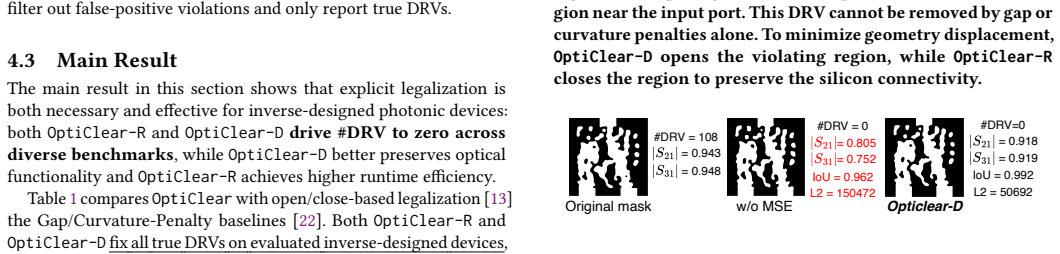
- [Abstract; §4.1; §5] Abstract and §5 claim translation into “manufacturable tape-out-ready devices,” but §4.1 explicitly limits evaluation to minimum width/spacing (SiEPiC, angle <80°), placing area, enclosure, notch, and layer-interaction rules outside scope. Tables 1–3 only report those width/spacing DRVs. Please calibrate the abstract/conclusion language to the validated rule subset, or expand evaluation to the remaining rules the introduction lists as relevant (Fig. 1).
- [§3.1 Eq. (2); §4.2; Fig. 10] The load-bearing premise (§3.1–3.3) is that Open(M)=Close(M)=M with kernel diameter from Eq. (2) (EF, θ, safety margin EC) yields a GDS that is clean under foundry DRC after contour extraction/simplification. Validation is only under KLayout+SiEPiC after manual false-positive filtering of angle-threshold mismatches caused by KLayout edge merging (§4.2, Fig. 10). Please add (i) sensitivity of residual true DRV and FoM to EC and to the polygonizer/simplifier settings, and (ii) an explicit limitations paragraph on transfer to other PDKs/polygonizers and rules beyond geometric edge distance. Without this, “true DRV = 0” is tied to a single filtered checker rather than a general manufacturability guarantee.
- [Table 1; §4.3; Fig. 11] Table 1 shows non-negligible FoM degradation on performance-sensitive devices for OptiClear-R (e.g., MDM 0.948→0.885; TTS 0.859→0.768; WDM 0.983→0.961), while OptiClear-D is milder but still not lossless. The paper correctly notes that global L2/IoU do not predict FoM (§4.3, Fig. 11). Please quantify when legalization is “safe” (e.g., FoM drop thresholds, critical-region diagnostics) and state guidance for choosing R vs. D in the EPDA flow, so zero DRV is not read as zero functional risk.
minor comments (6)
- [Eq. (4); §4.1] Eq. (4) writes level-set control as ϕ(β) and sharpness η=20, while §4.1 also refers to “Levelset sharpness β=20.” Align notation for the latent variables vs. the binarization sharpness throughout.
- [Fig. 9; §4.3] Fig. 9 caption states remaining raw DRVs are false positives filtered to True DRV=0; cross-reference §4.2 more explicitly in the main text of §4.3 so readers do not misread raw vs. true columns before reaching the filtering subsection.
- [Table 2] Table 2 multi-line FoM cells (especially OD |S21|/|S12|) are hard to parse; consider separate columns or a clearer multi-row layout for dual S-parameters.
- [§2] Related-work coverage of industrial photonic DRC/PDK practice and any prior morphology-based mask repair outside photonics is thin; a short paragraph would better situate OptiClear relative to foundry flows (AIM/GF/TSMC) mentioned in the introduction.
- [§1; Eq. (4)] Minor prose issues: “butso far” (p.1), “adifficult” / “jointlyenforce” spacing glitches, and “leveset” typo in Eq. (4) text. A careful copy-edit pass is needed.
- [Fig. 8; §3.4] Report wall-clock hardware for Triton vs. Kornia (Fig. 8) and whether peak-memory numbers include only the morphology kernel or the full ALM loop, for reproducibility of the 453× / 282× claims.
Circularity Check
No circularity: legalization is an algorithmic construction evaluated against external DRC and independent FDFD, not a prediction forced by its own inputs.
full rationale
OptiClear is a methods/engineering paper. The load-bearing claims are empirical: after morphology-based legalization, true DRVs under SiEPiC width/spacing rules fall to zero (Table 1, §4.3) while FoM is re-measured by independent FDFD. Morphological stationarity Open(M)=Close(M)=M (Eq. 3) and the ALM objective (Eqs. 4–5) are design choices that define the legalizer; they do not tautologically force the reported #DRV=0 or FoM numbers. Kernel size (Eq. 2) is derived from geometric rules plus a safety margin, then checked externally in KLayout after polygonization (with explicit false-positive filtering, §4.2). Self-citations (MAPS inverse-design infrastructure [29], FAID baselines [22,13], authors’ related PRISM/BOSON work) supply benchmarks and soft-penalty baselines; they do not define or force the legalization outcome. There is no fitted parameter renamed as a prediction, no uniqueness theorem imported from the authors, and no self-definitional reduction of the central claim. The skeptic’s concern about equivalence of mask-domain stationarity to full foundry DRC is a correctness/scope risk, not circularity. Score 0 is therefore the honest finding.
Axiom & Free-Parameter Ledger
free parameters (6)
- ALM penalty coefficient ρ
- Level-set binarization sharpness η
- Adam learning rate and step count
- Polygonization safety margin EC in kernel size Eq. (2)
- Small preprocessing kernel size (~K/2 minus margin)
- Mask resolution 1 nm/pixel
axioms (6)
- domain assumption Morphological opening removes sub-kernel-width features and closing removes sub-kernel gaps/holes, so open/close encode minimum width and spacing.
- ad hoc to paper A mask with Open(M)=Close(M)=M is a morphological stationary legal mask for the target curvilinear rules.
- ad hoc to paper Kernel diameter from Eq. (2) using edge distance EF, angle θ, and margin EC is sufficient for angle-triggered photonic width/spacing checks after GDS conversion.
- domain assumption Legalizing in the pixelated mask domain then polygonizing once is preferable to intermediate polygon edits.
- domain assumption Soft FAID penalties alone cannot guarantee DRV-clean discretized layouts.
- domain assumption Post-legalization FDFD S-parameter FoM is an adequate proxy for preserved device functionality under legalization distortion.
invented entities (3)
-
OptiClear-R conflict-zone legalizer
no independent evidence
-
OptiClear-D ALM morphological stationarity optimizer
no independent evidence
-
Triton sparse differentiable morphology operators
no independent evidence
Cite this review
Pith. "Pith review of OptiClear: Differentiable Curvilinear Design Rule Legalization for Inverse-Designed Photonic Devices." pith.science (2026). https://pith.science/paper/X2YXCYLN
@misc{pith2026260703632,
  author       = {Pith},
  title        = {Pith review of: OptiClear: Differentiable Curvilinear Design Rule Legalization for Inverse-Designed Photonic Devices},
  year         = {2026},
  howpublished = {\url{https://pith.science/paper/X2YXCYLN}},
  note         = {Machine review of arXiv:2607.03632}
}
read the original abstract
Photonic inverse design enables ultra-compact, high-performance devices with highly curvilinear and non-intuitive geometries, but the resulting layouts often violate fabrication design rules and hinder foundry manufacturing. Legalization methods designed for rectilinear Manhattan electrical layouts are not directly applicable to curvilinear inverse-designed photonic devices. Meanwhile, existing fabrication-aware inverse-design methods apply soft penalties on small features and sharp curvatures, but still cannot guarantee design-rule-compliant final layouts. In this work, we present OptiClear, a curvilinear design rule legalization framework for inverse-designed photonic devices. OptiClear provides two complementary legalization engines: OptiClear-R, a rule-based morphological legalizer that efficiently resolves violation regions through iterative morphology-guided mask processing, and OptiClear-D, a differentiable legalizer that formulates legalization as a minimum-distortion mask optimization problem under morphological stationary-point constraints, explicitly seeking a rule-compliant layout with minimal geometric deviation from the original design. We further develop customized differentiable morphological GPU operators that significantly improve the scalability of high-resolution mask legalization. Comprehensive evaluation across diverse inverse-designed photonic devices and a wide range of design-rule settings shows that OptiClear reduces design-rule violations from thousands to zero. The rule-based legalizer offers high runtime efficiency, while the differentiable legalizer more faithfully preserves the original optical functionality. This work establishes curvilinear design rule legalization as a practical post-design electronic-photonic design automation (EPDA) stage for translating high-performance inverse-designed photonic layouts into manufacturable tape-out-ready devices.
Figures



Reference graph
Works this paper leans on
-
[1]
Chen, Jiaqi Gu, and David Z
Hanqing Zhu, Shupeng Ning, Hongjian Zhou, Ziang Yin, Ray T. Chen, Jiaqi Gu, and David Z. Pan. Harnessing photonics for machine intelligence, 2026
2026
-
[2]
Hlaing, David Z
Shupeng Ning, Hanqing Zhu, Chenghao Feng, Jiaqi Gu, Zhixing Jiang, Zhoufeng Ying, Jason Midkiff, Sourabh Jain, May H. Hlaing, David Z. Pan, and Ray T. Chen. Photonic-electronic integrated circuits for high-performance computing and ai accelerators. 42(22):7834–7859, 2024
2024
-
[3]
Wavelength-division- multiplexing (WDM)-based integrated electronic–photonic switching network (EPSN) for high-speed data processing and transportation.Nanophotonics, 2020
Chenghao Feng, Zhoufeng Ying, Zheng Zhao, Jiaqi Gu, et al. Wavelength-division- multiplexing (WDM)-based integrated electronic–photonic switching network (EPSN) for high-speed data processing and transportation.Nanophotonics, 2020
2020
-
[4]
An integrated large-scale photonic accelerator with ultralow latency.Nature, 2025
Shanshan Yu Shiyue Hua, Erwan Divita et al. An integrated large-scale photonic accelerator with ultralow latency.Nature, 2025
2025
-
[5]
Ahmed, Reza Baghdadi et al
Mikhail Bernadskiy Sufi R. Ahmed, Reza Baghdadi et al. Universal photonic artificial intelligence acceleration.Nature, 2025
2025
-
[6]
Shastri, Alexander N
Bhavin J. Shastri, Alexander N. Tait, T. Ferreira de Lima, Wolfram H. P. Pernice, Harish Bhaskaran, C. D. Wright, and Paul R. Prucnal. Photonics for Artificial Intelligence and Neuromorphic Computing.Nature Photonics, 2021
2021
-
[7]
Inverse design of photonic crystals through automatic differentiation.Acs Photonics, 7(7):1729–1741, 2020
Momchil Minkov, Ian AD Williamson, Lucio C Andreani, Dario Gerace, Beicheng Lou, Alex Y Song, Tyler W Hughes, and Shanhui Fan. Inverse design of photonic crystals through automatic differentiation.Acs Photonics, 7(7):1729–1741, 2020
2020
-
[8]
Robust design of topology-optimized metasurfaces.Optical Materials Express, 9(2):469–482, 2019
Evan W Wang, David Sell, Thaibao Phan, and Jonathan A Fan. Robust design of topology-optimized metasurfaces.Optical Materials Express, 9(2):469–482, 2019
2019
-
[9]
Interpretable geometry sensitivity for inverse design of integrated photonics, 2026
Junho Park, Taehan Kim, Mohammad Ali, and Di Liang. Interpretable geometry sensitivity for inverse design of integrated photonics, 2026. URL https://arxiv.org/ abs/2510.22176
arXiv 2026
-
[10]
Hongjian Zhou, Haoyu Yang, Nicholas Gangi, Tianle Xu, Rena Huang, and Jiaqi Gu. PRISM: Photonics-Informed Inverse Lithography for Manufacturable Inverse- Designed Photonic Integrated Circuits.ACM TODAES, 2026. URL https://arxiv.org/ abs/2602.15762
Pith/arXiv arXiv 2026
-
[11]
Design space reparameterization enforces hard geometric constraints in inverse-designed nanophotonic devices.ACS Photonics, 7(11):3141–3151, 2020
Mingkun Chen, Jiaqi Jiang, and Jonathan A Fan. Design space reparameterization enforces hard geometric constraints in inverse-designed nanophotonic devices.ACS Photonics, 7(11):3141–3151, 2020
2020
-
[12]
Multi-task topology optimization of photonic devices in low- dimensional fourier domain via deep learning.Nanophotonics, 12(5):1007–1018, 2023
Simei Mao, Lirong Cheng, Houyu Chen, Xuanyi Liu, Zihan Geng, Qian Li, and Hongyan Fu. Multi-task topology optimization of photonic devices in low- dimensional fourier domain via deep learning.Nanophotonics, 12(5):1007–1018, 2023
2023
-
[13]
Hammond, Ardavan Oskooi, Steven G
Alec M. Hammond, Ardavan Oskooi, Steven G. Johnson, and Stephen E. Ralph. Pho- tonic topology optimization with semiconductor-foundry design-rule constraints. Optics Express, 29(15):23916–23938, Jul 2021
2021
-
[14]
Analytical level set fabrication constraints for inverse design.Scientific reports, 9(1): 8999, 2019
Dries Vercruysse, Neil V Sapra, Logan Su, Rahul Trivedi, and Jelena Vučković. Analytical level set fabrication constraints for inverse design.Scientific reports, 9(1): 8999, 2019
2019
-
[15]
Cambridge University Press, 2015
Lukas Chrostowski and Michael Hochberg.Silicon photonics design: from devices to systems. Cambridge University Press, 2015
2015
-
[16]
Design and simulation of silicon photonic schematics and layouts
Lukas Chrostowski, Zeqin Lu, Jonas Flueckiger, Xu Wang, Jackson Klein, Amy Liu, Jaspreet Jhoja, and James Pond. Design and simulation of silicon photonic schematics and layouts. InSilicon Photonics and Photonic Integrated Circuits V, volume 9891, page 989114, may 2016
2016
-
[17]
Nvcell: Standard cell layout in advanced technol- ogy nodes with reinforcement learning
Haoxing Ren and Matthew Fojtik. Nvcell: Standard cell layout in advanced technol- ogy nodes with reinforcement learning. In2021 58th ACM/IEEE Design Automation Conference (DAC), pages 1291–1294. IEEE, 2021
2021
-
[18]
Nvcell 2: Routability-driven standard cell layout in advanced nodes with lattice graph routability model
Chia-Tung Ho, Alvin Ho, Matthew Fojtik, Minsoo Kim, Shang Wei, Yaguang Li, Brucek Khailany, and Haoxing Ren. Nvcell 2: Routability-driven standard cell layout in advanced nodes with lattice graph routability model. InProceedings of the 2023 International Symposium on Physical Design, pages 44–52, 2023
2023
-
[19]
Optimal layout synthesis of multi-row standard cells for advanced technology nodes
Sehyeon Chung, Hyunbae Seo, Handong Cho, Kyumyung Choi, and Taewhan Kim. Optimal layout synthesis of multi-row standard cells for advanced technology nodes. InProceedings of the 43rd IEEE/ACM International Conference on Computer-Aided Design, pages 1–8, 2024
2024
-
[20]
Generating layouts of standard cells by implicit learning on design rules for advanced processes
Aaron C-W Liang, Hsuan-Ming Huang, and Charles H-P Wen. Generating layouts of standard cells by implicit learning on design rules for advanced processes. In 2021 Design, Automation & Test in Europe Conference & Exhibition (DATE), pages 1829–1834. IEEE, 2021
2021
-
[21]
A drc automatic repair strategy for standard cell layout based on improved simulated annealing algorithm.Electronics, 14(21):4267, 2025
Wenli Huang, Bin Li, Wenchao Liu, Zhaohui Wu, Zonghan Lei, Songting Huang, and Chaozheng Qin. A drc automatic repair strategy for standard cell layout based on improved simulated annealing algorithm.Electronics, 14(21):4267, 2025
2025
-
[22]
Sapra, Logan Su, Rahul Trivedi, and Jelena Vučković
Dries Vercruysse, Neil V. Sapra, Logan Su, Rahul Trivedi, and Jelena Vučković. Analytical level set fabrication constraints for inverse design.Scientific Reports, 9(1), 2019
2019
-
[23]
Reparameterization approach to gradient-based inverse design of three-dimensional nanophotonic devices.ACS Photonics, 10(4):815–823, 2022
Erez Gershnabel, Mingkun Chen, Chenkai Mao, Evan W Wang, Philippe Lalanne, and Jonathan A Fan. Reparameterization approach to gradient-based inverse design of three-dimensional nanophotonic devices.ACS Photonics, 10(4):815–823, 2022
2022
-
[24]
High-performance hybrid time/frequency-domain topology opti- mization for large-scale photonics inverse design.Optics Express, 30(3):4467–4491, 2022
Alec M Hammond, Ardavan Oskooi, Mo Chen, Zin Lin, Steven G Johnson, and Stephen E Ralph. High-performance hybrid time/frequency-domain topology opti- mization for large-scale photonics inverse design.Optics Express, 30(3):4467–4491, 2022
2022
-
[25]
Controlling the minimal feature sizes in adjoint optimization of nanophotonic devices using b-spline surfaces
Erfan Khoram, Xiaoping Qian, Ming Yuan, and Zongfu Yu. Controlling the minimal feature sizes in adjoint optimization of nanophotonic devices using b-spline surfaces. Optics Express, 28(5):7060–7069, 2020
2020
-
[26]
Bi-level optimization accelerated drc-aware physical design automation for photonic devices
Hao Chen, Yuzhe Ma, and Yeyu Tong. Bi-level optimization accelerated drc-aware physical design automation for photonic devices. In2025 Design, Automation & Test in Europe Conference (DATE), pages 1–7. IEEE, 2025
2025
-
[27]
Boning, and Jiaqi Gu
Pingchuan Ma, Zhengqi Gao, Amir Begovic, Meng Zhang, Haoyu Yang, Haoxing Ren, Rena Huang, Duane S. Boning, and Jiaqi Gu. BOSON −1: Understanding and Enabling Physically-Robust Photonic Inverse Design with Adaptive Variation-Aware Subspace Optimization. In2025 Design, Automation & Test in Europe Conference (DATE), 2025
2025
-
[28]
Image restoration based on morphological operations.International Journal of Computer Science, Engineering and Information Technology, 4(3):9–21, 2014
AM Raid, Wael Khedr, Mohamed El-dosuky, and Mona Aoud. Image restoration based on morphological operations.International Journal of Computer Science, Engineering and Information Technology, 4(3):9–21, 2014
2014
-
[29]
Boning, and Jiaqi Gu
Pingchuan Ma, Zhengqi Gao, Haoyu Yang Meng Zhang, Mark Ren, Rena Huang, Duane S. Boning, and Jiaqi Gu. MAPS: Multi-Fidelity AI-Augmented Photonic Simulation and Inverse Design Infrastructure. InProc. DATE, March 2025
2025
This paper was first reviewed by grok-4.5 on July 12, 2026.
discussion (0)
Sign in with ORCID, Apple, or X to comment. Anyone can read and Pith papers without signing in.