A New Benchmark Dataset for Texture Image Analysis and Surface Defect Detection
Pith reviewed 2026-05-25 14:52 UTC · model grok-4.3
The pith
The STI dataset offers four classes of stone textures with local rotations, zoom variations, and unbalanced sizes as a benchmark for texture analysis and defect detection.
A machine-rendered reading of the paper's core claim, the machinery that carries it, and where it could break.
Core claim
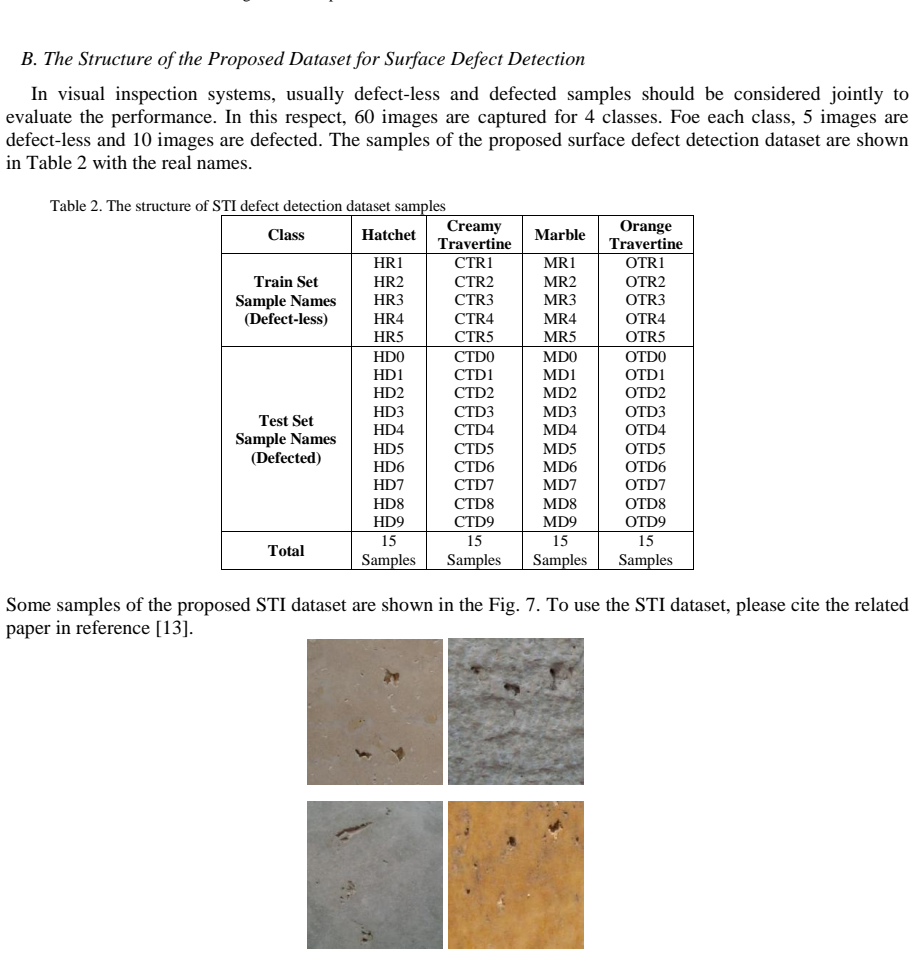
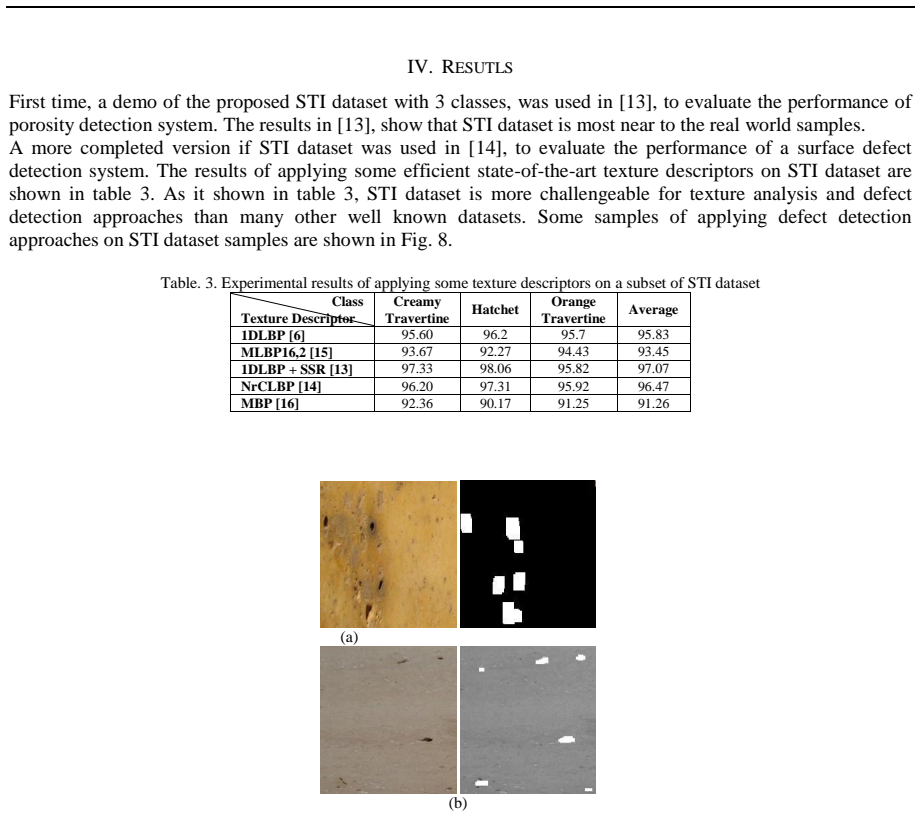
The paper proposes the STI benchmark dataset for texture image analysis and surface defect detection. The dataset contains four classes of stone texture images and possesses properties including local rotation, different zoom rates, unbalanced classes, and variation of textures in size, making it very near to real applications. In the result part, some descriptors are applied on this dataset to evaluate the proposed STI dataset in comparison with other state-of-the-art datasets.
What carries the argument
The STI dataset, consisting of four stone texture classes distinguished by its inclusion of local rotations, zoom rate changes, class imbalance, and size variations.
If this is right
- Texture descriptors can be tested for robustness to realistic variations in orientation and scale.
- Surface defect detection algorithms gain a new evaluation set that includes class imbalance typical of production environments.
- Comparisons across datasets become more informative when one option explicitly varies zoom and local rotation.
- Development of new analysis methods can target the specific challenges encoded in the four-class collection.
Where Pith is reading between the lines
- The dataset structure could support controlled experiments on how class imbalance affects descriptor stability beyond the paper's reported tests.
- Extending the same property set to other surface materials would test whether the realism claim holds outside stone textures.
- Researchers could measure whether models optimized on STI transfer to video-based inspection tasks where continuous zoom and rotation occur.
- The unbalanced classes provide a natural test bed for whether standard accuracy metrics overstate performance on minority defect types.
- keywords:[
Load-bearing premise
The listed properties of local rotation, different zoom rates, unbalanced classes, and variation of textures in size are sufficient to make the dataset representative of real-world conditions for texture analysis and surface defect detection.
What would settle it
A direct side-by-side test showing that top-performing descriptors on STI produce markedly different accuracy rankings when run on unaltered industrial stone surfaces with naturally occurring defects would falsify the near-real-application claim.
Figures

read the original abstract
Texture analysis plays an important role in many image processing applications to describe the image content or objects. On the other hand, visual surface defect detection is a highly research field in the computer vision. Surface defect refers to abnormalities in the texture of the surface. So, in this paper a dual purpose benchmark dataset is proposed for texture image analysis and surface defect detection titled stone texture image (STI dataset). The proposed benchmark dataset consist of 4 different class of stone texture images. The proposed benchmark dataset have some unique properties to make it very near to real applications. Local rotation, different zoom rates, unbalanced classes, variation of textures in size are some properties of the proposed dataset. In the result part, some descriptors are applied on this dataset to evaluate the proposed STI dataset in comparison with other state-of-the-art datasets.
Editorial analysis
A structured set of objections, weighed in public.
Referee Report
Summary. The manuscript proposes the Stone Texture Image (STI) dataset as a dual-purpose benchmark for texture analysis and surface defect detection. It consists of four classes of stone texture images and claims unique properties—local rotation, different zoom rates, unbalanced classes, and variation of textures in size—that make it close to real applications. The paper evaluates the dataset by applying some (unspecified) descriptors and comparing performance to other state-of-the-art datasets.
Significance. A well-validated dataset with realistic variations could support development of robust descriptors for industrial texture and defect tasks. However, the central claim that the enumerated properties render the dataset representative of real-world stone surfaces is presented without evidence, quantitative matching to industrial imagery, or domain references, so the work's significance remains limited in its current form.
major comments (2)
- [Abstract] Abstract: The claim that 'Local rotation, different zoom rates, unbalanced classes, variation of textures in size are some properties of the proposed dataset' that make it 'very near to real applications' is asserted without supporting argument, comparison to real industrial stone imagery, reference to literature on stone defect statistics, or ablation showing these factors (vs. illumination or sensor noise) are decisive.
- [Abstract] Abstract (results paragraph): The statement that 'some descriptors are applied on this dataset to evaluate the proposed STI dataset in comparison with other state-of-the-art datasets' provides no details on the specific descriptors, performance metrics, data splits, error handling, or how results tie back to the claimed properties, leaving the utility claim unsupported.
Simulated Author's Rebuttal
We thank the referee for the detailed review and constructive criticism. We address each major comment below and will revise the manuscript to strengthen the justification of the dataset properties and to clarify the evaluation details.
read point-by-point responses
-
Referee: [Abstract] Abstract: The claim that 'Local rotation, different zoom rates, unbalanced classes, variation of textures in size are some properties of the proposed dataset' that make it 'very near to real applications' is asserted without supporting argument, comparison to real industrial stone imagery, reference to literature on stone defect statistics, or ablation showing these factors (vs. illumination or sensor noise) are decisive.
Authors: We agree that the current presentation asserts these properties without sufficient supporting material. In the revised manuscript we will add citations to existing literature on industrial stone surface inspection and provide a concise qualitative argument, grounded in the image acquisition process, explaining why the observed variations (local rotation, zoom, imbalance, and size) are representative of practical conditions. We will not claim quantitative matching to external industrial corpora unless such data can be referenced. revision: yes
-
Referee: [Abstract] Abstract (results paragraph): The statement that 'some descriptors are applied on this dataset to evaluate the proposed STI dataset in comparison with other state-of-the-art datasets' provides no details on the specific descriptors, performance metrics, data splits, error handling, or how results tie back to the claimed properties, leaving the utility claim unsupported.
Authors: The full manuscript already specifies the descriptors (LBP, GLCM, and wavelet-based features), the metrics (classification accuracy and F1-score), the train/test splits, and the cross-validation procedure. We will expand the abstract to include these key elements and will add a short paragraph in the results section that explicitly relates performance differences to the dataset properties (e.g., effect of class imbalance). revision: yes
Circularity Check
No circularity; dataset proposal contains no derivations, fits, or self-referential predictions
full rationale
The manuscript introduces the STI dataset, enumerates its collection properties (local rotation, zoom rates, class imbalance, size variation), and reports generic descriptor performance. No equations, parameter fitting, uniqueness theorems, or predictions appear anywhere in the text. The representativeness claim is an unsupported assertion rather than a derived result that reduces to its own inputs. Because the work is purely descriptive with no derivation chain, no circular steps exist.
Axiom & Free-Parameter Ledger
Reference graph
Works this paper leans on
-
[1]
R. Peyret, A. Bouridane, F. Khelifi, M. A. Tahir, and S. Al-Maadeed, ― Automatic classification of colorectal and prostatic histological tumor images using multiscale multispectral local binary pattern texture features and stacked generalization,‖ Neurocomputing, Vol. 275, pp. 83–93, January 2018
work page 2018
-
[2]
Sh. Fekri-Ershad, and F. Tajeripour, ―Color texture classification based on proposed i mpulse-noise resistant color local binary patterns and significant points selection‖, Sensor Review, Vol. 37, No. 1, pp. 33-42, January 2017
work page 2017
-
[3]
H. Xing, H. Yinqping, G. Xiumin, and D. Qianqian, ―Squirrel-cage local binary pattern and its application in video anomaly,‖ IEEE Transaction on Information Forensics and Security, Vol. 14, No. 4, pp. 1007-1022, April 2019
work page 2019
- [4]
-
[5]
Sh. Fekri-Ershad, S. M. Fakhrahmad, and F. Tajeripour, ―Impulse noise reduction for texture images using real word spelling correction algorithm and local binary p atterns", International Arab Journal of Information Technology , Vol. 15, No. 6, pp.1024-1030, 2018
work page 2018
-
[6]
Sh. Fekri-Ershad, and F. Tajeripour, ―A robust approach for surface defect detection based on one dimensional local binary patterns‖, Indian Journal of Science and Technology, Vol. 5, No. 8, pp. 3197-3203, August 2012
work page 2012
-
[7]
T. Ojala, T. Maenppa, M. Pietikainen, J. Viertola, J. Kyllonen, and S. Huovinen, ―Outex-new framework for empirical evaluation of texture analysis algorithms‖, In Proc. 16 th International Conference on Pattern Recognition , Quebec, Canada, pp. 701–706. August 2002. (Downloadable at: http://www.outex.oulu.fi/)
work page 2002
-
[8]
Brodatz, ―Textures: A photographic album for artists and designers‖
P. Brodatz, ―Textures: A photographic album for artists and designers‖. Dover Pubns, 1966
work page 1966
- [9]
-
[10]
M. Svab, ― Computer-vision-based tree trunk recognition", PhD Thesis, Fakulteta za ra_cunalni_stvo in informatiko, Univerza v Ljubljani , 2014
work page 2014
-
[11]
Sh. Fekri-Ershad, ―Texture image analysis and texture classification methods - a review‖, International Online Journal of Image Processing and Pattern Recognition, Vol.2, No. 1, pp. 1-29, 2019
work page 2019
- [12]
-
[13]
F. Tajeripour, and Sh. Fekri -Ershad, ―Developing a novel approach for stone porosity computing using modified local binary patterns and single scale retinex‖, Arabian Journal for Science and Engineering , Vol. 39, No. 2, pp. 875 -889, 2014
work page 2014
-
[14]
Sh. Fekri-Ershad, and F. Tajeripour, "Multi-resolution and noise-resistant surface defect detection approach using new version of local binary patterns", Applied Artificial Intelligence, Vol. 31, No. 5-6, pp. 395-410, 2017
work page 2017
- [15]
-
[16]
A. Hafiane, G. Seetharaman, and B. Zavidovique, ―Median binary p attern for textures classification‖, In Proc. of the 4 th International Conference on Image Processing, pp. 387–98, 1989. Authors’ Profiles Shervan Fekri -Ershad received his B.Sc. degree in computer hardware engineering from Islamic Azad University of Najaf-Abad, Iran in 2009. He received h...
work page 1989
discussion (0)
Sign in with ORCID, Apple, or X to comment. Anyone can read and Pith papers without signing in.