REVIEW 5 major objections 5 minor 36 references
Cold Dark Matter and Self-Interacting Dark Matter Interpretations of Cloud-9
T0 review · 5 major / 5 minor · reviewed 2026-08-08 · deepseek-v4-flash
Pith's one-line read The starless gas cloud Cloud-9 can be fit by both a cuspy cold dark matter halo and a cored self-interacting dark matter halo, but the self-interacting interpretation avoids the improbably low concentration that cold dark matter would…
desk verdict First DM halo fit of Cloud-9, but the 7σ vs 3σ contrast leans on an unconditional concentration distribution; the fitting is careful, the cosmological preference claim is not yet established. read the letter →
The pith
A machine-rendered reading of the paper's core claim, the machinery that carries it, and where it could break.
The reading
What carries the argument
The load-bearing object is the hydrostatic equilibrium equation for the gas, dP/dr = −GM_enc(r)ρ_gas/r², solved with a photoionization temperature–density relation calibrated for RELHICs in CDM simulations and a self-consistent neutral-fraction calculation. For the dark halo, the paper uses the NFW profile for CDM and a parametric SIDM model in which the density profile interpolates between NFW and a cored form through a core radius r_c and an evolution parameter τ = t/t_c, with t_c set by the self-interaction cross section. The machinery's work is to map halo parameters (M200, c200, τ) to an HI column density profile, which is compared against the Cloud-9 data in an MCMC fit; a turning-point stability criterion is applied post hoc to remove dynamically unstable solutions.
What would settle it
A decisive test would be to measure the gas temperature or velocity dispersion in Cloud-9 and check whether it follows the assumed temperature–density relation; a clear deviation would invalidate the inferred halo parameters. Alternatively, a cosmological hydrodynamical simulation of RELHIC formation in SIDM halos that shows a cored halo cannot retain a hydrostatic gas cloud with the observed profile would falsify the SIDM interpretation.
Extended reading notes
Core claim
On the paper's own terms, the central discovery is that Cloud-9's observed neutral-hydrogen column density profile, interpreted as a reionization-limited HI cloud (RELHIC) in hydrostatic equilibrium with its dark halo, cannot by itself distinguish cuspy from cored halos: equally good fits exist for a standard NFW profile and for SIDM halos at very different gravothermal stages. The distinction emerges only when the inferred halo parameters are compared with the cosmological concentration–mass relation. The CDM fit requires a concentration around 7σ below the cosmological median, while SIDM halos near the maximum core-expansion stage need only a 3σ low concentration, with the favored cross section peaking around 200 cm²/g. This moves the tension from "CDM must produce an exceptionally diffuse halo" to "SIDM naturally produces such halos via core formation." The paper also reports that about half of the formal hydrostatic solutions are dynamically unstable, imposing a lower bound on the host halo mass near 2.5×10⁹ M⊙.
Load-bearing premise
The analysis assumes that the gas in Cloud-9 obeys the photoionization equilibrium temperature–density relation calibrated for RELHICs in CDM simulations, and that it is in pure hydrostatic equilibrium with the dark halo; if either fails, the inferred halo parameters and the 7σ/3σ tension change.
Editorial extensions
If this is right
- If the SIDM interpretation is correct, Cloud-9 is a dark matter halo in the core-formation phase, and RELHICs become a new, baryon-clean probe of dark matter self-interactions.
- In the CDM interpretation, Cloud-9 implies a halo concentration about 7σ below the cosmological median; such halos are extremely rare, making the CDM fit a striking coincidence rather than a natural outcome.
- For cross sections above about 50–100 cm²/g, the required concentration tension drops to roughly 3σ, making a large self-interaction cross section (peaking near 200 cm²/g at t_age = 10 Gyr) the cosmologically preferred solution.
- The exclusion of dynamically unstable solutions constrains Cloud-9's host halo to M200 ≳ 2.5×10⁹ M⊙, which sharpens the predicted mass range for RELHIC hosts.
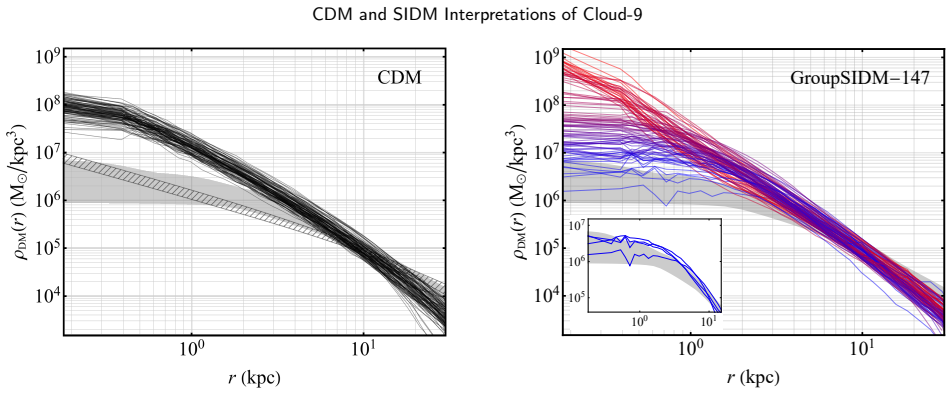
- In the Concerto cosmological zoom-in simulations with velocity-dependent SIDM, several isolated halos have density profiles compatible with Cloud-9, whereas no CDM halo in the same mass range matches, strengthening the case that RELHICs trace core-forming SIDM halos.
Reading between the lines
- If the assumed temperature–density relation holds in cored SIDM halos, then a census of RELHICs across a sky survey would be a direct test: CDM predicts a very rare low-concentration tail, while SIDM predicts a broader population of core-forming halos; counting such objects would separate the models more cleanly than a single object.
- The paper's fixed halo age of 10 Gyr scales the cross-section estimate linearly; if the actual age of Cloud-9's halo is significantly different, the favored cross section shifts, but the qualitative preference for strong self-interactions would persist unless the age is much larger.
- The connection drawn to gas-rich ultra-diffuse galaxies suggests a continuum of gas-dominated, low-concentration halos from roughly 10⁹ to 10¹⁰ M⊙; extending the same hydrostatic analysis to the gas profiles of UDGs could test whether SIDM core formation explains both populations.
- A hydrodynamical simulation of RELHIC formation specifically in SIDM halos would check the pivotal assumption that the gas follows the CDM-calibrated temperature–density relation; if the gas behaves differently in a cored potential, the 3σ/7σ comparison would shift.
Editorial analysis
A structured set of objections, weighed in public.
Referee Report
Summary. The paper interprets the HI column density profile of the Cloud-9 system, a candidate RELHIC near M94, using hydrostatic equilibrium models for cold dark matter (NFW) and self-interacting dark matter (parametric SIDM halo model). For each model the authors run MCMC to fit halo parameters and find that both CDM and SIDM can reproduce the observed column density profile. They report that the best CDM fit requires a concentration about 7.3σ below the cosmological concentration-mass relation, while SIDM core-forming halos with self-interaction cross sections above roughly 50 cm²/g reduce this tension to about 3σ. The paper further searches for Cloud-9-like halos in the Concerto SIDM zoom-in simulations and reports no CDM analog among 97 mass-selected halos, but several SIDM analogs in the core-expansion phase.
Significance. If the central quantitative claim were robust, this would be an important advance: Cloud-9 would become a new laboratory for dark matter models, and a preference for large SIDM cross sections would be a strong result. The paper has several concrete strengths: it provides a public implementation of the analysis, uses MCMC with convergence checks, applies a dynamical stability criterion to filter hydrostatic solutions, and highlights a degeneracy between halo concentration and the stage of gravothermal evolution in SIDM. However, the main conclusion depends on comparing the inferred concentration to the unconditional cosmological concentration-mass relation, and on applying a CDM-calibrated temperature-density relation to SIDM halos; both steps require additional scrutiny before the stated preference for SIDM can be accepted.
major comments (5)
- [Sec. 3.2, Fig. 4] The 7.3σ versus 3σ comparison treats Cloud-9 as a random draw from the unconditional halo concentration distribution of Diemer and Joyce (2019). Cloud-9 is however a RELHIC, a class defined by gas retention and the absence of star formation. In CDM, low-concentration halos at fixed mass have shallower central potentials, which is the same physics that suppresses cooling and star formation and promotes RELHIC status. The paper does not compute or cite the conditional concentration distribution of RELHIC-host halos (for example, from the Benítez-Llambay et al. 2017 simulations), nor does it account for this selection effect in the statistical comparison. Without such a correction, the 7.3σ CDM tension is likely overstated, and the claimed preference for large SIDM cross sections is not established. Please provide the conditional distribution or otherwise quantify the selection bias.
- [Sec. 2, Eq. (2)] The temperature-density relation used in Eq. (2) is taken from Benítez-Llambay et al. (2017), which was calibrated for RELHIC gas in CDM cosmological simulations. The same relation is applied to SIDM halos, whose gas density profiles and thermal histories differ because of the central core and the altered gravitational potential. If the gas in a cored SIDM halo does not follow the CDM T-ρ relation, the inferred halo parameters and the quoted sigma deviations would change. The paper should either justify the transferability of this relation or test the sensitivity of the results to plausible modifications of the T-ρ relation.
- [Sec. 2, Eq. (1)] The hydrostatic equilibrium equation (Eq. 1) includes only thermal pressure support. If non-thermal pressure from turbulence, cosmic rays, or magnetic fields contributes to the support of the gas cloud, the inferred dark matter density profile will be biased. Given the low gas densities and the extended envelope observed in Cloud-9, non-thermal pressure may not be negligible. The authors should estimate the magnitude of this effect or argue convincingly that it is small for RELHIC-like systems.
- [Sec. 1 and Sec. 4] Cloud-9 lies near M94, which is itself believed to be a merger remnant. The paper models Cloud-9 as an isolated spherical halo in hydrostatic equilibrium and does not account for tidal stripping or environmental interactions. In Sec. 4 the authors select simulated halos with distances greater than 366 kpc from the host, but they do not establish that Cloud-9 satisfies an isolation criterion. Tidal effects could modify both the DM density profile and the gas distribution, and the paper should discuss whether such effects could alter the inferred concentration and the CDM versus SIDM comparison.
- [Sec. 4, Fig. 6] The claim that the simulations contain 'no CDM halo consistent with the inferred halo properties' is too strong. The 97 CDM halos are mass-selected from a single zoom-in simulation, not selected to be RELHIC hosts, and they are DM-only (no gas). A halo that is 7σ below the median concentration has a probability of about 10⁻¹², so it is not expected in a sample of only 97 halos. The absence of such an extreme outlier in this small, mass-selected sample is therefore not meaningful evidence against CDM. This section should be reframed as a consistency check of the SIDM parametric model, not as direct empirical support for SIDM.
minor comments (5)
- [Sec. 2, Eq. (8)] Equation (8) contains a typo: 'theself- cross section' should read 'the self-interacting cross section'.
- [Sec. 2, Eq. (6)-(8)] The fixed halo age t_age = 10 Gyr is a strong assumption, and although the paper notes that the inferred cross section scales linearly with age, the posterior of σ/m shown in Fig. 3 is only illustrative for this assumed age. It would be helpful to show explicitly how the posterior would shift for a plausible range of halo ages (e.g., 8-14 Gyr).
- [Sec. 3.1] The text reports a 3.3σ deviation for the peak of the concentration posterior, while the abstract and conclusion emphasize the 7σ CDM limit. The paper should clarify that the 7.3σ value comes from the fixed cross-section analysis at σ/m → 0 (Fig. 4), not from the main MCMC with τ free.
- [Sec. 4] The number of selected halos differs between CDM (97) and SIDM (93). Please specify whether these are matched halos from the Symphony and Concerto suites with the same initial conditions, or independently selected samples; if they are independent, the comparison in Fig. 6 should make this clear.
- [Fig. 6] The color scheme in Fig. 6 (red and green curves) may be difficult to distinguish for color-blind readers; consider using different line styles or a color-blind-friendly palette.
Circularity Check
No circularity: the SIDM cross section is an explicitly derived inference from fits with a stated halo-age assumption, and the 7σ vs 3σ comparison rests on external mass-concentration and simulation benchmarks rather than on self-defined quantities.
full rationale
The paper's derivation chain is self-contained. It fits NFW and parametric SIDM density profiles to the observed Cloud-9 HI column density data through the hydrostatic equilibrium equation (Eqs. 1-2), with gas temperature and neutral fraction taken from independent calibrated relations (Benítez-Llambay et al. 2017; Rahmati et al. 2013). It then compares the fitted concentrations to the external Diemer & Joyce (2019) concentration-mass relation, so the quoted 7.3σ CDM and ~3σ SIDM deviations are comparisons against an external benchmark, not quantities defined in terms of one another. The inferred SIDM cross section is not presented as an independent prediction: it is obtained by inverting Eq. 6 as Eq. 8, with the halo age explicitly fixed to 10 Gyr and the paper noting the result can be rescaled for other ages. This is a derived fit parameter, not a fitted input renamed as a prediction. The parametric SIDM model (Yang et al. 2024, 2025) and the Concerto/Symphony simulation suites include co-author Yu, but they are calibrated against N-body simulations and are used as external modeling tools and simulation cross-checks rather than as load-bearing self-citations that already contain the Cloud-9 result. Section 4 further searches for CDM and SIDM analogs in simulations, providing an independent check on the parametric-model conclusions. The strongest potential criticism of the paper, namely that RELHIC selection may correlate with low halo concentration and bias the 7σ vs 3σ comparison, is a statistical selection-function concern, not a circularity of the paper's equations. No step reduces to its own input by construction, so no significant circularity is found.
Assumptions & free parameters
free parameters (5)
- M200 =
~3.3e9 Msun (posterior peak)
- c200 =
~3.9 (posterior peak)
- tau =
~0.1 (posterior peak)
- rho_c =
~1.2e5 Msun/kpc3 (posterior peak)
- t_age =
10 Gyr (fixed)
assumptions (8)
- domain assumption The gas is in hydrostatic equilibrium and locally isothermal with an ideal gas equation of state.
- domain assumption The temperature-density relation from Benitez-Llambay et al. (2017), calibrated for RELHICs in CDM simulations, applies to Cloud-9 in both CDM and SIDM halos.
- domain assumption The neutral hydrogen fraction follows the Rahmati et al. (2013) fitting formula.
- domain assumption CDM halos are described by the NFW profile.
- domain assumption SIDM halos follow the parametric model of Yang et al. (2024, 2025).
- standard math The turning-point stability criterion with dM_gas/drho_c > 0 applies.
- domain assumption The concentration-mass relation of Diemer and Joyce (2019) with 0.16 dex scatter applies to Cloud-9's halo mass of about 4e9 Msun.
- domain assumption Cloud-9 is an isolated halo, not a tidally stripped subhalo of M94.
Cite this review
Pith. "Pith review of Cold Dark Matter and Self-Interacting Dark Matter Interpretations of Cloud-9." pith.science (2026). https://pith.science/paper/X37DCZSU
@misc{pith2026260804362,
  author       = {Pith},
  title        = {Pith review of: Cold Dark Matter and Self-Interacting Dark Matter Interpretations of Cloud-9},
  year         = {2026},
  howpublished = {\url{https://pith.science/paper/X37DCZSU}},
  note         = {Machine review of arXiv:2608.04362}
}
abstract
Recently, the Five-hundred-meter Aperture Spherical Telescope discovered a gas-rich hydrogen cloud near M94 in the $21\,{\rm cm}$ band. Lacking an optical counterpart, this object, dubbed Cloud-9, has been identified as a compelling Reionization Limited \textsc{Hi} Cloud (RELHIC). RELHICs provide exceptionally clean laboratories for probing dark matter, free from the baryonic complexities associated with star formation and feedback. We show that the observed hydrogen column density profile of Cloud-9 is consistent with a gas cloud embedded in either a cuspy halo predicted by the standard cold dark matter (CDM) model or a cored halo produced by self-interacting dark matter (SIDM). In both cases, the halo must have an unusually diffuse central density. The best-fitting CDM halo lies around $7\sigma$ below the cosmological concentration--mass relation, whereas SIDM core-forming halos reduce the tension to only around $3\sigma$. We further identify Cloud-9 analogs in the Concerto suite of cosmological zoom-in simulations with velocity-dependent SIDM, demonstrating that RELHICs provide a promising new probe of dark matter self-interactions.
Figures


Figures from the paper (3 more)


Reference graph
Works this paper leans on
-
[1]
ThefirstRELHIC?Cloud-9isastarlessgascloud
Anand, G.S., Benítez-Llambay, A., Beaton, R., Fox, A.J., Navarro, J.F., D’Onghia,E.,2025. ThefirstRELHIC?Cloud-9isastarlessgascloud. The Astrophysical Journal Letters 993, L55. doi:10.3847/2041-8213/ae
-
[4]
BeyondCollisionlessDarkMatter: Particle Physics Dynamics for Dark Matter Halo Structure
Tulin,S.,Yu,H.B.,Zurek,K.M.,2013. BeyondCollisionlessDarkMatter: Particle Physics Dynamics for Dark Matter Halo Structure. Phys. Rev. D 87, 115007. doi:10.1103/PhysRevD.87.115007,arXiv:1302.3898. Yang, D.,
arXiv 2013
-
[10]
Commun.Appl.Math.Comput.Sc.5,65–80
Ensemble samplers with affine invariance. Commun.Appl.Math.Comput.Sc.5,65–80. doi:10.2140/camcos.2010. 5.65. Jenkins, A., Frenk, C.S., White, S.D.M., Colberg, J.M., Cole, S., Evrard, A.E.,Couchman,H.M.P.,Yoshida,N.,2001. Themassfunctionofdark matterhaloes. MonthlyNoticesoftheRoyalAstronomicalSociety321, 372–384. doi:10.1046/j.1365-8711.2001.04029.x. Jia,Z...
-
[14]
Gravothermal Collapse: Robust Against Baryonic Feedback
Gravothermal Collapse: Robust Against Bary- onic FeedbackarXiv:2605.31335. Mancera Piña, P.E., Golini, G., Trujillo, I., Montes, M.,
- [16]
- [18]
-
[22]
Gravothermal collapse and the diversity of galactic rotation curves. Phys. Rev. D 111, 103041. doi:10.1103/PhysRevD.111.103041,arXiv:2407.15005. Schmidt, L.D., Fischer, M.S., Garny, M.,
-
[23]
Cooling, conduction, compact objects: Gravothermal evolution of dissipative self-interacting dark matter halosarXiv:2606.19428. Tulin, S., Yu, H.B.,
Show all 36 references
-
[26]
Exploring self-interacting dark matter halos with diverse baryonic distributions: A parametric approach. Phys. Rev. D 110, 103044. doi:10.1103/PhysRevD.110.103044,arXiv:2405.03787. Yang, D., Nadler, E.O., Yu, H.B.,
-
[27]
Physics of the Dark Universe 47, 101807
Testing the parametric model for self-interacting dark matter using matched halos in cosmological Morgan Ohana et al.:Preprint submitted to ElsevierPage 9 of 10 CDM and SIDM Interpretations of Cloud-9 simulations. Physics of the Dark Universe 47, 101807. doi:10.1016/ j.dark.20...
-
[31]
Core-Collapsed SIDM Halos as the Common Origin of Dense Perturbers in Lenses, Streams, and Satellites. Phys. Rev. Lett. 136, 141001. doi:10.1103/txxx-97ln,arXiv:2510.11006. Zeng, Z.C., Peter, A.H.G., Du, X., Benson, A., Kim, S., Jiang, F., Cyr- Racine, F.Y., Vogelsberger, M.,
-
[32]
Yang,D.,Yu,H.B.,2022
doi:10.1088/1475 -7516/2024/02/032,arXiv:2305.16176. Yang,D.,Yu,H.B.,2022. Gravothermalevolutionofdarkmatterhaloswith differential elastic scattering. JCAP 09,
2024 arXiv
-
[33]
The population and diversity of HI-rich ’dark’ galaxies in the Hestia and Auriga simulationsarXiv:2511.16726
HIDES – I. The population and diversity of HI-rich ’dark’ galaxies in the Hestia and Auriga simulationsarXiv:2511.16726. Zhong, Y.M., Yang, D., Yu, H.B.,
-
[34]
Mon.Not.Roy.Astron.Soc.526,758–770
The impact of baryonic potentials on the gravothermal evolution of self-interacting dark matter haloes. Mon.Not.Roy.Astron.Soc.526,758–770. doi:10.1093/mnras/stad2765, arXiv:2306.08028. Zhou,R.,Zhu,M.,Yang,Y.,Yu,H.,Yuan,L.,Jiang,P.,Xi,W.,2023. FAST reveals new evidence for M94...
-
[36]
Monthly Notices of the RoyalAstronomicalSociety550,stag1293
The nature of cloud-9: a compact core embedded in a diffuse envelope. Monthly Notices of the RoyalAstronomicalSociety550,stag1293. doi:10.1093/mnras/stag1293. Morgan Ohana et al.:Preprint submitted to ElsevierPage 10 of 10
- [47]
- [61]
-
[69]
Nadler, E.O., Yang, D., Yu, H.B., 2023a
doi:10.3847/1538- 4357/adf553, arXiv:2503.10748. Nadler, E.O., Yang, D., Yu, H.B., 2023a. A Self-interacting Dark Matter Solution to the Extreme Diversity of Low-mass Halo Properties. Astro- phys.J.Lett.958,L39. doi:10.3847/2041-8213/ad0e09,arXiv:2306.01830. Nadler, E.O., et a...
-
[77]
Yang, S., Du, X., Zeng, Z.C., Benson, A., Jiang, F., Nadler, E.O., Peter, A.H.G.,
doi:10.1088/1475-7516/20 22/09/077,arXiv:2205.03392. Yang, S., Du, X., Zeng, Z.C., Benson, A., Jiang, F., Nadler, E.O., Peter, A.H.G.,
-
[130]
Zhou, R., Zhu, M., Zhang, C.P., Xu, J.,
doi:10.3847/1538-4357/acdcf5. Zhou, R., Zhu, M., Zhang, C.P., Xu, J.,
-
[159]
Navarro,J.F.,Frenk,C.S.,White,S.D.M.,1997
doi:10.3847/1538-4357/acb68c,arXiv:2209.02675. Navarro,J.F.,Frenk,C.S.,White,S.D.M.,1997. AUniversaldensityprofile from hierarchical clustering. Astrophys. J. 490, 493–508. doi:10.1086/ 304888,arXiv:astro-ph/9611107. Outmezguine, N.J., Boddy, K.K., Gad-Nasr, S., Kaplinghat, M....
1997 arXiv
-
[166]
Kong, D., Nadler, E.O., Yu, H.B.,
doi:10.3847/1538- 4357/ac8875, arXiv:2204.05981. Kong, D., Nadler, E.O., Yu, H.B.,
-
[168]
Essig, R., Mcdermott, S.D., Yu, H.B., Zhong, Y.M.,
doi:10.3847/1538-4357/aa fad6. Essig, R., Mcdermott, S.D., Yu, H.B., Zhong, Y.M.,
-
[722]
García-Bethencourt, G., Cintio, A.D., Comerón, S., Arjona-Gálvez, E., Contreras-Santos, A., Cardona-Barrero, S., Brook, C.B.A., Negri, A., Libeskind, N.I., Knebe, A.,
doi:10.1086/166043. García-Bethencourt, G., Cintio, A.D., Comerón, S., Arjona-Gálvez, E., Contreras-Santos, A., Cardona-Barrero, S., Brook, C.B.A., Negri, A., Libeskind, N.I., Knebe, A.,
-
[2002]
Astrophys
Selfinteracting dark matter halos and the gravothermal catastrophe. Astrophys. J. 568, 475–487. doi:10.1086/339038,arXiv:astro-ph/0110561. Benítez-Llambay, A., Navarro, J.F., Frenk, C.S., Sawala, T., Oman, K., Fattahi, A., Schaller, M., Schaye, J., Crain, R., Theuns, T.,
-
[2010]
Halo Shape and Relic DensityExclusionsofSommerfeld-EnhancedDarkMatterExplanations of Cosmic Ray Excesses. Phys. Rev. Lett. 104, 151301. doi:10.1103/Ph ysRevLett.104.151301,arXiv:0911.0422. Friedman, J.L., Ipser, J.R., Sorkin, R.D.,
-
[2014]
Tying Dark Matter to Baryons with Self-interactions. Phys. Rev. Lett. 113, 021302. doi:10.1103/PhysRevLett.113.021302,arXiv:1311.6524. Kong, D., Kaplinghat, M., Yu, H.B., Fraternali, F., Piña Mancera, P.E.,
-
[2017]
The properties of ‘dark’ΛCDM haloes in the Local Group. Mon. Not. Roy. Astron. Soc. 465, 3913–3926. doi:1 0 . 1 0 9 3 / m n r a s / s t w 2 9 8 2, arXiv:1609.01301. Benítez-Llambay, A., Dutta, R., Fumagalli, M., Navarro, J.F.,
-
[2018]
Physics Reports 730, 1–57
Dark matter self-interactions and small scale structure. Physics Reports 730, 1–57. doi:10.1016/j.physrep.2017.11
2017 doi
-
[2019]
Phys.Rev.Lett.123,121102
Constraining DissipativeDarkMatterSelf-Interactions. Phys.Rev.Lett.123,121102. doi:10.1103/PhysRevLett.123.121102,arXiv:1809.01144. Feng, J.L., Kaplinghat, M., Yu, H.B.,
-
[2020]
Robust HI kinematics of gas-rich ultra- diffuse galaxies: hints of a weak-feedback formation scenario. Mon. Not. Roy. Astron. Soc. 495, 3636–3655. doi:10.1093/mnras/staa1256, arXiv:2004.14392. Nadler, E.O.,
2004 arXiv
-
[2022]
Core-collapse, evaporation, and tidaleffects:thelifestoryofaself-interactingdarkmattersubhalo. Mon. Not. Roy. Astron. Soc. 513, 4845–4868. doi:10.1093/mnras/stac1094, arXiv:2110.00259. Zhang,X.,Yu,H.B.,2026. SIDMandCDMinterpretationsofthemillion- solar-mass lensing perturber J...
2026 arXiv
-
[2023]
Universal gravothermal evolution of isolated self-interacting dark matter halos for velocity-dependent cross-sections. Mon. Not. Roy. Astron. Soc. 523, 4786–4800. doi:1 0 . 1 0 9 3 / m n r a s / s t a d 1 7 05, arXiv:2204.06568. Rahmati,A.,Pawlik,A.H.,Raičević,M.,Schaye,J.,201...
2013 arXiv
-
[2024]
Explor- ing the nature of dark matter with the extreme galaxy AGC 114905. Astron. Astrophys. 689, A344. doi:10.1051/0004- 6361/202450230, arXiv:2404.06537. Mancera Piña, P.E., et al.,
-
[2025]
Kong, D., Yu, H.B.,
Strong-lensing Perturber Signa- turesinSelf-interactingDarkMatterSimulationsdoi:10.1103/xrqk-1w95, arXiv:2510.01491. Kong, D., Yu, H.B.,
-
[2026]
Goodman, J., Weare, J.,
Hi-bearing dark galaxies predictions from constrained local group simulations: how many and where to find themarXiv:2601.04024. Goodman, J., Weare, J.,
Reviewed August 8, 2026 · model on record in the stance chip above.
Discussion (0). Continue with ORCID to comment.