REVIEW 2 major objections 4 minor 47 references
Hexagonal Warping Control of Exceptional Points in Topological Insulator--Ferromagnetic Heterojunctions
T0 review · 2 major / 4 minor · reviewed 2026-08-04 · deepseek-v4-flash
Pith's one-line read A topological insulator–ferromagnet junction with hexagonal warping hosts six exceptional points — located exactly by a simple formula — that an in-plane magnetic field can move and annihilate; above a critical field only two survive.
desk verdict Six warping-tuned EPs with field annihilation: correct analytic model, overplayed 'realistic platform' — worth a referee after honest parameter fixes. read the letter →
The pith
A machine-rendered reading of the paper's core claim, the machinery that carries it, and where it could break.
The reading
What carries the argument
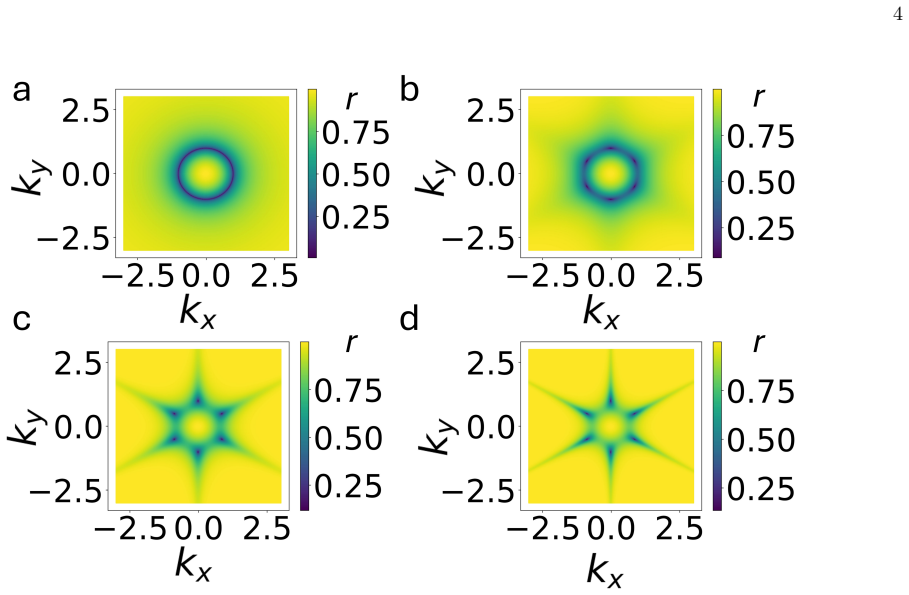
The argument is carried by expressing the effective non-Hermitian junction Hamiltonian as H_eff = ε0 + d·σ, with the complex vector d = dR + i dI. For this junction dR = (−αky + Bx, αkx, λ(kx³ − 3kxky²)) and dI = (0, 0, −γ). Non-Hermitian degeneracies occur precisely when dR² = dI² and dR·dI = 0; these two simultaneous conditions force the real and imaginary parts of both eigenvalues to coincide, and solving them yields the exceptional-point locations. The phase rigidity r = ⟨ΨL|ΨR⟩/⟨ΨR|ΨR⟩, which vanishes at an exceptional point, supplies the numerical check that the eigenvectors also coalesce.
What would settle it
Build a tight-binding or density-functional model of a concrete topological-insulator–ferromagnet junction (for example Bi2Te3 with a ferromagnetic layer), compute the full interface self-energy without the wide-band approximation, and test whether the degeneracy conditions γ² = (−αky+Bx)² + (αkx)² + λ²(kx³−3kxky²)² and λγ(kx³−3kxky²) = 0 still force the six formula points. Any momentum dependence or imaginary σx/σy component in the self-energy would shift or erase the analytic exceptional-point locations; alternatively, a measurement that maps the phase-rigidity hexagon in momentum space woul
Extended reading notes
Core claim
The central result is an analytic description of the exceptional points. With lead self-energy ΣL = −iΓ σ0 − iγ σz and Zeeman field Bx σx, the eigenvalues coalesce when γ² = (−αky+Bx)² + (αkx)² + λ²(kx³−3kxky²)² and λγ(kx³−3kxky²)=0. Solving these gives six k-space points: (0,(Bx±γ)/α) and (±√3(Bx±√(4γ²−3Bx²))/(4α),(Bx±√(4γ²−3Bx²))/(4α)). The locations do not depend on the warping strength λ, yet λ fragments the exceptional ring found at λ=0 into six discrete exceptional points with hexagonal symmetry. A magnetic field moves the points, and above Bc=√(4/3)γ four annihilate, leaving two on the kx=0 line. Phase-rigidity plots confirm that eigenvalues and eigenvectors coalesce.
Load-bearing premise
The analytic six-point pattern rests on the wide-band approximation in which the ferromagnetic lead contributes a momentum-independent, purely σz imaginary self-energy and the magnetic field enters only as a Zeeman term; if real interfaces add momentum-dependent or σx/σy imaginary self-energy pieces, or if orbital effects matter, the degeneracy equations and the hexagonal pattern no longer follow.
Editorial extensions
If this is right
- In the linear-plus-warping surface-state junction with a ferromagnetic lead, exceptional points appear at six explicitly known momenta arranged in a hexagon, so no numerical search is needed to locate them.
- An in-plane magnetic field moves all six exceptional points and can switch their number: above Bc = √(4/3)γ four annihilate and two remain, giving field control over non-Hermitian degeneracy.
- Hexagonal warping acts as a symmetry selector: at λ = 0 the system has a continuous exceptional ring, while any finite λ fragments it into exactly six exceptional points.
- Because the exceptional-point positions do not depend on λ but their pattern does, the prediction is insensitive to the warping strength; the phase-rigidity contours merely sharpen as λ increases.
- Junctions made from a material such as Bi2Te3, with its naturally warped surface states and existing ferromagnet heterostructure recipes, offer a concrete place to look for these effects.
Reading between the lines
- The four-point annihilation at the critical field resembles a pair-annihilation event in the complex-energy landscape; if the exceptional points carry integer winding charges, the two survivors may be constrained by a charge-conservation rule that the paper does not derive.
- The paper treats the magnetic field purely as a Zeeman term and the self-energy as momentum-independent; a tight-binding or first-principles version of the same junction is the natural next check, since orbital coupling and momentum-dependent lead self-energies would modify the two degeneracy equations.
- The same two-equation construction could be exported to other surface-state symmetries — trigonal warping, strained surfaces, or p-wave magnets — to predict when exceptional points replace exceptional rings.
- If the field-tunable annihilation survives in a real material, the sharp sensitivity of the remaining exceptional points could make the junction a magnetic-field-actuated sensing element; that device-level possibility goes beyond what the paper claims.
Editorial analysis
A structured set of objections, weighed in public.
Referee Report
Summary. The paper studies a two-band non-Hermitian Hamiltonian for a topological-insulator–ferromagnet junction, composed of the Fu-model surface state (linear Dirac term plus cubic hexagonal warping), a Zeeman field B_x, and a wide-band lead self-energy Σ_L = −iΓσ_0 − iγσ_z. The authors derive the non-Hermitian degeneracy conditions d_R^2 = d_I^2 and d_R·d_I = 0, obtaining exact exceptional-point locations that form a hexagon for λ ≠ 0 and are independent of the warping strength λ. They show that an in-plane magnetic field moves these EPs and that, above B_c = √(4/3)γ, four of the six EPs disappear, leaving two on the k_x = 0 line. Phase-rigidity plots corroborate the analytic results, and the λ = 0 limit is shown to produce an exceptional ring that fragments into six EPs for finite λ. The central claim is that TI–FM heterojunctions with hexagonally warped surface states provide a tunable platform for non-Hermitian physics.
Significance. If the model Hamiltonian is taken as given, the paper provides a clean, exactly solvable example in which hexagonal warping converts an exceptional ring into six isolated EPs and in which an in-plane field controls their positions and annihilation. The analytic solution is useful and the derivations are straightforward and correct: the listed EP coordinates satisfy the stated degeneracy conditions, and the phase-rigidity plots support the eigenvector coalescence. I found no parameter fitting or circularity; the EP positions follow from the model without adjustable parameters. The main value lies in the explicit analytic control of EP structure and in the proposal of a specific material platform. However, the transfer of the results to the proposed Fe₃GeTe₂|Bi₂Te₃ heterostructure depends on the validity of the wide-band, momentum-independent, σ_z-only self-energy, which is assumed rather than derived for that interface. The work is solid within its model but needs to address this gap before the stronger 'realistic platform' claim can be fully supported.
major comments (2)
- [§II, Eq. (2); §III, Eqs. (5)–(6)] The entire degeneracy analysis rests on the self-energy form Σ_L = −iΓσ_0 − iγσ_z, which gives d_I = (0,0,−γ). This form is quoted from Refs. [24,43–45] but is not derived for the Fe₃GeTe₂|Bi₂Te₃ interface proposed in Sec. VI. If a realistic FM lead produces off-diagonal imaginary self-energy components (d_Ix, d_Iy ≠ 0) or momentum-dependent terms, Eq. (6) is modified and the factorization into the three lines k_x = 0, k_x = ±√3 k_y is lost. In that case the hexagonal six-EP pattern and the prediction B_c = √(4/3)γ are not guaranteed. Please either derive or estimate the neglected components for the proposed interface, or explicitly state the conditions under which the σ_z-only wide-band form applies and temper the platform claims accordingly.
- [§III, parameter choice after Eq. (6)] The numerical calculations set Γ = 0, γ = 1. From Eq. (2), the spin-resolved broadening parameters are Γ_± = Γ ± γ, so this choice gives Γ_- = −1, i.e., a negative density of states for one spin channel of the passive lead. This is unphysical and weakens the experimental-relevance claim. Since Γ enters only through the common shift ϵ_0 = −iΓ, the degeneracy conditions and EP positions are independent of Γ. I recommend choosing Γ > γ > 0 (for example Γ = 1.5, γ = 1) or explicitly stating that Γ is set to zero for display only and has no effect on the EP locations.
minor comments (4)
- [§IV, critical-field discussion] The statement that 'four of the EPs annihilate at the critical field B_c' is imprecise. At B_c the square-root term vanishes, but the four off-axis EPs merge pairwise into two points at (±√3 B_c/(4α), B_c/(4α)); only for B > B_c do these two points disappear, leaving two EPs on the k_x = 0 line. Please clarify this in the text.
- [§VI and Abstract, wording] The abstract and outlook state that hexagonal warping plays a crucial role in 'determining the locations' of the EPs, but the derived locations are independent of λ. The warping determines whether the degeneracies are isolated EPs or an exceptional ring and fixes their hexagonal symmetry, not their coordinate values. The wording should be adjusted to avoid this mismatch.
- [§III, Eq. (7)] The phase-rigidity definition r = ⟨Ψ_L|Ψ_R⟩/⟨Ψ_R|Ψ_R⟩ requires specification of the normalization convention for the left and right eigenvectors. In biorthogonal quantum mechanics one usually writes r = ⟨Ψ_L|Ψ_R⟩/√(⟨Ψ_L|Ψ_L⟩⟨Ψ_R|Ψ_R⟩) or states that the right eigenvectors are normalized and the left vectors are chosen accordingly.
- [§II, Eq. (4)] The Zeeman term B_x σ_x is included, but the manuscript does not comment on orbital effects of the in-plane magnetic field. For a strictly two-dimensional surface state these are usually negligible, but a brief statement would be helpful.
Circularity Check
No circularity: the six-EP prediction is obtained by solving the standard degeneracy conditions for the stated non-Hermitian Hamiltonian; no fitted parameter is renamed as a prediction.
full rationale
The derivation chain is self-contained once the model is specified. The paper starts from the wide-band lead self-energy, Eq. (2), and the Fu hexagonal-warping surface Hamiltonian, Eq. (3), to form the effective non-Hermitian Hamiltonian, Eq. (4). The degeneracy conditions, Eqs. (5) and (6), are the standard NH conditions d_R^2 = d_I^2 and d_R · d_I = 0 obtained from E± = ε0 ± sqrt(d_R^2 - d_I^2 + 2i d_R·d_I). Solving these equations algebraically yields the listed EP positions; no parameter is fitted to the resulting six-EP pattern. The critical field Bc = sqrt(4/3) γ follows directly from the square root in the analytic solution vanishing, not from any auxiliary fit. The hexagonal warping enters through Eq. (6), whose zero set selects discrete points from the exceptional ring present at λ = 0; this is an algebraic consequence, not a renaming of the result. Self-citations, e.g. Refs. [26,28], refer to other junction models and are contextual rather than load-bearing. The wide-band self-energy is borrowed from external literature [24,43-45] as a modeling input; while this is an assumption whose microscopic validity could be questioned, it is not equivalent to the claimed EP prediction, so it does not constitute circularity. The paper is therefore best described as non-circular, with the caveat that the prediction is conditional on the assumed self-energy form.
Assumptions & free parameters
free parameters (5)
- α (Fermi velocity coefficient) =
1 (set for plots)
- γ (imaginary self-energy strength) =
1 (set for plots)
- Γ (common imaginary self-energy) =
0
- λ (hexagonal warping strength) =
1 (set for plots)
- Bx (in-plane magnetic field) =
0 to 1.1 Bc (tuning)
assumptions (7)
- domain assumption The TI surface is described by the Fu Hamiltonian H=α(−kyσx + kxσy) + λ(kx³ − 3kxky²)σz.
- domain assumption The FM lead is accounted for by a frequency- and momentum-independent wide-band self-energy ΣL = −iΓσ0 − iγσz.
- domain assumption The lead density of states ρL± = (1/(t'π))√(1−((μL±m)/(2tz))²) gives positive Γ±, so Γ>0 and |γ|<Γ.
- domain assumption The applied magnetic field enters only as the Zeeman term Bxσx; orbital and other Zeeman effects are neglected.
- standard math For a 2×2 non-Hermitian Hamiltonian, eigenvalues coalesce iff dR² = dI² and dR·dI = 0.
- standard math The phase rigidity r = ⟨ΨL|ΨR⟩/⟨ΨR|ΨR⟩ vanishes at an exceptional point.
- domain assumption The junction's non-Hermiticity is fully captured by the lead self-energy; the TI itself remains Hermitian and disorder-free.
Cite this review
Pith. "Pith review of Hexagonal Warping Control of Exceptional Points in Topological Insulator--Ferromagnetic Heterojunctions." pith.science (2026). https://pith.science/paper/X3ANGJ3P
@misc{pith2026260107443,
  author       = {Pith},
  title        = {Pith review of: Hexagonal Warping Control of Exceptional Points in Topological Insulator--Ferromagnetic Heterojunctions},
  year         = {2026},
  howpublished = {\url{https://pith.science/paper/X3ANGJ3P}},
  note         = {Machine review of arXiv:2601.07443}
}
read the original abstract
Exceptional points (EPs) are non-Hermitian degeneracies, where both eigenvalues and eigenvectors coalesce, which are fundamentally distinct from their Hermitian counterparts. In this study, we investigate the influence of hexagonal warping on EPs emerging at the interfaces between topological insulators and ferromagnets. We demonstrate that the presence of the warping term plays a crucial role in determining the locations of the EPs. Furthermore, we show that the number as well as the positions of EPs emerging at such junctions can be tuned by an applied magnetic field. Our results, in line with previous studies on topological insulator-ferromagnet junctions, suggest them as a promising platform for realizing non-Hermitian physics.
Figures


Figures from the paper (1 more)
Reference graph
Works this paper leans on
-
[1]
C. M. Bender, Making sense of non-hermitian hamiltoni- ans, Reports on Progress in Physics 70, 947 (2007)
2007
-
[2]
Ashida, Z
Y. Ashida, Z. Gong, and M. Ueda, Non-hermitian physics, Advances in Physics 69, 249 (2020)
2020
-
[3]
E. J. Bergholtz, J. C. Budich, and F. K. Kunst, Ex- ceptional topology of non-hermitian systems, Reviews of Modern Physics 93, 015005 (2021)
2021
-
[4]
Kawabata, K
K. Kawabata, K. Shiozaki, M. Ueda, and M. Sato, Sym- metry and topology in non-hermitian physics, Physical Review X 9, 041015 (2019)
2019
-
[5]
Banerjee, R
A. Banerjee, R. Sarkar, S. Dey, and A. Narayan, Non- hermitian topological phases: principles and prospects, Journal of Physics: Condensed Matter 35, 333001 (2023)
2023
-
[6]
K. Ding, C. Fang, and G. Ma, Non-hermitian topol- ogy and exceptional-point geometries, Nature Reviews Physics , 1 (2022)
2022
-
[7]
El-Ganainy, K
R. El-Ganainy, K. G. Makris, M. Khajavikhan, Z. H. Musslimani, S. Rotter, and D. N. Christodoulides, Non- hermitian physics and pt symmetry, Nature Physics 14, 11 (2018)
2018
-
[8]
Okuma and M
N. Okuma and M. Sato, Non-hermitian topological phe- nomena: A review, Annual Review of Condensed Matter Physics 14, 83 (2023)
2023
Show all 47 references
-
[9]
H. Meng, Y. S. Ang, and C. H. Lee, Exceptional points in non-hermitian systems: Applications and recent de- velopments, Applied Physics Letters 124 (2024)
2024
-
[10]
Heiss, The physics of exceptional points, Journal of Physics A: Mathematical and Theoretical 45, 444016 (2012)
W. Heiss, The physics of exceptional points, Journal of Physics A: Mathematical and Theoretical 45, 444016 (2012)
2012
-
[11]
Kato, Perturbation theory for linear operators , Vol
T. Kato, Perturbation theory for linear operators , Vol. 132 (Springer Science & Business Media, 2013)
2013
-
[12]
Banerjee, R
A. Banerjee, R. Jaiswal, M. Manjunath, and A. Narayan, A tropical geometric approach to exceptional points, Proceedings of the National Academy of Sciences 120, e2302572120 (2023)
2023
-
[13]
Jaiswal, A
R. Jaiswal, A. Banerjee, and A. Narayan, Characterizing and tuning exceptional points using newton polygons, New Journal of Physics 25, 033014 (2023)
2023
-
[14]
Hodaei, A
H. Hodaei, A. U. Hassan, S. Wittek, H. Garcia-Gracia, R. El-Ganainy, D. N. Christodoulides, and M. Kha- javikhan, Enhanced sensitivity at higher-order excep- tional points, Nature 548, 187 (2017)
2017
-
[15]
W. Chen, Ş. Kaya Özdemir, G. Zhao, J. Wiersig, and L. Yang, Exceptional points enhance sensing in an optical microcavity, Nature 548, 192 (2017)
2017
-
[16]
B. Peng, Ş. K. Özdemir, M. Liertzer, W. Chen, J. Kramer, H. Yılmaz, J. Wiersig, S. Rotter, and L. Yang, Chiral modes and directional lasing at exceptional points, Proceedings of the National Academy of Sciences 113, 6845 (2016)
2016
-
[17]
Parto, Y
M. Parto, Y. G. Liu, B. Bahari, M. Khajavikhan, and D. N. Christodoulides, Non-hermitian and topological 6 photonics: optics at an exceptional point, Nanophotonics 10, 403 (2020)
2020
-
[18]
Miri and A
M.-A. Miri and A. Alu, Exceptional points in optics and photonics, Science 363, eaar7709 (2019)
2019
-
[19]
Stehmann, W
T. Stehmann, W. Heiss, and F. Scholtz, Observation of exceptional points in electronic circuits, Journal of Physics A: Mathematical and General 37, 7813 (2004)
2004
-
[20]
Y. Choi, C. Hahn, J. W. Yoon, and S. H. Song, Ob- servation of an anti-pt-symmetric exceptional point and energy-difference conserving dynamics in electrical cir- cuit resonators, Nature communications 9, 2182 (2018)
2018
-
[21]
W. Zhu, X. Fang, D. Li, Y. Sun, Y. Li, Y. Jing, and H. Chen, Simultaneous observation of a topological edge state and exceptional point in an open and non-hermitian acoustic system, Physical review letters 121, 124501 (2018)
2018
-
[22]
C. Shi, M. Dubois, Y. Chen, L. Cheng, H. Ramezani, Y. Wang, and X. Zhang, Accessing the exceptional points of parity-time symmetric acoustics, Nature communica- tions 7, 11110 (2016)
2016
-
[23]
L. Xiao, T. Deng, K. Wang, Z. Wang, W. Yi, and P. Xue, Observation of non-bloch parity-time symmetry and ex- ceptional points, Physical Review Letters 126, 230402 (2021)
2021
-
[24]
E. J. Bergholtz and J. C. Budich, Non-hermitian weyl physics in topological insulator ferromagnet junctions, Physical Review Research 1, 012003 (2019)
2019
-
[25]
Cayao, Exceptional degeneracies in non-hermitian rashba semiconductors, Journal of Physics: Condensed Matter 35, 254002 (2023)
J. Cayao, Exceptional degeneracies in non-hermitian rashba semiconductors, Journal of Physics: Condensed Matter 35, 254002 (2023)
2023
-
[26]
M. A. Reja and A. Narayan, Emergence of tunable ex- ceptional points in altermagnet-ferromagnet junctions, arXiv preprint arXiv:2408.04459 (2024)
2024 arXiv
-
[27]
G. K. Dash, S. Panda, and S. Nandy, Fingerprint of non- hermiticity in ad-wave altermagnet, Physical Review B 111, 155119 (2025)
2025
-
[28]
M. A. Reja and A. Narayan, N \’eel vector controlled ex- ceptional contours in p-wave magnet-ferromagnet junc- tions, arXiv preprint arXiv:2506.12434 (2025)
2025
-
[29]
Alipourzadeh, D
M. Alipourzadeh, D. Afshar, and Y. Hajati, Opto- and magneto-tunable exceptional degeneracies in non- hermitian ferromagnet/ p-wave magnet junctions, arXiv preprint arXiv:2508.01295 (2025)
2025 arXiv
-
[30]
M. Z. Hasan and C. L. Kane, Colloquium: topological insulators, Reviews of modern physics 82, 3045 (2010)
2010
-
[31]
Qi and S.-C
X.-L. Qi and S.-C. Zhang, Topological insulators and superconductors, Reviews of modern physics 83, 1057 (2011)
2011
-
[32]
Y. Chen, J. G. Analytis, J.-H. Chu, Z. Liu, S.-K. Mo, X.-L. Qi, H. Zhang, D. Lu, X. Dai, Z. Fang, et al. , Ex- perimental realization of a three-dimensional topological insulator, bi2te3, science 325, 178 (2009)
2009
-
[33]
Hsieh, Y
D. Hsieh, Y. Xia, D. Qian, L. Wray, J. H. Dil, F. Meier, J. Osterwalder, L. Patthey, J. G. Checkelsky, N. P. Ong, et al. , A tunable topological insulator in the spin helical dirac transport regime, Nature 460, 1101 (2009)
2009
-
[34]
Fu, Hexagonal warping effects in the surface states of the topological insulator bi 2 te 3, Physical review letters 103, 266801 (2009)
L. Fu, Hexagonal warping effects in the surface states of the topological insulator bi 2 te 3, Physical review letters 103, 266801 (2009)
2009
-
[35]
Basak, H
S. Basak, H. Lin, L. Wray, S.-Y. Xu, L. Fu, M. Hasan, and A. Bansil, Spin texture on the warped dirac-cone surface states in topological insulators, Physical Review B—Condensed Matter and Materials Physics 84, 121401 (2011)
2011
-
[36]
Alpichshev, J
Z. Alpichshev, J. Analytis, J.-H. Chu, I. R. Fisher, Y. Chen, Z.-X. Shen, . f. A. Fang, and A. Kapitulnik, Stm imaging of electronic waves on the surface of bi 2 te 3:<? format?> topologically protected surface states and hexagonal warping effects, Physical review letters 104,...
2010
-
[37]
Li and J
Z. Li and J. Carbotte, Hexagonal warping on optical con- ductivity of surface states in topological insulator bi 2 te 3, Physical Review B—Condensed Matter and Materials Physics 87, 155416 (2013)
2013
-
[38]
Li and J
Z. Li and J. Carbotte, Hexagonal warping on spin tex- ture, hall conductivity, and circular dichroism of topo- logical insulators, Physical Review B 89, 165420 (2014)
2014
-
[39]
Saha and A
S. Saha and A. Narayan, Nonlinear hall effect in rashba systems with hexagonal warping, Journal of Physics: Condensed Matter 35, 485301 (2023)
2023
-
[40]
Chowdhury, A
D. Chowdhury, A. Banerjee, and A. Narayan, Excep- tional hexagonal warping effect in multi-weyl semimetals, Physical Review B 105, 075133 (2022)
2022
-
[41]
Wang and F
C. Wang and F. Yu, Effects of hexagonal warping on sur- face transport in topological insulators, Physical Review B—Condensed Matter and Materials Physics 84, 155440 (2011)
2011
-
[42]
Choudhari and N
T. Choudhari and N. Deo, Effect of hexagonal warping of the fermi surface on the thermoelectric properties of a topological insulator irradiated with linearly polarized radiation, Physical Review B 100, 035303 (2019)
2019
-
[43]
Ryndyk, R
D. Ryndyk, R. Gutiérrez, B. Song, and G. Cuniberti, Green function techniques in the treatment of quantum transport at the molecular scale, in Energy Transfer Dy- namics in Biomaterial Systems (Springer, 2009) pp. 213– 335
2009
-
[44]
Datta, Electronic transport in mesoscopic systems (Cambridge university press, 1997)
S. Datta, Electronic transport in mesoscopic systems (Cambridge university press, 1997)
1997
-
[45]
Cayao and A
J. Cayao and A. M. Black-Schaffer, Exceptional odd- frequency pairing in non-hermitian superconducting sys- tems, Physical Review B 105, 094502 (2022)
2022
-
[46]
D. C. Brody, Biorthogonal quantum mechanics, Journal of Physics A: Mathematical and Theoretical 47, 035305 (2013)
2013
-
[47]
X. Chen, H. Wang, H. Liu, C. Wang, G. Wei, C. Fang, H. Wang, C. Geng, S. Liu, P. Li, et al. , Generation and control of terahertz spin currents in topology-induced 2d ferromagnetic fe3gete2| bi2te3 heterostructures, Ad- vanced Materials 34, 2106172 (2022)
2022
Reviewed August 4, 2026 · model on record in the stance chip above.
Discussion (0). Continue with ORCID to comment.