Asymptotically-flat Black holes in Bumblebee gravity: Exact solutions and Thermodynamics
Pith reviewed 2026-06-28 00:43 UTC · model grok-4.3
The pith
Bumblebee gravity yields exact asymptotically flat black hole solutions when the vector field has only a temporal component.
A machine-rendered reading of the paper's core claim, the machinery that carries it, and where it could break.
Core claim
We construct analytic solutions to the bumblebee gravity theory in static and spherically symmetric spacetimes, where the bumblebee vector field admits only a non-vanishing temporal component. In particular, we identify the parameter space that allows for asymptotically flat black hole solutions. We further investigate the thermodynamic properties of these black holes and obtained the analytic formulas for the Y charge and X potential, which were introduced in the prior work to ensure the Smarr relation and the first law of black hole thermodynamics. Using the new analytic results, we verify the numerical findings reported in early work and uncover multiple cases missed in the previous numer
What carries the argument
The temporal-only ansatz for the bumblebee vector field in static spherical symmetry, which reduces the field equations to ordinary differential equations solved by exact metric functions.
If this is right
- Analytic Y charge and X potential close the first law and Smarr relation for the entire family.
- Charge-to-mass ratio becomes unbounded for ξ greater than 2κ.
- Overcharged solutions with ξ less than zero describe traversable wormholes.
- Hawking temperature exhibits non-monotonic dependence on charge-mass ratio.
- Constant-Y heat capacity possesses two distinct divergence points.
Where Pith is reading between the lines
- The exact solutions supply controlled initial data for numerical evolution of dynamical bumblebee black holes.
- The wormhole branch may be matched to thin-shell constructions to test stability under small perturbations.
- Non-monotonic temperature curves suggest the existence of multiple thermodynamic phases whose critical points can be located analytically.
Load-bearing premise
The bumblebee vector field is assumed to have only a non-vanishing temporal component.
What would settle it
An explicit static spherically symmetric solution with a non-zero spatial component of the bumblebee field that remains asymptotically flat yet lies outside the reported parameter space.
Figures
read the original abstract
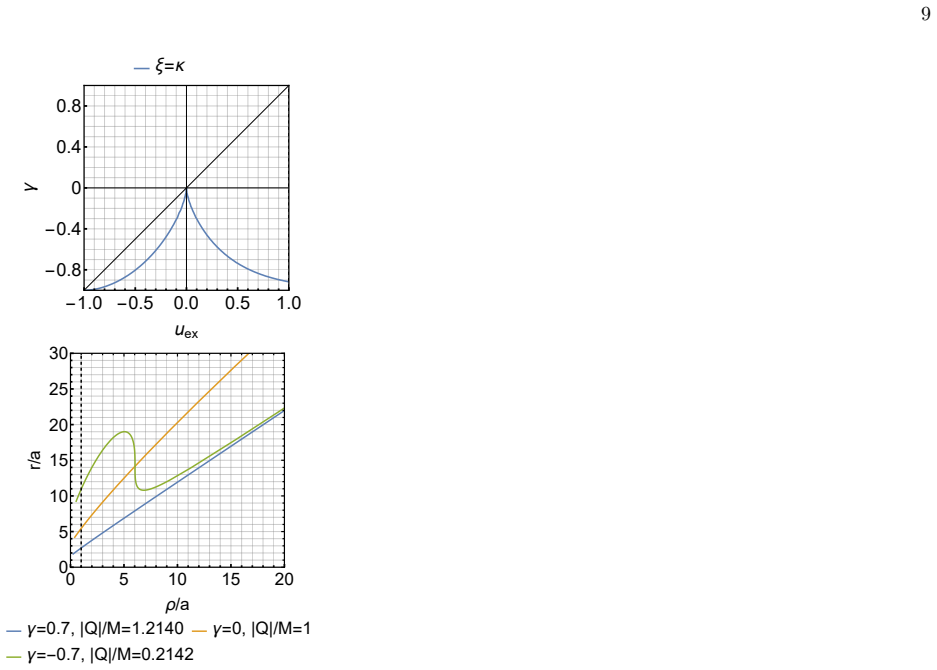
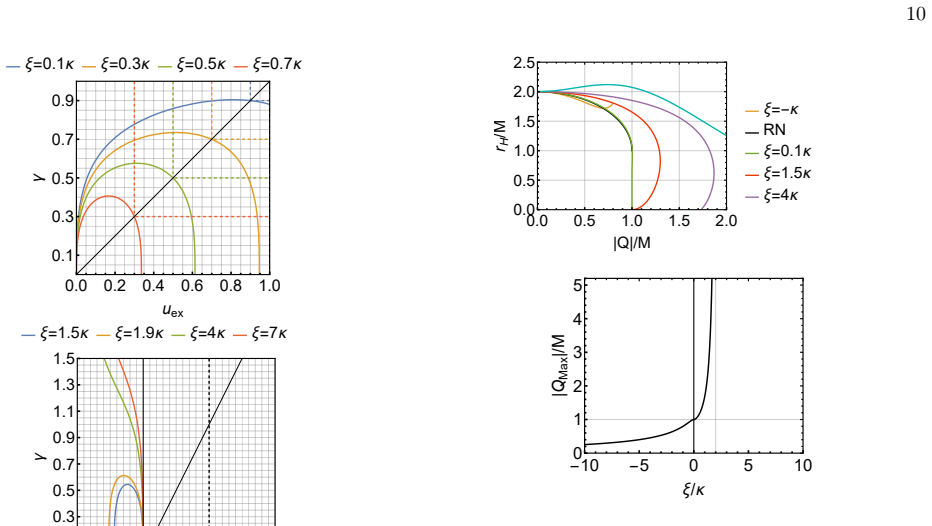
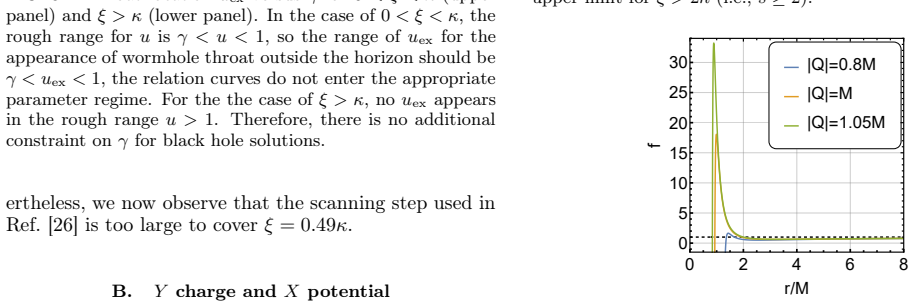
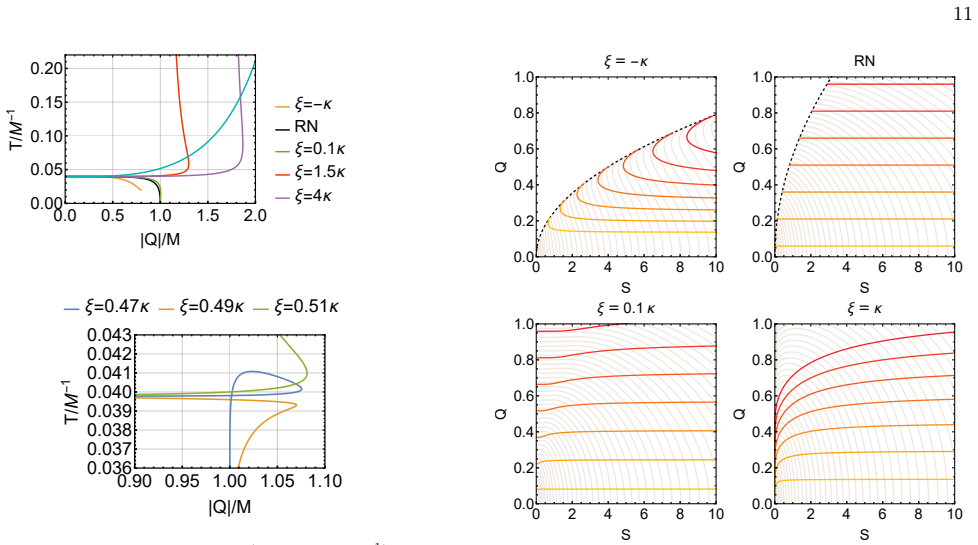
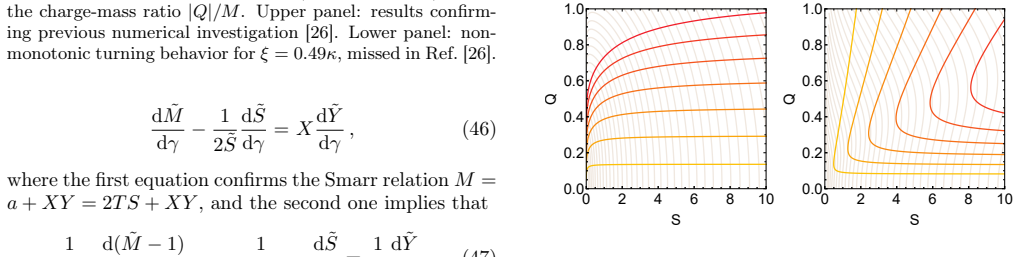
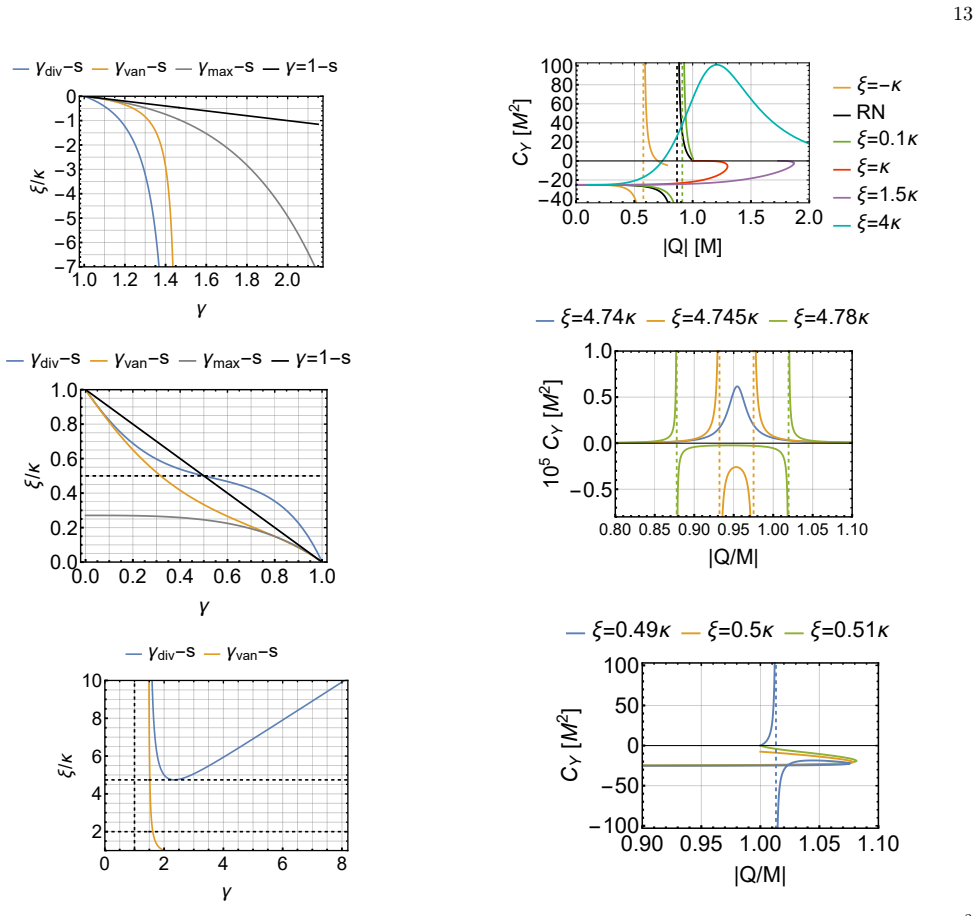
We construct analytic solutions to the bumblebee gravity theory in static and spherically symmetric spacetimes, where the bumblebee vector field admits only a non-vanishing temporal component. In particular, we identify the parameter space that allows for asymptotically flat black hole solutions. We further investigate the thermodynamic properties of these black holes and obtained the analytic formulas for the $Y$ charge and $X$ potential, which were introduced in the prior work to ensure the Smarr relation and the first law of black hole thermodynamics. Using the new analytic results, we verify the numerical findings reported in early work and uncover multiple cases missed in the previous numerical analysis. These include: (i) an unbounded charge-mass ratio when the non-minimal coupling parameter $\xi$ is larger than $2\kappa$, (ii) the emergence of a traversable wormhole configuration for overcharged solutions with $\xi<0$, (iii) the non-monotonic turning behavior of the Hawking temperature as a function of the charge-mass ratio, and (iv) the presence of two divergent points in the constant-$Y$ heat capacity.
Editorial analysis
A structured set of objections, weighed in public.
Referee Report
Summary. The paper constructs analytic solutions to bumblebee gravity in static spherically symmetric spacetimes assuming the bumblebee vector has only a temporal component. It identifies the parameter space for asymptotically flat black holes, derives analytic expressions for the Y charge and X potential to enforce the first law and Smarr relation, verifies prior numerical results, and reports new cases: unbounded charge-mass ratio for ξ > 2κ, traversable wormholes for overcharged solutions with ξ < 0, non-monotonic Hawking temperature vs. charge-mass ratio, and two divergences in constant-Y heat capacity.
Significance. If valid under the stated ansatz, the analytic solutions and thermodynamic formulas provide exact results that extend and verify numerical work in modified gravity, enabling precise exploration of new parameter regimes and thermodynamic behaviors not previously accessible.
major comments (2)
- [Abstract] Abstract (first sentence) and the ansatz used to reduce the field equations: the restriction to a purely temporal bumblebee vector component is adopted without demonstrating that a radial component is either inconsistent with the equations or incompatible with asymptotic flatness; this assumption is load-bearing for the claimed parameter space and new cases (i) and (ii).
- The derivation of the metric functions and verification against the bumblebee field equations: explicit substitution of the analytic solutions back into the full set of field equations derived from the action is required to confirm consistency, as the current support for the listed new cases rests on this step.
minor comments (1)
- Clarify the precise definition and range of the non-minimal coupling parameter ξ relative to κ in the action and in the reported bounds (e.g., ξ > 2κ).
Simulated Author's Rebuttal
We thank the referee for their careful reading and constructive comments. We respond to each major comment below and indicate the revisions we will make.
read point-by-point responses
-
Referee: [Abstract] Abstract (first sentence) and the ansatz used to reduce the field equations: the restriction to a purely temporal bumblebee vector component is adopted without demonstrating that a radial component is either inconsistent with the equations or incompatible with asymptotic flatness; this assumption is load-bearing for the claimed parameter space and new cases (i) and (ii).
Authors: The purely temporal ansatz is selected because it permits closed-form analytic solutions while remaining consistent with the static spherically symmetric symmetry and with the temporal-field focus of earlier numerical work. We will revise the introduction to state explicitly that this is a simplifying assumption adopted for analytic tractability; a radial component generally produces a system of coupled nonlinear ODEs that does not admit simple asymptotically flat analytic solutions under the same metric ansatz. A complete proof that every radial-inclusive configuration is incompatible with asymptotic flatness lies outside the present scope, but the revised text will make the load-bearing character of the assumption transparent. revision: partial
-
Referee: The derivation of the metric functions and verification against the bumblebee field equations: explicit substitution of the analytic solutions back into the full set of field equations derived from the action is required to confirm consistency, as the current support for the listed new cases rests on this step.
Authors: We agree that direct substitution provides the strongest confirmation. In the revised manuscript we will add an appendix that substitutes the derived metric functions, the temporal bumblebee vector, and the analytic expressions for the Y charge and X potential back into the complete set of field equations obtained from the action, verifying that all components are satisfied identically. This explicit check will underpin the new cases (i)–(iv). revision: yes
Circularity Check
No significant circularity; derivation proceeds from explicit ansatz to analytic solutions verified externally
full rationale
The paper states the temporal-only ansatz for the bumblebee vector explicitly to reduce the field equations under static spherical symmetry, then solves for asymptotically flat metrics and derives analytic expressions for the Y charge and X potential (introduced in prior work to satisfy thermodynamic relations). These steps do not reduce to self-definition, fitted inputs renamed as predictions, or load-bearing self-citations; the solutions are obtained directly from the equations and cross-verified against earlier numerical results rather than enforced by construction. The central claims retain independent content from the field equations.
Axiom & Free-Parameter Ledger
free parameters (1)
- ξ
axioms (1)
- domain assumption Bumblebee vector field has only non-vanishing temporal component in static spherically symmetric spacetime
Reference graph
Works this paper leans on
-
[1]
Extreme family We first consider the case of a constantgµνbµbν, namely, gµνbµbν =− b2 t h =−b 2 ,(A5) 15 wherebis a constant. Then Eq. (A3) gives (b2κ−2) dbt dρ 2 = 2αb2 t (ρ2 +α) 2 ,(A6) and Eq. (A4) becomes (ξ−2κ) ρ2 +α bt dbt dρ 2 = (ξ−κ) d dρ (ρ2 +α) dbt dρ .(A7) The unique set of consistent parameter values is b2 = 2 κ , α= 0.(A8) The reason is as fo...
-
[2]
separable
Integrable family The above result indicates that the case of a constantb2 can only be achieved whenα= 0andb 2 = 2/κ. Thus, we expect that the cases ofα̸= 0correspond to a misalignment betweenb µbµ and2/κ. It is natural to introduce a functionw(ρ)to evaluate this misalignment: w(ρ) = κ 2 b2 t (ρ) h(ρ) −1.(A18) Then we will use{w(ρ), bt(ρ)}rather than{h(ρ)...
-
[3]
Spontaneous Breaking of Lorentz Symmetry in String Theory,
V. Alan Kostelecký and Stuart Samuel, “Spontaneous Breaking of Lorentz Symmetry in String Theory,” Phys. Rev. D39, 683 (1989)
1989
-
[4]
Phenomenolog- ical Gravitational Constraints on Strings and Higher Di- mensional Theories,
V. Alan Kostelecký and Stuart Samuel, “Phenomenolog- ical Gravitational Constraints on Strings and Higher Di- mensional Theories,” Phys. Rev. Lett.63, 224 (1989)
1989
-
[5]
Gravitational Phenomenology in Higher Dimensional Theories and Strings,
V. Alan Kostelecký and Stuart Samuel, “Gravitational Phenomenology in Higher Dimensional Theories and Strings,” Phys. Rev. D40, 1886–1903 (1989)
1903
-
[6]
Gravity, Lorentz violation, and the standard model,
V. Alan Kostelecký, “Gravity, Lorentz violation, and the standard model,” Phys. Rev. D69, 105009 (2004), arXiv:hep-th/0312310
Pith/arXiv arXiv 2004
-
[7]
CPT violation and the standard model,
Don Colladay and V. Alan Kostelecký, “CPT violation and the standard model,” Phys. Rev. D55, 6760–6774 (1997), arXiv:hep-ph/9703464
Pith/arXiv arXiv 1997
-
[8]
Ralf Lehnert, ed.,Proceedings of the 9th Meeting on CPT and Lorentz Symmetry: Bloomington, USA, May 17–26, 2022(World Scientific, 2023)
2022
-
[9]
Static spherical vacuum solutions in the bumblebee gravity model,
Rui Xu, Dicong Liang, and Lijing Shao, “Static spherical vacuum solutions in the bumblebee gravity model,” Phys. Rev. D107, 024011 (2023), arXiv:2209.02209 [gr-qc]
arXiv 2023
-
[10]
Dynamic instability analysis for bumblebee black holes: The odd parity,
Zhan-Feng Mai, Rui Xu, Dicong Liang, and Lijing Shao, “Dynamic instability analysis for bumblebee black holes: The odd parity,” Phys. Rev. D109, 084076 (2024), arXiv:2401.07757 [gr-qc]
arXiv 2024
-
[11]
Exact Schwarzschild-like solution in a bumble- bee gravity model,
R. Casana, A. Cavalcante, F. P. Poulis, and E. B. Santos, “Exact Schwarzschild-like solution in a bumble- bee gravity model,” Phys. Rev. D97, 104001 (2018), arXiv:1711.02273 [gr-qc]
Pith/arXiv arXiv 2018
-
[12]
Vacuum solution within a metric-affine bumblebee gravity,
A.A.AraújoFilho, J.R.Nascimento, A.Yu.Petrov, and P. J. Porfírio, “Vacuum solution within a metric-affine bumblebee gravity,” Phys. Rev. D108, 085010 (2023), arXiv:2211.11821 [gr-qc]
arXiv 2023
-
[13]
Rotating BTZ- like black hole and central charges in Einstein- bumblebee gravity,
Chikun Ding, Yu Shi, Jun Chen, Yuebing Zhou, Changqing Liu, and Yuehua Xiao, “Rotating BTZ- like black hole and central charges in Einstein- bumblebee gravity,” Eur. Phys. J. C83, 573 (2023), arXiv:2302.01580 [gr-qc]
arXiv 2023
-
[14]
Einstein–Bumblebee- dilaton black hole solution,
L. A. Lessa and J. E. G. Silva, “Einstein–Bumblebee- dilaton black hole solution,” Eur. Phys. J. C83, 1035 (2023), arXiv:2308.14646 [hep-th]
arXiv 2023
-
[15]
An exact stationary axisymmetric vacuum solutionwithinametric-affinebumblebeegravity,
A.A.AraújoFilho, J.R.Nascimento, A.Yu.Petrov, and P. J. Porfírio, “An exact stationary axisymmetric vacuum solutionwithinametric-affinebumblebeegravity,” JCAP 07, 004 (2024), arXiv:2402.13014 [gr-qc]
arXiv 2024
-
[16]
Charged spherically symmetric and slowly rotating charged black hole solutions in bumblebee gravity,
Jia-Zhou Liu, Wen-Di Guo, Shao-Wen Wei, and Yu-Xiao Liu, “Charged spherically symmetric and slowly rotating charged black hole solutions in bumblebee gravity,” Eur. Phys. J. C85, 145 (2025), arXiv:2407.08396 [gr-qc]
arXiv 2025
-
[17]
Mou Xu, Jianbo Lu, Ruonan Li, Yu Liu, and Shu- Min Wu, “Particle dynamics and optical appearance of charged spherically symmetric black holes in bumble- bee gravity,” Class. Quant. Grav.42, 135008 (2025), arXiv:2506.17566 [gr-qc]
arXiv 2025
-
[18]
Exact black hole solutions in bumblebee grav- ity with lightlike or spacelike VEVs,
Jia-Zhou Liu, Shan-Ping Wu, Shao-Wen Wei, and Yu- Xiao Liu, “Exact black hole solutions in bumblebee grav- ity with lightlike or spacelike VEVs,” Sci. China Phys. Mech. Astron.69, 270411 (2026), arXiv:2510.16731 [gr- qc]
Pith/arXiv arXiv 2026
-
[19]
Taub-NUT-like black holes in Einstein-bumblebee gravity,
Yu-Qi Chen and Hai-Shan Liu, “Taub-NUT-like black holes in Einstein-bumblebee gravity,” Phys. Rev. D112, 084040 (2025), arXiv:2505.23104 [gr-qc]
arXiv 2025
-
[20]
Bumblebee gravity: Spherically sym- metric solutions away from the potential minimum,
Quentin G. Bailey, Hailey S. Murray, and Dario T. Walter-Cardona, “Bumblebee gravity: Spherically sym- metric solutions away from the potential minimum,” Phys. Rev. D112, 024069 (2025), arXiv:2503.10998 [gr- qc]
arXiv 2025
-
[21]
Static spherical vacuum solution to bumblebee gravity with time-like VEVs,
Hao Li and Jie Zhu, “Static spherical vacuum solution to bumblebee gravity with time-like VEVs,” Eur. Phys. J. C86, 2 (2026), arXiv:2506.17957 [gr-qc]
arXiv 2026
-
[22]
Full classification of static spherical vacuum solutions to bumblebee gravity with general VEVs,
Jie Zhu and Hao Li, “Full classification of static spherical vacuum solutions to bumblebee gravity with general VEVs,” Phys. Lett. B876, 140396 (2026), arXiv:2511.03231 [gr-qc]
Pith/arXiv arXiv 2026
-
[23]
New Exact Vacuum Solutions in ExtendedBumblebeeGravity,
Jie Zhu and Hao Li, “New Exact Vacuum Solutions in ExtendedBumblebeeGravity,” (2026),arXiv:2604.09464 [gr-qc]
Pith/arXiv arXiv 2026
-
[24]
Exact traversable wormhole solution in bumblebee gravity,
Ali Övgün, Kimet Jusufi, and İzzet Sakallı, “Exact traversable wormhole solution in bumblebee gravity,” Phys. Rev. D99, 024042 (2019), arXiv:1804.09911 [gr- qc]
Pith/arXiv arXiv 2019
-
[25]
Neutron stars in the bumble- bee theory of gravity,
Peixiang Ji, Zhuhai Li, Lirui Yang, Rui Xu, Zexin Hu, and Lijing Shao, “Neutron stars in the bumble- bee theory of gravity,” Phys. Rev. D110, 104057 (2024), 22 arXiv:2409.04805 [gr-qc]
arXiv 2024
-
[26]
Strange quark stars and condensate dark stars in Bumblebee gravity,
Grigoris Panotopoulos and Ali Övgün, “Strange quark stars and condensate dark stars in Bumblebee gravity,” Nucl. Phys. B1017, 116956 (2025), arXiv:2409.05801 [gr-qc]
arXiv 2025
-
[27]
Stars and quark stars in bumblebee gravity,
Juliano C. S. Neves and Fernando G. Gardim, “Stars and quark stars in bumblebee gravity,” Annals Phys.475, 169950 (2025), arXiv:2409.20360 [gr-qc]
arXiv 2025
-
[28]
Extended thermodynamics of the bumble- bee black holes,
Zhan-Feng Mai, Rui Xu, Dicong Liang, and Li- jing Shao, “Extended thermodynamics of the bumble- bee black holes,” Phys. Rev. D108, 024004 (2023), arXiv:2304.08030 [gr-qc]
arXiv 2023
-
[29]
Notes on thermodynamics of Schwarzschild- like bumblebee black hole,
Yu-Sen An, “Notes on thermodynamics of Schwarzschild- like bumblebee black hole,” Phys. Dark Univ.45, 101520 (2024), arXiv:2401.15430 [gr-qc]
arXiv 2024
-
[30]
QNMs of slowly rotating Einstein–Bumblebee black hole,
Wentao Liu, Xiongjun Fang, Jiliang Jing, and Jieci Wang, “QNMs of slowly rotating Einstein–Bumblebee black hole,” Eur. Phys. J. C83, 83 (2023), arXiv:2211.03156 [gr-qc]
arXiv 2023
-
[31]
Lorentz violation induces isospectrality breaking in Einstein-bumblebee gravity theory,
Wentao Liu, Xiongjun Fang, Jiliang Jing, and Jieci Wang, “Lorentz violation induces isospectrality breaking in Einstein-bumblebee gravity theory,” Sci. China Phys. Mech. Astron.67, 280413 (2024), arXiv:2402.09686 [gr- qc]
arXiv 2024
-
[32]
Quasinormal modes of a charged spherically symmetric black hole in bumblebee gravity,
Bo-Rui Li, Jia-Zhou Liu, Wen-Di Guo, and Yu- Xiao Liu, “Quasinormal modes of a charged spherically symmetric black hole in bumblebee gravity,” (2025), arXiv:2510.20503 [gr-qc]
arXiv 2025
-
[33]
Bumblebee BlackHolesinLightofEventHorizonTelescopeObserva- tions,
Rui Xu, Dicong Liang, and Lijing Shao, “Bumblebee BlackHolesinLightofEventHorizonTelescopeObserva- tions,” Astrophys. J.945, 148 (2023), arXiv:2302.05671 [gr-qc]
arXiv 2023
-
[34]
Gaetano Lambiase, Reggie C. Pantig, and Ali Övgün, “Weak field deflection angle and analytical parameter es- timation of the Lorentz-violating Bumblebee parameter through the black hole shadow using EHT data,” EPL 148, 49001 (2024), arXiv:2408.09620 [gr-qc]
arXiv 2024
-
[35]
Qi Qi, Yu Sang, and Xiao-Mei Kuang, “Probing a Lorentz-violating parameter from orbital precession of the S2 star around the galactic centre supermassive black hole,” Sci. China Phys. Mech. Astron.69, 260414 (2026), arXiv:2601.06491 [gr-qc]
Pith/arXiv arXiv 2026
-
[36]
Probing the vector charge of Sagit- tarius A* with pulsar timing,
Zexin Hu, Lijing Shao, Rui Xu, Dicong Liang, and Zhan-Feng Mai, “Probing the vector charge of Sagit- tarius A* with pulsar timing,” JCAP04, 087 (2024), arXiv:2312.02486 [astro-ph.HE]
arXiv 2024
-
[37]
Polarizations of gravitational waves in the bumble- bee gravity model,
Dicong Liang, Rui Xu, Xuchen Lu, and Lijing Shao, “Polarizations of gravitational waves in the bumble- bee gravity model,” Phys. Rev. D106, 124019 (2022), arXiv:2207.14423 [gr-qc]
arXiv 2022
-
[38]
Probing vector hair of black holes with extreme- mass-ratio inspirals,
Dicong Liang, Rui Xu, Zhan-Feng Mai, and Lijing Shao, “Probing vector hair of black holes with extreme- mass-ratio inspirals,” Phys. Rev. D107, 044053 (2023), arXiv:2212.09346 [gr-qc]
arXiv 2023
-
[39]
Mao-Jiang Liu, Long-Xing Huang, Yong-Qiang Wang, and Ke Yang, “Boson Stars in Bumblebee Gravity and Their Gravitational Waveforms from Extreme-Mass- Ratio Inspirals,” (2025), arXiv:2512.19581 [gr-qc]
Pith/arXiv arXiv 2025
-
[40]
Xiao-Bin Lai, Yu-Qi Dong, Yu-Zhi Fan, and Yu-Xiao Liu, “Stability analysis of cosmological perturbations in the bumblebee model: Parameter constraints and gravitational waves,” Phys. Rev. D113, 044003 (2026), arXiv:2509.13958 [gr-qc]
arXiv 2026
-
[41]
Peri- odic orbits and gravitational waveforms of black holes in bumblebee gravity,
Zijian Shi, Xiangdong Zhang, and Yunlong Liu, “Peri- odic orbits and gravitational waveforms of black holes in bumblebee gravity,” (2026), arXiv:2603.14413 [gr-qc]
Pith/arXiv arXiv 2026
-
[42]
Bumblebee field as a source of cosmological anisotropies,
R. V. Maluf and Juliano C. S. Neves, “Bumblebee field as a source of cosmological anisotropies,” JCAP10, 038 (2021), arXiv:2105.08659 [gr-qc]
arXiv 2021
-
[43]
Mohsen Khodadi, Gaetano Lambiase, and Ahmad Sheykhi, “Constraining the Lorentz-violating bumblebee vector field with big bang nucleosynthesis and gravita- tional baryogenesis,” Eur. Phys. J. C83, 386 (2023), arXiv:2211.07934 [gr-qc]
arXiv 2023
-
[44]
Anisotropic cosmology in bumblebee gravity theory,
Pranjal Sarmah and Umananda Dev Goswami, “Anisotropic cosmology in bumblebee gravity theory,” Phys. Dark Univ.49, 102057 (2025), arXiv:2407.13487 [gr-qc]
arXiv 2025
-
[45]
Bum- blebee cosmology: Tests using distance- and time- redshift probes,
Xincheng Zhu, Rui Xu, and Dandan Xu, “Bum- blebee cosmology: Tests using distance- and time- redshift probes,” Phys. Dark Univ.50, 102127 (2025), arXiv:2411.18559 [astro-ph.CO]
arXiv 2025
-
[46]
Bumblebee cosmology: The FLRW solution and the CMB temperature anisotropy,
Rui Xu, Dandan Xu, Lars Andersson, Pau Amaro Seoane, and Lijing Shao, “Bumblebee cosmology: The FLRW solution and the CMB temperature anisotropy,” Front. Phys. (Beijing)21, 036201 (2026), arXiv:2504.10297 [gr-qc]
arXiv 2026
-
[47]
Regular black holes and black universes,
K. A. Bronnikov, V. N. Melnikov, and Heinz Dehnen, “Regular black holes and black universes,” Gen. Rel. Grav.39, 973–987 (2007), arXiv:gr-qc/0611022
Pith/arXiv arXiv 2007
-
[48]
Black-bounce to traversable wormhole,
Alex Simpson and Matt Visser, “Black-bounce to traversable wormhole,” JCAP02, 042 (2019), arXiv:1812.07114 [gr-qc]
Pith/arXiv arXiv 2019
-
[49]
Charged Ellis Wormhole and Black Bounce,
Hyat Huang and Jinbo Yang, “Charged Ellis Wormhole and Black Bounce,” Phys. Rev. D100, 124063 (2019), arXiv:1909.04603 [gr-qc]
arXiv 2019
-
[50]
The Python’s Lunch: geomet- ric obstructions to decoding Hawking radiation,
Adam R. Brown, Hrant Gharibyan, Geoff Penington, and Leonard Susskind, “The Python’s Lunch: geomet- ric obstructions to decoding Hawking radiation,” JHEP 08, 121 (2020), arXiv:1912.00228 [hep-th]
arXiv 2020
-
[51]
Sean A. Hayward, “Dynamic wormholes,” Int. J. Mod. Phys. D8, 373–382 (1999), arXiv:gr-qc/9805019
Pith/arXiv arXiv 1999
-
[52]
Fate of the first traversible wormhole: Black hole collapse or inflationary expansion,
Hisa-aki Shinkai and Sean A. Hayward, “Fate of the first traversible wormhole: Black hole collapse or inflationary expansion,” Phys. Rev. D66, 044005 (2002), arXiv:gr- qc/0205041
arXiv 2002
-
[53]
Vaidya spacetimes, black-bounces, and traversable wormholes,
Alex Simpson, Prado Martin-Moruno, and Matt Visser, “Vaidya spacetimes, black-bounces, and traversable wormholes,” Class. Quant. Grav.36, 145007 (2019), arXiv:1902.04232 [gr-qc]
Pith/arXiv arXiv 2019
-
[54]
Trapping horizons of the evolving charged wormhole and black bounce,
Jinbo Yang and Hyat Huang, “Trapping horizons of the evolving charged wormhole and black bounce,” Phys. Rev. D104, 084005 (2021), arXiv:2104.11134 [gr-qc]
arXiv 2021
-
[55]
Ether flow through a drainhole - a particle model in general relativity,
H. G. Ellis, “Ether flow through a drainhole - a particle model in general relativity,” J. Math. Phys.14, 104–118 (1973)
1973
-
[56]
Scalar-tensor theory and scalar charge,
K. A. Bronnikov, “Scalar-tensor theory and scalar charge,” Acta Phys. Polon. B4, 251–266 (1973)
1973
discussion (0)
Sign in with ORCID, Apple, or X to comment. Anyone can read and Pith papers without signing in.