REVIEW 2 major objections 4 minor 43 references
Helically Enhanced Chiroptical Response and Symmetry Breaking in Conjugated Polymers
T0 review · 2 major / 4 minor · reviewed 2026-07-10 · grok-4.5
Pith's one-line read Helical polyacetylene chains amplify chiroptical response by two orders of magnitude through a solenoid effect that eliminates destructive interference.
desk verdict Solid model-level demonstration that continuous helices beat local twists for chiroptical strength in polyacetylene, with a clear solenoid + TCT-domain mechanism; the bridge to real microscale film morphology is the soft spot, not the calculations themselves. read the letter →
The pith
A machine-rendered reading of the paper's core claim, the machinery that carries it, and where it could break.
The reading
What carries the argument
Transition Chiral Tensor (TCT) maps: fragment-resolved products of electric and magnetic transition densities that visualize constructive versus destructive domains along the chain and thereby explain the net rotatory strength.
What would settle it
Linearly polarized absorption or dielectric-tensor measurements on oriented chiral polyacetylene films that fail to show the out-of-plane components and selection-rule breakdown predicted for the helix, or CD spectra whose anisotropy factors remain near the twist value rather than approaching 10^{-2}.
Extended reading notes
Core claim
A helical conformation of cis-(CH)x oligomers produces orders-of-magnitude stronger chiroptical activity than a simple twist of the same local torsion, because the helix amplifies the magnetic transition dipole through a solenoid effect and supports coherent domains that eliminate destructive interference between electric and magnetic contributions.
Load-bearing premise
That hand-twisted or helically wound cis-polyacetylene oligomers with fixed bond-length alternation are faithful enough models for the real films, even though microscopy finds no mesoscale helices and chirality is said to live only on the microscale.
Editorial extensions
If this is right
- Helical packing, not merely local torsion, becomes the structural design rule for maximizing circular dichroism in conjugated polymers.
- Linearly polarized spectroscopy on oriented films can diagnose out-of-plane symmetry breaking without requiring circular dichroism.
- The same hierarchical link from fragment torsion to global TCT domains should apply to donor–acceptor polymers used in circularly polarized light devices.
- Band-gap red-shifts from torsion provide an additional, geometry-controlled source of spectral broadening in chiral films.
Reading between the lines
- If the solenoid picture holds, deliberately increasing the effective radius of a helical polymer should further raise g_CD until packing constraints intervene.
- The same TCT domain analysis could flag when chain folding or inter-chain packing reintroduces cancellation, offering a diagnostic for why some chiral films under-perform.
- CISS spin selectivity may track the same magnetic-dipole amplification, suggesting helical geometry as a joint target for both optical and spin-transport figures of merit.
Editorial analysis
A structured set of objections, weighed in public.
Referee Report
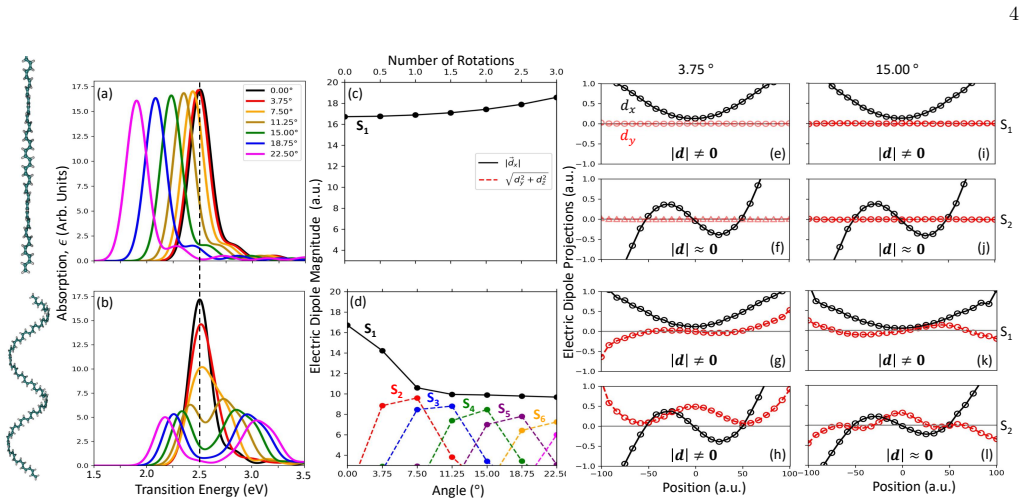
Summary. The manuscript combines experimental circular dichroism of chiral polyacetylene films with TD-DFT calculations on cis-(CH)x oligomers whose geometries are generated by uniform torsion applied either to successive C2H2 units (twist) or C4H4 units (helix). Both conformations reduce the bandgap via reduced nearest-neighbor hopping and bond-order alternation. The helix, however, breaks the planar D2h optical selection rules by introducing out-of-plane transition-dipole components and produces a maximal anisotropy factor g_CD ~ 3e-2, two orders of magnitude larger than the twist (~4e-4). The enhancement is attributed to a classical solenoid-like amplification of the magnetic transition dipole together with coherent domains of constructive interference revealed by Transition Chiral Tensor (TCT) maps. The authors conclude that local torsional symmetry breaking propagates hierarchically to the global chiroptical response and that this picture is general for pi-conjugated semiconductors.
Significance. If the helix-versus-twist contrast survives more realistic geometries and electronic-structure methods, the work supplies a concrete, chemically actionable design rule: continuous helical topology, rather than mere local torsion, is required for large magnetic-dipole amplification and elimination of destructive interference. The combination of fragment-projected transition dipoles, TCT domain maps, and experimental CD on the same material class is a useful methodological contribution. The solenoid analogy and the explicit link between out-of-plane dipole components and selection-rule breaking are pedagogically clear and should interest both synthetic chemists targeting chiral polymers and theorists modeling CISS or CPL devices.
major comments (2)
- Introduction and Fig. 1 discussion: microscopy finds no mesoscale helical fibrils and chirality is stated to be microscale only, yet the central quantitative claim (orders-of-magnitude g_CD enhancement via solenoid scaling and coherent TCT domains) is demonstrated exclusively for continuous helices of controlled pitch constructed by rigid C4H4 rotations at fixed BLA (Fig. 1c-d). Nothing in the manuscript establishes that the experimental microscale motif is a continuous helix rather than a distribution of local twists, packing motifs, or residual catalyst asymmetry. Because both |m| amplification (Phi ~ 1/tan^2 theta) and the elimination of destructive interference (Fig. 5) are geometry-specific consequences of continuous helical topology, the design rule does not automatically transfer. A short discussion of alternative microscale geometries, or a calculation on a disordered-twist ensem
- Computational methods (End Matter and Fig. 2-4): oligomer length (number of carbons), exact range-separated hybrid functional, basis set, and continuum-solvent settings are only partially explicit in the main text. Absolute TD-DFT rotatory strengths and g_CD ratios are known to be functional- and basis-sensitive; the reported ~75-fold helix/twist contrast could shift under a different electronic-structure protocol even for identical geometries. At minimum the full computational protocol (including oligomer size used for the spectra in Figs. 3-5) must be stated in the main text or a clearly referenced SI section so that the numerical claim can be reproduced.
minor comments (4)
- Abstract and throughout: repeated typos ('with with', 'tonsorial' for torsional, 'exctinction', 'deconstructive').
- Fig. 4 caption and panel labels: the text refers to panels (a)-(f) for optical gap, oscillator strength, rotatory strength, |d|, |m|, and angle, but the figure itself appears to show only CD spectra and insets; the mapping is unclear.
- Eq. (1) and Fig. 1e: the chirality characteristic is useful, but its numerical values are never related quantitatively to the observed g_CD; a brief remark on whether chi alone predicts the two-order enhancement would help.
- References: several self-citations to the TCT methodology (Refs. 35-37) are appropriate as analysis tools, but a short sentence distinguishing the present application from prior work would improve clarity for non-specialists.
Circularity Check
No load-bearing circularity: helical enhancement of rotatory strength is a direct TD-DFT output for hand-constructed geometries; TCT is only a post-hoc visualization tool from overlapping-author prior work.
-
self citation load bearing
[Helically Enhanced Chiroptical Activity section + End Matter + refs [35–37]]
"The rotatory strength of the S1 excitonic state can be further into decomposed into Transition Chiral Tensors (TCT)[35–37] which describe the non-local interactions of the electronic and magnetic transition dipoles. ... The matrices R0α_AB are visualized in Figure 5 ... Overall, these findings show that the helical geometry offers a synergistic enhancement of optical activity by both amplifying the transition magnetic dipole through a solenoid-like effect and supporting coherent domains of optical rotation that eliminate destructive interference."
TCT methodology and visualization protocol are taken from contemporaneous papers by the same core authors (Weight, Forde, Tretiak). While TCT is only a post-computation decomposition (R = Σ RAB by construction) and does not define the numerical enhancement of |m| or gCD, the paper’s hierarchical narrative of “domain ordering that eliminates destructive interference” rests on this self-cited tool rather than an independent external method. The circularity is minor and non-load-bearing for the primary claim.
full rationale
The derivation chain is: (i) construct twist vs helix cis-(CH)x oligomers by rigid dihedral rotations on fixed-BLA planar D2h chains (Fig. 1c–d); (ii) compute ground-state KS orbitals and TD-DFT transition densities via standard RPA/Casida; (iii) evaluate electric/magnetic transition dipoles and R0α = Im(d0α · mα0) directly; (iv) observe |m| two orders larger for helix and interpret classically as solenoid flux ∝ 1/tan²θ; (v) optionally project the already-computed R into fragment TCT matrices RAB to visualize coherent domains. None of these steps is definitional or fitted-to-target. Experimental CD (Fig. 1a–b) is independent of the models. The sole self-citation of note is the TCT decomposition itself ([35–37], overlapping authors Weight/Forde/Tretiak), used only for visualization of non-local interference after R has already been obtained; it does not force the magnitude of the enhancement or the selection-rule breaking. No uniqueness theorem, no parameter fit renamed as prediction, and no ansatz smuggled as external fact. Score 2 solely for the minor non-load-bearing self-citation of the analysis tool; the central quantitative claim remains an independent first-principles comparison of two geometries.
Assumptions & free parameters
free parameters (3)
- Applied torsion angle schedule (0–22.5°)
- Oligomer length / number of carbons
- Range-separated hybrid DFT / TD-DFT settings (functional, basis, continuum solvent)
assumptions (5)
- domain assumption TD-DFT (RPA/Casida) with the chosen functional yields reliable electric and magnetic transition dipoles and thus rotatory strengths for long polyene oligomers.
- ad hoc to paper Bond-length alternation can be held fixed while torsion is applied; electronic changes then come only from reduced hopping / BOA trends.
- domain assumption Free-boundary oligomers with elongated end bonds adequately represent the conjugated segments responsible for film CD.
- domain assumption Chirality characteristic χ (Eq. 1) is a sufficient scalar measure that local torsional symmetry breaking is comparable in twist and helix models.
- ad hoc to paper Classical solenoid flux scaling Φ ∝ π r² with r(θ) ∝ 1/tan(θ) at fixed arc length explains the non-monotonic |m| of the helix.
invented entities (2)
-
Solenoid effect (as the operative mechanism for helical |m| enhancement in (CH)x)
-
Transition Chiral Tensor (TCT) domain-ordering picture for constructive vs destructive rotatory contributions
Cite this review
Pith. "Pith review of Helically Enhanced Chiroptical Response and Symmetry Breaking in Conjugated Polymers." pith.science (2026). https://pith.science/paper/X3PUNGVG
@misc{pith2026260708087,
  author       = {Pith},
  title        = {Pith review of: Helically Enhanced Chiroptical Response and Symmetry Breaking in Conjugated Polymers},
  year         = {2026},
  howpublished = {\url{https://pith.science/paper/X3PUNGVG}},
  note         = {Machine review of arXiv:2607.08087}
}
abstract
Chiral $\pi$-conjugated polymers are an attractive material platform for spin polarized carrier-transport and spectroscopy, but fundamental considerations for how torsional disorder influences the response properties of the material have not been considered. Here we combine atomistic electronic structure modeling with with experimental spectroscopic measurements to examine symmetry breaking in the prototypical $\pi$-conjugated polymer polyacetylene, (CH)$_x$. Chiral (CH)$_x$ oligomers are generated in distinct conformations which differ in their out-of-plane tonsorial ordering. We find that a \textit{helical }conformation introduces orders of magnitude enhanced chiroptical activity due to a solenoid effect. This effect is visualized by the Transition Chiral Tensor analysis which shows signatures of domain ordering which eliminates destructive interference between electric and magnetic contributions. These findings highlight the capability to develop a hierarchical interpretation relating local, fragment symmetry breaking to global, nonlocal interactions governing chiroptical response in emerging chiral materials.
Figures


Figures from the paper (2 more)


Reference graph
Works this paper leans on
-
[1]
of thetwistandhelixoligomers as a function of torsion angle demonstrating the breaking of mirror and inversion symmetries. mations shown inFigure 1. In both the electronic structure and optical response the models show contrasting behavior. In the optical response thetwistmodel retains identical opti- cal selection rules as theD 2h symmetry group whereas ...
-
[2]
W. P. Su, J. R. Schrieffer, and A. J. Heeger, Phys. Rev. Lett.42, 1698 (1979)
work page 1979
- [3]
-
[4]
A. R. Bishop, D. K. Campbell, P. S. Lomdahl, B. Horovitz, and S. R. Phillpot, Phys. Rev. Lett.52, 671 (1984)
work page 1984
-
[5]
S. R. Phillpot, A. R. Bishop, and B. Horovitz, Phys. Rev. B40, 1839 (1989)
work page 1989
-
[6]
S. Tretiak, A. Saxena, R. L. Martin, and A. R. Bishop, Proceedings of the National Academy of Sciences100, 2185 (2003)
work page 2003
-
[7]
Z. G. Soos, S. Ramasesha, and D. S. Galv˜ ao, Phys. Rev. Lett.71, 1609 (1993)
work page 1993
-
[8]
S. Tretiak, A. Saxena, R. L. Martin, and A. R. Bishop, Phys. Rev. Lett.89, 097402 (2002)
work page 2002
Show all 43 references
-
[9]
Tretiak and S
S. Tretiak and S. Mukamel, Chemical Reviews102, 3171 (2002)
2002
-
[10]
K. N. Keya, M. A. Jabed, W. Xia, and D. Kilin, Applied Sciences12, 2830 (2022)
2022
-
[11]
X. Lin, J. Li, C. J. F¨ orst, and S. Yip, Proceedings of the National Academy of Sciences103, 8943 (2006)
2006
-
[12]
Hu and G
W. Hu and G. K.-L. Chan, Journal of Chemical Theory and Computation11, 3000 (2015)
2015
-
[13]
M. L. Tiago, M. Rohlfing, and S. G. Louie, Phys. Rev. B 70, 193204 (2004)
2004
-
[14]
S. G. Ray, S. S. Daube, G. Leitus, Z. Vager, and R. Naa- man, Phys. Rev. Lett.96, 036101 (2006)
2006
-
[15]
Z. Xie, T. Z. Markus, S. R. Cohen, Z. Vager, R. Gutier- rez, and R. Naaman, Nano Letters11, 4652 (2011)
2011
-
[16]
Furlan, J
F. Furlan, J. M. Moreno-Naranjo, N. Gasparini, S. Feld- mann, J. Wade, and M. J. Fuchter, Nat. Photon.18, 658 (2024)
2024
-
[17]
G.-L. Chen, H. Tsai, R. Shrestha, A. Forde, M. R. Craw- ley, C. Wei, K.-W. Tseng, Z.-Y. Liu, C.-A. Dai, X. Tong, M. Cotlet, L. Wang, S. Tretiak, and W. Nie, Nature Com- munications17, 10.1038/s41467-026-70362-x (2026)
2026 doi
-
[18]
Tiffany, A
G. Tiffany, A. Arshad, B. M. Weight, A. Amb, A. Forde, B. J. Gifford, A. Star, S. Tretiak, D. Kilin, and S. Kilina, ACS Nano19, 30476 (2025)
2025
-
[19]
Akagi, G
K. Akagi, G. Piao, S. Kaneko, K. Sakamaki, H. Shi- rakawa, and M. Kyotani, Science282, 1683 (1998)
1998
-
[20]
L. Wan, J. Wade, F. Salerno, O. Arteaga, B. Laidlaw, X. Wang, T. Penfold, M. J. Fuchter, and A. J. Campbell, ACS Nano13, 8099 (2019)
2019
-
[21]
L. Wan, J. Wade, X. Wang, A. J. Campbell, and M. J. Fuchter, J. Mater. Chem. C10, 5168 (2022)
2022
-
[22]
X. Han, J. Zhang, J. Huang, X. Wu, D. Yuan, Y. Liu, and Y. Cui, Nat Commun9, 1294 (2018)
2018
-
[23]
K. S. Park, J. J. Kwok, R. Dilmurat, G. Qu, P. Kafle, X. Luo, S.-H. Jung, Y. Olivier, J.-K. Lee, J. Mei, D. Beljonne, and Y. Diao, Science Advances5, eaaw7757 (2019)
2019
-
[24]
L. Wan, Y. Liu, M. J. Fuchter, and B. Yan, Nat. Photon. 17, 193 (2023)
2023
-
[25]
R. Sun, K. S. Park, A. H. Comstock, A. McConnell, Y.-C. Chen, P. Zhang, D. Beratan, W. You, A. Hoffmann, Z.-G. Yu, Y. Diao, and D. Sun, Nat. Mater.23, 782 (2024)
2024
-
[26]
Q. Zhu, J. E. Fischer, R. Zusok, and S. Roth, Solid State Communications83, 179 (1992)
1992
-
[27]
C. S. Yannoni and T. C. Clarke, Phys. Rev. Lett.51, 1191 (1983)
1983
-
[28]
D. B. Nguyen, K. A. Jackson, and J. E. Peralta, The Journal of Chemical Physics160, 014101 (2024)
2024
-
[29]
Z. W. Windom, A. Perera, and R. J. Bartlett, The Jour- nal of Chemical Physics156, 204308 (2022)
2022
-
[30]
Abraham and A
E. Abraham and A. Nitzan, The Journal of Chemical Physics160, 164104 (2024)
2024
-
[31]
Abraham and A
E. Abraham and A. Nitzan, Phys. Rev. Lett.133, 268001 (2024)
2024
-
[32]
A. E. Reed, R. B. Weinstock, and F. Weinhold, The Jour- nal of Chemical Physics83, 735 (1985)
1985
-
[33]
K. B. Wiberg, Tetrahedron24, 1083 (1968)
1968
-
[34]
C. Wu, S. V. Malinin, S. Tretiak, and V. Y. Chernyak, Nature Phys2, 631 (2006)
2006
-
[35]
V. M. Freixas, N. Oldani, L. Alfonso-Hernandez, D. Ondarse-Alvarez, H. Negrin-Yuvero, J. F. Galindo, S. Tretiak, and S. Fernandez-Alberti, The Journal of Physical Chemistry Letters16, 4228 (2025)
2025
-
[36]
B. M. Weight, V. M. Freixas, A. Forde, and S. Tretiak, ACS Nano20, 9287 (2026)
2026
-
[37]
V. M. Freixas, J. R. Rouxel, S. Tretiak, N. Govind, and S. Mukamel, Chem. Sci.16, 16218 (2025)
2025
-
[38]
B. M. Weight, G. Tiffany, B. J. Gifford, S. Kilina, D. Kilin, A. Forde, and S. Tretiak, Influence of Color-Center Electronegativity on Circular Dichroism in Single-Walled Carbon Nanotubes, chrmRxiv, 2026, https://doi.org/10.26434/chemrxiv.15005073/v1
2026 doi
-
[39]
M. J. Frisch, G. W. Trucks, H. B. Schlegel, G. E. Scuseria, M. A. Robb, J. R. Cheeseman, G. Scalmani, V. Barone, G. A. Petersson, H. Nakatsuji, X. Li,et al., Gaussian16 Revision C.01 (2016)
2016
-
[40]
Yanai, D
T. Yanai, D. P. Tew, and N. C. Handy, Chemical Physics Letters393, 51 (2004)
2004
-
[41]
J. B. Collins, P. von R. Schleyer, J. S. Binkley, and J. A. Pople, The Journal of Chemical Physics64, 5142 (1976)
1976
-
[42]
Klamt and G
A. Klamt and G. Sch¨ u¨ urmann, J. Chem. Soc., Perkin Trans. 2 , 799 (1993)
1993
-
[43]
Barone, M
V. Barone, M. Cossi, and J. Tomasi, Journal of Compu- tational Chemistry19, 404 (1998). 7 I. END MA TTER Here we describe the methods used to decompose the com- puted transition density matricies in the molecular orbital ba- sis into fragment projected transition dipoles and t...
1998
Reviewed July 10, 2026 · model on record in the stance chip above.
Discussion (0). Continue with ORCID to comment.