REVIEW 3 major objections 5 minor 49 references
GNN Applied to Ego-nets for Friend Suggestions
T0 review · 3 major / 5 minor · reviewed 2026-08-11 · deepseek-v4-flash
Pith's one-line read Walking the ego-net: a second-order graph neural network that scores friend pairs inside each user's local neighborhood, beats the production heuristic offline, and lifts friend-request clicks by 12% in a live A/B test.
desk verdict A genuinely new ego-net GNN architecture and a useful new dataset, but the offline evaluation split risks structural leakage and the online result is too thin to carry the claim alone. read the letter →
The pith
A machine-rendered reading of the paper's core claim, the machinery that carries it, and where it could break.
The reading
What carries the argument
The load-bearing object is WalkConv, a layer that treats each edge as an information filter: an MLP maps the edge's attribute vector (friendship age, message counts, likes, profile visits, direction) to a $[d \times d]$ matrix, and the state of every ordered pair of nodes is advanced by summing, over each incoming edge, the state of the source pair multiplied by that edge's filter, scaled by $1/d$. Stacked with residual connections and an output MLP, WalkConv builds pair embeddings that encode the local walk structure of the ego-net without any learned node identifiers, which is what makes the model usable on anonymized, independent ego-nets. The surrounding framework contributes the decomposition that makes the model deployable: ego-net construction via a distributed triangle-counting algorithm with a Bloom filter, per-ego inference as a map step, and out-ego aggregation by sum or max.
What would settle it
Re-run the Ego-VK experiment with a split that guarantees no node appears in both a training ego-net and a test ego-net, and also report the fraction of test ego-nets that share neighbors with the training pool; if WalkGNN's offline advantage over PPGN (0.090 vs 0.075) largely disappears under such a split, the central offline claim would be shown to rely on memorized local structures.
Extended reading notes
Core claim
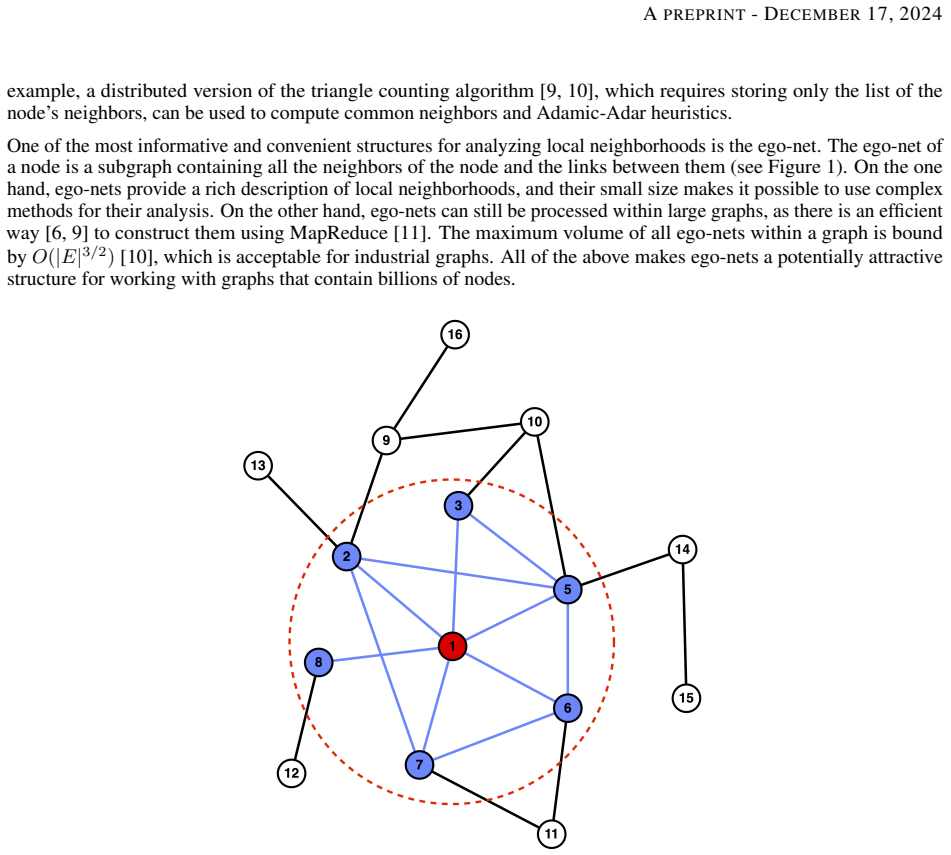
The central discovery is that graph-level link prediction inside ego-nets, treated as an independent supervised task on heterogeneous, dynamic, featureless graphs, is learnable by a second-order GNN that propagates pairwise states through edge-specific linear filters, and that aggregating these local scores across common neighbors produces better friend suggestions than the deployed heuristic. The paper states this as the Generalized Ego-network Friendship Score framework: an in-ego model maps an ego-net to a pairwise relevance matrix, and an out-ego aggregation (sum or max) combines scores for pairs appearing in several ego-nets. WalkGNN instantiates the in-ego model: each WalkConv layer updates the $[n \times n \times d]$ state tensor as $W^{u,v}_{k+1} = \frac{1}{d} \sum_{(t,v,e) \in E} W^{u,t}_{k} \times \mathrm{EdgeMLP}_k(e)$, turning every typed, timestamped edge into a linear filter on the propagated relationship state. The paper reports that this outperforms Adamic-Adar, GIN, and PPGN on Ego-VK and on the adapted Yeast dataset, and that the online A/B test shows a 12% increase in friend-request CTR against the production friendship-score baseline.
Load-bearing premise
The evaluation assumes that randomly dividing ego-nets into training, validation, and test sets prevents information leakage, even though in a real social graph ego-nets overlap heavily and the paper does not filter overlapping nodes across splits or measure how similar train and test ego-nets are.
Editorial extensions
If this is right
- On Ego-VK, WalkGNN with edge attributes reaches ndcg@5 = 0.090 ± 0.004, a 20% relative improvement over the best baseline (PPGN at 0.075 ± 0.004), and a 156% improvement over its own edge-attribute-free version.
- The framework makes complex supervised models deployable at industrial scale: all phases fit the MapReduce paradigm, and the production pipeline on VK runs daily on the full user graph in about 10 hours on 3k cores and 3TB RAM.
- A live A/B test on the VK People You May Know block reports a 12% increase in friend-request CTR relative to a production friendship-score baseline.
- Because the in-ego model learns from topology rather than node identities, the same trained model transfers to graphs outside the social domain; on the adapted Yeast dataset it reaches ndcg@5 = 0.720 versus 0.642 for PPGN.
- Edge attributes carry most of the information: ablating them drops Ego-VK accuracy by more than 50% (from 0.090 to 0.051), while removing node features costs little (0.090 to 0.086).
Reading between the lines
- The framework is not tied to friendship: any large graph whose edges carry typed, timestamped attributes and where local neighborhoods are informative could use the same in-ego/out-ego decomposition, so the method suggests a template for supervised link prediction on billion-edge graphs in other domains.
- The strongest offline results depend on the assumption that randomly split ego-nets do not leak; a natural robustness check is to re-run Ego-VK with a split that removes any test ego-net sharing nodes with training ego-nets, and if the gap narrows, part of the reported gain would be attributed to memorization rather than learned link-formation laws.
- The 12% online CTR gain is a business metric, not a direct measure of friendship precision; a follow-up could examine whether the model increases accepted suggestions and long-term retention, which would test whether the learned relevance scores align with genuine link formation.
- WalkGNN's O(n^3 d^2) per-layer cost is a natural bottleneck; future versions could sparsify the dense state tensor or use neighborhood sampling to push the same idea to even larger ego-nets, though the paper already caps ego-nets at 300 nodes.
Editorial analysis
A structured set of objections, weighed in public.
Referee Report
Summary. The paper proposes the Generalized Ego-network Friendship Score (GEFS) framework, which reduces link prediction on a large social graph to a series of per-ego-net tasks followed by an aggregation step, and introduces WalkGNN, a second-order GNN whose WalkConv layers propagate pairwise node-state matrices through edge-attribute-dependent filters. The authors also release Ego-VK, a dataset of VK ego-nets with heterogeneous temporal edge attributes, and report offline experiments showing WalkGNN outperforming heuristics and GNN baselines on Ego-VK and Yeast, together with a live A/B test at VK reporting a 12% increase in friend-request CTR. The central claims are that the framework is scalable, that WalkGNN learns link-formation laws from structure alone, and that the proposed model improves a deployed recommender system.
Significance. If the offline result is unbiased, the paper makes a useful industrial contribution: a scalable recipe for applying supervised graph-level models to friend suggestion, a new architecture that handles heterogeneous, dynamic, featureless graphs without node identifiers, and a publicly available benchmark dataset. The code and dataset are open-sourced, which is a concrete strength. However, the offline evaluation rests on an untreated potential information-leakage problem: ego-nets drawn from the same underlying social graph are not statistically independent under a random split, so the reported margin over PPGN (0.090 ± 0.004 vs 0.075 ± 0.004) may be inflated. The no-attribute comparison (0.035 vs 0.034) is well within the confidence intervals, and the online A/B report lacks the statistical detail needed to independently corroborate the headline claim. The framework and model remain plausible and worth publishing, but the current evidence does not yet establish that WalkGNN outperforms all baselines.
major comments (3)
- [Section 4.1, Dataset] The paper asserts that 'all ego-nets are completely independent' because node IDs are ordinal per ego-net. This is not a valid statistical independence argument: ego-nets of the same VK graph overlap in users and edges, and a random split can place structurally near-identical ego-nets in both training and test sets. The model could then memorize common local motifs rather than learn transferable link-formation laws, and the reported 20% relative gain over PPGN would be optimistically biased. Please quantify the overlap between ego-nets across the train/test boundary (e.g., fraction of shared nodes or shared candidate pairs), or re-run the evaluation with a node-disjoint or time-disjoint split, or otherwise provide evidence that the architecture does not exploit cross-split similarity.
- [Section 4.1, Table 2 and Results] The claim that WalkGNN 'outperforms the next-best solution by 20% and 3%' is not supported by the reported numbers in the no-attribute condition: WalkGNN achieves 0.035 ± 0.003 and PPGN 0.034 ± 0.003, so the 3% difference lies entirely within the confidence intervals and is not a statistically meaningful improvement. Please provide paired significance tests or error bars that account for paired ego-nets, and restrict the overstatement to the edge-attribute setting where a clear separation exists (0.090 ± 0.004 vs 0.075 ± 0.004).
- [Section 4.2, Online Experiments] The online experiment reports a single point estimate of a 12% increase in friend-request CTR, with no confidence interval, significance test, number of users per arm, experiment duration, or description of how the audience was split. Given that the abstract cites the A/B test as evidence of 'growth of business metrics', the manuscript should at least provide a standard error or p-value and state whether the 12% was the sole pre-registered metric. Without this information, the online result cannot independently carry the paper's central claim.
minor comments (5)
- [Algorithm 1] The variable name 'BloomF itler' contains a typo; it should be 'BloomFilter'.
- [Section 4.1, Dataset] The sentence 'Each type of edge have numerical characteristic' has a subject-verb agreement issue; it should be 'Each type of edge has a numerical characteristic'.
- [Section 4.1, Dataset] The relation between node features and edge attributes is stated twice in slightly different ways: first 'Natural node attributes are not used', then 'As attributes of nodes, we use attributes of edges with ego node in forward and backward directions'. Please clarify once and reconcile the two statements.
- [Section 4.1, Table 2] The column header 'EGO-VK- NO-ATTR' contains an awkward spacing/hyphenation; it would be clearer as 'EGO-VK (no attrs)'.
- [Section 4.3, Ablation Study] The ablation table does not report the no-attribute result for the same configuration as the base model? Specifically, 'WALK GNN-NO-E-ATTR' uses 6 blocks, which is fine, but the earlier no-attribute WalkGNN result in Table 2 (0.035 ± 0.003) differs from the ablation no-attribute result (0.051 ± 0.003). Please explain this discrepancy, since the same configuration should yield the same number unless hyperparameters or preprocessing differ.
Circularity Check
No significant circularity: the paper's claims are empirical and the model is evaluated against external and held-out data.
full rationale
The paper does not derive any prediction from a fitted quantity relabeled as a result. WalkGNN's architecture is presented as an explicit transition rule (Eq. 1) inspired by walk counting, and its parameters are learned from training ego-nets and evaluated on a held-out test split; the Ego-VK dataset is introduced by the authors, but the evaluation is not definitionally tied to the model. The Yeast dataset provides an external benchmark on which WalkGNN also outperforms baselines, and the online A/B test compares against a production system, giving an independent (if briefly reported) check. The only self-reference is the author's own code/dataset repository and a self-authored Node2Vec implementation, neither of which is load-bearing for the central claim. The concern about overlapping ego-nets in the random split is a threat to external validity, not a circularity of the kind where an input equals an output by construction. No equation or cited result in the paper reduces the claimed ndcg@5 or CTR improvement to its own assumptions.
Assumptions & free parameters
free parameters (7)
- number_of_walkconv_layers =
6
- hidden_units_d =
8
- mlp_hidden_units =
32
- mlp_layers =
4
- time_feature_transform_constant =
28
- ego_net_size_cap =
300
- out_ego_aggregation =
sum or max (unspecified)
assumptions (4)
- domain assumption Local ego-net context is sufficient to predict friendship formation.
- domain assumption Random split of ego-nets yields independent train, validation, and test sets despite node overlap.
- domain assumption Friendships formed on the next day are a valid label for friend-suggestion quality.
- ad hoc to paper The transform 28/(t+1) captures the temporal relevance of edge features.
Cite this review
Pith. "Pith review of GNN Applied to Ego-nets for Friend Suggestions." pith.science (2026). https://pith.science/paper/X3UCBTIQ
@misc{pith2026241211888,
  author       = {Pith},
  title        = {Pith review of: GNN Applied to Ego-nets for Friend Suggestions},
  year         = {2026},
  howpublished = {\url{https://pith.science/paper/X3UCBTIQ}},
  note         = {Machine review of arXiv:2412.11888}
}
read the original abstract
A major problem of making friend suggestions in social networks is the large size of social graphs, which can have hundreds of millions of people and tens of billions of connections. Classic methods based on heuristics or factorizations are often used to address the difficulties of scaling more complex models. However, the unsupervised nature of these methods can lead to suboptimal results. In this work, we introduce the Generalized Ego-network Friendship Score framework, which makes it possible to use complex supervised models without sacrificing scalability. The main principle of the framework is to reduce the problem of link prediction on a full graph to a series of low-scale tasks on ego-nets with subsequent aggregation of their results. Here, the underlying model takes an ego-net as input and produces a pairwise relevance matrix for its nodes. In addition, we develop the WalkGNN model which is capable of working effectively in the social network domain, where these graph-level link prediction tasks are heterogeneous, dynamic and featureless. To measure the accuracy of this model, we introduce the Ego-VK dataset that serves as an exact representation of the real-world problem that we are addressing. Offline experiments on the dataset show that our model outperforms all baseline methods, and a live A/B test demonstrates the growth of business metrics as a result of utilizing our approach.
Figures

Reference graph
Works this paper leans on
-
[1]
Graph Neural Networks: a bibliometrics overview
Abdalsamad Keramatfar, Mohadeseh Rafiee, and Hossein Amirkhani. Graph neural networks: a bibliometrics overview. CoRR, abs/2201.01188, 2022
work page Pith review arXiv 2022
-
[2]
Computing Graph Neural Networks: A Survey from Algorithms to Accelerators
Sergi Abadal, Akshay Jain, Robert Guirado, Jorge López-Alonso, and Eduard Alarcón. Computing graph neural networks: A survey from algorithms to accelerators. CoRR, abs/2010.00130, 2020
work page Pith review arXiv 2010
-
[3]
Lada A. Adamic and Eytan Adar. Friends and neighbors on the web. Soc. Networks, 25(3):211–230, 2003
work page 2003
-
[4]
Albert, r.: Emergence of scaling in random networks
Albert-Laszlo Barabasi and Rita Albert. Albert, r.: Emergence of scaling in random networks. science 286, 509-512. Science (New York, N.Y.), 286:509–12, 11 1999
work page 1999
-
[5]
Link prediction based on graph neural networks
Muhan Zhang and Yixin Chen. Link prediction based on graph neural networks. In Samy Bengio, Hanna M. Wallach, Hugo Larochelle, Kristen Grauman, Nicolò Cesa-Bianchi, and Roman Garnett, editors, Advances in Neural Information Processing Systems 31: Annual Conference on Neural Information Processing Systems 2018, NeurIPS 2018, December 3-8, 2018, Montréal, C...
work page 2018
-
[6]
Mirrokni, Ismail Sebe, Ahmed Taei, and Sunita Verma
Alessandro Epasto, Silvio Lattanzi, Vahab S. Mirrokni, Ismail Sebe, Ahmed Taei, and Sunita Verma. Ego-net community mining applied to friend suggestion. Proc. VLDB Endow., 9(4):324–335, 2015
work page 2015
-
[7]
Deepwalk: online learning of social representations
Bryan Perozzi, Rami Al-Rfou, and Steven Skiena. Deepwalk: online learning of social representations. In Sofus A. Macskassy, Claudia Perlich, Jure Leskovec, Wei Wang, and Rayid Ghani, editors, The 20th ACM SIGKDD International Conference on Knowledge Discovery and Data Mining, KDD ’14, New York, NY, USA - August 24 - 27, 2014, pages 701–710. ACM, 2014
work page 2014
-
[8]
Zhaocheng Zhu, Zuobai Zhang, Louis-Pascal A. C. Xhonneux, and Jian Tang. Neural bellman-ford networks: A general graph neural network framework for link prediction. In Marc’Aurelio Ranzato, Alina Beygelzimer, Yann N. Dauphin, Percy Liang, and Jennifer Wortman Vaughan, editors, Advances in Neural Information Processing Systems 34: Annual Conference on Neur...
work page 2021
Show all 49 references
-
[9]
Counting triangles and the curse of the last reducer
Siddharth Suri and Sergei Vassilvitskii. Counting triangles and the curse of the last reducer. In Sadagopan Srini- vasan, Krithi Ramamritham, Arun Kumar, M. P. Ravindra, Elisa Bertino, and Ravi Kumar, editors,Proceedings of the 20th International Conference on World Wide Web, ...
2011
-
[10]
Algorithmic Aspects of Triangle-Based Network Analysis
Thomas Schank. Algorithmic Aspects of Triangle-Based Network Analysis. PhD thesis, Institut für Theoretische Informatik, 2007
2007
-
[11]
Mapreduce: simplified data processing on large clusters
Jeffrey Dean and Sanjay Ghemawat. Mapreduce: simplified data processing on large clusters. Commun. ACM, 51(1):107–113, 2008
2008
-
[12]
A fair comparison of graph neural networks for graph classification
Federico Errica, Marco Podda, Davide Bacciu, and Alessio Micheli. A fair comparison of graph neural networks for graph classification. In 8th International Conference on Learning Representations, ICLR 2020, Addis Ababa, Ethiopia, April 26-30, 2020. OpenReview.net, 2020
2020
-
[13]
Predicting missing links via local information
Tao Zhou, Linyuan Lü, and Yi-Cheng Zhang. Predicting missing links via local information. The European Physical Journal B - Condensed Matter and Complex Systems, 71:623–630, 10 2009
2009
-
[14]
Link prediction of social networks based on weighted proximity measures
Tsuyoshi Murata and Sakiko Moriyasu. Link prediction of social networks based on weighted proximity measures. In 2007 IEEE / WIC / ACM International Conference on Web Intelligence, WI 2007, 2-5 November 2007, Silicon Valley, CA, USA, Main Conference Proceedings, pages 85–88. I...
2007
-
[15]
Link prediction in weighted networks: The role of weak ties
Linyuan Lü and Tao Zhou. Link prediction in weighted networks: The role of weak ties. Europhysics Letters, 89(1):18001, 2010
2010
-
[16]
node2vec: Scalable feature learning for networks
Aditya Grover and Jure Leskovec. node2vec: Scalable feature learning for networks. In Balaji Krishnapuram, Mohak Shah, Alexander J. Smola, Charu C. Aggarwal, Dou Shen, and Rajeev Rastogi, editors, Proceedings of the 22nd ACM SIGKDD International Conference on Knowledge Discove...
2016
-
[17]
LINE: large-scale information network embedding
Jian Tang, Meng Qu, Mingzhe Wang, Ming Zhang, Jun Yan, and Qiaozhu Mei. LINE: large-scale information network embedding. In Aldo Gangemi, Stefano Leonardi, and Alessandro Panconesi, editors, Proceedings of the 24th International Conference on World Wide Web, WWW 2015, Florence...
2015
-
[18]
Rossi, Nesreen K
Giang Hoang Nguyen, John Boaz Lee, Ryan A. Rossi, Nesreen K. Ahmed, Eunyee Koh, and Sungchul Kim. Continuous-time dynamic network embeddings. In Pierre-Antoine Champin, Fabien Gandon, Mounia Lalmas, and Panagiotis G. Ipeirotis, editors, Companion of the The Web Conference 2018...
2018
-
[19]
Translating embeddings for modeling multi-relational data
Antoine Bordes, Nicolas Usunier, Alberto García-Durán, Jason Weston, and Oksana Yakhnenko. Translating embeddings for modeling multi-relational data. In Christopher J. C. Burges, Léon Bottou, Zoubin Ghahramani, and Kilian Q. Weinberger, editors,Advances in Neural Information P...
2013
-
[20]
Rotate: Knowledge graph embedding by relational rotation in complex space
Zhiqing Sun, Zhi-Hong Deng, Jian-Yun Nie, and Jian Tang. Rotate: Knowledge graph embedding by relational rotation in complex space. In 7th International Conference on Learning Representations, ICLR 2019, New Orleans, LA, USA, May 6-9, 2019. OpenReview.net, 2019
2019
-
[21]
Embedding entities and relations for learning and inference in knowledge bases
Bishan Yang, Wen-tau Yih, Xiaodong He, Jianfeng Gao, and Li Deng. Embedding entities and relations for learning and inference in knowledge bases. In Yoshua Bengio and Yann LeCun, editors, 3rd International Conference on Learning Representations, ICLR 2015, San Diego, CA, USA, ...
2015
-
[22]
Simple embedding for link prediction in knowledge graphs
Seyed Mehran Kazemi and David Poole. Simple embedding for link prediction in knowledge graphs. In Samy Bengio, Hanna M. Wallach, Hugo Larochelle, Kristen Grauman, Nicolò Cesa-Bianchi, and Roman Garnett, editors, Advances in Neural Information Processing Systems 31: Annual Conf...
2018
-
[23]
Schoenholz, Patrick F
Justin Gilmer, Samuel S. Schoenholz, Patrick F. Riley, Oriol Vinyals, and George E. Dahl. Neural message passing for quantum chemistry. In Doina Precup and Yee Whye Teh, editors,Proceedings of the 34th International Conference on Machine Learning, ICML 2017, Sydney, NSW, Austr...
2017
-
[24]
Hamilton, Zhitao Ying, and Jure Leskovec
William L. Hamilton, Zhitao Ying, and Jure Leskovec. Inductive representation learning on large graphs. In Isabelle Guyon, Ulrike von Luxburg, Samy Bengio, Hanna M. Wallach, Rob Fergus, S. V . N. Vishwanathan, and Roman Garnett, editors, Advances in Neural Information Processi...
2017
-
[25]
Inductive representation learning on temporal graphs
Da Xu, Chuanwei Ruan, Evren Körpeoglu, Sushant Kumar, and Kannan Achan. Inductive representation learning on temporal graphs. In 8th International Conference on Learning Representations, ICLR 2020, Addis Ababa, Ethiopia, April 26-30, 2020. OpenReview.net, 2020
2020
-
[26]
Graph attention networks
Petar Velickovic, Guillem Cucurull, Arantxa Casanova, Adriana Romero, Pietro Liò, and Yoshua Bengio. Graph attention networks. In 6th International Conference on Learning Representations, ICLR 2018, Vancouver, BC, Canada, April 30 - May 3, 2018, Conference Track Proceedings. O...
2018
-
[27]
Kipf and Max Welling
Thomas N. Kipf and Max Welling. Semi-supervised classification with graph convolutional networks. In 5th International Conference on Learning Representations, ICLR 2017, Toulon, France, April 24-26, 2017, Conference Track Proceedings. OpenReview.net, 2017
2017
-
[28]
How powerful are graph neural networks? In 7th International Conference on Learning Representations, ICLR 2019, New Orleans, LA, USA, May 6-9, 2019
Keyulu Xu, Weihua Hu, Jure Leskovec, and Stefanie Jegelka. How powerful are graph neural networks? In 7th International Conference on Learning Representations, ICLR 2019, New Orleans, LA, USA, May 6-9, 2019. OpenReview.net, 2019
2019
-
[29]
Hamilton, Jan Eric Lenssen, Gaurav Rattan, and Martin Grohe
Christopher Morris, Martin Ritzert, Matthias Fey, William L. Hamilton, Jan Eric Lenssen, Gaurav Rattan, and Martin Grohe. Weisfeiler and leman go neural: Higher-order graph neural networks. In The Thirty-Third AAAI Conference on Artificial Intelligence, AAAI 2019, The Thirty-F...
2019
-
[30]
Understanding the representation power of graph neural networks in learning graph topology
Nima Dehmamy, Albert-László Barabási, and Rose Yu. Understanding the representation power of graph neural networks in learning graph topology. In Hanna M. Wallach, Hugo Larochelle, Alina Beygelzimer, Florence d’Alché-Buc, Emily B. Fox, and Roman Garnett, editors, Advances in N...
2019
-
[31]
On node features for graph neural networks
Chi Thang Duong, Thanh Dat Hoang, Ha The Hien Dang, Quoc Viet Hung Nguyen, and Karl Aberer. On node features for graph neural networks. CoRR, abs/1911.08795, 2019
1911 arXiv
-
[32]
Protein interface prediction using graph convolutional networks
Alex Fout, Jonathon Byrd, Basir Shariat, and Asa Ben-Hur. Protein interface prediction using graph convolutional networks. In Isabelle Guyon, Ulrike von Luxburg, Samy Bengio, Hanna M. Wallach, Rob Fergus, S. V . N. Vishwanathan, and Roman Garnett, editors, Advances in Neural I...
2017
-
[33]
A review of relational machine learning for knowledge graphs
Maximilian Nickel, Kevin Murphy, V olker Tresp, and Evgeniy Gabrilovich. A review of relational machine learning for knowledge graphs. Proc. IEEE, 104(1):11–33, 2016
2016
-
[34]
The surprising power of graph neural networks with random node initialization
Ralph Abboud, ˙Ismail ˙Ilkan Ceylan, Martin Grohe, and Thomas Lukasiewicz. The surprising power of graph neural networks with random node initialization. In Zhi-Hua Zhou, editor, Proceedings of the Thirtieth International Joint Conference on Artificial Intelligence, IJCAI 2021...
2021
-
[35]
Random features strengthen graph neural networks
Ryoma Sato, Makoto Yamada, and Hisashi Kashima. Random features strengthen graph neural networks. In Carlotta Demeniconi and Ian Davidson, editors, Proceedings of the 2021 SIAM International Conference on Data Mining, SDM 2021, Virtual Event, April 29 - May 1, 2021, pages 333–...
2021
-
[36]
Nature vs
Duong Chi Thang, Thanh Dat Hoang, Thanh Tam Nguyen, Jun Jo, Nguyen Quoc Viet Hung, and Karl Aberer. Nature vs. nurture: Feature vs. structure for graph neural networks. Pattern Recognit. Lett., 159:46–53, 2022
2022
-
[37]
On positional and structural node features for graph neural networks on non-attributed graphs
Hejie Cui, Zijie Lu, Pan Li, and Carl Yang. On positional and structural node features for graph neural networks on non-attributed graphs. In Mohammad Al Hasan and Li Xiong, editors, Proceedings of the 31st ACM International 11 A PREPRINT - D ECEMBER 17, 2024 Conference on Inf...
2024
-
[38]
Identity-aware graph neural networks
Jiaxuan You, Jonathan Michael Gomes Selman, Rex Ying, and Jure Leskovec. Identity-aware graph neural networks. In Thirty-Fifth AAAI Conference on Artificial Intelligence, AAAI 2021, Thirty-Third Conference on Innovative Applications of Artificial Intelligence, IAAI 2021, The E...
2021
-
[39]
The expressive power of graph neural networks
Pan Li and Jure Leskovec. The expressive power of graph neural networks. In Lingfei Wu, Peng Cui, Jian Pei, and Liang Zhao, editors, Graph Neural Networks: Foundations, Frontiers, and Applications, pages 63–98. Springer Singapore, Singapore, 2022
2022
-
[40]
A reduction of a graph to a canonical form and an algebra arising during this reduction
AA Leman and Boris Weisfeiler. A reduction of a graph to a canonical form and an algebra arising during this reduction. Nauchno-Technicheskaya Informatsiya, 2(9):12–16, 1968
1968
-
[41]
Pande, and Jure Leskovec
Weihua Hu, Bowen Liu, Joseph Gomes, Marinka Zitnik, Percy Liang, Vijay S. Pande, and Jure Leskovec. Strategies for pre-training graph neural networks. In 8th International Conference on Learning Representations, ICLR 2020, Addis Ababa, Ethiopia, April 26-30, 2020. OpenReview.net, 2020
2020
-
[42]
Graph convolutions that can finally model local structure.CoRR, abs/2011.15069, 2020
Rémy Brossard, Oriel Frigo, and David Dehaene. Graph convolutions that can finally model local structure.CoRR, abs/2011.15069, 2020
2011 arXiv
-
[43]
Invariant and equivariant graph networks
Haggai Maron, Heli Ben-Hamu, Nadav Shamir, and Yaron Lipman. Invariant and equivariant graph networks. CoRR, abs/1812.09902, 2018
2018 arXiv
-
[44]
Provably powerful graph networks
Haggai Maron, Heli Ben-Hamu, Hadar Serviansky, and Yaron Lipman. Provably powerful graph networks. In Hanna M. Wallach, Hugo Larochelle, Alina Beygelzimer, Florence d’Alché-Buc, Emily B. Fox, and Roman Gar- nett, editors, Advances in Neural Information Processing Systems 32: A...
2019
-
[45]
Burton H. Bloom. Space/time trade-offs in hash coding with allowable errors. Commun. ACM, 13(7):422–426, 1970
1970
-
[46]
Xifeng Yan, Hong Cheng, Jiawei Han, and Philip S. Yu. Mining significant graph patterns by leap search. In Jason Tsong-Li Wang, editor,Proceedings of the ACM SIGMOD International Conference on Management of Data, SIGMOD 2008, Vancouver, BC, Canada, June 10-12, 2008, pages 433–...
2008
-
[47]
Kriege, Franka Bause, Kristian Kersting, Petra Mutzel, and Marion Neumann
Christopher Morris, Nils M. Kriege, Franka Bause, Kristian Kersting, Petra Mutzel, and Marion Neumann. Tudataset: A collection of benchmark datasets for learning with graphs. In ICML 2020 Workshop on Graph Representation Learning and Beyond (GRL+ 2020), 2020
2020
-
[48]
Christopher J. C. Burges, Tal Shaked, Erin Renshaw, Ari Lazier, Matt Deeds, Nicole Hamilton, and Gregory N. Hullender. Learning to rank using gradient descent. In Luc De Raedt and Stefan Wrobel, editors, Machine Learning, Proceedings of the Twenty-Second International Conferen...
2005
-
[49]
The hadoop distributed file system
Konstantin Shvachko, Hairong Kuang, Sanjay Radia, and Robert Chansler. The hadoop distributed file system. In Mohammed G. Khatib, Xubin He, and Michael Factor, editors, IEEE 26th Symposium on Mass Storage Systems and Technologies, MSST 2012, Lake Tahoe, Nevada, USA, May 3-7, 2...
2012
Reviewed August 11, 2026 · model on record in the stance chip above.
Discussion (0). Continue with ORCID to comment.