Analysis on hadron spectra in heavy-ion collisions with a new non-extensive approach
Pith reviewed 2026-05-25 11:29 UTC · model grok-4.3
The pith
The Kaniadakis κ-distribution fits hadron pT spectra in heavy-ion collisions better than Boltzmann-Gibbs.
A machine-rendered reading of the paper's core claim, the machinery that carries it, and where it could break.
Core claim
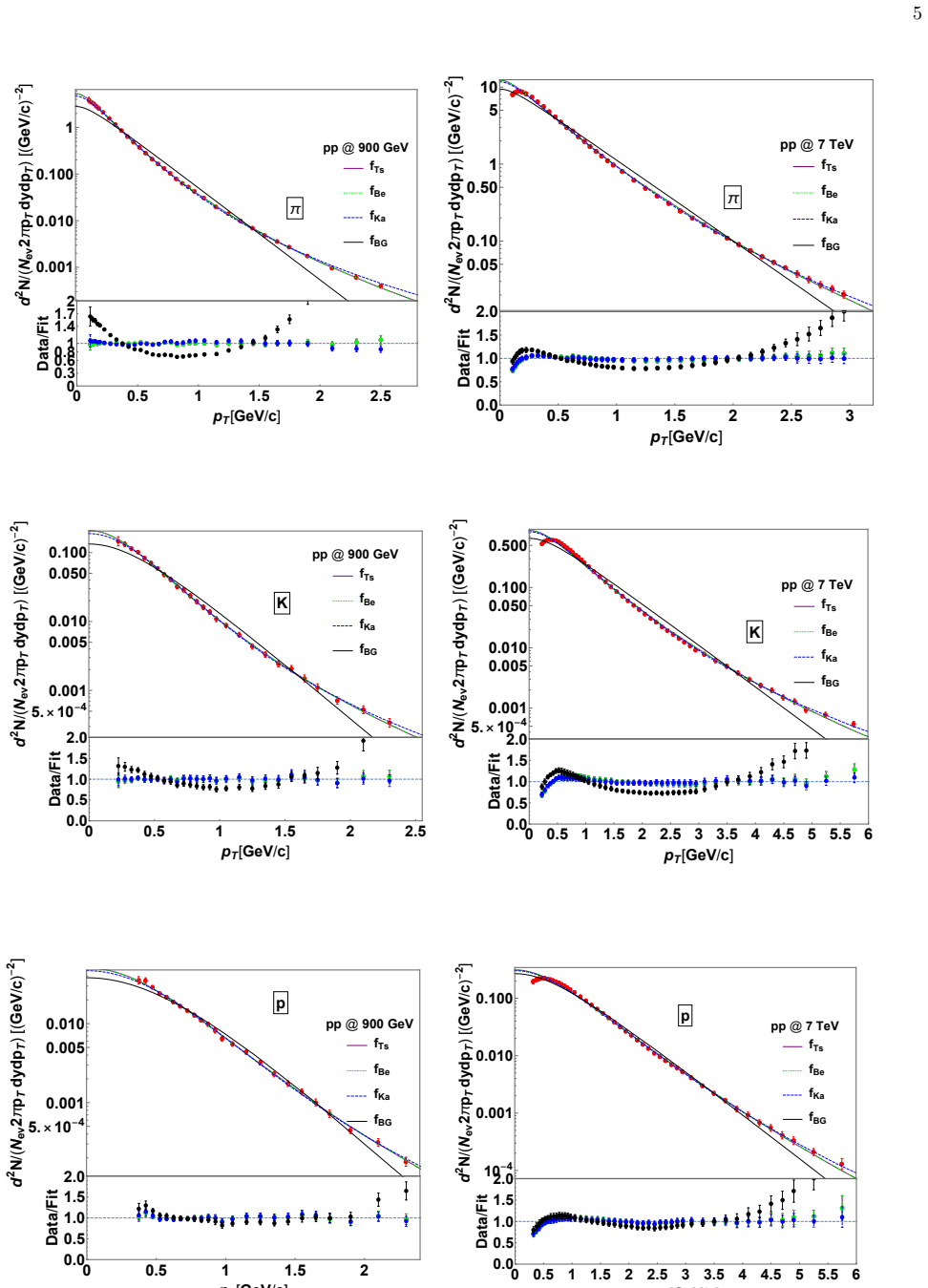
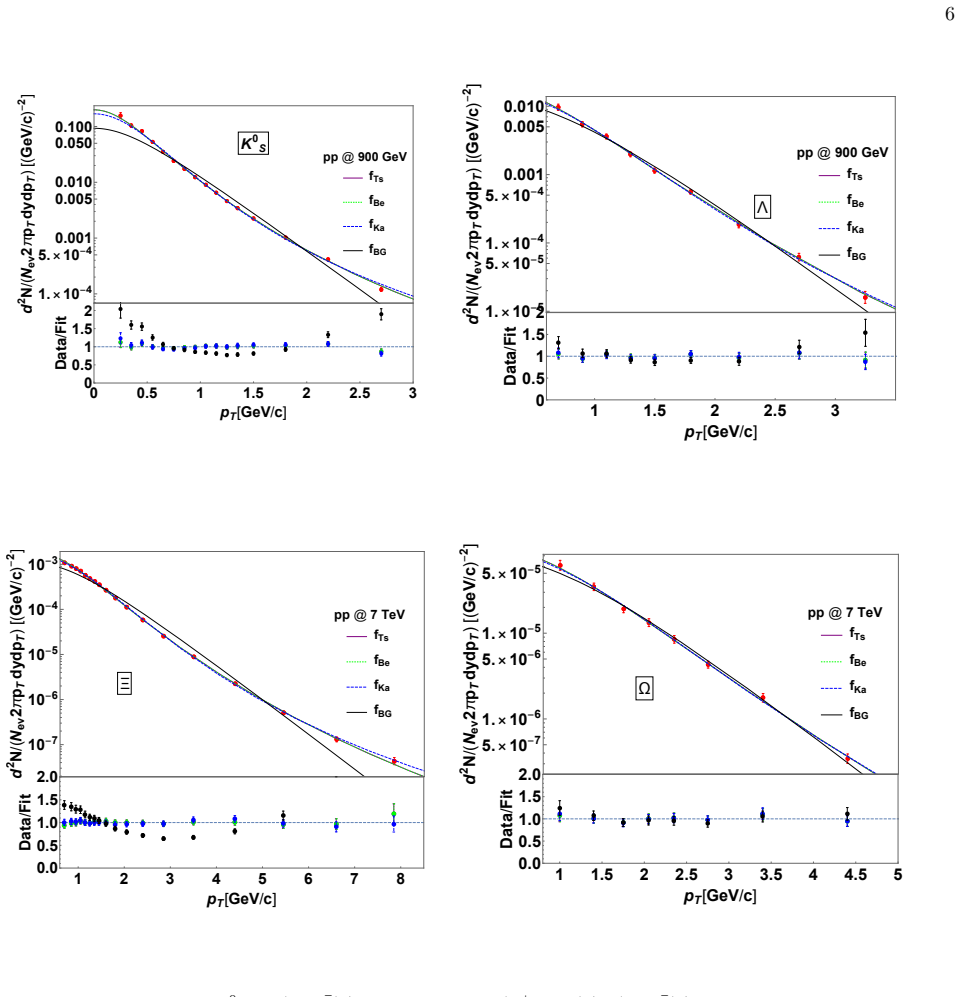
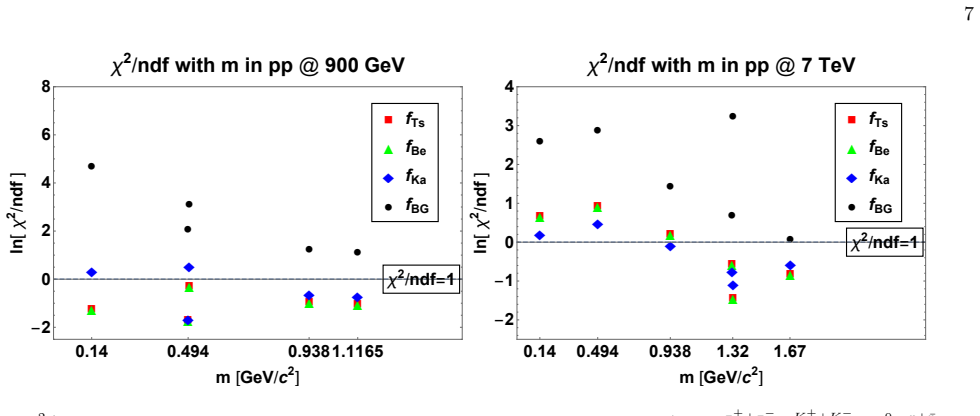
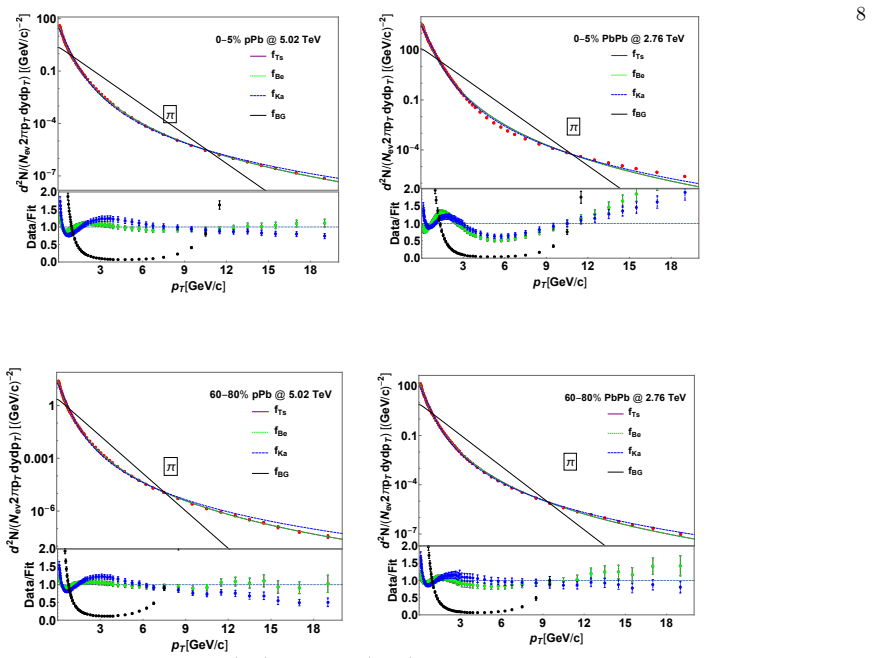
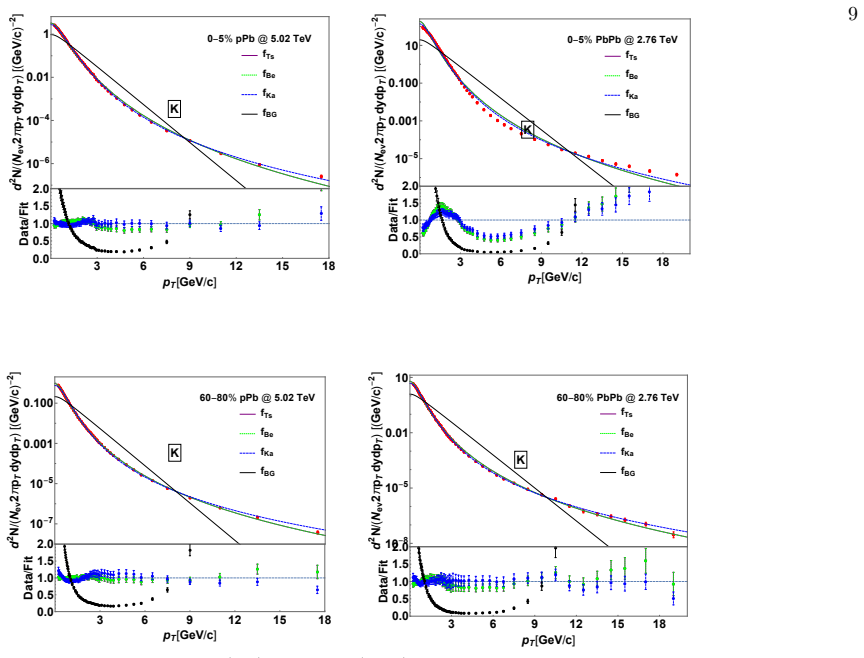
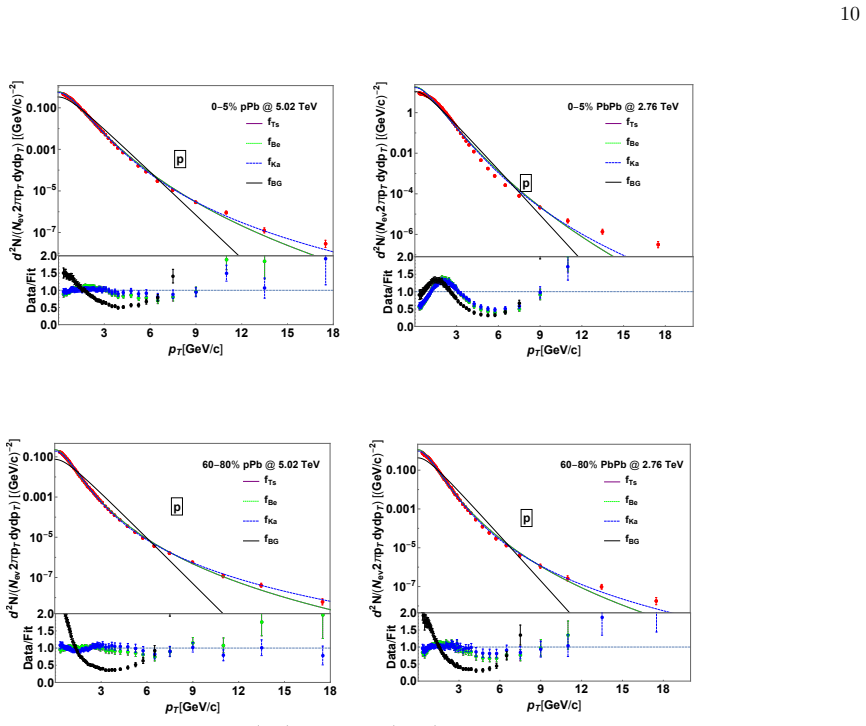
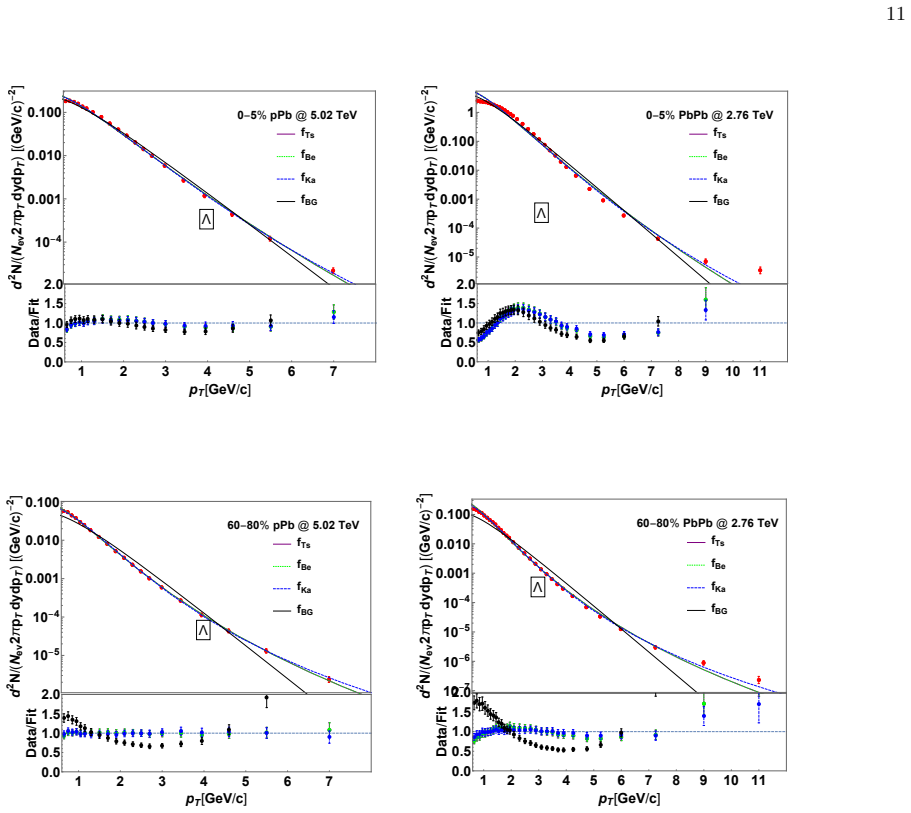
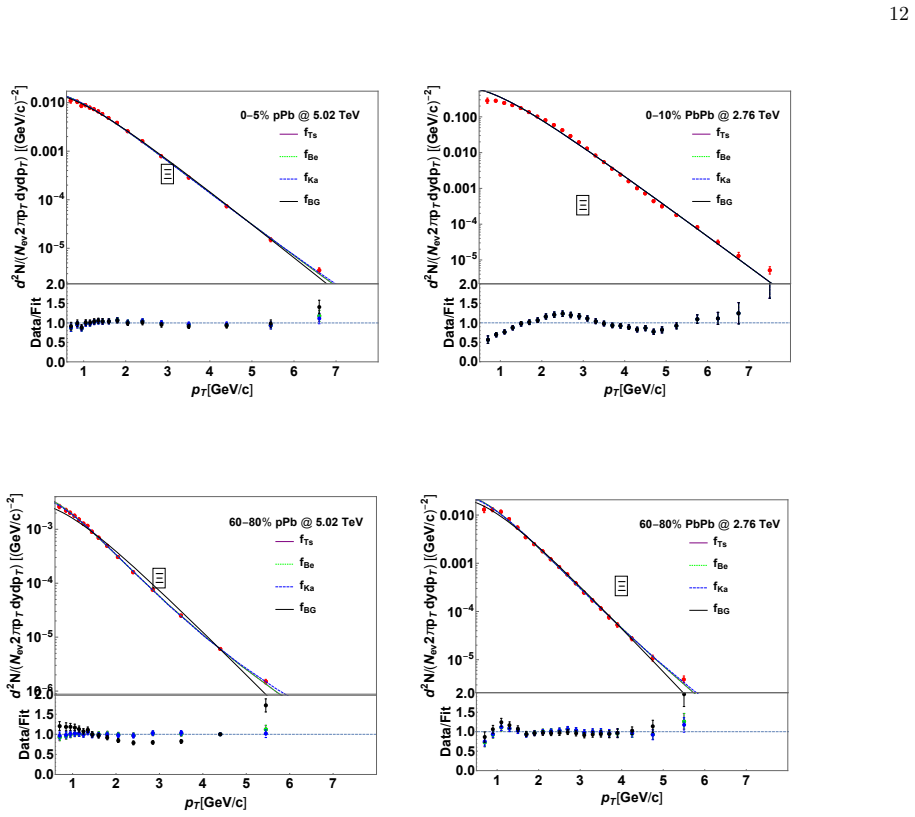
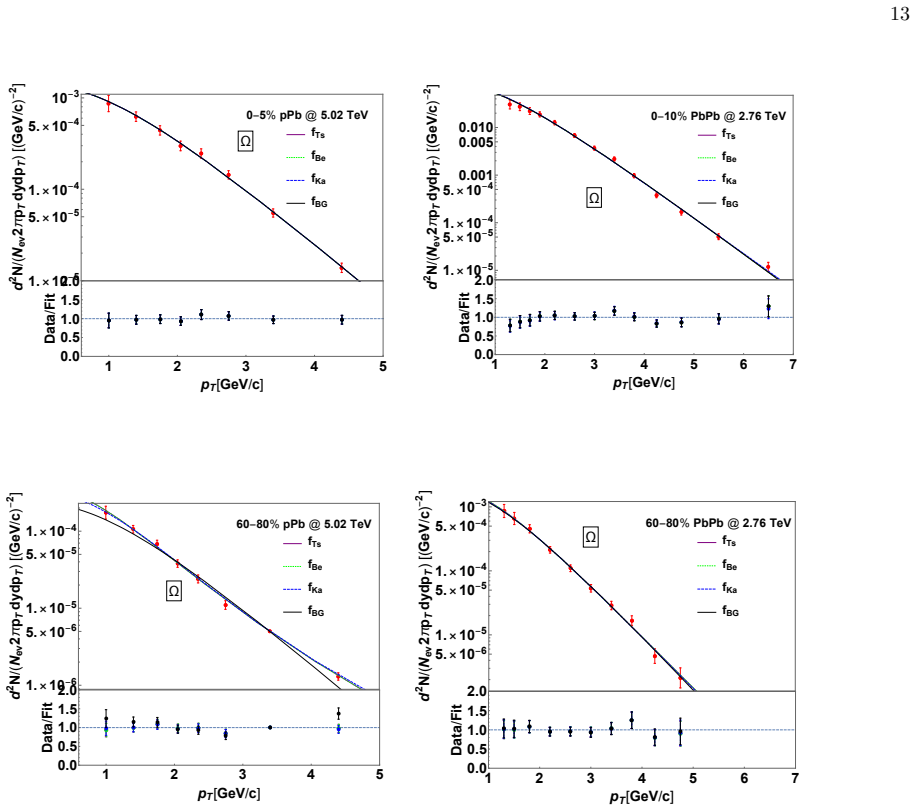
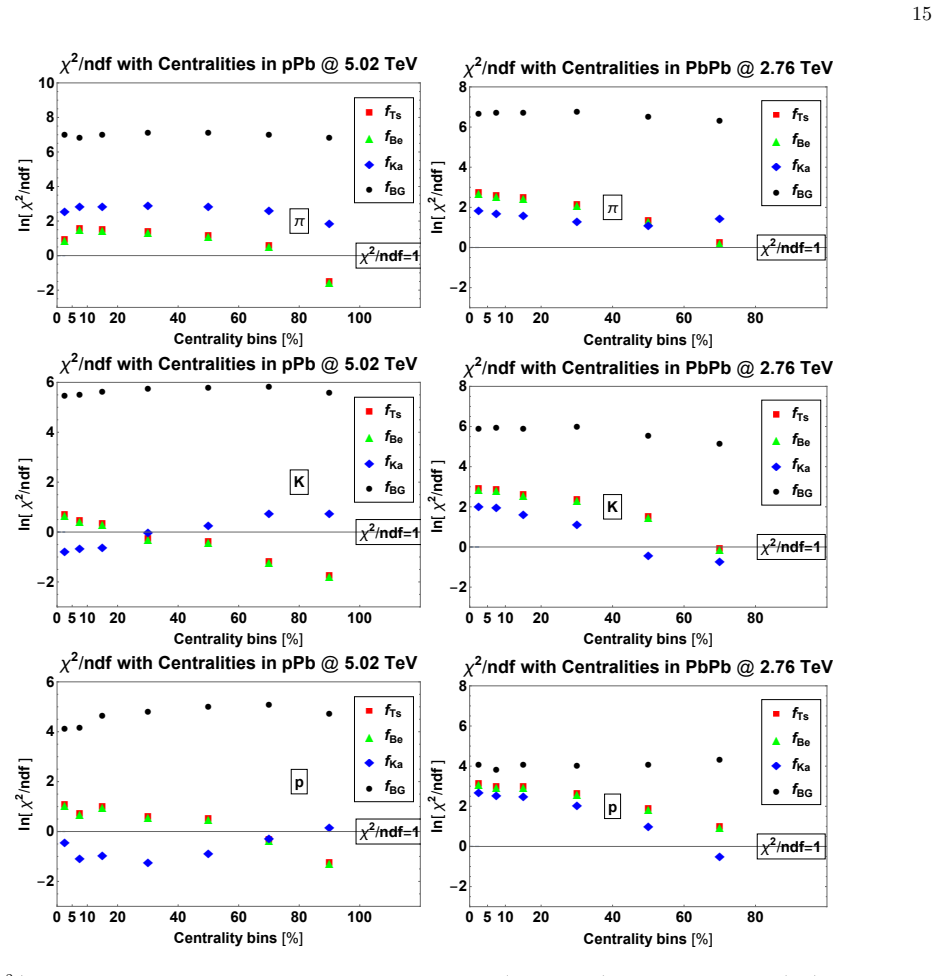
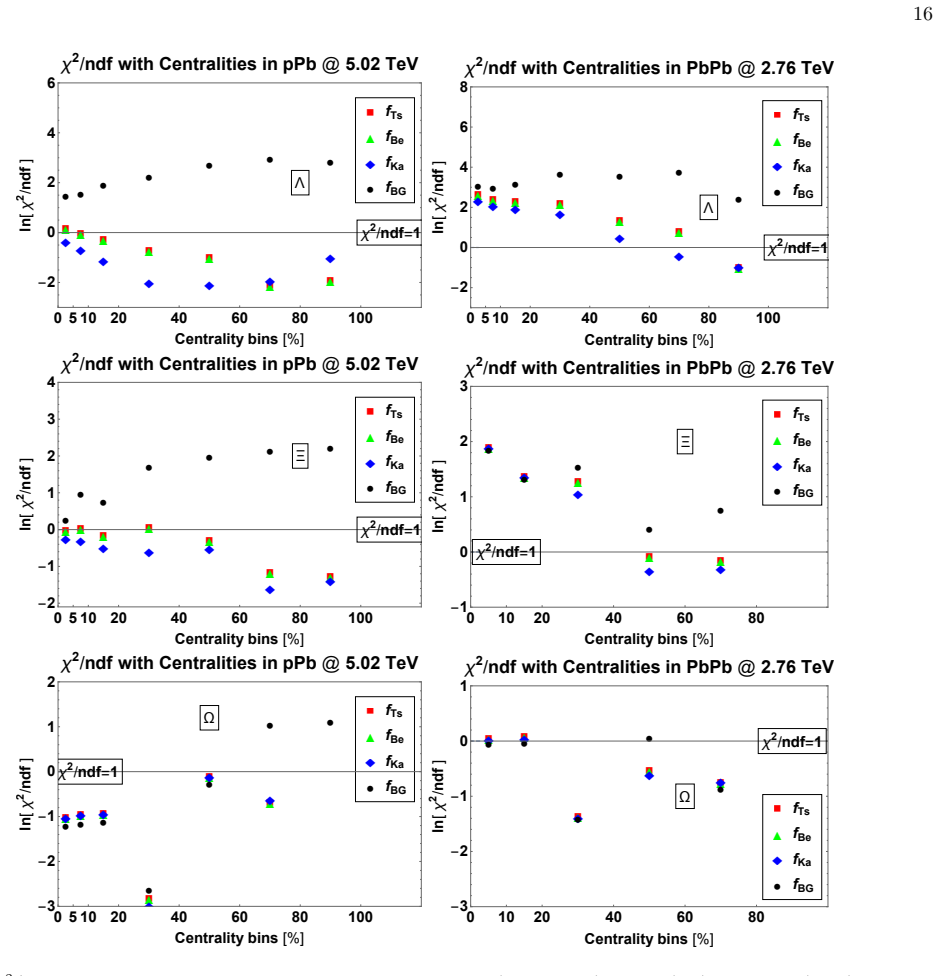
The transverse momentum spectra of identified charged hadrons stemming from high energy collisions at different beam energies are described by the Kaniadakis κ-distribution with respect to the constraints in non-extensive quantum statistics. All fittings are also compared with the Tsallis distributions as well as the usual Boltzmann-Gibbs one. χ²/ndf is also used to test the fitting goodness of all functions. Our results show that these different non-extensive approaches can be well applied in high energy collisions rather than the classical one. The Kaniadakis statistics is typically better applied into such systems with both positive and negative particles considered.
What carries the argument
The Kaniadakis κ-distribution, a non-extensive statistical form that incorporates a deformation parameter κ under quantum-statistical constraints and is fitted directly to the observed pT spectra.
If this is right
- Non-extensive distributions describe hadron pT spectra in heavy-ion collisions better than the classical Boltzmann-Gibbs distribution.
- The Kaniadakis form outperforms Tsallis when both positive and negative particles are included in the analysis.
- Fitting parameters exhibit similar relationships across the three functions, pointing to shared features of non-extensivity.
- The same non-extensive forms remain effective across a range of beam energies.
Where Pith is reading between the lines
- The advantage of Kaniadakis for oppositely charged particles may reflect its handling of charge asymmetry, which could be tested in collisions with net charge.
- Trends in the fitted parameters might be reinterpreted as non-extensive analogs of temperature or chemical potential for further thermodynamic analysis.
- The same fitting procedure could be applied to other observables such as rapidity or multiplicity distributions in the same collision systems.
Load-bearing premise
That a lower χ²/ndf value obtained by fitting free parameters in the Kaniadakis or Tsallis distributions to the observed pT spectra constitutes evidence that the non-extensive framework is physically applicable to the collision system, rather than merely a flexible empirical parametrization.
What would settle it
A re-fit in which the Kaniadakis and Tsallis forms are restricted to the same number of free parameters as the Boltzmann-Gibbs form and still produce significantly lower χ²/ndf values across the data sets.
Figures
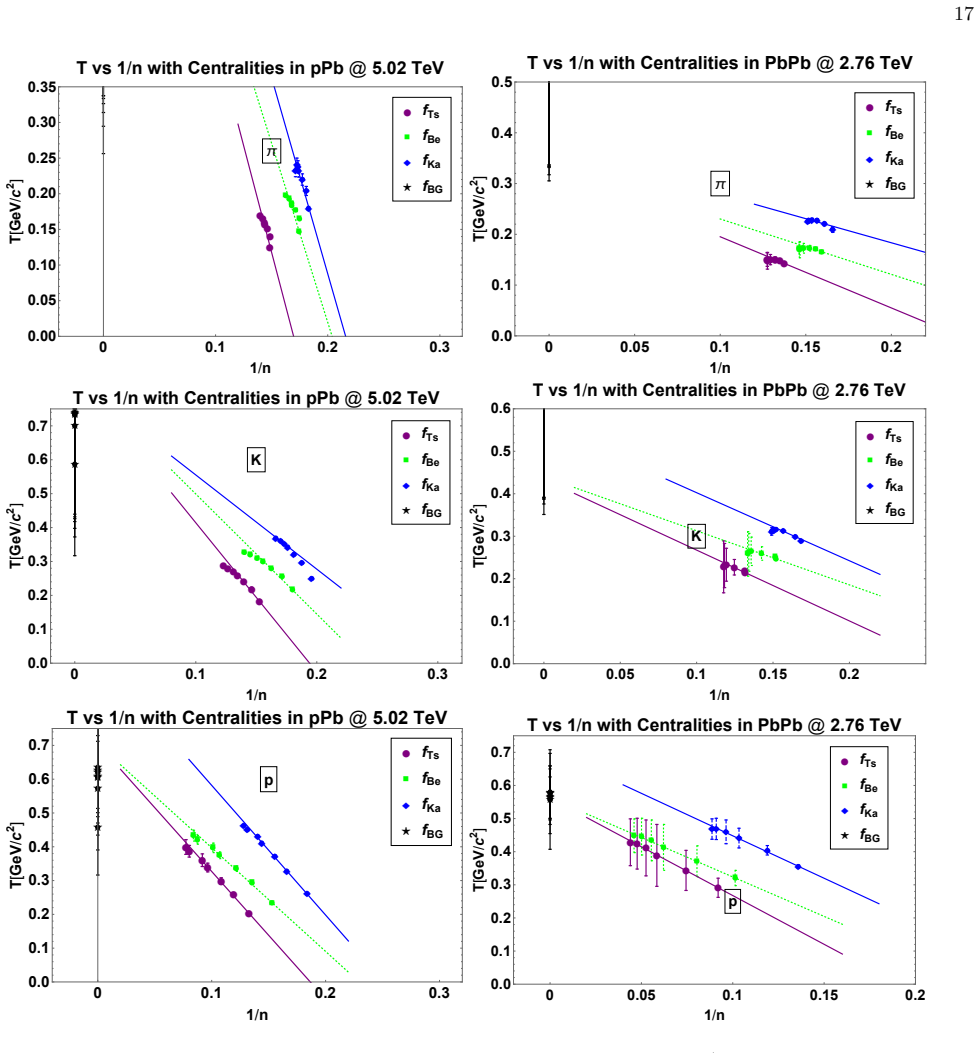
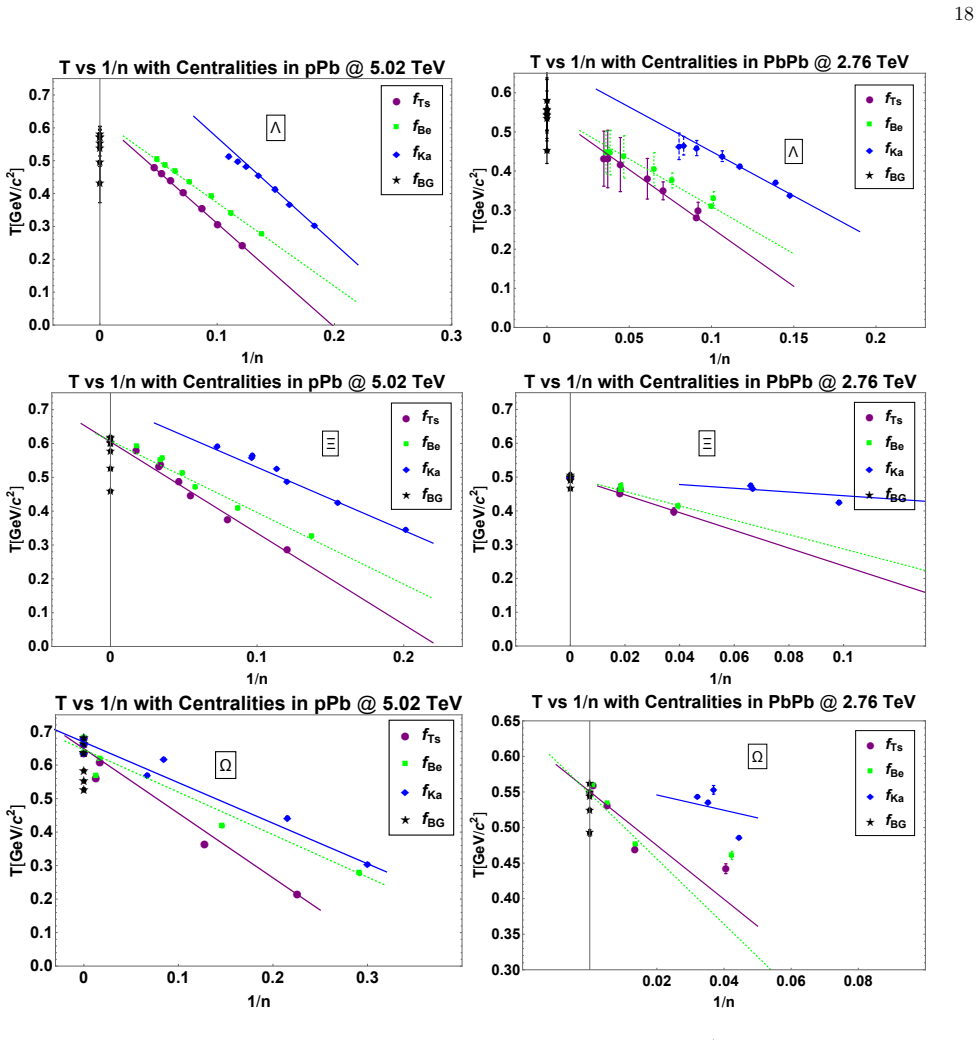
read the original abstract
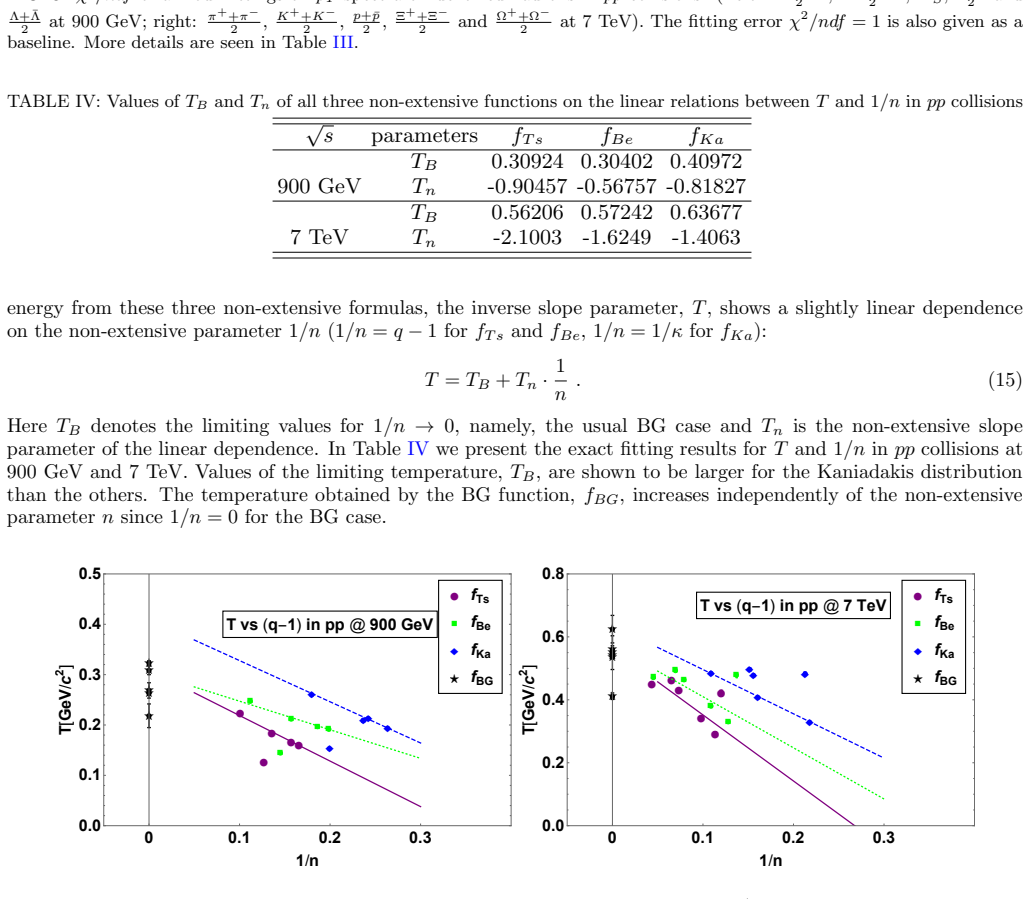
The transverse momentum spectra of identified charged hadrons stemming from high energy collisions at different beam energies are described by a new non-extensive distribution, the Kaniadakis $\kappa$-distribution, with respect to the constraints in non-extensive quantum statistics. All fittings are also compared with the Tsallis distributions as well as the usual Boltzmann-Gibbs one. $\chi^2/ndf$ is also used to test the fitting goodness of all functions. Our results show that these different non-extensive approaches can be well applied in high energy collisions rather than the classical one. The Kaniadakis statistics is typically better applied into such systems with both positive and negative particles considered. This provides an alternative non-extensive view to study high energy physics. Analysis on the fitting parameters are present as well. The similar relationships of all functions remind us of the further understanding of the non-extensivity.
Editorial analysis
A structured set of objections, weighed in public.
Referee Report
Summary. The manuscript analyzes transverse momentum spectra of identified charged hadrons from heavy-ion collisions at various beam energies using the Kaniadakis κ-distribution from non-extensive statistics. Fits are compared to Tsallis and Boltzmann-Gibbs distributions via χ²/ndf, leading to the claim that non-extensive approaches apply well (unlike the classical one) and that Kaniadakis is typically better when both positive and negative particles are considered. Parameter analysis is presented, with similar relationships across functions noted as motivation for further study of non-extensivity.
Significance. If the result holds after methodological clarification, the work would provide an empirical alternative for describing p_T spectra in high-energy collisions and highlight potential advantages of Kaniadakis statistics over Tsallis for charge-symmetric systems. The explicit multi-distribution comparison and inclusion of both particle charges are strengths that could aid model-building in the field.
major comments (2)
- [Abstract] Abstract: The reported χ²/ndf comparisons lack any information on fitting ranges, data selection criteria, number of points, or error treatment (statistical vs. systematic). This is load-bearing for the central claim of applicability, as the superiority of Kaniadakis or Tsallis cannot be assessed without these details.
- [Results] Results section (parameter tables and χ² comparisons): The claim that Kaniadakis 'is typically better applied' when both charges are considered rests solely on lower χ²/ndf after fitting the two free parameters (κ and effective temperature) to the same spectra. No cross-validation, parameter stability across energies, or out-of-sample predictions are shown, so the improvement may reflect only the functional shape rather than realization of the non-extensive statistics.
minor comments (2)
- [Methods] The explicit form of the Kaniadakis distribution (including the non-extensive constraint) should be written out in an early section or appendix for reproducibility, rather than referenced only.
- [Figures] Figure captions should state the collision systems, energies, and particle species shown to allow direct comparison with the text.
Simulated Author's Rebuttal
We thank the referee for the constructive comments on our manuscript. We address each major point below and indicate the revisions made to strengthen the presentation of our results.
read point-by-point responses
-
Referee: [Abstract] Abstract: The reported χ²/ndf comparisons lack any information on fitting ranges, data selection criteria, number of points, or error treatment (statistical vs. systematic). This is load-bearing for the central claim of applicability, as the superiority of Kaniadakis or Tsallis cannot be assessed without these details.
Authors: We agree that the abstract should be more self-contained regarding the fitting procedure. The body of the manuscript (Section 2) specifies the p_T ranges (0.1–3 GeV/c for most species, extending to 5 GeV/c at higher energies), the experimental datasets (STAR, PHENIX, ALICE), the number of points per spectrum, and the use of statistical uncertainties for χ² minimization. In the revised version we have added a concise clause to the abstract summarizing the typical p_T fitting range and that statistical errors were employed, while retaining the full details in the text. revision: yes
-
Referee: [Results] Results section (parameter tables and χ² comparisons): The claim that Kaniadakis 'is typically better applied' when both charges are considered rests solely on lower χ²/ndf after fitting the two free parameters (κ and effective temperature) to the same spectra. No cross-validation, parameter stability across energies, or out-of-sample predictions are shown, so the improvement may reflect only the functional shape rather than realization of the non-extensive statistics.
Authors: The claim is based on systematically lower χ²/ndf values obtained when fitting the same spectra for both charge signs across multiple collision energies. We acknowledge that cross-validation or explicit out-of-sample tests are not performed. However, the parameter trends (effective temperature and non-extensivity parameter) exhibit consistent energy dependence for all three distributions, which would be unlikely if the improvement were purely an artifact of functional flexibility. We have added a clarifying paragraph in the discussion noting that the empirical superiority is quantified by the goodness-of-fit metric and that this motivates further theoretical investigation of Kaniadakis statistics; no new numerical validation is added as it lies outside the present scope. revision: partial
Circularity Check
No circularity: empirical fitting study with direct data comparison
full rationale
The paper fits Kaniadakis, Tsallis, and Boltzmann-Gibbs distributions to measured pT spectra, reports χ²/ndf values, and interprets better fits as evidence that non-extensive forms 'can be well applied'. This is a standard phenomenological comparison, not a derivation chain, first-principles prediction, or uniqueness claim. No self-citations, ansatzes, or theorems are invoked to justify the central result; the output (fit quality rankings) is not forced by construction from the inputs beyond ordinary parameter adjustment. The analysis remains self-contained against external spectra data.
Axiom & Free-Parameter Ledger
free parameters (2)
- κ (Kaniadakis parameter)
- effective temperature or scale parameter
axioms (1)
- domain assumption Transverse momentum spectra in heavy-ion collisions are described by non-extensive statistical distributions.
Lean theorems connected to this paper
-
IndisputableMonolith/Cost/FunctionalEquation.leanwashburn_uniqueness_aczel echoes?
echoesECHOES: this paper passage has the same mathematical shape or conceptual pattern as the Recognition theorem, but is not a direct formal dependency.
The q−exponential function of Eq.(2), however, does not generally follow this relation, expq(x)·expq(−x)≠1. ... G. Kaniadakis considered this symmetry and gave out another non-extensive approach with the deformed κ-exponential function, expκ(x):=[√(1+(κx)²)+κx]^(1/κ).
-
IndisputableMonolith/Foundation/RealityFromDistinction.leanreality_from_one_distinction unclear?
unclearRelation between the paper passage and the cited Recognition theorem.
Our results show that these different non-extensive approaches can be well applied in high energy collisions rather than the classical one. The Kaniadakis statistics is typically better applied into such systems with both positive and negative particles considered.
What do these tags mean?
- matches
- The paper's claim is directly supported by a theorem in the formal canon.
- supports
- The theorem supports part of the paper's argument, but the paper may add assumptions or extra steps.
- extends
- The paper goes beyond the formal theorem; the theorem is a base layer rather than the whole result.
- uses
- The paper appears to rely on the theorem as machinery.
- contradicts
- The paper's claim conflicts with a theorem or certificate in the canon.
- unclear
- Pith found a possible connection, but the passage is too broad, indirect, or ambiguous to say the theorem truly supports the claim.
Reference graph
Works this paper leans on
-
[1]
B. I. Abelev et al. (STAR Collaboration), Phys. Rev. C 75 (2007) 064901
work page 2007
- [2]
-
[3]
PHENIX Collaboration, Phys. Rev. C 83 (2011) 064903. 14 TABLE VIII: Values of χ2/ndf of all four fitting functions on pT spectra of 0 ∼ 5% and 60 ∼ 80% in pPb collisions at 5.02 TeV: particles centrality NDF fTs fBe fKa fBG 0∼ 5% 58 2.46153 2.46153 12.6916 1102.45 π 60∼ 80% 58 1.69764 1.69764 13.7005 1155.55 0∼ 5% 51 1.93262 1.93262 0.460774 242.112 K 60∼ ...
work page 2011
-
[4]
V. Khachatryan et al. (CMS Collaboration), JHEP. 02 (2010) 041 and Phys. Rev. Lett. 105 (2010) 022002
work page 2010
-
[5]
A. Adare et al. (PHENIX Collaboration), Phys. Rev. D 83 (2011) 052004; Phys. Rev. C 83 (2011) 064903
work page 2011
- [6]
- [7]
- [8]
-
[9]
B. C. Li, Y. Z. Wang and F. H. Liu, Phys. Lett. B 725 (2013) 352
work page 2013
- [10]
-
[11]
C. Y. Wong and G. Wilk, Phys. Rev. D 87 (2013) 114007
work page 2013
- [12]
-
[13]
K. M. Shen, T. S. Biro and E. K. Wang, Physica A 492 (2018) 2353-2360
work page 2018
-
[14]
G. Biro, G. G. Barnafoldi, T. S. Biro, K. Urmossy and A. Takacs, Entropy 19 (2017) 3, 88
work page 2017
-
[15]
Il Nuovo Cimento A (1971-1996) (1967) 52: 1336
Hagedorn, R. Il Nuovo Cimento A (1971-1996) (1967) 52: 1336
work page 1971
-
[16]
M. Gazdzicki, M. Gorenstein, P. Seyboth, Acta Phys. Polon. B 42 (2011) 307
work page 2011
-
[17]
A. Khuntia, S. Tripathy, R. Sahoo and J. Cleymans, Eur. Phys. J. A 53 (2017) 103
work page 2017
-
[18]
C. Tsallis, J. Stat. Phys. 52 (1988) 479 and Eur. Phys. J. A 40 (2009) 257; cf. also C. Tsallis, Introduction to Nonextensive Statistical Mechanics (Berlin 2009: Springer). For an updated bibliography on this subject, see http://tsallis.cat.cbpf.br/biblio.htm
work page 1988
-
[19]
B. I. Abelev et al. (STAR Collaboration) Phys. Rev. C 75 (2007) 064901
work page 2007
-
[20]
Pareto, Cours d’Economie Politique
V. Pareto, Cours d’Economie Politique. Droz, Geneva, 1896
- [21]
-
[22]
T. S. Biro, K. M. Shen and B. W. Zhang, Physica A 428 (2015) 410
work page 2015
- [23]
- [24]
-
[25]
K. Ourabah, A. H. H. Bendimerad and M. Tribeche, Phys. Rev. E 92 (2015) 032114
work page 2015
- [26]
-
[27]
G. Kaniadakis, Eur. Phys. J. A 40 (2009) 275. 15 ■ ■ ■ ■ ■ ■ ■ ▲ ▲ ▲ ▲ ▲ ▲ ▲ ◆ ◆ ◆ ◆ ◆ ◆ ◆ ■fTs ▲fBe ◆fKa fBG 0 5 10 20 40 60 80 100 -2 0 2 4 6 8 10 Centrality bins[%] ln[χ 2/ndf] χ2/ndf with Centralities in pPb@5.02 TeV χ2/ndf=1 π ■ ■ ■ ■ ■ ■ ▲ ▲ ▲ ▲ ▲ ▲ ◆ ◆ ◆ ◆ ◆ ◆ ■fTs ▲fBe ◆fKa fBG 0 5 10 20 40 60 80 -2 0 2 4 6 8 Centrali...
work page 2009
- [28]
-
[29]
G. Biro, G. Barnafoldi, T. Biro and K. Shen, EPJ Web of Conferences 171 (2018) 14008
work page 2018
- [30]
- [31]
- [32]
- [33]
-
[34]
ALICE Collaboration, Phys. Lett. B 728 (2014) 25
work page 2014
-
[35]
ALICE Collaboration, Phys. Lett. B 758 (2016) 389
work page 2016
-
[36]
ALICE Collaboration, Phys. Lett. B 760 (2016) 720
work page 2016
-
[37]
ALICE Collaboration, Phys. Lett. B 728 (2014) 216
work page 2014
-
[38]
ALICE Collaboration, Phys. Rev. Lett. 111 (2013) 222301
work page 2013
- [39]
- [40]
-
[41]
Z. B. Tang et al. , Phys. Rev. C 79 (2009) 051901. 16 ■ ■ ■ ■ ■ ■ ■ ▲ ▲ ▲ ▲ ▲ ▲ ▲ ◆ ◆ ◆ ◆ ◆ ◆ ◆ ■fTs ▲fBe ◆fKa fBG 0 5 10 20 40 60 80 100 -2 0 2 4 6 Centrality bins[%] ln[χ 2/ndf] χ2/ndf with Centralities in pPb@5.02 TeV χ2/ndf=1 Λ ■ ■ ■ ■ ■ ■ ■ ▲ ▲ ▲ ▲ ▲ ▲ ▲ ◆ ◆ ◆ ◆ ◆ ◆ ◆ ■fTs ▲fBe ◆fKa fBG 0 5 10 20 40 60 80 100 -2 0 2 4 ...
work page 2009
-
[42]
C. Y. Wong, G. Wilk, L. J. L. Cirto and C. Tsallis, Phys. Rev. D 91 (2015) 114027
work page 2015
-
[43]
G. Biro, G. Barnafoldi, T. Biro, K. Urmossy and A. Takacs, Entropy 2017, 19, 88 17 ●●●●●● ● ■ ■■■■■ ■ ◆◆◆◆◆ ◆ ◆ ● fTs ■ fBe ◆ fKa ★fBG 0 0.1 0.2 0.30.00 0.05 0.10 0.15 0.20 0.25 0.30 0.35 1/n T[GeV/c2] T vs 1/n with Centralities in pPb@5.02 TeV π ●● ●●●● ■■■■■■ ◆◆◆◆◆◆ ● fTs ■ fBe ◆ fKa ★fBG 0 0.05 0.1 0.15 0.20.0 0.1 0.2 0.3 0.4 0.5 1/n T[GeV/c2] T vs 1/n...
work page 2017
discussion (0)
Sign in with ORCID, Apple, or X to comment. Anyone can read and Pith papers without signing in.