State-dependent Gaussian gate set using an optical tweezer for trapped ions
Pith reviewed 2026-07-01 05:08 UTC · model grok-4.3
The pith
An optical tweezer provides a complete state-dependent Gaussian gate set on trapped-ion motional modes through intensity and position control.
A machine-rendered reading of the paper's core claim, the machinery that carries it, and where it could break.
Core claim
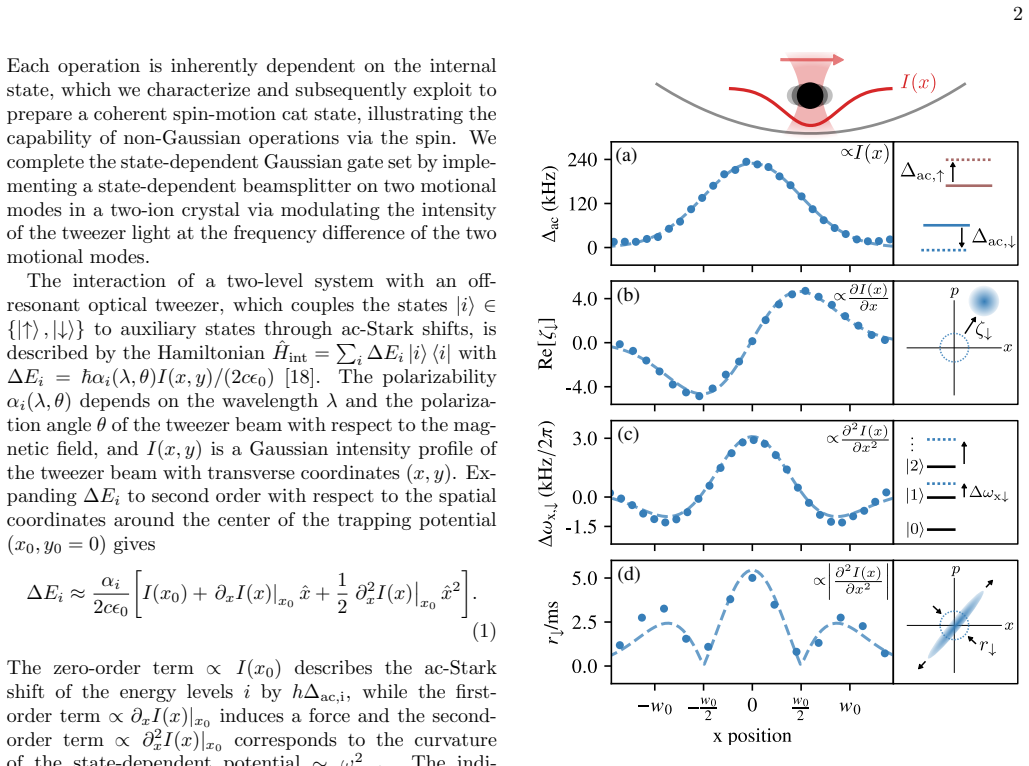
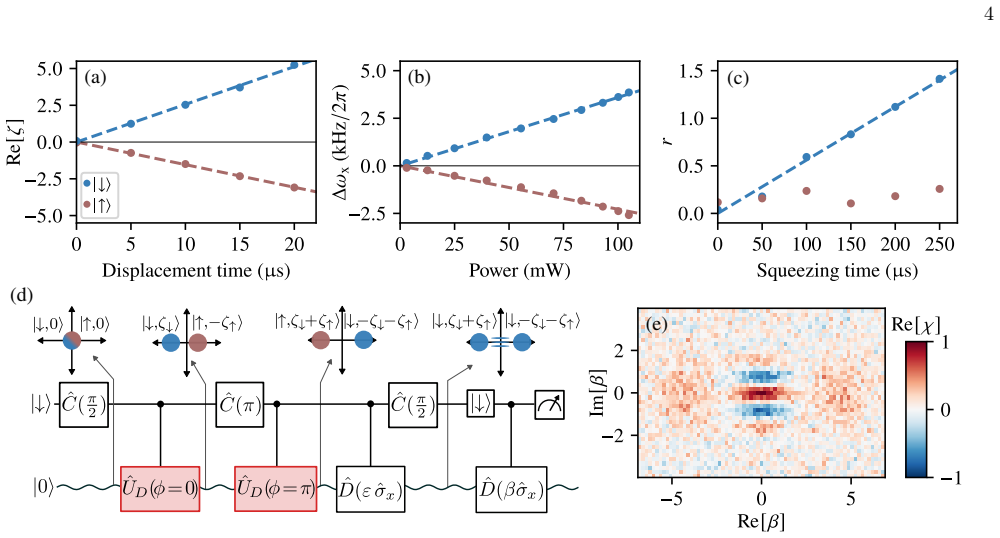
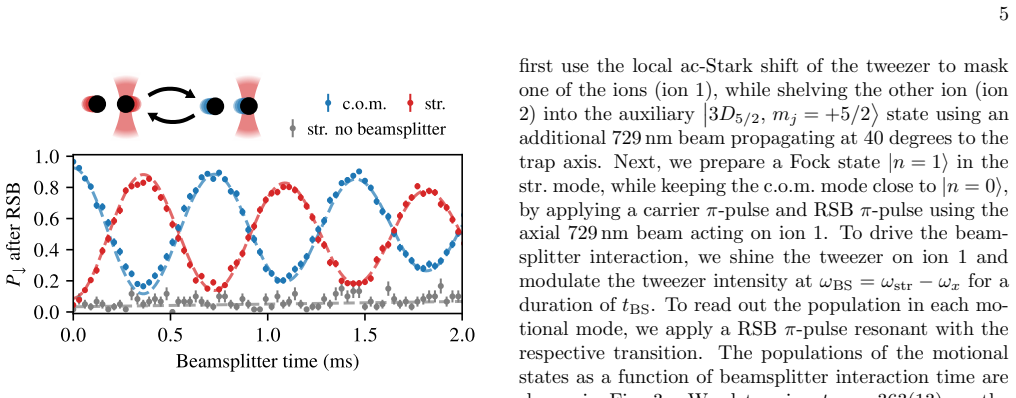
Dynamic control of the tweezer intensity and position enables local displacement, squeezing, phase-space rotation, and beamsplitter operations on the motional modes of trapped 40Ca+ ions, constituting a complete gate set. By varying the tweezer position relative to the ion, the strength of each operation is set by the corresponding spatial derivative of the local optical potential. The operations depend on the ion's internal state, and coherent spin-motion coupling provided by the tweezer creates a motional cat state.
What carries the argument
Spatial derivatives of the local optical potential, which determine the strength of each Gaussian operation when the tweezer position is varied relative to the ion.
If this is right
- A full set of continuous-variable operations becomes available locally on individual ion motional modes without requiring global laser fields.
- State dependence of the gates allows direct integration with the ion's internal qubit states for hybrid control.
- Coherent spin-motion coupling from the same tweezer produces non-classical motional states such as cat states.
Where Pith is reading between the lines
- The local character of the control may reduce crosstalk when scaling to many ions compared with global addressing schemes.
- Combining these gates with existing discrete-variable ion gates could enable hybrid discrete-continuous variable processors.
- The same position-dependent mechanism could be tested for higher-order operations such as cubic phase gates if the potential shape is modified.
Load-bearing premise
Varying the tweezer position sets each operation's strength solely through the spatial derivative of the optical potential, without dominant contributions from off-resonant scattering or trap anharmonicity.
What would settle it
Direct comparison of measured gate strengths against the values predicted from the measured spatial derivatives of the optical potential; significant mismatch would falsify the claim.
Figures
read the original abstract
We demonstrate a state-dependent Gaussian gate set on the motional modes of trapped $^{40}$Ca$^+$ ions, realized with an optical tweezer. Dynamic control of the tweezer intensity and position enables local displacement, squeezing, phase-space rotation, and beamsplitter operations, constituting a complete gate set. By varying the tweezer position relative to the ion, we show how the strength of each operation is set by the corresponding spatial derivative of the local optical potential. We further demonstrate the inherent dependence of each operation on the ion's internal state and use coherent spin-motion coupling provided by the tweezer to create a motional cat state. Our work establishes optical tweezers as a unified and local resource for continuous-variable quantum control in trapped ion systems.
Editorial analysis
A structured set of objections, weighed in public.
Referee Report
Summary. The manuscript demonstrates a state-dependent Gaussian gate set on the motional modes of trapped 40Ca+ ions realized with an optical tweezer. Dynamic control of tweezer intensity and position enables local displacement, squeezing, phase-space rotation, and beamsplitter operations. Strengths are tuned via the spatial derivative of the local optical potential, with explicit internal-state dependence shown; the tweezer is also used for coherent spin-motion coupling to generate a motional cat state.
Significance. If the quantitative performance metrics hold, the work supplies a local, unified resource for continuous-variable control in trapped-ion systems that could simplify architectures relying on motional modes for quantum information processing.
major comments (2)
- [Abstract] The abstract asserts that the four operations were demonstrated and a cat state created, yet supplies no fidelity values, error bars, or quantitative metrics; without these in the main text or figures the degree of experimental support for the central claim cannot be evaluated.
- [Results (position-variation data)] The interpretive step that operation strengths are set solely by the spatial derivative of the optical potential (when the tweezer position is varied) requires explicit checks against confounding effects such as off-resonant scattering or trap anharmonicity; any such test should be shown for each gate.
minor comments (2)
- Add error bars and fit residuals to all data plots that report gate strengths versus tweezer position.
- Clarify the exact sequence and timing used to combine the four operations into a complete gate set.
Simulated Author's Rebuttal
We thank the referee for their thoughtful comments on our manuscript. We provide point-by-point responses to the major comments below and indicate where revisions will be made.
read point-by-point responses
-
Referee: [Abstract] The abstract asserts that the four operations were demonstrated and a cat state created, yet supplies no fidelity values, error bars, or quantitative metrics; without these in the main text or figures the degree of experimental support for the central claim cannot be evaluated.
Authors: The abstract serves as a high-level summary and conventionally omits specific numerical values to maintain brevity. The quantitative metrics, including fidelities, error bars, and other performance indicators for the four operations and the cat state, are detailed in the main text and figures of the manuscript. We will make a revision to the abstract to include a brief mention of the achieved fidelities to better address this concern. revision: yes
-
Referee: [Results (position-variation data)] The interpretive step that operation strengths are set solely by the spatial derivative of the optical potential (when the tweezer position is varied) requires explicit checks against confounding effects such as off-resonant scattering or trap anharmonicity; any such test should be shown for each gate.
Authors: We acknowledge the importance of ruling out confounding effects. The position-variation data presented in the manuscript shows excellent agreement with the spatial derivative model for each gate. To further support this, we will include additional analysis in the revised manuscript or supplementary material that estimates the impact of off-resonant scattering and trap anharmonicity, demonstrating that these effects are minimal and do not alter the interpretation for any of the gates. revision: yes
Circularity Check
No significant circularity in experimental demonstration
full rationale
The manuscript is an experimental demonstration of four Gaussian motional operations (displacement, squeezing, rotation, beamsplitter) realized by dynamic control of an optical tweezer on trapped 40Ca+ ions. Strengths are tuned by tweezer position via the spatial derivative of the local potential, with explicit state dependence and a cat-state example shown. No derivation chain, fitted-parameter predictions, or self-citation load-bearing steps appear; results are presented as direct measurements whose functional forms can be compared against the expected gradient dependence without reduction to the same dataset by construction.
Axiom & Free-Parameter Ledger
Reference graph
Works this paper leans on
-
[1]
Next, we prepare a Fock state|n= 1⟩in the str
into the auxiliary 3D5/2, m j = +5/2 state using an additional 729 nm beam propagating at 40 degrees to the trap axis. Next, we prepare a Fock state|n= 1⟩in the str. mode, while keeping the c.o.m. mode close to|n= 0⟩, by applying a carrierπ-pulse and RSBπ-pulse using the axial 729 nm beam acting on ion 1. To drive the beam- splitter interaction, we shine ...
-
[2]
S. L. Braunstein and P. Van Loock, Quantum infor- mation with continuous variables, Reviews of Modern 6 Physics77, 513 (2005)
2005
-
[3]
Enomoto, K
Y. Enomoto, K. Yonezu, Y. Mitsuhashi, K. Takase, and S. Takeda, Programmable and sequential Gaussian gates in a loop-based single-mode photonic quantum processor, Science Advances7, eabj6624 (2021)
2021
-
[4]
J. M. Arrazola, V. Bergholm, K. Br´ adler, T. R. Brom- ley, M. J. Collins, I. Dhand, A. Fumagalli, T. Gerrits, A. Goussev, L. G. Helt, J. Hundal, T. Isacsson, R. B. Israel, J. Izaac, S. Jahangiri, R. Janik, N. Killoran, S. P. Kumar, J. Lavoie, A. E. Lita, D. H. Mahler, M. Menotti, B. Morrison, S. W. Nam, L. Neuhaus, H. Y. Qi, N. Que- sada, A. Repingon, K....
2021
-
[5]
Eickbusch, V
A. Eickbusch, V. Sivak, A. Z. Ding, S. S. Elder, S. R. Jha, J. Venkatraman, B. Royer, S. M. Girvin, R. J. Schoelkopf, and M. H. Devoret, Fast universal control of an oscillator with weak dispersive coupling to a qubit, Nature Physics 18, 1464 (2022)
2022
-
[6]
Encoding a qubit in a trapped-ion mechanical oscillator
C. Fl¨ uhmann, T. L. Nguyen, M. Marinelli, V. Neg- nevitsky, K. Mehta, and J. Home, Encoding a qubit in a trapped-ion mechanical oscillator, Nature566, 513 (2019), arXiv:1807.01033 [quant-ph]
work page internal anchor Pith review Pith/arXiv arXiv 2019
-
[7]
de Neeve, T.-L
B. de Neeve, T.-L. Nguyen, T. Behrle, and J. P. Home, Error correction of a logical grid state qubit by dissipative pumping, Nature Physics18, 296 (2022)
2022
-
[8]
Error Correction of Beamsplitter-Generated Entangled GKP States
M. Fontbot´ e-Schmidt, J. Metzner, F. Berterotti` ere, I. Ro- jkov, A. Ferk, M. Stadler, B. D¨ onmez, R. Berner, S. Welte, D. Kienzler, and J. P. Home, Error Correc- tion of Beamsplitter-Generated Entangled GKP States (2026), arXiv:2605.08009 [quant-ph]
work page internal anchor Pith review Pith/arXiv arXiv 2026
-
[9]
Lloyd and S
S. Lloyd and S. L. Braunstein, Quantum Computation over Continuous Variables, Physical Review Letters82, 1784 (1999)
1999
-
[10]
Lau and D
H.-K. Lau and D. F. V. James, Proposal for a scalable universal bosonic simulator using individually trapped ions, Physical Review A85, 062329 (2012)
2012
-
[11]
Tamura, T
M. Tamura, T. Mukaiyama, and K. Toyoda, Quantum Walks of a Phonon in Trapped Ions, Physical Review Letters124, 200501 (2020)
2020
-
[12]
Debnath, N
S. Debnath, N. Linke, S.-T. Wang, C. Figgatt, K. Lands- man, L.-M. Duan, and C. Monroe, Observation of Hop- ping and Blockade of Bosons in a Trapped Ion Spin Chain, Physical Review Letters120, 073001 (2018)
2018
-
[13]
Katz and C
O. Katz and C. Monroe, Programmable Quantum Simu- lations of Bosonic Systems with Trapped Ions, Physical Review Letters131, 033604 (2023)
2023
-
[14]
F. H. B. Somhorst, R. van der Meer, M. Correa Anguita, R. Schadow, H. J. Snijders, M. de Goede, B. Kassen- berg, P. Venderbosch, C. Taballione, J. P. Epping, H. H. van den Vlekkert, J. Timmerhuis, J. F. F. Bulmer, J. Lu- gani, I. A. Walmsley, P. W. H. Pinkse, J. Eisert, N. Walk, and J. J. Renema, Quantum simulation of thermodynam- ics in an integrated qua...
2023
-
[15]
U. L. Andersen, J. S. Neergaard-Nielsen, P. van Loock, and A. Furusawa, Hybrid discrete- and continuous- variable quantum information, Nature Physics11, 713 (2015)
2015
-
[16]
R. T. Sutherland and R. Srinivas, Universal hybrid quan- tum computing in trapped ions, Physical Review A104, 032609 (2021)
2021
-
[17]
L. P. H. Gallagher, M. Mazzanti, Z. E. D. Acker- man, R. J. C. Spreeuw, A. Safavi-Naini, and R. Ger- ritsma, Quadratic spin-phonon coupling and bipolarons in trapped ions, Physical Review A112, L020401 (2025)
2025
-
[18]
Y. Liu, S. Singh, K. C. Smith, E. Crane, J. M. Martyn, A. Eickbusch, A. Schuckert, R. D. Li, J. Sinanan-Singh, M. B. Soley, T. Tsunoda, I. L. Chuang, N. Wiebe, and S. M. Girvin, Hybrid Oscillator-Qubit Quantum Proces- sors: Instruction Set Architectures, Abstract Machine Models, and Applications, PRX Quantum7, 010201 (2026)
2026
-
[19]
Optical dipole traps for neutral atoms
R. Grimm, M. Weidem¨ uller, and Y. B. Ovchinnikov, Optical dipole traps for neutral atoms, Advances in Atomic, Molecular, and Optical Physics42, 95 (2000), arXiv:physics/9902072
work page internal anchor Pith review Pith/arXiv arXiv 2000
-
[20]
H. J. Manetsch, G. Nomura, E. Bataille, X. Lv, K. H. Leung, and M. Endres, A tweezer array with 6,100 highly coherent atomic qubits, Nature647, 60 (2025)
2025
- [21]
- [22]
-
[23]
Olsacher, L
T. Olsacher, L. Postler, P. Schindler, T. Monz, P. Zoller, and L. M. Sieberer, Scalable and Parallel Tweezer Gates for Quantum Computing with Long Ion Strings, PRX Quantum1, 020316 (2020)
2020
-
[24]
Shen and G.-D
Y.-C. Shen and G.-D. Lin, Scalable quantum comput- ing stabilised by optical tweezers on an ion crystal, New Journal of Physics22, 053032 (2020)
2020
-
[25]
Y. H. Teoh, M. Sajjan, Z. Sun, F. Rajabi, and R. Islam, Manipulating phonons of a trapped-ion system using op- tical tweezers, Physical Review A104, 022420 (2021)
2021
-
[26]
Schwerdt, L
D. Schwerdt, L. Peleg, Y. Shapira, N. Priel, Y. Florshaim, A. Gross, A. Zalic, G. Afek, N. Akerman, A. Stern, A. B. Kish, and R. Ozeri, Scalable Architecture for Trapped- Ion Quantum Computing Using rf Traps and Dynamic Optical Potentials, Physical Review X14, 041017 (2024)
2024
-
[27]
Mazzanti, R
M. Mazzanti, R. Sch¨ ussler, J. Arias Espinoza, Z. Wu, R. Gerritsma, and A. Safavi-Naini, Trapped Ion Quan- tum Computing Using Optical Tweezers and Electric Fields, Physical Review Letters127, 260502 (2021)
2021
-
[28]
Mazzanti, R
M. Mazzanti, R. Gerritsma, R. J. C. Spreeuw, and A. Safavi-Naini, Trapped ions quantum logic gate with optical tweezers and the Magnus effect, Physical Review Research5, 033036 (2023)
2023
-
[29]
Schwerdt, L
D. Schwerdt, L. Peleg, G. Dekel, L. Rajagopal, O. Ma- toki, A. Gross, Y. Shapira, N. Akerman, and R. Oz- eri, Optical Tweezer-Controlled Entanglement Gates with Trapped-Ion Qubits, Physical Review Letters136, 020604 (2026)
2026
-
[30]
J.-M. Cui, Y. Chen, Y.-F. Zhou, Q. Long, E.-T. An, R. He, Y.-F. Huang, C.-F. Li, and G.-C. Guo, Transverse Polarization Gradient Entangling Gates for Trapped-Ion Quantum Computation, Physical Review Letters135, 260604 (2025)
2025
-
[31]
T. Faorlin, L. Panzl, P. Grosser, P. Vi˜ nas, A. Kahan, W. J. H¨ ormann, Y. Weiser, G. Cerchiari, T. Feldker, A. Erhard, J. Ulmanis, R. Blatt, A. Bermudez, and T. Monz, Entangling ions with engineered light gradients (2026), arXiv:2603.07548 [quant-ph]. 7
-
[32]
Drechsler, M
M. Drechsler, M. Bel´ en Far´ ıas, N. Freitas, C. T. Schmiegelow, and J. P. Paz, State-dependent motional squeezing of a trapped ion: Proposed method and appli- cations, Physical Review A101, 052331 (2020)
2020
-
[33]
Lau and M
H.-K. Lau and M. B. Plenio, Universal Quantum Com- puting with Arbitrary Continuous-Variable Encoding, Physical Review Letters117, 100501 (2016)
2016
-
[34]
S. C. Burd, R. Srinivas, J. J. Bollinger, A. C. Wilson, D. J. Wineland, D. Leibfried, D. H. Slichter, and D. T. C. Allcock, Quantum amplification of mechanical oscillator motion, Science364, 1163 (2019)
2019
-
[35]
Metzner, A
J. Metzner, A. Quinn, S. Brudney, I. D. Moore, S. C. Burd, D. J. Wineland, and D. T. C. Allcock, Two-mode squeezing and SU(1,1) interferometry with trapped ions, Physical Review A110, 022613 (2024)
2024
-
[36]
M. J. Millican, V. G. Matsos, C. H. Valahu, T. Navickas, L. J. Bond, and T. R. Tan, Engineering Continuous- Variable Entanglement in Mechanical Oscillators with Optimal Control, Physical Review Letters135, 233604 (2025)
2025
-
[37]
B˘ az˘ avan, S
O. B˘ az˘ avan, S. Saner, D. J. Webb, E. M. Ainley, P. Dr- mota, D. P. Nadlinger, G. Araneda, D. M. Lucas, C. J. Ballance, and R. Srinivas, Squeezing, trisqueezing and quadsqueezing in a hybrid oscillator–spin system, Nature Physics22, 757–762 (2026)
2026
-
[38]
Leibfried, R
D. Leibfried, R. Blatt, C. Monroe, and D. Wineland, Quantum dynamics of single trapped ions, Reviews of Modern Physics75, 281 (2003)
2003
-
[39]
H. Gan, G. Maslennikov, K.-W. Tseng, C. Nguyen, and D. Matsukevich, Hybrid Quantum Computing with Con- ditional Beam Splitter Gate in Trapped Ion System, Physical Review Letters124, 170502 (2020)
2020
-
[40]
H. Jeon, J. Kang, W. Choi, K. Kim, J. You, and T. Kim, Two-Mode Bosonic State Tomography with Single-Shot Joint-Parity Measurement of a Trapped Ion, PRX Quan- tum6, 040352 (2025)
2025
-
[41]
Rojkov, P
I. Rojkov, P. M. R¨ oggla, M. Wagener, M. Fontbot´ e- Schmidt, S. Welte, J. Home, and F. Reiter, Two-Qubit Operations for Finite-Energy Gottesman-Kitaev-Preskill Encodings, Physical Review Letters133, 100601 (2024)
2024
-
[42]
Fl¨ uhmann and J
C. Fl¨ uhmann and J. Home, Direct Characteristic- Function Tomography of Quantum States of the Trapped-Ion Motional Oscillator, Physical Review Let- ters125, 043602 (2020)
2020
-
[43]
See Supplemental Material at [URL will be inserted by publisher] for the derivation of the tweezer-ion in- teraction Hamiltonian, details about the experimental setup and the tomography method used, which includes Refs. [43–47]
-
[44]
tiqi-group/atomphys: A Python package to help with atomic physics calculations
- [45]
-
[46]
James, Quantum dynamics of cold trapped ions with application to quantum computation, Applied Physics B: Lasers and Optics66, 181 (1998)
D. James, Quantum dynamics of cold trapped ions with application to quantum computation, Applied Physics B: Lasers and Optics66, 181 (1998)
1998
-
[47]
P. Leindecker, L. P. H. Gallagher, E. Brucke, D. Zehn- der, L. Milanovic, M. Marinelli, R. Gerritsma, R. J. C. Spreeuw, J. Home, and C. Hempel, Direct observation of the optical Magnus effect with a trapped ion (2026), arXiv:2601.22981 [physics.atom-ph]
-
[48]
Fl¨ uhmann,Encoding a qubit in the motion of a trapped ion using superpositions of displaced squeezed states, Ph.D
C. Fl¨ uhmann,Encoding a qubit in the motion of a trapped ion using superpositions of displaced squeezed states, Ph.D. thesis, ETH Zurich (2019)
2019
-
[49]
Leindecker, L
P. Leindecker, L. Milanovic, W. Adamczyk, J. Home, and C. Hempel, Anti-crossing dynamics and quantization axis control in a trapped ion using optical tweezer, (in preparation)
- [50]
-
[51]
J. Hastrup, K. Park, J. B. Brask, R. Filip, and U. L. Andersen, Measurement-free preparation of grid states, npj Quantum Information7, 17 (2021), arXiv:1912.12645 [quant-ph]
- [52]
-
[53]
L. J. Bond, C. H. Valahu, A. Shankar, T. R. Tan, and A. Safavi-Naini, Optimal Displacement Sens- ing with Spin-Dependent Squeezed States (2025), arXiv:2510.25870 [quant-ph]
work page internal anchor Pith review Pith/arXiv arXiv 2025
-
[54]
Shapira, S
Y. Shapira, S. Cohen, N. Akerman, A. Stern, and R. Oz- eri, Robust Two-Qubit Gates for Trapped Ions Using Spin-Dependent Squeezing, Physical Review Letters130, 030602 (2023)
2023
- [55]
-
[56]
Off Ion” position of the AODs is≈60µm displaced from the “On Ion
For simplicity we setℏ= 1 in the supplemental material. 8 Supplemental Material for: State-dependent Gaussian gate set using an optical tweezer for trapped ions I. TWEEZER-ION INTERACTION A. Hamiltonian The interaction of a two-level system with an optical field of intensityI(x, y), off-resonantly coupling the states i∈ {|↑⟩,|↓⟩}to auxiliary states, is de...
discussion (0)
Sign in with ORCID, Apple, or X to comment. Anyone can read and Pith papers without signing in.