Vacancy-mediated nitrogen diffusion and aggregation via high-fluence electron beam irradiation in HPHT synthesized diamond crystal
Pith reviewed 2026-06-30 10:19 UTC · model grok-4.3
The pith
High-fluence electron beam irradiation forms H3 centers in diamond at 1375°C through vacancy-mediated nitrogen diffusion.
A machine-rendered reading of the paper's core claim, the machinery that carries it, and where it could break.
Core claim
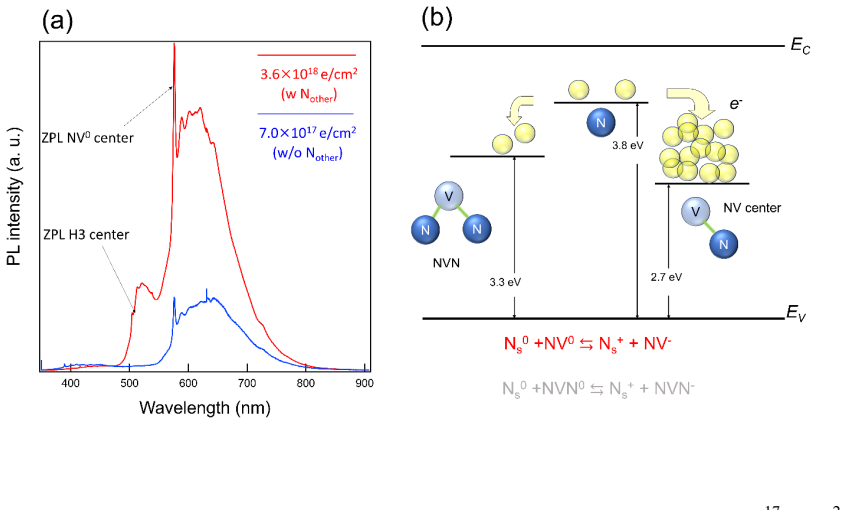
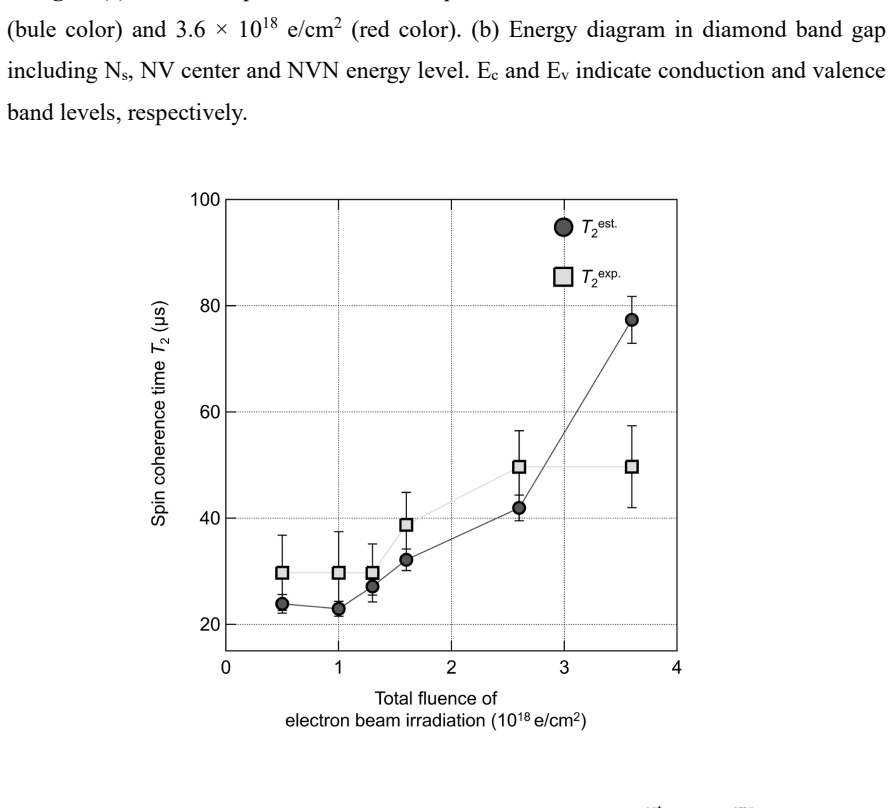
While the Ns0 to NV0 and NV- conversion process dominated at low EBI fluences, in a high-fluence region, NV0 and NV- center and Ns0 and Ns+ concentrations decreased with increasing EBI fluence, indicating the formation of unknown nitrogen-related defects such as the H3 center. Although H3 centers were observed at high EBI fluence, their annealing temperature of 1375 ± 25 °C was lower than the typically reported temperatures over 1600 °C. We attribute this low-temperature formation to vacancy-mediated nitrogen diffusion and aggregation.
What carries the argument
Vacancy-mediated nitrogen diffusion and aggregation, which permits H3-center formation after high-fluence irradiation at reduced annealing temperatures.
If this is right
- High EBI fluence shifts the dominant process from isolated NV formation to nitrogen-vacancy aggregation.
- H3 centers can form after room-temperature irradiation once vacancies are supplied in sufficient numbers.
- Annealing temperatures above 1375°C are not required for nitrogen aggregation when irradiation-induced vacancies are present.
- The same irradiation conditions that create NV centers at low fluence begin to consume them at high fluence through aggregation.
Where Pith is reading between the lines
- Controlling fluence could let experimenters choose between maximizing NV density or deliberately creating aggregate centers in the same starting material.
- The vacancy-supply route might extend to other impurities whose diffusion is normally limited by high activation barriers.
- Measuring the actual vacancy population before and after the 1375°C step would give a direct test of how many vacancies are needed to trigger the observed aggregation.
Load-bearing premise
The drop in NV and substitutional-nitrogen concentrations at high fluence is produced by H3 centers rather than other undetected defects, and the measured 1375°C temperature directly marks the onset of vacancy-mediated aggregation.
What would settle it
Annealing the same high-fluence samples while directly tracking both vacancy concentration and H3 formation, or detecting a different dominant defect instead of H3, would test whether the low temperature is caused by vacancy mediation.
Figures
read the original abstract
The negatively charged nitrogen vacancy (NV-) center in diamond is a promising point defect for highly sensitive quantum sensing. The formation of high-density NV- centers is essential for improving sensitivity. We performed room-temperature electron beam irradiation (EBI) and annealing on nitrogen-doped high-pressure high-temperature diamond crystals, aiming to convert all substitutional nitrogen into NV structures by increasing EBI fluence. While the Ns0 to NV0 and NV- conversion process dominated at low EBI fluences, in a high-fluence region, NV0 and NV- center and Ns0 and Ns+ concentrations decreased with increasing EBI fluence, indicating the formation of unknown nitrogen-related defects such as the H3 center, which is a nitrogen and vacancy aggregation defect. Although H3 centers were observed at high EBI fluence, their annealing temperature of 1375 +- 25 {\deg}C was lower than the typically reported temperatures over 1600 {\deg}C. We attribute this low-temperature formation to vacancy-mediated nitrogen diffusion and aggregation.
Editorial analysis
A structured set of objections, weighed in public.
Referee Report
Summary. The manuscript reports experiments involving room-temperature electron beam irradiation (EBI) at varying fluences on nitrogen-doped HPHT diamond crystals, followed by annealing. At low fluences, Ns0 converts to NV0 and NV- centers; at high fluences, concentrations of NV0, NV-, Ns0, and Ns+ decrease, which is interpreted as formation of H3 (nitrogen-vacancy aggregate) centers. H3 centers are observed to form and anneal at 1375 ± 25 °C, lower than the typical >1600 °C, and this is attributed to vacancy-mediated nitrogen diffusion and aggregation enabled by the high-fluence irradiation.
Significance. If the reduced annealing temperature for H3 formation is shown to arise specifically from vacancy-mediated processes induced by high-fluence EBI, the result could inform defect-engineering strategies for nitrogen-related centers in diamond relevant to quantum sensing. The work is observational and interpretive in its current form, with no machine-checked proofs, reproducible code, or parameter-free derivations presented.
major comments (2)
- [Abstract] Abstract: The central claim that high-fluence EBI causes formation of H3 centers (rather than other undetected defects) and that the measured 1375 °C annealing temperature directly reflects the onset of vacancy-mediated nitrogen aggregation rests on qualitative trends without quantitative spectra, fluence values, error bars, or statistical controls.
- [Abstract] Abstract: The attribution of the observed drop in NV0, NV-, Ns0, and Ns+ concentrations specifically to H3 formation and the low-temperature aggregation to vacancy mediation lacks direct measurement or controls that would rule out confounding factors from sample history or measurement method.
Simulated Author's Rebuttal
We thank the referee for the careful review and constructive feedback on our manuscript. We address each major comment below with clarifications drawn from the full text and figures. Where the presentation can be strengthened, we indicate revisions that will be incorporated.
read point-by-point responses
-
Referee: [Abstract] Abstract: The central claim that high-fluence EBI causes formation of H3 centers (rather than other undetected defects) and that the measured 1375 °C annealing temperature directly reflects the onset of vacancy-mediated nitrogen aggregation rests on qualitative trends without quantitative spectra, fluence values, error bars, or statistical controls.
Authors: The full manuscript presents quantitative absorption and photoluminescence spectra (Figs. 2–4) showing the appearance of the H3 zero-phonon line at 503 nm concurrent with the decline in NV and Ns signals at fluences above ~10^18 e/cm². Fluence values are explicitly stated in the methods and figure captions, and the 1375 ± 25 °C temperature is obtained from a series of isochronal anneals with the uncertainty reflecting the temperature step size. Error bars on concentration estimates (derived from integrated absorption cross-sections) are shown in the supplementary figures. We agree the abstract is overly concise and will revise it to reference the specific fluence threshold and the direct spectroscopic identification of H3. A brief statistical note on reproducibility across three sample positions will also be added to the results section. revision: partial
-
Referee: [Abstract] Abstract: The attribution of the observed drop in NV0, NV-, Ns0, and Ns+ concentrations specifically to H3 formation and the low-temperature aggregation to vacancy mediation lacks direct measurement or controls that would rule out confounding factors from sample history or measurement method.
Authors: The decrease in NV and Ns concentrations is accompanied by the emergence of the H3 signature in the same spectra, providing a direct spectroscopic link rather than an inference from concentration loss alone. Sample history is controlled by using adjacent sectors from the same HPHT boule; all irradiation and annealing steps were performed on pieces cut from a single crystal. Measurement conditions (FTIR and PL setups) were identical across the fluence series. We acknowledge that the manuscript does not include separate control samples annealed without prior high-fluence EBI at the same temperature, which would further isolate the vacancy-mediated pathway. In revision we will add a paragraph explicitly discussing this limitation and why alternative explanations (e.g., formation of undetected larger aggregates or measurement artifacts) are inconsistent with the observed H3 growth kinetics and the temperature reduction relative to literature values for unirradiated material. revision: yes
Circularity Check
No significant circularity; purely observational attribution
full rationale
The manuscript reports experimental measurements of defect concentrations (NV0, NV-, Ns0, Ns+, H3) under varying EBI fluences and annealing temperatures in diamond samples. The central claim attributes the observed 1375°C H3 onset to vacancy-mediated nitrogen diffusion, but this is presented as an interpretive conclusion from the data trends rather than any derivation, equation, or fitted parameter. No self-citations, ansatzes, uniqueness theorems, or predictions that reduce to inputs by construction appear in the text. The analysis contains no mathematical chain that could be circular.
Axiom & Free-Parameter Ledger
Reference graph
Works this paper leans on
-
[1]
J. F. Barry, J. M. Schloss, E. Bauch, M. J. Turner, C. A. Hart, L. M. Pham, and R. L. Walsworth, Rev. Mod. Phys. 92, (2020)
2020
-
[2]
Sekiguchi, M
N. Sekiguchi, M. Fushimi, A. Yoshimura, C. Shinei, M. Miyakawa, T. Taniguchi, T. Teraji, H. Abe, S. Onoda, T. Ohshima, and M. Hatano, Phys. Rev. Appl. 21, 064010 (2024)
2024
-
[3]
Shinei, M
C. Shinei, M. Miyakawa, S. Ishii, S. Saiki, S. Onoda, T. Taniguchi, T. Ohshima, and T. Teraji, Appl. Phys. Lett. 119, (2021)
2021
-
[4]
Löfgren, K
R. Löfgren, K. V . Sopiha, S. Öberg, and J. A. Larsson, Comput. Mater. Sci. 250, 113685 (2025)
2025
-
[5]
N. B. Manson, M. Hedges, M. S. J. Barson, R. Ahlefeldt, M. W. Doherty, H. Abe, T. Ohshima, and M. J. Sellars, New J. Phys. 20, 113037 (2018)
2018
-
[6]
Löfgren, R
R. Löfgren, R. Pawar, S. Öberg, and J. A. Larsson, New J. Phys. 20, 023002 (2018)
2018
-
[7]
J. F. Barry, M. J. Turner, J. M. Schloss, D. R. Glenn, Y . Song, M. D. Lukin, H. Park, and R. L. Walsworth, Proc. Natl. Acad. Sci. U. S. A. 113, 14133 (2016)
2016
-
[8]
K. Arai, A. Kuwahata, D. Nishitani, I. Fujisaki, R. Matsuki, Y . Nishio, Z. Xin, X. Cao, Y . Hatano, S. Onoda, and C. Shinei, Commun. Phys. 5, 1 (2022)
2022
-
[9]
Herbschleb, H
E.D. Herbschleb, H. Kato, Y . Maruyama, T. Danjo, T. Makino, S. Yamasaki, I. Ohki, K. Hayashi, H. Morishita, M. Fujiwara, and N. Mizuochi, Nat. Commun. 10, 3766 (2019)
2019
-
[10]
Y . Doi, T. Fukui, H. Kato, T. Makino, S. Yamasaki, T. Tashima, H. Morishita, S. Miwa, F. Jelezko, Y . Suzuki, and N. Mizuochi, Phys. Rev. B Condens. Matter 93, 081203 (2016)
2016
-
[11]
Murai, T
T. Murai, T. Makino, H. Kato, M. Shimizu, T. Murooka, E.D. Herbschleb, H. Morishita, M. Fujiwara, M. Hatano, S. Yamasaki, and N. Mizuochi, Appl. Phys. Lett. 112, 111903 (2018)
2018
-
[12]
Shimizu, T
M. Shimizu, T. Makino, T. Iwasaki, J. Hasegawa, K. Tahara, W. Naruki, H. Kato, S. Yamasaki, and M. Hatano, Diam. Relat. Mater. 63, 192 (2016)
2016
-
[13]
Masuyama, C
Y . Masuyama, C. Shinei, S. Ishii, H. Abe, T. Taniguchi, T. Teraji, and T. Ohshima, Sci. Rep. 14, 1 (2024)
2024
-
[14]
Shinei, Y
C. Shinei, Y . Masuyama, M. Miyakawa, H. Abe, S. Ishii, S. Saiki, S. Onoda, T. Taniguchi, T. Ohshima, and T. Teraji, J. Appl. Phys. 132, (2022)
2022
-
[15]
T. Luo, L. Lindner, J. Langer, V . Cimalla, X. Vidal, F. Hahl, C. Schreyvogel, S. Onoda, S. Ishii, T. Ohshima, and D. Wang, New J. Phys. 24, 033030 (2022). 19
2022
-
[16]
Ishii, S
S. Ishii, S. Saiki, S. Onoda, Y . Masuyama, H. Abe, and T. Ohshima, Quantum Beam Sci., 6(1), 2 (2021)
2021
-
[17]
Shinei, H
C. Shinei, H. Abe, T. Ohshima, and T. Teraji, Diam. Relat. Mater. 140, 110523 (2023)
2023
-
[18]
Teraji and C
T. Teraji and C. Shinei, J. Appl. Phys. 133(16) (2023)
2023
-
[19]
A. T. Collins, J. Phys. Condens. Matter 14, 3743 (2002)
2002
-
[20]
A. M. Zaitsev, Optical Properties of Diamond: A Data Handbook , 2001st ed. (Springer, Berlin, Germany, 2013)
2013
-
[21]
Lühmann, N
T. Lühmann, N. Raatz, R. John, M. Lesik, J. Rödiger, M. Portail, D. Wildanger, F. Kleissler, K. Nordlund, A. Zaitsev, and J.F. Roch, J. Phys. D Appl. Phys. 51, 483002 (2018)
2018
-
[22]
Jones, J
R. Jones, J. P. Goss, H. Pinto, and D. W. Palmer, Diam. Relat. Mater. 53, 35 (2015)
2015
-
[23]
S. T. Alsid, J. F. Barry, L. M. Pham, J. M. Schloss, M. F. O’Keeffe, P. Cappellaro, and D. A. Braje, Phys. Rev. Appl. 12, 044003 (2019)
2019
-
[24]
P. Deák, B. Aradi, M. Kaviani, T. Frauenheim, and A. Gali, Phys. Rev. B 89, (2014)
2014
-
[25]
Umemoto, T
A. Umemoto, T. Iida, M. Yoshino, A. Yoshikawa, and S. Nomura, Nucl. Instrum. Methods Phys. Res. A 1057, 168789 (2023)
2023
-
[26]
Luo, F.A
T. Luo, F.A. Hahl, J. Langer, V . Cimalla, L. Lindner, X. Vidal, M. Haertelt, R. Blinder, S. Onoda, T. Ohshima, and J. Jeske, Philos. Trans. A Math. Phys. Eng. Sci. 382, 20220314 (2024)
2024
-
[27]
Bauch, S
E. Bauch, S. Singh, J. Lee, C.A. Hart, J.M. Schloss, M.J. Turner, J.F. Barry, L.M. Pham, N. Bar-Gill, S.F. Yelin, and R.L. Walsworth, Phys. Rev. B Condens. Matter 102, 134210 (2020). 20 Supplemental: CL spectrum of nitrogen-doped HPHT diamond with high EBI fluence We present the differences in the population of the NVN charge states. The CL measurements w...
2020
discussion (0)
Sign in with ORCID, Apple, or X to comment. Anyone can read and Pith papers without signing in.