REVIEW 6 minor 2 cited by
Deterministic Equations for Feedback Control of Open Quantum Systems II: Properties of the memory function
T0 review · 0 major / 6 minor · reviewed 2026-08-03 · deepseek-v4-flash
Pith's one-line read A quantum feedback controller's memory can be treated as a classical system coupled to the measured qubit, making feedback statistics deterministic.
desk verdict A solid part II that turns Part I's memory-resolved state into a toolbox for memory statistics and system-memory information; the 'arbitrary' language oversells slightly, but the core math holds up. read the letter →
The pith
A machine-rendered reading of the paper's core claim, the machinery that carries it, and where it could break.
The reading
What carries the argument
The memory-resolved state ϱ_t(y), the unnormalized system state conditioned on the memory being y and averaged over outcomes, is the central object. Its deterministic update equation encodes both the causal memory update rule y_n = f_n(x_n, y_{n−1}) and the memory-dependent instruments M_x(y), and from it all memory statistics descend. The hybrid bipartite state ρ_sm(t) supplies the information-theoretic window, and the counting-field Fourier transform ϱ_t(χ) = Σ_y e^{iyχ} ϱ_t(y) is the generating function for moments and cumulants.
What would settle it
Simulate or run a feedback protocol whose instrument at step n+1 depends on the outcome two steps back—so no function f_n makes y_n = f_n(x_n, y_{n−1}) capture the full dependence—and compare the histogram of y_n, its moments, and its two-time correlations with the predictions of the deterministic equation; any discrepancy would show the framework requires the stated causal, current-memory condition.
Extended reading notes
Core claim
On the paper's terms, the central claim is that the stochastic memory in arbitrary feedback control is not an obstacle to deterministic treatment: by defining the memory-resolved state ϱ_n(y) = E[ρ_{x_{1:n}} δ_{y,y_n}], the feedback update becomes a linear deterministic equation, ϱ_{n+1}(y) = Σ_{x',y'} δ_{y,f_{n+1}(x',y')} M_{x'}(y') ϱ_n(y'). The memory is a classical degree of freedom, so the joint state ρ_sm(t) = Σ_y P_t(y) ρ_t(y) ⊗ |y⟩⟨y| is always separable; from it one obtains the mutual information between system and memory and covariances such as cov(y_t, O). The Fourier transform of the memory-resolved state acts as a counting field, yielding all moments and cumulants, while correlat
Load-bearing premise
The load-bearing premise is that every relevant feedback action depends only on the current memory y_n, and that y_n itself updates causally from the newest outcome and the previous memory; real feedback with delays or with dependence on a longer un-compressed history would not fit the deterministic equation without enlarging the memory.
Editorial extensions
If this is right
- Because the central equation is deterministic and linear, feedback steady states and memory distributions can be found by solving an algebraic eigenproblem or a small closed set of equations, rather than by averaging many stochastic trajectories.
- The memory statistics formulas apply with and without feedback, so the same memory-resolved state gives outcome statistics under continuous monitoring and doubles as a tool for metrology and parameter estimation from detection records.
- The mutual information and covariance formulas are computable from the hybrid state, giving experimentally accessible quantifiers of how much information the memory carries about the system during feedback.
- For the current-resolved memory y_n = x_n, the deterministic equation reduces to the known continuous-feedback master equation in the diffusive limit, unifying discrete and continuous feedback descriptions.
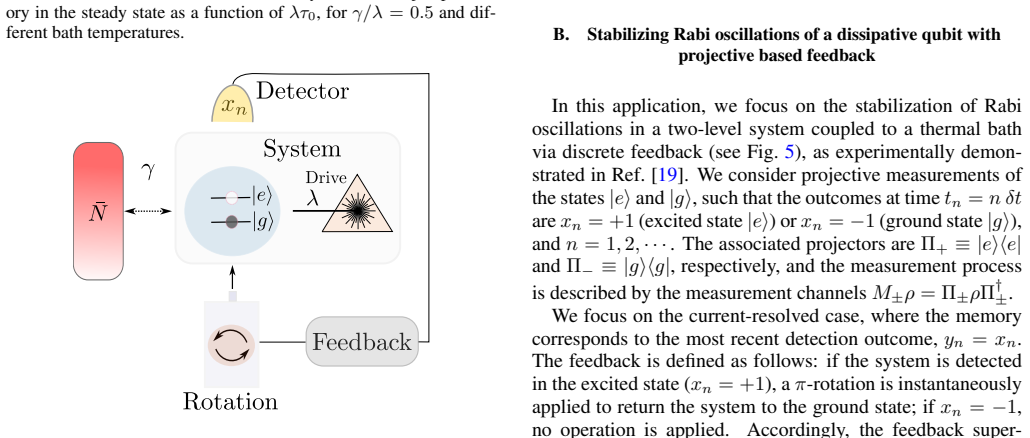
- In the Rabi-stabilization example, the feedback resets the system each interval, making the dynamics a renewal process; the paper derives outcome probabilities, cooling limits, and leading corrections in the measurement interval.
Reading between the lines
- The same deterministic construction should extend to non-causal or higher-order memories by enlarging the classical register to include a finite history; the cost is a larger classical Hilbert space, but the statistical formulas likely remain unchanged.
- The counting-field transform places memory statistics inside the framework of full counting statistics, so waiting-time distributions and first-passage quantities may be derivable from the same ϱ_t(χ), connecting feedback control to large-deviation theory.
- The hybrid-state mutual information suggests a design principle: effective feedback protocols may be those that reduce the memory's predictive uncertainty about the system at the moment of control; this is testable by comparing the protocol curves computed in the paper.
- Because the memory distribution is experimentally accessible, the derived quantities such as P_ss(−1) and covariances could serve as signatures for certifying or characterizing an unknown feedback implementation.
Editorial analysis
A structured set of objections, weighed in public.
Referee Report
Summary. This is the second paper in a series on deterministic descriptions of feedback control in open quantum systems. The authors consider a stochastic memory y_n that is a causal function of the measurement record, and feedback instruments that depend on this memory. They take as input the memory-resolved state ϱ_n(y) and its deterministic evolution Eq. (4), derived in Part I, and build a hybrid classical-quantum state ρ_sm on H_s ⊗ H_cl, Eq. (8). From this representation they introduce system-memory mutual information and covariance, and then derive characteristic functions, moments, cumulants, and two-time correlation functions of the memory. The formalism is extended to no-feedback and indirect-feedback scenarios, and applied to two qubit feedback protocols: jump-based inversion and projective-measurement stabilization of Rabi oscillations. The paper also gives explicit Taylor expansions for the projective-feedback protocol and a number of illustrative figures.
Significance. If the companion Part I is sound, the central formulas here are valid and useful: they provide a deterministic, parameter-free route to the memory statistics and to information-theoretic quantifiers of system-memory correlations, avoiding stochastic trajectory averages. The paper makes falsifiable quantitative predictions, such as the expansion in Eq. (69), and it connects to an existing experiment (Ref. [19]). Its novelty is not in a new master equation but in repackaging the Part I state into a bipartite classical-quantum state and extracting statistical and informational quantities. This is a reasonable contribution for a Part II, provided the dependency on Part I is made explicit and the few presentation gaps are fixed.
minor comments (6)
- [Abstract and Sec. II.B, Eq. (4)] The abstract and introduction say 'arbitrary feedback dynamics', but Eq. (4) holds only when y_n is a causal memory that is a sufficient statistic for the feedback action: the instrument at step n+1 depends only on y_n and y_n=f_n(x_n,y_{n-1}). This is indeed the class defined in Definition 1, but the text should state explicitly that any feedback protocol using longer histories must enlarge y_n to contain them. A clarifying sentence would prevent the overstatement.
- [Sec. VII.B, Eqs. (69)-(71)] These Taylor expansions are stated without derivation. They are not immediate from the text and involve non-commuting terms; please include a derivation or an appendix outlining the expansion of P(x_n=-1)=⟨g|e^{δt L}(|g⟩⟨g|)|g⟩, and state the small-parameter regime (e.g., γδt, λδt ≪ 1) in which they are valid.
- [Sec. VII.B, text before Fig. 6] The initial state is written as '(|e⟩+|g⟩)/2' twice, but a normalized pure state should be '(|e⟩+|g⟩)/√2'. Please correct.
- [Sec. VII.A, Fig. 3 and surrounding text] The discussion of the negative covariance between σ_z and k_t is slightly confusing. The text first says 'when k_t is above its average, σ_z tends to be below its average', then gives an example involving 'as the number of emissions (k_t=-1) increases' without connecting that example to k_t being above or below the mean. Please rephrase for consistency.
- [Sec. VII.A, Eq. (61)] The expression for τ_1^{opt} is quoted from Part I. Since this quantity is used in several figures, it would be helpful to either reproduce the derivation briefly in an appendix or give a precise equation number and derivation context from Ref. [32].
- [Sec. IV.B, Eqs. (28)-(33)] The conditional-probability construction is correct, but it would be clearer to state explicitly that the evolution of ϱ_{t+τ}(y'|y) is generated by the same feedback dynamics Eq. (4), and that the Markov property in the pair (system state, y_n) is what justifies starting from the single-time conditional state.
Circularity Check
No significant circularity: the central equations either follow from the paper's own definitions or are standard reformulations, and the self-citation to Part I is not the sole support for the deterministic framework.
full rationale
The paper does not fit parameters and then call them predictions, nor does it reduce any derived quantity to an input by construction. The deterministic memory-resolved equation (4) is attributed to Ref. [32] by the same authors, but within this manuscript it follows immediately from the definitions in Eqs. (2)-(3) together with the causal-memory update rule (1): averaging the stochastic feedback rule over outcomes and inserting the delta constraint yields Eq. (4). Thus the self-citation is not the only or load-bearing justification. The hybrid classical-quantum state in Eq. (8) is a direct rearrangement of the memory-resolved state ϱ_t(y), and the map Ω_n in Eq. (11) is explicitly defined so that Eq. (12) reproduces Eq. (4); the paper presents this as an equivalent reformulation, not as an independent prediction. The memory-statistics results in Sec. IV are standard characteristic-function and conditional-probability identities applied to ϱ_t(y), so they do not reduce to the target claims. The applications use previously published experimental parameters and no-feedback baselines rather than fitted inputs. The main scope condition, that the feedback instrument depends only on the chosen causal memory, is a modeling assumption stated in Eqs. (1)-(2); it limits generality but is not circular. Overall, the paper is a self-contained framework conditional on the causal-memory assumption, with self-citation present but not creating circularity.
Assumptions & free parameters
assumptions (6)
- standard math Sequential measurements are described by instruments M_x with Σ_x M_x CPTP (Sec II B).
- domain assumption The memory is causal: y_n = f_n(x_n, y_{n-1}) (Eq (1)).
- domain assumption Feedback instruments depend only on the current memory, M_{x_{n+1}}(y_n) (Eq (2)).
- domain assumption Part I's Eq (4) correctly gives the deterministic evolution of ϱ_n(y).
- domain assumption The Lindblad equation (Eq (59)) with jump operators L± (Eq (40)) describes the qubit-bath interaction in the weak-coupling limit.
- ad hoc to paper The inverses [L_off0]^{-1} and [L_on0]^{-1} exist where used in Eqs (65)-(66).
Cite this review
Pith. "Pith review of Deterministic Equations for Feedback Control of Open Quantum Systems II: Properties of the memory function." pith.science (2026). https://pith.science/paper/X5D3QPQD
@misc{pith2026251208085,
  author       = {Pith},
  title        = {Pith review of: Deterministic Equations for Feedback Control of Open Quantum Systems II: Properties of the memory function},
  year         = {2026},
  howpublished = {\url{https://pith.science/paper/X5D3QPQD}},
  note         = {Machine review of arXiv:2512.08085}
}
read the original abstract
Feedback uses past detection outcomes to dynamically modify a quantum system and is central to quantum control. These outcomes can be stored in a memory, defined as a stochastic function of past measurements. In this work, we investigate the main properties of a general memory function subject to arbitrary feedback dynamics. We show that the memory can be treated as a classical system coupled to the monitored quantum system, and that their joint evolution is described by a hybrid bipartite state. This framework allows us to introduce information-theoretic measures that quantify the correlations between the system and the memory. Furthermore, we develop a general framework to characterize the statistics of the memory -- such as moments, cumulants, and correlation functions -- which can be applied both to general feedback-control protocols and to monitored systems without feedback. As an application, we analyze feedback schemes based on detection events in a two-level system coupled to a thermal bath, focusing on protocols that stabilize either the excited-state population or Rabi oscillations against thermal dissipation.
Figures


Figures from the paper (3 more)


Forward citations
Cited by 2 Pith papers
-
Deterministic Equations for Feedback Control of Open Quantum Systems III: Full counting statistics for jump-based feedback
Memory-based quantum-jump feedback is mapped to a Markovian Lindblad equation on an enlarged space, enabling full counting statistics of any counting observable.
-
Deterministic Equations for Feedback Control of Open Quantum Systems
A general deterministic feedback master equation is derived, unifying existing schemes and enabling time-dependent feedback based on the last quantum jump and the time since it occurred.
Reference graph
Works this paper leans on
-
[19]
J. P. Pekola, Towards quantum thermodynamics in electronic circuits, Nature Physics11, 118 (2015)
2015
-
[1]
For sim- plicity, we assume thatx n takes values in a discrete set; the continuous case can be treated analogously
General instruments Let us consider the case in which the memory corresponds to the most recently detected outcome,y n =x n. For sim- plicity, we assume thatx n takes values in a discrete set; the continuous case can be treated analogously. This scenario is referred to as thecurrent-resolved case. For this choice of memory, the framework developed above y...
-
[2]
We now particularize this equation to the case in which the feedback is implemented through a super-operator that de- pends explicitly on the latest detection outcome
Feedback super-operators for a general measurement scheme Equation (48) describes a general feedback scheme based solely on the most recent detection event, applicable to any measurement protocol defined by the instrumentsM x(x′). We now particularize this equation to the case in which the feedback is implemented through a super-operator that de- pends ex...
-
[3]
The measurement outcomes are real numbers, x∈R
Feedback super-operators for weak Gaussian measurements In this section, we focus on the case of a weak Gaussian measurement of a Hermitian operatorA, which is described by the Kraus operators Vx = 2λδt π 1 4 e−λδt(x−A)2 ,(55) whereAis a given observable of the system,λdenotes the measurement strength, andδt >0is an infinitesimal time in- terval [43, 44]....
-
[4]
De Sousa, P
G. De Sousa, P. Bakhshinezhad, B. Annby-Andersson, P. Samuelsson, P. P. Potts, and C. Jarzynski, Continuous feed- back protocols for cooling and trapping a quantum harmonic 14 oscillator, Phys. Rev. E111, 014152 (2025)
2025
-
[5]
S. K. Manikandan and S. Qvarfort, Optimal quantum paramet- ric feedback cooling, Phys. Rev. A107, 023516 (2023)
2023
-
[6]
Buffoni, A
L. Buffoni, A. Solfanelli, P. Verrucchi, A. Cuccoli, and M. Campisi, Quantum measurement cooling, Phys. Rev. Lett. 122, 070603 (2019)
2019
-
[7]
J. Guo, R. Norte, and S. Gr ¨oblacher, Feedback cooling of a room temperature mechanical oscillator close to its motional ground state, Phys. Rev. Lett.123, 223602 (2019)
2019
Show all 51 references
-
[8]
Frimmer, J
M. Frimmer, J. Gieseler, and L. Novotny, Cooling mechanical oscillators by coherent control, Phys. Rev. Lett.117, 163601 (2016)
2016
-
[9]
Jacobs, H
K. Jacobs, H. I. Nurdin, F. W. Strauch, and M. James, Com- paring resolved-sideband cooling and measurement-based feed- back cooling on an equal footing: Analytical results in the regime of ground-state cooling, Phys. Rev. A91, 043812 (2015)
2015
-
[10]
Bushev, D
P. Bushev, D. Rotter, A. Wilson, F. m. c. Dubin, C. Becher, J. Eschner, R. Blatt, V . Steixner, P. Rabl, and P. Zoller, Feedback cooling of a single trapped ion, Phys. Rev. Lett.96, 043003 (2006)
2006
-
[11]
D. A. Steck, K. Jacobs, H. Mabuchi, S. Habib, and T. Bhat- tacharya, Feedback cooling of atomic motion in cavity qed, Phys. Rev. A74, 012322 (2006)
2006
-
[12]
D’Urso, B
B. D’Urso, B. Odom, and G. Gabrielse, Feedback cooling of a one-electron oscillator, Phys. Rev. Lett.90, 043001 (2003)
2003
-
[13]
Hopkins, K
A. Hopkins, K. Jacobs, S. Habib, and K. Schwab, Feed- back cooling of a nanomechanical resonator, Phys. Rev. B68, 235328 (2003)
2003
-
[14]
Rist `e, M
D. Rist `e, M. Dukalski, C. A. Watson, G. de Lange, M. J. Tiggel- man, Y . M. Blanter, K. W. Lehnert, R. N. Schouten, and L. Di- Carlo, Deterministic entanglement of superconducting qubits by parity measurement and feedback, Nature502, 350 (2013)
2013
-
[15]
Marcos, A
D. Marcos, A. Smith, A. Bednorz, and N. Yunger Halpern, Quantum thermodynamics for quantum computing, Phys. Rev. X10, 041013 (2020)
2020
-
[16]
Sarovar, C
M. Sarovar, C. Ahn, K. Jacobs, and G. J. Milburn, Practi- cal scheme for error control using feedback, Phys. Rev. A69, 052324 (2004)
2004
-
[17]
Barker, M
D. Barker, M. Scandi, S. Lehmann, C. Thelander, K. A. Dick, M. Perarnau-Llobet, and V . F. Maisi, Experimental verification of the work fluctuation-dissipation relation for information-to- work conversion, Phys. Rev. Lett.128, 040602 (2022)
2022
-
[18]
P. P. Potts and P. Samuelsson, Detailed fluctuation relation for arbitrary measurement and feedback schemes, Phys. Rev. Lett. 121, 210603 (2018)
2018
-
[20]
Prech, J
K. Prech, J. Aschwanden, and P. P. Potts, Quantum thermody- namics of continuous feedback control, arXiv e-print (2025), submitted 22 May 2025, arXiv:arXiv:2505.16615 [quant-ph]
2025 arXiv
-
[21]
W. G. van der Wiel, S. De Franceschi, J. M. Elzerman, T. Fu- jisawa, S. Tarucha, and L. P. Kouwenhoven, Electron transport through double quantum dots, Rev. Mod. Phys.75, 1 (2002)
2002
-
[22]
Campagne-Ibarcq, E
P. Campagne-Ibarcq, E. Flurin, N. Roch, D. Darson, P. Morfin, M. Mirrahimi, M. H. Devoret, F. Mallet, and B. Huard, Persis- tent control of a superconducting qubit by stroboscopic mea- surement feedback, Phys. Rev. X3, 021008 (2013)
2013
-
[23]
Rist `e, C
D. Rist `e, C. C. Bultink, K. W. Lehnert, and L. DiCarlo, Feed- back control of a solid-state qubit using high-fidelity projective measurement, Phys. Rev. Lett.109, 240502 (2012)
2012
-
[24]
Vijay, C
R. Vijay, C. Macklin, D. H. Slichter, S. J. Weber, K. W. Murch, R. Naik, A. N. Korotkov, and I. Siddiqi, Stabilizing rabi os- cillations in a superconducting qubit using quantum feedback, Nature490, 77 (2012)
2012
-
[25]
Z. K. Minev, S. O. Mundhada, S. Shankar, P. Reinhold, R. Guti ´errez-J´auregui, R. J. Schoelkopf, M. Mirrahimi, H. J. Carmichael, and M. H. Devoret, To catch and reverse a quantum jump mid-flight, Nature570, 200 (2019), arXiv:1902.10355 [quant-ph]
2019 arXiv
-
[26]
Sayrin, I
C. Sayrin, I. Dotsenko, X. Zhou, B. Peaudecerf, T. Rybarczyk, S. Gleyzes, P. Rouchon, M. Mirrahimi, H. Amini, M. Brune, J.- M. Raimond, and S. Haroche, Real-time quantum feedback pre- pares and stabilizes photon number states, Nature477, 73–77 (2011)
2011
-
[27]
M. T. Mitchison, J. Goold, and J. Prior, Charging a quantum battery with linear feedback control, Quantum5, 500 (2021)
2021
-
[28]
Ribezzi-Crivellari and F
M. Ribezzi-Crivellari and F. Ritort, Large work extraction and the landauer limit in a continuous maxwell demon, Nature Physics15, 660 (2019)
2019
-
[29]
Naghiloo, J
M. Naghiloo, J. J. Alonso, A. Romito, E. Lutz, and K. W. Murch, Information gain and loss for a quantum maxwell’s de- mon, Phys. Rev. Lett.121, 030604 (2018)
2018
-
[30]
M. D. Vidrighin, O. Dahlsten, M. Barbieri, M. S. Kim, V . Ve- dral, and I. A. Walmsley, Photonic maxwell’s demon, Phys. Rev. Lett.116, 050401 (2016)
2016
-
[31]
K. Funo, Y . Watanabe, and M. Ueda, Integral quantum fluctua- tion theorems under measurement and feedback control, Phys. Rev. E88, 052121 (2013)
2013
-
[32]
Sagawa and M
T. Sagawa and M. Ueda, Fluctuation theorem with information exchange: Role of correlations in stochastic thermodynamics, Phys. Rev. Lett.109, 180602 (2012)
2012
-
[33]
Sagawa and M
T. Sagawa and M. Ueda, Generalized jarzynski equality under nonequilibrium feedback control, Phys. Rev. Lett.104, 090602 (2010)
2010
-
[34]
Prech and P
K. Prech and P. P. Potts, Quantum fluctuation theorem for arbi- trary measurement and feedback schemes, Phys. Rev. Lett.133, 140401 (2024)
2024
-
[35]
A. J. B. Rosal, P. P. Potts, and G. T. Landi, Deterministic Equa- tions for Feedback Control of Open Quantum Systems, arXiv preprint arXiv:2507.01934 (2025), quant-ph
2025 arXiv
-
[36]
Annby-Andersson, F
B. Annby-Andersson, F. Bakhshinezhad, D. Bhattacharyya, G. De Sousa, C. Jarzynski, P. Samuelsson, and P. P. Potts, Quantum fokker-planck master equation for continuous feed- back control, Phys. Rev. Lett.129, 050401 (2022)
2022
-
[37]
H. M. Wiseman and G. J. Milburn, Quantum theory of opti- cal feedback via homodyne detection, Phys. Rev. Lett.70, 548 (1993)
1993
-
[38]
H. M. Wiseman, Quantum theory of continuous feedback, Phys. Rev. A49, 2133 (1994)
1994
-
[39]
M. J. Kewming, A. Kiely, S. Campbell, and G. T. Landi, First passage times for continuous quantum measurement currents, Phys. Rev. A109, L050202 (2024)
2024
-
[40]
M. M. Wilde,From Classical to Quantum Shannon Theory, 2nd ed. (Cambridge University Press, Cambridge, 2021) prepubli- cation version available on arXiv:1106.1445
2021
-
[41]
Milz and K
S. Milz and K. Modi, Quantum stochastic processes and quan- tum non-markovian phenomena, PRX Quantum2, 030201 (2021)
2021
-
[42]
M. A. Nielsen and I. L. Chuang,Quantum Computation and Quantum Information, 10th ed. (Cambridge University Press, Cambridge, 2010)
2010
-
[43]
G. T. Landi, M. J. Kewming, M. T. Mitchison, and P. P. Potts, Current fluctuations in open quantum systems: Bridging the gap between quantum continuous measurements and full counting statistics, PRX Quantum5, 020201 (2024)
2024
-
[44]
Hofmann, V
A. Hofmann, V . F. Maisi, C. Gold, T. Kr¨ahenmann, C. R¨ossler, J. Basset, P. M¨arki, C. Reichl, W. Wegscheider, K. Ensslin, and 15 T. Ihn, Measuring the degeneracy of discrete energy levels using aGaAs/AlGaAsquantum dot, Phys. Rev. Lett.117, 206803 (2016)
2016
-
[45]
A. J. B. Rosal, G. Fiusa, P. P. Potts, and G. T. Landi, Determinis- tic Equations for Feedback Control of Open Quantum Systems III: Full counting statistics for jump-based feedback, To appear (2025), quant-ph
2025
-
[46]
Jacobs and D
K. Jacobs and D. A. Steck, A straightforward introduction to continuous quantum measurement, Contemporary Physics47, 279 (2006)
2006
-
[47]
Bednorz, W
A. Bednorz, W. Belzig, and A. Nitzan, Nonclassical time cor- relation functions in continuous quantum measurement, New Journal of Physics14, 013009 (2012)
2012
-
[48]
H. M. Wiseman and G. J. Milburn,Quantum Measurement and Control(Cambridge University Press, 2010)
2010
-
[49]
J. C. Bergquist, R. G. Hulet, W. M. Itano, and D. J. Wineland, Observation of quantum jumps in a single atom, Phys. Rev. Lett.57, 1699 (1986)
1986
-
[50]
Sauter, W
T. Sauter, W. Neuhauser, R. Blatt, and P. E. Toschek, Observa- tion of quantum jumps, Phys. Rev. Lett.57, 1696 (1986)
1986
-
[51]
Nagourney, J
W. Nagourney, J. Sandberg, and H. Dehmelt, Shelved optical electron amplifier: Observation of quantum jumps, Phys. Rev. Lett.56, 2797 (1986)
1986
Reviewed August 3, 2026 · model on record in the stance chip above.
Discussion (0). Sign in to comment.